
Circuit Networks: Original HSC Physics Practice Exam
Test your circuit-network skills with an original 60-mark timed practice paper for the supplied NSW HSC Physics 2017 syllabus scope. Includes series and parallel circuits, Kirchhoff’s laws, calculations, worked solutions, and a marking guide.
This original tutorgum practice paper assesses circuit networks within the supplied Physics 2017 syllabus scope. It is a focused topic paper, not a full-course exam, and it is not an official, endorsed, past, or predicted NESA paper. The questions cover series and parallel circuits, reducible networks, Kirchhoff’s current and voltage laws, and calculations involving resistance, current, potential difference, and electrical power.
01Exam instructions
- Suggested working time: 75 minutes.
- Reading time: 5 minutes.
- Total marks: 60.
- Permitted equipment: Scientific calculator and writing materials. No notes.
- Assumptions: All sources are ideal and maintain their stated potential difference. Wires have negligible resistance, resistors are ohmic, and all circuits are in steady-state direct current (DC).
- Working: Show your calculations and reasoning. Include units and use appropriate significant figures.
The symbols used are \(I\) for current, measured in amperes (A); \(V\) for potential difference, measured in volts (V); \(R\) for resistance, measured in ohms (\(\Omega\)); and \(P\) for power, measured in watts (W). The symbol \(R_{\text{eq}}\) denotes equivalent resistance.
Assessed content
- Kirchhoff’s current law and voltage law.
- Series and parallel circuits, including reducible combinations.
- Equivalent resistance, total current, and branch currents.
- Potential differences across individual components and branches.
- Electrical power and conservation of charge and energy.
- Determining unknown resistance and analysing changes to circuit components.
Exclusions: Capacitors and transient behaviour, AC circuits, source internal resistance, non-ohmic components, and material outside the specified circuit-networks scope.
02Questions
Question 1 (6 marks)
An ideal 18.0 V source is connected to two resistors, \(3.0\,\Omega\) and \(6.0\,\Omega\), in series.
(a) Calculate the equivalent resistance of the circuit. (1 mark)
(b) Calculate the current supplied by the source. (1 mark)
(c) Determine the potential difference across each resistor. (2 marks)
(d) Calculate the electrical power dissipated by the \(6.0\,\Omega\) resistor. (2 marks)
Question 2 (7 marks)
An ideal 12.0 V source is connected across two parallel resistors, \(6.0\,\Omega\) and \(3.0\,\Omega\).
(a) State the potential difference across each resistor. (1 mark)
(b) Calculate the current through each resistor. (2 marks)
(c) Calculate the equivalent resistance of the parallel network and the total current supplied by the source. (2 marks)
(d) Calculate the power dissipated by the \(3.0\,\Omega\) resistor and the power supplied by the source. (2 marks)
Question 3 (7 marks)
(a) At a junction, a current of \(2.80\,\text{A}\) enters. Two currents of \(0.65\,\text{A}\) and \(1.05\,\text{A}\) leave. A fourth branch carries an unknown current \(I\).
Determine the magnitude and direction of \(I\). (2 marks)
(b) A single closed loop contains an ideal 12.0 V source and two resistors. The potential differences across the resistors are \(4.5\,\text{V}\) and \(V_x\), respectively, where \(V_x\) is the unknown potential difference. The connecting wires have negligible resistance.
Determine \(V_x\). (2 marks)
(c) A student claims:
“A resistor consumes current, so less current comes out of a resistor than enters it.”
Explain why this statement is incorrect. Your answer must distinguish between the conservation of charge and the transfer of electrical energy. (3 marks)
Question 4 (8 marks)
An ideal 18.0 V source is connected to a \(3.0\,\Omega\) resistor in series with a parallel combination of \(6.0\,\Omega\) and \(3.0\,\Omega\) resistors.
(a) Calculate the equivalent resistance of the parallel combination. (2 marks)
(b) Calculate the equivalent resistance of the entire circuit. (1 mark)
(c) Calculate the total current supplied by the source. (1 mark)
(d) Determine the potential difference across the parallel combination. (2 marks)
(e) Calculate the current through each resistor in the parallel combination. (2 marks)
Question 5 (8 marks)
An ideal 20.0 V source is connected across two parallel branches.
- Branch A contains an unknown resistor \(R\) in series with a \(4.0\,\Omega\) resistor.
- Branch B contains a single \(10.0\,\Omega\) resistor.
The total current supplied by the source is \(3.00\,\text{A}\).
(a) Calculate the current through the \(10.0\,\Omega\) resistor. (1 mark)
(b) Determine the current through Branch A. (2 marks)
(c) Calculate the resistance \(R\). (3 marks)
(d) Calculate the power dissipated by resistor \(R\). (2 marks)
Question 6 (7 marks)
An ideal 12.0 V source is connected across two parallel branches containing a \(6.0\,\Omega\) resistor and a \(3.0\,\Omega\) resistor.
The \(3.0\,\Omega\) resistor is then replaced with a \(6.0\,\Omega\) resistor. The source voltage remains constant.
(a) Calculate the total current supplied by the source before the replacement. (1 mark)
(b) Calculate the new total current supplied by the source after the replacement. (2 marks)
(c) Compare the current through the original \(6.0\,\Omega\) branch before and after the replacement. Explain why this current does or does not change. (2 marks)
(d) Calculate the change in power supplied by the source. State whether the power increases or decreases and determine the magnitude of the change. (2 marks)
Question 7 (8 marks)
An ideal 18.0 V source feeds a \(1.5\,\Omega\) resistor in series with a parallel section containing a \(4.0\,\Omega\) resistor and an unknown resistor \(R\).
The total current supplied by the source is \(4.0\,\text{A}\).
(a) Use Kirchhoff’s voltage law to determine the potential difference across the parallel section. (2 marks)
(b) Use the current through the \(4.0\,\Omega\) resistor and Kirchhoff’s current law to determine the current through \(R\). (2 marks)
(c) Calculate the resistance \(R\). (2 marks)
(d) Calculate the power dissipated by the \(1.5\,\Omega\) resistor. (2 marks)
Question 8 (9 marks)
An ideal 24.0 V source is connected across two parallel branches.
- Branch A contains a \(4.0\,\Omega\) resistor in series with an \(8.0\,\Omega\) resistor.
- Branch B contains a single \(6.0\,\Omega\) resistor.
(a) Calculate the equivalent resistance of Branch A and the equivalent resistance of the entire network. (2 marks)
(b) Calculate the total current supplied by the source. (1 mark)
(c) Determine the current through each branch. (2 marks)
(d) Calculate the potential difference across each resistor in Branch A. (2 marks)
(e) Verify the conservation of energy by calculating the power supplied by the source and comparing it with the total power dissipated by all three resistors. (2 marks)
03Worked solutions and marking guide
Award marks for equivalent valid methods. Follow-through credit is appropriate when a student uses an earlier result consistently in a later calculation, even if the earlier result contains an error.
Solution 1
(a) Equivalent resistance
For resistors in series, their resistances add directly.
\[ \begin{aligned} R_{\text{eq}} &= 3.0+6.0\\ &=9.0\,\Omega \end{aligned} \]
Answer: \(9.0\,\Omega\).
Marking (1 mark):
- 1 mark for correctly adding the series resistances.
(b) Total current
Apply Ohm’s law, \(I=V/R\).
\[ I=\frac{18.0}{9.0}=2.00\,\text{A} \]
Answer: \(2.00\,\text{A}\).
Marking (1 mark):
- 1 mark for the correct calculation and answer with units.
(c) Potential difference across each resistor
The same current flows through every component in a series circuit.
For the \(3.0\,\Omega\) resistor:
\[ V_3=IR=2.00\times3.0=6.0\,\text{V} \]
For the \(6.0\,\Omega\) resistor:
\[ V_6=IR=2.00\times6.0=12.0\,\text{V} \]
Answers: \(6.0\,\text{V}\) across the \(3.0\,\Omega\) resistor and \(12.0\,\text{V}\) across the \(6.0\,\Omega\) resistor.
The potential differences add to \(18.0\,\text{V}\), matching the source voltage.
Marking (2 marks):
- 1 mark for each correct potential difference, including units.
(d) Power dissipated by the \(6.0\,\Omega\) resistor
Use \(P=I^2R\).
\[ \begin{aligned} P_6&=(2.00)^2\times6.0\\ &=24.0\,\text{W} \end{aligned} \]
Answer: \(24.0\,\text{W}\).
Marking (2 marks):
- 1 mark for the correct power relationship and substitution.
- 1 mark for the correct answer with units.
Solution 2
(a) Potential difference across each resistor
In a parallel circuit, each branch connects across the same two terminals of the source. Therefore, each resistor has the full source potential difference across it.
\[ V_6=V_3=12.0\,\text{V} \]
Answer: \(12.0\,\text{V}\) across each resistor.
Marking (1 mark):
- 1 mark for identifying the potential difference across both resistors.
(b) Current through each resistor
Use \(I=V/R\) for each branch.
For the \(6.0\,\Omega\) resistor:
\[ I_6=\frac{12.0}{6.0}=2.00\,\text{A} \]
For the \(3.0\,\Omega\) resistor:
\[ I_3=\frac{12.0}{3.0}=4.00\,\text{A} \]
Answers: \(2.00\,\text{A}\) and \(4.00\,\text{A}\), respectively.
Marking (2 marks):
- 1 mark for each correct branch current.
(c) Equivalent resistance and total current
For two resistors in parallel:
\[ \begin{aligned} \frac{1}{R_{\text{eq}}} &=\frac{1}{6.0}+\frac{1}{3.0}\\ &=\frac{1}{2.0} \end{aligned} \]
Therefore,
\[ R_{\text{eq}}=2.00\,\Omega \]
The total source current is:
\[ I_{\text{total}}=\frac{12.0}{2.00} =6.00\,\text{A} \]
This agrees with Kirchhoff’s current law:
\[ I_{\text{total}}=I_6+I_3=2.00+4.00 \]
Answer: \(R_{\text{eq}}=2.00\,\Omega\) and \(I_{\text{total}}=6.00\,\text{A}\).
Marking (2 marks):
- 1 mark for the equivalent resistance.
- 1 mark for the total current.
(d) Power dissipated and supplied
Power dissipated by the \(3.0\,\Omega\) resistor:
\[ \begin{aligned} P_3&=\frac{V^2}{R}\\ &=\frac{12.0^2}{3.0}\\ &=48.0\,\text{W} \end{aligned} \]
Power supplied by the source:
\[ \begin{aligned} P_{\text{source}}&=VI_{\text{total}}\\ &=12.0\times6.00\\ &=72.0\,\text{W} \end{aligned} \]
Answers: \(48.0\,\text{W}\) dissipated by the \(3.0\,\Omega\) resistor and \(72.0\,\text{W}\) supplied by the source.
Marking (2 marks):
- 1 mark for the power dissipated by the \(3.0\,\Omega\) resistor.
- 1 mark for the power supplied by the source.
Solution 3
(a) Unknown junction current
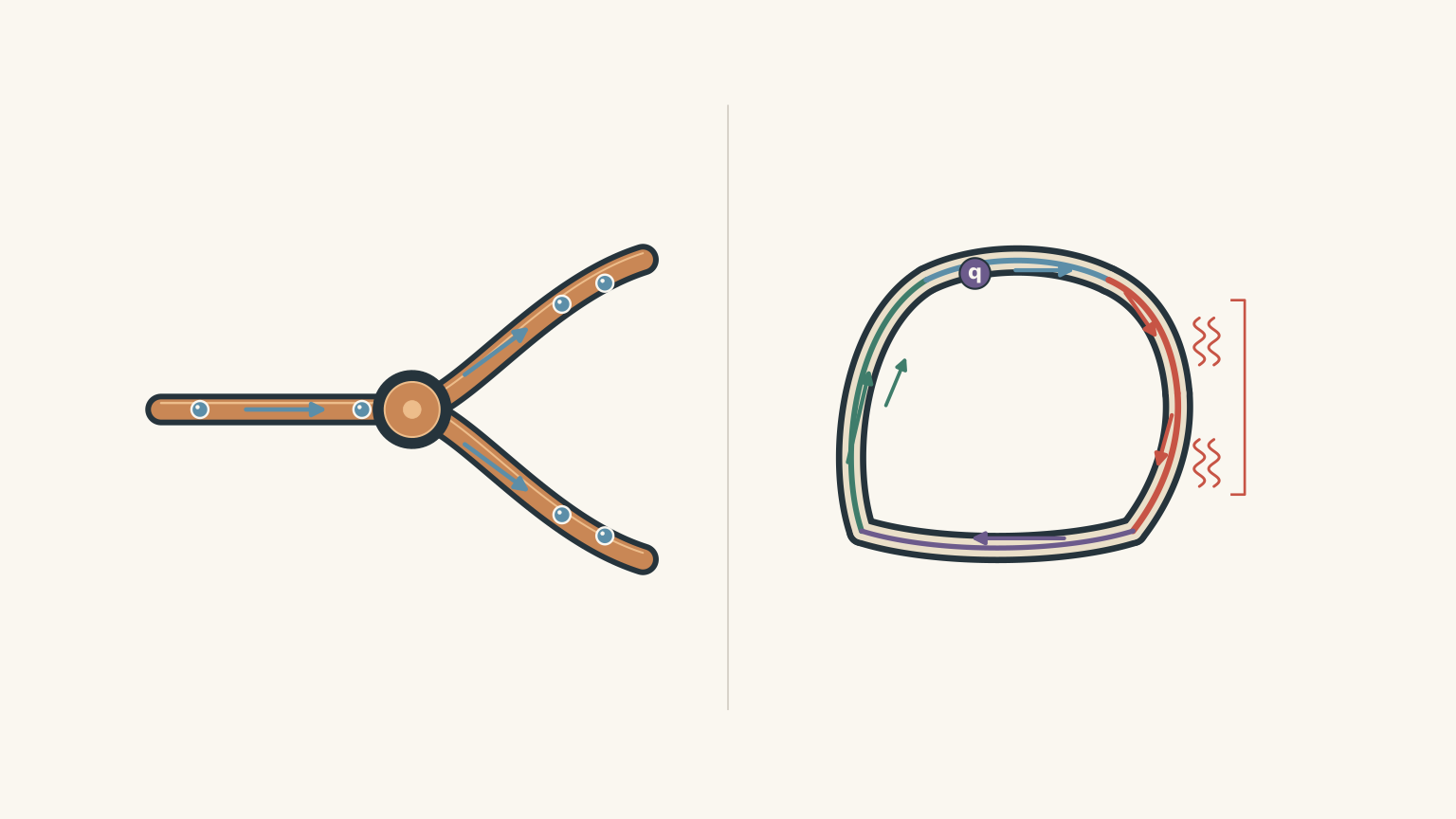
Kirchhoff’s current law states that the total current entering a junction equals the total current leaving it. This follows from conservation of charge.
The total current entering is \(2.80\,\text{A}\). The total current leaving is \(0.65+1.05+I\).
\[ \begin{aligned} 2.80&=0.65+1.05+I\\ I&=2.80-1.70\\ &=1.10\,\text{A} \end{aligned} \]
Answer: \(1.10\,\text{A}\), leaving the junction.
Marking (2 marks):
- 1 mark for correctly applying Kirchhoff’s current law.
- 1 mark for the correct magnitude and direction.
(b) Unknown potential difference
Kirchhoff’s voltage law states that the algebraic sum of potential differences around a closed loop is zero. The source provides a \(12.0\,\text{V}\) rise, which balances the two resistor voltage drops.
\[ \begin{aligned} 12.0&=4.5+V_x\\ V_x&=12.0-4.5\\ &=7.5\,\text{V} \end{aligned} \]
Answer: \(V_x=7.5\,\text{V}\).
Marking (2 marks):
- 1 mark for correctly applying Kirchhoff’s voltage law.
- 1 mark for the correct potential difference with units.
(c) Does a resistor consume current?
No. Current measures the rate at which electric charge flows. In a steady-state circuit, charge does not continually accumulate inside a resistor, so the current entering it equals the current leaving it.
A resistor does transfer electrical energy into other forms, usually thermal energy. Its potential difference represents the electrical energy transferred per unit of charge. The resistor can therefore dissipate power without consuming current.
Kirchhoff’s current law expresses conservation of charge, while Kirchhoff’s voltage law expresses conservation of energy around a closed loop.
Marking (3 marks):
- 1 mark for explaining that charge is conserved and does not accumulate in the resistor.
- 1 mark for stating that the current entering the resistor equals the current leaving it.
- 1 mark for distinguishing energy transfer from current and linking the voltage drop to energy transfer.
Solution 4
(a) Equivalent resistance of the parallel combination
For the \(6.0\,\Omega\) and \(3.0\,\Omega\) resistors in parallel:
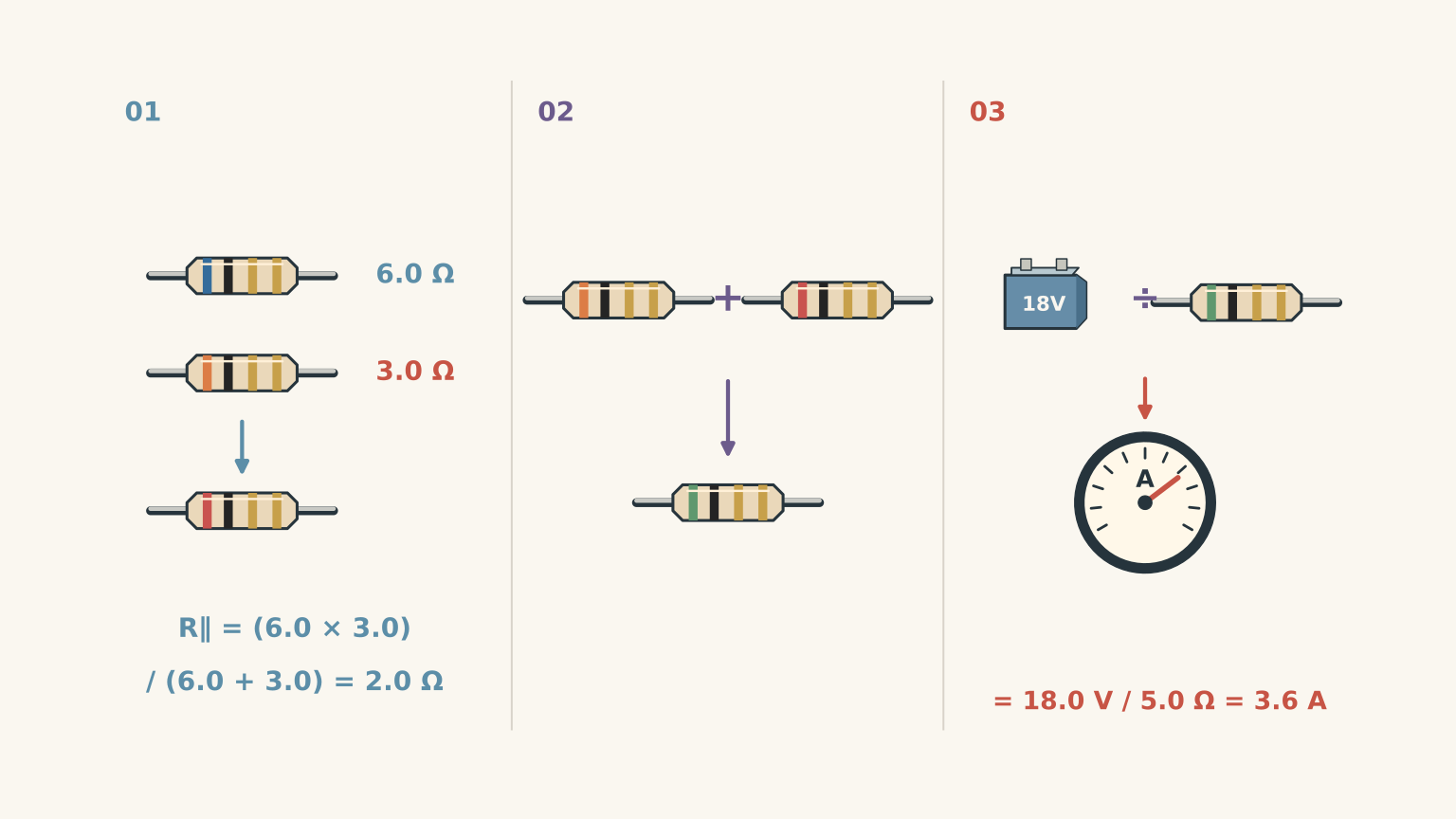
\[ \begin{aligned} R_{\parallel} &=\frac{6.0\times3.0}{6.0+3.0}\\ &=\frac{18.0}{9.0}\\ &=2.0\,\Omega \end{aligned} \]
Answer: \(2.0\,\Omega\).
Marking (2 marks):
- 1 mark for the correct parallel-resistance relationship.
- 1 mark for the correct equivalent resistance.
(b) Equivalent resistance of the entire circuit
The equivalent parallel resistance is in series with the \(3.0\,\Omega\) resistor.
\[ R_{\text{eq}}=3.0+2.0=5.0\,\Omega \]
Answer: \(5.0\,\Omega\).
Marking (1 mark):
- 1 mark for the correct total resistance.
(c) Total current
Apply Ohm’s law to the entire circuit.
\[ I_{\text{total}}=\frac{18.0}{5.0} =3.6\,\text{A} \]
Answer: \(3.6\,\text{A}\).
Marking (1 mark):
- 1 mark for the correct total current.
(d) Potential difference across the parallel combination
The \(3.0\,\Omega\) series resistor carries the total current of \(3.6\,\text{A}\).
Its potential difference is:
\[ V_{\text{series}}=3.6\times3.0 =10.8\,\text{V} \]
Using Kirchhoff’s voltage law, the source potential difference equals the sum of the drops across the series resistor and the parallel section.
\[ \begin{aligned} V_{\parallel}&=18.0-10.8\\ &=7.2\,\text{V} \end{aligned} \]
Answer: \(7.2\,\text{V}\).
Marking (2 marks):
- 1 mark for finding the series-resistor potential difference or using an equivalent valid method.
- 1 mark for the correct potential difference across the parallel section.
(e) Current through each parallel resistor
Both resistors have a potential difference of \(7.2\,\text{V}\).
For the \(6.0\,\Omega\) resistor:
\[ I_6=\frac{7.2}{6.0}=1.2\,\text{A} \]
For the \(3.0\,\Omega\) resistor:
\[ I_3=\frac{7.2}{3.0}=2.4\,\text{A} \]
Answer: \(1.2\,\text{A}\) through the \(6.0\,\Omega\) resistor and \(2.4\,\text{A}\) through the \(3.0\,\Omega\) resistor.
The branch currents add to \(3.6\,\text{A}\), matching the total current.
Marking (2 marks):
- 1 mark for each correct branch current.
Solution 5
(a) Current through the \(10.0\,\Omega\) resistor
Branch B is connected directly across the \(20.0\,\text{V}\) source.
\[ I_B=\frac{20.0}{10.0}=2.00\,\text{A} \]
Answer: \(2.00\,\text{A}\).
Marking (1 mark):
- 1 mark for the correct branch current.
(b) Current through Branch A
Kirchhoff’s current law gives the total current as the sum of the two branch currents.
\[ \begin{aligned} I_{\text{total}}&=I_A+I_B\\ I_A&=3.00-2.00\\ &=1.00\,\text{A} \end{aligned} \]
Answer: \(1.00\,\text{A}\).
Marking (2 marks):
- 1 mark for correctly relating the total current to the branch currents.
- 1 mark for the correct current through Branch A.
(c) Unknown resistance \(R\)
The entire Branch A has a potential difference of \(20.0\,\text{V}\) and carries a current of \(1.00\,\text{A}\).
Its total resistance is:
\[ R_A=\frac{20.0}{1.00}=20.0\,\Omega \]
The two resistors in Branch A are in series, so their resistances add.
\[ \begin{aligned} R_A&=R+4.0\\ R&=20.0-4.0\\ &=16.0\,\Omega \end{aligned} \]
Answer: \(R=16.0\,\Omega\).
Marking (3 marks):
- 1 mark for calculating the total resistance of Branch A.
- 1 mark for correctly relating the branch resistance to the two series resistors.
- 1 mark for the correct value of \(R\).
(d) Power dissipated by \(R\)
The current through \(R\) is \(1.00\,\text{A}\), because the two resistors in Branch A are in series.
Using \(P=I^2R\):
\[ \begin{aligned} P_R&=(1.00)^2\times16.0\\ &=16.0\,\text{W} \end{aligned} \]
Answer: \(16.0\,\text{W}\).
Marking (2 marks):
- 1 mark for the correct power relationship and substitution.
- 1 mark for the correct power with units.
Solution 6
(a) Initial total current
Before the replacement, both resistors are connected across the \(12.0\,\text{V}\) source.
The branch currents are:
\[ I_6=\frac{12.0}{6.0}=2.00\,\text{A} \]
\[ I_3=\frac{12.0}{3.0}=4.00\,\text{A} \]
The total current is:
\[ I_{\text{initial}}=2.00+4.00 =6.00\,\text{A} \]
Answer: \(6.00\,\text{A}\).
Marking (1 mark):
- 1 mark for the correct initial total current.
(b) New total current
After the replacement, both parallel branches contain \(6.0\,\Omega\) resistors.
Each branch carries:
\[ I=\frac{12.0}{6.0}=2.00\,\text{A} \]
Therefore,
\[ I_{\text{final}}=2.00+2.00 =4.00\,\text{A} \]
Answer: \(4.00\,\text{A}\).
Marking (2 marks):
- 1 mark for correctly determining the current through each new branch.
- 1 mark for the correct total current.
(c) Current through the unchanged branch
The original \(6.0\,\Omega\) resistor carries \(2.00\,\text{A}\) before the replacement and \(2.00\,\text{A}\) afterwards.
Its current does not change because the ideal source maintains the same potential difference of \(12.0\,\text{V}\), and the resistance of this branch remains \(6.0\,\Omega\).
From Ohm’s law, \(I=V/R\), the current in this branch remains constant.
Answer: The current stays at \(2.00\,\text{A}\).
Marking (2 marks):
- 1 mark for correctly comparing the initial and final currents.
- 1 mark for explaining the result using the unchanged branch resistance and source voltage.
(d) Change in source power
Before the replacement:
\[ \begin{aligned} P_{\text{initial}}&=VI_{\text{initial}}\\ &=12.0\times6.00\\ &=72.0\,\text{W} \end{aligned} \]
After the replacement:
\[ \begin{aligned} P_{\text{final}}&=VI_{\text{final}}\\ &=12.0\times4.00\\ &=48.0\,\text{W} \end{aligned} \]
The change is:
\[ \begin{aligned} \Delta P&=P_{\text{final}}-P_{\text{initial}}\\ &=48.0-72.0\\ &=-24.0\,\text{W} \end{aligned} \]
Answer: The power supplied by the source decreases by \(24.0\,\text{W}\).
Marking (2 marks):
- 1 mark for correctly calculating the initial and final power.
- 1 mark for identifying a decrease of \(24.0\,\text{W}\).
Solution 7
(a) Potential difference across the parallel section
The \(1.5\,\Omega\) series resistor carries the total current of \(4.0\,\text{A}\).
Its potential difference is:
\[ \begin{aligned} V_{\text{series}}&=IR\\ &=4.0\times1.5\\ &=6.0\,\text{V} \end{aligned} \]
Using Kirchhoff’s voltage law:
\[ \begin{aligned} V_{\parallel}&=18.0-6.0\\ &=12.0\,\text{V} \end{aligned} \]
Answer: \(12.0\,\text{V}\).
Marking (2 marks):
- 1 mark for the potential difference across the series resistor.
- 1 mark for the correct potential difference across the parallel section.
(b) Current through each parallel branch
The \(4.0\,\Omega\) resistor has a potential difference of \(12.0\,\text{V}\) across it.
\[ I_4=\frac{12.0}{4.0}=3.0\,\text{A} \]
The total current entering the parallel section is \(4.0\,\text{A}\). By Kirchhoff’s current law:
\[ \begin{aligned} I_{\text{total}}&=I_4+I_R\\ I_R&=4.0-3.0\\ &=1.0\,\text{A} \end{aligned} \]
Answer: \(3.0\,\text{A}\) through the \(4.0\,\Omega\) resistor and \(1.0\,\text{A}\) through \(R\).
Marking (2 marks):
- 1 mark for the current through the \(4.0\,\Omega\) resistor.
- 1 mark for correctly applying Kirchhoff’s current law to find the current through \(R\).
(c) Unknown resistance
The unknown resistor has a potential difference of \(12.0\,\text{V}\) and a current of \(1.0\,\text{A}\).
\[ \begin{aligned} R&=\frac{V}{I}\\ &=\frac{12.0}{1.0}\\ &=12\,\Omega \end{aligned} \]
Answer: \(R=12\,\Omega\).
Marking (2 marks):
- 1 mark for the correct relationship and substitution.
- 1 mark for the correct resistance with units.
Follow-through: Award the method mark if a current from part (b) is carried through consistently.
(d) Power dissipated by the \(1.5\,\Omega\) resistor
The series resistor carries the total current of \(4.0\,\text{A}\).
\[ \begin{aligned} P&=I^2R\\ &=(4.0)^2\times1.5\\ &=24\,\text{W} \end{aligned} \]
Answer: \(24\,\text{W}\).
Marking (2 marks):
- 1 mark for the correct power relationship and substitution.
- 1 mark for the correct power with units.
Solution 8
(a) Equivalent resistance
Branch A contains two resistors in series, so its resistance is:
\[ R_A=4.0+8.0=12.0\,\Omega \]
Branch A, with a resistance of \(12.0\,\Omega\), is in parallel with Branch B, which has a resistance of \(6.0\,\Omega\).
The equivalent resistance of the complete network is:
\[ \begin{aligned} R_{\text{eq}} &=\frac{12.0\times6.0}{12.0+6.0}\\ &=\frac{72.0}{18.0}\\ &=4.0\,\Omega \end{aligned} \]
Answers: Branch A has a resistance of \(12.0\,\Omega\), and the complete network has an equivalent resistance of \(4.0\,\Omega\).
Marking (2 marks):
- 1 mark for the equivalent resistance of Branch A.
- 1 mark for the equivalent resistance of the complete network.
(b) Total source current
Apply Ohm’s law to the equivalent network.
\[ I_{\text{total}}=\frac{24.0}{4.0} =6.0\,\text{A} \]
Answer: \(6.0\,\text{A}\).
Marking (1 mark):
- 1 mark for the correct total current.
(c) Current through each branch
Both branches have the full source potential difference of \(24.0\,\text{V}\) across them.
For Branch A:
\[ I_A=\frac{24.0}{12.0}=2.0\,\text{A} \]
For Branch B:
\[ I_B=\frac{24.0}{6.0}=4.0\,\text{A} \]
Answer: \(2.0\,\text{A}\) through Branch A and \(4.0\,\text{A}\) through Branch B.
The currents add to \(6.0\,\text{A}\), as required by Kirchhoff’s current law.
Marking (2 marks):
- 1 mark for the current through Branch A.
- 1 mark for the current through Branch B.
(d) Potential difference across each resistor in Branch A
The two resistors in Branch A are in series, so both carry the branch current of \(2.0\,\text{A}\).
Across the \(4.0\,\Omega\) resistor:
\[ V_4=IR=2.0\times4.0=8.0\,\text{V} \]
Across the \(8.0\,\Omega\) resistor:
\[ V_8=IR=2.0\times8.0=16.0\,\text{V} \]
Answers: \(8.0\,\text{V}\) across the \(4.0\,\Omega\) resistor and \(16.0\,\text{V}\) across the \(8.0\,\Omega\) resistor.
Their potential differences add to \(24.0\,\text{V}\), matching the source.
Marking (2 marks):
- 1 mark for each correct potential difference.
(e) Conservation of energy
The power supplied by the source is:
\[ \begin{aligned} P_{\text{source}}&=VI_{\text{total}}\\ &=24.0\times6.0\\ &=144\,\text{W} \end{aligned} \]
Now calculate the power dissipated by each resistor.
For the \(4.0\,\Omega\) resistor:
\[ P_4=I_A^2R=(2.0)^2\times4.0 =16\,\text{W} \]
For the \(8.0\,\Omega\) resistor:
\[ P_8=I_A^2R=(2.0)^2\times8.0 =32\,\text{W} \]
For the \(6.0\,\Omega\) resistor:
\[ P_6=I_B^2R=(4.0)^2\times6.0 =96\,\text{W} \]
The total power dissipated is:
\[ \begin{aligned} P_{\text{resistors}}&=P_4+P_8+P_6\\ &=16+32+96\\ &=144\,\text{W} \end{aligned} \]
Therefore,
\[ P_{\text{source}}=P_{\text{resistors}} =144\,\text{W} \]
The power supplied by the source equals the total power dissipated by the resistors. This is consistent with conservation of energy.
Answer: The source supplies \(144\,\text{W}\), and the three resistors dissipate a combined \(144\,\text{W}\).
Marking (2 marks):
- 1 mark for correctly calculating the power supplied by the source.
- 1 mark for correctly summing the power dissipated by the three resistors and establishing that the two totals agree.