
Elements, Properties and Chemical Names: 50-Mark Chemistry Exam
Test your understanding of element properties, periodic reactivity trends, and inorganic chemical nomenclature with this original 50-mark Chemistry practice paper. Includes a 70-minute assessment, complete worked solutions, and a detailed marking guide.
This original tutorgum practice paper assesses a focused section of the Chemistry 2017 syllabus: the physical and chemical properties of elements, patterns in reactivity across the periodic table, and IUPAC nomenclature of common inorganic substances. It includes a mix of recall, application, interpretation, and extended reasoning questions. This is a topic-specific revision paper, not a full-course examination.
01Exam instructions
Suggested working time: 70 minutes
Suggested reading time: 5 minutes
Total marks: 50
Equipment permitted:
- Scientific calculator
- Periodic table
- Pen, pencil, and ruler
Instructions:
- Answer all six questions.
- Show your working and explain your reasoning where requested.
- Use correct chemical formulae, including subscripts and brackets.
- Include Roman numerals in compound names where required.
- Use the supplied reference information where needed.
Assessed content
This paper covers:
- Physical properties of elements and their classification as metals or non-metals.
- Chemical properties of elements and evidence of chemical reactions.
- Periodic-table position and patterns in elemental reactivity.
- IUPAC naming of common ionic and molecular compounds.
- Naming and interpreting other common inorganic substances.
This paper uses the Chemistry 2017 syllabus edition only. It does not assess other syllabus editions, quantitative stoichiometry, organic nomenclature, equilibrium, or electrochemistry.
Reference information: common polyatomic ions
| Ion | Name | Charge |
|---|---|---|
| \(\ce{NH4+}\) | Ammonium | +1 |
| \(\ce{OH-}\) | Hydroxide | −1 |
| \(\ce{NO3-}\) | Nitrate | −1 |
| \(\mathrm{SO_{4}}^{2-}\) | Sulfate | −2 |
| \(\mathrm{PO_{4}}^{3-}\) | Phosphate | −3 |
02Questions
Question 1 (6 marks)
A student examines four unknown elements and records the following observations.
| Sample | Observations |
|---|---|
| A | A shiny, silver-coloured solid that can be hammered into thin sheets and conducts electricity. |
| B | A yellow solid that is brittle and does not conduct electricity. |
| C | When exposed to oxygen, a new white powder forms on the surface and the mass of the sample increases. |
| D | When placed in water, bubbles form and a new solution is produced. |
(a) For each sample, classify the observations as evidence of either physical or chemical properties. (4 marks)
(b) Using the observations provided, classify samples A and B as metals or non-metals. (2 marks)
Question 2 (8 marks)
Four elements, P, Q, R, and S, occupy the following positions in the periodic table.
| Element | Group | Period |
|---|---|---|
| P | 1 | 2 |
| Q | 1 | 4 |
| R | 17 | 2 |
| S | 18 | 3 |
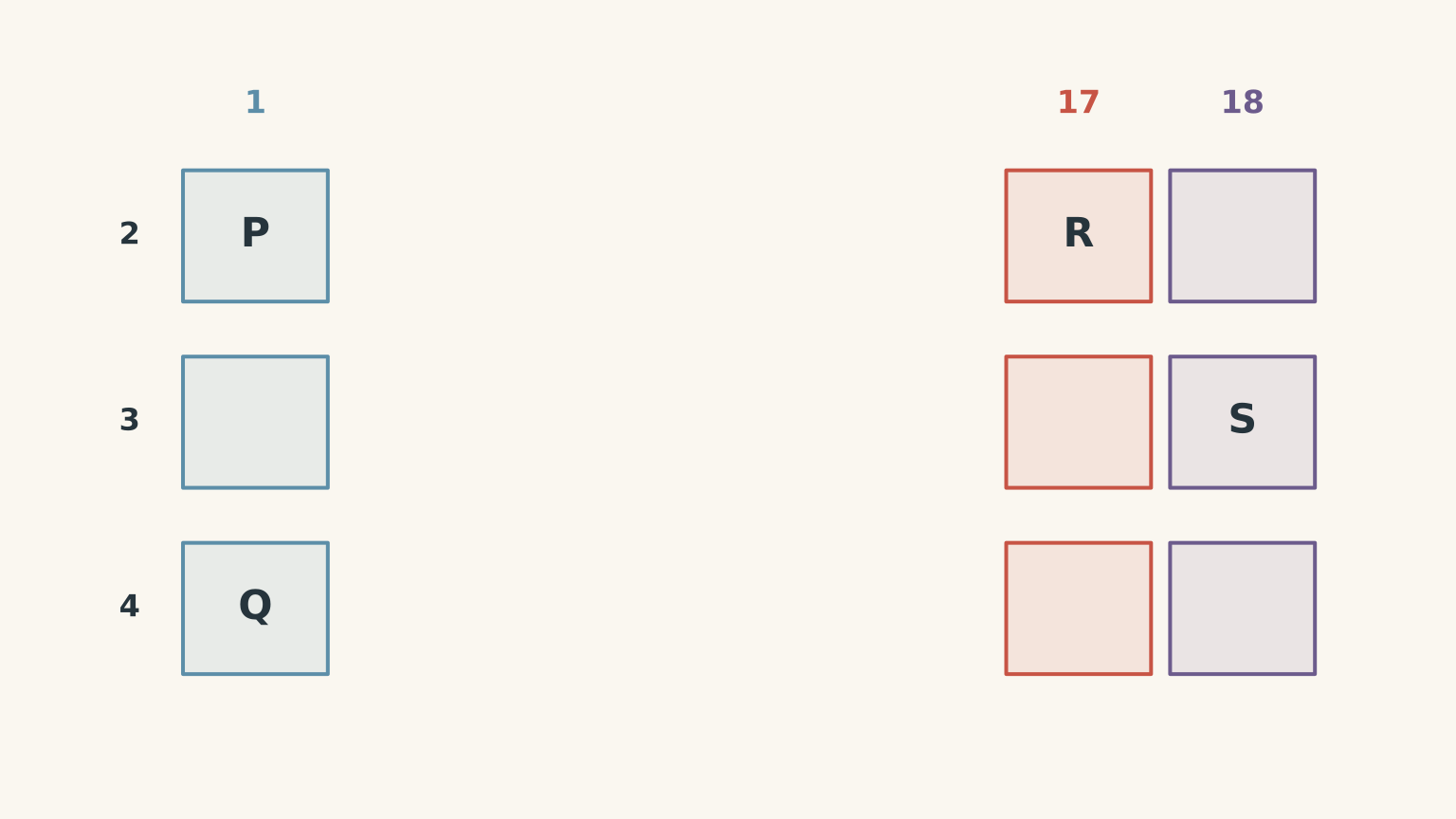
(a) Identify the two elements that belong to the same group. State how many valence electrons each of these elements has. (2 marks)
(b) Classify each of P, Q, R, and S as either a metal or a non-metal, based on its periodic-table position. (4 marks)
(c) Which of R or S would be more likely to form chemical compounds? Explain your answer with reference to their positions in the periodic table. (2 marks)
Question 3 (12 marks)
Ionic compounds consist of positively and negatively charged ions. Their names identify the ions present, while Roman numerals are used when a metal can form more than one common positive ion.
(a) Write the correct IUPAC name for each of the following ionic compounds. (5 marks)
i. \(\ce{Na2O}\)
ii. \(\ce{FeCl3}\)
iii. \(\ce{Ca(NO3)2}\)
iv. \(\ce{(NH4)2SO4}\)
v. \(\ce{CuO}\)
(b) Write the correct chemical formula for each of the following compounds. (3 marks)
i. Magnesium hydroxide
ii. Aluminium sulfate
iii. Iron(II) phosphate
(c) For calcium nitrate, \(\ce{Ca(NO3)2}\):
- Identify the cation and anion present.
- State whether the compound is ionic or molecular.
(2 marks)
(d) Explain why the name iron(III) chloride contains a Roman numeral, whereas sodium oxide does not. (2 marks)
Question 4 (10 marks)
Molecular compounds commonly form between non-metal elements. Their names use numerical prefixes to indicate the number of atoms of each element present.
(a) Name the following molecular compounds using the appropriate IUPAC conventions. (4 marks)
i. \(\ce{CO2}\)
ii. \(\ce{N2O4}\)
iii. \(\ce{PCl5}\)
iv. \(\ce{SF4}\)
(b) Write the chemical formula for each of the following molecular compounds. (2 marks)
i. Dinitrogen trioxide
ii. Sulfur hexafluoride
(c) Hydrogen chloride can exist in different physical forms.
Give the correct name for each of the following:
i. \(\ce{HCl(g)}\)
ii. \(\ce{HCl(aq)}\)
(2 marks)
(d) For carbon dioxide, \(\ce{CO2}\), identify its two constituent elements and classify the compound as either ionic or molecular. (2 marks)
Question 5 (6 marks)
Three elements are examined at a temperature of \(20^\circ\text{C}\) and a pressure of 100 kPa.
Their physical properties are recorded below.
| Element | Appearance and physical properties |
|---|---|
| A | A lustrous solid that is malleable and conducts electricity. |
| B | A dull, brittle solid that is a poor electrical conductor. |
| C | A colourless gas with a low melting point and poor electrical conductivity. |
(a) Classify each element as either a metal or a non-metal, using the physical properties provided. (3 marks)
(b) State the broad region of the periodic table in which you would expect to find:
i. Element A
ii. Elements B and C
(2 marks)
(c) Graphite is a form of carbon that conducts electricity, even though carbon is classified as a non-metal.
What does this tell us about using electrical conductivity as the only method of classifying elements? (1 mark)
Question 6 (8 marks)
The chemical reactivity of elements follows patterns across the periodic table.
A student is given the following experimental observations. All comparisons were made under the same conditions using comparable samples.
Part A: Group 1 elements reacting with water
| Element | Observed reaction |
|---|---|
| Lithium | Slow fizzing |
| Sodium | Faster fizzing |
| Potassium | Very rapid fizzing |
Part B: Halogen displacement observations
| Halogen added | Substance in solution | Observation |
|---|---|---|
| Chlorine, \(\ce{Cl2}\) | Potassium bromide, \(\ce{KBr(aq)}\) | Bromine is produced. |
| Bromine, \(\ce{Br2}\) | Potassium iodide, \(\ce{KI(aq)}\) | Iodine is produced. |
| Iodine, \(\ce{I2}\) | Potassium bromide, \(\ce{KBr(aq)}\) | No displacement is observed. |
(a) Describe the trend in reactivity as you move down Group 1 from lithium to potassium. Use the experimental observations to support your answer. (2 marks)
(b) Predict how rubidium would react with water compared with potassium. Justify your prediction using the periodic-table trend. (2 marks)
(c) Rank chlorine, bromine, and iodine from most reactive to least reactive. Use the displacement observations to support your ranking. (2 marks)
(d) Explain why the reactivity trends down Group 1 and Group 17 are different. Refer to electron loss or gain and the effect of increasing atomic size and electron shielding. (2 marks)
03Worked solutions and marking guide
Solution 1
(a) Classifying physical and chemical evidence
| Sample | Classification | Explanation |
|---|---|---|
| A | Physical | Lustre, malleability, and electrical conductivity can be observed without changing the substance’s chemical identity. |
| B | Physical | Colour, brittleness, and electrical conductivity are physical properties. |
| C | Chemical | A new substance forms when the element reacts with oxygen. |
| D | Chemical | The formation of gas bubbles and a new solution indicates a chemical reaction. |
A physical property can be observed or measured without changing the chemical identity of a substance.
A chemical property describes how a substance behaves when it reacts and forms new substances.
Marking breakdown:
- Sample A correctly classified as physical: 1 mark.
- Sample B correctly classified as physical: 1 mark.
- Sample C correctly classified as chemical: 1 mark.
- Sample D correctly classified as chemical: 1 mark.
(b) Classifying the elements
- Sample A is a metal. Its lustre, malleability, and electrical conductivity are characteristic metallic properties.
- Sample B is a non-metal. Its brittleness and poor electrical conductivity are consistent with non-metallic behaviour.
Marking breakdown:
- Correct classification of A as a metal: 1 mark.
- Correct classification of B as a non-metal: 1 mark.
Total: 6 marks
Solution 2
(a) Identifying elements in the same group
P and Q both belong to Group 1.
Elements in the same main group generally have the same number of valence electrons. Group 1 elements have one valence electron.
Therefore, both P and Q have one valence electron.
Marking breakdown:
- Identifies P and Q as belonging to the same group: 1 mark.
- States that each has one valence electron: 1 mark.
(b) Classifying the elements
| Element | Group | Classification |
|---|---|---|
| P | 1 | Metal |
| Q | 1 | Metal |
| R | 17 | Non-metal |
| S | 18 | Non-metal |
Metals are generally located on the left and in the centre of the periodic table.
Non-metals are generally found towards the upper right-hand side, with hydrogen being an exception to this general pattern.
Group 18 contains the noble gases, which are non-metals.
Marking breakdown:
- P correctly classified as a metal: 1 mark.
- Q correctly classified as a metal: 1 mark.
- R correctly classified as a non-metal: 1 mark.
- S correctly classified as a non-metal: 1 mark.
(c) Predicting chemical behaviour
R is more likely to form chemical compounds than S.
R belongs to Group 17, the halogens. These elements have seven valence electrons and tend to gain one electron to achieve a full outer electron shell.
S belongs to Group 18, the noble gases. Its outer electron shell is full, making it relatively unreactive under ordinary conditions.
This difference in electron arrangement helps explain why halogens are generally much more chemically reactive than noble gases.
Marking breakdown:
- Identifies R as more likely to form compounds: 1 mark.
- Explains the difference using the electron arrangements and relative reactivity of Groups 17 and 18: 1 mark.
Total: 8 marks
Solution 3
(a) Naming ionic compounds
i. \(\ce{Na2O}\): Sodium oxide.
Sodium forms \(\mathrm{Na}^{+}\) ions, while oxygen forms oxide ions, \(\mathrm{O}^{2-}\).
ii. \(\ce{FeCl3}\): Iron(III) chloride.
Each chloride ion has a charge of −1. Three chloride ions give a total charge of −3.
Therefore, iron must have a charge of +3 in this compound. The Roman numeral (III) indicates this charge.
iii. \(\ce{Ca(NO3)2}\): Calcium nitrate.
The compound contains calcium ions and nitrate ions. Nitrate is a polyatomic ion, so its name is retained.
iv. \(\ce{(NH4)2SO4}\): Ammonium sulfate.
The compound contains ammonium ions, \(\ce{NH4+}\), and sulfate ions, \(\mathrm{SO_{4}}^{2-}\).
v. \(\ce{CuO}\): Copper(II) oxide.
The oxide ion has a charge of −2. Copper must therefore have a charge of +2, giving the name copper(II) oxide.
Marking breakdown:
- Sodium oxide: 1 mark.
- Iron(III) chloride: 1 mark.
- Calcium nitrate: 1 mark.
- Ammonium sulfate: 1 mark.
- Copper(II) oxide: 1 mark.
(b) Writing ionic formulae
i. Magnesium hydroxide
Magnesium forms \(\mathrm{Mg}^{2+}\), while hydroxide is \(\ce{OH-}\).
Two hydroxide ions are needed to balance one magnesium ion.
\[ \boxed{\ce{Mg(OH)2}} \]
ii. Aluminium sulfate
Aluminium forms \(\mathrm{Al}^{3+}\), while sulfate is \(\mathrm{SO_{4}}^{2-}\).
The lowest whole-number ratio that balances the charges is two aluminium ions to three sulfate ions.
\[ \boxed{\ce{Al2(SO4)3}} \]
iii. Iron(II) phosphate
Iron(II) forms \(\mathrm{Fe}^{2+}\), while phosphate is \(\mathrm{PO_{4}}^{3-}\).
Three iron(II) ions give a total positive charge of +6. Two phosphate ions give a total negative charge of −6.
\[ \boxed{\ce{Fe3(PO4)2}} \]
Marking breakdown:
- Correct formula for magnesium hydroxide: 1 mark.
- Correct formula for aluminium sulfate: 1 mark.
- Correct formula for iron(II) phosphate: 1 mark.
(c) Identifying the ions and classification
Calcium nitrate contains:
- Cation: \(\mathrm{Ca}^{2+}\)
- Anion: \(\ce{NO3-}\)
The compound is ionic because it consists of positively and negatively charged ions held together by electrostatic attraction.
Two nitrate ions are required to balance the charge of one calcium ion.
Marking breakdown:
- Correctly identifies the calcium and nitrate ions: 1 mark.
- Correctly classifies the compound as ionic: 1 mark.
(d) Explaining Roman numerals
Iron can form more than one common positive ion, including \(\mathrm{Fe}^{2+}\) and \(\mathrm{Fe}^{3+}\).
The Roman numeral identifies the charge of the iron ion in a particular compound. In iron(III) chloride, iron has a charge of +3.
Sodium, however, forms \(\mathrm{Na}^{+}\) ions in common ionic compounds. Its charge is predictable, so a Roman numeral is unnecessary.
Marking breakdown:
- Identifies that iron can form ions with different charges: 1 mark.
- Explains that the Roman numeral identifies the charge of iron in the compound: 1 mark.
Total: 12 marks
Solution 4
(a) Naming molecular compounds
i. \(\ce{CO2}\): Carbon dioxide.
There is one carbon atom and two oxygen atoms. The prefix di- indicates two oxygen atoms.
ii. \(\ce{N2O4}\): Dinitrogen tetroxide.
There are two nitrogen atoms and four oxygen atoms. The prefix tetra- becomes tetroxide in this name.
iii. \(\ce{PCl5}\): Phosphorus pentachloride.
There is one phosphorus atom and five chlorine atoms. The prefix penta- indicates five chlorine atoms.
iv. \(\ce{SF4}\): Sulfur tetrafluoride.
There is one sulfur atom and four fluorine atoms. The prefix tetra- indicates four fluorine atoms.
Remember that the prefix mono- is generally omitted from the first element in a binary molecular compound.
Marking breakdown:
- Carbon dioxide: 1 mark.
- Dinitrogen tetroxide: 1 mark.
- Phosphorus pentachloride: 1 mark.
- Sulfur tetrafluoride: 1 mark.
(b) Writing molecular formulae
i. Dinitrogen trioxide
Di- indicates two nitrogen atoms, while tri- indicates three oxygen atoms.
\[ \boxed{\ce{N2O3}} \]
ii. Sulfur hexafluoride
There is one sulfur atom and six fluorine atoms.
\[ \boxed{\ce{SF6}} \]
Marking breakdown:
- Correct formula for dinitrogen trioxide: 1 mark.
- Correct formula for sulfur hexafluoride: 1 mark.
(c) Naming hydrogen chloride
i. \(\ce{HCl(g)}\): Hydrogen chloride.
ii. \(\ce{HCl(aq)}\): Hydrochloric acid.
The state symbol changes the name used.
Hydrogen chloride is the gaseous molecular substance. When dissolved in water, it is known as hydrochloric acid.
Marking breakdown:
- Correct name for \(\ce{HCl(g)}\): 1 mark.
- Correct name for \(\ce{HCl(aq)}\): 1 mark.
(d) Classifying carbon dioxide
The two constituent elements are carbon and oxygen.
Both are non-metals. Carbon dioxide is therefore classified as a molecular compound.
Marking breakdown:
- Identifies carbon and oxygen: 1 mark.
- Correctly identifies the compound as molecular: 1 mark.
Total: 10 marks
Solution 5
(a) Classifying the elements
| Element | Classification | Supporting physical properties |
|---|---|---|
| A | Metal | Lustrous, malleable, and electrically conductive. |
| B | Non-metal | Dull, brittle, and a poor electrical conductor. |
| C | Non-metal | Gaseous at room temperature, with a low melting point and poor electrical conductivity. |
Metallic elements commonly have a shiny appearance, conduct electricity, and can be shaped without breaking.
Non-metals generally lack metallic lustre and are often brittle when solid. Many also have relatively low melting points.
Marking breakdown:
- A classified as a metal: 1 mark.
- B classified as a non-metal: 1 mark.
- C classified as a non-metal: 1 mark.
(b) Periodic-table regions
i. Element A would most likely be found on the left-hand side or in the centre of the periodic table, where most metals are located.
ii. Elements B and C would most likely be found towards the upper right-hand side of the periodic table, where most non-metals are located.
Marking breakdown:
- Correctly identifies the broad metallic region for A: 1 mark.
- Correctly identifies the broad non-metallic region for B and C: 1 mark.
(c) The limitation of electrical conductivity
Electrical conductivity is useful for identifying metals, but it is not a perfect classification method.
Graphite is a non-metal that conducts electricity. Therefore, conductivity alone cannot reliably distinguish every metal from every non-metal.
Marking breakdown:
- Recognises that graphite is a conducting non-metal and that conductivity is not a universal classification rule: 1 mark.
Total: 6 marks
Solution 6
(a) Reactivity down Group 1
Reactivity increases as you move down Group 1.
The observations support this trend:
- Lithium reacts relatively slowly.
- Sodium reacts faster.
- Potassium reacts very rapidly.
The increasing rate of reaction indicates increasing chemical reactivity under the conditions tested.
Marking breakdown:
- Correctly identifies that reactivity increases down Group 1: 1 mark.
- Uses the experimental observations to support the trend: 1 mark.
(b) Predicting rubidium’s reactivity
Rubidium would be expected to react more readily with water than potassium.
Rubidium is located below potassium in Group 1. Reactivity increases down this group, so rubidium is expected to be more reactive.
Marking breakdown:
- Predicts that rubidium is more reactive than potassium: 1 mark.
- Justifies the prediction using the Group 1 trend: 1 mark.
(c) Ranking halogen reactivity
The correct order from most reactive to least reactive is:
\[ \boxed{\ce{Cl2 > Br2 > I2}} \]
The displacement observations support this order.
- Chlorine displaces bromine from potassium bromide, showing that chlorine is more reactive than bromine.
- Bromine displaces iodine from potassium iodide, showing that bromine is more reactive than iodine.
- Iodine cannot displace bromine from potassium bromide, which is consistent with iodine being less reactive than bromine.
Therefore, chlorine is the most reactive of the three, followed by bromine and then iodine.
Marking breakdown:
- Correct ranking: 1 mark.
- Correctly uses displacement observations to justify the ranking: 1 mark.
(d) Explaining the different reactivity trends
Group 1 and Group 17 have opposite reactivity trends because they react by different electron processes.
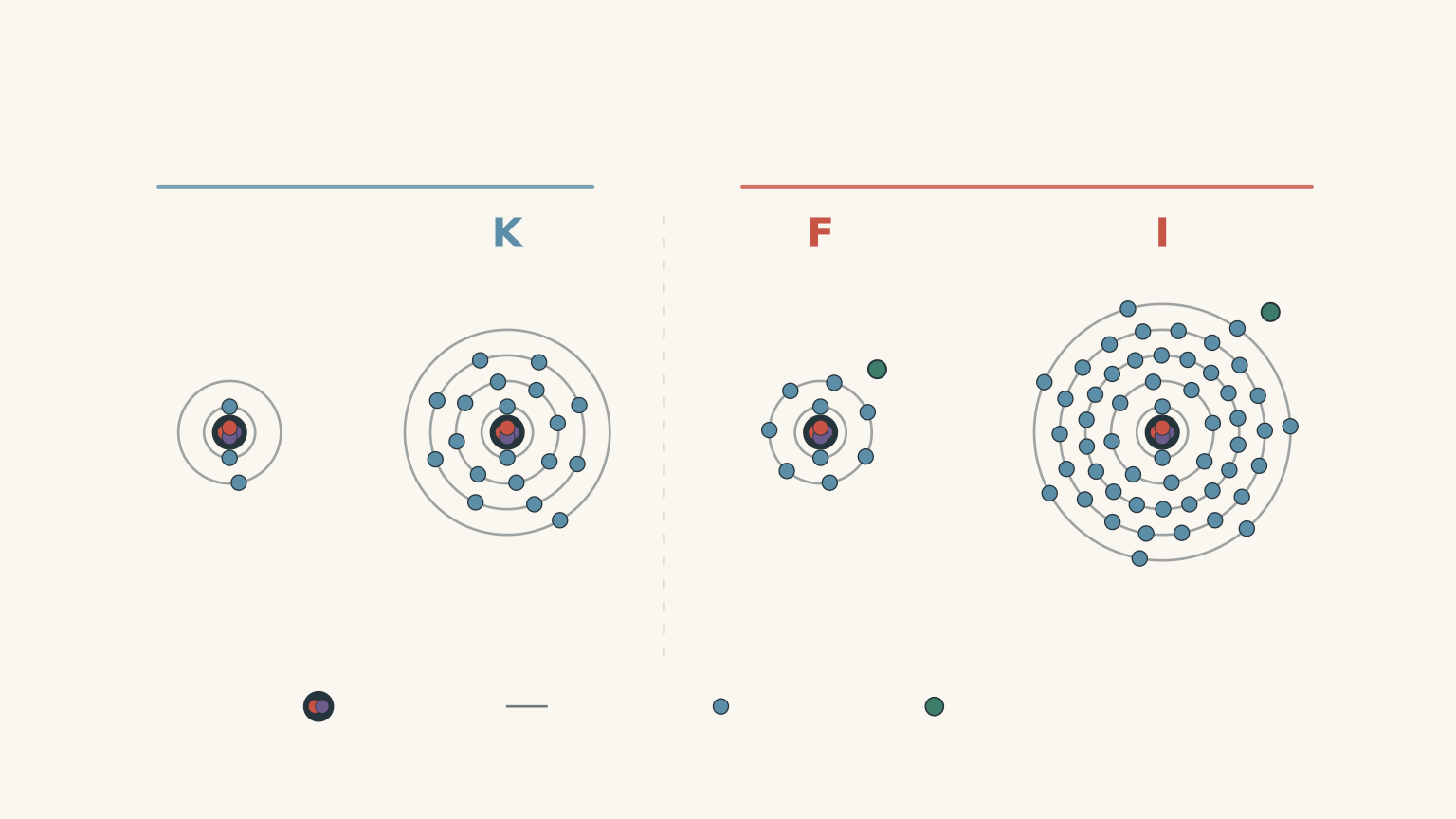
Group 1:
Group 1 elements react by losing their outermost electron.
As you move down the group:
- The number of occupied electron shells increases.
- The outermost electron is further from the nucleus.
- Increased electron shielding reduces the effective attraction between the nucleus and the outermost electron.
The outermost electron becomes easier to remove. This explains why Group 1 reactivity increases down the group.
Group 17:
Group 17 elements react by gaining an electron.
As you move down the group:
- The number of occupied electron shells increases.
- The incoming electron is further from the nucleus.
- Increased electron shielding reduces the attraction between the nucleus and the incoming electron.
The atom becomes less effective at attracting an additional electron. This explains why Group 17 reactivity decreases down the group.
Marking breakdown:
- Explains that Group 1 atoms lose electrons more readily down the group because of increasing distance and shielding: 1 mark.
- Explains that Group 17 atoms attract incoming electrons less strongly down the group because of increasing distance and shielding: 1 mark.
Total: 8 marks
04Final mark summary
| Question | Topic | Marks |
|---|---|---|
| 1 | Physical and chemical properties | 6 |
| 2 | Periodic-table position and chemical behaviour | 8 |
| 3 | Ionic nomenclature | 12 |
| 4 | Molecular and other inorganic nomenclature | 10 |
| 5 | Physical classification of elements | 6 |
| 6 | Chemical reactivity and periodic trends | 8 |
| Total | 50 |
Marking note: Award marks for equivalent correct chemical names and formulae. Formulae must have the correct subscripts and brackets. Roman numerals must correctly identify variable metal-ion charges. No follow-through marks are required because the questions are independently assessed.
The most important revision skills tested in this paper are recognising physical versus chemical evidence, using periodic-table position to predict behaviour, and moving accurately between inorganic names, formulae, and constituent ions.