
Connected Blocks on Slopes and Pulleys: Physics Practice Exam
Test your understanding of connected blocks on inclined planes and pulley systems with this original 40-mark tutorgum physics practice exam. Includes timed assessment questions, complete worked solutions, and a detailed marking guide.
This original tutorgum practice paper assesses the supplied physics-2025 scope: connected blocks on slopes and pulleys. It covers connected-body motion, tension, Newton’s second law along inclined surfaces, and static and kinetic friction where specified. The paper is a focused topic assessment, not a full-course exam, and is not an official, endorsed, past, or predicted NESA paper.
01Exam instructions
Suggested working time: 55 minutes
Suggested reading time: 5 minutes
Total marks: 40
Permitted equipment
- Scientific calculator
- Ruler
- Pens and pencils
These are suggested conditions for this practice paper, not claims about current official NESA examination rules. No notes or formula sheet are required.
Assessed content
- Connected bodies joined by light, inextensible strings.
- Tension in ideal pulley systems.
- Applying Newton’s second law to blocks on inclined surfaces.
- Determining the direction of motion in connected systems.
- Calculating acceleration and tension.
- Static friction and kinetic friction in the specified situations.
Exclusions: Pulley rotational dynamics, massive strings, non-ideal pulley effects, and unrelated mechanics topics are not assessed.
Assumptions and data
Unless a question states otherwise:
- Use \(g=9.8\text{ m s}^{-2}\).
- Strings are light and inextensible.
- Pulleys are smooth and massless.
- Tension is uniform throughout a single continuous string.
- Connected bodies have the same acceleration magnitude.
- Air resistance is negligible.
- A smooth surface has no friction.
- Static friction satisfies \(f_s\leq\mu_sN\).
- Kinetic friction has magnitude \(f_k=\mu_kN\).
Here, \(T\) represents tension, \(N\) represents the normal reaction force, and \(a\) represents acceleration magnitude.
Useful trigonometric values:
| Angle | Sine | Cosine |
|---|---|---|
| \(30^\circ\) | 0.500 | 0.866 |
| \(45^\circ\) | 0.707 | 0.707 |
Working requirements
- Show your working for every calculation.
- Include appropriate units in numerical answers.
- Give answers to three significant figures unless otherwise appropriate.
- Draw free-body diagrams where requested.
- Clearly state the direction of motion when asked.
- Do not assume static friction is automatically at its maximum value.
02Questions
Question 1 (5 marks)
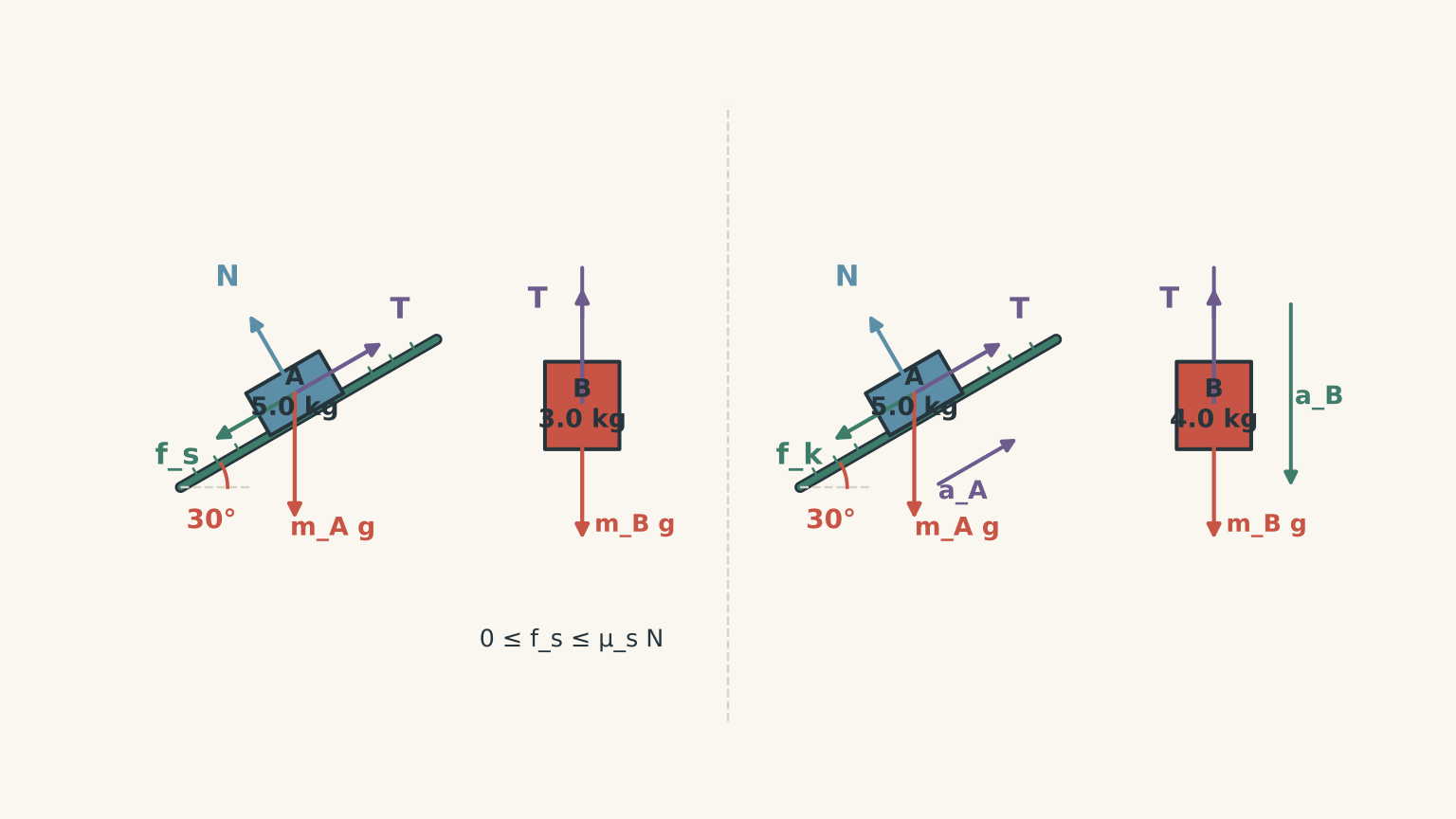
A \(4.0\text{ kg}\) block A rests on a smooth \(30^\circ\) inclined surface. It is connected by a light, inextensible string over a smooth pulley to a \(3.0\text{ kg}\) hanging block B.
The system is released from rest.
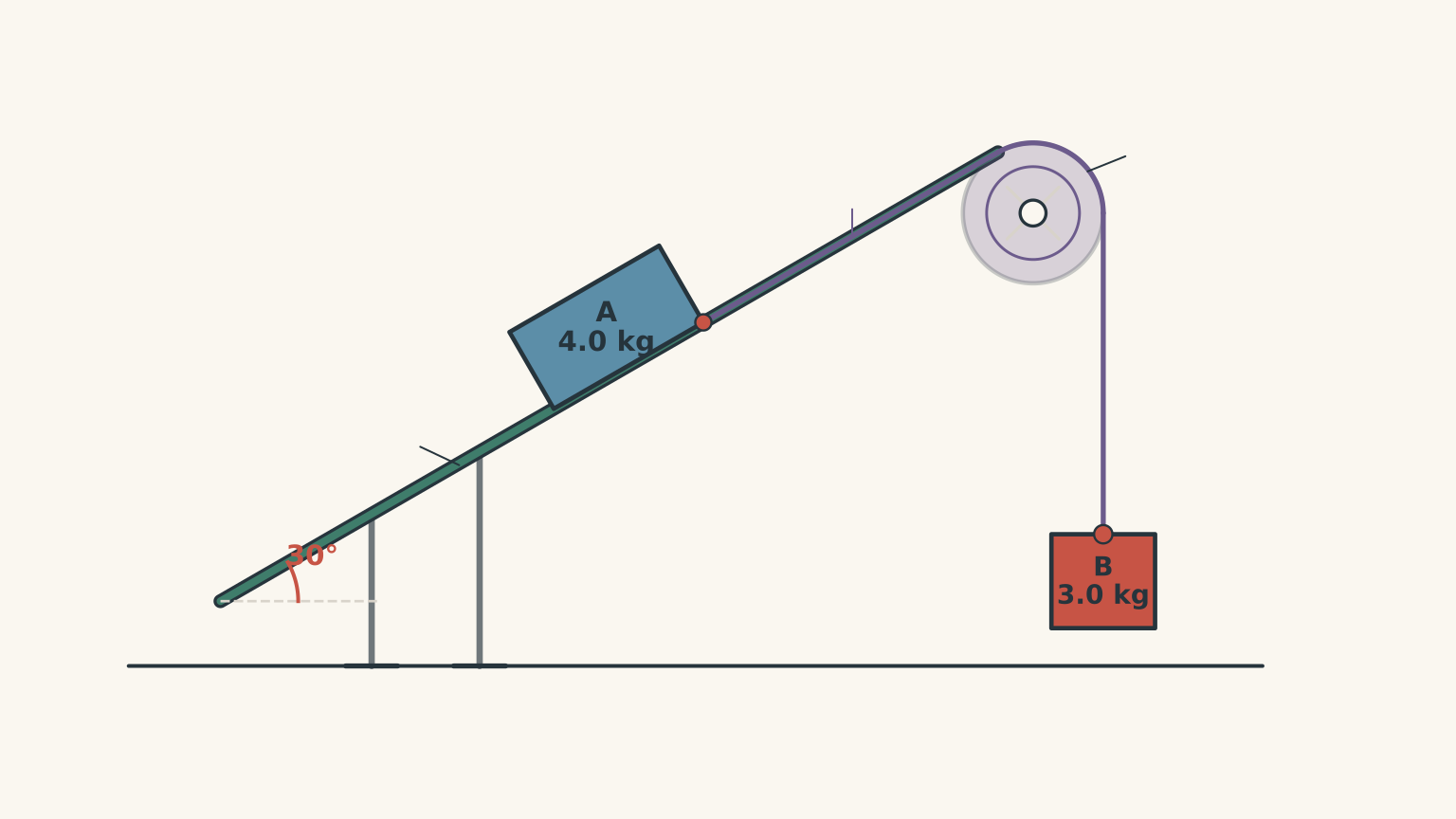
(a) Draw a separate free-body diagram for each block. Determine the direction of motion and calculate the acceleration magnitude of the system. (3 marks)
(b) Calculate the tension in the connecting string. (2 marks)
Question 2 (6 marks)
A \(5.0\text{ kg}\) block A rests on a rough \(30^\circ\) inclined surface. It is connected over an ideal pulley to a \(3.0\text{ kg}\) hanging block B.
The coefficient of static friction between block A and the incline is \(0.20\).
The system is released from rest.
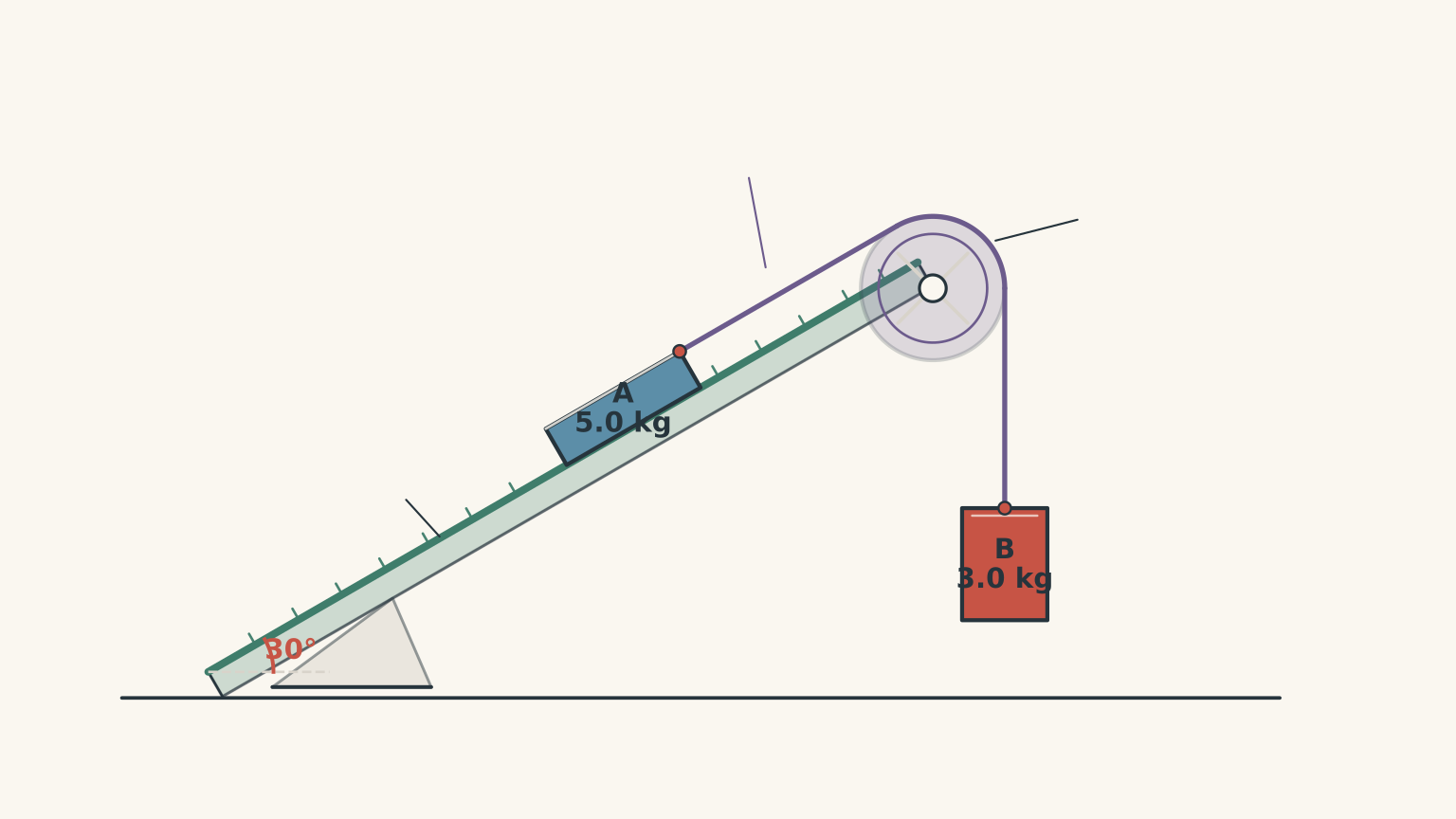
(a) Determine whether the system begins to move. Support your conclusion with an appropriate static-friction calculation. (4 marks)
(b) Use your result from part (a) to determine the tension in the string and the magnitude and direction of the friction force acting on block A. (2 marks)
Question 3 (7 marks)
A \(5.0\text{ kg}\) block A is placed on a rough \(30^\circ\) inclined surface and connected over an ideal pulley to a \(4.0\text{ kg}\) hanging block B.
The coefficients of friction between block A and the incline are:
- Coefficient of static friction: \(\mu_s=0.20\)
- Coefficient of kinetic friction: \(\mu_k=0.15\)
The system is released from rest.
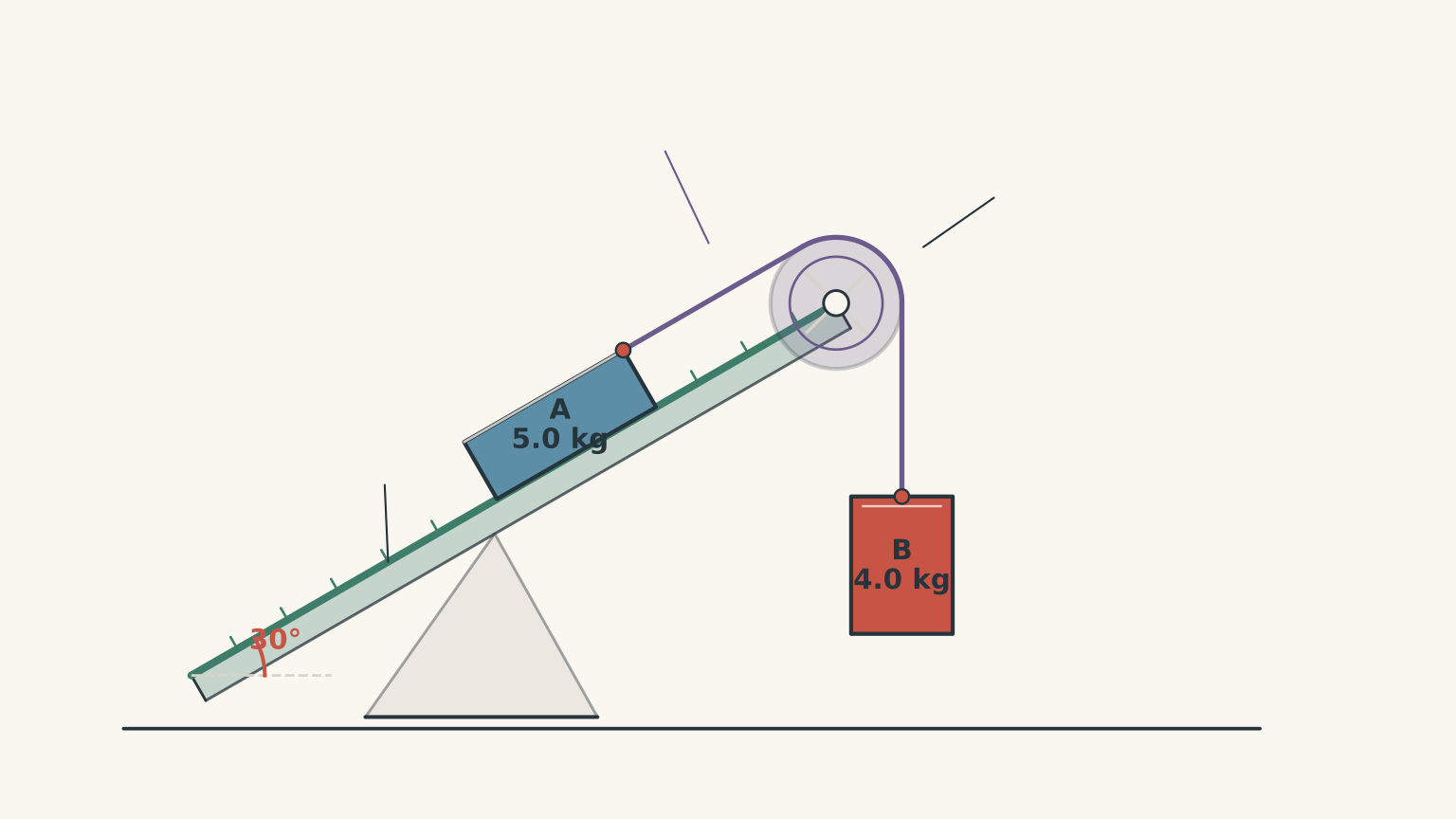
(a) Determine whether static friction can keep the system at rest. If the system moves, state its direction of motion. (2 marks)
(b) Calculate the acceleration magnitude of the system once sliding begins. (3 marks)
(c) Calculate the tension in the connecting string. (2 marks)
Question 4 (7 marks)
Two blocks, A and B, are placed on opposite sides of a pair of inclined surfaces. The surfaces meet at a raised central point, where a smooth pulley is positioned.
Block A has a mass of \(6.0\text{ kg}\) and rests on a smooth \(30^\circ\) incline.
Block B has a mass of \(4.0\text{ kg}\) and rests on a smooth \(45^\circ\) incline.
The blocks are connected by a single light, inextensible string passing over the pulley. The system is released from rest.
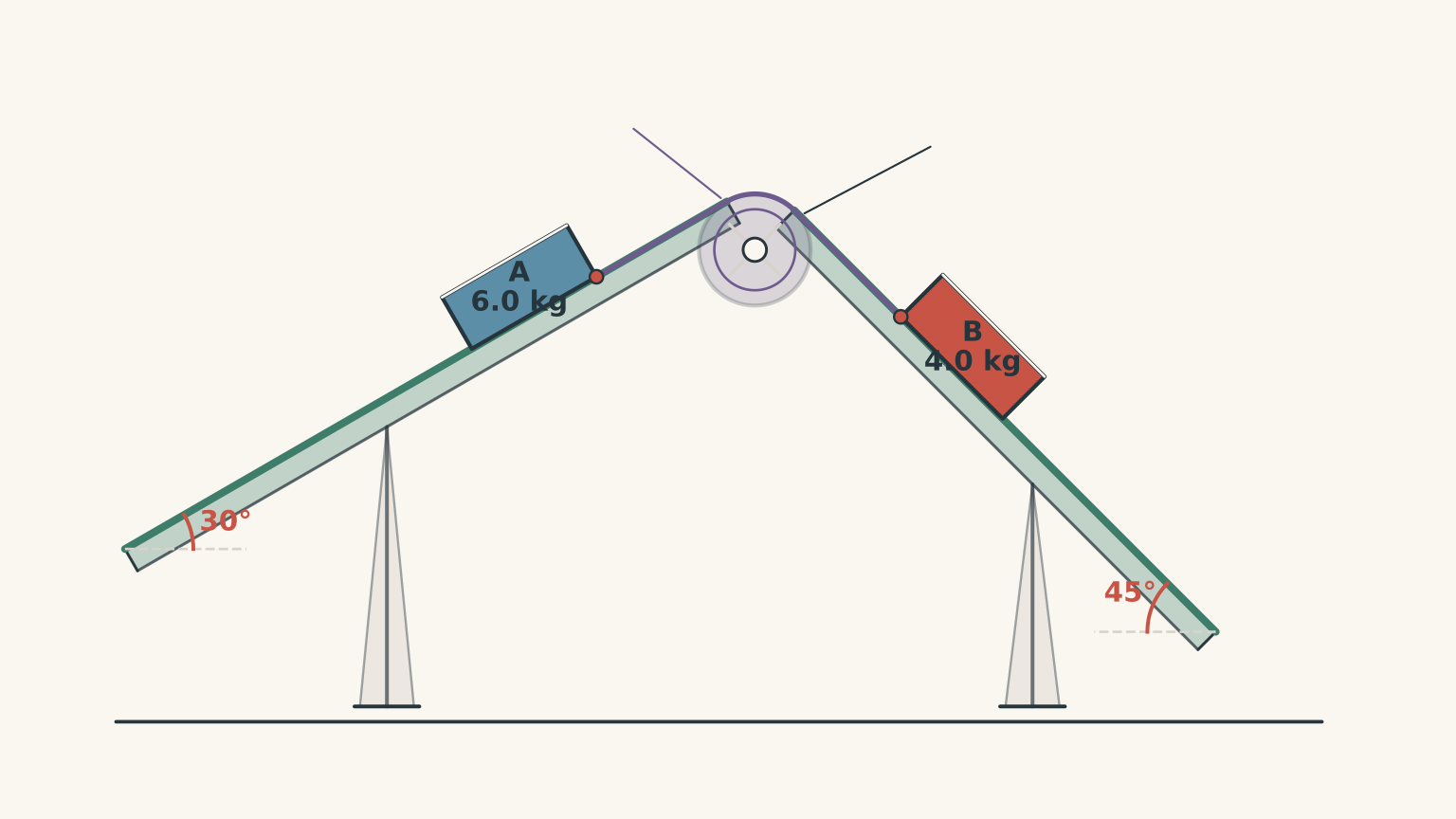
(a) Determine which block moves down its inclined surface when the system is released. Justify your answer using the components of gravitational force parallel to each incline. (2 marks)
(b) Calculate the acceleration magnitude of the system. (3 marks)
(c) Calculate the tension in the connecting string. (2 marks)
Question 5 (7 marks)
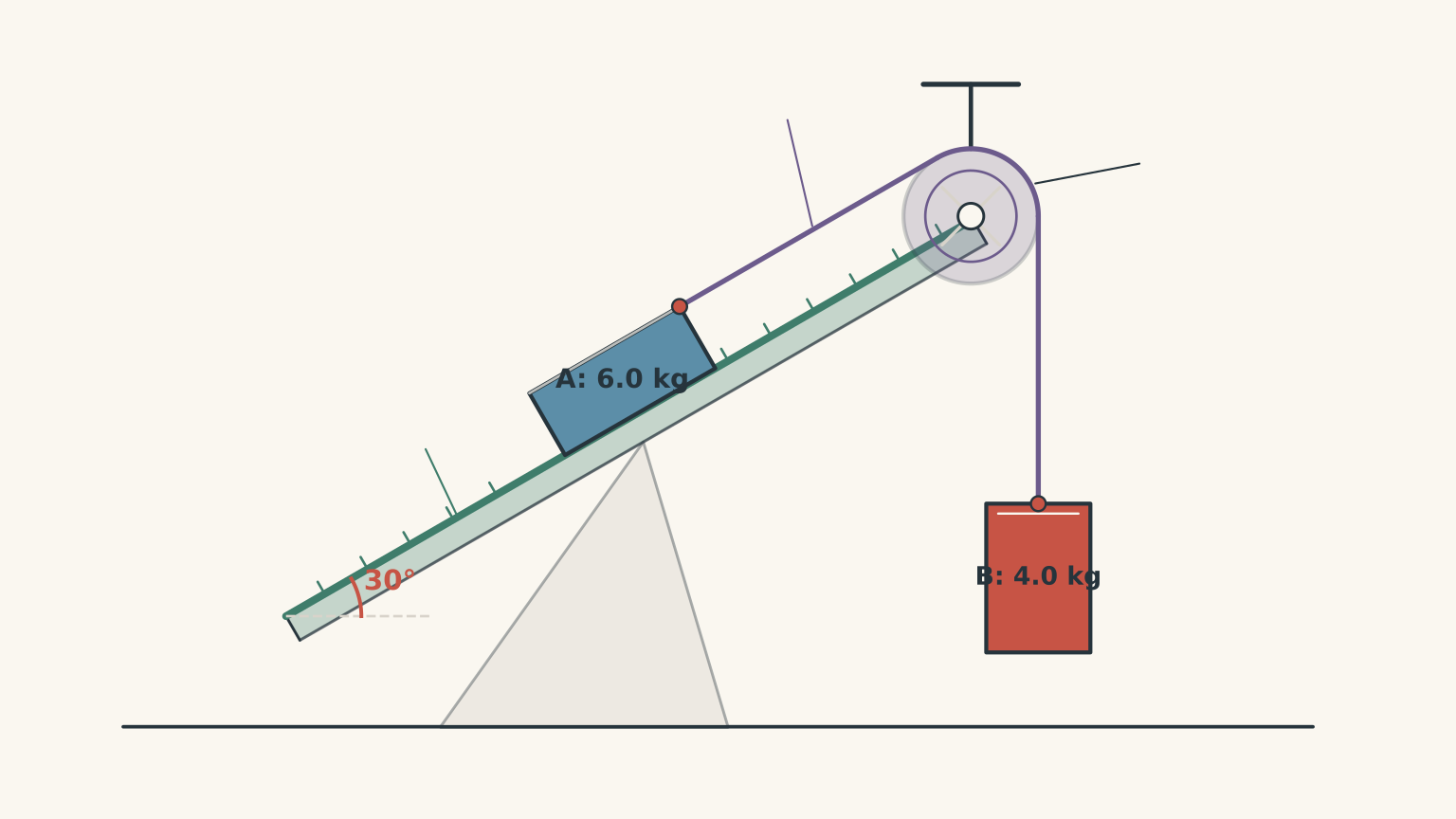
A \(6.0\text{ kg}\) block A rests on a rough \(30^\circ\) inclined surface. It is connected over an ideal pulley to a \(4.0\text{ kg}\) hanging block B.
The system is already sliding. Block B is descending and speeding up at \(0.60\text{ m s}^{-2}\).
(a) Calculate the tension in the connecting string. (2 marks)
(b) Determine the coefficient of kinetic friction between block A and the inclined surface. (3 marks)
(c) State the direction of the kinetic friction force acting on block A. Explain why kinetic friction, rather than static friction, is used in this calculation. (2 marks)
Question 6 (8 marks)
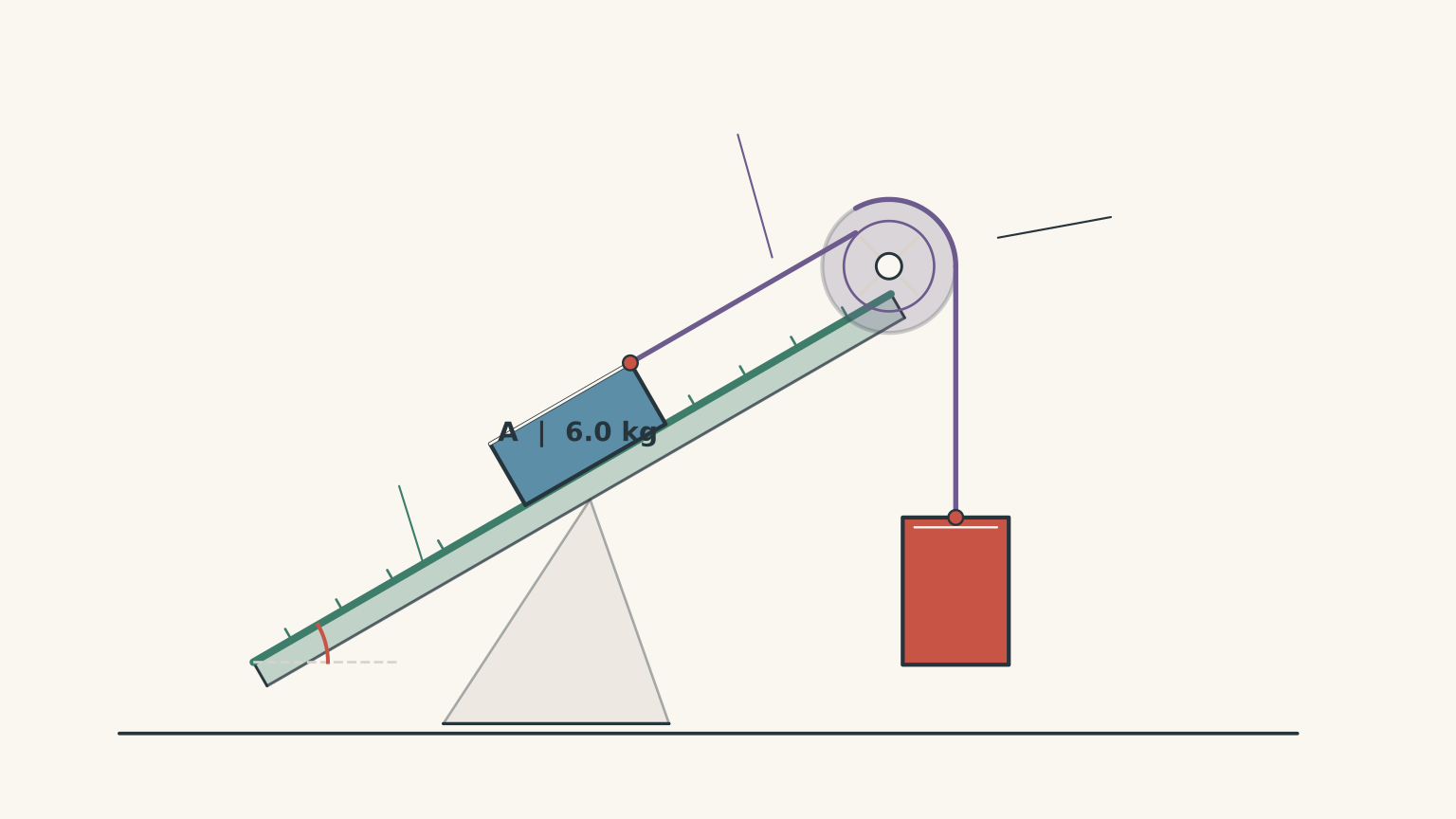
A \(6.0\text{ kg}\) block A rests on a rough \(30^\circ\) inclined surface. It is connected over an ideal pulley to a hanging block B of unknown mass \(m\).
The coefficient of static friction between block A and the incline is \(0.25\).
The system is released from rest.
(a) Determine the minimum hanging mass required for block A to be just about to move up the incline. (5 marks)
(b) If the hanging mass is \(4.00\text{ kg}\), determine whether the system moves or remains at rest. Support your answer with an appropriate friction calculation. (3 marks)
03Worked solutions and marking guide
The solutions below show one valid method for each question. Equivalent correct approaches should receive credit.
Follow-through marks are appropriate when a student makes an earlier numerical error but uses that result correctly in a subsequent calculation.
Solution 1
(a) Free-body diagrams, direction, and acceleration (3 marks)
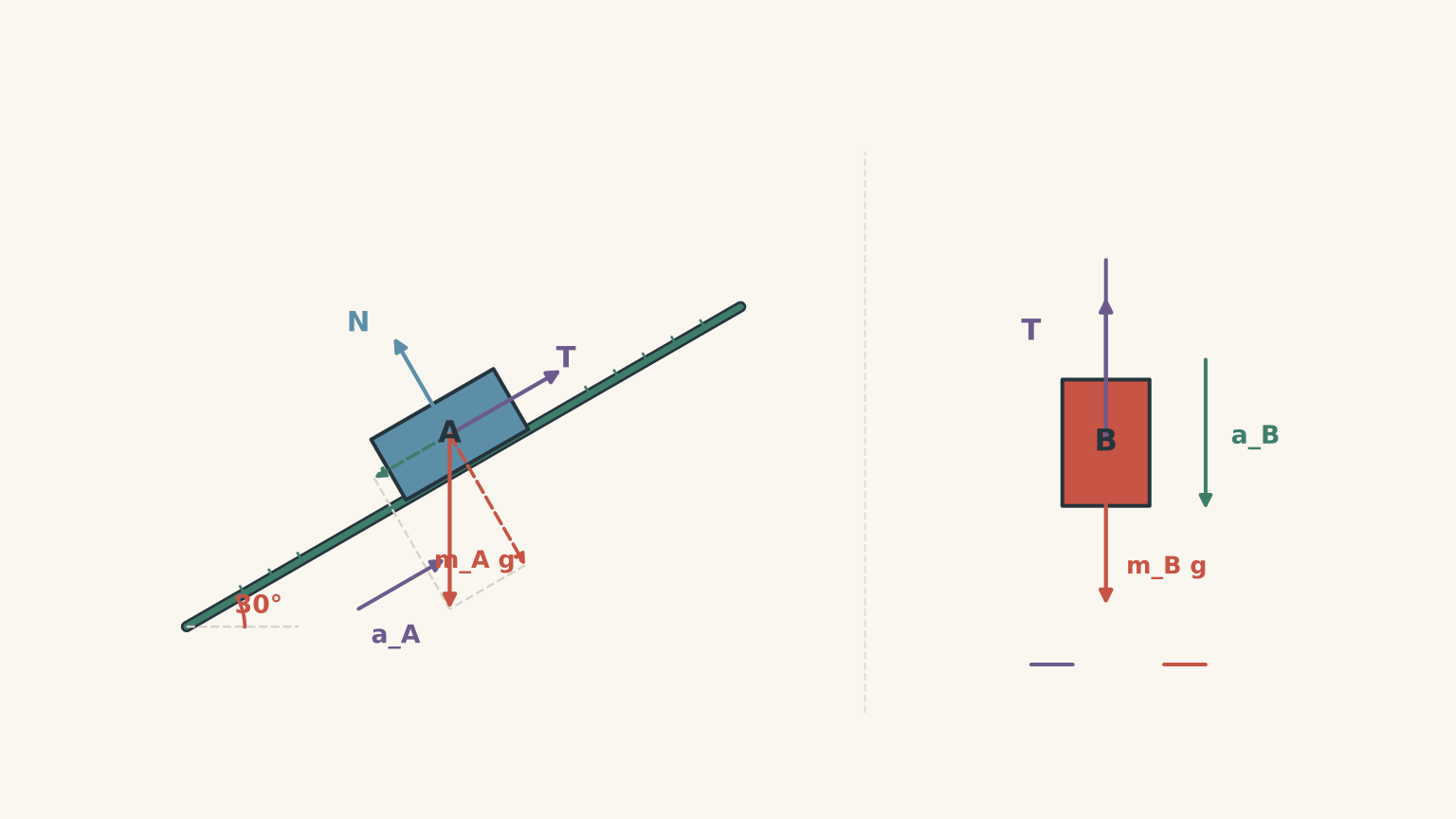
Start by resolving the gravitational force on block A into components.
The component parallel to the incline is:
\[ F_{A,\parallel}=m_Ag\sin30^\circ \]
\[ =4.0(9.8)(0.500) \]
\[ =19.6\text{ N} \]
The weight of block B is:
\[ F_B=m_Bg \]
\[ =3.0(9.8)=29.4\text{ N} \]
Compare the two forces:
- Block A experiences \(19.6\text{ N}\) down the incline.
- Block B experiences \(29.4\text{ N}\) downwards.
The hanging block has the greater driving force.
Therefore, block B moves downwards, pulling block A up the incline.
Apply Newton’s second law to the entire system:
\[ F_{\text{net}}=(m_A+m_B)a \]
\[ a=\frac{29.4-19.6}{4.0+3.0} \]
\[ \boxed{a=1.40\text{ m s}^{-2}} \]
Answer: Block B accelerates downwards, and block A accelerates up the incline at \(1.40\text{ m s}^{-2}\).
(b) Tension (2 marks)
Consider block B, which accelerates downwards.
Its weight acts downwards, while tension acts upwards.
Taking downwards as positive:
\[ m_Bg-T=m_Ba \]
Rearrange:
\[ T=m_B(g-a) \]
Substitute:
\[ T=3.0(9.8-1.40) \]
\[ \boxed{T=25.2\text{ N}} \]
We can check this using block A:
\[ T-m_Ag\sin30^\circ=m_Aa \]
\[ T=4.0(1.40)+19.6 \]
\[ T=25.2\text{ N} \]
Both blocks give the same tension, as expected for an ideal string and pulley.
Marking guide
| Part | Demonstrated working | Marks |
|---|---|---|
| (a) | Correct free-body diagrams and resolved gravitational component | 1 |
| (a) | Correct comparison and direction of motion | 1 |
| (a) | Correct Newton’s second law calculation and acceleration | 1 |
| (b) | Correct equation for block B | 1 |
| (b) | Correct tension with units | 1 |
| Total | 5 |
Solution 2
(a) Determine whether the system moves (4 marks)
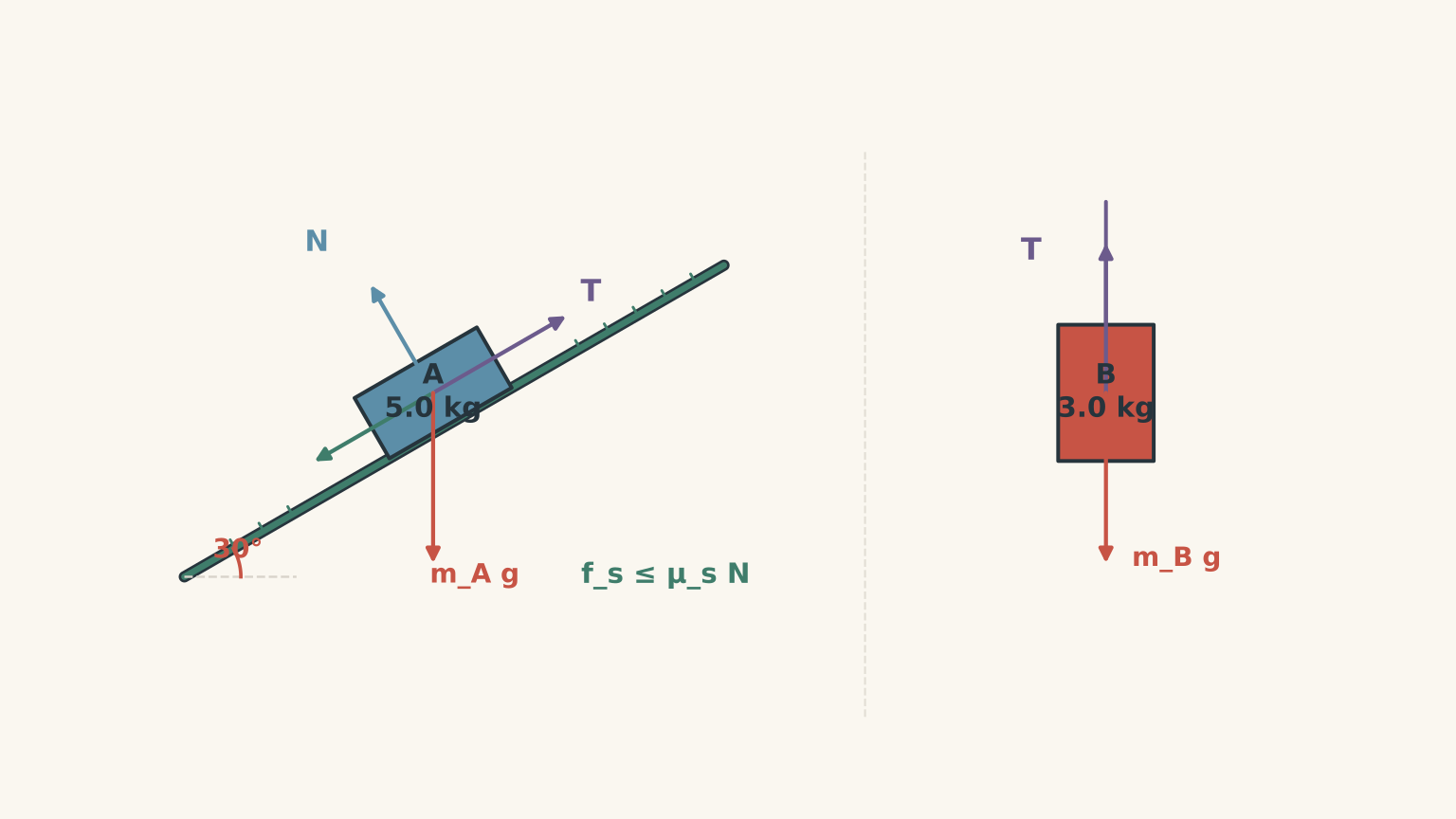
First, compare the forces that would drive the system if friction were absent.
The hanging block has weight:
\[ F_B=3.0(9.8)=29.4\text{ N} \]
The component of block A’s weight down the incline is:
\[ F_{A,\parallel} =5.0(9.8)\sin30^\circ \]
\[ =24.5\text{ N} \]
Without friction, block B would tend to move downwards, pulling block A up the incline.
The difference between these driving forces is:
\[ F_{\text{difference}}=29.4-24.5 \]
\[ =4.90\text{ N} \]
For the system to remain at rest, static friction must provide \(4.90\text{ N}\) down the incline on block A.
Now calculate the maximum available static friction.
First, find the normal reaction:
\[ N=m_Ag\cos30^\circ \]
\[ N=5.0(9.8)(0.866) \]
\[ N=42.4\text{ N} \]
The maximum static friction is:
\[ f_{s,\max}=\mu_sN \]
\[ =0.20(42.4) \]
\[ =8.49\text{ N} \]
Compare the required friction with the maximum:
\[ 4.90\text{ N}<8.49\text{ N} \]
Static friction is strong enough to prevent motion.
\[ \boxed{\text{The system remains at rest.}} \]
(b) Tension and static friction (2 marks)
Since the system remains at rest, the acceleration of block B is zero.
For block B:
\[ T=m_Bg \]
\[ T=3.0(9.8) \]
\[ \boxed{T=29.4\text{ N}} \]
Now consider block A.
The forces along the incline must balance:
\[ T-m_Ag\sin30^\circ-f_s=0 \]
Rearrange:
\[ f_s=T-m_Ag\sin30^\circ \]
\[ f_s=29.4-24.5 \]
\[ \boxed{f_s=4.90\text{ N}} \]
The static friction acts down the incline, opposing the tendency of block A to move upwards.
Notice that the actual static friction is \(4.90\text{ N}\), not \(8.49\text{ N}\).
Static friction adjusts to the force required to prevent sliding, up to its maximum possible value.
Marking guide
| Part | Demonstrated working | Marks |
|---|---|---|
| (a) | Calculates the force imbalance and identifies the tendency of motion | 1 |
| (a) | Calculates the normal reaction | 1 |
| (a) | Calculates maximum static friction | 1 |
| (a) | Compares the forces and correctly concludes that the system remains at rest | 1 |
| (b) | Calculates tension using equilibrium of block B | 1 |
| (b) | Calculates the actual static friction and its direction | 1 |
| Total | 6 |
Solution 3
(a) Determine the direction of motion (2 marks)
Start by checking whether static friction can keep the system at rest.
The weight of block B is:
\[ F_B=4.0(9.8)=39.2\text{ N} \]
The component of block A’s weight down the incline is:
\[ F_{A,\parallel}=5.0(9.8)(0.500) \]
\[ =24.5\text{ N} \]
The required static friction to prevent motion would therefore be:
\[ f_{s,\text{required}}=39.2-24.5 \]
\[ =14.7\text{ N} \]
From the normal reaction:
\[ N=5.0(9.8)(0.866)=42.4\text{ N} \]
The maximum static friction is:
\[ f_{s,\max}=0.20(42.4) \]
\[ =8.49\text{ N} \]
Since:
\[ 14.7>8.49 \]
static friction cannot hold the system stationary.
Therefore:
\[ \boxed{\text{B moves downwards and A moves up the incline.}} \]
(b) Calculate acceleration (3 marks)
Once the blocks begin sliding, kinetic friction applies.
Its magnitude is:
\[ f_k=\mu_kN \]
\[ f_k=0.15(42.4) \]
\[ f_k=6.37\text{ N} \]
Kinetic friction acts down the incline because block A is moving up the incline.
Now consider both blocks as one connected system.
The external forces driving the system are:
- Weight of block B downwards: \(39.2\text{ N}\).
- Component of block A’s weight down the incline: \(24.5\text{ N}\).
- Kinetic friction opposing A’s upward movement: \(6.37\text{ N}\).
Applying Newton’s second law:
\[ m_Bg-m_Ag\sin30^\circ-f_k =(m_A+m_B)a \]
Substitute:
\[ 39.2-24.5-6.37=9.0a \]
\[ a=\frac{8.33}{9.0} \]
\[ \boxed{a=0.926\text{ m s}^{-2}} \]
(c) Calculate tension (2 marks)
Consider block B separately.
It accelerates downwards, so:
\[ m_Bg-T=m_Ba \]
Rearrange:
\[ T=m_B(g-a) \]
Substitute:
\[ T=4.0(9.8-0.926) \]
\[ \boxed{T=35.5\text{ N}} \]
Marking guide
| Part | Demonstrated working | Marks |
|---|---|---|
| (a) | Calculates required and maximum static friction | 1 |
| (a) | Correctly concludes that static friction is insufficient and identifies motion direction | 1 |
| (b) | Calculates kinetic friction | 1 |
| (b) | Correctly applies Newton’s second law to the connected system | 1 |
| (b) | Calculates acceleration with units | 1 |
| (c) | Correctly applies Newton’s second law to block B | 1 |
| (c) | Calculates tension with units | 1 |
| Total | 7 |
Solution 4
(a) Determine the direction of motion (2 marks)
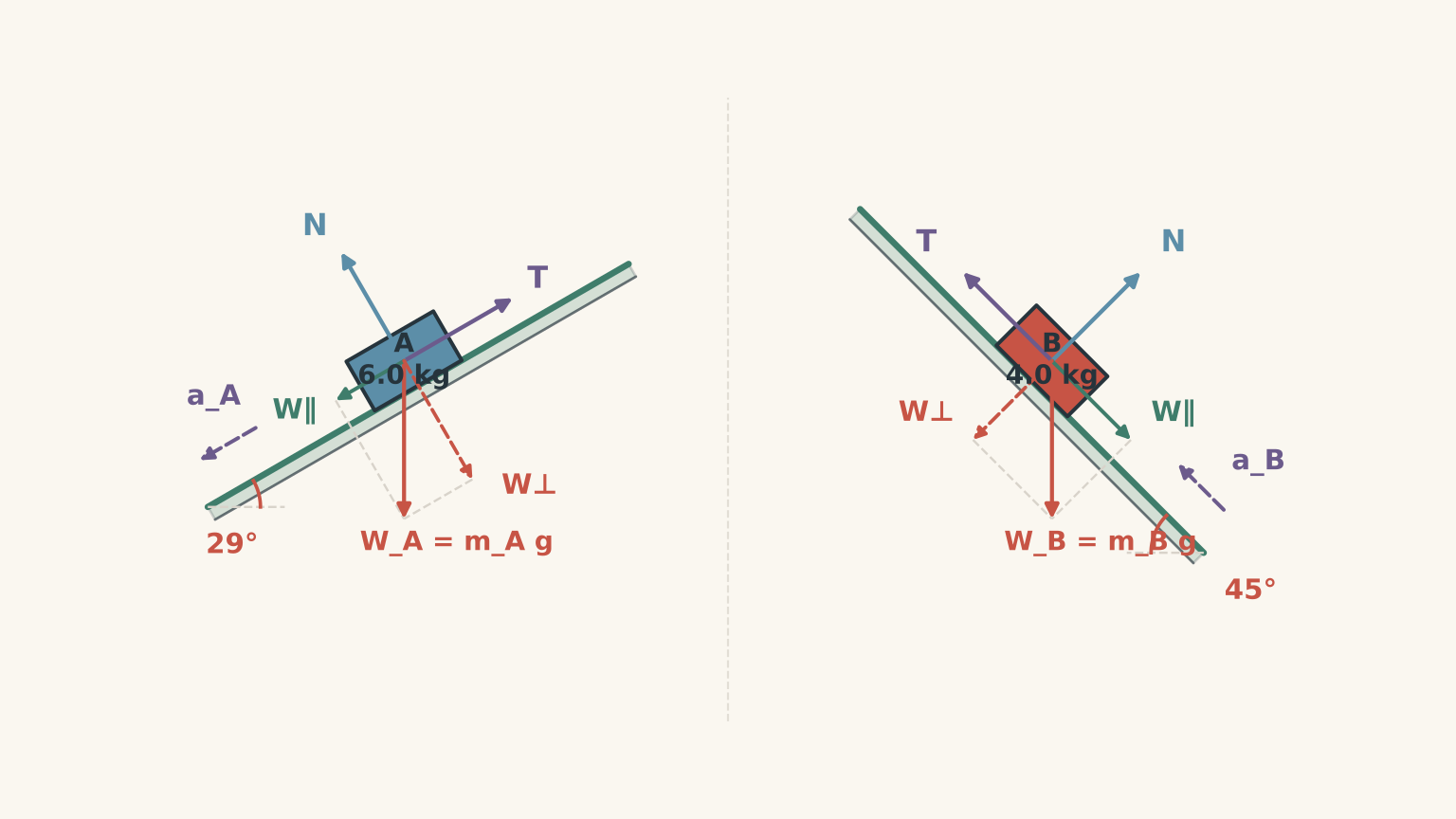
The important forces are the components of gravitational force parallel to each incline.
For block A:
\[ F_{A,\parallel}=m_Ag\sin30^\circ \]
\[ =6.0(9.8)(0.500) \]
\[ =29.4\text{ N} \]
For block B:
\[ F_{B,\parallel}=m_Bg\sin45^\circ \]
\[ =4.0(9.8)(0.707) \]
\[ =27.7\text{ N} \]
Block A has the larger gravitational component along its incline.
Therefore:
\[ \boxed{\text{A moves down its incline, and B moves up its incline.}} \]
(b) Calculate acceleration (3 marks)
Take A’s downward direction as positive.
The net driving force on the connected system is:
\[ F_{\text{net}}= m_Ag\sin30^\circ-m_Bg\sin45^\circ \]
Using the values calculated above:
\[ F_{\text{net}}=29.4-27.72 \]
\[ =1.68\text{ N} \]
The total mass of the system is:
\[ m_{\text{total}}=6.0+4.0=10.0\text{ kg} \]
Apply Newton’s second law:
\[ F_{\text{net}}=m_{\text{total}}a \]
\[ a=\frac{1.68}{10.0} \]
\[ \boxed{a=0.168\text{ m s}^{-2}} \]
(c) Calculate tension (2 marks)
Consider block A, which accelerates down its incline.
The component of its weight acts down the incline, while tension acts up the incline.
Taking downwards as positive:
\[ m_Ag\sin30^\circ-T=m_Aa \]
Rearrange:
\[ T=m_Ag\sin30^\circ-m_Aa \]
Substitute:
\[ T=29.4-6.0(0.168) \]
\[ \boxed{T=28.4\text{ N}} \]
Marking guide
| Part | Demonstrated working | Marks |
|---|---|---|
| (a) | Calculates the gravitational components along both inclines | 1 |
| (a) | Correctly identifies the direction of motion | 1 |
| (b) | Establishes the correct net driving force | 1 |
| (b) | Applies Newton’s second law to the total mass | 1 |
| (b) | Calculates acceleration with units | 1 |
| (c) | Applies Newton’s second law to either block | 1 |
| (c) | Calculates tension with units | 1 |
| Total | 7 |
Solution 5
(a) Calculate tension (2 marks)
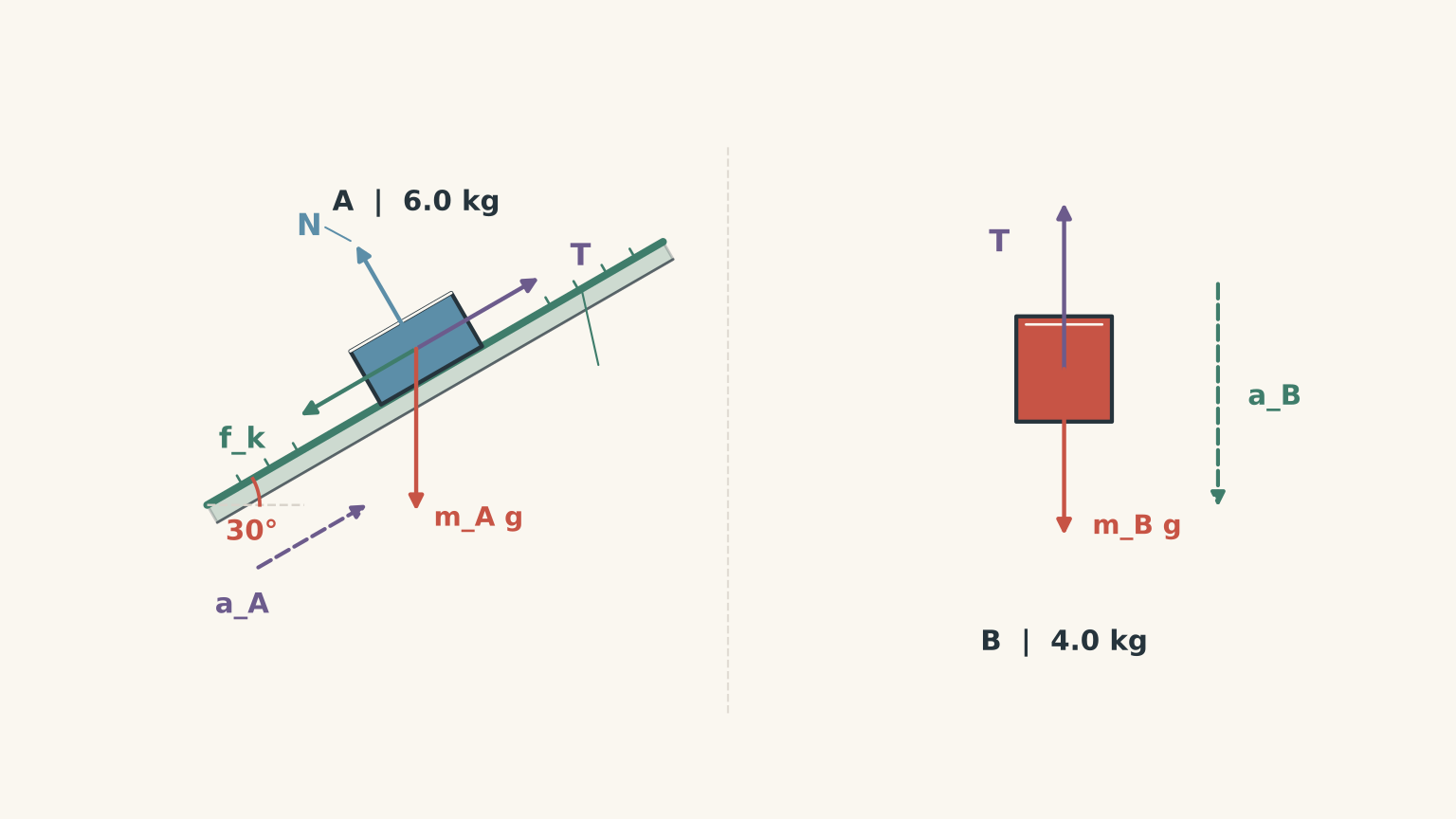
Start with block B.
It accelerates downwards at:
\[ a=0.60\text{ m s}^{-2} \]
Apply Newton’s second law, taking downwards as positive:
\[ m_Bg-T=m_Ba \]
Rearrange:
\[ T=m_B(g-a) \]
Substitute:
\[ T=4.0(9.8-0.60) \]
\[ \boxed{T=36.8\text{ N}} \]
(b) Calculate the coefficient of kinetic friction (3 marks)
Now consider block A.
It accelerates up the incline, so tension acts up the incline.
Both the gravitational component and kinetic friction act down the incline.
Newton’s second law gives:
\[ T-m_Ag\sin30^\circ-f_k=m_Aa \]
Rearrange to find the kinetic friction:
\[ f_k=T-m_Ag\sin30^\circ-m_Aa \]
Substitute:
\[ f_k=36.8-6.0(9.8)(0.500)-6.0(0.60) \]
\[ f_k=36.8-29.4-3.60 \]
\[ f_k=3.80\text{ N} \]
Next, calculate the normal reaction:
\[ N=m_Ag\cos30^\circ \]
\[ N=6.0(9.8)(0.866) \]
\[ N=50.9\text{ N} \]
Recall that:
\[ f_k=\mu_kN \]
Therefore:
\[ \mu_k=\frac{f_k}{N} \]
\[ \mu_k=\frac{3.80}{50.9} \]
\[ \boxed{\mu_k=0.0746} \]
The coefficient of kinetic friction is dimensionless.
(c) Direction and type of friction (2 marks)
Block A is sliding up the incline.
Kinetic friction always acts opposite to the relative sliding motion between the contacting surfaces.
Therefore, friction acts down the incline.
Kinetic friction is used because the blocks are already sliding relative to the surfaces. Static friction applies when there is no relative sliding.
Answer: Kinetic friction acts down the incline, with magnitude \(3.80\text{ N}\).
Marking guide
| Part | Demonstrated working | Marks |
|---|---|---|
| (a) | Correctly applies Newton’s second law to block B | 1 |
| (a) | Calculates tension with units | 1 |
| (b) | Correctly applies Newton’s second law to block A | 1 |
| (b) | Calculates kinetic friction and normal reaction | 1 |
| (b) | Calculates the coefficient of kinetic friction | 1 |
| (c) | Identifies the direction of kinetic friction | 1 |
| (c) | Explains why kinetic friction applies | 1 |
| Total | 7 |
Solution 6
(a) Minimum hanging mass (5 marks)
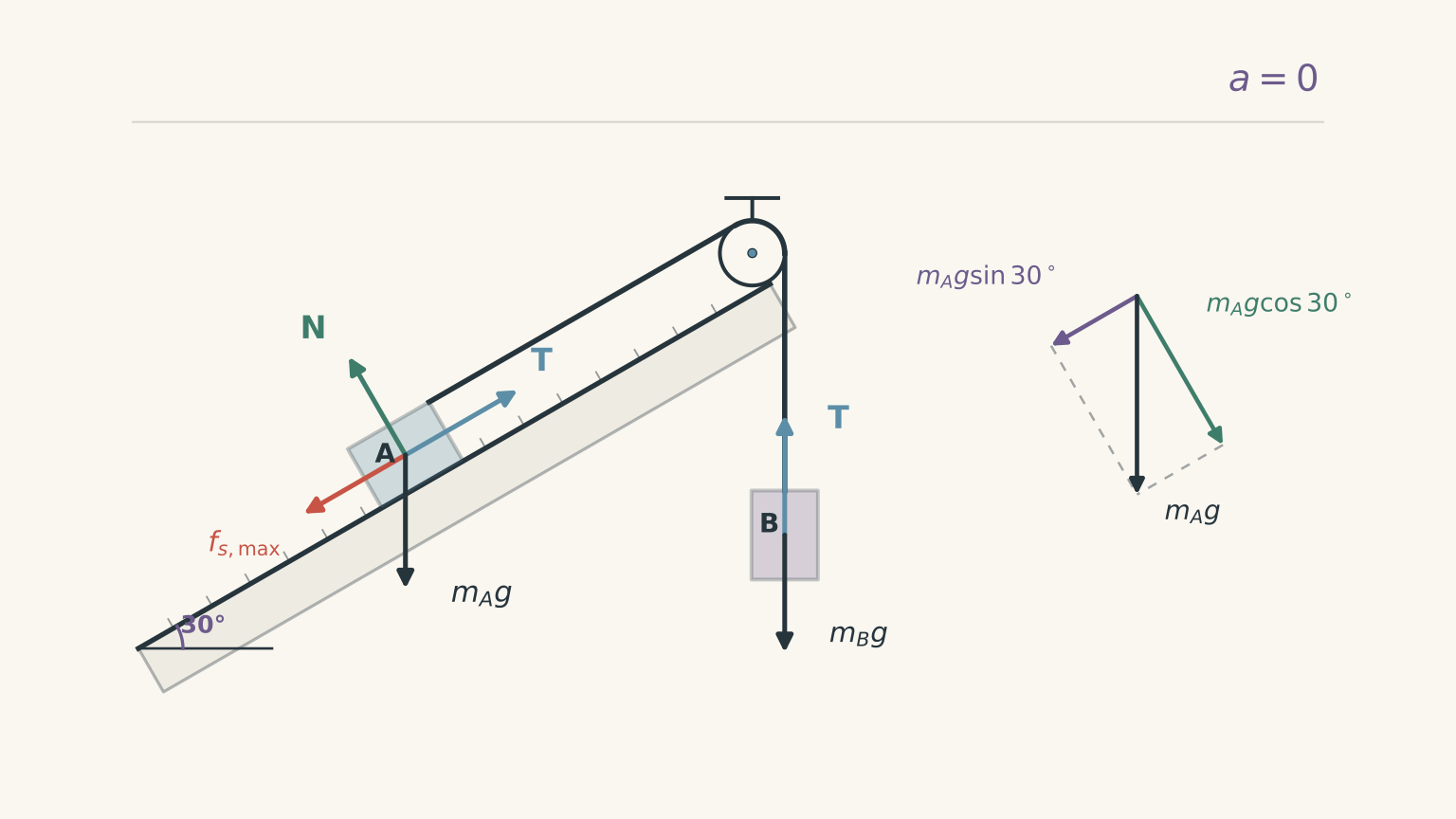
This question involves a system at the threshold of motion.
That means the blocks are still momentarily stationary, but block A is just about to move up the incline.
At this point, static friction acts down the incline and has reached its maximum value.
First, calculate the normal reaction on block A:
\[ N=m_Ag\cos30^\circ \]
\[ N=6.0(9.8)(0.866) \]
\[ N=50.9\text{ N} \]
The maximum static friction is:
\[ f_{s,\max}=\mu_sN \]
\[ f_{s,\max}=0.25(50.9) \]
\[ f_{s,\max}=12.7\text{ N} \]
Now apply Newton’s second law along the incline for block A.
At the threshold of motion, acceleration is zero.
Taking up the incline as positive:
\[ T-m_Ag\sin30^\circ-f_{s,\max}=0 \]
Rearrange:
\[ T=m_Ag\sin30^\circ+f_{s,\max} \]
Substitute:
\[ T=6.0(9.8)(0.500)+12.7 \]
\[ T=42.1\text{ N} \]
Now consider hanging block B.
It is also stationary at the threshold, so:
\[ m_Bg-T=0 \]
Therefore:
\[ m_Bg=T \]
Substitute the tension:
\[ m_B(9.8)=42.1 \]
\[ m_B=\frac{42.1}{9.8} \]
\[ \boxed{m_B=4.30\text{ kg}} \]
The minimum hanging mass required to pull block A up the incline is approximately \(4.30\text{ kg}\).
An alternative way to obtain the result is to combine the equations directly:
\[ m_Bg=m_Ag\sin30^\circ+\mu_sm_Ag\cos30^\circ \]
Cancel \(g\):
\[ m_B=m_A(\sin30^\circ+\mu_s\cos30^\circ) \]
\[ m_B=6.0(0.500+0.25(0.866)) \]
\[ \boxed{m_B=4.30\text{ kg}} \]
(b) Determine whether the system moves (3 marks)
Now the hanging mass is:
\[ m_B=4.00\text{ kg} \]
First, assume the system is stationary.
For hanging block B:
\[ T=m_Bg \]
\[ T=4.00(9.8) \]
\[ T=39.2\text{ N} \]
The component of block A’s weight down the incline is:
\[ m_Ag\sin30^\circ=29.4\text{ N} \]
The difference between tension and this gravitational component is:
\[ 39.2-29.4=9.80\text{ N} \]
Therefore, block A would tend to move up the incline, and static friction must act down the incline with a magnitude of \(9.80\text{ N}\) to keep it stationary.
Now compare this with the maximum available static friction:
\[ f_{s,\max}=12.7\text{ N} \]
Since:
\[ 9.80<12.7 \]
static friction is sufficient to prevent motion.
Therefore:
\[ \boxed{\text{The system remains at rest.}} \]
Marking guide
| Part | Demonstrated working | Marks |
|---|---|---|
| (a) | Identifies the direction of limiting static friction | 1 |
| (a) | Calculates the normal reaction and maximum static friction | 1 |
| (a) | Applies Newton’s second law to block A at the threshold | 1 |
| (a) | Applies equilibrium to block B and relates tension to its weight | 1 |
| (a) | Calculates the minimum hanging mass with units | 1 |
| (b) | Calculates the tension for the stationary hanging block | 1 |
| (b) | Calculates the required static friction and its direction | 1 |
| (b) | Compares required and maximum friction and concludes that the system remains stationary | 1 |
| Total | 8 |
End of practice paper
Total available: 40 marks