
Carbon-13 NMR Practice Exam: Questions and Worked Solutions
Test your carbon-13 NMR skills with this original 26-mark Chemistry practice exam for Year 11 and 12 students. Includes timed assessment conditions, structure identification questions, and fully worked solutions with a detailed marking guide.
This original tutorgum practice paper tests carbon-13 NMR spectroscopy, with a focus on identifying distinct carbon environments, interpreting chemical shifts, and using molecular symmetry to work out how many signals a compound should produce. It covers the supplied carbon-13 NMR scope compatible with the Chemistry 2017 and 2025 syllabus editions. All questions and solutions are original.
01Exam instructions
Assessment conditions
| Condition | Details |
|---|---|
| Suggested reading time | 5 minutes |
| Suggested working time | 50 minutes |
| Total time | 55 minutes |
| Total marks | 26 |
| Permitted equipment | Pen, pencil, and scientific calculator |
| Notes | No external notes or reference material |
These are suggested conditions for this tutorgum practice paper, not official NESA examination conditions.
Assessed content
You will be assessed on:
- Identifying the number of distinct carbon environments in a simple organic compound.
- Interpreting carbon-13 chemical shifts to identify carbon environments.
- Using chemical shifts and molecular formulae to constrain possible structures.
- Recognising symmetry and explaining why equivalent carbon atoms produce one signal.
The paper does not assess proton NMR, DEPT spectroscopy, signal splitting, integration, or other spectroscopy techniques.
Important assumptions
For every question, assume:
- All spectra are proton-decoupled carbon-13 NMR spectra.
- Each chemically distinct carbon environment produces one signal.
- Chemically equivalent carbon atoms produce the same signal.
- There is no accidental overlap between signals from different carbon environments.
- Chemical shifts are approximate and reported in parts per million (ppm).
Chemical shift reference table
Use the following approximate chemical shift ranges throughout the paper.
| Carbon environment | Approximate chemical shift |
|---|---|
| Saturated alkyl carbon (C-C or C-H) | 0-50 ppm |
| Carbon bonded directly to oxygen (C-O) | 50-90 ppm |
| Alkene or aromatic carbon | 100-160 ppm |
| Ester or carboxylic acid carbonyl | 160-185 ppm |
| Aldehyde or ketone carbonyl | 190-220 ppm |
These ranges are guides rather than exact values. Consider the molecular formula, number of signals, and all available chemical shifts together.
02Questions
Question 1 (5 marks)
A compound has the molecular formula \(\ce{C4H10O}\).
Its proton-decoupled carbon-13 NMR spectrum contains three signals at:
\[ \delta = 19,\ 31,\ 68\ \mathrm{ppm} \]
Four possible structures are being considered:
- A. Butan-1-ol: \(\ce{CH3CH2CH2CH2OH}\)
- B. Butan-2-ol: \(\ce{CH3CH(OH)CH2CH3}\)
- C. 2-methylpropan-1-ol: \(\ce{(CH3)2CHCH2OH}\)
- D. 2-methylpropan-2-ol: \(\ce{(CH3)3COH}\)
(a) Identify which candidate is consistent with the three observed signals. (1 mark)
(b) Assign each of the three chemical shifts to the corresponding carbon environment in your chosen structure. (3 marks)
(c) Explain why the selected compound produces three signals despite containing four carbon atoms. (1 mark)
Question 2 (7 marks)
An unknown organic compound has the molecular formula:
\[ \ce{C4H8O2} \]
Its carbon-13 NMR spectrum contains four signals:
| Signal | Chemical shift (ppm) |
|---|---|
| 1 | 14 |
| 2 | 21 |
| 3 | 61 |
| 4 | 171 |
(a) Identify the broad type of carbon environment represented by the signal at 171 ppm. (1 mark)
(b) Propose one condensed structural formula consistent with the molecular formula and all four signals. Explain how the signal at 61 ppm helps support your proposed structure. (2 marks)
(c) Assign each of the four chemical shifts to its corresponding carbon environment in your proposed structure. (4 marks)
Question 3 (7 marks)
Two possible organic compounds have the molecular formula \(\ce{C8H10}\).
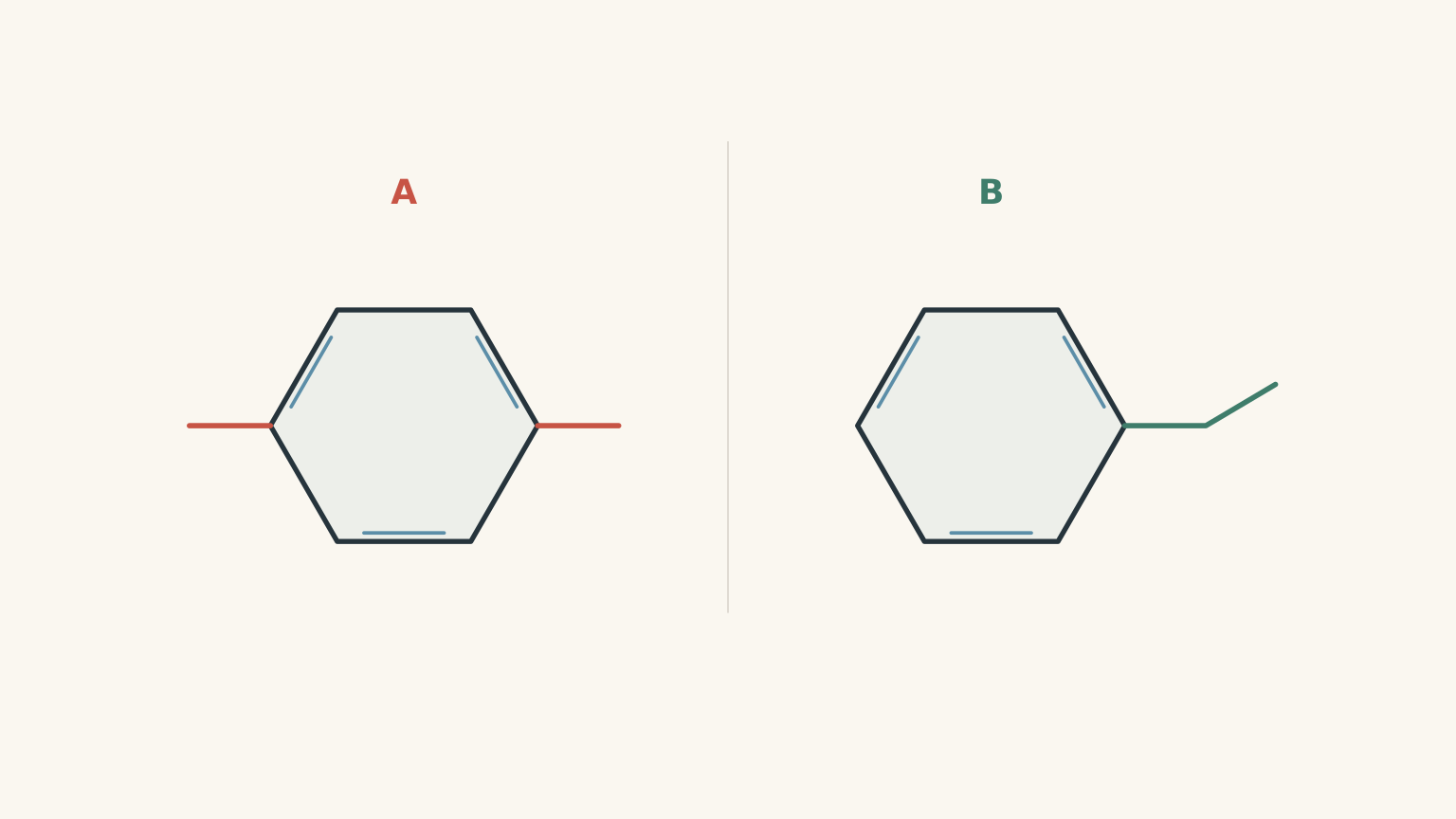
- Candidate A: 1,4-dimethylbenzene (p-xylene).
- Candidate B: Ethylbenzene.
An unknown sample produces four carbon-13 NMR signals at:
\[ \delta = 21,\ 127,\ 129,\ 137\ \mathrm{ppm} \]
(a) Identify which candidate is consistent with the observed spectrum. (1 mark)
(b) Determine the expected number of distinct carbon environments in each candidate. Explain how the symmetry of candidate A affects its number of signals. (3 marks)
(c) Assign the four chemical shifts to the carbon environments in the structure you selected. (3 marks)
Question 4 (7 marks)
An unknown compound has the molecular formula:
\[ \ce{C5H10O} \]
Its carbon-13 NMR spectrum contains four signals:
\[ \delta = 18,\ 30,\ 45,\ 210\ \mathrm{ppm} \]
Four possible structures are being considered:
- A. Pentan-2-one: \(\ce{CH3COCH2CH2CH3}\)
- B. Pentan-3-one: \(\ce{CH3CH2COCH2CH3}\)
- C. 3-methylbutan-2-one: \(\ce{CH3COCH(CH3)2}\)
- D. 2,2-dimethylpropanal: \(\ce{(CH3)3CCHO}\)
(a) Identify the broad type of carbon environment represented by the signal at 210 ppm. (1 mark)
(b) Select the candidate that is consistent with the molecular formula and observed number of signals. (1 mark)
(c) Assign all four chemical shifts to their corresponding carbon environments in your selected structure. (4 marks)
(d) Explain why one of the signals represents two carbon atoms rather than one. (1 mark)
03Worked solutions and marking guide
Solution 1
(a) Correct answer: Candidate C, 2-methylpropan-1-ol.
The compound has four carbon atoms but produces only three signals.
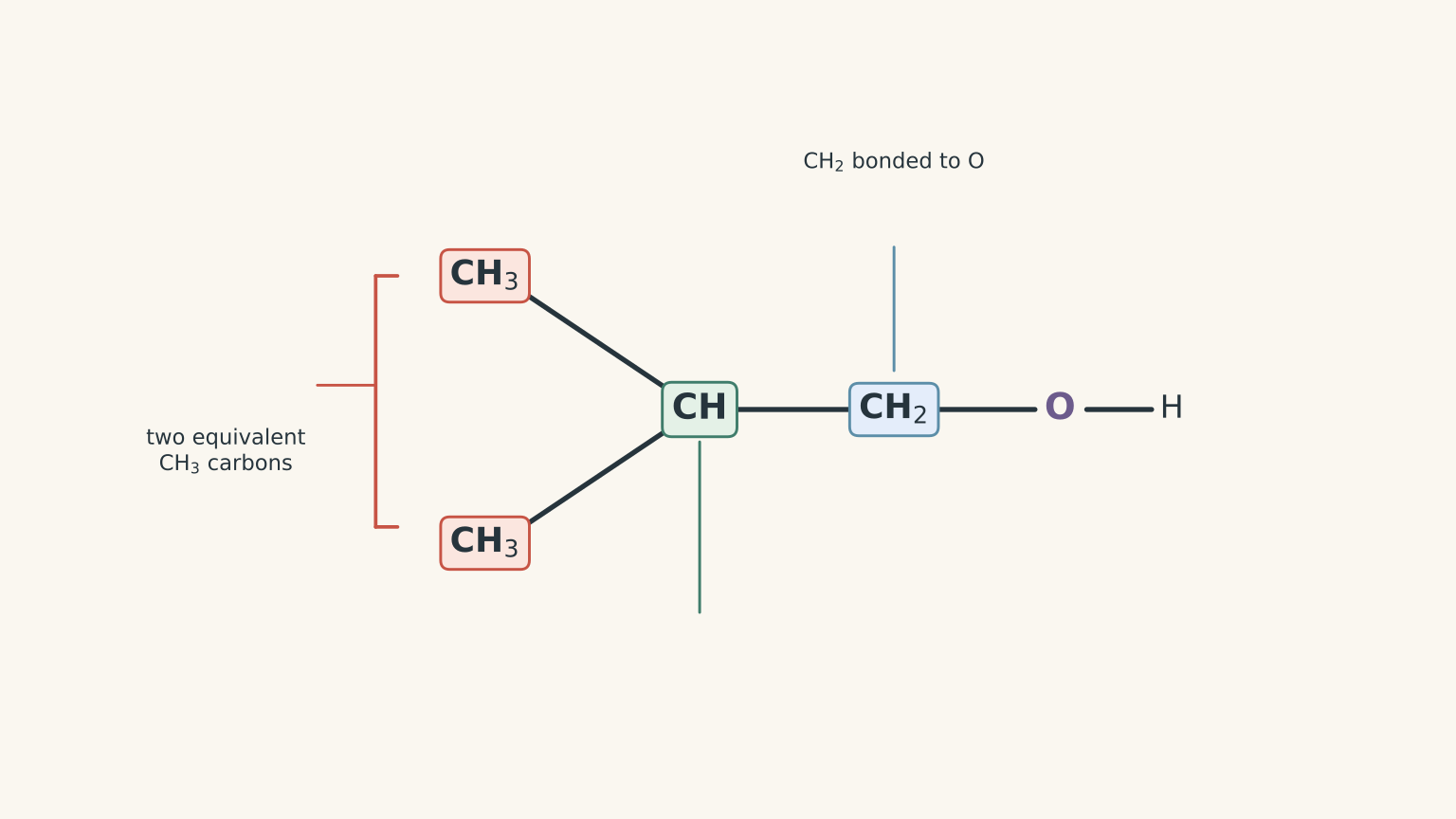
Candidate C contains two equivalent methyl groups. These two carbon atoms have the same chemical environment, so they produce one signal rather than two.
The other candidates do not give the required three distinct carbon environments.
(b) Assigning the chemical shifts
The structure is:
\[ \ce{(CH3)2CHCH2OH} \]
The three signals correspond to:
| Chemical shift | Carbon environment | Reason |
|---|---|---|
| 19 ppm | Two equivalent \(\ce{CH3}\) carbons | Saturated alkyl carbons |
| 31 ppm | Central \(\ce{CH}\) carbon | Saturated carbon bonded to other carbons |
| 68 ppm | \(\ce{CH2OH}\) carbon | Directly bonded to oxygen |
The signal at 68 ppm is particularly useful. A carbon bonded directly to oxygen is shifted further downfield than a typical saturated alkyl carbon.
The central carbon appears around 31 ppm, while the two equivalent methyl carbons appear around 19 ppm.
(c) Why are there only three signals?
The two methyl groups are attached to the same central carbon and have identical chemical environments.
They are chemically equivalent and therefore produce one carbon-13 NMR signal.
The four carbon atoms can therefore be grouped into three distinct environments.
Marking guide – 5 marks
| Requirement | Marks |
|---|---|
| (a) Correctly identifies candidate C | 1 |
| (b) Assigns 19 ppm to the equivalent methyl carbons | 1 |
| (b) Assigns 31 ppm to the central CH carbon | 1 |
| (b) Assigns 68 ppm to the CH2OH carbon | 1 |
| (c) Explains that the two methyl carbons are chemically equivalent | 1 |
| Total | 5 |
Solution 2
(a) Identifying the 171 ppm signal
The signal at 171 ppm represents a carbonyl carbon in a carboxylic acid or ester environment.
Both types of carbonyl can occur within the supplied 160-185 ppm range.
Award 1 mark for identifying the carbonyl environment.
(b) Proposing a structure
A suitable structure is ethyl ethanoate:
\[ \ce{CH3COOCH2CH3} \]
The molecular formula is \(\ce{C4H8O2}\), which matches the information provided.
The signal at 61 ppm is particularly important. It indicates a carbon bonded directly to oxygen.
In the proposed structure, the \(\ce{CH2}\) group is directly attached to the ester oxygen. This accounts for the signal around 61 ppm.
The combination of a carbonyl signal around 171 ppm and an oxygen-bonded carbon around 61 ppm supports an ester structure.
(c) Assigning all four signals
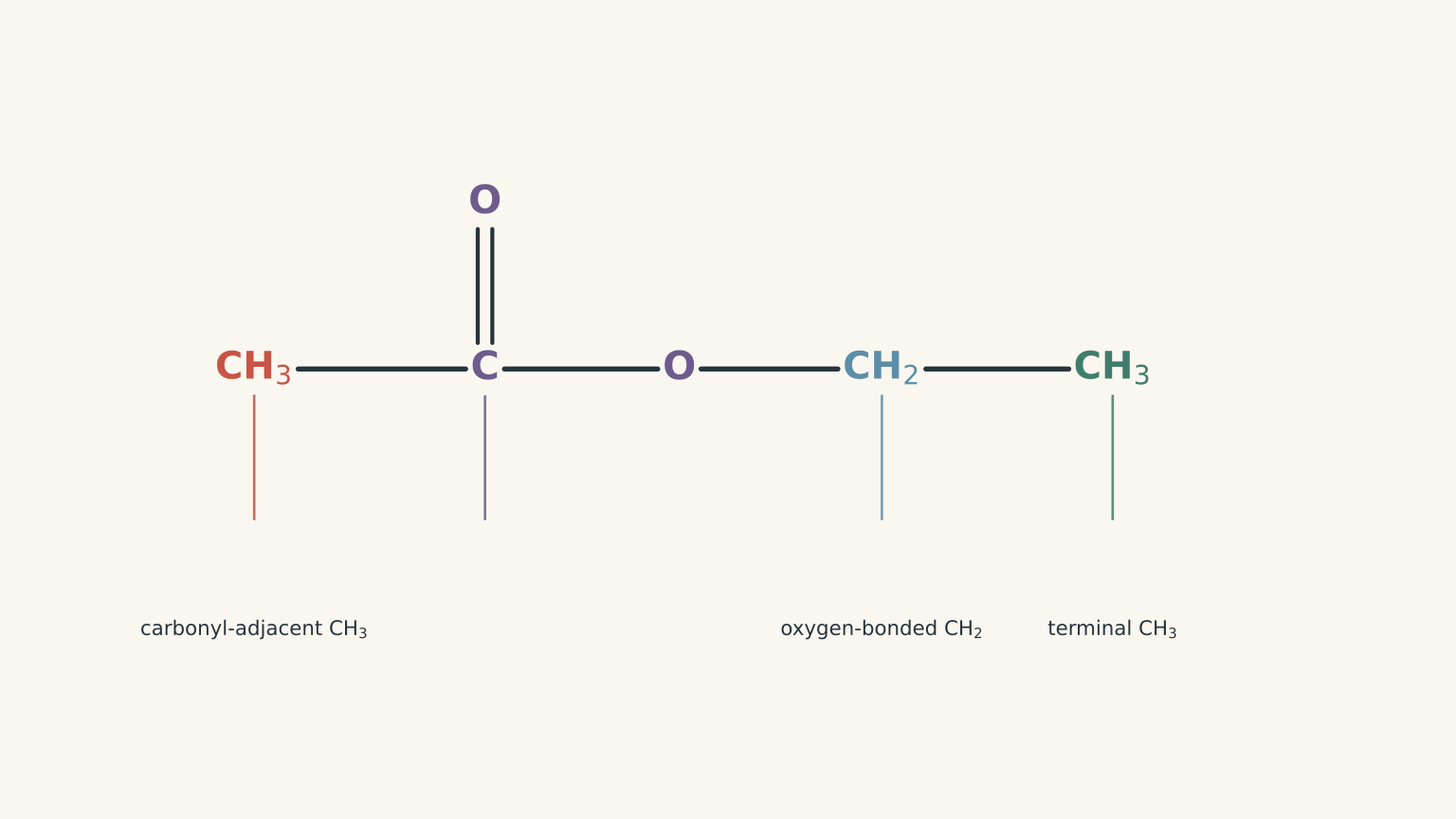
Ethyl ethanoate contains four carbon atoms, each in a different chemical environment.
Its carbon environments are:
| Chemical shift | Carbon | Explanation |
|---|---|---|
| 14 ppm | Terminal \(\ce{CH3}\) | Saturated methyl at the end of the ethyl group |
| 21 ppm | \(\ce{CH3CO}\) | Methyl carbon adjacent to the carbonyl |
| 61 ppm | \(\ce{OCH2}\) | Carbon directly bonded to oxygen |
| 171 ppm | \(\ce{C=O}\) | Ester carbonyl carbon |
Notice that both methyl carbons are in different environments.
One is attached to the carbonyl carbon, while the other is attached to a carbon bonded to oxygen. They therefore produce separate signals.
Marking guide – 7 marks
| Requirement | Marks |
|---|---|
| (a) Identifies the 171 ppm signal as a carbonyl carbon | 1 |
| (b) Proposes ethyl ethanoate or an equivalent valid structure | 1 |
| (b) Explains the 61 ppm signal using the oxygen-bonded carbon | 1 |
| (c) Assigns 14 ppm to the terminal methyl | 1 |
| (c) Assigns 21 ppm to the carbonyl-adjacent methyl | 1 |
| (c) Assigns 61 ppm to the oxygen-bonded CH2 | 1 |
| (c) Assigns 171 ppm to the ester carbonyl | 1 |
| Total | 7 |
A chemically valid alternative structure may be accepted if it accounts for the molecular formula and all four signals. Follow-through marks should be awarded for assignments that are internally consistent with an accepted alternative.
Solution 3
(a) Correct answer: Candidate A, 1,4-dimethylbenzene (p-xylene).
The observed spectrum contains four signals.
Candidate A has four distinct carbon environments, while candidate B has six.
The signal count therefore supports candidate A.
(b) Counting the carbon environments
Start with candidate A: p-xylene.
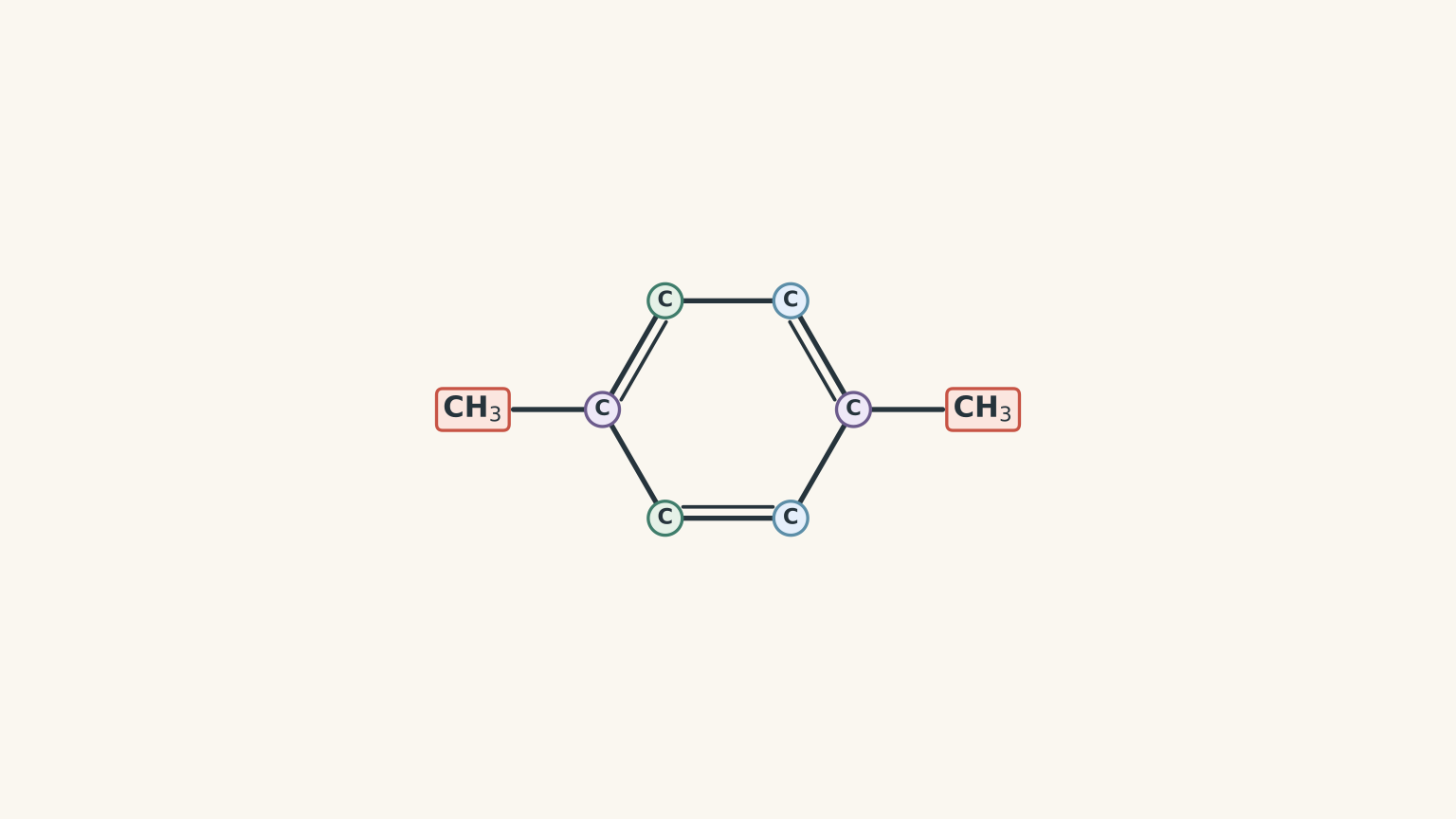
It contains eight carbon atoms in total:
- Two methyl carbon atoms.
- Six aromatic carbon atoms in the benzene ring.
Because the molecule is symmetrical, several carbon atoms are chemically equivalent.
The carbon atoms form four groups:
| Carbon group | Number of carbon atoms | Distinct environments |
|---|---|---|
| Two methyl carbons | 2 | 1 |
| Two ring carbons attached to methyl groups | 2 | 1 |
| Two ring carbons adjacent to the methyl-substituted positions | 2 | 1 |
| Remaining two ring carbons | 2 | 1 |
| Total | 8 | 4 |
Therefore, p-xylene produces four carbon-13 NMR signals.
Now consider candidate B: ethylbenzene.
Ethylbenzene has six distinct carbon environments:
- The aromatic carbon attached directly to the ethyl group.
- The two equivalent ortho aromatic carbons.
- The two equivalent meta aromatic carbons.
- The para aromatic carbon.
- The \(\ce{CH2}\) carbon in the ethyl group.
- The terminal \(\ce{CH3}\) carbon.
This gives six signals.
Since the unknown spectrum contains only four signals, p-xylene is the consistent candidate.
(c) Assigning the chemical shifts
The four signals correspond to:
| Chemical shift | Carbon environment |
|---|---|
| 21 ppm | Two equivalent methyl carbons |
| 127 ppm | Two equivalent aromatic carbons in the meta positions |
| 129 ppm | Two equivalent aromatic carbons in the ortho positions |
| 137 ppm | Two equivalent aromatic carbons directly attached to the methyl groups |
The 21 ppm signal is characteristic of the methyl carbons attached to the aromatic ring.
The remaining three signals represent the three distinct aromatic carbon environments.
Marking guide – 7 marks
| Requirement | Marks |
|---|---|
| (a) Selects candidate A | 1 |
| (b) Identifies four environments for p-xylene | 1 |
| (b) Identifies six environments for ethylbenzene | 1 |
| (b) Explains the equivalent carbon groups in symmetrical p-xylene | 1 |
| (c) Assigns 21 ppm to the equivalent methyl carbons | 1 |
| (c) Assigns 137 ppm to the ipso aromatic carbons | 1 |
| (c) Correctly assigns 129 ppm to the ortho pair and 127 ppm to the meta pair | 1 |
| Total | 7 |
Solution 4
(a) Identifying the 210 ppm signal
The signal at 210 ppm represents a carbonyl carbon.
This falls within the approximate chemical shift range for aldehyde and ketone carbonyl groups.
The chemical shift alone does not distinguish between these two functional groups. We need to consider the other signals and the molecular structure.
(b) Selecting the correct candidate
The correct answer is:
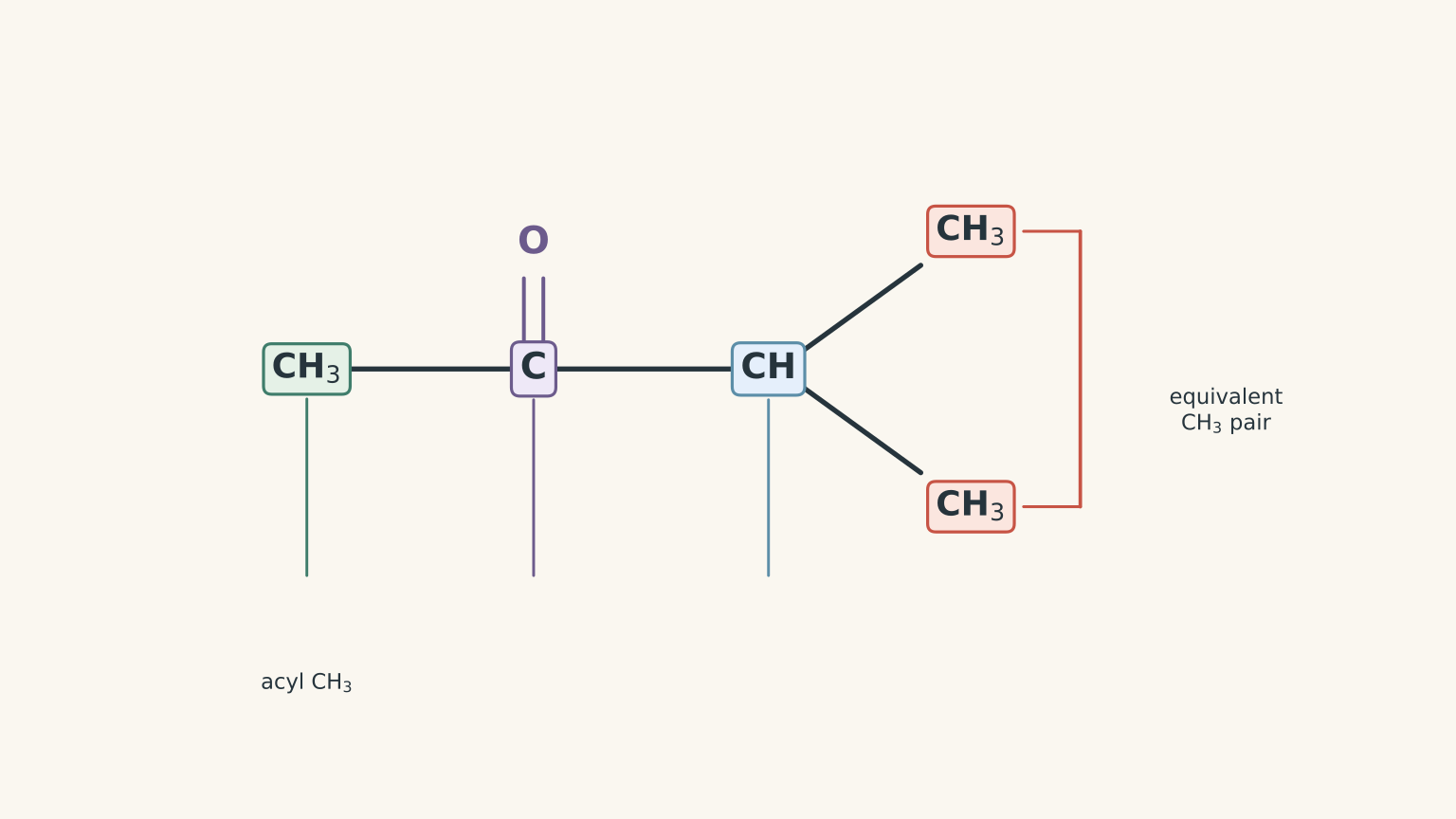
Candidate C: 3-methylbutan-2-one.
Its structure is:
\[ \ce{CH3COCH(CH3)2} \]
It has five carbon atoms but produces four distinct carbon environments.
The two methyl groups attached to the central \(\ce{CH}\) carbon are equivalent, accounting for the difference between the total number of carbon atoms and the number of signals.
The other candidates do not produce the observed four-signal pattern:
- Pentan-2-one has five distinct carbon environments.
- Pentan-3-one has three distinct carbon environments because of its symmetry.
- 2,2-dimethylpropanal has three distinct carbon environments because its three methyl groups are equivalent.
(c) Assigning the four signals
For 3-methylbutan-2-one:
\[ \ce{CH3COCH(CH3)2} \]
The signals can be assigned as follows:
| Chemical shift | Carbon environment | Explanation |
|---|---|---|
| 18 ppm | Two equivalent \(\ce{CH3}\) carbons | Both are attached to the central CH carbon |
| 30 ppm | \(\ce{CH3CO}\) carbon | Methyl group adjacent to the carbonyl |
| 45 ppm | Central \(\ce{CH}\) carbon | Saturated carbon adjacent to the carbonyl |
| 210 ppm | \(\ce{C=O}\) carbon | Ketone carbonyl |
The signal at 210 ppm is particularly useful because it identifies the presence of a carbonyl group.
The 30 ppm signal belongs to the methyl group directly attached to that carbonyl.
The 45 ppm signal belongs to the neighbouring methine carbon, while the 18 ppm signal represents the two equivalent methyl groups attached to that methine carbon.
(d) Explaining the four signals
The two methyl groups attached to the central methine carbon have identical chemical environments.
They are chemically equivalent, so they produce one carbon-13 NMR signal.
Consequently, five carbon atoms produce only four distinct signals.
Marking guide – 7 marks
| Requirement | Marks |
|---|---|
| (a) Identifies the 210 ppm signal as a carbonyl carbon | 1 |
| (b) Selects candidate C | 1 |
| (c) Assigns 18 ppm to the two equivalent methyl carbons | 1 |
| (c) Assigns 30 ppm to the carbonyl-adjacent methyl carbon | 1 |
| (c) Assigns 45 ppm to the central methine carbon | 1 |
| (c) Assigns 210 ppm to the ketone carbonyl carbon | 1 |
| (d) Explains that the two methyl carbons are chemically equivalent and produce one signal | 1 |
| Total | 7 |
04Final mark summary
| Question | Main skill assessed | Marks |
|---|---|---|
| Question 1 | Identifying equivalent carbons and assigning shifts | 5 |
| Question 2 | Using chemical shifts to constrain an ester structure | 7 |
| Question 3 | Applying molecular symmetry to aromatic compounds | 7 |
| Question 4 | Combining carbonyl shifts, molecular formulae, and symmetry | 7 |
| Total | 26 |
05Final revision checklist
Before considering this topic exam-ready, make sure you can:
- [ ] Explain why one carbon-13 NMR signal does not necessarily represent one carbon atom.
- [ ] Count distinct carbon environments in a given molecular structure.
- [ ] Recognise when symmetry makes two or more carbon atoms chemically equivalent.
- [ ] Identify carbon environments using approximate chemical shift ranges.
- [ ] Recognise ester, ketone, and aldehyde carbonyl signals.
- [ ] Use the molecular formula and number of signals together to eliminate possible structures.
- [ ] Assign every observed signal to a specific carbon environment.
- [ ] Explain why a proposed structure is consistent with the complete spectrum, rather than relying on just one chemical shift.
The most important habit is to count the carbon environments before interpreting the individual shifts. Once you know how many signals to expect, the chemical shifts become much more useful for narrowing down the structure.