
Ester Structures and Physical Properties: 30-Mark Practice Exam
Test your understanding of ester nomenclature, functional-group isomers, boiling points, and water solubility with this original 30-mark Chemistry practice paper. Includes timed exam conditions, fully worked solutions, and a detailed marking guide.
This original tutorgum practice paper assesses ester structures and physical properties within the Chemistry 2025 syllabus scope. It covers ester nomenclature, identifying the acid- and alcohol-derived parts of an ester, functional-group isomerism, and physical-property comparisons involving boiling point and water solubility.
The paper contains 30 marks across five questions. It is an original revision resource, not an official, endorsed, past, or predicted NESA examination paper.
01Exam instructions
Suggested working time: 45 minutes
Suggested reading time: 5 minutes
Total marks: 30
Permitted equipment:
- Pen or pencil.
- Non-programmable calculator.
- Periodic table.
Instructions:
- Answer all five questions.
- Show your working and explain your reasoning where requested.
- Give chemical names using accepted systematic nomenclature.
- When drawing or writing structural formulas, make the connectivity between atoms clear.
- Use the numerical data supplied in the questions. Unless stated otherwise, assume all boiling-point measurements are taken at 1 atm.
- Assume all compounds are pure, straight-chain, saturated, acyclic organic compounds.
Assessed topics:
- Naming esters and identifying their acid- and alcohol-derived components.
- Functional-group isomerism between esters and carboxylic acids.
- Intermolecular forces and boiling-point comparisons.
- Ester interactions with water and the effect of carbon-chain length on solubility.
- Boiling-point trends within a homologous series of esters.
Exclusions: Ester preparation, reaction mechanisms, ester reactions, and organic structures outside the specified scope are not assessed.
02Questions
Question 1 (6 marks)
Consider the following three ester structures.
(a) Give the systematic name of each ester.
(i) \(\ce{CH3CH2COOCH3}\) (1 mark)
(ii) \(\ce{CH3COOCH2CH3}\) (1 mark)
(iii) \(\ce{HCOOCH2CH2CH3}\) (1 mark)
(b) Consider the ester in part (a)(ii).
Identify:
(i) The alcohol from which the ester is derived. (1 mark)
(ii) The carboxylic acid from which the ester is derived. (1 mark)
(iii) Which part of the ester name corresponds to the alcohol, and which part corresponds to the carboxylic acid. (1 mark)
Question 2 (6 marks)
Methyl propanoate has the following condensed structural formula:
\[ \ce{CH3CH2COOCH3} \]
(a) Determine the molecular formula of methyl propanoate. Show how you obtained your answer. (2 marks)
(b) Write the condensed structural formula of a straight-chain, saturated monocarboxylic acid that is a functional-group isomer of methyl propanoate. (2 marks)
(c) Explain why methyl propanoate and the compound identified in part (b) are functional-group isomers rather than chain isomers. (2 marks)
Question 3 (6 marks)
A student investigates the boiling points of methyl propanoate and butanoic acid.
The following data are provided.
| Property | Methyl propanoate | Butanoic acid |
|---|---|---|
| Molecular formula | \(\ce{C4H8O2}\) | \(\ce{C4H8O2}\) |
| Molar mass | 88.1 g mol\(^{-1}\) | 88.1 g mol\(^{-1}\) |
| Boiling point | 80°C | 164°C |
The condensed structural formulas are:
- Methyl propanoate: \(\ce{CH3CH2COOCH3}\)
- Butanoic acid: \(\ce{CH3CH2CH2COOH}\)
(a) Identify which compound has the higher boiling point. (1 mark)
(b) Identify the intermolecular attractions present between molecules of each pure substance. (2 marks)
(c) Explain why butanoic acid has a significantly higher boiling point than methyl propanoate, despite both compounds having the same molecular formula and molar mass. Refer to their structures and intermolecular forces. (3 marks)
Question 4 (6 marks)
Two esters are compared to investigate their solubility in water at 25°C.
| Ester | Condensed structural formula |
|---|---|
| Methyl ethanoate | \(\ce{CH3COOCH3}\) |
| Ethyl ethanoate | \(\ce{CH3COOCH2CH3}\) |
(a) Predict which ester would be more soluble in water. (1 mark)
(b) Explain how the ester functional group allows these compounds to interact with water molecules. Refer to the intermolecular forces involved. (2 marks)
(c) Explain why increasing the length of the alkyl chain decreases the relative water solubility of an ester. (3 marks)
Question 5 (6 marks)
A homologous series of esters is investigated. The compounds all contain the ethanoate functional group, but their alkyl chains increase in length.
The following experimental data are obtained.
| Ester | Molecular formula | Boiling point |
|---|---|---|
| Methyl ethanoate | \(\ce{C3H6O2}\) | 57°C |
| Ethyl ethanoate | \(\ce{C4H8O2}\) | 77°C |
| Propyl ethanoate | \(\ce{C5H10O2}\) | 102°C |
All measurements were taken at 1 atm.
(a) Describe the relationship between molecular size and boiling point across this series. (1 mark)
(b) Explain this trend in terms of intermolecular forces. (3 marks)
(c) A student claims:
“As the alkyl chain gets longer, the ester functional group becomes more polar. This is why the boiling point increases.”
Evaluate this explanation. (2 marks)
03Worked solutions and marking guide
Solution 1
(a) Systematic names
(i) \(\ce{CH3CH2COOCH3}\)
Answer: methyl propanoate.
- The alcohol-derived alkyl group contains one carbon, so it is methyl.
- The acid-derived component contains three carbons, so it is propanoate.
(ii) \(\ce{CH3COOCH2CH3}\)
Answer: ethyl ethanoate.
- The alcohol-derived alkyl group contains two carbons, so it is ethyl.
- The acid-derived component contains two carbons, so it is ethanoate.
(iii) \(\ce{HCOOCH2CH2CH3}\)
Answer: propyl methanoate.
- The alcohol-derived alkyl group contains three carbons, so it is propyl.
- The acid-derived component contains one carbon, so it is methanoate.
The key naming principle is that the alcohol-derived alkyl group is named first, followed by the acid-derived alkanoate group.
Marking breakdown:
| Requirement | Marks |
|---|---|
| Correct name for (i) | 1 |
| Correct name for (ii) | 1 |
| Correct name for (iii) | 1 |
| Subtotal | 3 |
(b) Identifying the parent alcohol and carboxylic acid
The structure is:
\[ \ce{CH3COOCH2CH3} \]
The ester contains two identifiable parts.
- The \(\ce{CH2CH3}\) group is the alcohol-derived part. It comes from ethanol.
- The \(\ce{CH3COO}\) group is the acid-derived part. It comes from ethanoic acid.
Therefore:
(i) Alcohol: ethanol.
(ii) Carboxylic acid: ethanoic acid.
(iii) In the name ethyl ethanoate, ethyl comes from ethanol, while ethanoate comes from ethanoic acid.
Marking breakdown:
| Requirement | Marks |
|---|---|
| Correctly identifies ethanol | 1 |
| Correctly identifies ethanoic acid | 1 |
| Correctly identifies the origin of each part of the ester name | 1 |
| Subtotal | 3 |
Total: 6 marks
Solution 2
(a) Determining the molecular formula
The condensed structural formula is:
\[ \ce{CH3CH2COOCH3} \]
Count each type of atom.
- Carbon: 4 atoms.
- Hydrogen: \(3+2+3=8\) atoms.
- Oxygen: 2 atoms.
Therefore, the molecular formula is:
\[ \boxed{\ce{C4H8O2}} \]
Marking breakdown:
| Requirement | Marks |
|---|---|
| Correctly counts the atoms in the structure | 1 |
| Gives the correct molecular formula | 1 |
| Subtotal | 2 |
(b) Identifying a functional-group isomer
The required compound must be a carboxylic acid with the same molecular formula, \(\ce{C4H8O2}\).
The straight-chain carboxylic acid with this formula is butanoic acid.
Its condensed structural formula is:
\[ \boxed{\ce{CH3CH2CH2COOH}} \]
Count the atoms:
- Carbon: 4.
- Hydrogen: 8.
- Oxygen: 2.
It therefore has the same molecular formula as methyl propanoate.
Marking breakdown:
| Requirement | Marks |
|---|---|
| Correct four-carbon chain | 1 |
| Correct carboxylic acid functional group and connectivity | 1 |
| Subtotal | 2 |
(c) Explaining functional-group isomerism
Methyl propanoate and butanoic acid are functional-group isomers because they have the same molecular formula, \(\ce{C4H8O2}\), but contain different functional groups.
Methyl propanoate contains an ester functional group, whereas butanoic acid contains a carboxylic acid functional group.
This is different from chain isomerism.
Chain isomers have the same molecular formula and the same functional group, but differ in the arrangement of their carbon skeletons.
Marking breakdown:
| Requirement | Marks |
|---|---|
| States that both compounds have the same molecular formula | 1 |
| Identifies the different functional groups as ester and carboxylic acid | 1 |
| Subtotal | 2 |
Total: 6 marks
Solution 3
(a) Identifying the higher boiling point
Butanoic acid has the higher boiling point.
- Methyl propanoate: 80°C.
- Butanoic acid: 164°C.
Answer: Butanoic acid.
Marking breakdown:
| Requirement | Marks |
|---|---|
| Correctly identifies butanoic acid | 1 |
| Subtotal | 1 |
(b) Identifying intermolecular attractions
Methyl propanoate:
- London dispersion forces.
- Dipole-dipole attractions.
Butanoic acid:
- London dispersion forces.
- Dipole-dipole attractions.
- Hydrogen bonding.
Both compounds experience London dispersion forces because all molecules have fluctuating electron distributions.
Both are polar molecules, so they also experience dipole-dipole attractions.
The important difference is hydrogen bonding.
Butanoic acid contains an O-H bond, allowing its molecules to form hydrogen bonds with one another.
Methyl propanoate has oxygen atoms that can accept hydrogen bonds, but it does not contain an O-H bond. Its molecules cannot donate hydrogen bonds to other methyl propanoate molecules.
Marking breakdown:
| Requirement | Marks |
|---|---|
| Identifies dispersion and dipole-dipole attractions in methyl propanoate | 1 |
| Identifies dispersion, dipole-dipole attractions, and hydrogen bonding in butanoic acid | 1 |
| Subtotal | 2 |
(c) Explaining the boiling-point difference
Both compounds have the same molecular formula and molar mass. Therefore, their different boiling points cannot be explained simply by a difference in molecular mass.
The main difference is the strength of their intermolecular attractions.
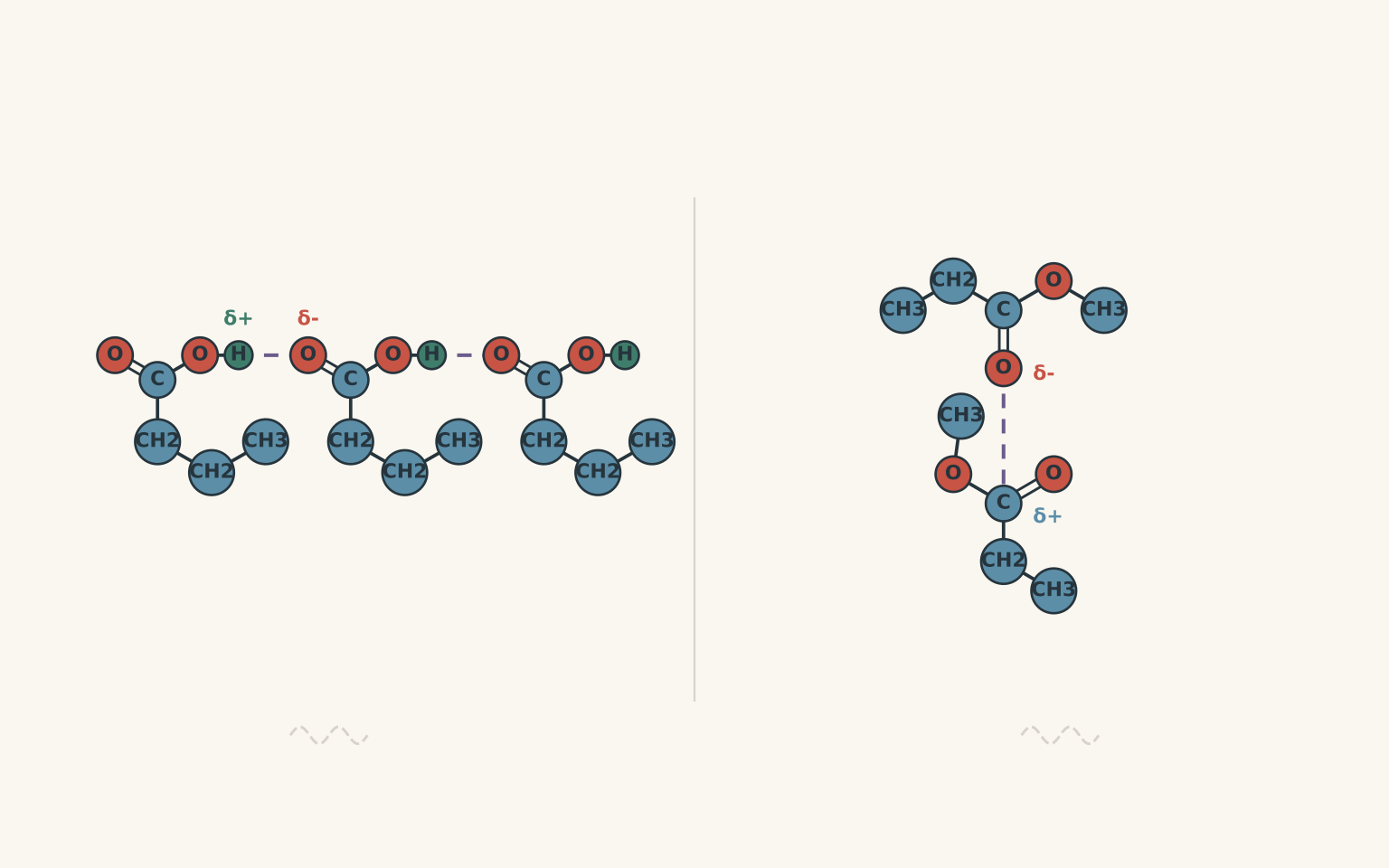
Butanoic acid contains a carboxyl group, \(\ce{-COOH}\). Its O-H bond allows the hydrogen atom to participate in hydrogen bonding with the oxygen atom of another butanoic acid molecule.
Methyl propanoate does not have an O-H bond, so its molecules cannot form hydrogen bonds with one another. Its intermolecular attractions consist mainly of dipole-dipole attractions and London dispersion forces.
Hydrogen bonding is stronger than ordinary dipole-dipole attractions. Consequently, more energy is required to separate butanoic acid molecules sufficiently for boiling to occur.
This explains why butanoic acid has a much higher boiling point.
Marking breakdown:
| Requirement | Marks |
|---|---|
| Recognises that equal molar masses mean molecular mass alone does not explain the difference | 1 |
| Explains hydrogen bonding between the O-H group and another acid molecule’s oxygen atom | 1 |
| Explains that stronger intermolecular attractions require more energy to overcome, increasing boiling point | 1 |
| Subtotal | 3 |
Total: 6 marks
Solution 4
(a) Predicting water solubility
Methyl ethanoate is expected to be more soluble in water than ethyl ethanoate.
Answer: Methyl ethanoate.
Marking breakdown:
| Requirement | Marks |
|---|---|
| Correctly identifies methyl ethanoate | 1 |
| Subtotal | 1 |
(b) Explaining interactions between esters and water
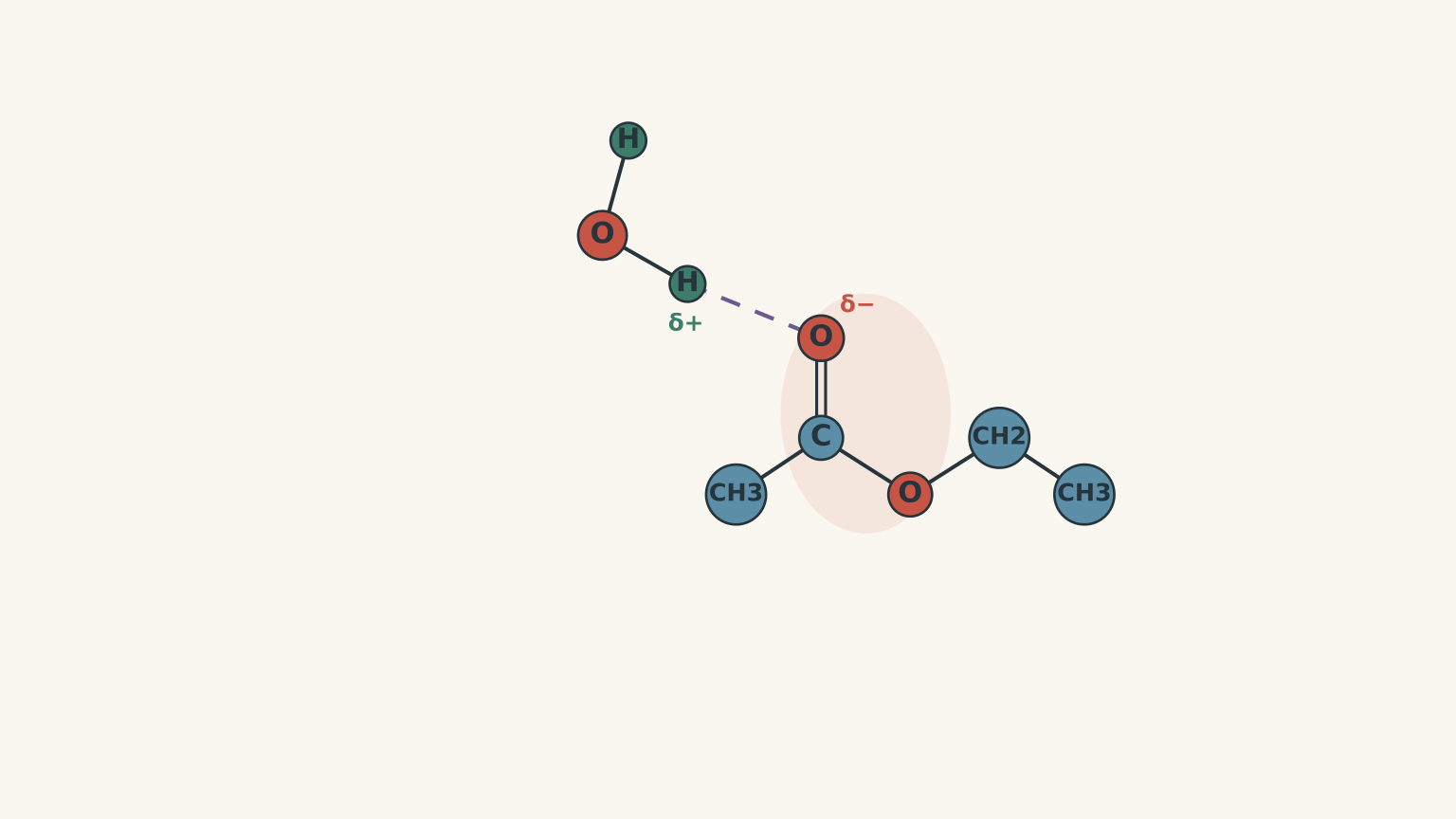
Esters contain a polar functional group with oxygen atoms that have lone pairs of electrons.
These oxygen atoms can act as hydrogen-bond acceptors.
Water molecules can form hydrogen bonds with the oxygen atoms of an ester. This allows ester molecules to interact favourably with water.
For example, a hydrogen atom from a water molecule can form a hydrogen bond with the carbonyl oxygen of an ester.
It is important to distinguish between accepting and donating hydrogen bonds. Esters can accept hydrogen bonds from water, but cannot donate hydrogen bonds to other ester molecules because they do not contain an O-H bond.
Marking breakdown:
| Requirement | Marks |
|---|---|
| Identifies the ester functional group as polar | 1 |
| Explains that water can form hydrogen bonds with ester oxygen atoms | 1 |
| Subtotal | 2 |
(c) Explaining the effect of alkyl chain length
Compare the structures:
Methyl ethanoate:
\[ \ce{CH3COOCH3} \]
Ethyl ethanoate:
\[ \ce{CH3COOCH2CH3} \]
Ethyl ethanoate has an additional \(\ce{CH2}\) group in its alkyl chain.
The ester functional group remains unchanged, so both compounds have a similar ability to interact with water through hydrogen bonding.
However, the longer alkyl chain increases the size of the non-polar hydrocarbon region.
This non-polar region does not interact favourably with polar water molecules. As the hydrocarbon region becomes larger relative to the polar ester group, the overall ability of the molecule to dissolve in water decreases.
Therefore, increasing the alkyl chain length generally decreases the water solubility of an ester.
Marking breakdown:
| Requirement | Marks |
|---|---|
| Identifies the larger non-polar hydrocarbon region in ethyl ethanoate | 1 |
| Recognises that the polar ester functional group remains unchanged | 1 |
| Explains that the increasing non-polar region reduces relative water solubility | 1 |
| Subtotal | 3 |
Total: 6 marks
Solution 5
(a) Describing the trend
As molecular size increases across the series, the boiling point also increases.
The order is:
\[ \text{Methyl ethanoate} < \text{Ethyl ethanoate} < \text{Propyl ethanoate} \]
The boiling points increase from 57°C to 77°C to 102°C.
Marking breakdown:
| Requirement | Marks |
|---|---|
| Correctly identifies the increasing boiling-point trend | 1 |
| Subtotal | 1 |
(b) Explaining the trend using intermolecular forces
The three esters have the same ester functional group, but their alkyl chains increase in length.
As the alkyl chain becomes longer:
- The molecules become larger and contain more electrons.
- Their electron clouds become more polarizable, increasing the strength of London dispersion forces between molecules.
- More energy is therefore required to overcome these intermolecular attractions and separate the molecules during boiling.
Consequently, the boiling point increases as the molecular size increases.
The important point is that boiling involves overcoming intermolecular attractions. The covalent bonds within each ester molecule are not broken during boiling.
Marking breakdown:
| Requirement | Marks |
|---|---|
| Identifies increasing molecular size or electron number | 1 |
| Explains that larger electron clouds are more polarizable, strengthening London dispersion forces | 1 |
| Connects stronger intermolecular attractions to greater energy required for boiling and a higher boiling point | 1 |
| Subtotal | 3 |
(c) Evaluating the student’s explanation
The student’s explanation is incorrect.
The ester functional group remains the same throughout the series. Increasing the length of the alkyl chain does not mean that the ester functional group itself becomes more polar.
The main reason for the increasing boiling points is the strengthening of London dispersion forces as molecular size and electron-cloud polarizability increase.
Therefore, the trend is primarily explained by stronger intermolecular attractions arising from larger molecules, rather than an increasingly polar ester functional group.
Marking breakdown:
| Requirement | Marks |
|---|---|
| Correctly rejects the claim that the ester functional group becomes more polar | 1 |
| Identifies increasing London dispersion forces as the main explanation | 1 |
| Subtotal | 2 |
Total: 6 marks
04Final mark summary
| Question | Assessed content | Marks |
|---|---|---|
| 1 | Ester nomenclature and component identification | 6 |
| 2 | Molecular formulas and functional-group isomerism | 6 |
| 3 | Intermolecular forces and boiling-point comparison | 6 |
| 4 | Ester-water interactions and solubility | 6 |
| 5 | Boiling-point trends in a homologous series | 6 |
| Total | 30 |
05Key concepts to review after marking
If you lost marks, use the following distinctions to identify what needs more revision.
| If you struggled with… | Revisit… |
|---|---|
| Question 1 | Identifying the alcohol-derived and acid-derived parts of an ester name |
| Question 2 | Molecular formulas, structural formulas, and functional-group isomerism |
| Question 3 | Hydrogen bonding, dipole-dipole attractions, and London dispersion forces |
| Question 4 | Hydrogen-bond acceptance and the relationship between polarity and water solubility |
| Question 5 | Molecular size, polarizability, and boiling-point trends |
Three distinctions worth remembering:
An ester and a carboxylic acid can have the same molecular formula but different functional groups. These are functional-group isomers.
Esters can accept hydrogen bonds from water, but pure ester molecules cannot donate hydrogen bonds to one another.
Increasing the alkyl chain length generally increases an ester’s boiling point through stronger London dispersion forces, while decreasing its relative solubility in water because its non-polar region becomes larger.
When reviewing your answers, focus on explaining why a physical property changes, rather than simply memorising which compound has the higher boiling point. That reasoning is what allows you to apply the same chemistry to unfamiliar compounds.