
Electrical Power, Energy and Heating: HSC Physics Practice Exam
Test your understanding of electrical power, energy, and resistive heating with this original 50-mark tutorgum HSC Physics practice paper. Includes timed exam conditions, six original questions, and fully worked solutions with a detailed marking guide.
This is an original tutorgum HSC Physics practice paper covering electrical power, electrical energy, and the heating effect of electric current. It assesses only the supplied focused syllabus scope, compatible with the Physics 2017 and Physics 2025 syllabus editions. It is not a full-course examination or an official, endorsed, past, or predicted NESA paper.
01Exam instructions
| Examination detail | Conditions |
|---|---|
| Suggested reading time | 5 minutes |
| Suggested working time | 60 minutes |
| Total marks | 50 |
| Permitted equipment | Scientific calculator, ruler, pens, and pencils |
Assessed content
This paper assesses:
- Electrical energy using \(E=Pt\), including connections between energy use and circuit quantities.
- Electrical power using \(P=VI\) and equivalent resistive power relationships.
- Resistive heating and calculations involving electrical power and energy.
- Comparisons of electrical power and energy when voltage or current is held constant.
Ohm’s law may be used to connect voltage, current, and resistance where required.
Circuit-network analysis, internal resistance, electromotive force, and other electricity topics outside the supplied scope are excluded.
Working requirements
- Show your working for all calculations. A correct numerical answer without supporting working may not receive full marks.
- Include appropriate units in all numerical answers.
- Give answers to an appropriate number of significant figures. Two or three significant figures will generally be suitable.
- Unless stated otherwise, assume resistors are ohmic and their resistance remains constant.
- Assume ideal power supplies and ignore energy losses in connecting wires.
- Keep unrounded values during calculations and round your final answer.
Useful conversions
\[ 1\text{ kW}=1000\text{ W} \]
\[ 1\text{ h}=3600\text{ s} \]
\[ 1\text{ Wh}=3600\text{ J} \]
\[ 1\text{ kWh}=3.6\times10^6\text{ J} \]
02Questions
Question 1 (6 marks)
A rechargeable torch is connected to a \(9.0\text{ V}\) supply. While switched on, it draws a steady current of \(0.40\text{ A}\).
The torch remains switched on for \(18\text{ minutes}\).
(a) Calculate the electrical power drawn by the torch. (2 marks)
(b) Calculate the electrical energy transferred to the torch during the 18-minute period. Express your answer in joules. (2 marks)
(c) Express the same energy transfer in watt-hours (Wh). (2 marks)
Question 2 (8 marks)
A resistive heating element has a resistance of \(24\ \Omega\). It is connected directly across an ideal \(12\text{ V}\) DC supply.
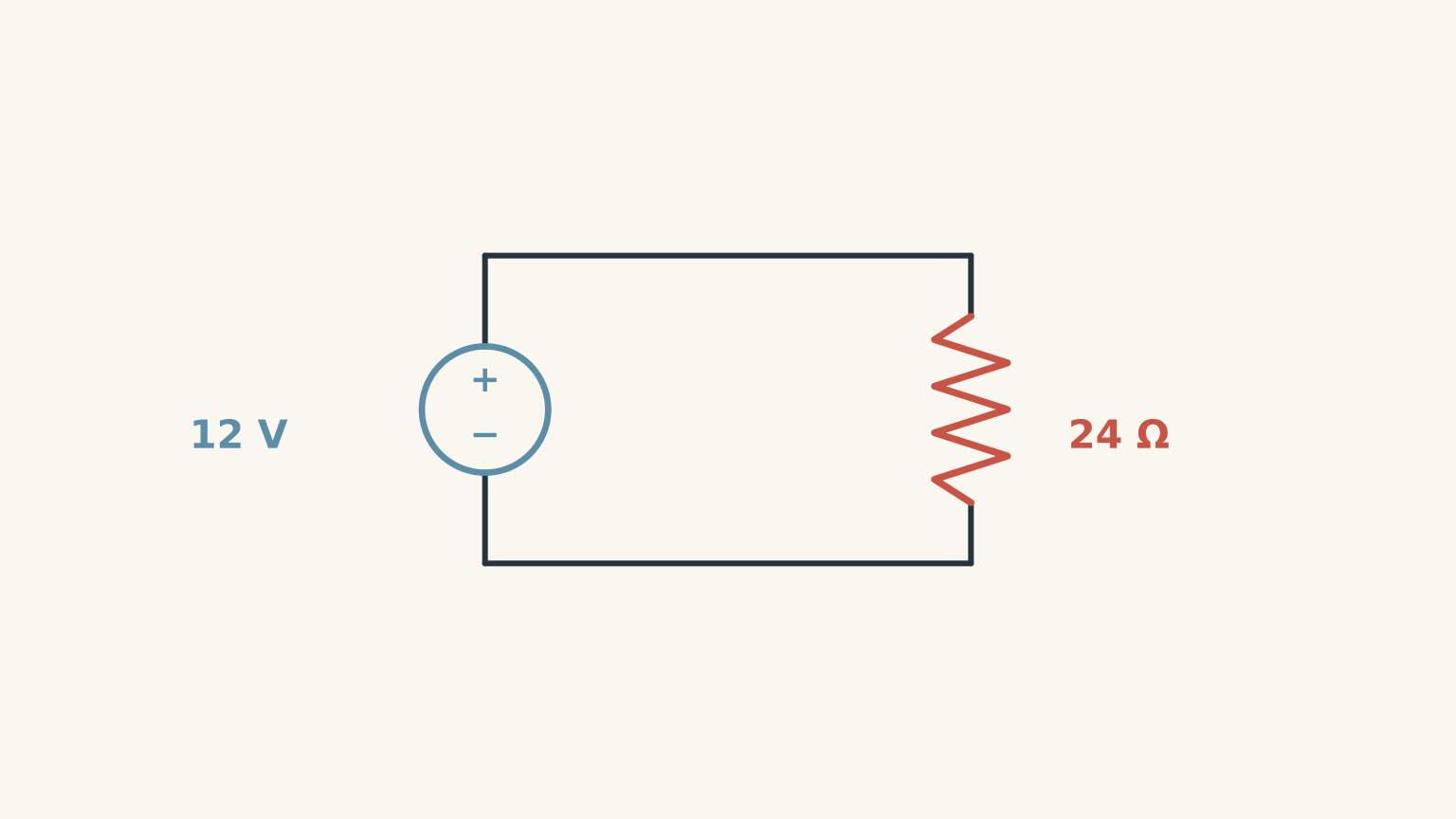
(a) Calculate the current flowing through the heating element. (2 marks)
(b) Calculate the electrical power dissipated by the heating element. (2 marks)
(c) The heating element is replaced with another element of resistance \(48\ \Omega\), while the supply voltage remains at \(12\text{ V}\).
Calculate the new electrical power dissipated by the element. (2 marks)
(d) Explain why the electrical power changes when the resistance is doubled while the supply voltage remains constant. (2 marks)
Question 3 (8 marks)
An electric kettle operates from a \(230\text{ V}\) supply and draws a steady current of \(9.6\text{ A}\) while heating.
The kettle is used for \(4.0\text{ minutes}\) per boil, three times each day, for five days.
Electricity costs 32 cents per kilowatt-hour (kWh).
Ignore any standby electricity consumption.
(a) Calculate the operating power of the kettle in kilowatts. (2 marks)
(b) Calculate the electrical energy transferred during one boil, in kWh. (2 marks)
(c) Calculate the total electrical energy used by the kettle over the five days. (2 marks)
(d) Calculate the electricity cost of operating the kettle over those five days. (2 marks)
Question 4 (8 marks)
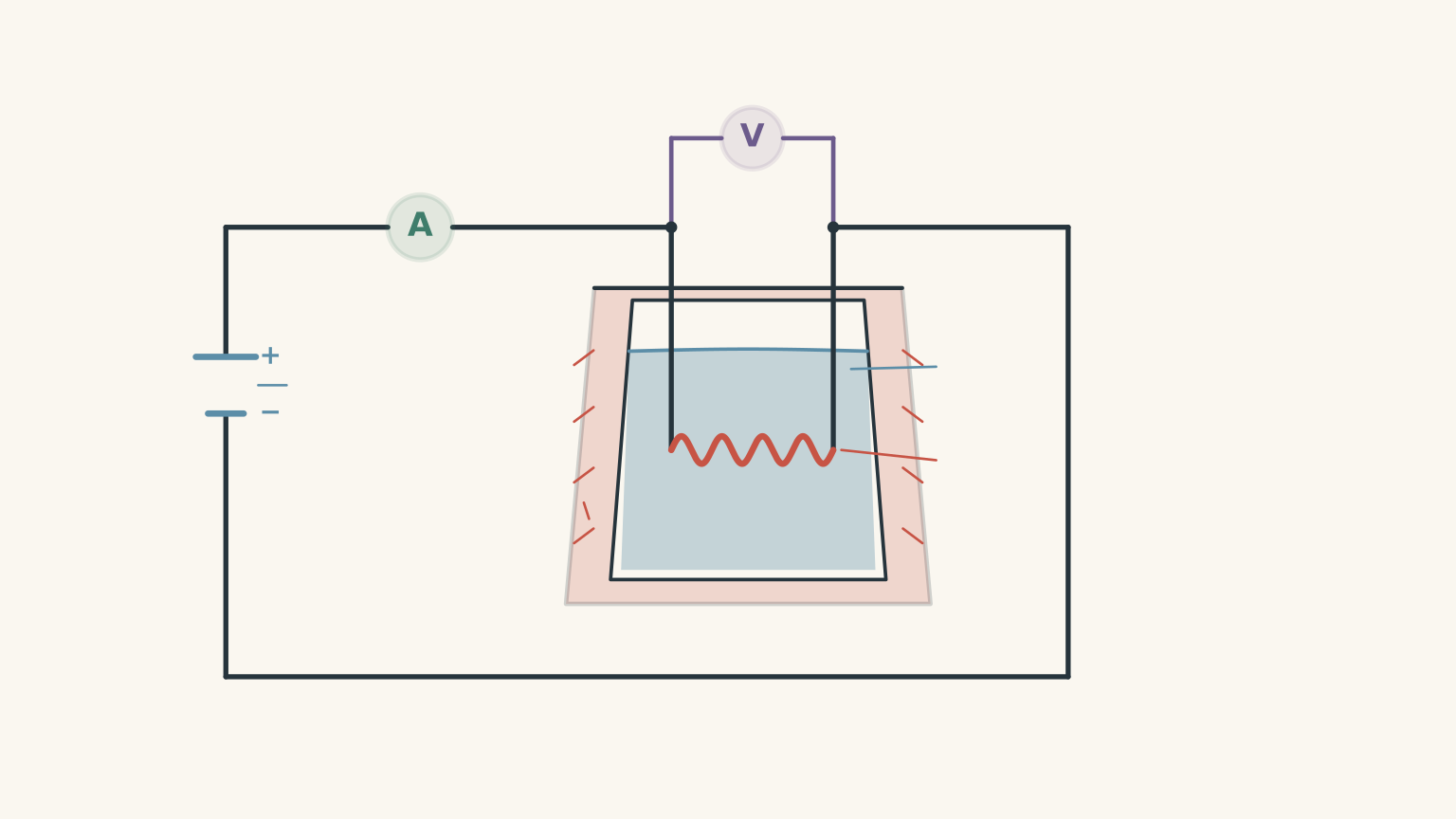
An insulated calorimeter contains water and a resistive heating element. The element is immersed in the water and connected to a low-voltage DC supply.
An ammeter measures the current through the element, while a voltmeter measures the potential difference across it.
During one experimental run, the following measurements are recorded:
| Quantity | Measurement |
|---|---|
| Voltage across the element | \(6.0\text{ V}\) |
| Current through the element | \(0.75\text{ A}\) |
| Heating duration | \(120\text{ s}\) |
(a) Calculate the electrical power dissipated by the heating element. (2 marks)
(b) Calculate the electrical energy supplied to the heating element during the experimental run. (2 marks)
(c) Explain, using the particle model of a metal, why an electric current passing through the heating element causes it to heat up. (2 marks)
(d) The thermal energy gained by the water is measured to be less than the electrical energy supplied to the heating element.
Explain one reason for this difference. (2 marks)
Question 5 (10 marks)
Two ohmic resistors have the following resistances:
| Resistor | Resistance |
|---|---|
| A | \(6.0\ \Omega\) |
| B | \(12.0\ \Omega\) |
Assume their resistances remain constant throughout both tests.
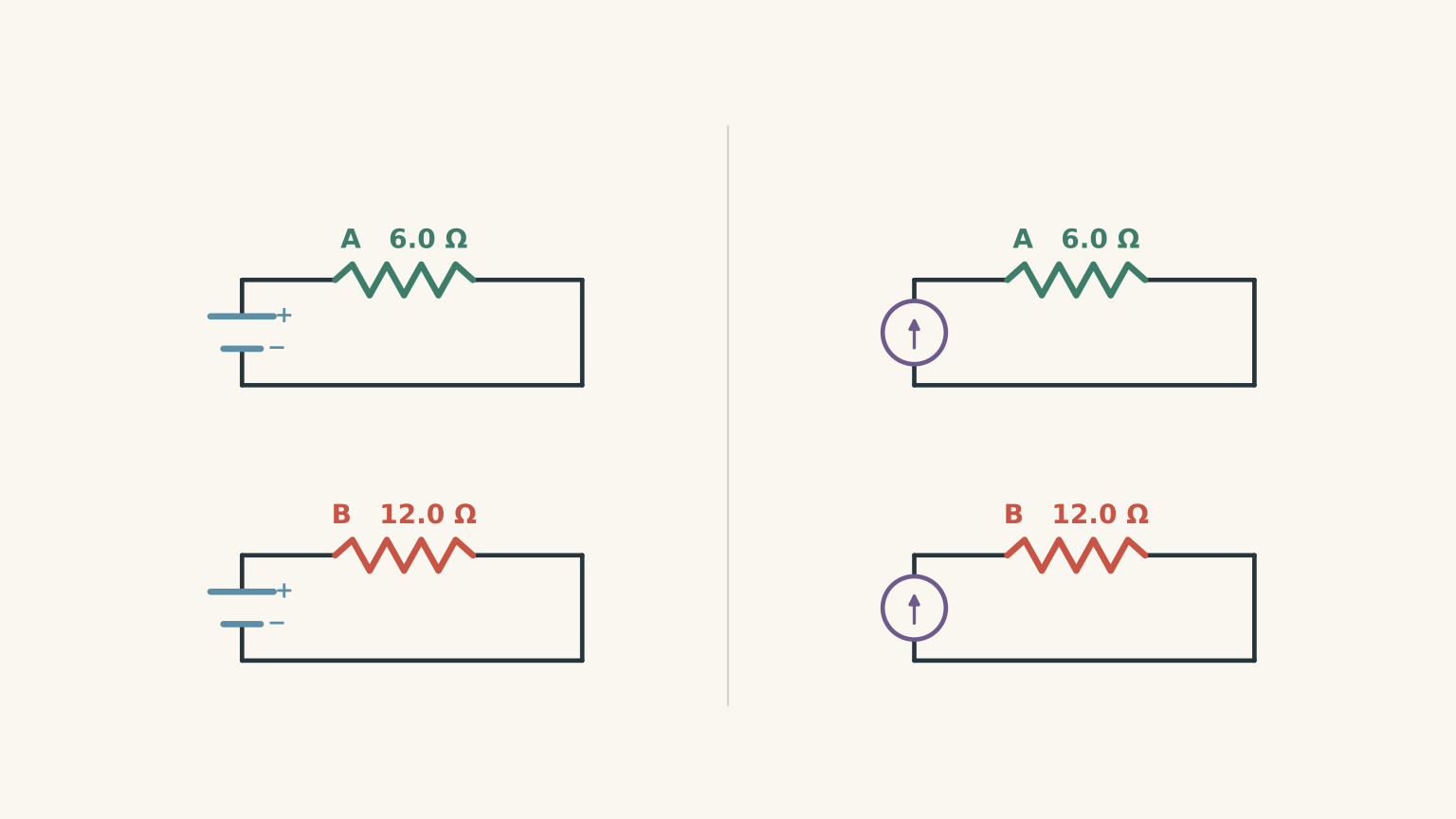
(a) Each resistor is connected separately across an ideal \(12\text{ V}\) supply.
Calculate the electrical power dissipated by both resistors. (4 marks)
- Resistor A.
- Resistor B.
(b) Each resistor is now tested separately in a circuit that maintains a constant current of \(0.50\text{ A}\) through it.
Calculate the electrical power dissipated by both resistors. (4 marks)
- Resistor A.
- Resistor B.
(c) State which resistor dissipates more power under each testing condition.
Explain why the comparison changes when the controlled quantity changes from voltage to current. (2 marks)
Question 6 (10 marks)
An electric hotplate contains a purely resistive heating element with a resistance of \(52.9\ \Omega\) when operating.
It is connected to a \(230\text{ V}\) supply. Treat this as the effective voltage across the element while it is switched on.
During a \(20\text{-minute}\) cooking period, a thermostat keeps the element switched on for a total of \(13\text{ minutes}\). It is switched off for the remaining \(7\text{ minutes}\).
Assume that the element draws no electrical power while switched off.
(a) Calculate the current flowing through the heating element while it is switched on. (2 marks)
(b) Calculate the electrical power dissipated by the heating element while it is switched on. Express your answer in kilowatts. (2 marks)
(c) Calculate the total electrical energy supplied to the hotplate during the \(20\text{-minute}\) cooking period. Express your answer in kWh. (2 marks)
(d) Calculate the electrical energy that would be supplied if the element remained switched on continuously for the entire \(20\text{-minute}\) period. Express your answer in kWh. (2 marks)
(e) Calculate the electrical energy saved by the thermostat during the cooking period. Express your answer in kWh. (2 marks)
03Worked solutions and marking guide
The following solutions show the expected reasoning and calculations. Equivalent mathematical methods are acceptable, provided they are correct and clearly demonstrated.
Follow-through marks should be awarded where a student makes an earlier numerical error but correctly applies the appropriate method using their previous result.
Solution 1
(a) Calculate the electrical power. (2 marks)
The appropriate relationship is:
\[ P=VI \]
Where:
- \(P\) is electrical power in watts (W).
- \(V\) is potential difference in volts (V).
- \(I\) is current in amperes (A).
Substitute the given values:
\[ \begin{aligned} P&=9.0\times0.40\\ &=3.6\text{ W} \end{aligned} \]
Answer:
\[ \boxed{P=3.6\text{ W}} \]
Marking guide:
- 1 mark: Selects and applies \(P=VI\).
- 1 mark: Correct substitution and answer with units.
(b) Calculate the electrical energy transferred. (2 marks)
We use:
\[ E=Pt \]
Where:
- \(E\) is electrical energy in joules (J).
- \(P\) is power in watts (W).
- \(t\) is time in seconds (s).
First, convert the time into seconds:
\[ t=18\times60=1080\text{ s} \]
Substitute:
\[ \begin{aligned} E&=3.6\times1080\\ &=3888\text{ J} \end{aligned} \]
To two significant figures:
\[ \boxed{E=3.9\times10^3\text{ J}} \]
Marking guide:
- 1 mark: Correctly converts minutes into seconds.
- 1 mark: Applies \(E=Pt\) and obtains the correct energy with units.
(c) Express the energy in watt-hours. (2 marks)
We know:
\[ 1\text{ Wh}=3600\text{ J} \]
Therefore:
\[ E=\frac{3888}{3600} \]
\[ E=1.08\text{ Wh} \]
To two significant figures:
\[ \boxed{E=1.1\text{ Wh}} \]
Marking guide:
- 1 mark: Correctly converts joules into watt-hours.
- 1 mark: Correct final answer with units and appropriate precision.
Solution 2
(a) Calculate the current through the heating element. (2 marks)
We are given:
- Voltage: \(V=12\text{ V}\)
- Resistance: \(R=24\ \Omega\)
Using Ohm’s law:
\[ V=IR \]
Rearrange to make current the subject:
\[ I=\frac{V}{R} \]
Substitute:
\[ \begin{aligned} I&=\frac{12}{24}\\ &=0.50\text{ A} \end{aligned} \]
Answer:
\[ \boxed{I=0.50\text{ A}} \]
Marking guide:
- 1 mark: Correctly applies Ohm’s law and rearranges for current.
- 1 mark: Correct calculation and unit.
(b) Calculate the electrical power. (2 marks)
We know the voltage and resistance.
The most direct relationship is:
\[ P=\frac{V^2}{R} \]
Substitute:
\[ \begin{aligned} P&=\frac{12^2}{24}\\ &=\frac{144}{24}\\ &=6.0\text{ W} \end{aligned} \]
Answer:
\[ \boxed{P=6.0\text{ W}} \]
We could also use \(P=VI\), using the current calculated in part (a):
\[ P=12\times0.50=6.0\text{ W} \]
Both methods are correct.
Marking guide:
- 1 mark: Selects an appropriate power relationship.
- 1 mark: Correct substitution and answer with units.
(c) Calculate the new electrical power. (2 marks)
The new resistance is:
\[ R=48\ \Omega \]
The voltage remains:
\[ V=12\text{ V} \]
Using:
\[ P=\frac{V^2}{R} \]
Substitute:
\[ \begin{aligned} P&=\frac{12^2}{48}\\ &=\frac{144}{48}\\ &=3.0\text{ W} \end{aligned} \]
Answer:
\[ \boxed{P=3.0\text{ W}} \]
Marking guide:
- 1 mark: Correctly uses the new resistance and unchanged voltage.
- 1 mark: Correct power calculation and units.
(d) Explain why the power changes. (2 marks)
The supply voltage remains constant.
For a resistive element:
\[ P=\frac{V^2}{R} \]
This means that, at constant voltage, electrical power is inversely proportional to resistance.
Therefore, doubling the resistance halves the power.
The original power was \(6.0\text{ W}\), while the new power is \(3.0\text{ W}\).
Marking guide:
- 1 mark: Identifies that voltage remains constant and power is inversely proportional to resistance.
- 1 mark: Correctly explains that doubling resistance halves the power.
Solution 3
(a) Calculate the operating power in kilowatts. (2 marks)
We are given:
- Voltage: \(230\text{ V}\)
- Current: \(9.6\text{ A}\)
Use:
\[ P=VI \]
Substitute:
\[ \begin{aligned} P&=230\times9.6\\ &=2208\text{ W} \end{aligned} \]
Convert watts into kilowatts:
\[ P=\frac{2208}{1000} \]
\[ \boxed{P=2.208\text{ kW}} \]
Marking guide:
- 1 mark: Correct application of \(P=VI\).
- 1 mark: Correct power calculation and conversion into kilowatts.
(b) Calculate the energy used per boil. (2 marks)
Use:
\[ E=Pt \]
Since power is in kilowatts, time must be in hours to obtain energy in kWh.
Convert the boiling time:
\[ t=\frac{4.0}{60}\text{ h} \]
\[ t=0.0667\text{ h} \]
Now calculate the energy:
\[ \begin{aligned} E&=2.208\times\frac{4.0}{60}\\ &=0.1472\text{ kWh} \end{aligned} \]
Answer:
\[ \boxed{E=0.147\text{ kWh per boil}} \]
Marking guide:
- 1 mark: Correctly converts minutes into hours.
- 1 mark: Correct application of \(E=Pt\) and final answer.
(c) Calculate the total energy used over five days. (2 marks)
The kettle is used:
\[ 3\times5=15\text{ boils} \]
Each boil uses \(0.1472\text{ kWh}\).
Therefore:
\[ \begin{aligned} E_{\text{total}}&=15\times0.1472\\ &=2.208\text{ kWh} \end{aligned} \]
Answer:
\[ \boxed{E_{\text{total}}=2.21\text{ kWh}} \]
Marking guide:
- 1 mark: Correctly determines the total number of boils.
- 1 mark: Correctly calculates the total energy used.
(d) Calculate the electricity cost. (2 marks)
The electricity price is:
\[ 32\text{ cents per kWh} \]
Convert this into dollars:
\[ 32\text{ cents}=\$0.32 \]
The total energy consumption is \(2.208\text{ kWh}\).
Therefore:
\[ \begin{aligned} \text{Cost}&=2.208\times0.32\\ &=\$0.70656 \end{aligned} \]
Rounded to the nearest cent:
\[ \boxed{\text{Cost}=\$0.71} \]
Marking guide:
- 1 mark: Correctly converts the electricity price into dollars per kWh and selects the appropriate calculation.
- 1 mark: Correct multiplication and final cost to the nearest cent.
Solution 4
(a) Calculate the electrical power dissipated. (2 marks)
We are given:
- Voltage: \(6.0\text{ V}\)
- Current: \(0.75\text{ A}\)
Use:
\[ P=VI \]
Substitute:
\[ \begin{aligned} P&=6.0\times0.75\\ &=4.5\text{ W} \end{aligned} \]
Answer:
\[ \boxed{P=4.5\text{ W}} \]
Marking guide:
- 1 mark: Correctly selects \(P=VI\).
- 1 mark: Correct calculation and units.
(b) Calculate the electrical energy supplied. (2 marks)
Use:
\[ E=Pt \]
The power is \(4.5\text{ W}\), and the heating duration is \(120\text{ s}\).
Substitute:
\[ \begin{aligned} E&=4.5\times120\\ &=540\text{ J} \end{aligned} \]
Answer:
\[ \boxed{E=540\text{ J}} \]
Marking guide:
- 1 mark: Correctly selects and applies \(E=Pt\).
- 1 mark: Correct calculation and units.
(c) Explain why the heating element becomes hot. (2 marks)
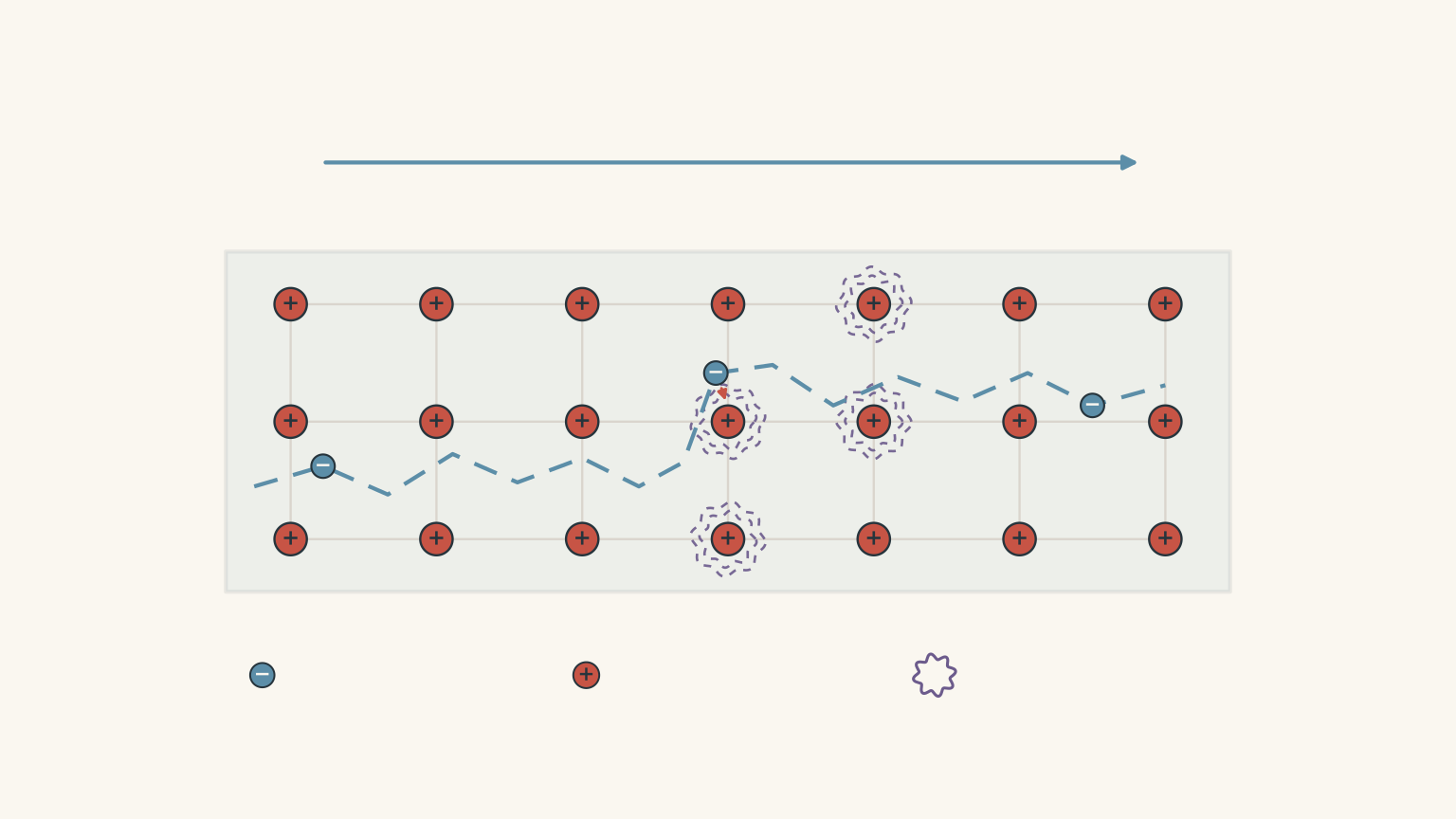
A metal contains mobile conduction electrons that can move through its lattice of positive metal ions.
When a potential difference is applied, an electric field causes the electrons to drift through the metal. As they move, they scatter through interactions with the metal lattice, transferring energy to it.
This increases the lattice’s internal energy, causing its temperature to rise.
Marking guide:
- 1 mark: Explains that conduction electrons move through the metal under an applied electric field.
- 1 mark: Explains that interactions transfer energy to the metal lattice, increasing its internal energy and temperature.
(d) Explain why the water gains less energy than the electrical energy supplied. (2 marks)
Not all the electrical energy supplied to the heating element ends up in the water.
Some thermal energy is transferred to the calorimeter itself and to the surrounding environment. Some energy also increases the internal energy of the heating element.
As a result, the measured energy gained by the water is less than the electrical energy supplied.
Marking guide:
- 1 mark: Identifies a valid destination for energy outside the water, such as the calorimeter, heating element, or surroundings.
- 1 mark: Explains that this energy transfer means less energy is gained by the water.
Solution 5
(a) Calculate the power at constant voltage. (4 marks)
Both resistors are connected separately across a \(12\text{ V}\) supply.
The voltage is constant, so we can use:
\[ P=\frac{V^2}{R} \]
For resistor A:
\[ \begin{aligned} P_A&=\frac{12^2}{6.0}\\ &=\frac{144}{6.0}\\ &=24\text{ W} \end{aligned} \]
Therefore:
\[ \boxed{P_A=24\text{ W}} \]
For resistor B:
\[ \begin{aligned} P_B&=\frac{12^2}{12.0}\\ &=\frac{144}{12.0}\\ &=12\text{ W} \end{aligned} \]
Therefore:
\[ \boxed{P_B=12\text{ W}} \]
At constant voltage, resistor A dissipates twice as much power as resistor B.
Marking guide:
For resistor A:
- 1 mark: Selects and applies \(P=V^2/R\).
- 1 mark: Correct calculation and answer with units.
For resistor B:
- 1 mark: Selects and applies \(P=V^2/R\).
- 1 mark: Correct calculation and answer with units.
(b) Calculate the power at constant current. (4 marks)
This time, both resistors carry a constant current of \(0.50\text{ A}\).
The appropriate relationship is:
\[ P=I^2R \]
For resistor A:
\[ \begin{aligned} P_A&=(0.50)^2\times6.0\\ &=0.25\times6.0\\ &=1.5\text{ W} \end{aligned} \]
Therefore:
\[ \boxed{P_A=1.5\text{ W}} \]
For resistor B:
\[ \begin{aligned} P_B&=(0.50)^2\times12.0\\ &=0.25\times12.0\\ &=3.0\text{ W} \end{aligned} \]
Therefore:
\[ \boxed{P_B=3.0\text{ W}} \]
At constant current, resistor B dissipates twice as much power as resistor A.
Marking guide:
For resistor A:
- 1 mark: Selects and applies \(P=I^2R\).
- 1 mark: Correct calculation and answer with units.
For resistor B:
- 1 mark: Selects and applies \(P=I^2R\).
- 1 mark: Correct calculation and answer with units.
(c) Explain why the comparison changes. (2 marks)
The results can be summarised as follows:
| Condition | Resistor A | Resistor B | Greater power |
|---|---|---|---|
| Constant voltage | 24 W | 12 W | A |
| Constant current | 1.5 W | 3.0 W | B |
The reason is that the relationship between power and resistance depends on which electrical quantity is held constant.
At constant voltage:
\[ P=\frac{V^2}{R} \]
Power decreases as resistance increases.
At constant current:
\[ P=I^2R \]
Power increases as resistance increases.
Therefore, the lower-resistance resistor dissipates more power at constant voltage, while the higher-resistance resistor dissipates more power at constant current.
Marking guide:
- 1 mark: Correctly identifies the higher-power resistor under both conditions.
- 1 mark: Explains the reversal using the appropriate power relationships.
Solution 6
(a) Calculate the current while the element is switched on. (2 marks)
We are given:
- Voltage: \(230\text{ V}\)
- Resistance: \(52.9\ \Omega\)
Using Ohm’s law:
\[ V=IR \]
Rearrange:
\[ I=\frac{V}{R} \]
Substitute:
\[ \begin{aligned} I&=\frac{230}{52.9}\\ &=4.3478\text{ A} \end{aligned} \]
To three significant figures:
\[ \boxed{I=4.35\text{ A}} \]
Marking guide:
- 1 mark: Correctly applies Ohm’s law and rearranges for current.
- 1 mark: Correct calculation and units.
(b) Calculate the operating power in kilowatts. (2 marks)
We know the voltage and resistance.
Use:
\[ P=\frac{V^2}{R} \]
Substitute:
\[ \begin{aligned} P&=\frac{230^2}{52.9}\\ &=\frac{52900}{52.9}\\ &=1000\text{ W} \end{aligned} \]
Convert into kilowatts:
\[ P=\frac{1000}{1000} \]
Therefore:
\[ \boxed{P=1.00\text{ kW}} \]
Marking guide:
- 1 mark: Selects and applies \(P=V^2/R\).
- 1 mark: Correct calculation and conversion into kilowatts.
(c) Calculate the energy supplied during the cooking period. (2 marks)
The heating element is switched on for a total of \(13\text{ minutes}\).
We need to use the actual time that the element is operating, rather than the full 20-minute cooking period.
Convert the operating time into hours:
\[ t=\frac{13}{60}\text{ h} \]
Use:
\[ E=Pt \]
Substitute:
\[ \begin{aligned} E&=1.00\times\frac{13}{60}\\ &=0.21667\text{ kWh} \end{aligned} \]
Therefore:
\[ \boxed{E=0.217\text{ kWh}} \]
Marking guide:
- 1 mark: Correctly uses the 13-minute operating time and converts it into hours.
- 1 mark: Correct application of \(E=Pt\) and final answer with units.
(d) Calculate the energy supplied if the element remained switched on continuously. (2 marks)
This time, the element operates for the entire 20-minute period.
Convert the time into hours:
\[ t=\frac{20}{60}\text{ h} \]
Using:
\[ E=Pt \]
Substitute:
\[ \begin{aligned} E&=1.00\times\frac{20}{60}\\ &=0.33333\text{ kWh} \end{aligned} \]
Therefore:
\[ \boxed{E=0.333\text{ kWh}} \]
Marking guide:
- 1 mark: Correctly converts 20 minutes into hours.
- 1 mark: Correct application of \(E=Pt\) and final answer with units.
(e) Calculate the energy saved by the thermostat. (2 marks)
Energy saved is the difference between the energy supplied if the element operated continuously and the energy actually supplied with the thermostat.
Therefore:
\[ E_{\text{saved}}=E_{\text{continuous}}-E_{\text{actual}} \]
Substitute the unrounded values:
\[ \begin{aligned} E_{\text{saved}} &=1.00\left(\frac{20}{60}-\frac{13}{60}\right)\\ &=1.00\times\frac{7}{60}\\ &=0.11667\text{ kWh} \end{aligned} \]
To three significant figures:
\[ \boxed{E_{\text{saved}}=0.117\text{ kWh}} \]
This can also be checked using the seven minutes when the element is switched off:
\[ E_{\text{saved}}=1.00\times\frac{7}{60} \]
The result is the same.
Marking guide:
- 1 mark: Correctly determines the difference between continuous and actual energy use, or uses the seven-minute off period.
- 1 mark: Correct final answer with units and appropriate precision.
04Final mark summary
| Question | Topic | Marks |
|---|---|---|
| 1 | Electrical power and energy calculations | 6 |
| 2 | Power, voltage, and resistance | 8 |
| 3 | Energy consumption and electricity costs | 8 |
| 4 | Resistive heating and energy transfer | 8 |
| 5 | Comparing power at constant voltage and current | 10 |
| 6 | Heating power, operating time, and energy savings | 10 |
| Total | 50 |
Revision priorities after completing the paper
Use your results to identify which relationships need more practice.
| If you struggled with… | Revisit |
|---|---|
| Questions 1 and 3 | Choosing between power and energy equations, converting time, and calculating kWh |
| Question 2 | Applying equivalent power relationships when resistance or voltage changes |
| Question 4 | Understanding resistive heating and following energy transfers |
| Question 5 | Recognising what happens to power when voltage or current is held constant |
| Question 6 | Calculating energy when an appliance switches on and off |
One particularly useful habit is to identify what the question holds constant before choosing an equation.
- If voltage and resistance are given, consider \(P=V^2/R\).
- If current and resistance are given, consider \(P=I^2R\).
- If voltage and current are given, consider \(P=VI\).
- If power and operating time are given, use \(E=Pt\).
Getting comfortable with these decisions will make electrical power and heating questions much more manageable.