
Electromagnetic Wave Properties and Uses: HSC Practice Exam
Test your understanding of electromagnetic wave properties and uses with this original 40-mark NSW HSC Physics practice paper. Includes timed exam conditions, seven original questions, complete worked solutions, and a detailed marking guide.
This original tutorgum practice paper assesses the 2025 NSW HSC Physics scope on electromagnetic wave properties and uses. It covers the electromagnetic spectrum and its applications, the differences between mechanical and electromagnetic waves, photon energy and wavelength, and the production and propagation of electromagnetic radiation.
The paper is designed as a focused topic assessment, not a full-course Physics examination. All questions and solutions are original and written for revision. This is not an official or NESA-endorsed examination.
01Exam instructions
| Assessment detail | Conditions |
|---|---|
| Suggested reading time | 5 minutes |
| Suggested working time | 55 minutes |
| Total marks | 40 |
| Permitted equipment | Scientific calculator, ruler, pens and pencils |
| Notes | No notes or external resources |
Instructions
- Attempt every question.
- Show all working for calculations.
- Include appropriate units in numerical answers.
- Give calculated answers to three significant figures unless otherwise stated.
- Explain your reasoning in written responses. A correct statement without an explanation may not receive full marks.
Assessed content
This paper assesses:
- The electromagnetic spectrum and applications of different regions.
- Differences between mechanical and electromagnetic waves, including their need for a medium and physical behaviour.
- Relationships between photon energy, frequency and wavelength.
- The production of electromagnetic radiation by accelerating charges.
- The transverse nature of electromagnetic waves and the propagation of energy.
No other Physics modules or wave phenomena outside this supplied syllabus scope are assessed.
Constants and useful information
The following constants are provided:
- Speed of electromagnetic waves in a vacuum: \(c=3.00\times10^8\ \mathrm{m\,s^{-1}}\)
- Planck’s constant: \(h=6.63\times10^{-34}\ \mathrm{J\,s}\)
In the questions and solutions:
- \(c\) represents the speed of electromagnetic waves in a vacuum.
- \(v\) represents the speed of a wave in its stated medium.
- \(f\) represents frequency, measured in hertz (Hz).
- \(\lambda\) represents wavelength, measured in metres (m).
- \(E\) represents the energy of one photon, measured in joules (J).
- \(h\) represents Planck’s constant.
Useful unit conversions:
- \(1\ \mathrm{nm}=1.00\times10^{-9}\ \mathrm{m}\)
- \(1\ \mathrm{cm}=1.00\times10^{-2}\ \mathrm{m}\)
- \(1\ \mathrm{kHz}=1.00\times10^3\ \mathrm{Hz}\)
Assume electromagnetic waves travel through a vacuum unless otherwise stated.
02Questions
Question 1 (5 marks)
(a) Arrange the following regions of the electromagnetic spectrum in order of increasing frequency:
X-rays, radio waves, ultraviolet, microwaves, gamma rays, visible light, infrared.
(3 marks)
(b) Gamma radiation is used to sterilise sealed medical equipment.
Explain how two properties of gamma radiation make it suitable for this application.
(2 marks)
Question 2 (5 marks)
A student makes the following statement:
“Both sound waves and radio waves need particles to pass a disturbance from one place to another. Neither can travel through a vacuum.”
(a) Evaluate this statement. In your response, compare how sound waves and radio waves propagate, referring to their behaviour in a vacuum.
(3 marks)
(b) State what oscillates in each of the following waves and identify whether each wave is longitudinal or transverse:
- Sound travelling through air.
- A radio wave travelling through space.
(2 marks)
Question 3 (5 marks)
A green laser emits electromagnetic radiation with a wavelength of \(532\ \mathrm{nm}\).
(a) Calculate the frequency of the emitted radiation.
(2 marks)
(b) Calculate the energy of one photon emitted by the laser.
(3 marks)
Question 4 (5 marks)
Two electromagnetic radiation sources emit photons with the following wavelengths:
| Source | Type of radiation | Wavelength |
|---|---|---|
| A | Microwave | \(0.120\ \mathrm{m}\) |
| B | X-ray | \(1.20\times10^{-10}\ \mathrm{m}\) |
(a) Calculate the energy of one photon emitted by Source A.
(2 marks)
(b) Calculate the energy of one photon emitted by Source B.
(2 marks)
(c) Determine how many times greater the energy of an X-ray photon is than the energy of a microwave photon.
(1 mark)
Question 5 (7 marks)
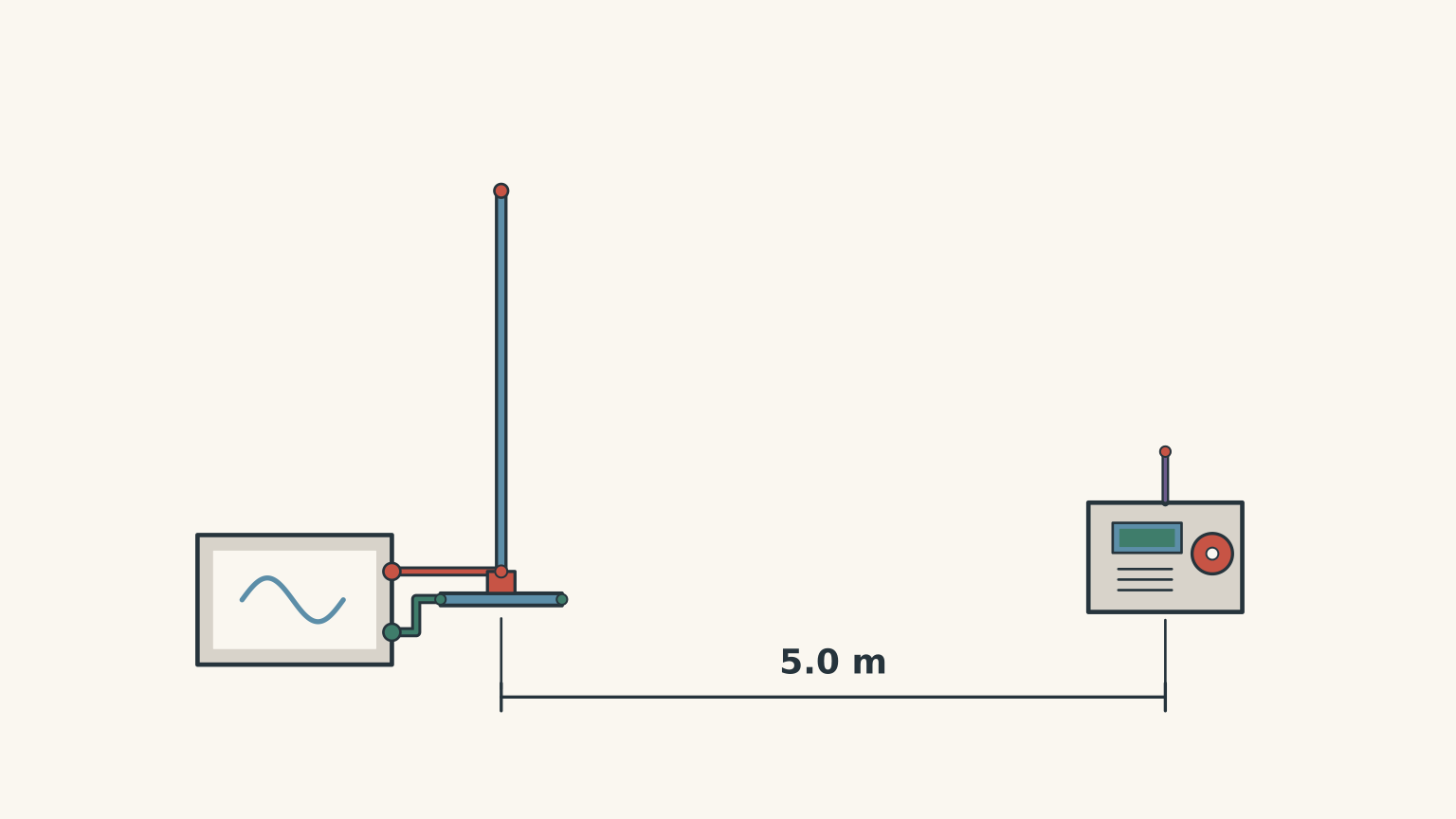
A vertical transmitting antenna is connected to an alternating-current power supply. During operation, electrons in the antenna move back and forth along its length.
A receiver is positioned \(5.0\ \mathrm{m}\) away from the antenna in a vacuum.
(a) Explain why the movement of electrons in the antenna can produce electromagnetic radiation.
(2 marks)
(b) Describe the orientation of the electric and magnetic fields in an electromagnetic wave relative to each other and the direction of wave propagation.
(3 marks)
(c) Explain how energy can be transferred from the antenna to the receiver through the vacuum.
(2 marks)
Question 6 (7 marks)
An engineering team needs to select electromagnetic radiation for three different applications:
- Transmitting information between a ground station and a satellite.
- Detecting temperature differences across the surface of hot machinery without physical contact.
- Producing images of the contents of closed luggage at an airport.
(a) Identify the most suitable region of the electromagnetic spectrum for each application.
(3 marks)
(b) For each application, explain one relevant property of the selected radiation that makes it suitable.
(3 marks)
(c) Arrange the three selected regions in order of increasing photon energy.
(1 mark)
Question 7 (6 marks)
A sound wave travelling through air and a radio wave travelling through a vacuum both have a frequency of \(10.0\ \mathrm{kHz}\).
The speed of sound in air is \(340\ \mathrm{m\,s^{-1}}\).
The speed of the radio wave is \(3.00\times10^8\ \mathrm{m\,s^{-1}}\).
(a) Calculate the wavelength of the sound wave in air.
(2 marks)
(b) Calculate the wavelength of the radio wave in the vacuum.
(2 marks)
(c) Explain why the two waves have different wavelengths despite having the same frequency.
(2 marks)
03Worked solutions and marking guide
Solution 1
(a) The correct order of increasing frequency is:
\[ \boxed{ \begin{aligned} &\text{Radio waves}\\ &\text{Microwaves}\\ &\text{Infrared}\\ &\text{Visible light}\\ &\text{Ultraviolet}\\ &\text{X-rays}\\ &\text{Gamma rays} \end{aligned} } \]
Frequency increases as you move from radio waves towards gamma rays.
The wavelength decreases in the same direction.
The electromagnetic spectrum is continuous, but it is divided into regions based on wavelength and frequency.
Marking guide:
- 1 mark for correctly ordering radio waves, microwaves and infrared.
- 1 mark for correctly positioning visible light between infrared and ultraviolet.
- 1 mark for correctly ordering ultraviolet, X-rays and gamma rays.
(b) Gamma radiation has two important properties that make it suitable for sterilising medical equipment.
First, gamma photons have very high energy. They can damage microorganisms, including by damaging the structures needed for their survival and reproduction.
Second, gamma radiation has strong penetrating ability. It can pass through suitable packaging and reach the medical equipment inside.
These properties allow gamma radiation to sterilise equipment without requiring the packaging to be opened.
Marking guide:
- 1 mark for identifying the high energy of gamma photons and explaining their ability to damage microorganisms.
- 1 mark for identifying their penetrating ability and explaining how this allows radiation to reach sealed equipment.
Solution 2
(a) The student’s statement is incorrect.
Sound waves are mechanical waves. They require a material medium because sound propagates through the oscillation of particles in that medium.
For example, when sound travels through air, air particles vibrate and transfer energy to neighbouring particles. Without particles, there is nothing to transmit the mechanical disturbance. Therefore, sound cannot travel through a vacuum.
Radio waves are electromagnetic waves. They consist of oscillating electric and magnetic fields and do not require a material medium.
Radio waves can therefore travel through a vacuum, including the space between Earth and a distant spacecraft.
Marking guide:
- 1 mark for identifying sound as a mechanical wave that requires a material medium.
- 1 mark for explaining that sound propagates through particle oscillations and cannot travel through a vacuum.
- 1 mark for identifying radio waves as electromagnetic waves that can propagate through a vacuum without a material medium.
(b) The two waves behave differently.
Sound travelling through air:
- Air particles oscillate parallel to the direction of wave propagation.
- Sound is a longitudinal wave.
Radio wave travelling through space:
- Electric and magnetic fields oscillate perpendicular to the direction of propagation.
- Radio waves are transverse waves.
Marking guide:
- 1 mark for identifying the oscillation of air particles and the longitudinal nature of sound.
- 1 mark for identifying oscillating electromagnetic fields and the transverse nature of radio waves.
Solution 3
(a) We are given:
\[ \lambda=532\ \mathrm{nm} \]
First, convert the wavelength into metres:
\[ \lambda=532\times10^{-9} \]
\[ \lambda=5.32\times10^{-7}\ \mathrm{m} \]
The relationship between wave speed, frequency and wavelength is:
\[ c=f\lambda \]
Rearranging to make frequency the subject:
\[ f=\frac{c}{\lambda} \]
Substitute the values:
\[ f=\frac{3.00\times10^8} {5.32\times10^{-7}} \]
\[ \boxed{f=5.64\times10^{14}\ \mathrm{Hz}} \]
Answer: The frequency of the laser radiation is \(5.64\times10^{14}\ \mathrm{Hz}\).
Marking guide:
- 1 mark for correctly converting the wavelength into metres.
- 1 mark for using the wave equation and obtaining the correct frequency.
(b) The energy of a photon is calculated using Planck’s relationship:
\[ E=hf \]
Where:
- \(E\) is the energy of one photon in joules.
- \(h\) is Planck’s constant.
- \(f\) is the frequency of the radiation.
Substitute the frequency calculated in part (a):
\[ E=(6.63\times10^{-34}) (5.64\times10^{14}) \]
\[ \boxed{E=3.74\times10^{-19}\ \mathrm{J}} \]
Answer: Each photon emitted by the laser has an energy of \(3.74\times10^{-19}\ \mathrm{J}\).
Notice the relationship between wavelength and photon energy.
Since \(c=f\lambda\) and \(E=hf\), we can combine the equations:
\[ \boxed{E=\frac{hc}{\lambda}} \]
This tells us that photon energy is inversely proportional to wavelength.
A shorter wavelength means a higher photon energy.
Marking guide:
- 1 mark for correctly using \(E=hf\).
- 1 mark for substituting the correct frequency and Planck’s constant.
- 1 mark for obtaining the correct energy with units.
Solution 4
The key relationship is:
\[ E=hf \]
We also know:
\[ c=f\lambda \]
Combining these equations gives:
\[ E=\frac{hc}{\lambda} \]
This allows us to calculate photon energy directly from wavelength.
(a) Source A emits microwave radiation with:
\[ \lambda_A=0.120\ \mathrm{m} \]
Substitute into the photon energy equation:
\[ E_A=\frac{hc}{\lambda_A} \]
\[ E_A= \frac{(6.63\times10^{-34})(3.00\times10^8)} {0.120} \]
\[ \boxed{E_A=1.66\times10^{-24}\ \mathrm{J}} \]
Answer: The energy of one microwave photon is \(1.66\times10^{-24}\ \mathrm{J}\).
Marking guide:
- 1 mark for selecting and correctly substituting into \(E=hc/\lambda\).
- 1 mark for the correct numerical answer with units.
(b) Source B emits X-ray radiation with:
\[ \lambda_B=1.20\times10^{-10}\ \mathrm{m} \]
Substitute into the same equation:
\[ E_B=\frac{hc}{\lambda_B} \]
\[ E_B= \frac{(6.63\times10^{-34})(3.00\times10^8)} {1.20\times10^{-10}} \]
\[ \boxed{E_B=1.66\times10^{-15}\ \mathrm{J}} \]
Answer: The energy of one X-ray photon is \(1.66\times10^{-15}\ \mathrm{J}\).
Marking guide:
- 1 mark for selecting and correctly substituting into \(E=hc/\lambda\).
- 1 mark for the correct numerical answer with units.
(c) To determine how many times greater the X-ray photon energy is, calculate the ratio:
\[ \text{Ratio}=\frac{E_B}{E_A} \]
Substitute:
\[ \text{Ratio}= \frac{1.66\times10^{-15}} {1.66\times10^{-24}} \]
\[ \boxed{\text{Ratio}=1.00\times10^9} \]
Answer: An X-ray photon has \(1.00\times10^9\) times the energy of a microwave photon.
That is one billion times greater.
This is a huge difference, even though both types of radiation are electromagnetic waves.
Marking guide:
- 1 mark for the correct ratio and comparison.
Solution 5
(a) Electrons in the antenna move back and forth because of the alternating current.
As the electrons repeatedly change their direction of motion, their velocity changes. A change in velocity means the electrons are accelerating.
Accelerating electric charges produce electromagnetic radiation.
Therefore, the accelerating electrons in the antenna generate electromagnetic waves that propagate away from it.
Marking guide:
- 1 mark for recognising that the electrons accelerate because their velocity changes.
- 1 mark for stating that accelerating charges produce electromagnetic radiation.
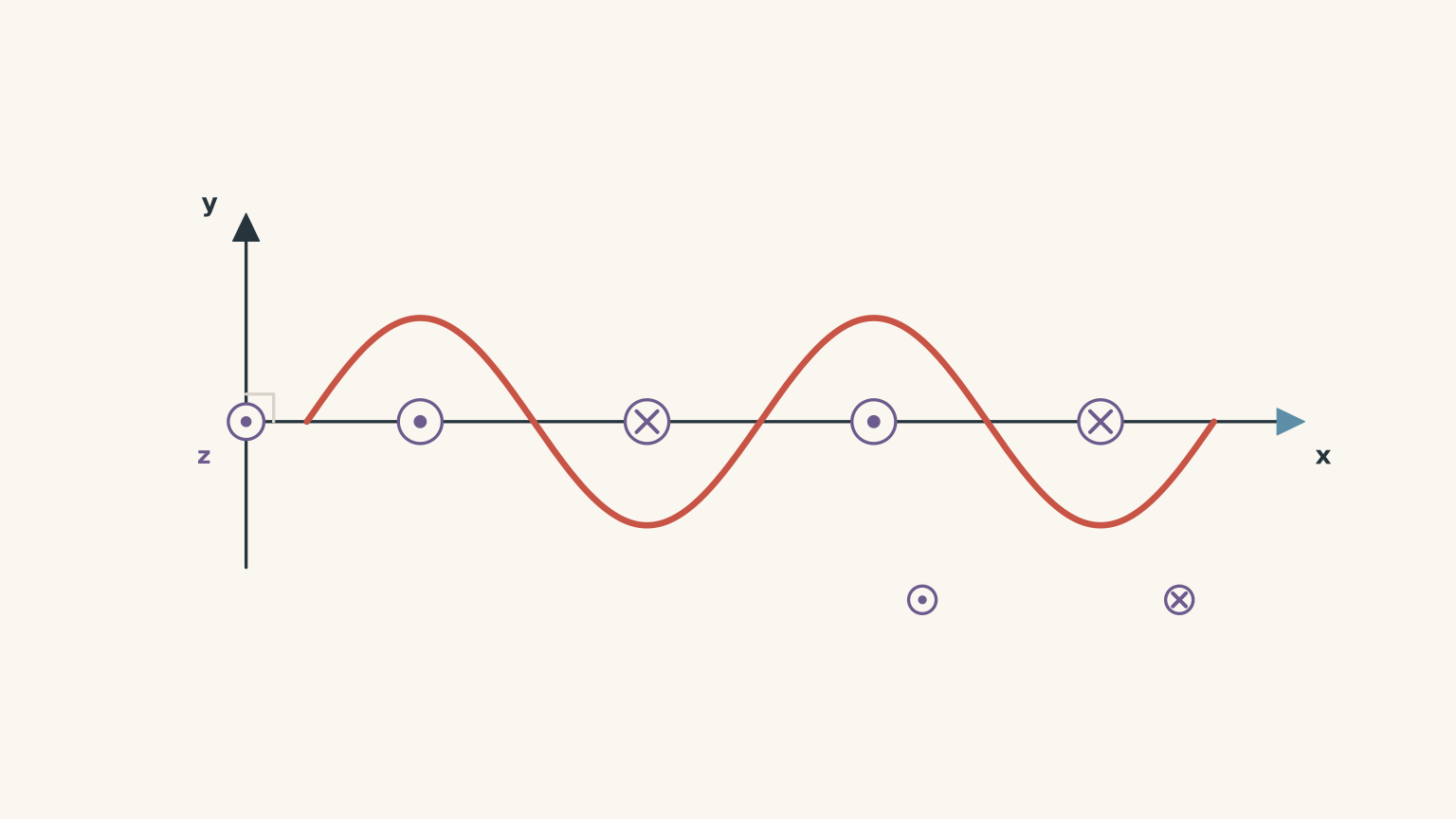
(b) Electromagnetic waves are transverse waves.
They contain two oscillating fields:
- An electric field.
- A magnetic field.
These fields have a specific orientation:
- The electric field is perpendicular to the magnetic field.
- Both fields are perpendicular to the direction of wave propagation.
The three directions are therefore mutually perpendicular.
This is what makes electromagnetic waves transverse.
Marking guide:
- 1 mark for stating that the electric and magnetic fields are perpendicular to each other.
- 1 mark for stating that both fields are perpendicular to the direction of propagation.
- 1 mark for identifying electromagnetic waves as transverse waves.
(c) The electromagnetic wave carries energy away from the antenna through its oscillating electric and magnetic fields.
The wave propagates through the vacuum and transfers energy to the receiver when it reaches it.
No material medium is needed, and the electrons in the antenna do not need to travel to the receiver.
Marking guide:
- 1 mark for explaining that electromagnetic fields carry energy away from the antenna.
- 1 mark for explaining that this energy propagates through the vacuum to the receiver without requiring a material medium.
Solution 6
(a) The most suitable regions are:
| Application | Electromagnetic region |
|---|---|
| Satellite communication | Microwaves |
| Thermal imaging | Infrared |
| Airport luggage scanning | X-rays |
Marking guide:
- 1 mark for correctly identifying microwaves.
- 1 mark for correctly identifying infrared.
- 1 mark for correctly identifying X-rays.
(b) Each application uses a different property of electromagnetic radiation.
1. Satellite communication – Microwaves
Selected microwave frequencies can pass through Earth’s atmosphere with relatively little absorption.
Microwaves can also travel through the vacuum between a satellite and a ground station. This makes them useful for transmitting information over large distances.
2. Thermal imaging – Infrared
Objects emit infrared radiation, and the intensity of this radiation varies with their surface temperature.
A thermal imaging camera detects infrared radiation from different parts of an object. Differences in the detected radiation allow the camera to produce a temperature image.
This makes infrared radiation useful for detecting hot spots in machinery without touching the equipment.
3. Airport luggage scanning – X-rays
X-rays can penetrate luggage and pass through many materials.
Different materials absorb X-rays to different extents. The radiation reaching the detector therefore varies depending on the contents of the luggage.
This produces contrast in the resulting image, allowing security staff to examine the contents.
Marking guide:
- 1 mark for explaining the suitability of microwaves for satellite communication, referring to their transmission through the atmosphere or vacuum.
- 1 mark for explaining the relationship between infrared emission and temperature differences.
- 1 mark for explaining the penetration of X-rays and their different absorption by materials.
(c) The three regions, in order of increasing photon energy, are:
\[ \boxed{ \text{Microwaves} < \text{Infrared} < \text{X-rays} } \]
Photon energy increases with frequency:
\[ E=hf \]
Therefore, higher-frequency radiation has more energy per photon.
Marking guide:
- 1 mark for the complete correct order.
Solution 7
(a) We are given:
- Frequency: \(f=10.0\ \mathrm{kHz}\)
- Speed of sound: \(v=340\ \mathrm{m\,s^{-1}}\)
First, convert the frequency into hertz:
\[ f=10.0\times10^3 \]
\[ f=1.00\times10^4\ \mathrm{Hz} \]
The relationship between wave speed, frequency and wavelength is:
\[ v=f\lambda \]
Rearrange to make wavelength the subject:
\[ \lambda=\frac{v}{f} \]
Substitute:
\[ \lambda=\frac{340}{1.00\times10^4} \]
\[ \boxed{\lambda=3.40\times10^{-2}\ \mathrm{m}} \]
Answer: The sound wave has a wavelength of \(0.0340\ \mathrm{m}\), or \(3.40\ \mathrm{cm}\).
Marking guide:
- 1 mark for using the correct wave equation and frequency conversion.
- 1 mark for the correct wavelength with units.
(b) The radio wave travels through a vacuum.
Its speed is:
\[ c=3.00\times10^8\ \mathrm{m\,s^{-1}} \]
Its frequency is:
\[ f=1.00\times10^4\ \mathrm{Hz} \]
Using:
\[ \lambda=\frac{c}{f} \]
Substitute:
\[ \lambda= \frac{3.00\times10^8} {1.00\times10^4} \]
\[ \boxed{\lambda=3.00\times10^4\ \mathrm{m}} \]
Answer: The radio wave has a wavelength of \(30\,000\ \mathrm{m}\), or \(30.0\ \mathrm{km}\).
Marking guide:
- 1 mark for using the correct wave equation and values.
- 1 mark for the correct wavelength with units.
(c) The radio wave has a much longer wavelength than the sound wave, despite both having the same frequency.
This is because wavelength depends on both wave speed and frequency:
\[ \lambda=\frac{v}{f} \]
Since the two waves have equal frequencies, the difference in wavelength comes from their different speeds.
The radio wave travels through a vacuum at approximately \(3.00\times10^8\ \mathrm{m\,s^{-1}}\), whereas sound travels through air at only \(340\ \mathrm{m\,s^{-1}}\).
The much greater speed of the radio wave produces a much longer wavelength.
Marking guide:
- 1 mark for relating wavelength to wave speed at a fixed frequency.
- 1 mark for explaining that the radio wave’s much greater speed gives it a much longer wavelength.
End of paper – 40 marks