
Energy of a Circular Orbit: Physics Revision Practice Exam
Test your understanding of kinetic, gravitational potential, and total energy in bound circular orbits with this original 40-mark tutorgum Physics practice paper. Includes timed exam instructions, five questions, fully worked solutions, and a detailed marking guide.
This original tutorgum practice paper assesses the energy relationships of a bound circular orbit. You’ll calculate kinetic, gravitational potential, and total mechanical energy, compare satellites in different orbits, and interpret the sign and behaviour of orbital energy on a graph.
This is a focused Physics revision paper on energy of a circular orbit, not a full-course examination. It is an original tutorgum resource, not an official or NESA-endorsed paper.
01Exam instructions
Assessment details
| Condition | Details |
|---|---|
| Suggested reading time | 5 minutes |
| Suggested working time | 50 minutes |
| Total marks | 40 |
| Number of questions | 5 |
| Permitted equipment | Scientific calculator, ruler, pens and pencils |
| Notes | No notes or textbooks |
Assessed content
This paper tests your ability to:
- Relate kinetic energy, gravitational potential energy, and total mechanical energy for a bound circular orbit.
- Apply \(E=-\frac{GMm}{2r}\) to calculate total orbital energy.
- Calculate and compare the three energy values at different orbital radii.
- Explain why a higher circular orbit has a lower speed but a higher total energy.
- Interpret negative orbital energy and graphs of total energy against orbital radius.
This paper does not assess elliptical orbits, escape velocity, orbital transfers, or Kepler’s laws.
Physical assumptions and constants
Unless stated otherwise:
- All orbits are circular.
- Gravity is the only force acting on the orbiting object.
- The central body is spherical and can be treated as having its mass concentrated at its centre.
- The orbiting object can be treated as a point mass.
- Gravitational potential energy is zero at infinite separation.
- Ignore atmospheric resistance and interactions with other bodies.
Use the following gravitational constant:
\[ G=6.67\times10^{-11} \ \mathrm{N\,m^2\,kg^{-2}} \]
Symbols used throughout:
| Symbol | Meaning | SI unit |
|---|---|---|
| \(G\) | Universal gravitational constant | \(\mathrm{N\,m^2\,kg^{-2}}\) |
| \(M\) | Mass of the central body | kg |
| \(m\) | Mass of the orbiting object | kg |
| \(r\) | Orbital radius, measured from the centre of the central body | m |
| \(K\) | Kinetic energy | J |
| \(U\) | Gravitational potential energy | J |
| \(E\) | Total mechanical energy | J |
Show all working, include units in numerical answers, and give final answers to three significant figures unless otherwise stated.
02Questions
Question 1 (7 marks)
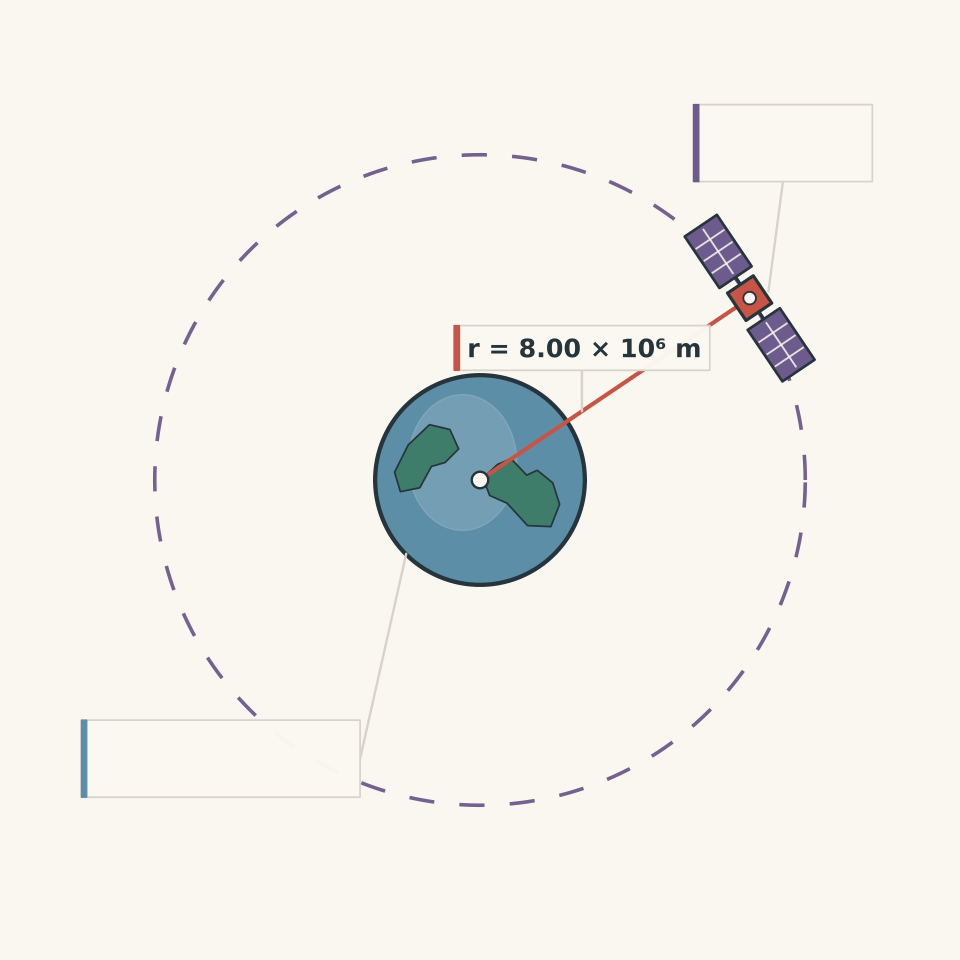
A satellite of mass \(850\ \mathrm{kg}\) moves in a circular orbit around a planet of mass \(5.00\times10^{24}\ \mathrm{kg}\).
The orbital radius is \(8.00\times10^6\ \mathrm{m}\), measured from the centre of the planet.
(a) Calculate the gravitational potential energy of the satellite. (2 marks)
(b) Calculate the kinetic energy of the satellite. (2 marks)
(c) Calculate the total mechanical energy of the satellite. Show how your result relates to the kinetic and gravitational potential energies. (3 marks)
Question 2 (8 marks)
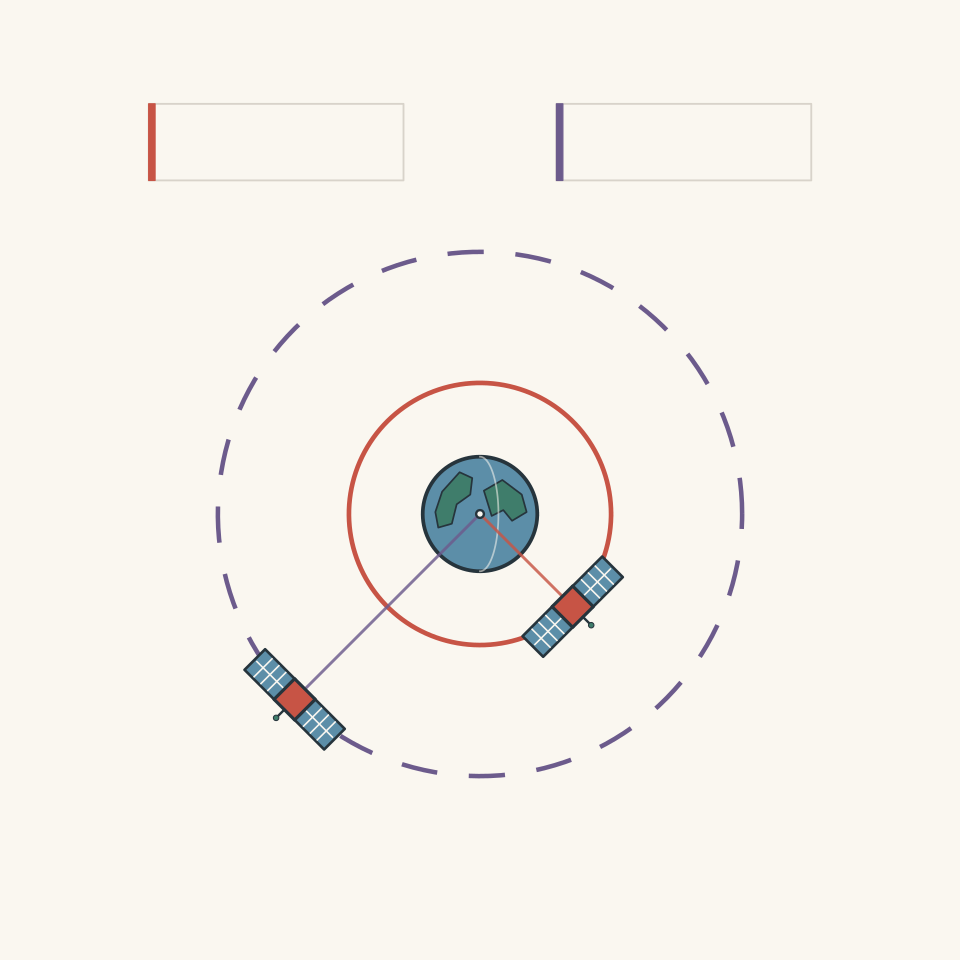
A satellite of constant mass moves in one of two possible circular orbits around the same planet.
The orbital radii are:
- Orbit A: \(r_A=7.00\times10^6\ \mathrm{m}\)
- Orbit B: \(r_B=1.40\times10^7\ \mathrm{m}\)
(a) Determine the ratio of the kinetic energies \(K_B/K_A\) and the ratio of the orbital speeds \(v_B/v_A\). (3 marks)
(b) Determine the ratio of the total mechanical energies \(E_B/E_A\). State which orbit has the higher total mechanical energy. (2 marks)
(c) Explain how the satellite can have a lower kinetic energy but a higher total mechanical energy in Orbit B. Refer to the changes in both kinetic and gravitational potential energy. (3 marks)
Question 3 (8 marks)
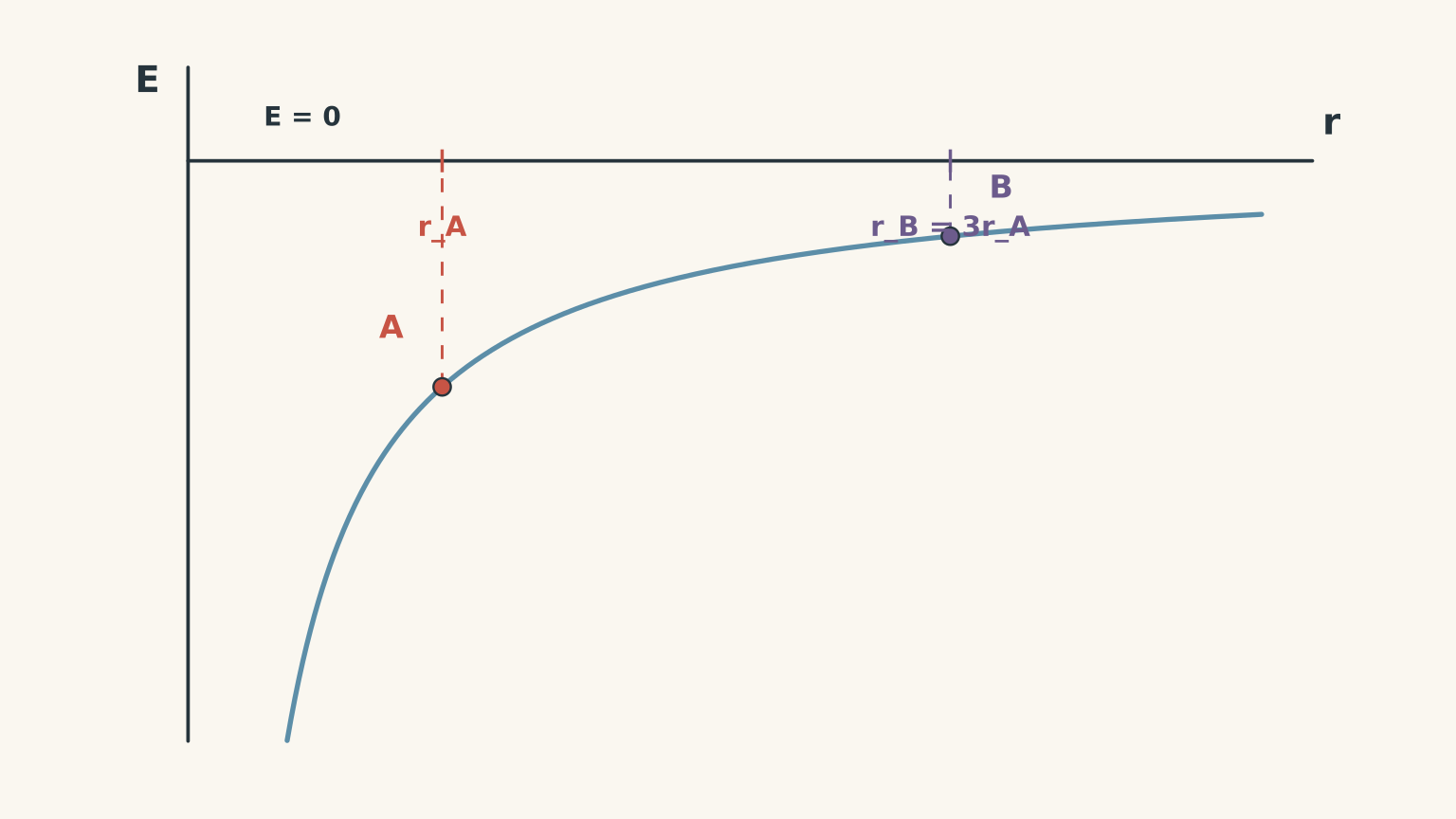
The graph below represents the total mechanical energy \(E\) of a satellite in a circular orbit as a function of its orbital radius \(r\).
The central planet and satellite remain unchanged throughout the graph.
(a) State whether the total mechanical energy is positive or negative for any finite circular orbital radius. Explain what this indicates about the satellite’s orbit. (2 marks)
(b) At point A, the satellite has an orbital radius of \(8.00\times10^6\ \mathrm{m}\) and a total mechanical energy of \(-1.20\times10^{10}\ \mathrm{J}\).
Point B is located at an orbital radius three times that of point A.
Calculate the total mechanical energy at point B. (2 marks)
(c) Calculate the change in total mechanical energy as the satellite moves from the circular orbit at A to the circular orbit at B.
Use:
\[ \Delta E=E_B-E_A \]
(2 marks)
(d) State the limiting value of total mechanical energy as the orbital radius approaches infinity. Explain why the graph approaches this value from below. (2 marks)
Question 4 (8 marks)
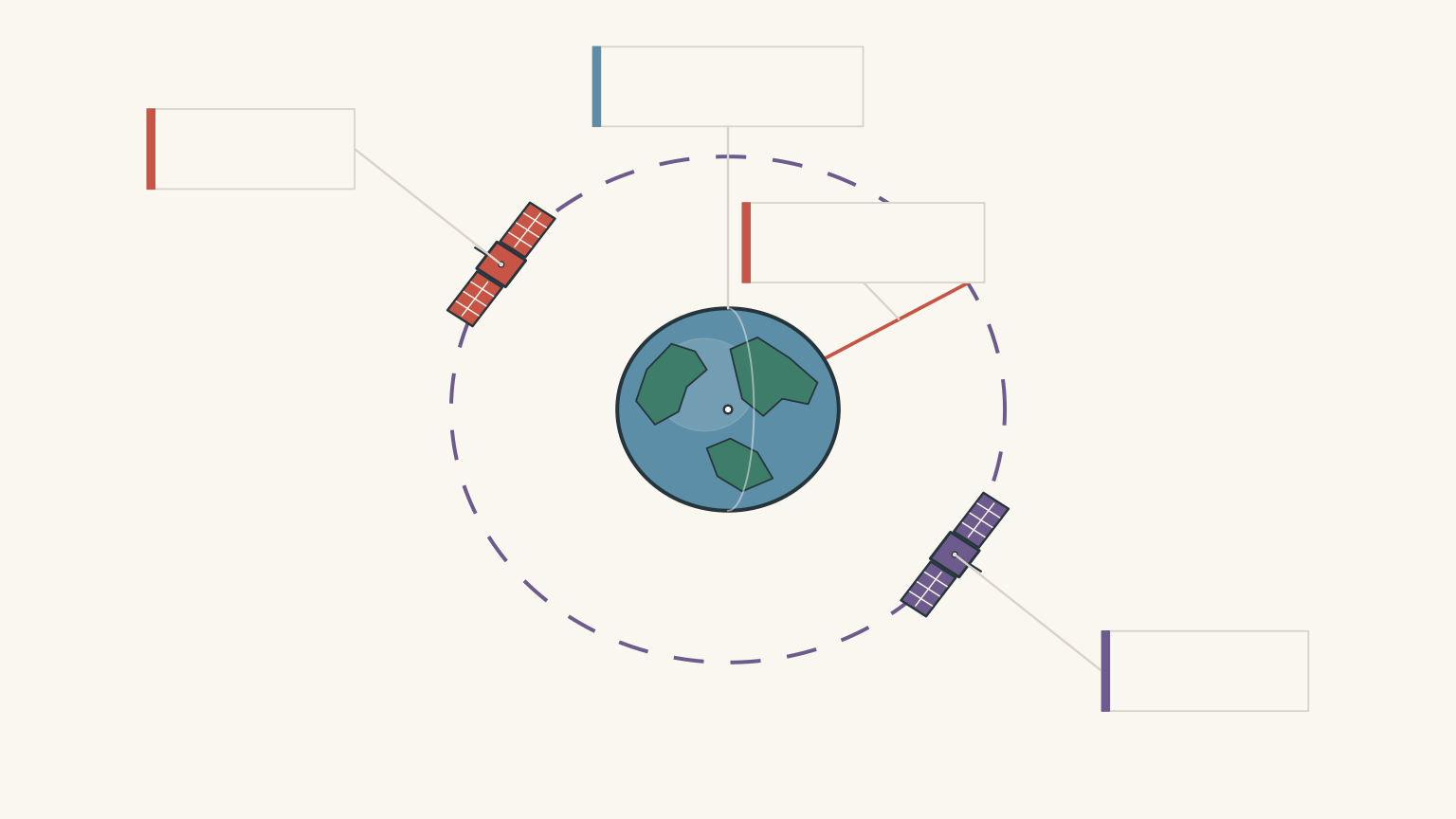
Two satellites, A and B, orbit the same planet in the same circular orbit.
The planet has a mass of \(5.00\times10^{24}\ \mathrm{kg}\), and the orbital radius is \(1.00\times10^7\ \mathrm{m}\).
The satellite masses are:
- Satellite A: \(300\ \mathrm{kg}\)
- Satellite B: \(900\ \mathrm{kg}\)
(a) Calculate the total mechanical energy of Satellite A. (2 marks)
(b) Calculate the kinetic energy, gravitational potential energy, and total mechanical energy of Satellite B. (4 marks)
(c) Determine the ratio \(E_B/E_A\). Then compare the orbital speeds of the two satellites, justifying your answer. (2 marks)
Question 5 (9 marks)
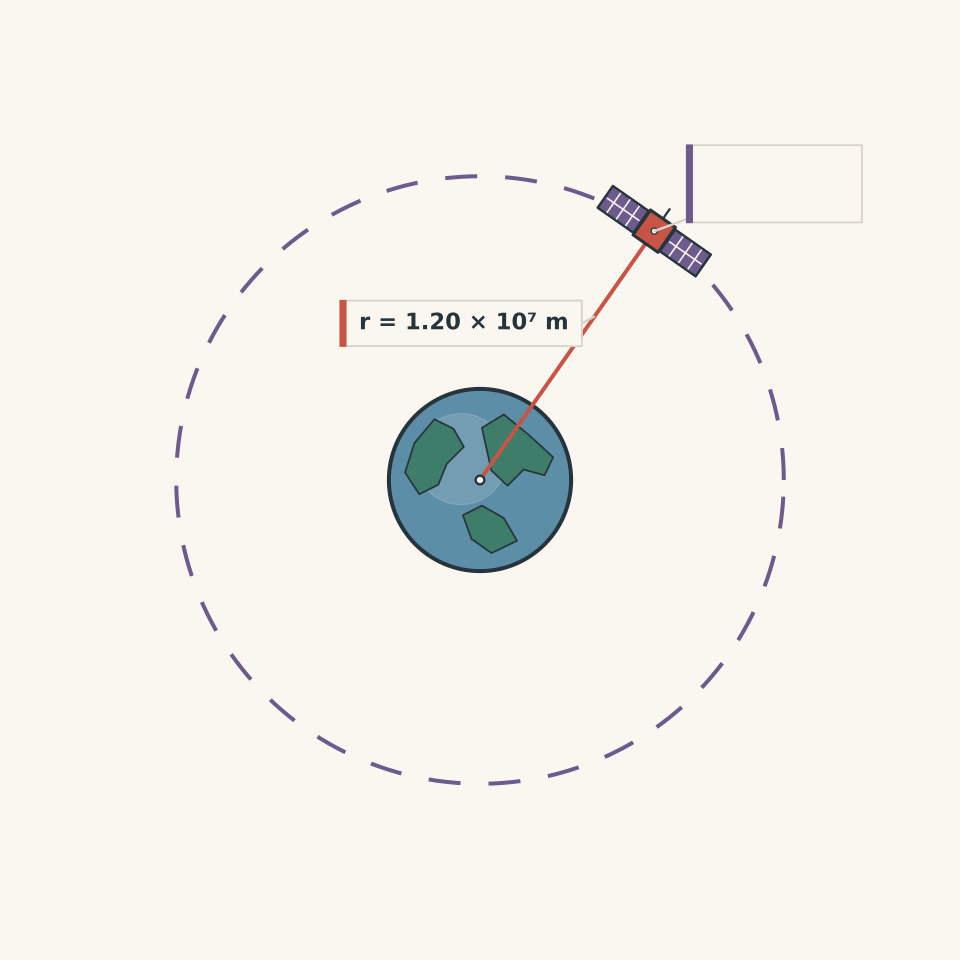
A satellite of mass \(750\ \mathrm{kg}\) moves in a circular orbit around an unknown planet.
The satellite’s orbital radius is \(1.20\times10^7\ \mathrm{m}\), and its kinetic energy is measured to be \(1.25\times10^{10}\ \mathrm{J}\).
(a) Calculate the mass of the planet. (4 marks)
(b) Determine the satellite’s gravitational potential energy and total mechanical energy. (2 marks)
(c) A second observation considers the same satellite in a different circular orbit around the same planet. Its total mechanical energy is now \(-6.25\times10^9\ \mathrm{J}\).
Calculate the new orbital radius. (3 marks)
03Worked solutions and marking guide
Solution 1
For a circular orbit, the gravitational force provides the centripetal force required to maintain circular motion.
Equating the gravitational force and centripetal force gives:
\[ \frac{GMm}{r^2}=\frac{mv^2}{r} \]
Rearranging:
\[ v^2=\frac{GM}{r} \]
Using \(K=\frac12mv^2\), the kinetic energy becomes:
\[ K=\frac{GMm}{2r} \]
The gravitational potential energy, using zero potential energy at infinity, is:
\[ U=-\frac{GMm}{r} \]
The total mechanical energy is the sum of these two energies:
\[ E=K+U \]
Therefore:
\[ E=-\frac{GMm}{2r} \]
These relationships apply to all the circular orbits in this paper.
(a) Gravitational potential energy (2 marks)
Use:
\[ U=-\frac{GMm}{r} \]
Substitute the given values:
\[ U=-\frac{ (6.67\times10^{-11}) (5.00\times10^{24})(850) }{ 8.00\times10^6 } \]
Therefore:
\[ \boxed{U=-3.54\times10^{10}\ \mathrm{J}} \]
The negative sign indicates that the satellite is gravitationally bound relative to the zero-energy reference at infinity.
Marking breakdown:
- Correct gravitational potential energy relationship: 1 mark.
- Correct substitution and numerical answer, including units and sign: 1 mark.
(b) Kinetic energy (2 marks)
Use:
\[ K=\frac{GMm}{2r} \]
Substitute:
\[ K=\frac{ (6.67\times10^{-11}) (5.00\times10^{24})(850) }{ 2(8.00\times10^6) } \]
Therefore:
\[ \boxed{K=1.77\times10^{10}\ \mathrm{J}} \]
Kinetic energy is positive because it is associated with the satellite’s motion.
Marking breakdown:
- Correct kinetic energy relationship: 1 mark.
- Correct substitution and numerical answer, including units: 1 mark.
(c) Total mechanical energy (3 marks)
Total mechanical energy is the sum of kinetic and gravitational potential energy.
\[ E=K+U \]
Substitute the calculated values:
\[ E=1.77\times10^{10} -3.54\times10^{10} \]
Therefore:
\[ \boxed{E=-1.77\times10^{10}\ \mathrm{J}} \]
The total energy is negative because the magnitude of the gravitational potential energy is greater than the kinetic energy.
This also demonstrates the circular-orbit relationship:
\[ E=-K=\frac{U}{2} \]
Marking breakdown:
- Correct use of \(E=K+U\): 1 mark.
- Correct substitution and calculation: 1 mark.
- Correct negative answer with units: 1 mark.
Question total: 7 marks.
Solution 2
The important relationship here is that kinetic energy and total mechanical energy are both inversely proportional to orbital radius for a fixed planet and satellite mass.
\[ K=\frac{GMm}{2r} \]
\[ E=-\frac{GMm}{2r} \]
Orbit B has twice the radius of Orbit A.
(a) Kinetic energy and orbital speed ratios (3 marks)
The kinetic energy is inversely proportional to orbital radius.
Therefore:
\[ \frac{K_B}{K_A}=\frac{r_A}{r_B} \]
Substitute:
\[ \frac{K_B}{K_A} =\frac{7.00\times10^6}{1.40\times10^7} \]
\[ \boxed{\frac{K_B}{K_A}=0.500} \]
Orbit B has half the kinetic energy of Orbit A.
To determine the speed ratio, use:
\[ K=\frac12mv^2 \]
Since the satellite mass is unchanged:
\[ \frac{K_B}{K_A} =\frac{v_B^2}{v_A^2} \]
Taking the square root:
\[ \frac{v_B}{v_A} =\sqrt{\frac{K_B}{K_A}} \]
\[ =\sqrt{0.500} \]
\[ \boxed{\frac{v_B}{v_A}=0.707} \]
The satellite travels more slowly in Orbit B.
Marking breakdown:
- Correct kinetic energy ratio: 1 mark.
- Correct relationship between kinetic energy and speed: 1 mark.
- Correct speed ratio: 1 mark.
(b) Total mechanical energy ratio (2 marks)
Total mechanical energy is also inversely proportional to orbital radius.
\[ \frac{E_B}{E_A}=\frac{r_A}{r_B} \]
Therefore:
\[ \boxed{\frac{E_B}{E_A}=0.500} \]
This means:
\[ E_B=0.5E_A \]
Both energies are negative.
For example, if:
\[ E_A=-100\ \mathrm{J} \]
then:
\[ E_B=-50\ \mathrm{J} \]
Since \(-50\) is greater than \(-100\), Orbit B has the higher total mechanical energy.
This is an important distinction: a higher total energy does not necessarily mean a greater energy magnitude.
Marking breakdown:
- Correct total energy ratio: 1 mark.
- Correct identification of Orbit B as having the higher (less negative) total energy: 1 mark.
(c) Explaining the energy changes (3 marks)
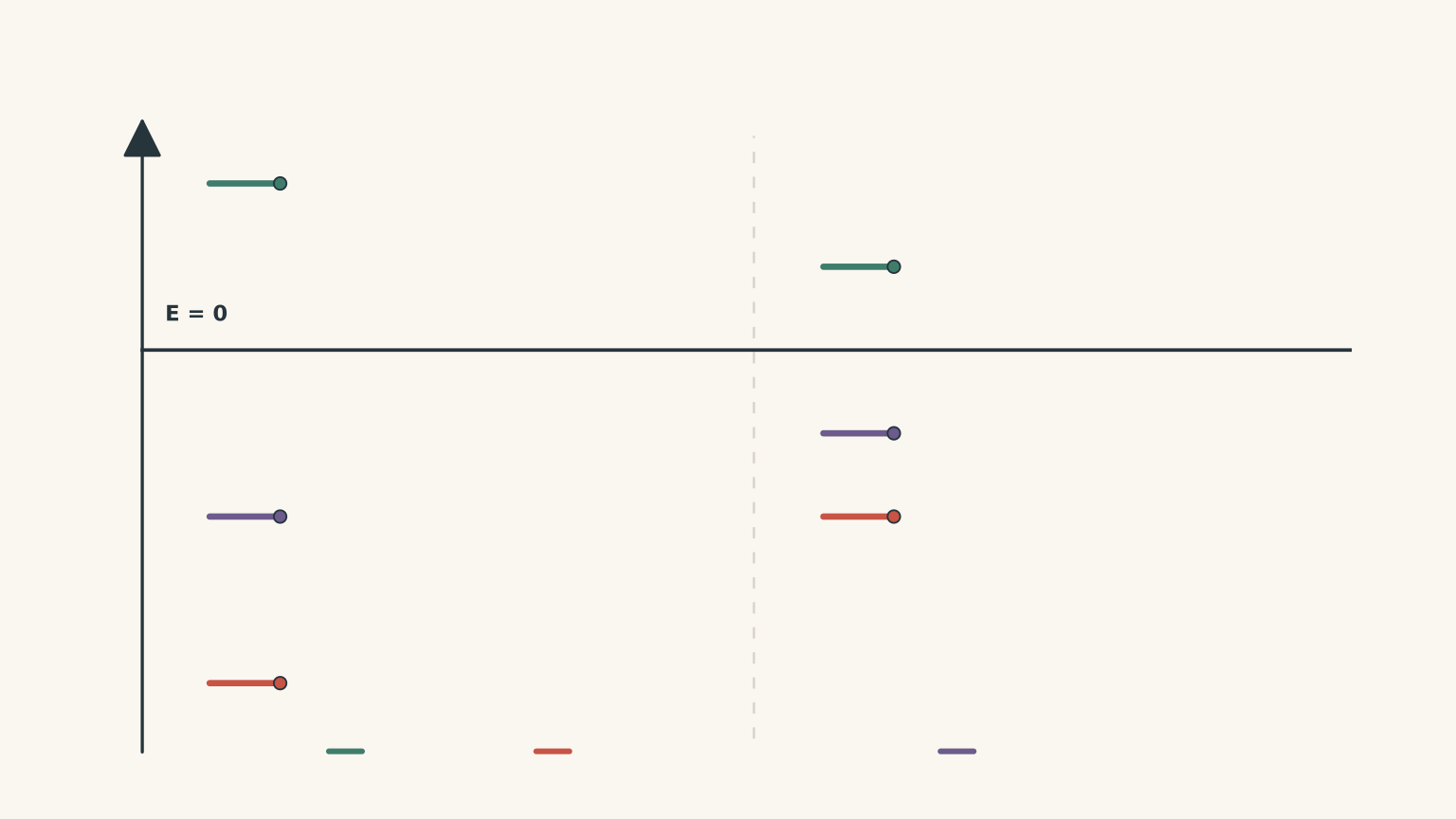
Moving to a higher circular orbit causes two changes.
First, the kinetic energy decreases because the satellite’s orbital speed decreases.
Second, the gravitational potential energy increases because it becomes less negative as the satellite moves further from the planet.
We can demonstrate this using the energy relationships.
Let the kinetic energy in Orbit A be \(K\).
For a circular orbit:
\[ U_A=-2K \]
Therefore:
\[ E_A=K-2K=-K \]
In Orbit B, the radius doubles, so:
\[ K_B=\frac{K}{2} \]
and:
\[ U_B=-K \]
The total energy becomes:
\[ E_B=\frac{K}{2}-K \]
\[ E_B=-\frac{K}{2} \]
Therefore:
\[ E_B>E_A \]
The potential energy increases by more than the kinetic energy decreases. The net result is an increase in total mechanical energy.
Marking breakdown:
- Identifies that kinetic energy decreases: 1 mark.
- Identifies that gravitational potential energy increases (becomes less negative): 1 mark.
- Explains that the net change produces a higher total mechanical energy: 1 mark.
Question total: 8 marks.
Solution 3
This question tests whether you can interpret orbital energy without relying entirely on calculations.
Remember:
\[ E=-\frac{GMm}{2r} \]
For a fixed planet and satellite, \(GMm/2\) is constant.
(a) Sign of total mechanical energy (2 marks)
The total mechanical energy is negative for any finite circular orbital radius.
\[ \boxed{E<0} \]
A negative total mechanical energy indicates that the satellite is gravitationally bound to the planet.
The satellite does not have enough total mechanical energy to reach infinite separation while retaining a non-negative total energy under the stated model.
Marking breakdown:
- Identifies that total energy is negative: 1 mark.
- Correctly explains that the satellite is in a bound orbit: 1 mark.
(b) Total mechanical energy at point B (2 marks)
We are given:
\[ r_B=3r_A \]
For the same planet and satellite:
\[ E\propto-\frac{1}{r} \]
Therefore:
\[ \frac{E_B}{E_A}=\frac{r_A}{r_B} \]
Substitute:
\[ E_B=E_A\left(\frac{r_A}{3r_A}\right) \]
\[ E_B=\frac{-1.20\times10^{10}}{3} \]
Therefore:
\[ \boxed{E_B=-4.00\times10^9\ \mathrm{J}} \]
Marking breakdown:
- Correctly applies the inverse-radius relationship: 1 mark.
- Correct numerical answer with sign and units: 1 mark.
(c) Change in total mechanical energy (2 marks)
Use:
\[ \Delta E=E_B-E_A \]
Substitute:
\[ \Delta E=(-4.00\times10^9) -(-1.20\times10^{10}) \]
Therefore:
\[ \boxed{\Delta E=+8.00\times10^9\ \mathrm{J}} \]
The positive change means the total mechanical energy has increased.
The final energy is less negative than the initial energy.
Marking breakdown:
- Correct subtraction using the initial and final energies: 1 mark.
- Correct positive result with units: 1 mark.
(d) Energy at infinite orbital radius (2 marks)
The total mechanical energy is:
\[ E=-\frac{GMm}{2r} \]
As the orbital radius approaches infinity:
\[ \lim_{r\to\infty}E=0 \]
Therefore:
\[ \boxed{E\to0\ \mathrm{J}} \]
The graph approaches zero from below because the total energy remains negative for every finite circular orbital radius.
The zero-energy reference is defined at infinite separation, where both the kinetic and gravitational potential energies approach zero.
Marking breakdown:
- Correct limiting value of zero: 1 mark.
- Explains why the curve approaches zero from below: 1 mark.
Question total: 8 marks.
Solution 4
This question examines how the mass of an orbiting satellite affects its energy.
Both satellites have the same orbital radius and orbit the same planet.
The kinetic and gravitational potential energies are proportional to satellite mass:
\[ K\propto m \]
\[ U\propto m \]
Total mechanical energy is also proportional to satellite mass:
\[ E\propto m \]
(a) Total mechanical energy of Satellite A (2 marks)
Use:
\[ E_A=-\frac{GMm_A}{2r} \]
Substitute:
\[ E_A=-\frac{ (6.67\times10^{-11}) (5.00\times10^{24})(300) }{ 2(1.00\times10^7) } \]
Therefore:
\[ \boxed{E_A=-5.00\times10^9\ \mathrm{J}} \]
Marking breakdown:
- Correct total energy equation and substitution: 1 mark.
- Correct numerical answer with sign and units: 1 mark.
(b) Energies of Satellite B (4 marks)
Satellite B has a mass of \(900\ \mathrm{kg}\).
First, calculate its kinetic energy:
\[ K_B=\frac{GMm_B}{2r} \]
\[ K_B=\frac{ (6.67\times10^{-11}) (5.00\times10^{24})(900) }{ 2(1.00\times10^7) } \]
\[ \boxed{K_B=1.50\times10^{10}\ \mathrm{J}} \]
Next, calculate its gravitational potential energy:
\[ U_B=-\frac{GMm_B}{r} \]
\[ U_B=-\frac{ (6.67\times10^{-11}) (5.00\times10^{24})(900) }{ 1.00\times10^7 } \]
\[ \boxed{U_B=-3.00\times10^{10}\ \mathrm{J}} \]
Finally, calculate the total mechanical energy:
\[ E_B=K_B+U_B \]
\[ E_B=1.50\times10^{10} -3.00\times10^{10} \]
\[ \boxed{E_B=-1.50\times10^{10}\ \mathrm{J}} \]
Marking breakdown:
- Correct kinetic energy calculation: 1 mark.
- Correct gravitational potential energy calculation: 1 mark.
- Correct use of \(E_B=K_B+U_B\): 1 mark.
- Correct total energy with sign and units: 1 mark.
(c) Energy ratio and orbital speeds (2 marks)
The ratio of total mechanical energies is:
\[ \frac{E_B}{E_A} = \frac{-1.50\times10^{10}} {-5.00\times10^9} \]
Therefore:
\[ \boxed{\frac{E_B}{E_A}=3.00} \]
Satellite B has three times the magnitude of total mechanical energy of Satellite A. Its total energy is more negative.
However, both satellites have the same orbital speed.
For a circular orbit:
\[ v=\sqrt{\frac{GM}{r}} \]
The orbital speed depends on the central planet’s mass and the orbital radius, not the satellite’s mass.
Since both satellites have the same \(M\) and \(r\):
\[ \boxed{v_A=v_B} \]
Marking breakdown:
- Correct energy ratio: 1 mark.
- Correctly identifies equal orbital speeds and explains why: 1 mark.
Question total: 8 marks.
Solution 5
This question requires you to rearrange the circular-orbit energy relationships to find an unknown quantity.
The kinetic energy of a satellite in a circular orbit is:
\[ K=\frac{GMm}{2r} \]
This relationship can be rearranged to determine the mass of the central planet.
(a) Mass of the planet (4 marks)
Start with:
\[ K=\frac{GMm}{2r} \]
Rearrange to make \(M\) the subject:
\[ 2Kr=GMm \]
\[ M=\frac{2Kr}{Gm} \]
Substitute the supplied values:
\[ M= \frac{ 2(1.25\times10^{10}) (1.20\times10^7) }{ (6.67\times10^{-11})(750) } \]
Simplifying:
\[ M= \frac{3.00\times10^{17}} {5.0025\times10^{-8}} \]
Therefore:
\[ \boxed{M=6.00\times10^{24}\ \mathrm{kg}} \]
Marking breakdown:
- Correctly identifies the kinetic energy relationship: 1 mark.
- Correct rearrangement to make \(M\) the subject: 1 mark.
- Correct substitution and calculation: 1 mark.
- Correct final answer with units and appropriate precision: 1 mark.
(b) Gravitational potential energy and total mechanical energy (2 marks)
For a circular orbit:
\[ U=-\frac{GMm}{r} \]
Compare this with:
\[ K=\frac{GMm}{2r} \]
Therefore:
\[ U=-2K \]
Substitute the given kinetic energy:
\[ U=-2(1.25\times10^{10}) \]
\[ \boxed{U=-2.50\times10^{10}\ \mathrm{J}} \]
Now calculate total mechanical energy:
\[ E=K+U \]
\[ E=1.25\times10^{10} -2.50\times10^{10} \]
Therefore:
\[ \boxed{E=-1.25\times10^{10}\ \mathrm{J}} \]
Notice that the total energy is equal to the negative of the kinetic energy.
Marking breakdown:
- Correct gravitational potential energy: 1 mark.
- Correct total mechanical energy, including the negative sign: 1 mark.
(c) New orbital radius (3 marks)
We are now given a new total mechanical energy:
\[ E=-6.25\times10^9\ \mathrm{J} \]
The satellite mass and planet mass remain unchanged.
Start with the total energy equation:
\[ E=-\frac{GMm}{2r} \]
Rearrange to make \(r\) the subject:
\[ r=-\frac{GMm}{2E} \]
Since \(E\) is negative, we can also write:
\[ r=\frac{GMm}{2|E|} \]
Substitute the values:
\[ r= \frac{ (6.67\times10^{-11}) (6.00\times10^{24})(750) }{ 2(6.25\times10^9) } \]
Simplifying:
\[ r=\frac{3.0015\times10^{17}} {1.25\times10^{10}} \]
Therefore:
\[ \boxed{r=2.40\times10^7\ \mathrm{m}} \]
The new orbital radius is twice the original radius.
This makes sense because the magnitude of the total energy has halved, and total energy is inversely proportional to orbital radius.
Marking breakdown:
- Correct rearrangement of the total energy equation: 1 mark.
- Correct substitution using the planet mass and new total energy: 1 mark.
- Correct orbital radius with units: 1 mark.
Question total: 9 marks.
04Final mark summary
| Question | Main skill assessed | Marks |
|---|---|---|
| 1 | Calculating kinetic, potential, and total energy | 7 |
| 2 | Comparing energy and speed at different orbital radii | 8 |
| 3 | Interpreting energy signs, changes, and graphs | 8 |
| 4 | Comparing orbital energies for different satellite masses | 8 |
| 5 | Rearranging energy relationships to find unknown quantities | 9 |
| Total | 40 |
Marking note: Accept mathematically equivalent methods. Follow-through marks are appropriate where a student makes an earlier numerical error but correctly applies the relevant relationship in a later part.
05Key relationships to remember after the exam
For a satellite of mass \(m\) in a circular orbit of radius \(r\) around a planet of mass \(M\):
| Energy | Relationship |
|---|---|
| Kinetic energy | \(K=\frac{GMm}{2r}\) |
| Gravitational potential energy | \(U=-\frac{GMm}{r}\) |
| Total mechanical energy | \(E=-\frac{GMm}{2r}\) |
The most useful relationships between these energies are:
\[ \boxed{U=-2K} \]
\[ \boxed{E=-K=\frac{U}{2}} \]
And remember the key comparison:
- A smaller orbital radius gives a greater kinetic energy and a more negative total energy.
- A larger orbital radius gives a smaller kinetic energy and a less negative total energy.
- A negative total mechanical energy indicates a bound orbit.
- As the orbital radius approaches infinity, total mechanical energy approaches zero from below.
One of the easiest mistakes in this topic is confusing a higher total energy with a greater energy magnitude. For negative values, \(-5\ \mathrm{J}\) is higher than \(-10\ \mathrm{J}\). Keep that distinction clear in calculations and explanations.