
HSC Chemistry: Ion Identification and Solubility Practice Exam
Test your understanding of ion identification and solubility applications with this original 60-mark HSC Chemistry practice paper. Includes timed exam questions, cycad detoxification applications, precipitation tests, and complete worked solutions with marking guides.
This original tutorgum practice paper assesses the chemistry-2017 syllabus scope on ionic dissolution, solubility rules, precipitation reactions, ion identification, and solubility-based food detoxification. It includes a focused case study of cycad fruit processing and applications of solubility equilibria in Indigenous food knowledge. This is a topic-specific revision paper, not a full-course examination or an official or NESA-endorsed paper.
01Exam instructions
Suggested working time: 75 minutes
Reading time: 5 minutes
Total marks: 60
Permitted equipment:
- Scientific calculator
- Periodic table
- Ruler
- Pen, pencil, and eraser
Instructions:
- Answer all six questions.
- Show all working for calculations. Answers without working may not receive full marks.
- Include appropriate units and use suitable significant figures.
- Write balanced chemical equations, including state symbols, where requested.
- For ionic equations, include only the ions and substances involved in the formation of the precipitate.
- Assume aqueous solutions are at room temperature unless stated otherwise.
- All numerical data and experimental observations required are provided.
The conditions above are suggested conditions for this original practice paper. They are not claims about official NESA examination requirements.
Mark allocation
| Question | Topic | Marks |
|---|---|---|
| 1 | Dissolution of ionic compounds | 8 |
| 2 | Precipitation reactions | 12 |
| 3 | Identification of unknown ions | 10 |
| 4 | Experimental solubility rules | 10 |
| 5 | Cycad fruit detoxification | 10 |
| 6 | Solubility equilibria in food processing | 10 |
| Total | 60 |
02Questions
Question 1 (8 marks)
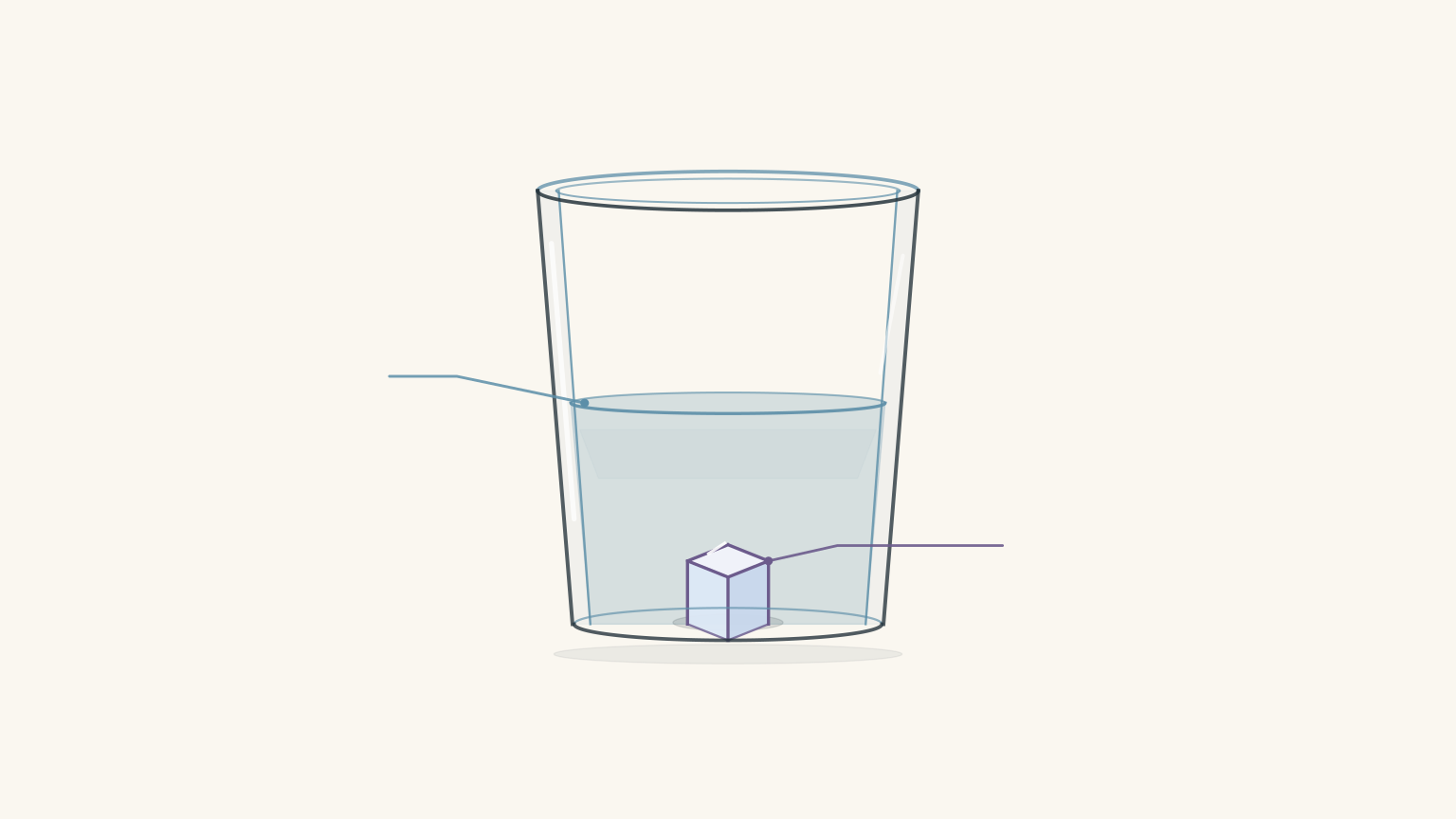
A student places a small crystal of sodium chloride, \(\ce{NaCl(s)}\), into a beaker of water and stirs until the solid is no longer visible.
(a) Describe what happens to the ionic lattice when sodium chloride dissolves in water. Include what happens to the \(\mathrm{Na}^{+}\) and \(\mathrm{Cl}^{-}\) ions. (2 marks)
(b) Draw a labelled particle diagram showing:
- One hydrated sodium ion.
- One hydrated chloride ion.
- The surrounding water molecules.
- The correct orientation of the water molecules around each ion.
Your diagram must include the partial charges on the water molecules. (3 marks)
(c) The dissolution of sodium chloride involves two energy changes:
| Process | Energy change |
|---|---|
| Separating one mole of sodium chloride into gaseous ions | \(+787\ \mathrm{kJ\,mol^{-1}}\) |
| Hydrating one mole of sodium ions and one mole of chloride ions | \(-783\ \mathrm{kJ\,mol^{-1}}\) |
Assume these are the only two energy contributions.
Calculate the overall enthalpy change for dissolving one mole of sodium chloride. State whether the dissolution is endothermic or exothermic. (3 marks)
Question 2 (12 marks)
Three pairs of aqueous ionic solutions are mixed separately. Assume each mixture produces a visible precipitate where an insoluble ionic compound forms.
For each mixture:
- Identify the precipitate.
- Write the balanced molecular equation, including state symbols.
- Write the net ionic equation.
- State the expected colour of the precipitate.
(a) Potassium chloride solution is mixed with silver nitrate solution.
\[ \ce{KCl(aq) + AgNO3(aq)} \]
(4 marks)
(b) Potassium iodide solution is mixed with lead(II) nitrate solution.
\[ \ce{KI(aq) + Pb(NO3)2(aq)} \]
(4 marks)
(c) Sodium sulfate solution is mixed with barium nitrate solution.
\[ \ce{Na2SO4(aq) + Ba(NO3)2(aq)} \]
(4 marks)
Question 3 (10 marks)
A laboratory technician is given three unlabelled aqueous solutions, P, Q, and R.
Each solution contains exactly one of the following anions:
- Chloride, \(\mathrm{Cl}^{-}\)
- Iodide, \(\mathrm{I}^{-}\)
- Sulfate, \(\mathrm{SO_{4}}^{2-}\)
The technician has access to:
- \(0.10\ \mathrm{mol\,L^{-1}}\) barium nitrate solution.
- \(0.10\ \mathrm{mol\,L^{-1}}\) silver nitrate solution.
- Clean test tubes and droppers.
(a) Describe an ordered sequence of tests that would distinguish all three anions.
Your answer must identify:
- Which reagent should be used first.
- What observation would identify one of the anions.
- Which samples should undergo the second test.
- How the second test distinguishes the remaining two anions.
Explain why fresh aliquots should be used when necessary. (5 marks)
(b) The technician obtains the following observations using the test sequence.
| Sample | After adding barium nitrate | After adding silver nitrate |
|---|---|---|
| P | White precipitate | Not tested |
| Q | No visible change | Pale-yellow precipitate |
| R | No visible change | White precipitate |
Identify the anion present in each sample. (3 marks)
(c) Write the net ionic equation for the positive test obtained with sample P. Include state symbols. (2 marks)
Question 4 (10 marks)
A chemistry class investigates the solubility of different ionic compounds by mixing aqueous solutions.
Equal volumes of solutions with the same concentration are mixed. The students record the following observations.
| Solutions mixed | Observation |
|---|---|
| \(\ce{NaCl(aq) + AgNO3(aq)}\) | White precipitate |
| \(\ce{KCl(aq) + AgNO3(aq)}\) | White precipitate |
| \(\ce{NaI(aq) + AgNO3(aq)}\) | Yellow precipitate |
| \(\ce{KI(aq) + AgNO3(aq)}\) | Yellow precipitate |
| \(\ce{Na2SO4(aq) + Ba(NO3)2(aq)}\) | White precipitate |
| \(\ce{K2SO4(aq) + Ba(NO3)2(aq)}\) | White precipitate |
| \(\ce{NaCl(aq) + Ba(NO3)2(aq)}\) | No visible change |
| \(\ce{KI(aq) + Ba(NO3)2(aq)}\) | No visible change |
| \(\ce{NaNO3(aq) + BaCl2(aq)}\) | No visible change |
A student examines the results and makes the following claim:
“A white precipitate always indicates the presence of sulfate ions.”
(a) Evaluate the student’s claim using evidence from the experimental results. (2 marks)
(b) Formulate two solubility patterns supported by the results:
- One pattern involving silver ions.
- One pattern involving barium ions.
Restrict your conclusions to the anions tested. (4 marks)
(c) A soluble sodium salt containing an unknown monovalent anion, \(\mathrm{X}^{-}\), is available.
Describe an experiment that could determine whether the barium salt of \(\mathrm{X}^{-}\) is insoluble. State the observation that would support your conclusion. (2 marks)
(d) Explain why observing no visible precipitate does not necessarily prove that a salt has zero solubility in water. (2 marks)
Question 5 (10 marks)
Cycad fruit processing provides a useful case study of solubility chemistry in Indigenous food knowledge.
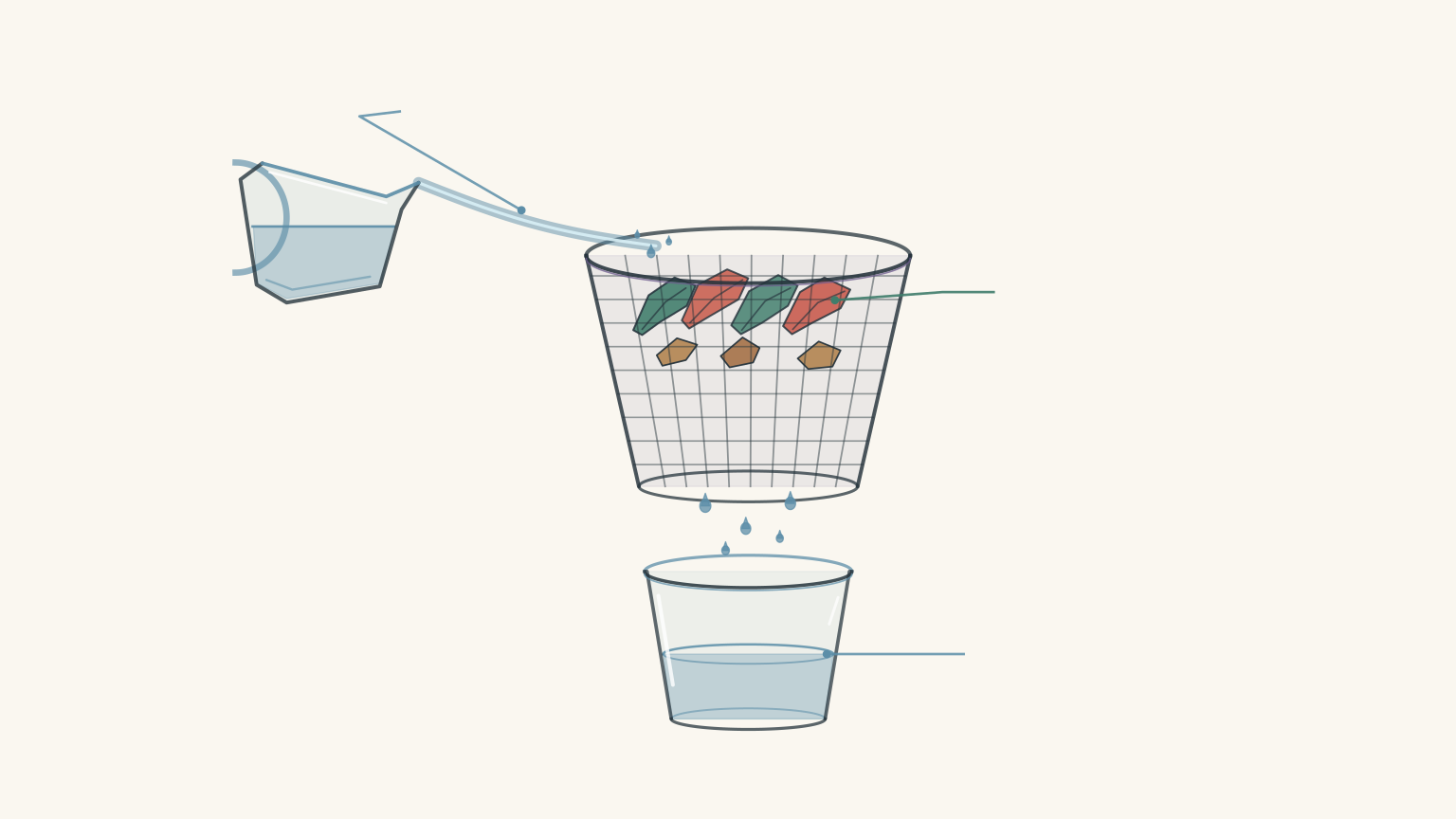
Some Aboriginal Australian communities have developed knowledge for processing particular cycad foods before they are used as food. The plant species, plant parts, and processing methods vary between communities. In some contexts, repeated washing or leaching helps remove water-soluble toxic compounds from plant material.
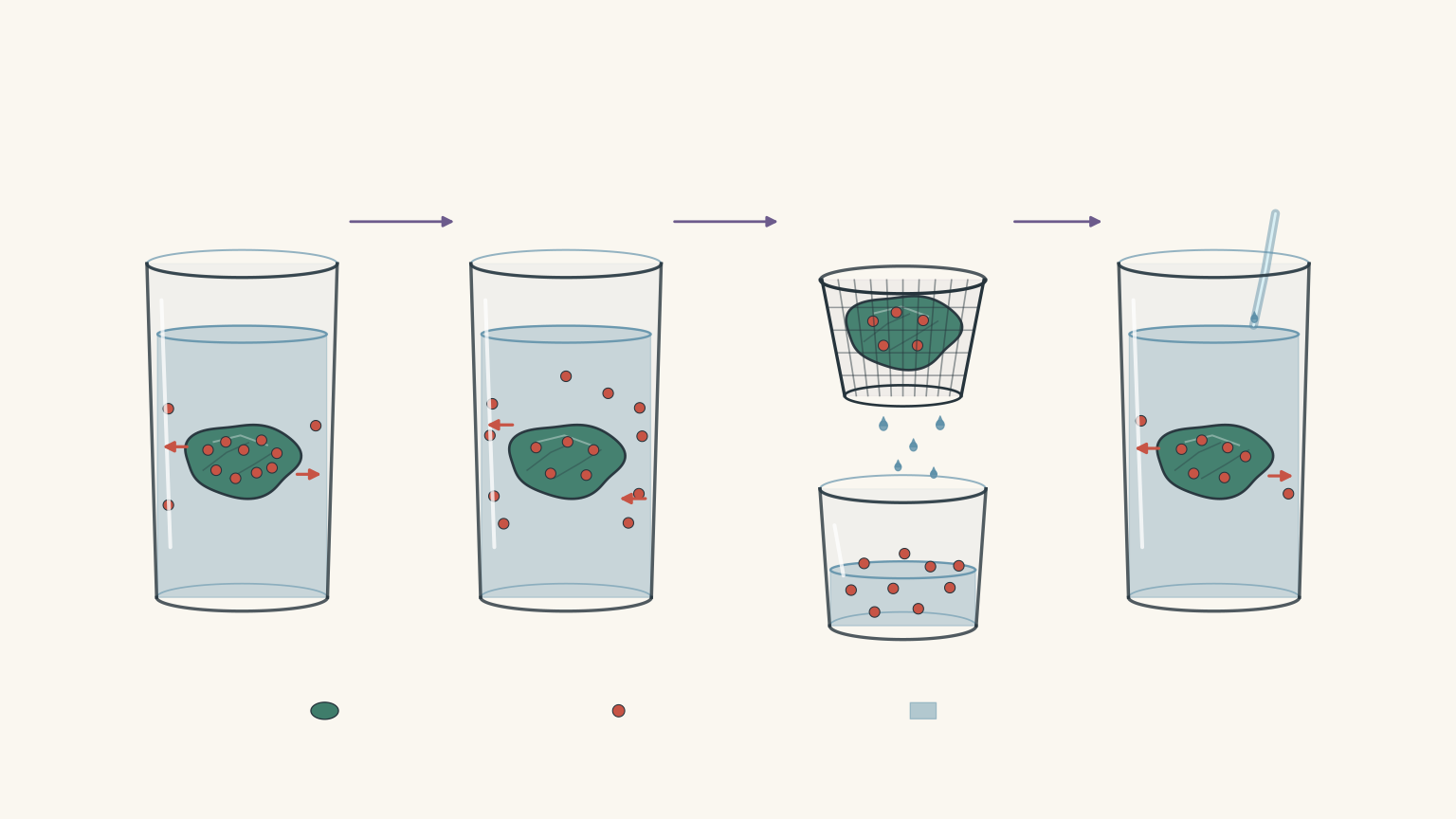
The chemistry focus in this question is the movement of soluble compounds from plant material into water. The following diagram represents a simplified model of leaching, not the equipment or procedure of any particular community.
For the following calculations, consider a notional plant-material sample containing \(160.0\ \mathrm{mg}\) of a water-soluble toxic compound before washing.
Under the simplified conditions of this question:
- \(65.0\%\) of the toxin remaining in the plant material transfers into the water during each wash.
- The wash water is discarded after each cycle.
- Fresh water is used for each subsequent wash.
- All toxin transferred into the water is removed when that water is discarded.
These numerical values are supplied for the mathematical model only. They are not measured values for any real cycad species or traditional processing method.
(a) Explain how washing with water can reduce the amount of toxin remaining in plant material. Your answer must refer to dissolution and the establishment of solubility equilibrium. (3 marks)
(b) Calculate the mass of toxin remaining in the plant material after two washes. Show your working. (3 marks)
(c) Calculate:
- The total mass of toxin removed after two washes.
- The percentage of the original toxin removed.
(2 marks)
(d) Give two reasons why the mathematical model cannot be used as a universal guide to cycad processing or as proof that a real processed cycad product is safe to eat. (2 marks)
Question 6 (10 marks)
Aboriginal and Torres Strait Islander Peoples hold diverse, place-specific knowledge about preparing foods. Some food-processing methods for selected plant foods use water to leach water-soluble compounds, reducing the amount of certain naturally occurring toxins remaining in the food.
The particular foods, toxins, and processing methods are specific to their cultural and environmental contexts. The following investigation is a simplified chemistry model, not a description of a named community’s traditional practice.
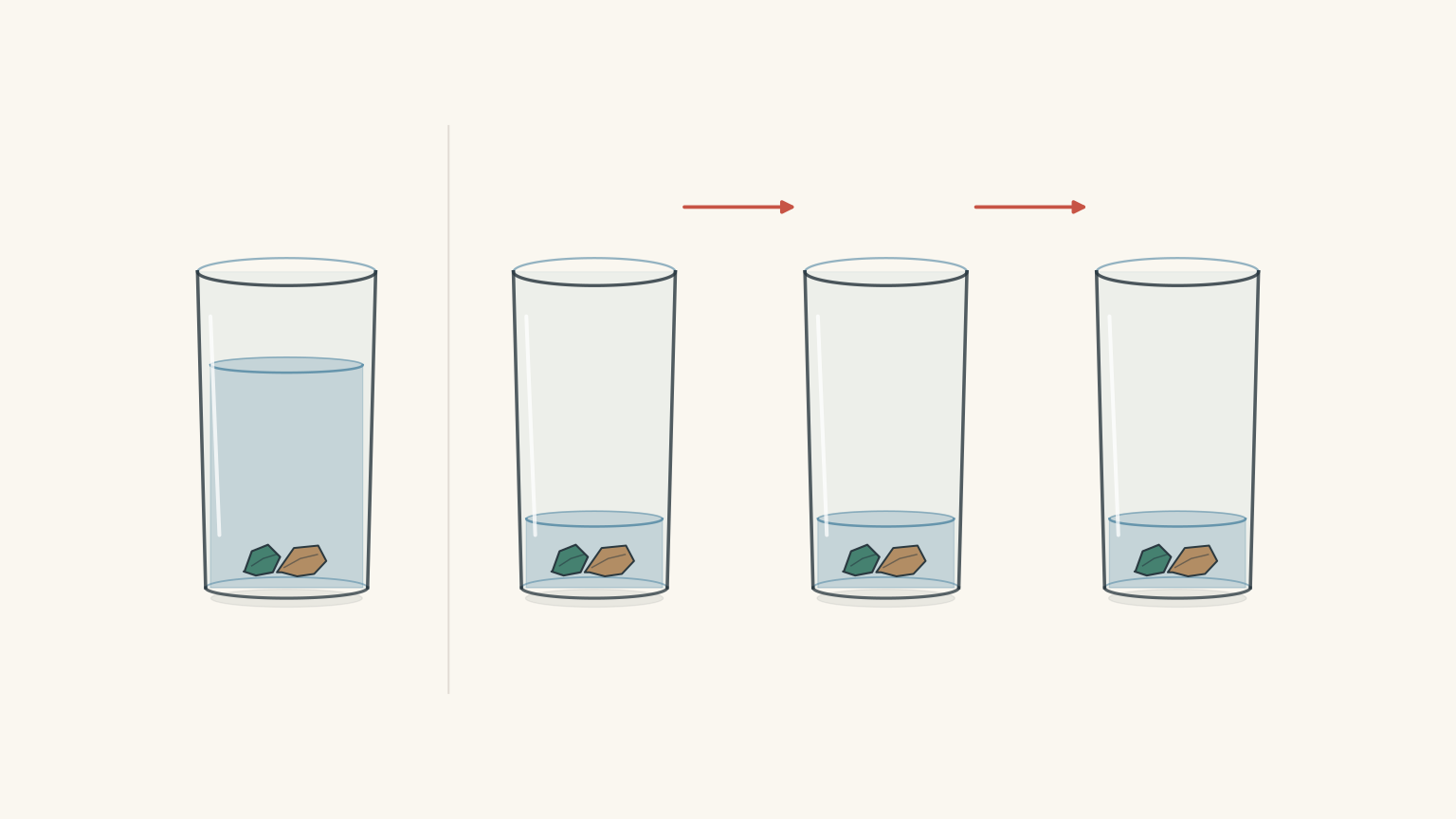
Two equal samples of plant tissue each initially contain \(120.0\ \mathrm{mg}\) of a hypothetical water-soluble toxin.
Two washing methods are compared.
- Method A uses one wash with \(600\ \mathrm{mL}\) of fresh water.
- Method B uses three consecutive washes, each with \(200\ \mathrm{mL}\) of fresh water. The water is discarded after each wash.
Both methods use the same total volume of water. All other conditions are held constant, and each wash is allowed to reach equilibrium before the water is removed.
The experimental results are:
| Measurement | Method A | Method B |
|---|---|---|
| Initial toxin in plant tissue | 120.0 mg | 120.0 mg |
| Toxin remaining after wash 1 | 54.0 mg | 78.0 mg |
| Toxin remaining after wash 2 | Not applicable | 51.0 mg |
| Toxin remaining after wash 3 | Not applicable | 33.0 mg |
Assume all toxin removed from the plant tissue enters the wash water.
(a) Calculate the percentage of the original toxin removed using:
(i) Method A. (2 marks)
(ii) Method B. (2 marks)
(b) Calculate the concentration of toxin in the third wash water used in Method B.
Express your answer in \(\mathrm{mg\,L^{-1}}\). (2 marks)
(c) Explain, using the concept of solubility equilibrium, why Method B removes more toxin than Method A despite both methods using the same total volume of water. (2 marks)
(d) State two additional pieces of information that would be needed before deciding whether the final plant-tissue sample is safe to eat. (2 marks)
03Worked solutions and marking guide
Solution 1
(a) Dissolution of the ionic lattice (2 marks)
Solid sodium chloride consists of a regular ionic lattice containing alternating positive sodium ions and negative chloride ions.
When sodium chloride dissolves:
- Attractions between the ions in the lattice are overcome, allowing the ions to separate.
- The separated ions become surrounded by water molecules and disperse throughout the solution.
The ions do not disappear or turn into neutral atoms. They remain as \(\mathrm{Na}^{+}\) and \(\mathrm{Cl}^{-}\) ions in the aqueous solution.
Marking guide:
- 1 mark: Identifies separation of ions from the ionic lattice.
- 1 mark: Identifies that the separated ions become hydrated and disperse through the water.
(b) Hydration of ions (3 marks)
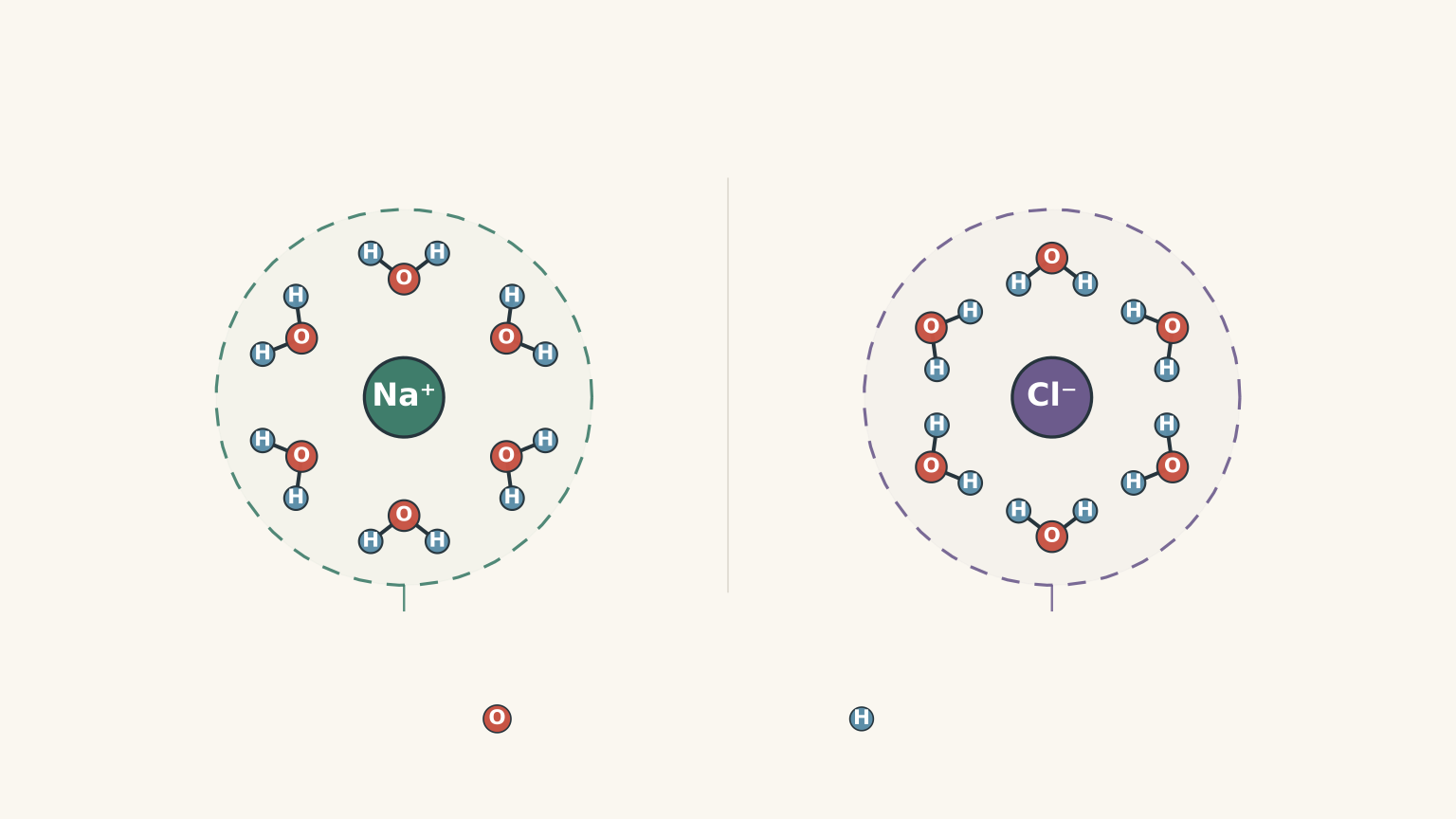
Water is a polar molecule. This means its electrical charge is distributed unevenly.
- The oxygen end has a partial negative charge, \(\delta-\).
- The hydrogen ends have partial positive charges, \(\delta+\).
The orientation of water molecules depends on the charge of the ion being hydrated.
For a sodium ion, \(\mathrm{Na}^{+}\), the partially negative oxygen end of each water molecule points towards the positive ion.
For a chloride ion, \(\mathrm{Cl}^{-}\), the partially positive hydrogen ends point towards the negative ion.
This surrounding arrangement of water molecules is called a hydration shell.
Marking guide:
- 1 mark: Correctly identifies the polarity of water, including partial charges.
- 1 mark: Shows oxygen ends directed towards \(\mathrm{Na}^{+}\).
- 1 mark: Shows hydrogen ends directed towards \(\mathrm{Cl}^{-}\).
(c) Energy changes during dissolution (3 marks)
Dissolving an ionic compound involves two competing energy changes.
First, energy is required to separate the ions from the ionic lattice. This is an endothermic process.
Second, energy is released when water molecules attract and surround the separated ions. This is an exothermic process called hydration.
The overall enthalpy change is the sum of these two contributions.
\[ \begin{aligned} \Delta H_{\mathrm{soln}} &= \Delta H_{\mathrm{lattice}} +\Delta H_{\mathrm{hydration}}\\ &= 787+(-783)\\ &= +4\ \mathrm{kJ\,mol^{-1}} \end{aligned} \]
Therefore:
\[ \boxed{\Delta H_{\mathrm{soln}}=+4\ \mathrm{kJ\,mol^{-1}}} \]
The positive value means that more energy is absorbed during lattice separation than is released during hydration.
The dissolution is therefore slightly endothermic.
Marking guide:
- 1 mark: Correctly adds the two energy contributions.
- 1 mark: Obtains \(+4\ \mathrm{kJ\,mol^{-1}}\).
- 1 mark: Correctly identifies the process as endothermic.
Solution 2
(a) Potassium chloride and silver nitrate (4 marks)
The ions present before mixing are:
- \(\mathrm{K}^{+}\)
- \(\mathrm{Cl}^{-}\)
- \(\mathrm{Ag}^{+}\)
- \(\ce{NO3-}\)
Silver ions combine with chloride ions to form silver chloride, which is insoluble in water.
The precipitate is \(\ce{AgCl(s)}\).
Balanced molecular equation:
\[ \ce{KCl(aq) + AgNO3(aq) -> AgCl(s) + KNO3(aq)} \]
Net ionic equation:
\[ \ce{Ag+(aq) + Cl-(aq) -> AgCl(s)} \]
The precipitate is white.
Potassium and nitrate ions remain dissolved in the solution. They are spectator ions because they do not participate in the formation of the precipitate.
Marking guide:
- 1 mark: Correct precipitate, \(\ce{AgCl(s)}\).
- 1 mark: Correct balanced molecular equation.
- 1 mark: Correct net ionic equation.
- 1 mark: Identifies the white precipitate.
(b) Potassium iodide and lead(II) nitrate (4 marks)
The important ions are \(\mathrm{Pb}^{2+}\) and \(\mathrm{I}^{-}\).
These ions combine to form lead(II) iodide, an insoluble ionic compound.
The precipitate is \(\ce{PbI2(s)}\).
Balanced molecular equation:
\[ \ce{2KI(aq) + Pb(NO3)2(aq) -> PbI2(s) + 2KNO3(aq)} \]
Notice that two iodide ions are required for every lead(II) ion because the charges must balance.
Net ionic equation:
\[ \ce{Pb^2+(aq) + 2I-(aq) -> PbI2(s)} \]
The precipitate is bright yellow.
Marking guide:
- 1 mark: Correct precipitate, \(\ce{PbI2(s)}\).
- 1 mark: Correctly balanced molecular equation.
- 1 mark: Correct net ionic equation, including the coefficient of two iodide ions.
- 1 mark: Identifies the yellow precipitate.
(c) Sodium sulfate and barium nitrate (4 marks)
The important ions are \(\mathrm{Ba}^{2+}\) and \(\mathrm{SO_{4}}^{2-}\).
These ions combine to form barium sulfate, which is insoluble in water.
The precipitate is \(\ce{BaSO4(s)}\).
Balanced molecular equation:
\[ \ce{Na2SO4(aq) + Ba(NO3)2(aq) -> BaSO4(s) + 2NaNO3(aq)} \]
Net ionic equation:
\[ \ce{Ba^2+(aq) + SO4^2-(aq) -> BaSO4(s)} \]
The precipitate is white.
Marking guide:
- 1 mark: Correct precipitate, \(\ce{BaSO4(s)}\).
- 1 mark: Correct balanced molecular equation.
- 1 mark: Correct net ionic equation.
- 1 mark: Identifies the white precipitate.
Equivalent correctly balanced equations receive full marks.
Solution 3
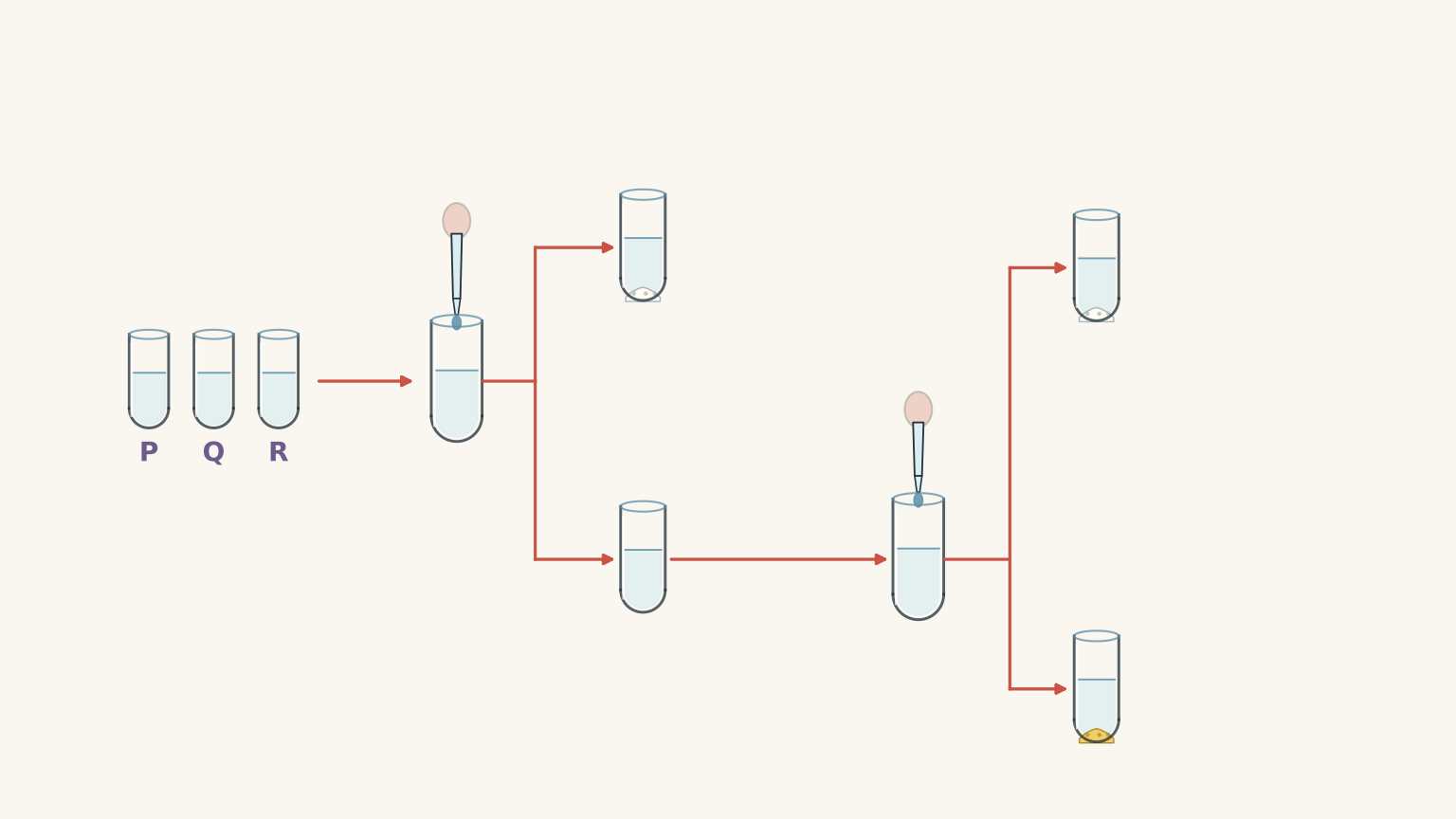
(a) Ordered sequence of ion identification tests (5 marks)
The best approach is to test for sulfate ions first, followed by chloride and iodide ions.
This order is important because silver sulfate has limited solubility. Testing with silver nitrate before identifying sulfate could introduce ambiguity.
Step 1: Test for sulfate ions.
Take a fresh aliquot of each unknown solution.
Add a few drops of barium nitrate solution to each sample.
Observe the results.
- A white precipitate indicates the presence of sulfate ions.
- No visible precipitate indicates that sulfate has not been identified.
The reaction responsible for the positive sulfate test is:
\[ \ce{Ba^2+(aq) + SO4^2-(aq) -> BaSO4(s)} \]
Step 2: Distinguish chloride and iodide ions.
Take fresh aliquots of the samples that did not produce a precipitate with barium nitrate.
Add silver nitrate solution.
Observe the precipitate colour.
- White precipitate: chloride ions are present.
- Pale-yellow precipitate: iodide ions are present.
The relevant reactions are:
\[ \ce{Ag+(aq) + Cl-(aq) -> AgCl(s)} \]
\[ \ce{Ag+(aq) + I-(aq) -> AgI(s)} \]
Using fresh aliquots prevents contamination from the first test and avoids introducing additional ions that could interfere with the second test.
Marking guide:
- 1 mark: Uses separate aliquots for the tests.
- 1 mark: Selects barium nitrate as the first reagent.
- 1 mark: Correctly identifies sulfate from a white precipitate.
- 1 mark: Uses silver nitrate on samples that did not precipitate in the first test.
- 1 mark: Correctly distinguishes chloride and iodide using precipitate colours.
(b) Identification of samples (3 marks)
Use the observations from the table.
| Sample | Observation | Identified anion |
|---|---|---|
| P | White precipitate with barium nitrate | Sulfate, \(\mathrm{SO_{4}}^{2-}\) |
| Q | Pale-yellow precipitate with silver nitrate | Iodide, \(\mathrm{I}^{-}\) |
| R | White precipitate with silver nitrate | Chloride, \(\mathrm{Cl}^{-}\) |
Therefore:
- P contains sulfate ions.
- Q contains iodide ions.
- R contains chloride ions.
Marking guide:
- 1 mark: Correctly identifies P.
- 1 mark: Correctly identifies Q.
- 1 mark: Correctly identifies R.
(c) Net ionic equation for sample P (2 marks)
Sample P produced a white precipitate when barium nitrate was added.
This identifies sulfate ions reacting with barium ions.
\[ \boxed{ \ce{Ba^2+(aq) + SO4^2-(aq) -> BaSO4(s)} } \]
Marking guide:
- 1 mark: Correct reactant ions and precipitate formula.
- 1 mark: Correct coefficients, charges, and state symbols.
Solution 4
(a) Evaluating the student’s claim (2 marks)
The student’s claim is incorrect.
A white precipitate does not uniquely identify sulfate ions.
For example, mixing sodium chloride and silver nitrate produces a white silver chloride precipitate:
\[ \ce{Ag+(aq) + Cl-(aq) -> AgCl(s)} \]
Mixing sodium sulfate and barium nitrate also produces a white precipitate:
\[ \ce{Ba^2+(aq) + SO4^2-(aq) -> BaSO4(s)} \]
Both reactions produce white solids.
Therefore, precipitate colour alone is insufficient to identify an unknown anion. The reagent used must also be considered.
Marking guide:
- 1 mark: Rejects the claim.
- 1 mark: Uses silver chloride as evidence that a non-sulfate ion can produce a white precipitate.
(b) Formulating solubility patterns (4 marks)
The experimental results support the following patterns.
Pattern 1: Silver ions
When silver nitrate is mixed with chloride-containing solutions, a white precipitate forms.
When silver nitrate is mixed with iodide-containing solutions, a yellow precipitate forms.
This supports the conclusion that silver chloride and silver iodide are insoluble under the experimental conditions.
\[ \ce{AgCl(s)} \]
\[ \ce{AgI(s)} \]
Pattern 2: Barium ions
When barium nitrate is mixed with sulfate-containing solutions, a white precipitate forms.
However, mixing barium nitrate with chloride- or iodide-containing solutions produces no visible precipitate.
This supports the conclusion that barium sulfate is insoluble, while barium chloride and barium iodide remain sufficiently soluble under the tested conditions.
\[ \ce{BaSO4(s)} \]
Marking guide:
- 1 mark: Identifies the precipitation of silver chloride.
- 1 mark: Identifies the precipitation of silver iodide.
- 1 mark: Identifies the precipitation of barium sulfate.
- 1 mark: Correctly interprets the absence of precipitation with chloride and iodide in the barium tests.
(c) Testing an unknown anion (2 marks)
Prepare a mixture of the soluble sodium salt containing \(\mathrm{X}^{-}\) and barium nitrate solution.
For example:
\[ \ce{2NaX(aq) + Ba(NO3)2(aq)} \]
If an insoluble barium salt forms, a precipitate will appear.
The possible reaction is:
\[ \ce{Ba^2+(aq) + 2X-(aq) -> BaX2(s)} \]
A visible precipitate would support the conclusion that the barium salt is insoluble under the experimental conditions.
If no precipitate forms, the barium salt may be sufficiently soluble at the tested concentrations.
For a stronger experiment, a known positive control and a negative control could also be tested under identical conditions.
Marking guide:
- 1 mark: Correctly selects a soluble \(\mathrm{X}^{-}\) solution and barium nitrate as the reagents.
- 1 mark: Identifies precipitate formation as evidence of an insoluble barium salt.
(d) Limitations of precipitation tests (2 marks)
No visible precipitate does not mean a compound has zero solubility.
A salt may dissolve sufficiently at the tested concentration that no solid forms.
Alternatively, the solution may contain a small amount of an insoluble compound that remains below the visual detection limit.
The observation only establishes that no detectable precipitate formed under the specific experimental conditions.
Marking guide:
- 1 mark: Recognises that some salts are soluble or sufficiently soluble at the tested concentration.
- 1 mark: Recognises the limitation of visual detection or the influence of experimental conditions.
Solution 5
(a) Dissolution and solubility equilibrium in cycad processing (3 marks)
Water can dissolve certain toxic compounds present in plant material.
When the plant material is washed, water comes into contact with the soluble compounds. Some of these compounds dissolve and move from the plant tissue into the surrounding water.
As the concentration of dissolved toxin in the water increases, the net transfer of toxin from the plant material slows. The system approaches an equilibrium distribution between the plant material and the water.
When the used water is discarded, the dissolved toxin is physically removed.
Replacing it with fresh water creates conditions that allow further toxin to dissolve from the plant material.
Repeated washing can therefore reduce the amount of water-soluble toxin remaining in the material.
Marking guide:
- 1 mark: Explains that water dissolves water-soluble toxic compounds from the plant material.
- 1 mark: Explains that dissolved concentration increases as the system approaches equilibrium, reducing net transfer.
- 1 mark: Explains that discarding the water and introducing fresh water allows further removal.
(b) Mass remaining after two washes (3 marks)
The initial mass of toxin is:
\[ m_0=160.0\ \mathrm{mg} \]
Each wash transfers \(65.0\%\) of the remaining toxin into the water.
Therefore, the percentage remaining after each wash is:
\[ 100\%-65.0\%=35.0\% \]
As a decimal:
\[ 35.0\%=0.350 \]
After the first wash:
\[ m_1=160.0\times0.350 \]
\[ m_1=56.0\ \mathrm{mg} \]
After the second wash:
\[ m_2=56.0\times0.350 \]
\[ \boxed{m_2=19.6\ \mathrm{mg}} \]
Therefore, \(19.6\ \mathrm{mg}\) of toxin remains after two washes.
Marking guide:
- 1 mark: Correctly determines the remaining fraction of \(0.350\).
- 1 mark: Correctly calculates the mass remaining after the first wash.
- 1 mark: Correctly calculates \(19.6\ \mathrm{mg}\) after the second wash.
(c) Total mass and percentage removed (2 marks)
The original mass was \(160.0\ \mathrm{mg}\).
The remaining mass is \(19.6\ \mathrm{mg}\).
Therefore, the mass removed is:
\[ m_{\mathrm{removed}}=160.0-19.6 \]
\[ \boxed{m_{\mathrm{removed}}=140.4\ \mathrm{mg}} \]
To calculate the percentage removed:
\[ \begin{aligned} \%\text{ removed} &=\frac{140.4}{160.0}\times100\\ &=87.75\% \end{aligned} \]
To three significant figures:
\[ \boxed{87.8\%} \]
Marking guide:
- 1 mark: Correctly calculates the mass removed as \(140.4\ \mathrm{mg}\).
- 1 mark: Correctly calculates the percentage removed as approximately \(87.8\%\).
(d) Limitations of the model (2 marks)
There are several important limitations.
First, the model assumes that \(65.0\%\) of the remaining toxin transfers into the water during every wash. Actual transfer would depend on factors such as the cycad species, the chemical identity of the toxin, the physical properties of the plant material, and the processing conditions.
Second, the calculation does not establish that the remaining material is safe to eat. We have not been given the toxicity threshold, the amount of toxin that is harmful, or information about any other toxic compounds that may be present.
There is also an important cultural consideration. Cycad processing knowledge is specific to particular communities, environments, and plant species. It must not be presented as one universal practice shared by all Aboriginal and Torres Strait Islander Peoples.
The chemistry model explains one part of a broader body of Indigenous ecological and food-processing knowledge. It does not replace or fully describe that knowledge.
Cycads can be highly toxic. These calculations are not a guide to processing or consuming cycad material.
Marking guide:
- 1 mark: Identifies a limitation relating to actual species, toxin properties, or processing conditions.
- 1 mark: Identifies the absence of a demonstrated safe toxicity threshold or recognises the need to respect community-specific knowledge.
Solution 6
(a) Percentage of toxin removed (4 marks)
The general formula is:
\[ \%\text{ removed} = \frac{\text{initial mass}-\text{remaining mass}} {\text{initial mass}}\times100 \]
(i) Method A: One 600 mL wash (2 marks)
Initial mass:
\[ 120.0\ \mathrm{mg} \]
Remaining mass:
\[ 54.0\ \mathrm{mg} \]
Mass removed:
\[ 120.0-54.0=66.0\ \mathrm{mg} \]
Percentage removed:
\[ \begin{aligned} \%\text{ removed} &=\frac{66.0}{120.0}\times100\\ &=\boxed{55.0\%} \end{aligned} \]
Method A removes \(55.0\%\) of the original toxin.
(ii) Method B: Three 200 mL washes (2 marks)
Initial mass:
\[ 120.0\ \mathrm{mg} \]
Remaining mass after the third wash:
\[ 33.0\ \mathrm{mg} \]
Mass removed:
\[ 120.0-33.0=87.0\ \mathrm{mg} \]
Percentage removed:
\[ \begin{aligned} \%\text{ removed} &=\frac{87.0}{120.0}\times100\\ &=\boxed{72.5\%} \end{aligned} \]
Method B removes \(72.5\%\) of the original toxin.
Comparison:
| Method | Percentage removed |
|---|---|
| A: One 600 mL wash | 55.0% |
| B: Three 200 mL washes | 72.5% |
Method B removes a greater percentage of the toxin, even though both methods use the same total volume of water.
Marking guide:
- Method A: 1 mark for mass removed, 1 mark for percentage.
- Method B: 1 mark for mass removed, 1 mark for percentage.
(b) Concentration in the third wash water (2 marks)
First, determine how much toxin enters the third wash.
After the second wash, the plant tissue contains:
\[ 51.0\ \mathrm{mg} \]
After the third wash, it contains:
\[ 33.0\ \mathrm{mg} \]
Therefore, the mass transferred into the third wash water is:
\[ 51.0-33.0=18.0\ \mathrm{mg} \]
The volume of the third wash is:
\[ 200\ \mathrm{mL}=0.200\ \mathrm{L} \]
Concentration is calculated using:
\[ c=\frac{m}{V} \]
Substituting:
\[ \begin{aligned} c&=\frac{18.0}{0.200}\\ &=90.0\ \mathrm{mg\,L^{-1}} \end{aligned} \]
Therefore:
\[ \boxed{c=90.0\ \mathrm{mg\,L^{-1}}} \]
Marking guide:
- 1 mark: Correctly calculates the mass transferred during the third wash.
- 1 mark: Correctly calculates the concentration with appropriate units.
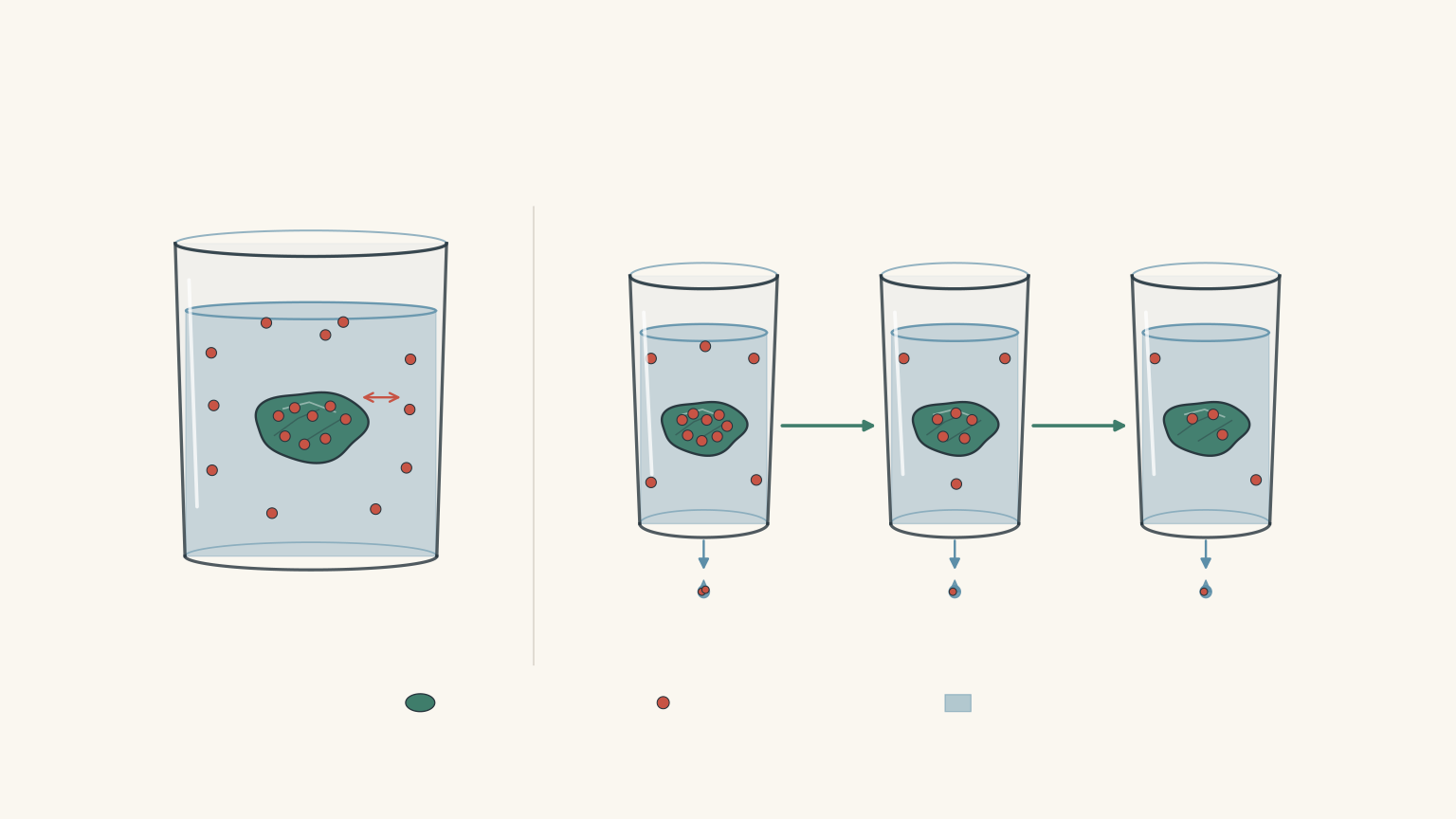
(c) Why repeated fresh-water washes are more effective (2 marks)
During a wash, water dissolves some of the toxin from the plant material.
As more toxin enters the water, its concentration increases. The system approaches equilibrium, and the net transfer of additional toxin into the water becomes smaller.
With Method A, the same water remains in contact with the plant material throughout the wash. Its dissolved toxin concentration increases as extraction continues.
With Method B, the water is discarded after each wash and replaced with fresh water.
Fresh water initially contains very little of the dissolved toxin. This creates favourable conditions for further toxin to transfer from the plant material into the water.
The repeated replacement of water therefore allows more toxin to be removed overall.
Marking guide:
- 1 mark: Explains that a single wash approaches equilibrium as dissolved toxin accumulates in the water.
- 1 mark: Explains that replacing the water with fresh water allows further net dissolution and removal.
(d) Further information needed to establish food safety (2 marks)
Knowing how much toxin remains is not enough to determine whether a food is safe.
Two important pieces of additional information are:
- The identity and toxicity of the compound, including the concentration or amount that could cause harm.
- The safe exposure threshold for the relevant food and the possibility of other toxic compounds remaining in the plant material.
Other factors, such as variation between plant samples and uncertainty in the experimental measurements, could also affect a real food-safety assessment.
A successful reduction in toxin concentration does not automatically establish that the remaining material is safe to consume.
Marking guide:
- 1 mark: Identifies the toxin’s chemical identity, toxicity, or a relevant safe exposure threshold.
- 1 mark: Identifies another relevant safety consideration, such as additional toxins, residual exposure, or experimental uncertainty.
End of paper – 60 marks