
Ion Identification and Solubility: HSC Chemistry Practice Exam
Test your understanding of ion identification and solubility applications with this original 40-mark Chemistry practice exam. Includes timed exam conditions, experimental scenarios, precipitation reactions, and fully worked solutions with a detailed marking guide.
This original tutorgum practice paper assesses ion identification and solubility applications from the supplied Chemistry 11-12 (2025) syllabus scope. It tests your understanding of how ionic compounds dissolve, how solubility rules are established experimentally, how unknown ions can be identified, and how lead-phosphate solubility equilibria can be applied to environmental monitoring.
The paper is designed to test more than your ability to memorise solubility rules. You’ll need to interpret experimental observations, select appropriate reagents, construct balanced equations, and evaluate the limitations of chemical tests.
01Exam instructions
Assessment details
| Condition | Details |
|---|---|
| Suggested reading time | 5 minutes |
| Suggested working time | 50 minutes |
| Total marks | 40 |
| Permitted equipment | Scientific calculator, periodic table, writing equipment and ruler |
| Reference material | No notes or solubility table |
| Paper type | Focused topic practice paper |
This is an original tutorgum practice paper. It is not an official, endorsed, past, or predicted NESA examination. It assesses the supplied Chemistry 11-12 (2025) topic scope, rather than the full Chemistry course.
Assessed topics
- Particle and energy processes involved in the dissolution of ionic compounds in water.
- Experimental determination and application of solubility rules.
- Prediction and analysis of precipitation reactions.
- Experimental identification of two unknown ions in an aqueous solution.
- Environmental applications of lead and phosphate solubility equilibria.
Exclusions
This paper does not assess quantitative \(K_{sp}\) calculations, other equilibrium calculations, acid-base calculations, or unrelated Chemistry course content.
General assumptions
- All aqueous solutions are at \(25^\circ\mathrm{C}\), unless otherwise stated.
- A precipitate is an insoluble or sparingly soluble solid formed when aqueous solutions are mixed.
- Aqueous solutions are represented by (aq), solids by (s), and liquids by (l).
- Unless a question states otherwise, assume there are no interfering ions.
- Where an experiment reports no visible precipitate, interpret this as no detectable solid under the stated experimental conditions. It does not necessarily mean that the substance has zero solubility.
Show all working for calculations. Write balanced chemical equations with appropriate state symbols. Include chemical reasoning when explaining experimental observations.
02Questions
Question 1 (8 marks)
An ionic compound dissolves in water through a series of particle and energy changes.
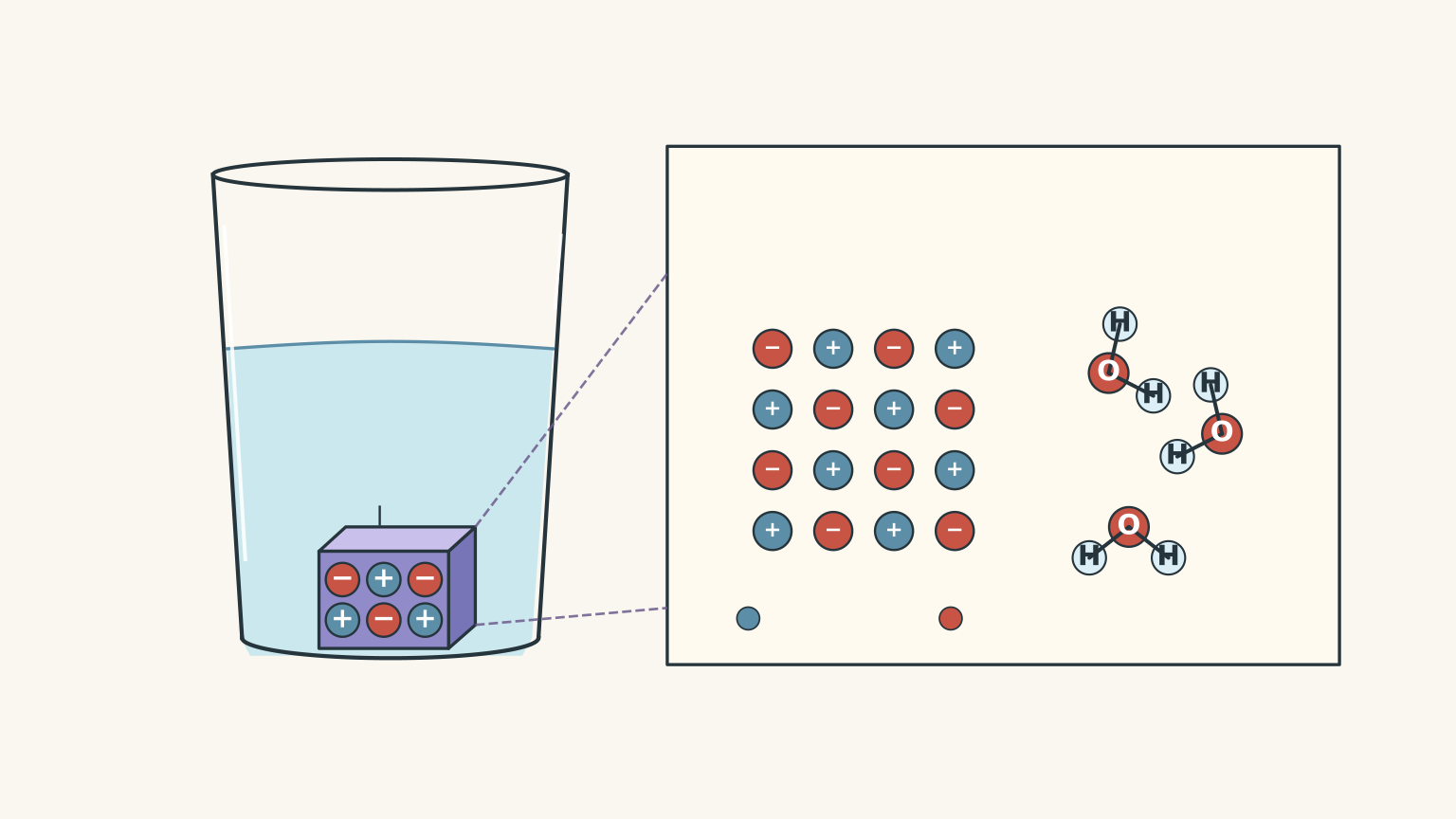
(a) Describe the particle-level processes that occur when an ionic compound dissolves in water. Your answer should explain what happens to the ionic lattice and how water molecules interact with the resulting ions. (3 marks)
A student investigates the energy changes associated with dissolving two ionic compounds, P and Q.
The following data are collected:
| Energy change | Compound P | Compound Q |
|---|---|---|
| Energy required to separate the ionic lattice | +760 kJ mol⁻¹ | +760 kJ mol⁻¹ |
| Energy change during hydration of the ions | −790 kJ mol⁻¹ | −725 kJ mol⁻¹ |
The hydration values include the hydration of all ions in one mole of formula units.
(b) Calculate the overall energy change associated with dissolving each compound. (3 marks)
(c) Predict whether the temperature of the water increases or decreases when each compound dissolves, assuming no external heating or cooling. Explain your reasoning. (2 marks)
Question 2 (12 marks)
A student investigates precipitation reactions to establish solubility rules for different ionic compounds.
Three pairs of aqueous solutions are prepared:
- Potassium chloride and silver nitrate.
- Potassium iodide and lead(II) nitrate.
- Sodium sulfate and barium nitrate.
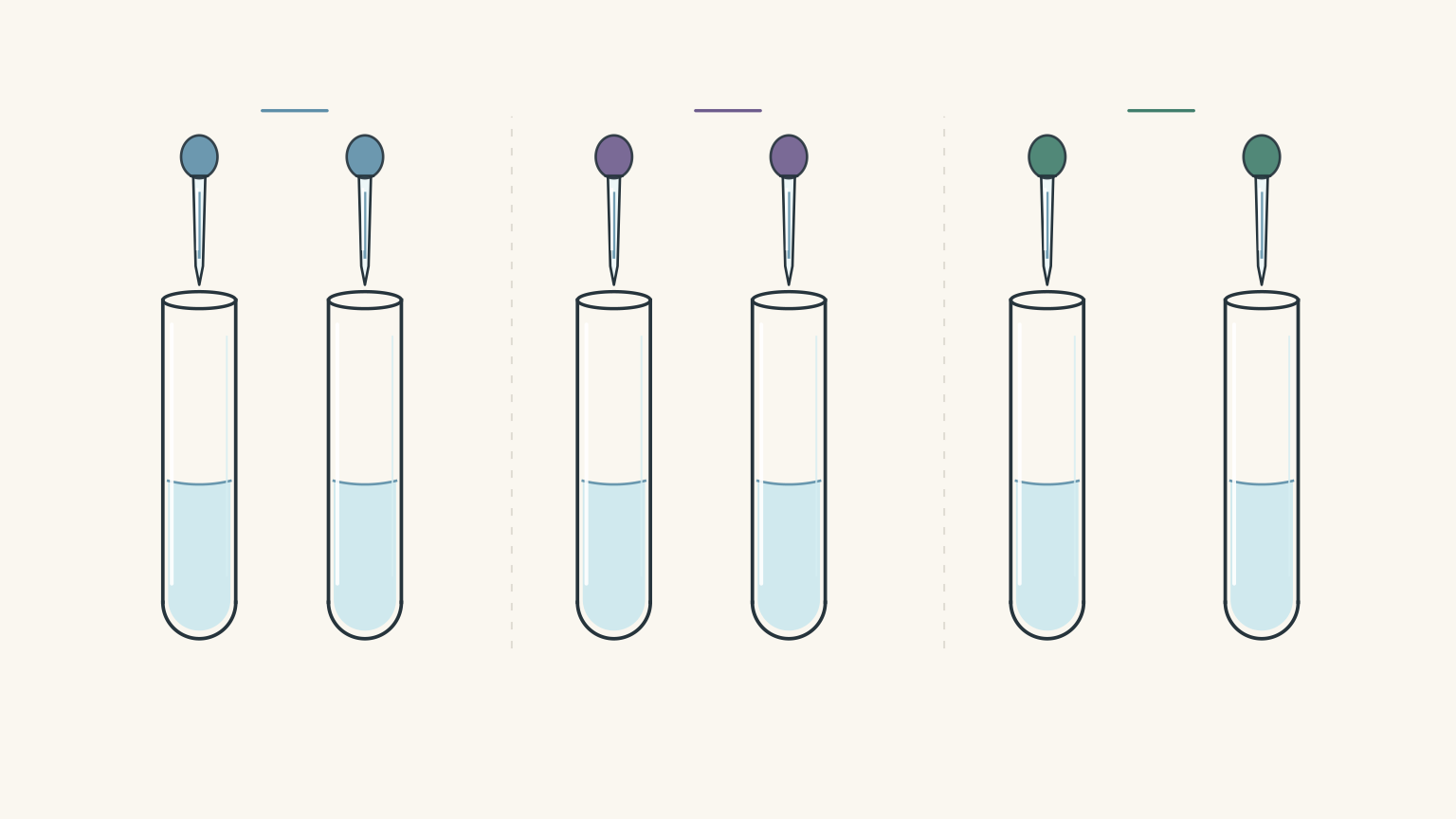
(a) For each pair of solutions:
- State whether a precipitate forms.
- Identify the precipitate, if one forms.
- Write a balanced molecular equation, including state symbols.
(6 marks)
(b) Write the net ionic equation for the reaction between potassium iodide and lead(II) nitrate. Identify the spectator ions. (2 marks)
A second experiment investigates the solubility of selected silver and barium compounds.
All solutions have a concentration of \(0.010\ \mathrm{mol\,L^{-1}}\), and equal volumes are mixed.
The student records the following observations:
| Solutions mixed | Observation |
|---|---|
| \(\ce{AgNO3}\) and \(\ce{NaCl}\) | White precipitate |
| \(\ce{AgNO3}\) and \(\ce{NaBr}\) | Cream precipitate |
| \(\ce{AgNO3}\) and \(\ce{NaI}\) | Yellow precipitate |
| \(\ce{AgNO3}\) and \(\ce{NaCH3COO}\) | No visible precipitate |
| \(\ce{Ba(NO3)2}\) and \(\ce{Na2SO4}\) | White precipitate |
| \(\ce{Ba(NO3)2}\) and \(\ce{Na3PO4}\) | White precipitate |
| \(\ce{Ba(NO3)2}\) and \(\ce{NaCl}\) | No visible precipitate |
(c) Use the experimental observations to state two solubility patterns supported by the data. Your answer must identify the relevant ions and the compounds formed. (2 marks)
(d) Identify one variable that should be controlled when constructing solubility rules experimentally. Explain one limitation of using visible precipitate formation as the only method of determining solubility. (2 marks)
Question 3 (10 marks)
A chemistry laboratory receives an aqueous solution containing exactly two unknown ions:
- One cation selected from \(\mathrm{Cu}^{2+}\) and \(\mathrm{Fe}^{3+}\).
- One anion selected from \(\mathrm{Cl}^{-}\) and \(\mathrm{CH_{3}COO}^{-}\).
Assume the solution contains no other ions that interfere with the tests. The solutions are sufficiently concentrated for visible precipitates to form when expected. Under the stated dilute test conditions, silver acetate remains dissolved.
(a) Design a sequence of qualitative tests to identify both unknown ions.
For each test, specify:
- The reagent to be added.
- The experimental procedure.
- The expected observations that would distinguish the candidate ions.
Explain why separate aliquots of the unknown solution should be used. (4 marks)
A student performs the tests and records the following observations:
| Test | Reagent added | Observation |
|---|---|---|
| 1 | Sodium hydroxide solution | Blue precipitate forms |
| 2 | Silver nitrate solution | White precipitate forms |
(b) Identify the two unknown ions. Write a balanced net ionic equation for each precipitation reaction observed. (4 marks)
(c) Explain why the absence of a precipitate in the silver nitrate test would not, by itself, prove that an unknown solution contains acetate ions if the candidate list were not restricted. Identify one additional control that would improve the reliability of the investigation. (2 marks)
Question 4 (10 marks)
Lead contamination is an environmental concern because dissolved lead(II) ions can be toxic to aquatic organisms and humans.
One possible approach to reducing dissolved lead concentrations involves adding phosphate ions. Lead(II) ions and phosphate ions can form a sparingly soluble lead phosphate solid.
For this question, use the simplified model in which the lead-containing precipitate is \(\ce{Pb3(PO4)2(s)}\). Assume the temperature and pH are held constant during the treatment.
A hypothetical environmental monitoring study reports the following results:
| Sample condition | Dissolved lead concentration (mg L⁻¹) | Dissolved phosphate concentration (mg L⁻¹) |
|---|---|---|
| Before phosphate treatment, filtered | 0.32 | 0.04 |
| After phosphate addition, settling and filtration | 0.018 | 0.12 |
| After treatment, unfiltered sample following acid digestion | 0.30 total lead | Not measured |
A pale solid forms after phosphate is added.
For this investigation, the project uses a target dissolved lead concentration of \(0.010\ \mathrm{mg\,L^{-1}}\). This is a supplied study criterion, not a statement of a regulatory limit.
(a) Write a balanced net ionic equation for the formation of lead(II) phosphate from aqueous lead(II) and phosphate ions. Include state symbols. (2 marks)
(b) Calculate the percentage reduction in dissolved lead concentration following phosphate treatment. Determine whether the treatment achieves the project’s target concentration. (3 marks)
(c) A researcher concludes:
“The water is safe because a solid formed and the filtered sample appears clear.”
Evaluate this conclusion using the supplied data and your understanding of lead phosphate solubility. Explain what happened to the lead during treatment and identify why the solid must also be managed appropriately. (3 marks)
(d) Identify two experimental conditions or methodological details that should be investigated before applying these findings to a different waterway. Explain briefly why each matters. (2 marks)
03Worked solutions and marking guide
Solution 1
(a) Describe the particle-level processes involved in dissolution.
When an ionic compound dissolves, the attractions holding the ions together in the crystal lattice must be overcome.
The process involves three important stages:
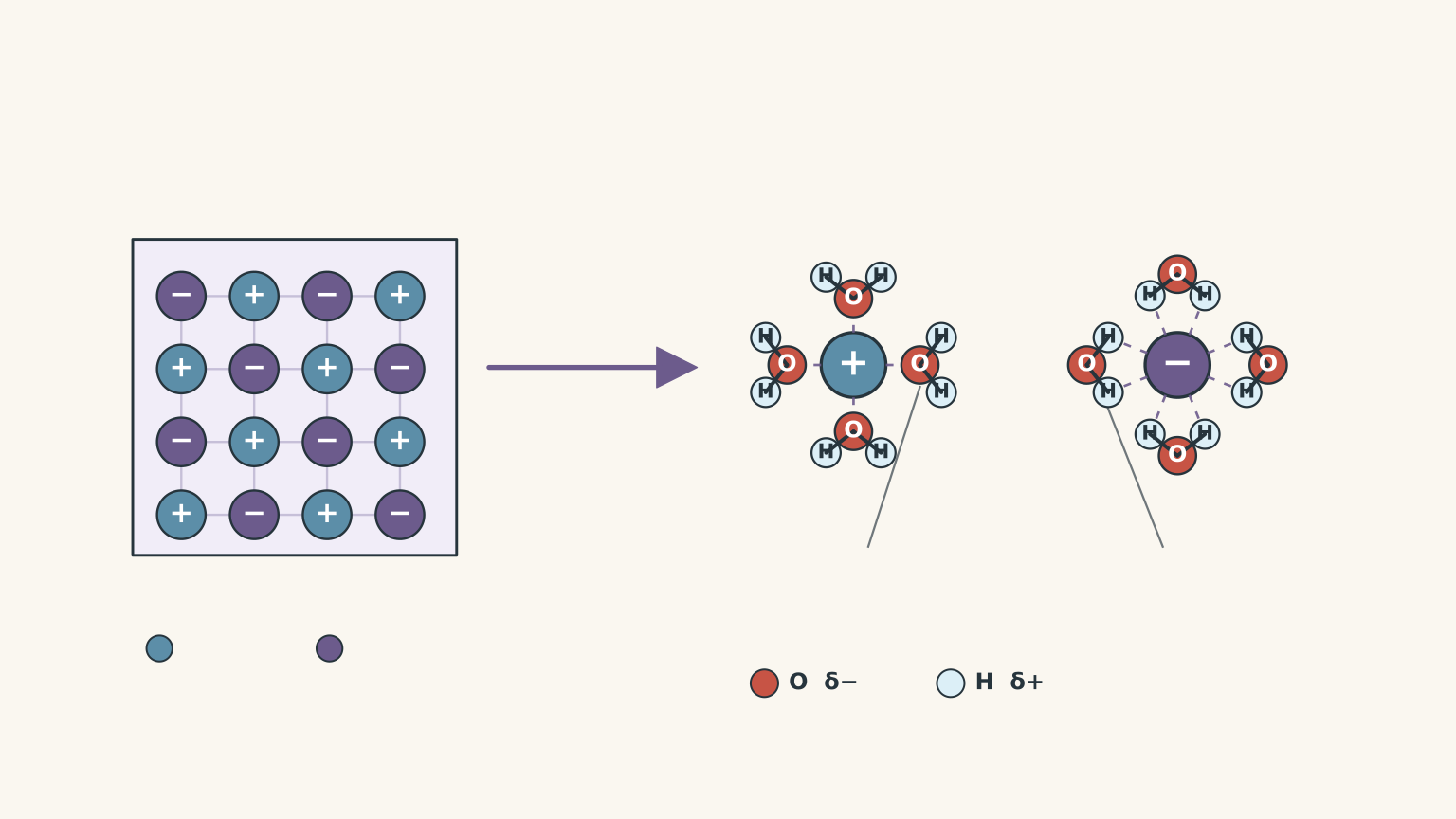
- The ionic lattice separates as the attractions between oppositely charged ions are overcome.
- Polar water molecules orient themselves around the separated ions. The partially negative oxygen end faces positive cations, while the partially positive hydrogen ends face negative anions.
- Attractions form between the water molecules and the ions. These are called ion-dipole attractions. The water molecules surround the ions, forming hydration shells, and the hydrated ions disperse throughout the solution.
This process of surrounding dissolved ions with water molecules is called hydration.
Marking guide (3 marks)
- 1 mark: Explains that the ionic lattice separates as electrostatic attractions between ions are overcome.
- 1 mark: Correctly describes the orientation of polar water molecules around positive and negative ions.
- 1 mark: Explains that hydration shells form through ion-dipole attractions and that hydrated ions disperse throughout the solution.
(b) Calculate the overall energy change for compounds P and Q.
The overall energy change of dissolution depends on the energy required to separate the ionic lattice and the energy released during hydration.
Use:
\[ \Delta H_{\text{soln}} = E_{\text{lattice}} + \Delta H_{\text{hydration}} \]
For compound P:
\[ \begin{aligned} \Delta H_{\text{soln}} &= +760 + (-790)\\ &= -30\ \mathrm{kJ\,mol^{-1}} \end{aligned} \]
For compound Q:
\[ \begin{aligned} \Delta H_{\text{soln}} &= +760 + (-725)\\ &= +35\ \mathrm{kJ\,mol^{-1}} \end{aligned} \]
Therefore:
- Compound P has an overall energy change of \(-30\ \mathrm{kJ\,mol^{-1}}\).
- Compound Q has an overall energy change of \(+35\ \mathrm{kJ\,mol^{-1}}\).
A negative value indicates an exothermic dissolution process. A positive value indicates an endothermic dissolution process.
Marking guide (3 marks)
- 1 mark: Correctly identifies the relationship between lattice separation energy and hydration enthalpy.
- 1 mark: Calculates \(-30\ \mathrm{kJ\,mol^{-1}}\) for P.
- 1 mark: Calculates \(+35\ \mathrm{kJ\,mol^{-1}}\) for Q.
(c) Predict the temperature changes.
Compound P releases more energy during hydration than is absorbed during lattice separation.
Its dissolution is exothermic, so the solution temperature increases.
Compound Q absorbs more energy separating the ionic lattice than is released during hydration.
Its dissolution is endothermic, so the solution temperature decreases.
The key is to compare the total energy absorbed and released, rather than looking at either process independently.
Marking guide (2 marks)
- 1 mark: Identifies that P increases the solution temperature because its dissolution is exothermic.
- 1 mark: Identifies that Q decreases the solution temperature because its dissolution is endothermic.
Solution 2
(a) Predict the precipitation reactions.
There are three mixtures to consider.
Mixture 1: Potassium chloride and silver nitrate
The ions present are \(\mathrm{K}^{+}\), \(\mathrm{Cl}^{-}\), \(\mathrm{Ag}^{+}\), and \(\mathrm{NO_{3}}^{-}\).
Silver ions combine with chloride ions to form insoluble silver chloride.
The precipitate is \(\ce{AgCl(s)}\).
Balanced molecular equation:
\[ \ce{KCl(aq) + AgNO3(aq) -> AgCl(s) + KNO3(aq)} \]
Mixture 2: Potassium iodide and lead(II) nitrate
The ions present are \(\mathrm{K}^{+}\), \(\mathrm{I}^{-}\), \(\mathrm{Pb}^{2+}\), and \(\mathrm{NO_{3}}^{-}\).
Lead(II) ions combine with iodide ions to form insoluble lead(II) iodide.
The precipitate is \(\ce{PbI2(s)}\).
Balanced molecular equation:
\[ \ce{2KI(aq) + Pb(NO3)2(aq) -> PbI2(s) + 2KNO3(aq)} \]
Mixture 3: Sodium sulfate and barium nitrate
The ions present are \(\mathrm{Na}^{+}\), \(\mathrm{SO_{4}}^{2-}\), \(\mathrm{Ba}^{2+}\), and \(\mathrm{NO_{3}}^{-}\).
Barium ions combine with sulfate ions to form insoluble barium sulfate.
The precipitate is \(\ce{BaSO4(s)}\).
Balanced molecular equation:
\[ \ce{Na2SO4(aq) + Ba(NO3)2(aq) -> BaSO4(s) + 2NaNO3(aq)} \]
Marking guide (6 marks)
Award 2 marks for each reaction:
- 1 mark: Correctly identifies the precipitate.
- 1 mark: Writes the correctly balanced molecular equation with state symbols.
(b) Write the net ionic equation and identify spectator ions.
The molecular equation is:
\[ \ce{2KI(aq) + Pb(NO3)2(aq) -> PbI2(s) + 2KNO3(aq)} \]
The aqueous compounds dissociate into their respective ions.
The potassium ions and nitrate ions remain dissolved throughout the reaction. They do not participate in forming the precipitate.
The net ionic equation is:
\[ \ce{Pb^2+(aq) + 2I^-(aq) -> PbI2(s)} \]
The spectator ions are:
- \(\mathrm{K}^{+}\) (potassium ions)
- \(\mathrm{NO_{3}}^{-}\) (nitrate ions)
Spectator ions appear unchanged on both sides of the complete ionic equation, so they are removed when writing the net ionic equation.
Marking guide (2 marks)
- 1 mark: Correct net ionic equation with balanced atoms and charges.
- 1 mark: Correctly identifies both spectator ions.
(c) Determine solubility patterns from the observations.
Two valid patterns can be identified.
First, silver forms insoluble precipitates with the halide ions tested:
- \(\ce{AgCl}\) is insoluble.
- \(\ce{AgBr}\) is insoluble.
- \(\ce{AgI}\) is insoluble.
However, silver acetate remains dissolved under the experimental conditions.
Second, barium forms insoluble compounds with sulfate and phosphate ions:
- \(\ce{BaSO4}\) is insoluble.
- \(\ce{Ba3(PO4)2}\) is insoluble.
Barium chloride remains dissolved.
These observations help establish experimental solubility rules. Notice that the conclusions refer to particular combinations of ions, rather than suggesting that every compound containing a particular anion has the same solubility.
Marking guide (2 marks)
- 1 mark: Correctly identifies the silver halide precipitation pattern and distinguishes silver acetate.
- 1 mark: Correctly identifies the barium sulfate and phosphate precipitation pattern and distinguishes barium chloride.
(d) Identify a controlled variable and an experimental limitation.
One important controlled variable is the concentration of the solutions.
If different concentrations are used, the amount of dissolved ions available to form a precipitate changes. This could affect whether a visible precipitate forms.
Another controlled variable could be the volume of each solution or the temperature.
A limitation is that visual observations cannot reliably distinguish between a substance that is highly soluble and one that is only slightly soluble.
For example, a small amount of precipitate might form but remain difficult to see. A substance may also produce no visible precipitate because the concentrations are below the level needed for detectable precipitation.
The investigation could be improved by repeating tests, maintaining consistent concentrations and volumes, and comparing the results with reliable secondary sources.
Marking guide (2 marks)
- 1 mark: Identifies a valid controlled variable.
- 1 mark: Explains a relevant limitation of relying only on visible precipitation.
Solution 3
(a) Design a sequence of qualitative tests.
The unknown solution contains one cation and one anion. The candidate ions are restricted to two possibilities for each.
We need one test that distinguishes the metal ions and another that distinguishes the anions.
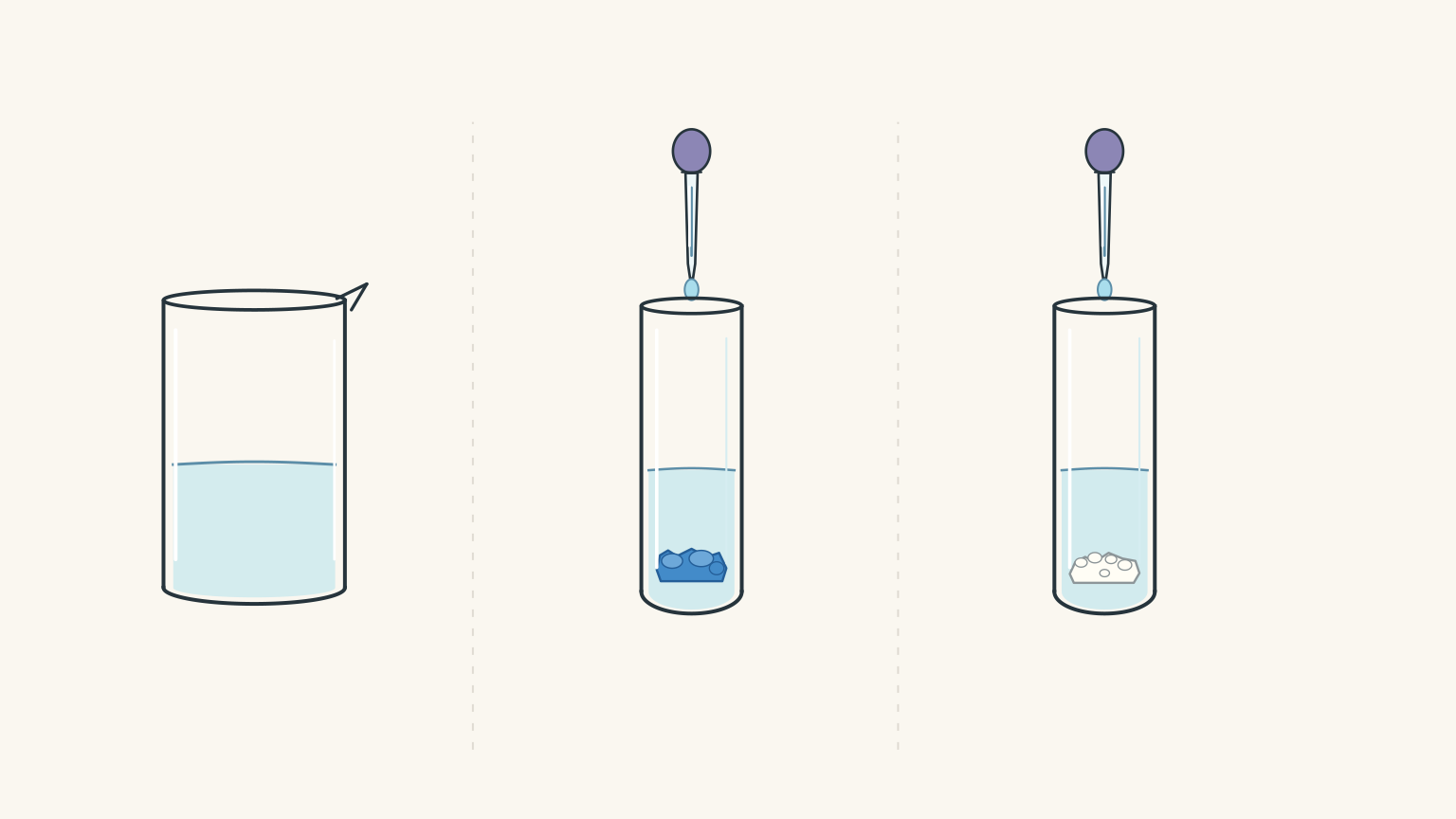
Test 1: Identify the cation
Use sodium hydroxide solution.
- Transfer a small volume of the unknown solution into a clean test tube.
- Add sodium hydroxide solution dropwise.
- Observe the colour of any precipitate formed.
The two possible outcomes are:
| Candidate ion | Expected observation |
|---|---|
| \(\mathrm{Cu}^{2+}\) | Blue precipitate of \(\ce{Cu(OH)2}\) |
| \(\mathrm{Fe}^{3+}\) | Reddish-brown precipitate of \(\ce{Fe(OH)3}\) |
This test distinguishes the two candidate cations through the characteristic colours of their hydroxide precipitates.
Test 2: Identify the anion
Use silver nitrate solution.
- Transfer a fresh aliquot of the unknown solution into another clean test tube.
- Add silver nitrate solution.
- Observe whether a precipitate forms.
The two possible outcomes are:
| Candidate ion | Expected observation |
|---|---|
| \(\mathrm{Cl}^{-}\) | White precipitate of \(\ce{AgCl}\) |
| \(\mathrm{CH_{3}COO}^{-}\) | No visible precipitate under the stated conditions |
Silver chloride is insoluble, while silver acetate remains dissolved at the specified dilute concentrations.
Why use separate aliquots?
The tests must be performed on separate portions of the original solution.
If sodium hydroxide is added first and silver nitrate is subsequently added to the same test tube, the additional ions and precipitates could interfere with the second test.
Using separate aliquots prevents contamination between tests and makes the observations easier to interpret.
Marking guide (4 marks)
- 1 mark: Describes using separate aliquots and clean apparatus.
- 1 mark: Selects sodium hydroxide and correctly describes the distinguishing cation observations.
- 1 mark: Selects silver nitrate and correctly describes the distinguishing anion observations.
- 1 mark: Provides a suitable experimental control, repeat, or recording procedure.
(b) Identify the two unknown ions.
The first test produces a blue precipitate after sodium hydroxide is added.
This indicates the presence of copper(II) ions, \(\mathrm{Cu}^{2+}\).
The net ionic equation is:
\[ \ce{Cu^2+(aq) + 2OH^-(aq) -> Cu(OH)2(s)} \]
The second test produces a white precipitate after silver nitrate is added.
This indicates the presence of chloride ions, \(\mathrm{Cl}^{-}\).
The net ionic equation is:
\[ \ce{Ag+(aq) + Cl^-(aq) -> AgCl(s)} \]
Therefore, the two unknown ions are:
- Cation: \(\mathrm{Cu}^{2+}\)
- Anion: \(\mathrm{Cl}^{-}\)
Marking guide (4 marks)
- 1 mark: Correctly identifies \(\mathrm{Cu}^{2+}\).
- 1 mark: Writes the correct balanced net ionic equation for copper(II) hydroxide formation.
- 1 mark: Correctly identifies \(\mathrm{Cl}^{-}\).
- 1 mark: Writes the correct balanced net ionic equation for silver chloride formation.
(c) Explain the limitation of a negative silver nitrate test.
A lack of visible precipitate does not uniquely identify acetate ions.
Many other anions can form soluble silver salts. Therefore, a negative result could be consistent with several different ions.
In this question, acetate can be identified because the candidate list is restricted to chloride and acetate, and the stated concentrations are sufficient for a visible chloride precipitate.
An appropriate control would be to test a known chloride solution alongside the unknown. This confirms that the silver nitrate reagent is working and that the experimental conditions allow a visible silver chloride precipitate to form.
Marking guide (2 marks)
- 1 mark: Explains that other anions may also produce no visible precipitate, so a negative result is not universally specific to acetate.
- 1 mark: Identifies a suitable control, such as a known chloride solution or a reagent blank.
Solution 4
(a) Write the balanced net ionic equation.
Lead(II) ions have a charge of \(+2\), while phosphate ions have a charge of \(-3\).
To form a neutral ionic compound, three lead(II) ions combine with two phosphate ions.
The balanced net ionic equation is:
\[ \ce{3Pb^2+(aq) + 2PO4^3-(aq) -> Pb3(PO4)2(s)} \]
The total positive charge is \(+6\), and the total negative charge is \(-6\).
The resulting solid is electrically neutral.
Marking guide (2 marks)
- 1 mark: Correctly identifies the formula \(\ce{Pb3(PO4)2}\) and its stoichiometric coefficients.
- 1 mark: Provides a correctly balanced ionic equation with appropriate state symbols.
(b) Calculate the percentage reduction in dissolved lead.
The initial dissolved lead concentration is:
\[ 0.32\ \mathrm{mg\,L^{-1}} \]
The final dissolved lead concentration is:
\[ 0.018\ \mathrm{mg\,L^{-1}} \]
The percentage reduction is calculated using:
\[ \text{Percentage reduction} = \frac{\text{Initial}-\text{Final}} {\text{Initial}}\times100 \]
Substituting:
\[ \begin{aligned} \text{Percentage reduction} &=\frac{0.32-0.018}{0.32}\times100\\ &=\frac{0.302}{0.32}\times100\\ &=94.375\% \end{aligned} \]
To an appropriate number of significant figures:
\[ \boxed{94\%} \]
The treatment reduces the dissolved lead concentration by approximately 94%.
However, the final concentration is:
\[ 0.018\ \mathrm{mg\,L^{-1}} \]
The project target is:
\[ 0.010\ \mathrm{mg\,L^{-1}} \]
Since:
\[ 0.018>0.010 \]
the treatment does not achieve the project’s target.
Marking guide (3 marks)
- 1 mark: Correctly substitutes the initial and final concentrations into the percentage reduction formula.
- 1 mark: Calculates approximately 94%.
- 1 mark: Correctly concludes that the project target has not been achieved.
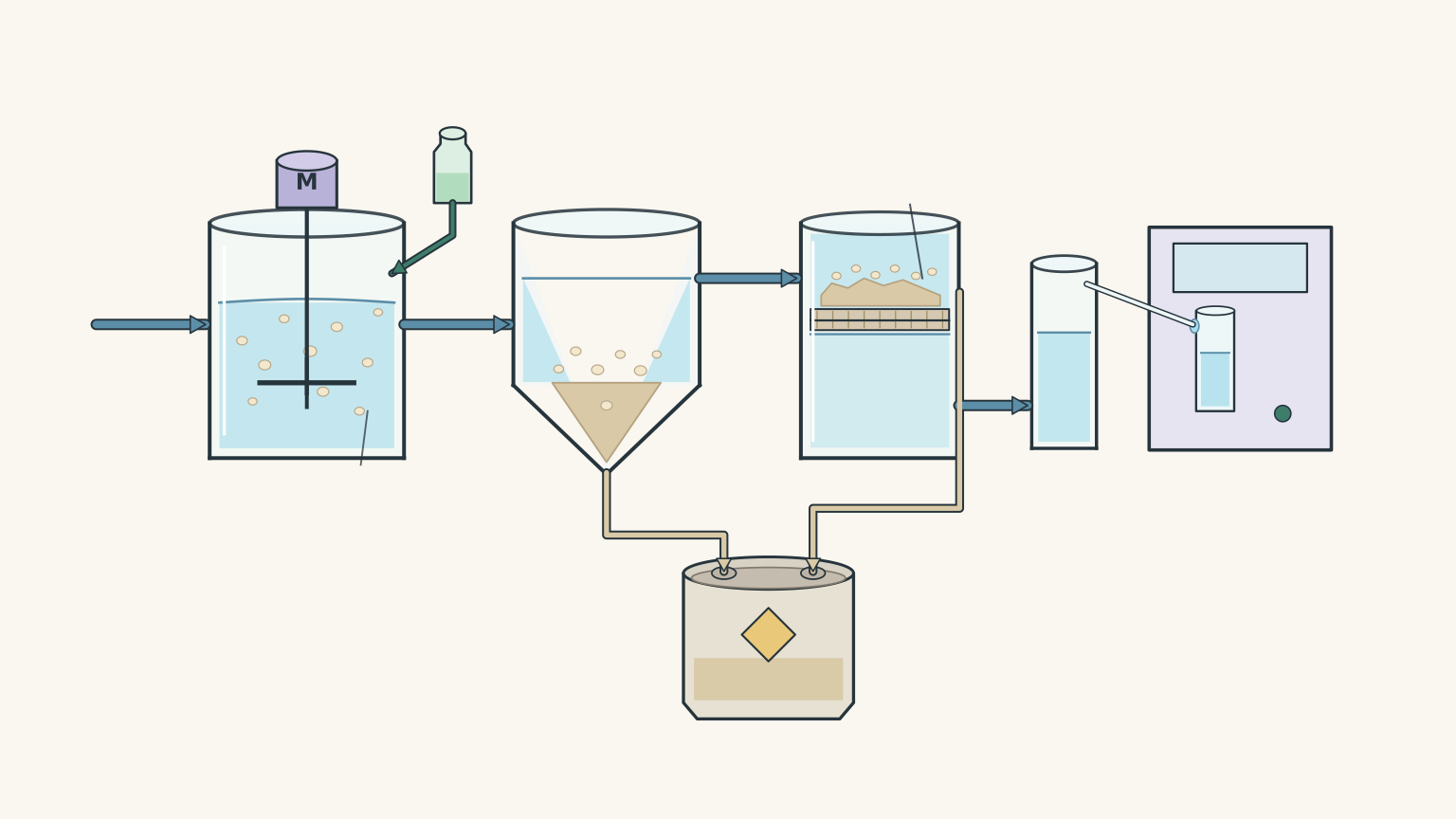
(c) Evaluate the researcher’s conclusion.
The researcher’s conclusion is not justified.
The formation of a pale solid is consistent with lead phosphate precipitation. This suggests that dissolved lead ions have combined with phosphate ions to form a sparingly soluble compound.
As the precipitate forms, some lead is transferred from the dissolved phase into the solid phase. Filtering the sample removes suspended solid particles, reducing the amount of lead remaining in the filtered water.
However, precipitation does not destroy lead.
The total lead concentration in the acid-digested, unfiltered sample is \(0.30\ \mathrm{mg\,L^{-1}}\), which is close to the initial dissolved concentration of \(0.32\ \mathrm{mg\,L^{-1}}\).
This indicates that much of the lead remains present in the sample, but is now associated with the solid material rather than dissolved in the water.
There are several problems with the researcher’s conclusion:
- The filtered sample still contains \(0.018\ \mathrm{mg\,L^{-1}}\) dissolved lead, which exceeds the project’s target.
- The lead-containing precipitate must be collected and disposed of appropriately. Otherwise, lead could re-enter the environment.
- Changes in environmental conditions, such as pH, may affect the stability and solubility of the solid. Lead could potentially become available in the surrounding water again.
A clear-looking water sample is not necessarily free from dissolved contaminants.
The researcher should therefore measure dissolved lead quantitatively after treatment, check the stability of the precipitate, and ensure that the lead-containing solid is safely managed.
Marking guide (3 marks)
- 1 mark: Explains that lead phosphate precipitation transfers dissolved lead into a solid phase.
- 1 mark: Uses the total lead result to explain that lead has not been destroyed or eliminated from the sample.
- 1 mark: Explains why clear filtrate alone does not establish safety and identifies the need for appropriate solid management or further testing.
(d) Identify two conditions or methodological details to investigate.
Two important considerations are:
1. pH of the water
The pH affects the chemical forms of phosphate present in water and can influence the formation and stability of lead-containing precipitates.
Results obtained at one pH may not apply to water with a substantially different pH.
2. Other dissolved ions
Other metal ions may also react with phosphate to form insoluble compounds.
These competing reactions can change the amount of phosphate available to react with lead and can affect the composition of the resulting solid.
Other valid considerations include temperature, initial lead and phosphate concentrations, filtration method, and the detection limits of the analytical techniques used.
When comparing secondary sources, these conditions must be considered before concluding that different studies are directly comparable.
Marking guide (2 marks)
- 1 mark: Identifies a relevant experimental condition, such as pH or temperature, and explains its significance.
- 1 mark: Identifies a second relevant condition or methodological detail, such as competing ions, initial concentrations, or analytical detection limits, and explains its significance.
04Final mark summary
| Question | Topic | Marks |
|---|---|---|
| 1 | Dissolution of ionic compounds | 8 |
| 2 | Solubility rules and precipitation | 12 |
| 3 | Identification of two unknown ions | 10 |
| 4 | Environmental lead and phosphate solubility | 10 |
| Total | 40 |
How to use your results
When marking your attempt, pay particular attention to the reasoning behind your answers, not just whether you reached the correct conclusion.
The most important skills tested in this paper are:
- Explaining how lattice separation and hydration contribute to dissolution.
- Distinguishing between soluble and insoluble ionic compounds using experimental evidence.
- Writing balanced molecular and net ionic equations.
- Selecting reagents that distinguish between candidate ions.
- Recognising the limitations of qualitative precipitation tests.
- Explaining how low-solubility lead compounds can reduce dissolved lead concentrations without removing lead from the environment entirely.
A strong response consistently connects the chemical evidence to the conclusion. In particular, avoid treating the absence of a visible precipitate as proof that an ion is absent, or treating the formation of a precipitate as proof that a contaminant has been completely removed.