
Why Water Is Bent but Carbon Dioxide Is Linear
Discover why water has a bent molecular shape while carbon dioxide is linear. Learn how valence electrons, lone pairs, VSEPR theory, and bond dipoles explain their different geometries, with experimental evidence and worked HSC Chemistry questions.
Water and carbon dioxide each contain three atoms, with one central atom bonded to two outer atoms. If you looked only at which atoms are connected, you might predict that both molecules should be straight.
But they aren’t. An isolated water molecule has an H-O-H bond angle of approximately \(104.5^\circ\), while carbon dioxide has an O-C-O bond angle of \(180^\circ\).
The difference comes down to the arrangement of electrons around the central atom.
In water, oxygen has two bonding regions and two lone pairs. These four regions produce a tetrahedral electron-pair arrangement, but the molecular shape is bent.
In carbon dioxide, carbon has two bonding regions and no lone pairs. These regions spread in opposite directions, producing a linear molecule.
There is one important detail to predict before going further: carbon dioxide contains two double bonds. Should we count these as four electron regions because each double bond contains two shared electron pairs?
No. Each double bond counts as one electron region in VSEPR theory because it occupies one general direction around the central atom. That distinction explains why carbon dioxide is linear rather than tetrahedral.
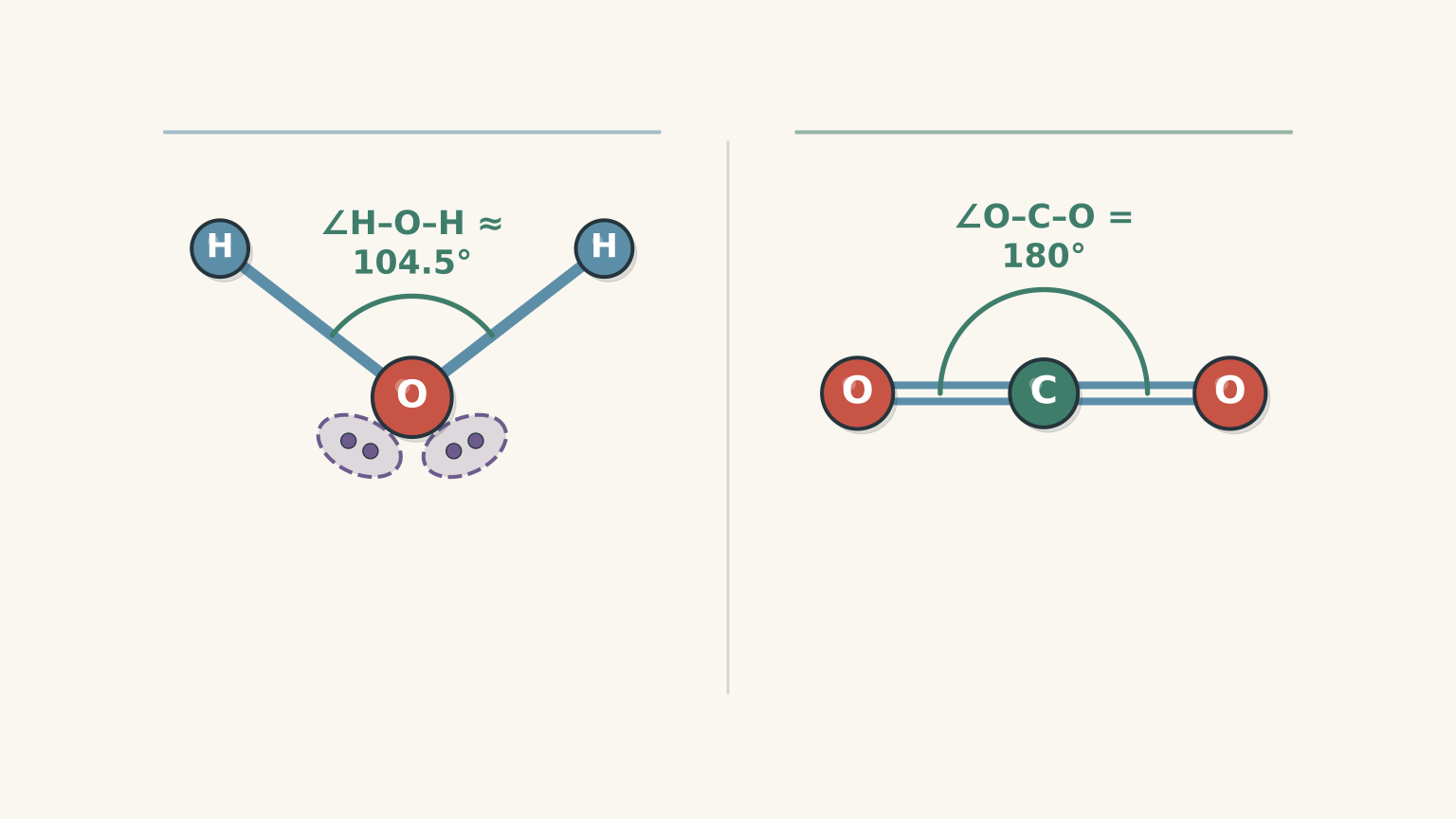
Due to technical limitations, this figure may display incorrectly or contain inaccuracies. Please check key details against your course materials.
01Start with the valence electrons
Before predicting molecular shape, we need to understand what the atoms are doing with their valence electrons.
Valence electrons are the electrons in an atom’s outermost shell. They determine how atoms form covalent bonds and how many lone pairs remain.
The periodic table tells us how many valence electrons each atom contributes.
- Hydrogen has 1 valence electron.
- Carbon has 4 valence electrons.
- Oxygen has 6 valence electrons.
Let’s count the total valence electrons in both molecules.
Water: H₂O
A water molecule contains one oxygen atom and two hydrogen atoms.
Its total number of valence electrons is:
\[ N=6+2(1)=8 \]
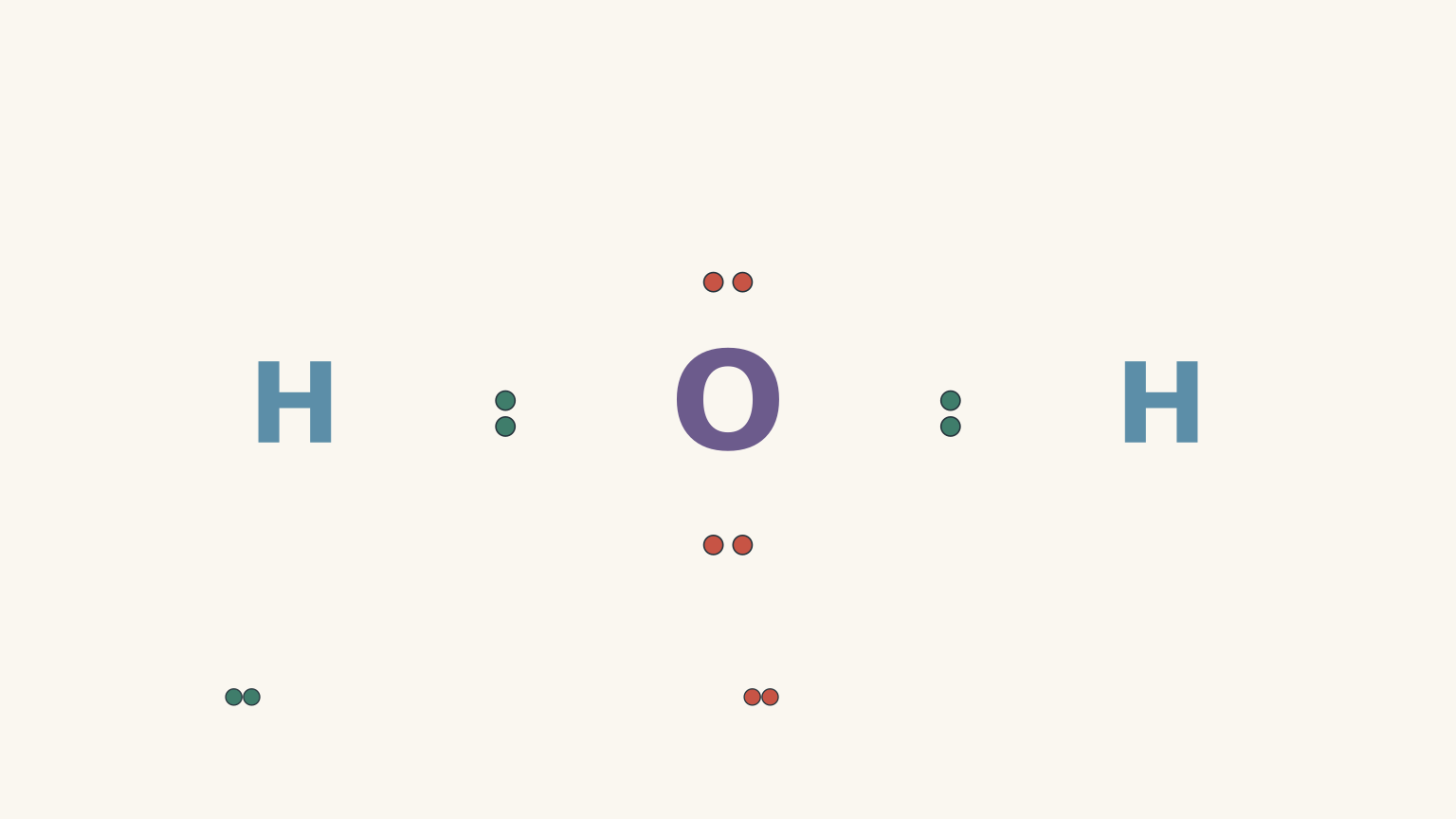
Oxygen forms two single covalent bonds, one with each hydrogen.
Each covalent bond contains two shared electrons, so the bonds account for four electrons. The remaining four electrons form two lone pairs on oxygen.
The resulting Lewis structure has:
- Two O-H single bonds.
- Two lone pairs on oxygen.
- No lone pairs on hydrogen.
Each hydrogen achieves a stable duet, while oxygen achieves an octet.
Carbon dioxide: CO₂
Carbon dioxide contains one carbon atom and two oxygen atoms.
Its total number of valence electrons is:
\[ N=4+2(6)=16 \]
Carbon forms a double bond with each oxygen atom.
The Lewis structure is:
\[ \ce{O=C=O} \]
Each C=O double bond contains two shared electron pairs. Each terminal oxygen also has two lone pairs.
Carbon has no lone pairs.
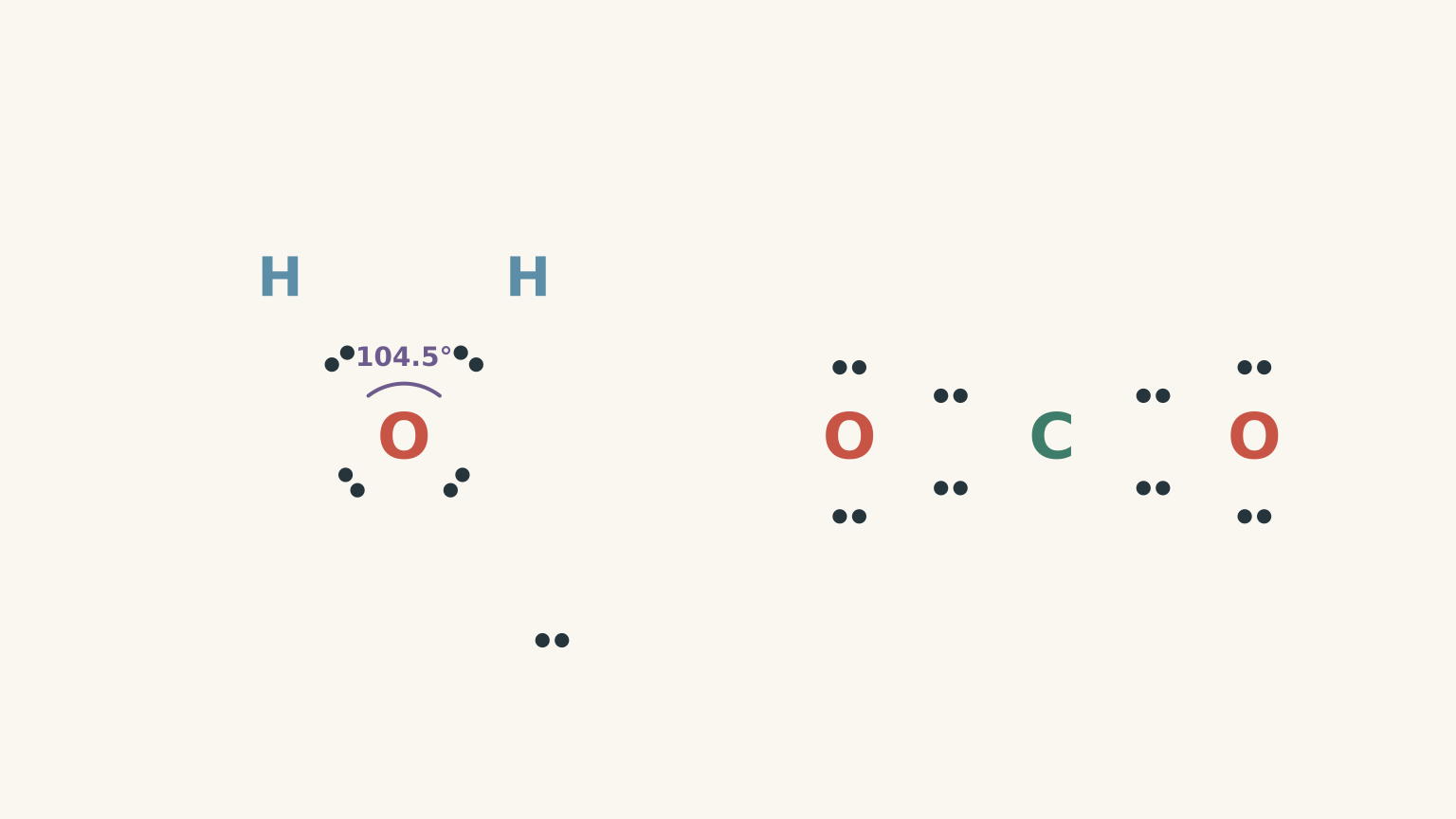
Due to technical limitations, this figure may display incorrectly or contain inaccuracies. Please check key details against your course materials.
Does formal charge affect the structures?
It is worth checking the formal charges because an incorrect Lewis structure can lead to an incorrect prediction of molecular shape.
Formal charge is a bookkeeping method used to assess how electrons are assigned in a Lewis structure.
The formula is:
\[ \mathrm{FC}=V-N-\frac{B}{2} \]
Where:
- \(V\) is the number of valence electrons in the isolated atom.
- \(N\) is the number of non-bonding electrons.
- \(B\) is the number of bonding electrons.
For water, oxygen has six valence electrons, four non-bonding electrons, and four bonding electrons.
\[ \mathrm{FC(O)}=6-4-\frac{4}{2}=0 \]
Each hydrogen also has a formal charge of zero.
For carbon dioxide, carbon has four valence electrons, no non-bonding electrons, and eight bonding electrons.
\[ \mathrm{FC(C)}=4-0-\frac{8}{2}=0 \]
Each oxygen also has a formal charge of zero.
Both molecules are neutral, with zero formal charge on every atom in these Lewis structures.
However, formal charge is not the same as partial charge. Oxygen still attracts shared electrons more strongly than carbon or hydrogen, so the bonds involving oxygen can be polar even when every formal charge is zero.
Also remember that an overall ionic charge changes the total electron count. Add electrons for a negative charge and subtract electrons for a positive charge before constructing the Lewis structure.
If you need more practice with this counting process, see How to Count Lone Pairs in Lewis Structures for HSC Chemistry.
02Why the number of electron regions changes the shape
Now that we have the Lewis structures, we can use VSEPR theory to predict the molecular geometry.
VSEPR stands for Valence Shell Electron Pair Repulsion.
The central idea is that regions of electron density around a central atom arrange themselves to minimise repulsion.
Think of each electron region as claiming a direction around the central atom. A double bond contains two shared electron pairs, but both occupy the same general direction. It therefore counts as one region.
This is a useful counting model, not a literal picture of electrons sitting in fixed positions. Electron density is spread through space.
For VSEPR calculations:
- A single bond counts as one electron region.
- A double bond counts as one electron region.
- A triple bond counts as one electron region.
- A lone pair counts as one electron region.
Why water is bent
Look at the oxygen atom in water.
It has:
- Two bonding regions from its two O-H bonds.
- Two lone pairs.
That gives four electron regions around oxygen.
Four electron regions arrange themselves approximately towards the corners of a tetrahedron. This is called a tetrahedral electron-pair geometry.
However, water does not have four bonded atoms around oxygen. It has only two.
When we describe molecular shape, we consider the positions of the atoms, not the positions of lone pairs.
The result is a bent or V-shaped molecule.
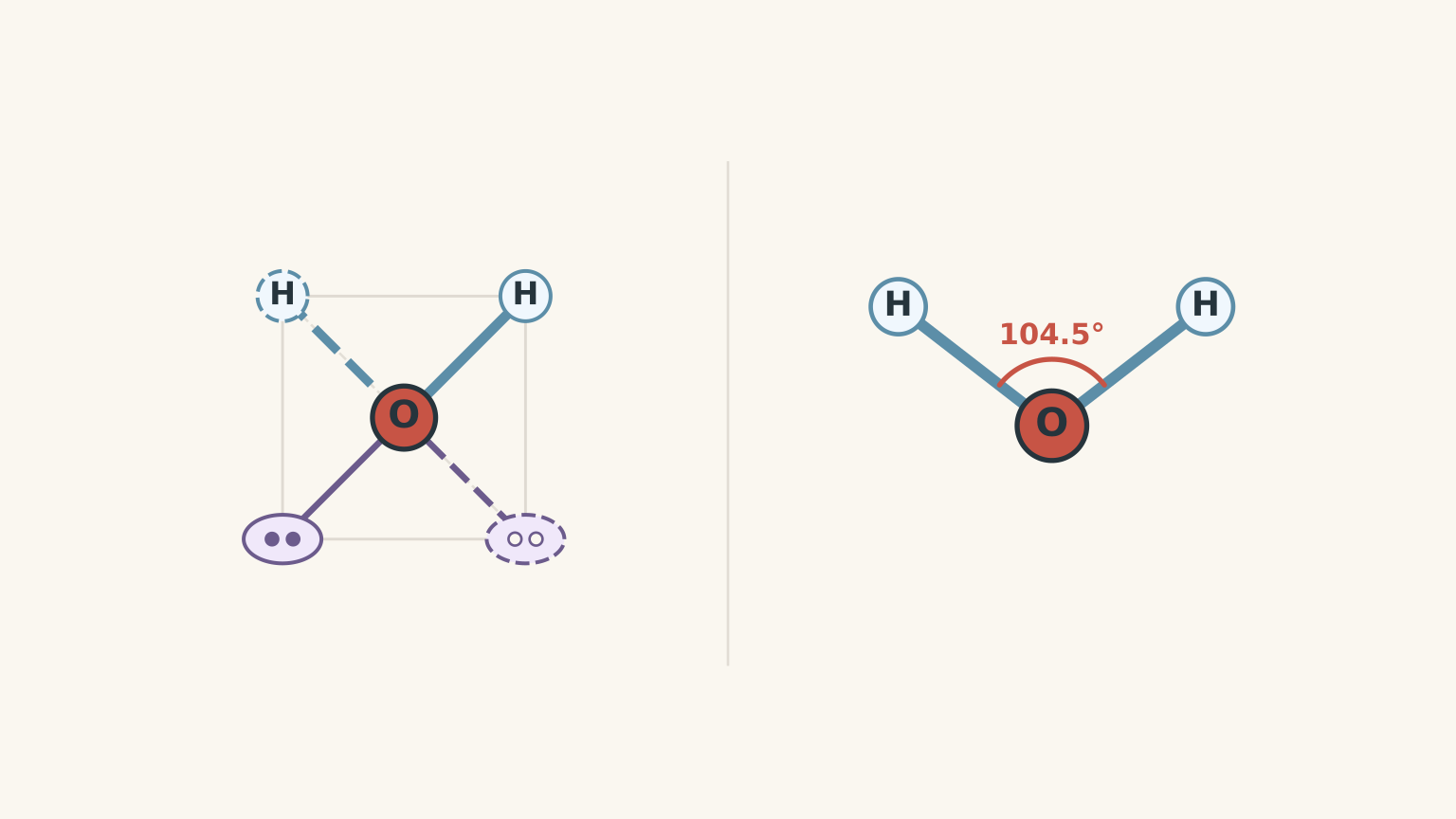
Due to technical limitations, this figure may display incorrectly or contain inaccuracies. Please check key details against your course materials.
There is another important detail.
If all four electron regions were equivalent, the ideal tetrahedral bond angle would be:
\[ 109.5^\circ \]
But the measured gas-phase H-O-H angle is approximately:
\[ 104.5^\circ \]
Why is it smaller?
Lone pairs repel other electron regions more strongly than bonding pairs do. They occupy more angular space around the oxygen atom and push the two bonding regions closer together.
The general repulsion order is:
\[ \text{LP-LP}>\text{LP-BP}>\text{BP-BP} \]
Here, LP means lone pair and BP means bonding pair.
The two lone pairs therefore compress the H-O-H angle below the ideal tetrahedral angle.
This is why water is bent rather than linear.
Why carbon dioxide is linear
Now consider carbon dioxide.
The central carbon atom has two double bonds and no lone pairs.
Although each double bond contains two shared electron pairs, each occupies one direction around carbon.
Therefore, carbon has only two electron regions.
Two electron regions spread as far apart as possible, giving an angle of:
\[ 180^\circ \]
The oxygen atoms sit on opposite sides of the carbon atom.
The molecular shape is linear.
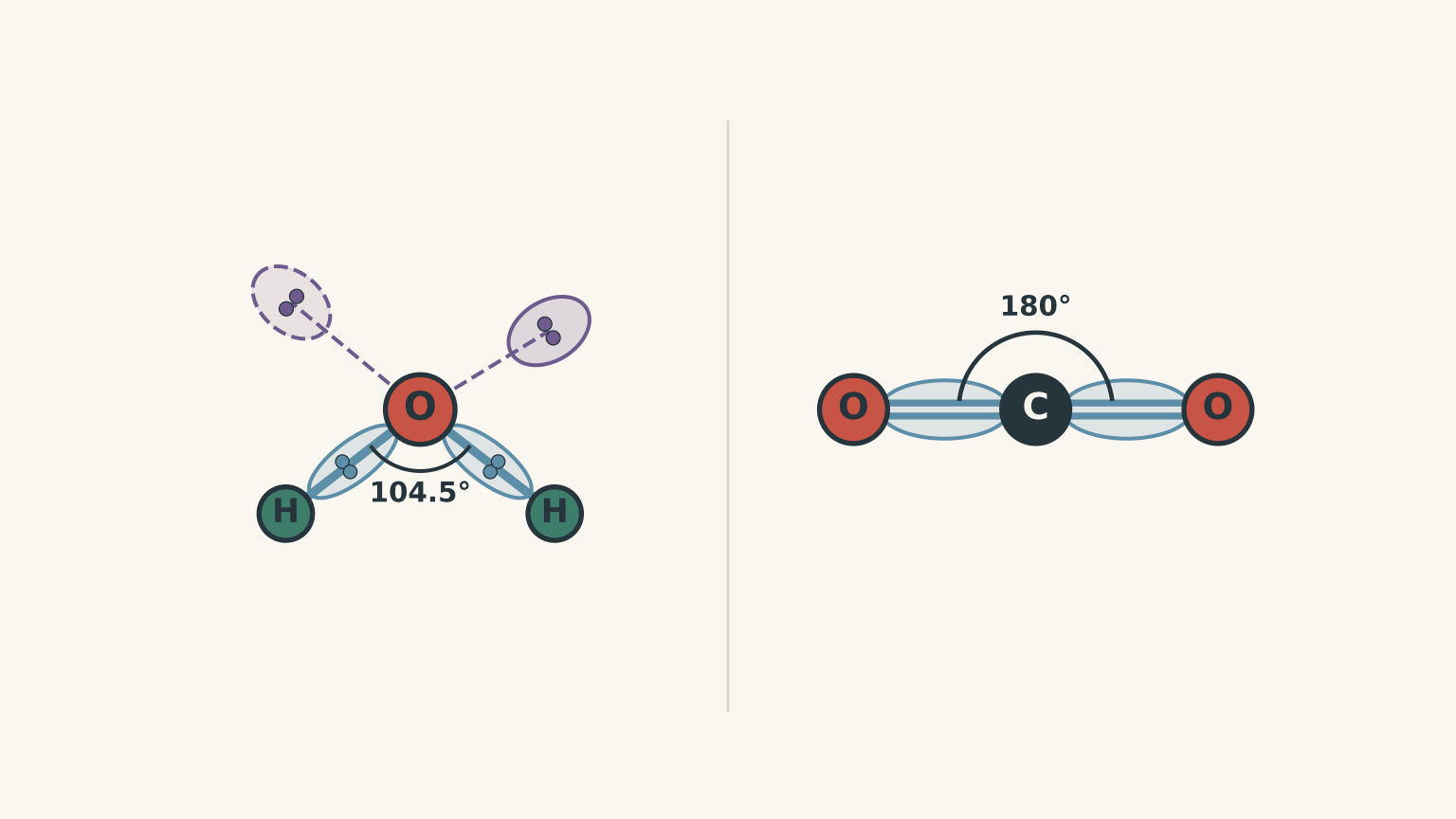
Due to technical limitations, this figure may display incorrectly or contain inaccuracies. Please check key details against your course materials.
Compare the two molecules
| Feature | Water, H₂O | Carbon dioxide, CO₂ |
|---|---|---|
| Central atom | Oxygen | Carbon |
| Total valence electrons | 8 | 16 |
| Bonding regions | 2 | 2 |
| Lone pairs on central atom | 2 | 0 |
| Total electron regions | 4 | 2 |
| Electron-pair geometry | Tetrahedral | Linear |
| Molecular shape | Bent | Linear |
| Bond angle | Approximately 104.5° | 180° |
Notice that both molecules have two bonding regions.
The difference is the number of lone pairs on the central atom.
This is the key distinction to remember when comparing water and carbon dioxide.
For a more detailed explanation of the difference between electron-pair geometry and molecular shape, see Electron-Pair Geometry vs Molecular Shape: HSC Chemistry.
03How molecular shape affects polarity
There is another way to test whether our predicted structures make sense: examine the polarity of each molecule.
A covalent bond is polar when the bonded atoms attract the shared electrons unequally.
Oxygen is more electronegative than both carbon and hydrogen. It therefore attracts the shared electrons towards itself in both O-H and C=O bonds.
This produces polar bonds.
However, having polar bonds does not automatically mean that the entire molecule is polar.
We need to consider the direction of each bond dipole.
Water has a net dipole
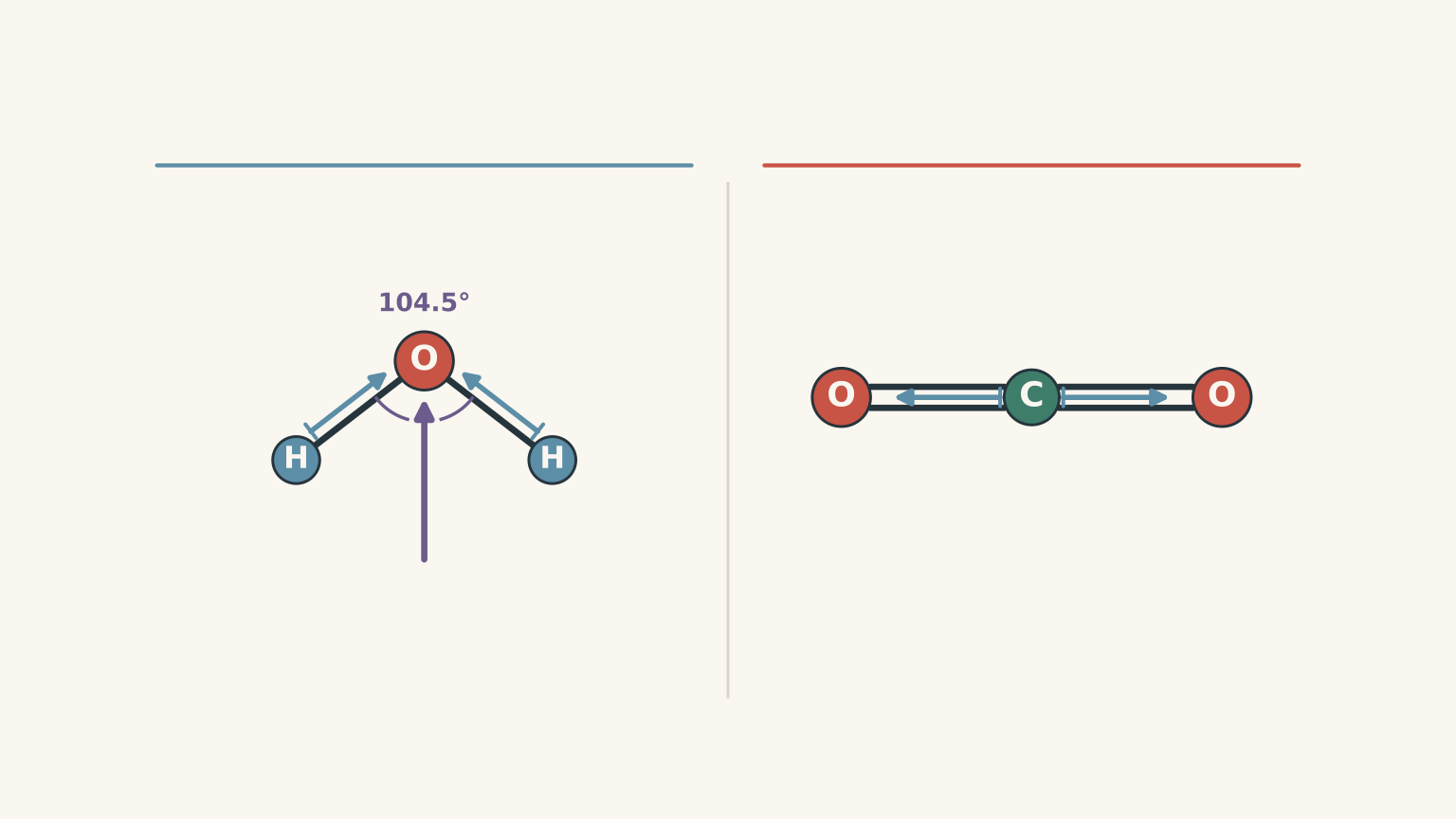
Each O-H bond has a dipole pointing towards oxygen.
Because water is bent, these two bond dipoles do not point in opposite directions.
Instead, their components along the angle bisector reinforce one another.
The molecule therefore has a net dipole moment.
Water is polar.
Due to technical limitations, this figure may display incorrectly or contain inaccuracies. Please check key details against your course materials.
Carbon dioxide has no net dipole
Each C=O bond is polar because oxygen attracts the shared electrons more strongly than carbon.
But carbon dioxide is linear and symmetrical.
The two C=O bond dipoles have equal magnitudes and point in opposite directions.
They cancel completely.
Therefore, carbon dioxide has no permanent molecular dipole moment.
It is non-polar despite containing two polar covalent bonds.
This is a common HSC Chemistry misconception:
A molecule can contain polar bonds and still be non-polar overall.
The correct method is to determine the molecular shape first, then consider the vector sum of its bond dipoles.
| Property | H₂O | CO₂ |
|---|---|---|
| Are the bonds polar? | Yes | Yes |
| Is the molecule symmetrical? | No | Yes |
| Do bond dipoles cancel? | No | Yes |
| Net molecular dipole | Non-zero | Zero |
| Molecular polarity | Polar | Non-polar |
04How do experiments confirm that these shapes are real?
So far, we have used Lewis structures and VSEPR theory to predict molecular geometry.
But how do we know water is actually bent and carbon dioxide is actually linear?
Chemists cannot simply photograph the electron pairs and measure the angle between them.
Instead, they use physical measurements, including rotational spectroscopy, infrared spectroscopy, and gas-phase electron diffraction.
These experiments provide evidence about the positions of atoms and the distribution of charge.
Testing water using microwave spectroscopy
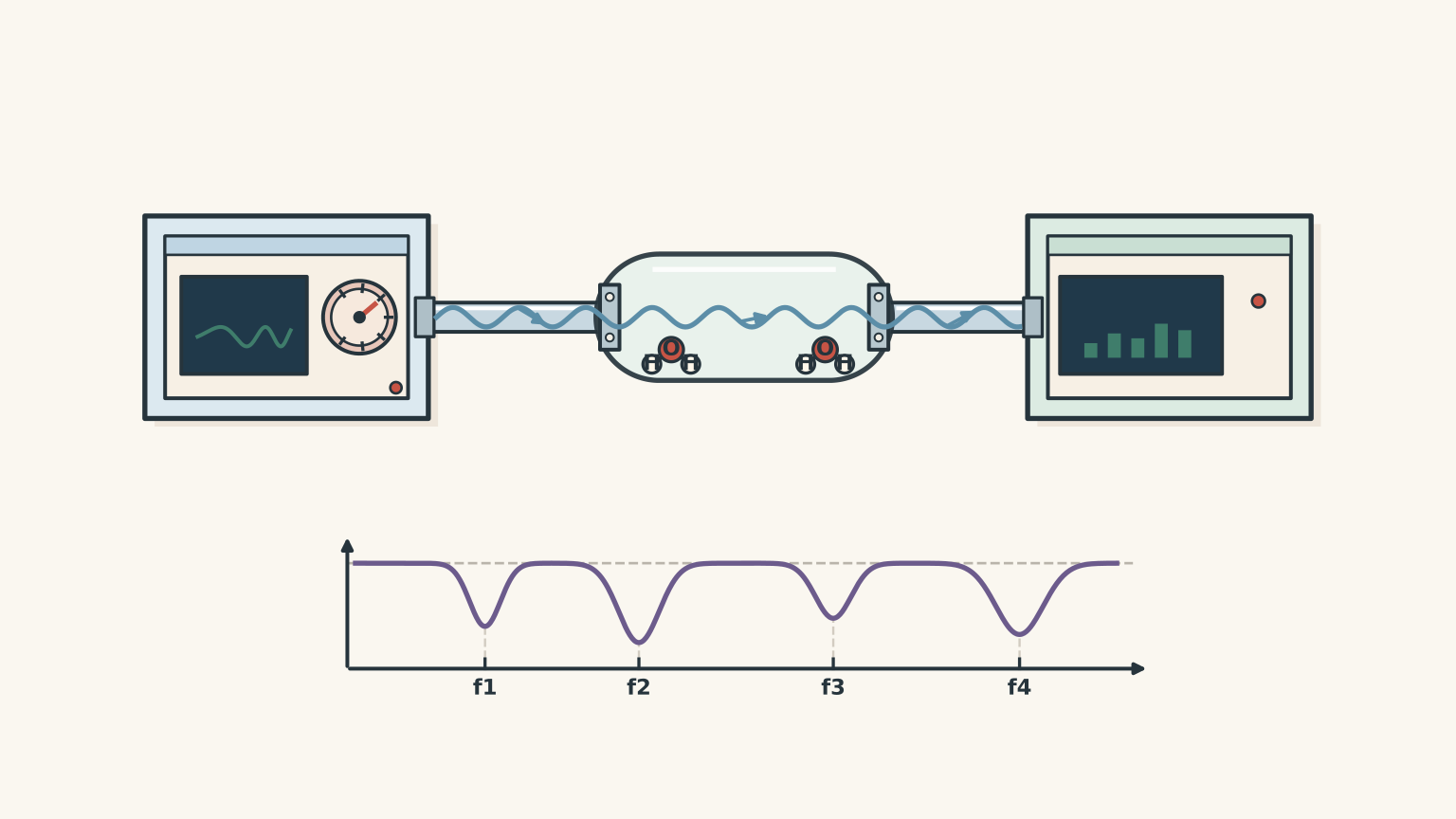
Imagine a chamber containing water vapour at low pressure.
A microwave source directs radiation through the chamber. On the other side, a detector measures how much radiation passes through.
The microwave source sweeps through different frequencies.
When the radiation matches an allowed rotational energy transition in a water molecule, the molecule absorbs some of that energy. The detector records a reduction in transmitted radiation.
The pattern of absorption lines contains information about how the molecule rotates.
Why does this tell us anything about shape?
A molecule’s rotational behaviour depends on its moment of inertia, which describes how its mass is distributed around an axis of rotation.
Changing the positions of the atoms changes the moments of inertia and therefore changes the rotational spectrum.
By analysing the measured spectrum, scientists can determine a molecular geometry consistent with the observed rotational behaviour.
For gas-phase water, the experimental structure is bent, with an equilibrium H-O-H angle close to \(104.5^\circ\).
Due to technical limitations, this figure may display incorrectly or contain inaccuracies. Please check key details against your course materials.
Why the same microwave experiment does not work for CO₂
Now imagine passing microwaves through carbon dioxide instead.
You do not observe an ordinary pure rotational microwave absorption spectrum.
This might seem surprising. Surely carbon dioxide can rotate?
It can.
The problem is that ordinary pure rotational microwave absorption requires a permanent molecular dipole moment.
Carbon dioxide has no permanent dipole because its two equal C=O bond dipoles cancel.
Its rotational motion therefore does not couple to the microwave electric field in the required way.
This is a limitation of the measurement method, not evidence that the molecule cannot rotate.
The revised experiment: infrared spectroscopy
To investigate carbon dioxide, scientists can use infrared spectroscopy.
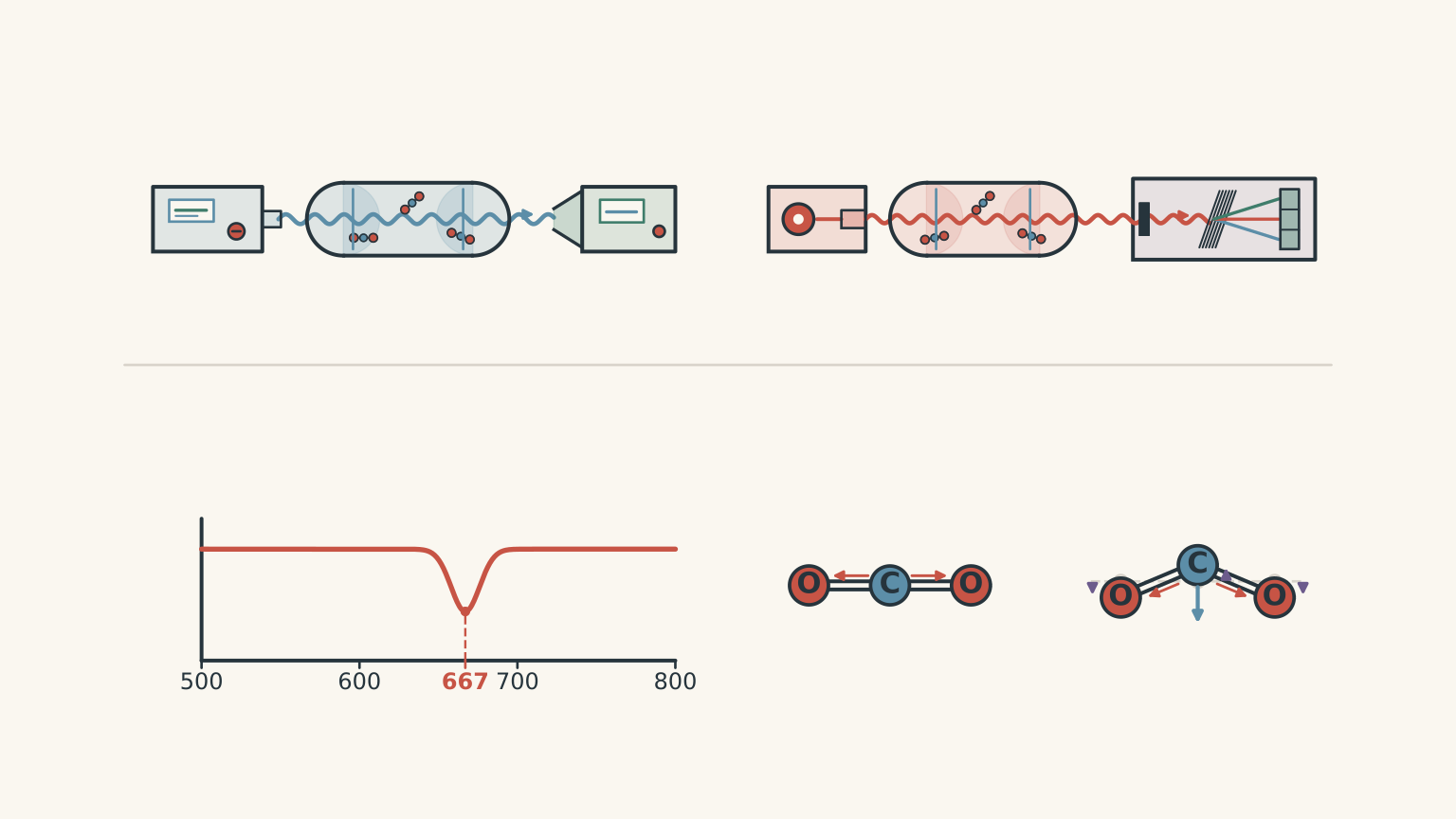
The arrangement is similar: an infrared source directs radiation through a gas sample, and a detector measures which frequencies are absorbed.
However, infrared spectroscopy can detect molecular vibrations that change the dipole moment.
Carbon dioxide has a bending vibrational mode at approximately:
\[ 667\ \mathrm{cm^{-1}} \]
During this vibration, the molecule temporarily moves away from its straight equilibrium arrangement.
The two C=O bond dipoles no longer cancel perfectly, so the molecule develops a changing dipole moment.
It can therefore absorb infrared radiation during this bending vibration.
This gives us an important distinction:
A molecule can have a linear equilibrium structure and still undergo bending vibrations.
The measured vibration does not mean that carbon dioxide is bent at rest.
Independent structural measurements, including gas-phase electron diffraction, also support a linear equilibrium geometry for carbon dioxide.
Due to technical limitations, this figure may display incorrectly or contain inaccuracies. Please check key details against your course materials.
What the experimental evidence tells us
The important measurements can be summarised as follows.
| Experimental property | Water | Carbon dioxide |
|---|---|---|
| Permanent dipole moment | Approximately 1.85 D | 0 D |
| Pure rotational microwave absorption | Yes | No |
| Gas-phase bending vibration | Approximately 1595 cm⁻¹ | Approximately 667 cm⁻¹ |
| Equilibrium molecular shape | Bent | Linear |
| Equilibrium bond angle | Approximately 104.5° | 180° |
The symbol D represents the debye, a unit of electric dipole moment.
The measurements support the structures predicted using electron counting and VSEPR theory.
However, remember what each model tells us:
- A Lewis structure represents how valence electrons are assigned.
- VSEPR predicts the approximate arrangement of electron regions.
- Molecular geometry describes the positions of the atoms.
- Spectroscopy provides physical evidence about molecular structure and motion.
None of these representations is a literal photograph of a molecule.
05Worked examples
Worked example: Why do two double bonds give linear CO₂?
A student draws the Lewis structure \(\ce{O=C=O}\) and argues that carbon has four electron regions because the two double bonds contain four shared electron pairs.
Determine the correct number of valence electrons, calculate the formal charges, and predict the molecular shape.
Step 1
Carbon contributes four electrons, and each oxygen contributes six.
\[ N=4+2(6)=16 \]
There are 16 valence electrons in total.
Step 2
Carbon forms two double bonds, one with each oxygen.
Each oxygen has two lone pairs, while carbon has no lone pairs.
Step 3
For carbon:
\[ \mathrm{FC(C)}=4-0-\frac{8}{2}=0 \]
For each oxygen:
\[ \mathrm{FC(O)}=6-4-\frac{4}{2}=0 \]
The formal charges are all zero.
Step 4
There are two C=O double bonds.
Each double bond counts as one electron region, giving two regions around carbon.
Step 5
Two electron regions arrange themselves \(180^\circ\) apart.
The molecule is linear, with an O-C-O bond angle of \(180^\circ\).
The student’s mistake was counting shared electron pairs rather than directions of electron density around the central atom.
Worked example: Estimate water’s net dipole moment
A simplified model assigns each O-H bond a dipole moment of \(1.50\ \mathrm{D}\).
The H-O-H bond angle is \(104.5^\circ\).
Estimate the net dipole moment of the water molecule using vector addition.
Step 1
The two bond dipoles have equal magnitudes and are separated by:
\[ \theta=104.5^\circ \]
Their resultant points along the angle bisector.
Step 2
For two equal dipole vectors separated by an angle \(\theta\):
\[ \mu_{\mathrm{net}} =2\mu_{\mathrm{bond}}\cos\left(\frac{\theta}{2}\right) \]
Here, \(\mu_{\mathrm{bond}}\) is the magnitude of one O-H bond dipole.
Step 3
\[ \begin{aligned} \mu_{\mathrm{net}} &=2(1.50\ \mathrm{D})\cos(104.5^\circ/2)\\ &=3.00\ \mathrm{D}\cos(52.25^\circ)\\ &\approx 1.84\ \mathrm{D} \end{aligned} \]
Step 4
The estimated molecular dipole is approximately:
\[ \boxed{1.84\ \mathrm{D}} \]
The measured gas-phase dipole moment of water is approximately \(1.85\ \mathrm{D}\).
The close agreement supports the simplified vector model.
For comparison, two equal bond dipoles separated by \(180^\circ\), as in carbon dioxide, produce:
\[ \mu_{\mathrm{net}} =2\mu_{\mathrm{bond}}\cos(90^\circ)=0 \]
The dipoles cancel completely.
Assumption: The calculation treats the two bond dipoles as equal vectors and uses an illustrative bond dipole magnitude. Individual bond dipoles are model-dependent quantities, so this is a consistency estimate rather than an independent measurement of the molecular geometry.
06Questions and solutions
Question 1
A neutral water molecule contains eight valence electrons. Its Lewis structure has two O-H single bonds and two lone pairs on the central oxygen atom.
State:
a) The electron-pair geometry.
b) The molecular shape.
c) The approximate H-O-H bond angle.
d) Why the molecule is not linear.
Due to technical limitations, this figure may display incorrectly or contain inaccuracies. Please check key details against your course materials.
Solution 1
Water has a tetrahedral electron-pair geometry, a bent molecular shape, and an H-O-H bond angle of approximately \(104.5^\circ\).
The reasoning is as follows.
Step 1: Count the electron regions.
Oxygen has two bonding regions and two lone pairs.
Therefore:
\[ 2+2=4\text{ electron regions} \]
Step 2: Determine the electron-pair geometry.
Four electron regions arrange themselves approximately tetrahedrally.
Step 3: Determine the molecular shape.
Only the positions of the bonded atoms are used when naming molecular shape.
Water has two bonded hydrogen atoms, so its molecular shape is bent.
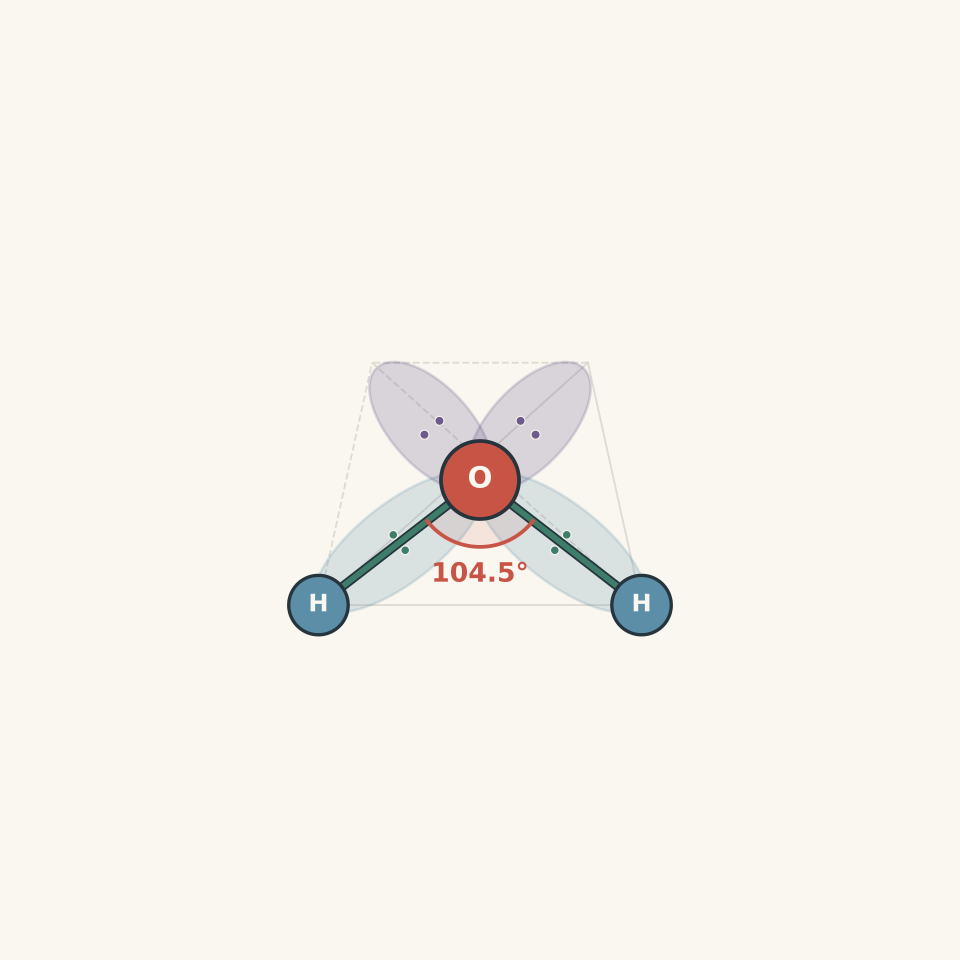
Due to technical limitations, this figure may display incorrectly or contain inaccuracies. Please check key details against your course materials.
Step 4: Explain the bond angle.
The two lone pairs repel the bonding regions more strongly than bonding pairs repel one another.
This pushes the O-H bonds closer together, reducing the angle below the ideal tetrahedral value of \(109.5^\circ\).
Water is therefore bent rather than linear.
Question 2
A student makes two statements about carbon dioxide:
- Each C=O bond is non-polar because the overall molecule is non-polar.
- Carbon has four electron regions because the two double bonds contain four shared electron pairs.
Identify both errors.
Calculate the total valence electrons, determine the formal charges, and explain the correct molecular shape and polarity.
Solution 2
Both statements are incorrect. Carbon dioxide has two polar C=O bonds, but their dipoles cancel because the molecule is linear. Carbon also has only two electron regions, not four.
Step 1: Count the total valence electrons.
\[ N=4+2(6)=16 \]
Step 2: Determine the Lewis structure.
The structure is:
\[ \ce{O=C=O} \]
Each oxygen has two lone pairs, and carbon has no lone pairs.
Step 3: Calculate formal charges.
For carbon:
\[ \mathrm{FC(C)}=4-0-4=0 \]
For oxygen:
\[ \mathrm{FC(O)}=6-4-2=0 \]
All atoms have zero formal charge.
Step 4: Count the electron regions.
Each double bond counts as one region around carbon.
Therefore, carbon has two electron regions.
These regions arrange themselves in opposite directions, giving a linear molecular shape.
Step 5: Explain the polarity.
Each C=O bond is polar because oxygen is more electronegative than carbon.
However, the two bond dipoles have equal magnitudes and opposite directions.
Their vector sum is zero.
Carbon dioxide is therefore non-polar overall.
The important distinction is that bond polarity and molecular polarity describe different things. Molecular polarity depends on the vector sum of all bond dipoles, not simply whether polar bonds are present.
Question 3
Water reacts with a hydrogen ion to form hydronium:
\[ \ce{H2O + H+ -> H3O+} \]
A student argues that adding a hydrogen ion should leave the molecular shape unchanged because the oxygen atom is still the central atom.
Determine:
a) The total number of valence electrons in \(\ce{H3O+}\).
b) The number of lone pairs on oxygen.
c) The formal charge on oxygen.
d) The electron-pair geometry and molecular shape.
Explain why the shape changes from water to hydronium.
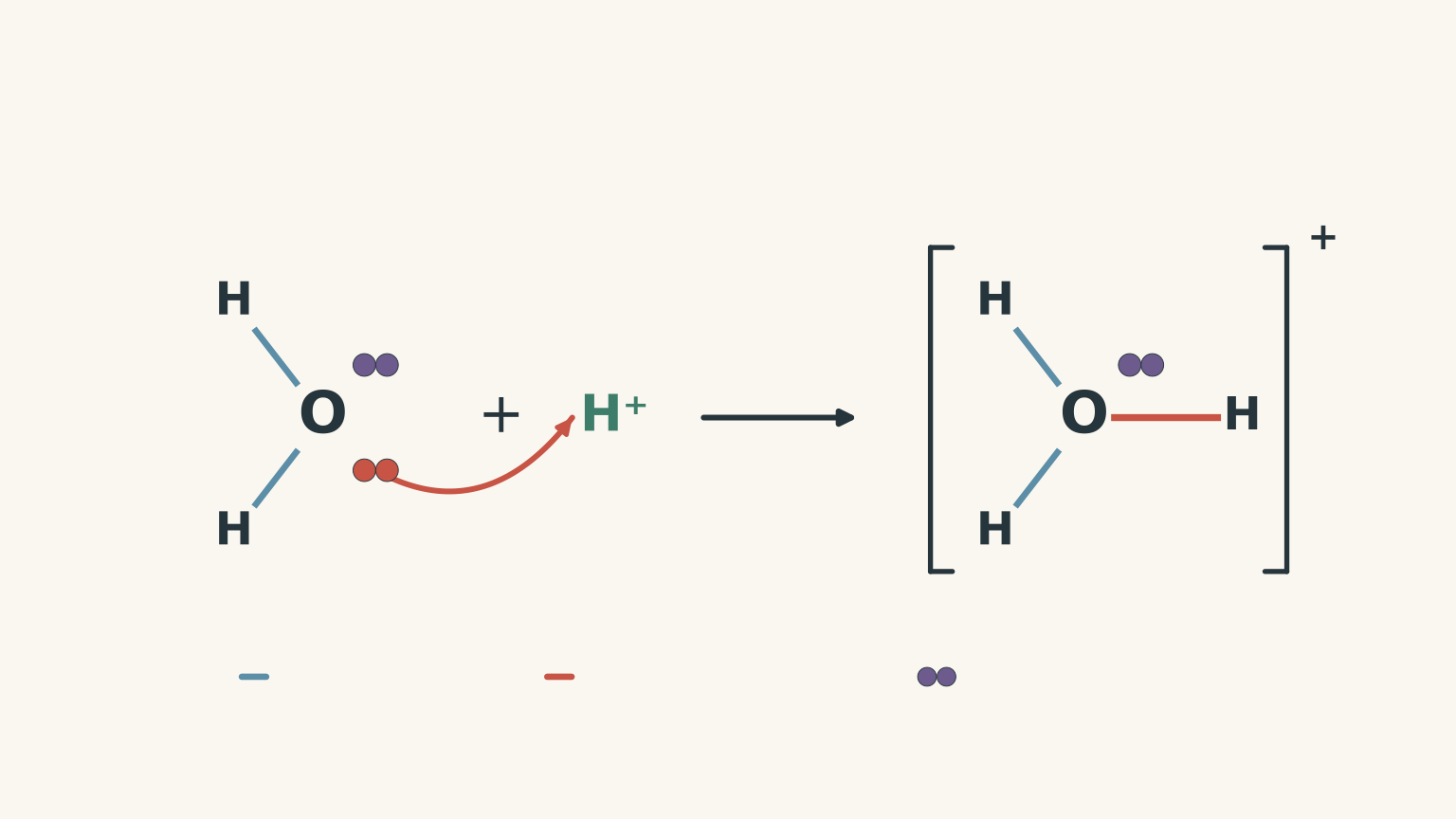
Due to technical limitations, this figure may display incorrectly or contain inaccuracies. Please check key details against your course materials.
Solution 3
Hydronium has a tetrahedral electron-pair geometry and a trigonal pyramidal molecular shape. Oxygen has one lone pair and a formal charge of \(+1\).
The addition of the hydrogen ion converts one of water’s lone pairs into an additional O-H bonding pair.
Step 1: Count the total valence electrons.
Oxygen contributes six electrons, and the three hydrogen atoms contribute three.
Because the overall charge is \(+1\), subtract one electron:
\[ N=6+3(1)-1=8 \]
Hydronium has eight valence electrons.
Step 2: Determine the electron distribution.
Oxygen forms three O-H single bonds.
These bonds account for six electrons.
The remaining two electrons form one lone pair on oxygen.
Therefore, oxygen has three bonding regions and one lone pair.
Step 3: Calculate the formal charge on oxygen.
Using the formal charge equation:
\[ \begin{aligned} \mathrm{FC(O)} &=6-2-\frac{6}{2}\\ &=6-2-3\\ &=+1 \end{aligned} \]
Each hydrogen has a formal charge of zero.
The overall charge is therefore \(+1\), as required.
Step 4: Determine the geometry.
Oxygen has four electron regions:
\[ 3\text{ bonding regions}+1\text{ lone pair} \]
The electron-pair geometry is tetrahedral.
However, only three positions are occupied by bonded hydrogen atoms. The molecular shape is trigonal pyramidal.
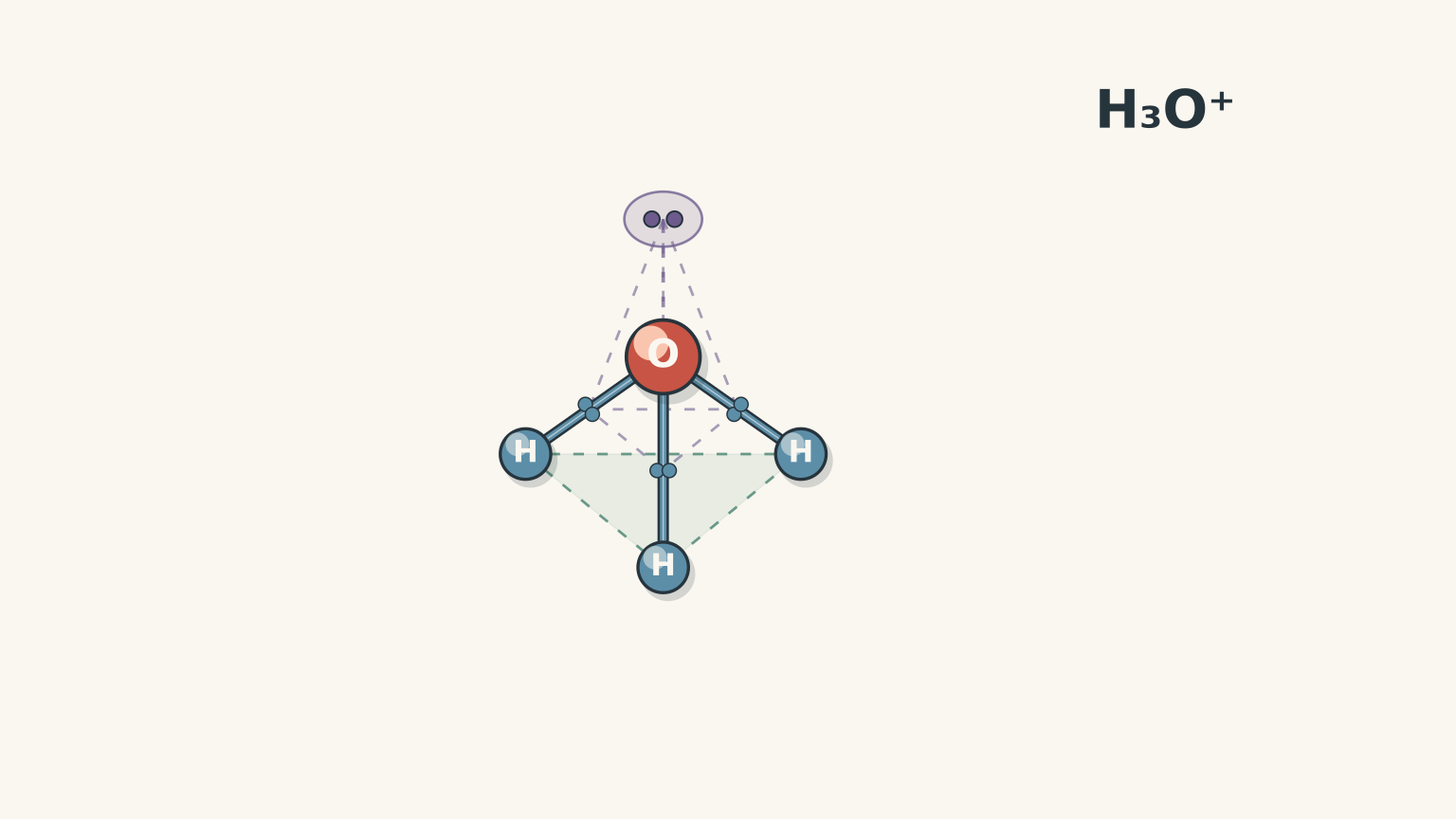
Due to technical limitations, this figure may display incorrectly or contain inaccuracies. Please check key details against your course materials.
Step 5: Compare water and hydronium.
| Feature | H₂O | H₃O⁺ |
|---|---|---|
| O-H bonds | 2 | 3 |
| Lone pairs on oxygen | 2 | 1 |
| Electron regions | 4 | 4 |
| Electron-pair geometry | Tetrahedral | Tetrahedral |
| Molecular shape | Bent | Trigonal pyramidal |
| Overall charge | 0 | +1 |
The tempting prediction is that adding one hydrogen should simply make the existing bent structure larger.
But the new hydrogen uses one of oxygen’s lone pairs to form a bond. This changes the number of bonded atoms and therefore changes the molecular shape.
The number of electron regions remains four, but their distribution between bonding pairs and lone pairs changes.
Question 4
Carbon dioxide and boron trifluoride, \(\ce{BF3}\), both have zero permanent molecular dipole moments.
However, all three B-F bonds in boron trifluoride are polar.
A student concludes that boron trifluoride must be linear because it has zero molecular dipole moment.
Using valence electrons and VSEPR theory:
a) Calculate the total valence electrons in \(\ce{BF3}\).
b) Describe its Lewis structure and determine the number of electron regions around boron.
c) Predict its molecular shape and approximate bond angle.
d) Explain why its three polar bonds produce a zero net dipole moment.
e) Explain why the student’s conclusion is incorrect.
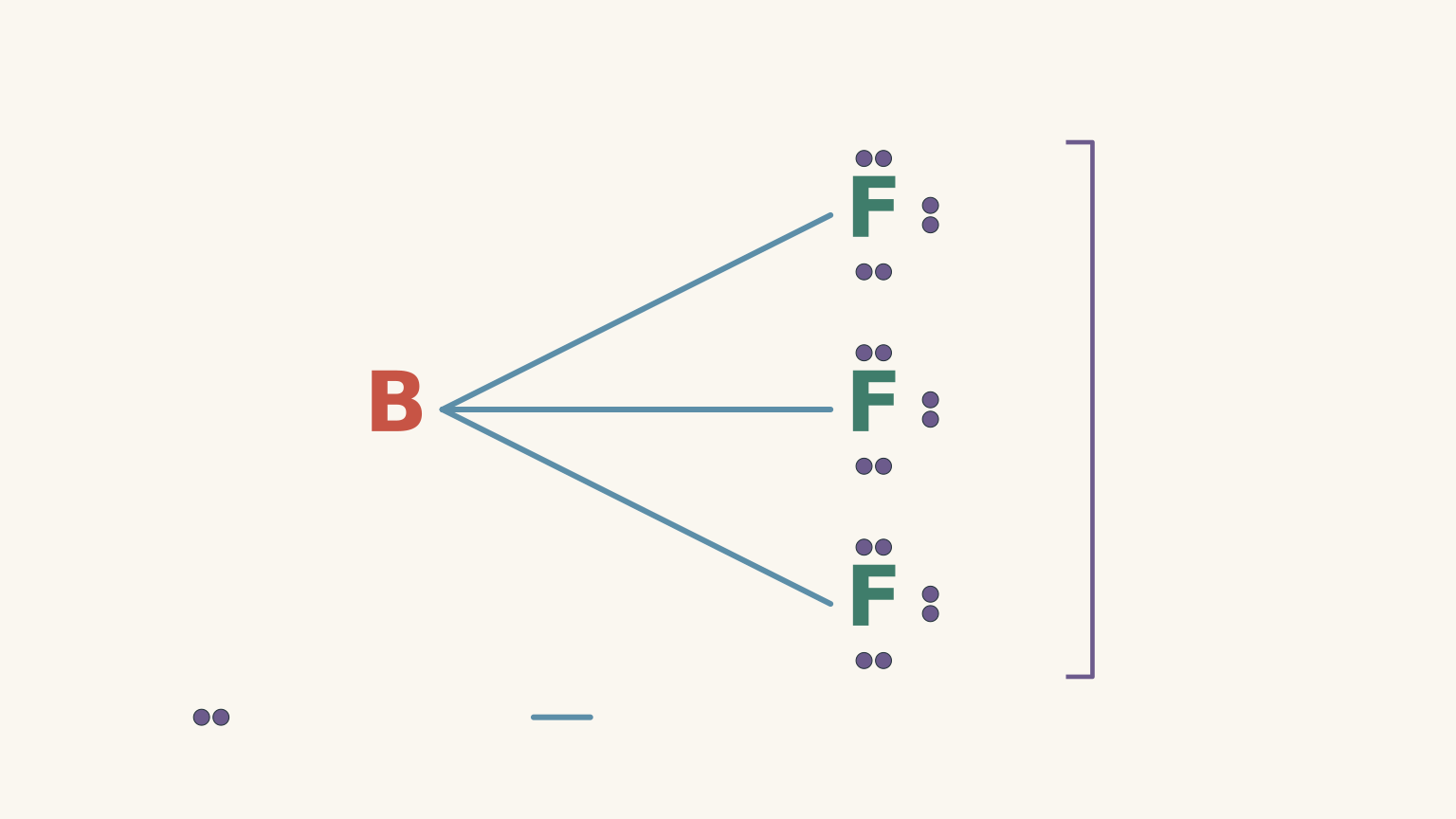
Due to technical limitations, this figure may display incorrectly or contain inaccuracies. Please check key details against your course materials.
Solution 4
Boron trifluoride is trigonal planar, with bond angles of approximately \(120^\circ\). Its three equal B-F bond dipoles cancel because they are symmetrically distributed around boron.
Step 1: Calculate the total valence electrons.
Boron contributes three electrons, and each fluorine contributes seven.
\[ N=3+3(7)=24 \]
There are 24 valence electrons.
Step 2: Construct the Lewis structure.
Boron forms three single covalent bonds with fluorine.
Each fluorine has three lone pairs.
Boron has no lone pairs and only six electrons around it.
This is an important exception to the octet rule. Boron can form a stable electron-deficient structure with six electrons in this molecule.
The formal charges are zero:
\[ \mathrm{FC(B)}=3-0-3=0 \]
\[ \mathrm{FC(F)}=7-6-1=0 \]
Step 3: Count the electron regions.
Boron has three bonding regions and no lone pairs.
Therefore:
\[ 3+0=3\text{ electron regions} \]
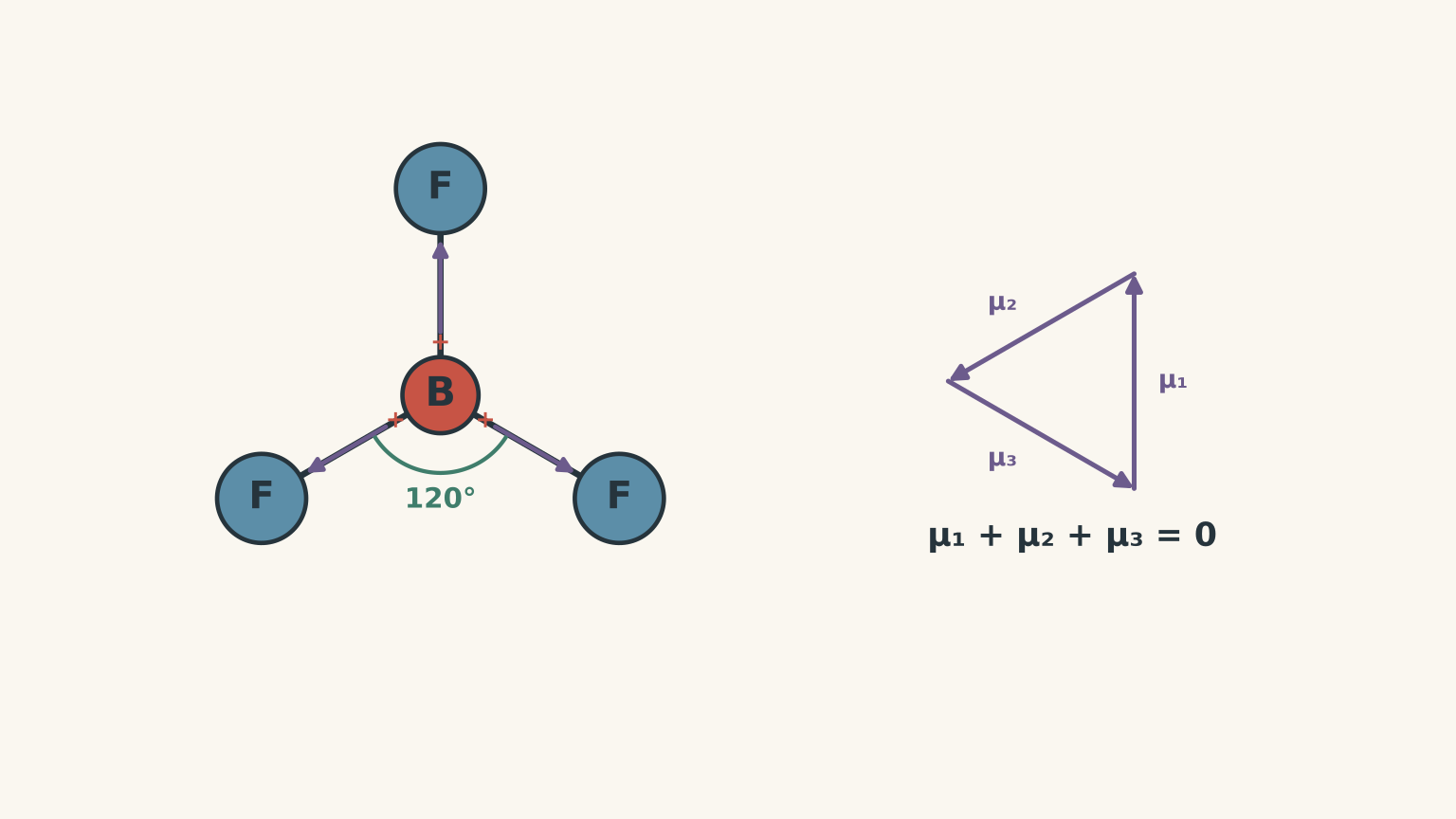
Three electron regions arrange themselves approximately \(120^\circ\) apart in a plane.
The molecular shape is trigonal planar.
Due to technical limitations, this figure may display incorrectly or contain inaccuracies. Please check key details against your course materials.
Step 4: Explain the molecular polarity.
Each B-F bond is polar because fluorine attracts the shared electrons more strongly than boron.
However, the three bond dipoles are equal and arranged symmetrically.
Their vector sum is zero.
The molecule is non-polar overall.
Step 5: Identify the misconception.
A zero molecular dipole does not necessarily mean that a molecule is linear.
Carbon dioxide is linear and non-polar because two equal bond dipoles point in opposite directions.
Boron trifluoride is trigonal planar and non-polar because three equal bond dipoles cancel through threefold symmetry.
Molecular polarity is determined by the combined directions and magnitudes of the bond dipoles, not by a single required molecular shape.
Question 5
A chemist investigates an unknown neutral triatomic molecule, Q.
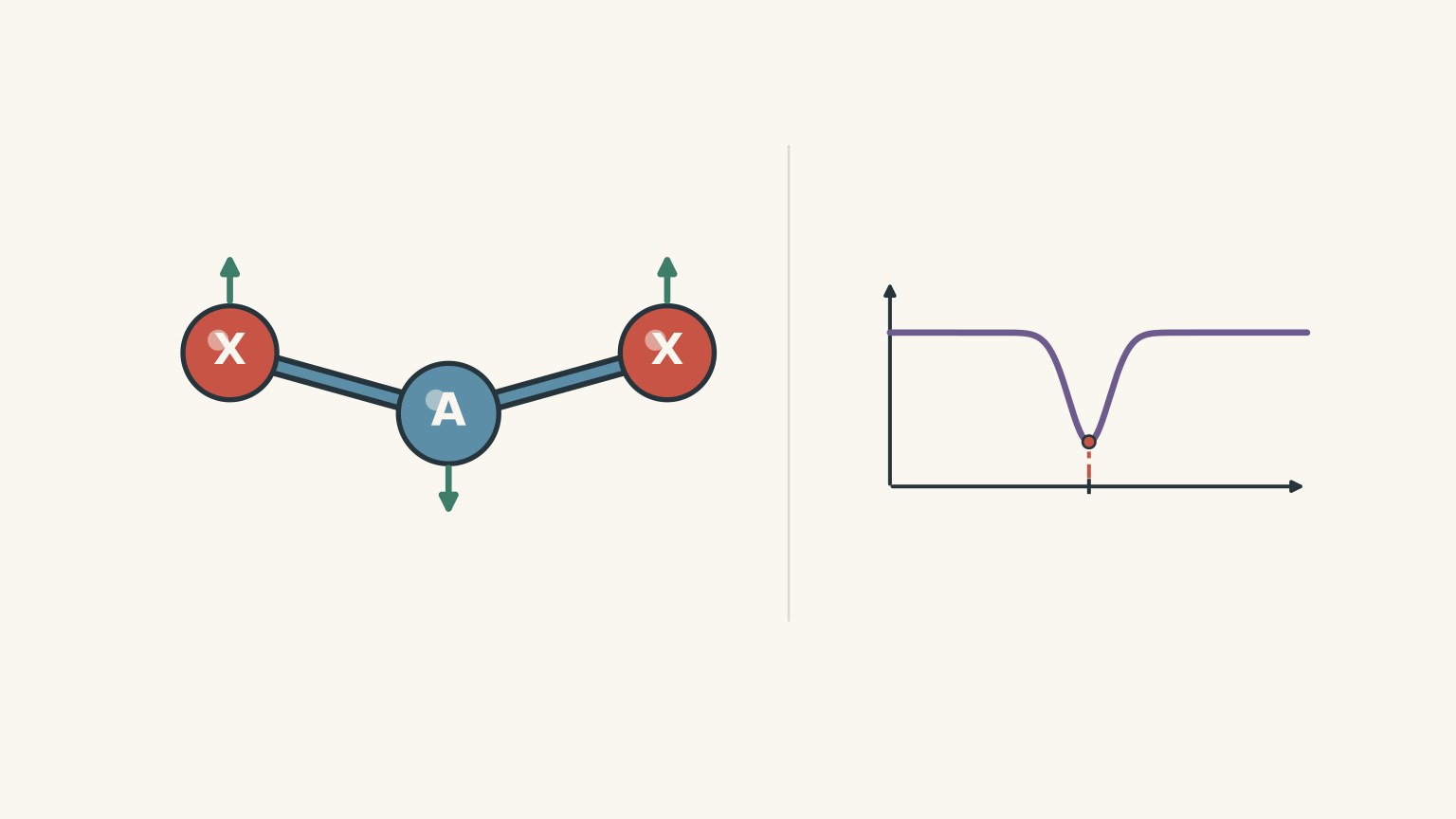
The molecule has two identical terminal atoms, X, bonded to a central atom, A.
The following observations are recorded:
- The Lewis structure has two bonding regions around A and no lone pairs on A.
- The molecule has no permanent dipole moment.
- Infrared spectroscopy identifies an absorption band at \(667\ \mathrm{cm^{-1}}\), assigned to a bending vibration.
Two students propose different explanations.
Student 1 argues:
“The infrared bending band proves the molecule must be bent at equilibrium. A molecule cannot have a bending vibration if its normal structure is linear.”
Student 2 argues:
“The molecule has zero permanent dipole, so it cannot develop a dipole during a vibration. The infrared absorption must have another explanation.”
Assume the molecule is symmetric, the assigned band is a genuine fundamental bending mode, and the measurements are made in the gas phase.
Determine the most consistent equilibrium geometry.
Evaluate both students’ explanations. Your answer must explain:
a) How the number of electron regions constrains the equilibrium geometry.
b) Why the molecule has no permanent dipole.
c) How a bending vibration can produce an infrared absorption band despite the zero permanent dipole.
d) Why the instantaneous geometry during vibration must be distinguished from the equilibrium molecular shape.
Due to technical limitations, this figure may display incorrectly or contain inaccuracies. Please check key details against your course materials.
Solution 5
The most consistent equilibrium geometry is linear. Both students are incorrect because they confuse the molecule’s equilibrium structure with its instantaneous structure during vibration.
The key is that molecular shape describes the equilibrium arrangement of the atoms, while a vibrational mode describes how those atoms move around that arrangement.
Step 1: Determine the equilibrium geometry using the electron regions.
The central atom has two bonding regions and no lone pairs.
Under VSEPR theory, two electron regions arrange themselves in opposite directions.
Therefore, the equilibrium molecular shape is linear:
\[ \angle XAX=180^\circ \]
This is the same basic arrangement as carbon dioxide.
Step 2: Explain the zero permanent dipole.
The two terminal atoms are identical.
Consequently, the two bond dipoles have equal magnitudes.
Because the molecule is linear, the bond dipoles point in opposite directions.
Their vector sum is zero.
The molecule therefore has no permanent dipole moment at equilibrium.
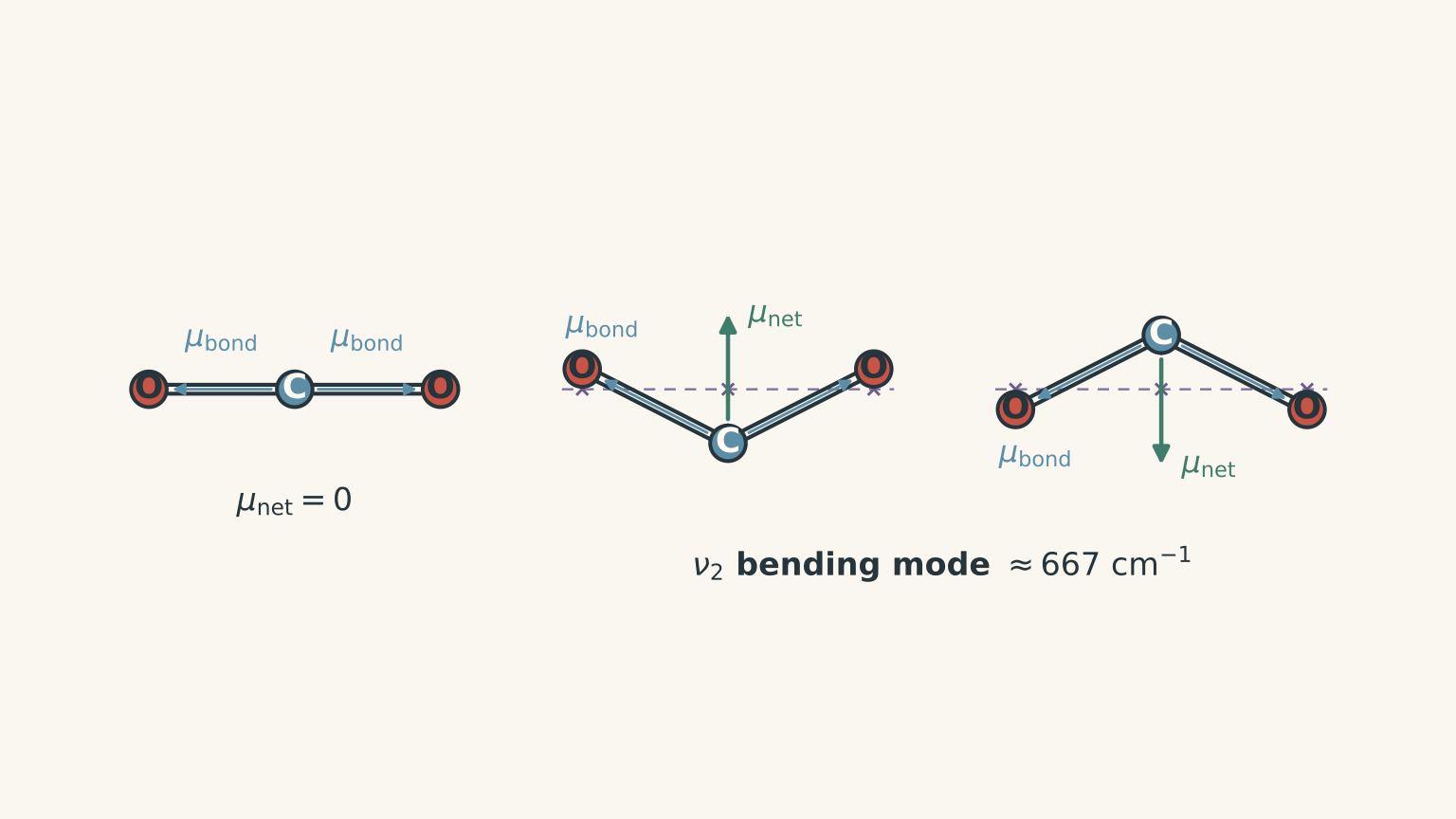
Step 3: Consider what happens during a bending vibration.
A bending vibration changes the angle between the bonds.
The terminal atoms move away from their equilibrium positions, so the molecule is temporarily no longer straight.
The two bond dipoles no longer point in exactly opposite directions.
They therefore produce a temporary molecular dipole.
As the molecule continues vibrating, this dipole changes with time.
The changing dipole allows the vibration to interact with infrared radiation.
This is why the bending mode can absorb infrared radiation even though the molecule has no permanent dipole.
Due to technical limitations, this figure may display incorrectly or contain inaccuracies. Please check key details against your course materials.
Step 4: Evaluate Student 1’s explanation.
Student 1 is incorrect.
A bending vibration does not require the equilibrium molecule to be bent.
A linear molecule can have a bending mode in which its bond angle oscillates away from \(180^\circ\) and then returns.
The molecule is linear at equilibrium, but its instantaneous geometry changes during the vibration.
Step 5: Evaluate Student 2’s explanation.
Student 2 is also incorrect.
Having zero permanent dipole does not prevent a molecule from developing a temporary dipole.
The permanent dipole describes the molecule’s equilibrium charge distribution.
During the bending vibration, the molecular symmetry is temporarily disturbed, and the bond dipoles no longer cancel.
The changing dipole allows infrared absorption.
Step 6: Connect the evidence to the molecular model.
The three observations are consistent with one another:
| Observation | Explanation |
|---|---|
| Two electron regions around A | Predicts a linear equilibrium arrangement |
| Zero permanent dipole | Equal and opposite bond dipoles cancel |
| Infrared bending absorption | The vibration temporarily changes the molecular dipole |
The surprising result is that the molecule can be linear at equilibrium while repeatedly moving through bent configurations during vibration.
This is why a molecular structure diagram should be understood as a representation of equilibrium geometry, not a claim that the atoms remain motionless.
The same distinction applies to carbon dioxide.
07Where to go next
The reasoning chain for these molecules is:
\[ \text{Valence electrons} \]
\[ \downarrow \]
\[ \text{Lewis structure} \]
\[ \downarrow \]
\[ \text{Electron regions} \]
\[ \downarrow \]
\[ \text{Molecular shape} \]
\[ \downarrow \]
\[ \text{Molecular polarity} \]
Water is bent because oxygen has two bonding regions and two lone pairs. Carbon dioxide is linear because carbon has two bonding regions and no lone pairs.
The next useful connection is intermolecular forces. Water’s bent, polar structure allows strong hydrogen bonding, while non-polar carbon dioxide has different intermolecular attractions.
Understanding molecular geometry therefore gives you a foundation for explaining physical properties such as boiling points, solubility, and the differences between substances with similar molecular sizes.