
How to Purify an Ester After a Small-Scale Preparation
Learn how to purify an ester after a small-scale esterification reaction using washing, neutralisation, drying, and distillation. Includes explanations of reagent choices, worked calculations, and challenging HSC Chemistry practice questions.
Your esterification flask has stopped refluxing, and the liquid looks clear. Is it ready to collect as a pure ester?
Not yet. After preparing ethyl ethanoate from ethanol and ethanoic acid, the reaction mixture can still contain unreacted alcohol, unreacted carboxylic acid, water, and sulfuric acid catalyst. Some of these substances have properties quite similar to the ester, so simply pouring the mixture into another container won’t produce a pure sample.
For a small-scale school preparation, the general purification process is:
- Wash the cooled reaction mixture with water to extract water-soluble impurities.
- Use sodium carbonate or sodium hydrogen carbonate to neutralise remaining acid.
- Separate the ester-rich organic layer using a separating funnel.
- Dry the organic layer using an anhydrous drying agent.
- Distil the dried liquid to collect the ester-rich fraction.
Each step removes a different type of impurity. Understanding why they happen in this order is more useful than memorising a list of chemicals.
Safety: These procedures are for supervised school laboratory work. Ethyl ethanoate and ethanol are flammable, while concentrated sulfuric acid is corrosive. Wear appropriate eye protection, use the ventilation and heating arrangements specified by your teacher, and never heat the organic liquid directly over a naked flame. Follow your school’s chemical risk assessment and disposal instructions.
01Understand what is in the reaction mixture
Before choosing a purification method, identify the substances you need to separate.
Consider the preparation of ethyl ethanoate.
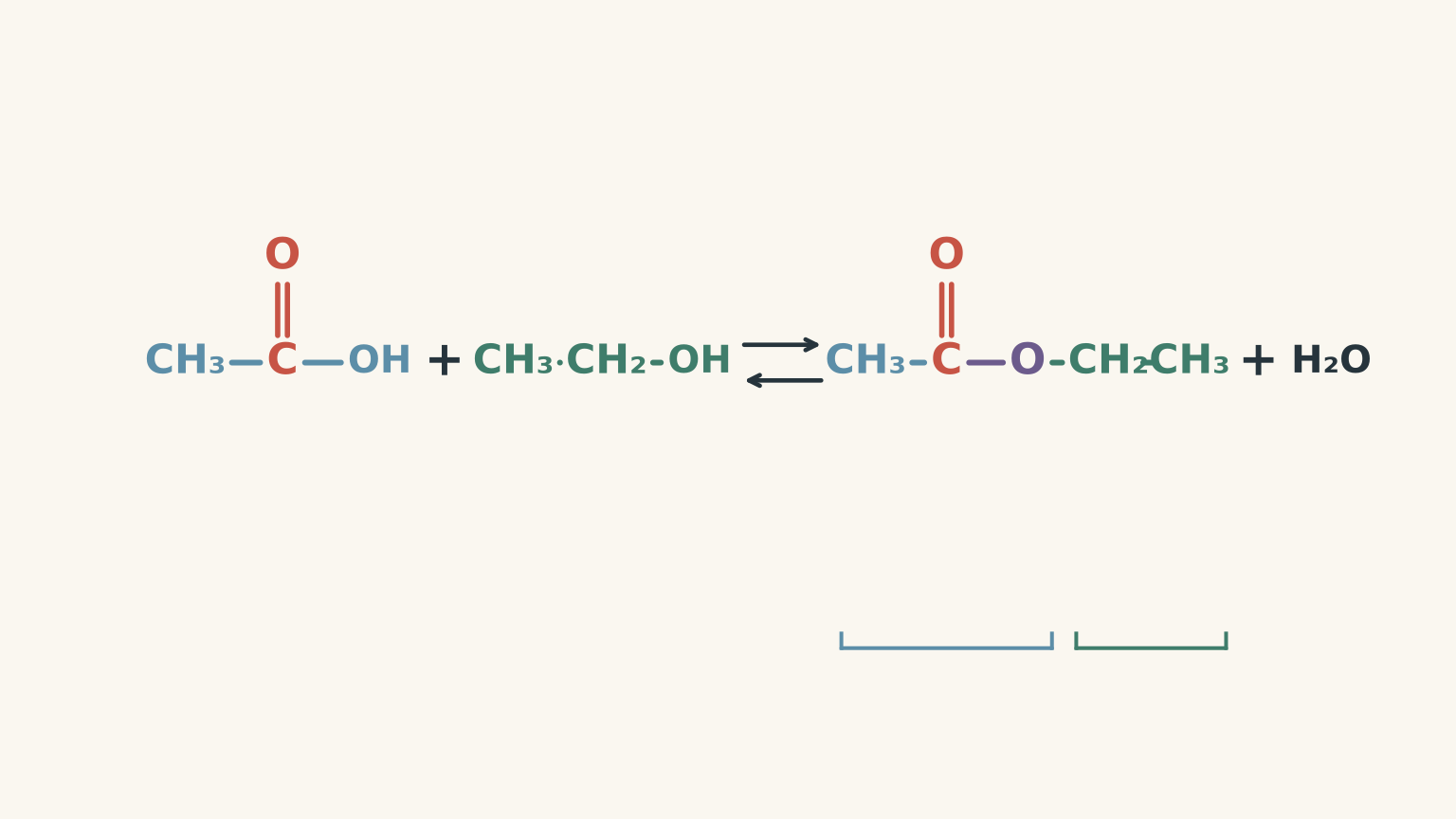
The reaction is:
\[ \ce{CH3COOH + CH3CH2OH <=> CH3COOCH2CH3 + H2O} \]
Ethanoic acid reacts with ethanol to form ethyl ethanoate and water.
The ester has the structure:
\[ \ce{CH3-C(=O)-O-CH2-CH3} \]
Notice the connectivity. The ester contains a carbonyl group, \(\ce{C=O}\), directly connected to another oxygen atom, which is attached to the ethyl group.
The ethanoic acid supplies the ethanoate portion, while ethanol supplies the ethyl portion.
Due to technical limitations, this figure may display incorrectly or contain inaccuracies. Please check key details against your course materials.
Why isn’t the reaction mixture already pure?
The reaction is reversible. It does not necessarily convert every molecule of alcohol and carboxylic acid into ester.
At equilibrium, the reaction mixture can contain:
| Substance | Why it is present |
|---|---|
| Ethyl ethanoate | Desired product |
| Ethanol | Unreacted alcohol |
| Ethanoic acid | Unreacted carboxylic acid |
| Water | Product of esterification |
| Sulfuric acid | Acid catalyst used during preparation |
The sulfuric acid has an important role during formation. It increases the reaction rate by acting as an acid catalyst. Concentrated sulfuric acid can also act as a dehydrating agent, helping remove water and favouring ester formation.
However, that same sulfuric acid becomes an unwanted impurity once the reaction is finished.
This is an important distinction: a reagent can be useful during synthesis but need to be removed during purification.
For a fuller explanation of the formation stage, see Simple Ester Production: HSC Chemistry Lab Explained.
02Wash the reaction mixture to remove soluble impurities
The first challenge is separating the ester from the substances that dissolve readily in water.
Water is useful because ethanol and many of the acidic substances in the reaction mixture are water-soluble. Ethyl ethanoate, in contrast, is only slightly soluble in water.
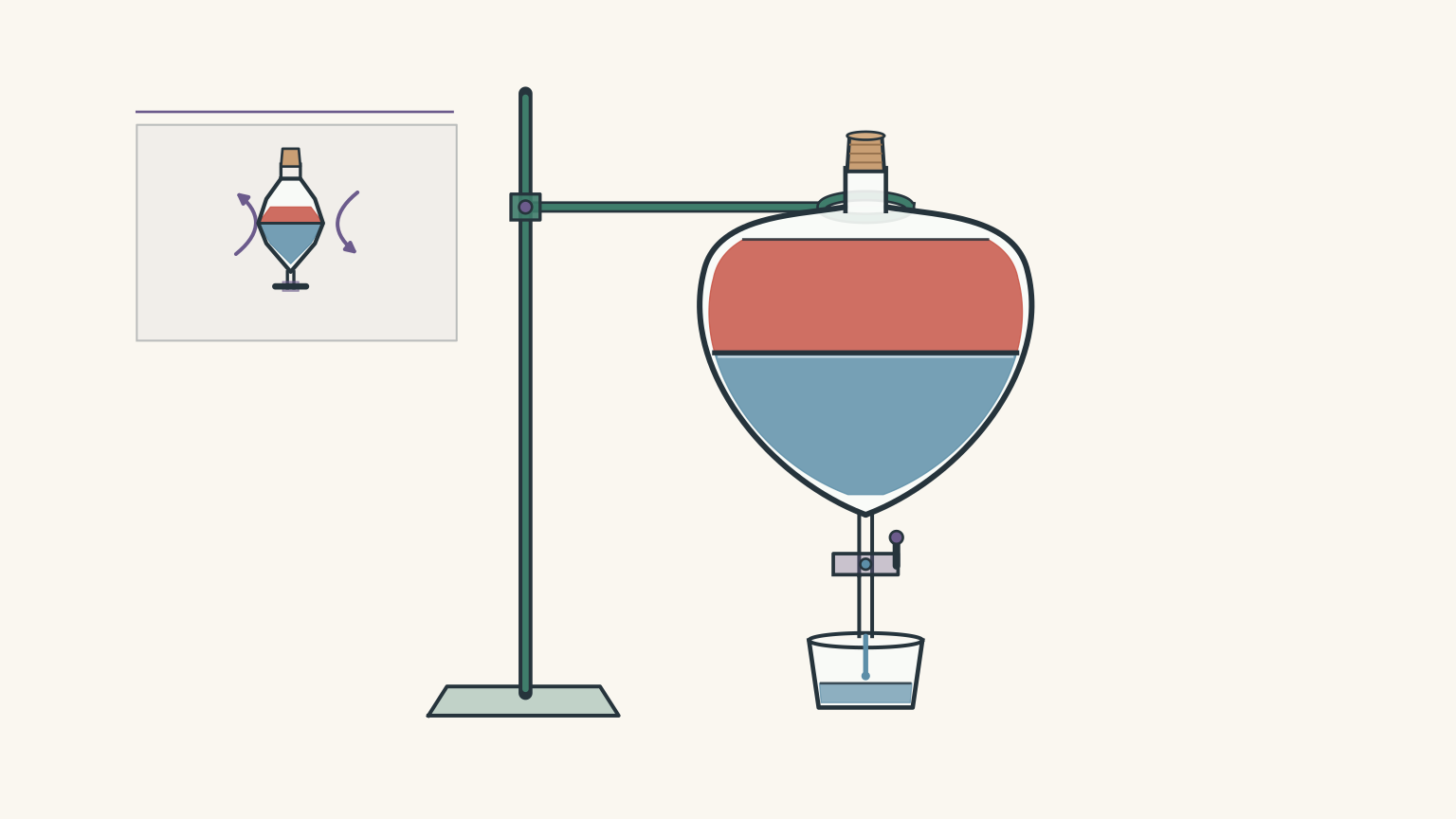
A typical school-scale procedure begins by allowing the reaction mixture to cool before transferring it into a separating funnel with distilled water.
Gently mix the liquids, allow them to settle, and wait for two distinct layers to form.
Due to technical limitations, this figure may display incorrectly or contain inaccuracies. Please check key details against your course materials.
Which layer contains the ester?
Predict whether the ester will sit above or below the water.
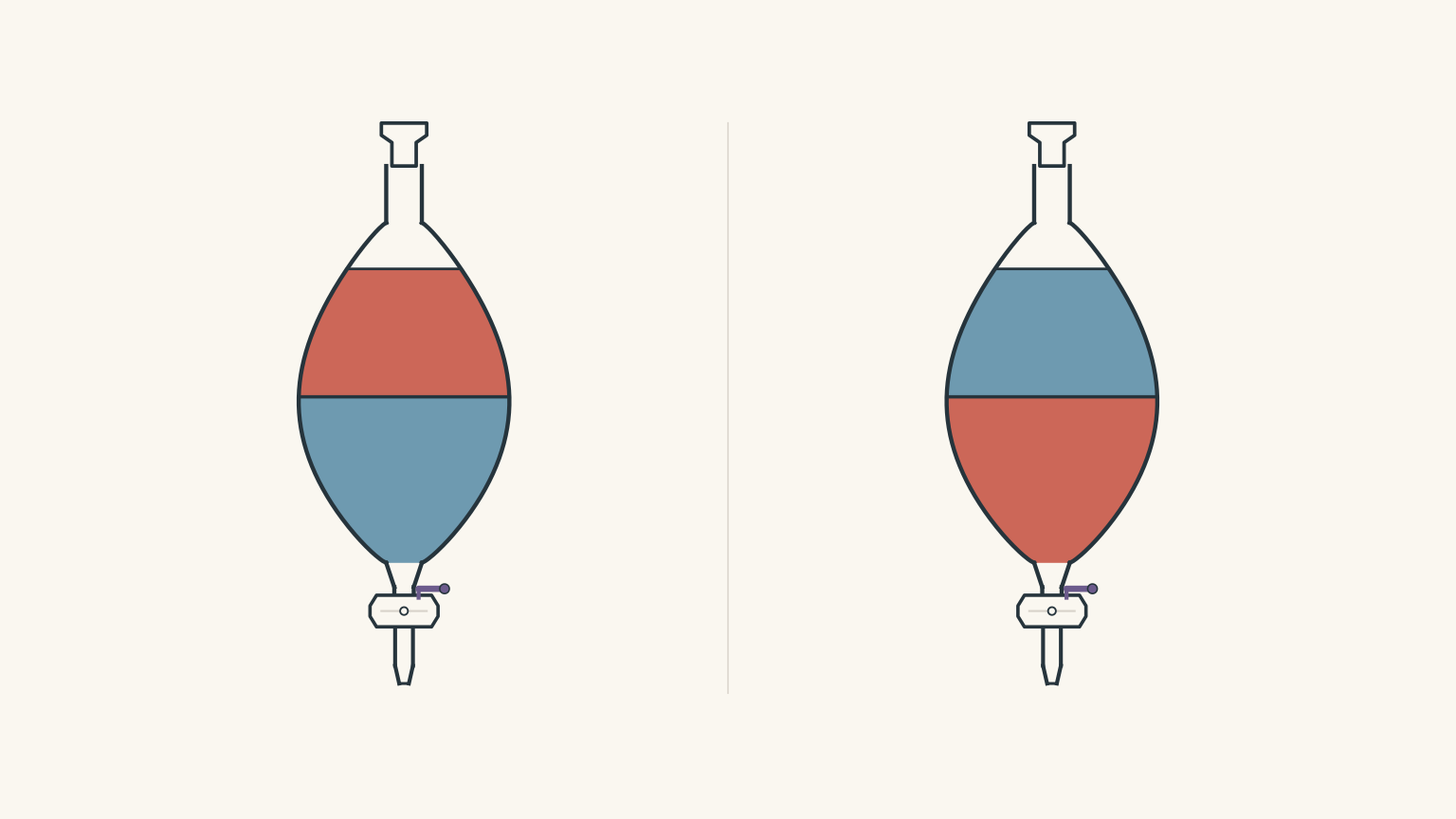
For ethyl ethanoate, the organic layer is on top because ethyl ethanoate is less dense than water.
Approximate reference data:
| Substance | Density at approximately 20°C |
|---|---|
| Ethyl ethanoate | 0.895 g mL⁻¹ |
| Water | 1.00 g mL⁻¹ |
The less dense liquid floats above the denser liquid.
Therefore:
- Upper layer: ethyl ethanoate-rich organic layer.
- Lower layer: aqueous layer containing dissolved impurities.
The aqueous layer can be drained through the stopcock into a separate container. Retain the organic layer.
There is an important limitation here. Not every ester is less dense than water. Some esters are denser and will form the lower layer instead.
Never assume that the organic layer is always on top.
If you are uncertain, a small water-drop test can help. Add a few drops of water and observe which layer increases in volume. That is the aqueous layer.
Due to technical limitations, this figure may display incorrectly or contain inaccuracies. Please check key details against your course materials.
Why does the water wash work?
Water extracts substances that dissolve more readily in the aqueous phase.
These include:
- Unreacted ethanol.
- Much of the remaining ethanoic acid.
- Some of the sulfuric acid catalyst.
The ester remains mostly in the organic layer.
However, ethyl ethanoate is not completely insoluble in water. Some product will be lost during washing.
This creates a practical trade-off: washing more thoroughly can improve purity, but excessive washing can reduce the amount of ester recovered.
The water wash should also be relatively brief and cool. Leaving an acidic esterification mixture in contact with water for an extended period can encourage the reverse reaction, ester hydrolysis.
03Neutralise the remaining acid using sodium carbonate
Even after the water wash, traces of acid may remain in the organic layer.
How can you remove them?
Use sodium carbonate, \(\ce{Na2CO3}\), or sodium hydrogen carbonate, \(\ce{NaHCO3}\), as specified by the laboratory procedure.
These bases react with residual carboxylic acids and sulfuric acid, converting them into ionic salts that dissolve in water.
For ethanoic acid, the reaction with sodium carbonate is:
\[ \ce{2CH3COOH + Na2CO3 ->} \]
\[ \ce{2CH3COONa + H2O + CO2} \]
The ethanoic acid becomes sodium ethanoate, which is water-soluble.
Sulfuric acid is also neutralised:
\[ \ce{H2SO4 + Na2CO3 ->} \]
\[ \ce{Na2SO4 + H2O + CO2} \]
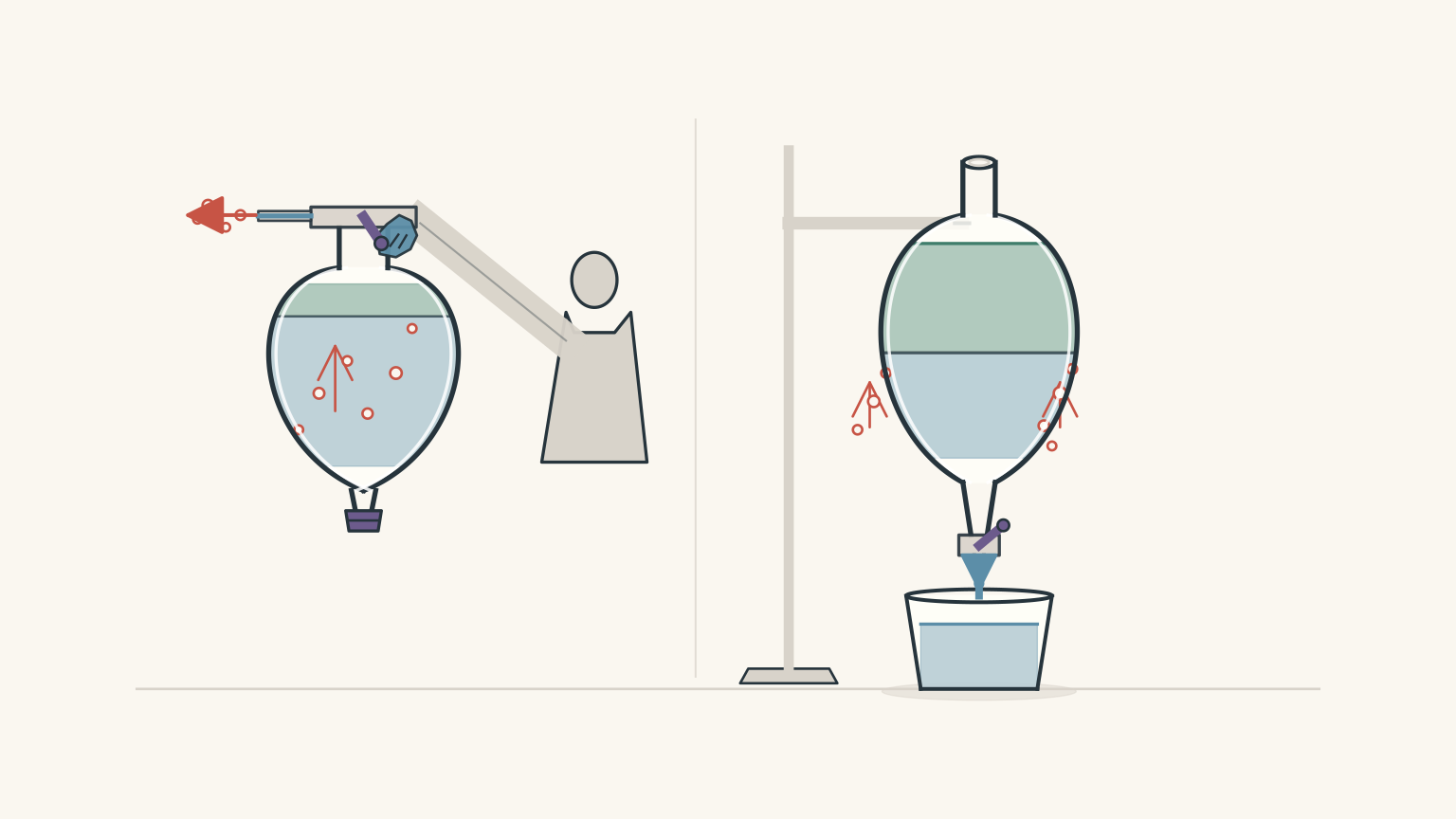
Both reactions produce carbon dioxide gas.
Why does the separating funnel need to be vented?
As carbon dioxide forms, pressure builds inside the sealed separating funnel.
If the pressure is not released, it can force the stopper out or cause liquid to spray when the funnel is opened.
During the carbonate wash, follow the teacher-approved venting procedure. Point the outlet away from people and release accumulated gas frequently.
Due to technical limitations, this figure may display incorrectly or contain inaccuracies. Please check key details against your course materials.
What does the bubbling tell you?
The bubbles are carbon dioxide produced when carbonate reacts with acid.
As the acidic impurities are neutralised, less carbon dioxide is produced.
When a fresh portion of carbonate produces no further effervescence, there is no readily detectable acidic material remaining under those test conditions.
This is useful evidence, but it does not prove that the ester is completely pure. Ethanol and water can still be present without producing carbon dioxide.
After neutralisation, allow the layers to separate again and remove the aqueous layer.
A small water rinse can then remove remaining soluble sodium salts and excess carbonate. Separate the layers once more.
Some school procedures combine the carbonate wash and water rinse differently. Follow the specific method supplied by your teacher.
The important distinction is:
- Water washing extracts water-soluble impurities.
- Carbonate neutralises residual acids.
- The final water rinse removes soluble salts.
A tempting alternative: why not use sodium hydroxide?
You might predict that sodium hydroxide would be even better because it is a stronger base.
It would certainly neutralise the acid. However, it can also destroy the ester through alkaline hydrolysis, commonly called saponification.
For ethyl ethanoate:
\[ \ce{CH3COOCH2CH3 + NaOH ->} \]
\[ \ce{CH3COONa + CH3CH2OH} \]
The ester is converted back into sodium ethanoate and ethanol.
This is the opposite of what you want during purification.
Sodium carbonate is a milder base and is suitable for neutralising residual acid under controlled, brief washing conditions. Even then, avoid unnecessary contact with the aqueous wash.
04Dry the organic layer
After separating the aqueous layer, your ester-rich liquid may still contain small amounts of dissolved water.
It might look slightly cloudy.
This is where an anhydrous drying agent is useful.
A common choice is anhydrous sodium sulfate, \(\ce{Na2SO4}\). Anhydrous magnesium sulfate, \(\ce{MgSO4}\), is another option when appropriate for the particular product.
These substances absorb residual water from the organic liquid by forming hydrated solids.
For example:
\[ \ce{Na2SO4 + 10H2O -> Na2SO4.10H2O} \]
The drying agent removes water without being intended to react with the ester.
How do you know when enough drying agent has been added?
Add a small amount of the anhydrous drying agent and gently swirl the flask.
Initially, the solid may clump together as it absorbs water.
If it continues to clump, more drying agent is needed.
Continue adding small portions until:
- The liquid becomes clear.
- Fresh drying agent remains loose and free-flowing.
- No obvious water droplets remain.
The liquid can then be carefully decanted or filtered to remove the solid drying agent.
Remember that drying and neutralisation are different processes.
Anhydrous sodium sulfate removes water. It does not neutralise residual ethanoic acid or remove significant quantities of unreacted ethanol.
That is why the washing stages must come first.
05Distil the dried ester
The final stage is distillation.
Even after washing and drying, the organic liquid may contain small amounts of other organic substances.
Distillation separates liquids according to differences in boiling point.
The dried organic mixture is placed in a distillation flask, with anti-bumping granules added before heating.
A thermometer measures the temperature of the vapour entering the condenser. The condenser cools the vapour, turning it back into liquid, which is collected in a separate receiving flask.
Cooling water enters the condenser at the bottom and exits at the top. This keeps the condenser jacket filled with cooling water.
What temperature should you collect the ester at?
For ethyl ethanoate, the normal boiling point is approximately \(77.1^\circ\mathrm{C}\) at atmospheric pressure.
This means you would expect the ester-rich fraction to distil around this temperature.
Approximate reference data:
| Substance | Normal boiling point |
|---|---|
| Ethyl ethanoate | 77.1°C |
| Ethanol | 78.3°C |
| Water | 100°C |
| Ethanoic acid | 118°C |
These are reference values, not measurements from a particular school experiment. Ethyl ethanoate’s physical properties are reported by the Australian Department of Climate Change, Energy, the Environment and Water, while the ethanol value is available from the NIST Chemistry WebBook.
Notice something important: ethanol and ethyl ethanoate have very similar boiling points.
This means distillation alone may not separate them effectively.
That is why the earlier water wash matters. Ethanol dissolves readily in water, allowing much of it to be removed before distillation.
If significant ethanol remains, a simple distillation may produce a fraction containing both substances.
Collect the fraction around the expected boiling point, following the method and temperature range specified for your preparation. Do not distil the flask to dryness.
What does the final distillation tell you?
A relatively narrow boiling range close to the expected boiling point supports the conclusion that the sample is reasonably pure.
A broad boiling range suggests that other substances may still be present.
However, boiling point is not absolute proof of identity. An impurity with a similar boiling point may still accompany the product.
For a more detailed purity assessment, instrumental techniques such as infrared spectroscopy can provide stronger structural evidence.
06How to test whether the ester has been purified
It is important to distinguish between evidence that acidic impurities have been removed and evidence that the final ester is pure.
Different observations tell you different things.
| Observation | What it suggests | What it does not prove |
|---|---|---|
| Carbon dioxide bubbles during carbonate washing | Acidic impurities are present | That esterification is still occurring |
| No further bubbling with fresh carbonate | Little detectable residual acid | That ethanol and water are absent |
| Cloudy organic layer | Water may remain | That the ester itself is impure |
| Drying agent continues to clump | More water needs to be removed | That residual acid is present |
| Clear organic liquid | No obvious suspended water droplets | That the liquid is chemically pure |
| Narrow boiling range near expected value | Reasonable evidence of purity | Definitive molecular identity |
One common mistake is to treat the absence of bubbling as a positive test for an ester.
It isn’t.
The carbonate test identifies acidic impurities. A carboxylic acid reacts with carbonate to produce carbon dioxide, whereas an ester does not undergo the same acid-base reaction under these mild conditions.
A neutral liquid could still contain substantial quantities of unreacted alcohol or water.
Also, pH is measured for aqueous solutions. You cannot meaningfully establish the pH of a separate organic ester layer simply by placing pH paper against it.
If you need to refresh the mole calculations involved in neutralisation, see pH After Dilution and Acid-Base Mixing | HSC Chemistry.
07Worked examples
Worked example: Which layer contains ethyl ethanoate?
A student prepares ethyl ethanoate and transfers the cooled mixture into a separating funnel containing water.
The density of ethyl ethanoate is \(0.895\ \mathrm{g\,mL^{-1}}\), while the density of water is \(1.00\ \mathrm{g\,mL^{-1}}\).
Identify which layer contains the ester and explain how it should be collected.
Step 1
Ethyl ethanoate has a density of:
\[ 0.895\ \mathrm{g\,mL^{-1}} \]
Water has a density of:
\[ 1.00\ \mathrm{g\,mL^{-1}} \]
Step 2
Ethyl ethanoate is less dense than water.
Therefore, it floats above the aqueous layer.
Step 3
The lower aqueous layer should be drained through the stopcock first.
The upper organic layer containing ethyl ethanoate is retained.
The key principle is that the less dense liquid sits above the denser liquid. This is true regardless of whether the liquid is organic or aqueous.
Worked example: Calculate the sodium carbonate required for neutralisation
A student has \(0.80\ \mathrm{mL}\) of a \(0.50\ \mathrm{mol\,L^{-1}}\) ethanoic acid solution remaining in a sample.
They intend to neutralise it using \(0.20\ \mathrm{mol\,L^{-1}}\) sodium carbonate.
Calculate the minimum volume of sodium carbonate solution required.
Step 1
\[ \ce{2CH3COOH + Na2CO3 ->} \]
\[ \ce{2CH3COONa + H2O + CO2} \]
The mole ratio is:
\[ 2:1 \]
Two moles of ethanoic acid react with one mole of sodium carbonate.
Step 2
Use:
\[ n=cV \]
where \(n\) is the amount in moles, \(c\) is concentration in \(\mathrm{mol\,L^{-1}}\), and \(V\) is volume in litres.
Convert the volume:
\[ 0.80\ \mathrm{mL}=0.00080\ \mathrm{L} \]
Therefore:
\[ \begin{aligned} n(\ce{CH3COOH}) &=0.50\times0.00080\\ &=4.00\times10^{-4}\ \mathrm{mol} \end{aligned} \]
Step 3
The equation requires one mole of sodium carbonate for every two moles of ethanoic acid.
\[ \begin{aligned} n(\ce{Na2CO3}) &=\frac{4.00\times10^{-4}}{2}\\ &=2.00\times10^{-4}\ \mathrm{mol} \end{aligned} \]
Step 4
Rearrange the concentration equation:
\[ V=\frac{n}{c} \]
Substitute:
\[ \begin{aligned} V&=\frac{2.00\times10^{-4}}{0.20}\\ &=1.00\times10^{-3}\ \mathrm{L}\\ &=1.00\ \mathrm{mL} \end{aligned} \]
The minimum theoretical volume is therefore:
\[ \boxed{1.00\ \mathrm{mL}} \]
This calculation assumes complete neutralisation and no other acidic impurities.
In an actual purification procedure, the quantity of washing reagent is determined by the approved laboratory method, rather than relying on an exact theoretical minimum. Remember that carbon dioxide is produced, so pressure must be released during the washing process.
08Questions and solutions
Question 1
After preparing ethyl ethanoate, a student carries out three purification steps:
- Washes the reaction mixture with sodium carbonate solution.
- Adds anhydrous sodium sulfate to the separated organic layer.
- Distils the resulting liquid.
Explain the purpose of each step and why they are performed in this order.
Solution 1
The three steps remove different impurities: sodium carbonate removes acidic impurities, sodium sulfate removes residual water, and distillation separates the ester from remaining volatile impurities.
First, sodium carbonate neutralises unreacted ethanoic acid and residual sulfuric acid.
For ethanoic acid:
\[ \ce{2CH3COOH + Na2CO3 ->} \]
\[ \ce{2CH3COONa + H2O + CO2} \]
The sodium ethanoate formed is water-soluble and can be removed with the aqueous layer.
Second, anhydrous sodium sulfate absorbs residual water from the separated organic layer.
It must be added after the aqueous washing stages because those stages deliberately introduce water into the mixture.
Finally, distillation separates the ester from remaining impurities using differences in boiling point.
The order matters because drying does not neutralise acid, and distillation does not reliably remove every dissolved impurity.
Question 2
A student prepares a different ester, X, with a density of \(1.12\ \mathrm{g\,mL^{-1}}\).
The aqueous sodium carbonate solution has a density of \(1.04\ \mathrm{g\,mL^{-1}}\).
After mixing, the liquids form two separate layers in a separating funnel.
Identify:
(a) Which layer contains ester X.
(b) Which layer should be drained first through the stopcock.
(c) How the student could confirm which layer is aqueous if the density data were unavailable.
Solution 2
(a) Ester X is in the lower layer.
Its density, \(1.12\ \mathrm{g\,mL^{-1}}\), is greater than the aqueous solution’s density of \(1.04\ \mathrm{g\,mL^{-1}}\). Therefore, the ester-rich organic layer settles underneath the aqueous layer.
(b) The upper aqueous layer should be drained first only if it can be collected through a suitable arrangement that allows it to be removed without losing the lower organic layer. In a standard separating funnel with a bottom stopcock, the lower organic layer drains first.
Therefore, the student should carefully collect the lower organic layer first, stopping when the interface reaches the tap, and then retain the upper aqueous layer separately.
(c) The student can add a few drops of water to the funnel and observe which layer increases in volume.
The layer that increases is the aqueous layer because the added water mixes with it.
The important point is that density determines the layer positions. Organic liquids are not automatically less dense than water.
Question 3
A student decides to replace the sodium carbonate wash with a concentrated sodium hydroxide solution.
They argue that sodium hydroxide will remove the remaining ethanoic acid more effectively because it is a stronger base.
Explain why this is a poor choice when purifying ethyl ethanoate.
Include a balanced chemical equation in your answer.
Solution 3
Using concentrated sodium hydroxide risks destroying the desired ester through alkaline hydrolysis.
Ethyl ethanoate reacts with sodium hydroxide to form sodium ethanoate and ethanol:
\[ \ce{CH3COOCH2CH3 + NaOH ->} \]
\[ \ce{CH3COONa + CH3CH2OH} \]
This reaction is commonly called saponification.
The ester linkage is broken, so some of the desired product is converted into other substances.
Although sodium hydroxide neutralises acidic impurities, it is too aggressive for this purification purpose.
A controlled sodium carbonate or sodium hydrogen carbonate wash is more appropriate because it neutralises residual acid without deliberately subjecting the ester to strongly alkaline conditions.
The misconception is assuming that a stronger base must produce a better purification. The reagent must be compatible with the substance being purified.
Question 4
An impure ethyl ethanoate sample contains the following acidic impurities:
- \(1.20\ \mathrm{mL}\) of \(0.300\ \mathrm{mol\,L^{-1}}\) ethanoic acid.
- \(0.20\ \mathrm{mL}\) of \(0.500\ \mathrm{mol\,L^{-1}}\) sulfuric acid.
A student uses \(0.250\ \mathrm{mol\,L^{-1}}\) sodium carbonate solution to neutralise both acids.
Calculate the minimum volume of sodium carbonate solution required.
Assume both acidic protons of sulfuric acid are neutralised and that no other acidic substances are present.
Solution 4
The minimum volume required is \(1.12\ \mathrm{mL}\).
The calculation must account for the fact that sulfuric acid can supply two moles of acidic hydrogen ions per mole of acid, while ethanoic acid supplies one.
Step 1: Calculate the moles of ethanoic acid.
Convert the volume into litres:
\[ 1.20\ \mathrm{mL}=0.00120\ \mathrm{L} \]
Use \(n=cV\):
\[ \begin{aligned} n(\ce{CH3COOH}) &=0.300\times0.00120\\ &=3.60\times10^{-4}\ \mathrm{mol} \end{aligned} \]
Each mole of ethanoic acid requires one mole of acidic hydrogen ion equivalents to be neutralised.
Step 2: Calculate the moles of sulfuric acid.
\[ 0.20\ \mathrm{mL}=0.00020\ \mathrm{L} \]
Therefore:
\[ \begin{aligned} n(\ce{H2SO4}) &=0.500\times0.00020\\ &=1.00\times10^{-4}\ \mathrm{mol} \end{aligned} \]
Sulfuric acid is diprotic, so:
\[ \begin{aligned} n(\mathrm{H^+})_{\ce{H2SO4}} &=2(1.00\times10^{-4})\\ &=2.00\times10^{-4}\ \mathrm{mol} \end{aligned} \]
Step 3: Calculate the total acidic hydrogen ion equivalents.
\[ \begin{aligned} n(\mathrm{H^+})_{\text{total}} &=3.60\times10^{-4}\\ &\quad+2.00\times10^{-4}\\ &=5.60\times10^{-4}\ \mathrm{mol} \end{aligned} \]
Step 4: Calculate the moles of sodium carbonate required.
One mole of sodium carbonate neutralises two moles of acidic hydrogen ion equivalents.
\[ \begin{aligned} n(\ce{Na2CO3}) &=\frac{5.60\times10^{-4}}{2}\\ &=2.80\times10^{-4}\ \mathrm{mol} \end{aligned} \]
Step 5: Calculate the required volume.
\[ \begin{aligned} V&=\frac{n}{c}\\ &=\frac{2.80\times10^{-4}}{0.250}\\ &=1.12\times10^{-3}\ \mathrm{L}\\ &=1.12\ \mathrm{mL} \end{aligned} \]
Therefore:
\[ \boxed{V=1.12\ \mathrm{mL}} \]
The calculation demonstrates why you must account for the number of acidic protons supplied by each acid. Treating one mole of sulfuric acid as equivalent to one mole of ethanoic acid would underestimate the amount of sodium carbonate required.
Question 5
A group of students prepares ethyl ethanoate using ethanol and ethanoic acid.
After the reaction reaches equilibrium, they disagree about the best way to purify the product.
Three suggestions are made:
Student A: Avoid water washing completely. Water is a product of esterification’s reverse reaction, so adding water will convert all the ester back into alcohol and carboxylic acid.
Student B: Add a very large excess of water and leave the mixture for 30 minutes. This will extract all the ethanol and acid, producing a pure ester.
Student C: Skip the washing stages and immediately distil the reaction mixture. Collect everything around \(77.1^\circ\mathrm{C}\), because this is the boiling point of ethyl ethanoate.
The following illustrative reference data are provided:
| Property | Ethyl ethanoate | Ethanol |
|---|---|---|
| Density at approximately 20°C | 0.895 g mL⁻¹ | 0.789 g mL⁻¹ |
| Normal boiling point | 77.1°C | 78.3°C |
| Water solubility | Slightly soluble | Completely miscible |
Assume the cooled reaction mixture contains residual sulfuric acid catalyst, unreacted ethanoic acid, ethanol, water, and ethyl ethanoate.
Evaluate all three suggestions.
Then propose a suitable purification sequence, explaining:
(a) How adding water affects esterification equilibrium and why a brief water wash can still be useful.
(b) Why sodium carbonate is used and whether it increases the equilibrium yield of ester.
(c) Which layer should be retained after separation.
(d) Why distillation alone is unlikely to remove all the ethanol.
(e) Why recovering a larger mass of liquid does not necessarily mean obtaining a higher yield of pure ester.
Solution 5
None of the three suggestions is completely correct. The best approach is to carry out controlled aqueous washing, neutralise the remaining acids, separate the organic layer, dry it, and finally distil it.
The important distinction is between changing the equilibrium during ester formation and separating the substances after the reaction has finished.
(a) The effect of adding water
Student A is partly correct about the equilibrium but draws an incorrect practical conclusion.
The esterification reaction is:
\[ \ce{CH3COOH + CH3CH2OH <=>} \]
\[ \ce{CH3COOCH2CH3 + H2O} \]
Water is a product of the forward reaction and a reactant in the reverse reaction.
If additional water is introduced into an active equilibrium mixture, the equilibrium shifts towards the reactants. This favours ester hydrolysis.
However, it does not mean that every ester molecule will immediately convert back into alcohol and acid.
During purification, the mixture is cooled, washed, and separated promptly. The water-soluble impurities move into the aqueous phase, while most of the ethyl ethanoate remains in the organic phase.
Neutralising the sulfuric acid catalyst also reduces acid-catalysed hydrolysis.
Therefore, a brief, controlled water wash is useful, even though prolonged contact between water and an acidic esterification mixture should be avoided.
Some ester is still lost because ethyl ethanoate has a small but non-zero solubility in water.
(b) The role of sodium carbonate
Student B’s suggestion to use a large amount of water for an extended period is unnecessary and can increase product loss.
Sodium carbonate is used to neutralise the remaining acidic impurities.
For example:
\[ \ce{2CH3COOH + Na2CO3 ->} \]
\[ \ce{2CH3COONa + H2O + CO2} \]
It converts ethanoic acid into water-soluble sodium ethanoate.
It also neutralises the sulfuric acid catalyst.
Importantly, sodium carbonate washing should not be described as increasing the equilibrium yield of ester.
If ethanoic acid were selectively removed from an active esterification equilibrium, the system would favour the reverse reaction to replace the removed reactant.
In the actual purification process, however, carbonate neutralises the acid catalyst and transfers acidic impurities into the aqueous phase. Its purpose is to isolate the product and remove impurities, not to improve the original reaction conversion.
(c) Which layer should be retained?
The ethyl ethanoate-rich organic layer should be retained.
Its density is:
\[ 0.895\ \mathrm{g\,mL^{-1}} \]
The aqueous layer is denser.
Therefore, the organic layer floats above the aqueous layer and should be retained as the upper layer.
The lower aqueous layer contains much of the dissolved ethanol and neutralisation salts.
(d) Why isn’t immediate distillation sufficient?
Student C is correct that ethyl ethanoate has a lower boiling point than ethanol, but the difference is very small.
\[ \Delta T_b=78.3-77.1 \]
\[ \Delta T_b=1.2^\circ\mathrm{C} \]
A simple distillation is not a reliable way to separate two liquids with such similar boiling points.
Some ethanol may therefore carry over with the ester.
This is why water washing is important: ethanol is completely miscible with water, whereas ethyl ethanoate is only slightly soluble.
Removing most of the ethanol before distillation makes the final separation more effective.
(e) Why does a larger recovered mass not prove a higher yield?
The mass of the collected liquid includes anything that remains in the sample.
For example, residual ethanol, water, or other organic impurities can increase the measured mass.
A student who collects more liquid has not necessarily collected more pure ester.
There are two separate quantities to consider:
- Purity: how much of the collected sample is actually the desired ester.
- Percentage yield: how much ester was recovered compared with the theoretical amount calculated from the limiting reactant.
A larger mass of impure liquid does not automatically represent a greater yield of pure ester.
The best purification procedure is therefore to use controlled washing, neutralisation, drying, and distillation, accepting that some product may be lost during separation.
The next useful calculation is the percentage yield using the mass of purified ester rather than the mass of the original crude reaction mixture.