
Why Chromium and Copper Have Unusual Electron Configurations
Discover why chromium and copper break the usual electron-filling pattern, how spectroscopy supports their ground-state configurations, and what happens when they form ions. Includes worked calculations, orbital diagrams, and challenging HSC Chemistry practice questions with solutions.
Copper has 29 electrons. Follow the usual orbital-filling order, and you would predict \([\mathrm{Ar}]\,3d^9\,4s^2\). But that’s not copper’s actual ground-state configuration. Its electrons arrange themselves as \([\mathrm{Ar}]\,3d^{10}\,4s^1\).
Chromium does something similar. Instead of the predicted \([\mathrm{Ar}]\,3d^4\,4s^2\), it has \([\mathrm{Ar}]\,3d^5\,4s^1\).
Why would an electron occupy \(3d\) when the filling rule tells us to fill \(4s\) first?
Chromium and copper have unusual ground-state electron configurations because the \(3d\) and \(4s\) subshells are close enough in energy that electron interactions can make a different arrangement more stable overall. Chromium achieves a half-filled \(3d^5\) subshell, while copper achieves a completely filled \(3d^{10}\) subshell. In both atoms, that arrangement has a lower total energy than the simple filling rule predicts.
The important word is total. The electrons don’t make their decisions one at a time. They interact with one another, and the lowest-energy arrangement of the entire atom is what determines its ground state.
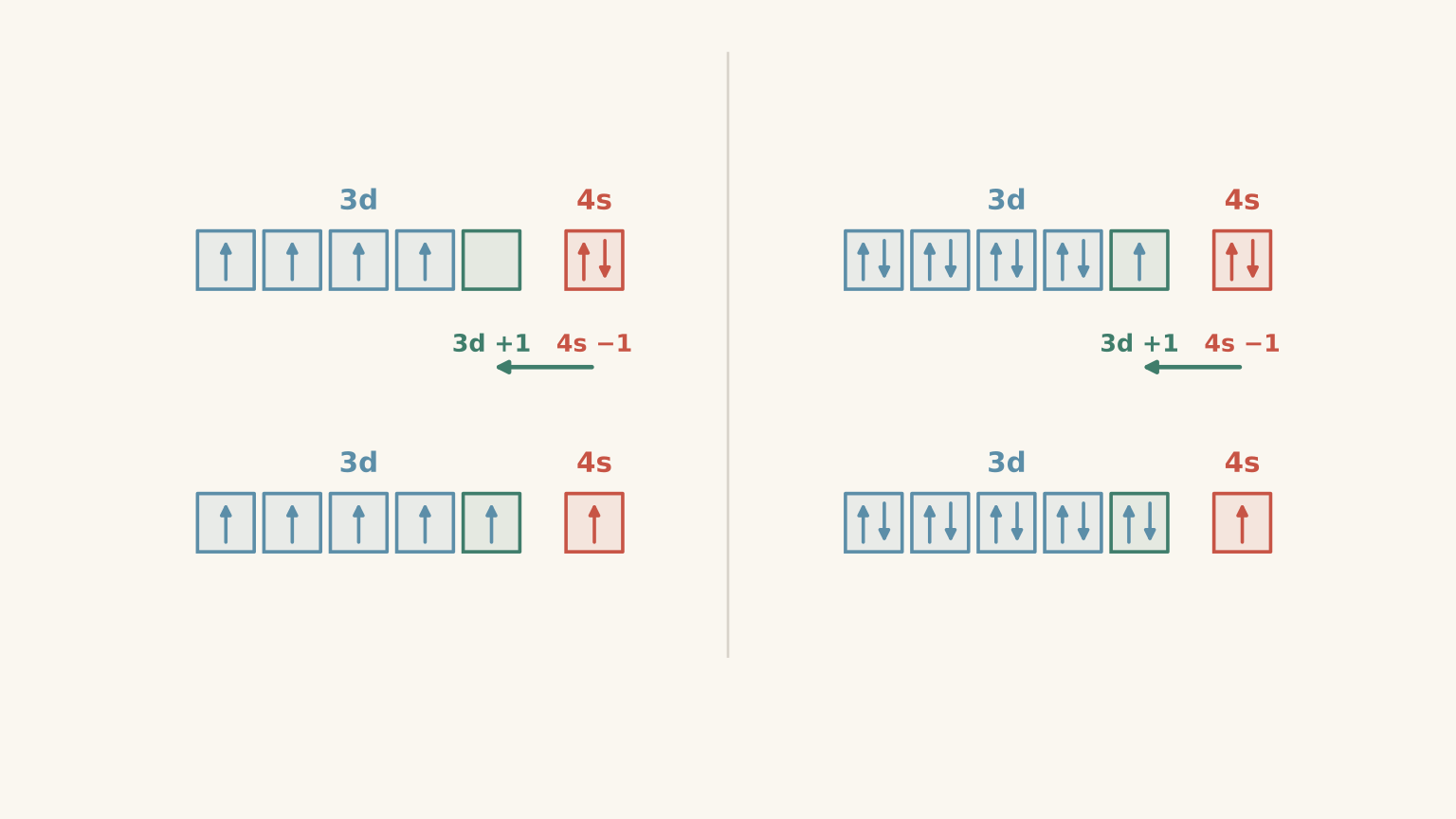
Due to technical limitations, this figure may display incorrectly or contain inaccuracies. Please check key details against your course materials.
01Where the usual electron-filling rule breaks down
First, recall what the Aufbau principle predicts.
Electrons generally occupy lower-energy orbitals before higher-energy ones. For the first-row transition metals, the familiar filling sequence includes:
\[ 3p \rightarrow 4s \rightarrow 3d \]
This correctly predicts that potassium begins filling \(4s\), and calcium completes \(4s^2\).
As we move into the transition metals, electrons begin occupying \(3d\).
For chromium, which has atomic number 24, the simple counting process gives:
\[ 18+2+4=24 \]
That means 18 electrons in the argon core, two in \(4s\), and four in \(3d\).
So we might predict:
\[ \mathrm{Cr}:\ [\mathrm{Ar}]\,3d^4\,4s^2 \]
But experimental evidence identifies its ground state as:
\[ \mathrm{Cr}:\ [\mathrm{Ar}]\,3d^5\,4s^1 \]
Copper, atomic number 29, shows the same kind of change:
\[ \begin{aligned} \text{Predicted: }& [\mathrm{Ar}]\,3d^9\,4s^2\\ \text{Actual: }& [\mathrm{Ar}]\,3d^{10}\,4s^1 \end{aligned} \]
Both arrangements still contain the correct total number of electrons. What changes is their distribution.
Why half-filled and filled d subshells help
A \(d\) subshell contains five orbitals, each capable of holding two electrons.
Hund’s rule tells us that electrons occupy these orbitals singly, with parallel spins, before pairing where the orbitals have equal energy.
For chromium, the \(3d^5\) arrangement places one electron in each of the five \(d\) orbitals.
For copper, the \(3d^{10}\) arrangement places two electrons in every \(d\) orbital.
These arrangements can benefit from favourable electron interactions, including quantum-mechanical exchange effects.
But there’s a limit to this explanation.
A half-filled or completely filled subshell isn’t automatically the lowest-energy arrangement in every atom. Electrons also experience attraction to the nucleus, repulsion from other electrons, and changes in orbital energies as occupations change.
The actual ground state depends on the balance of all these contributions.
Think of the filling sequence as a prediction made before the electrons have fully influenced one another. It’s useful for finding likely configurations, but it isn’t an exact calculation of atomic energy.
For a refresher on the general filling procedure, see Electronic Configuration for HSC Chemistry: Atoms and Ions.
02How spectroscopy revealed the unusual configurations
The interesting historical question wasn’t originally how to memorise two exceptions.
It was how to determine the arrangement of electrons inside an atom when those electrons couldn’t be observed directly.
An orbital-box diagram is a model. Scientists needed measurable evidence to decide which arrangements were genuinely lowest in energy.
Atomic spectroscopy provided that evidence.
The apparatus: turning atomic light into energy measurements
Consider a representative modern investigation using a copper hollow-cathode lamp and a spectrometer. This illustrates the experimental method, rather than recreating one particular historical experiment.
The apparatus works from the light source towards the detector.
- A sealed lamp contains a copper cathode, another electrode, and low-pressure inert gas.
- A power supply produces an electrical discharge. Positive gas ions strike the copper cathode, releasing copper atoms into the gas.
- Collisions excite some of those copper atoms, giving their electrons additional energy.
- As excited atoms move to lower energy states, they can emit photons.
- Light leaves the lamp through a suitable window, passes through a narrow slit, and is directed towards a diffraction grating.
- The grating separates different wavelengths, allowing a detector to record the atomic emission spectrum.
For ultraviolet measurements, the lamp window and optical system must transmit the relevant ultraviolet wavelengths.
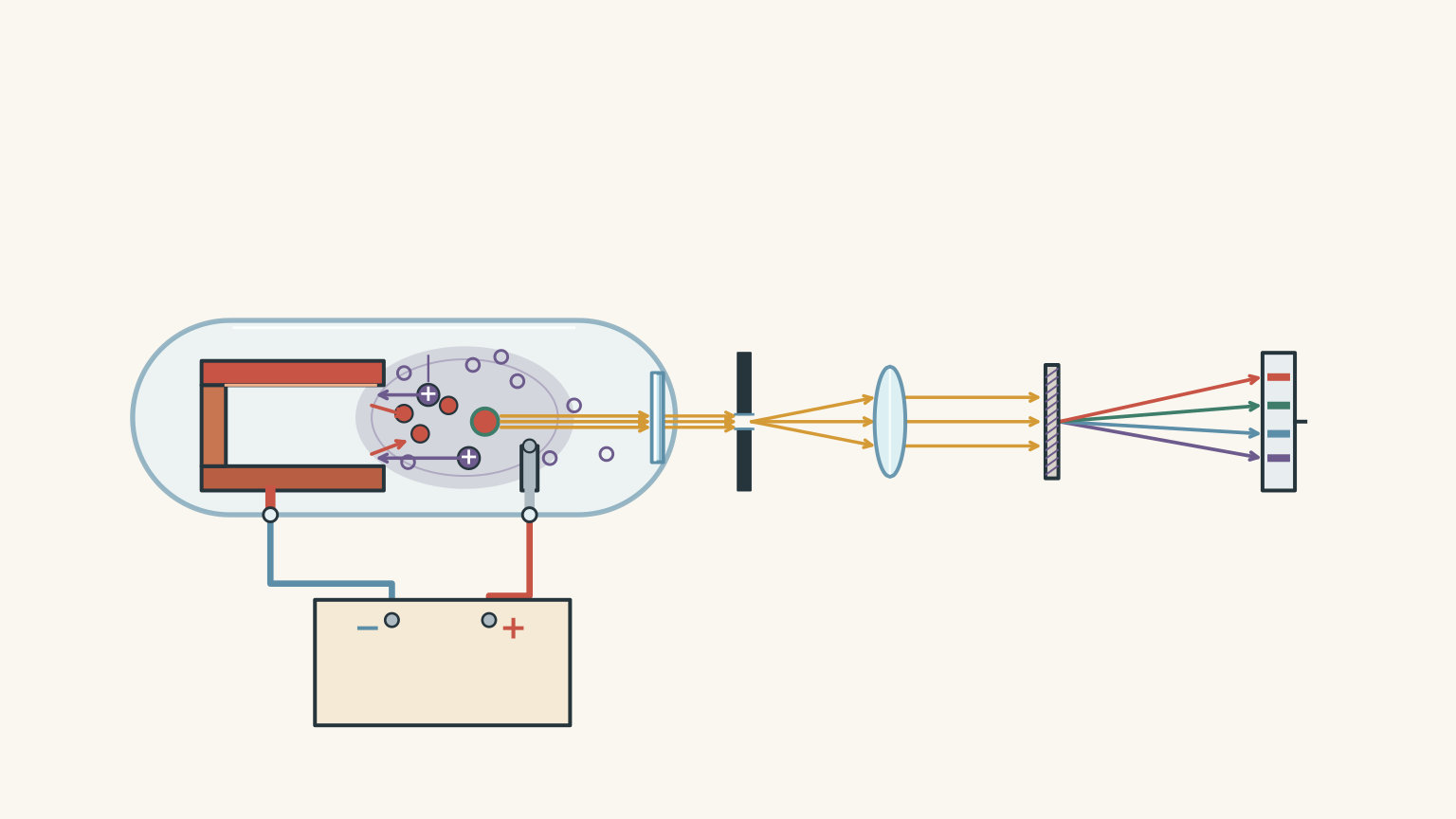
Due to technical limitations, this figure may display incorrectly or contain inaccuracies. Please check key details against your course materials.
What would the experiment show?
Suppose electrons could have any energy they liked.
An excited atom might then emit photons over a continuous range of energies. You would expect a continuous spread of wavelengths.
Instead, isolated atoms produce characteristic spectral lines at specific wavelengths.
Each line corresponds to a difference between two allowed atomic energy levels.
The energy carried by a photon is:
\[ E=\frac{hc}{\lambda} \]
where:
- \(E\) is photon energy in joules (J).
- \(h\) is Planck’s constant, \(6.626\times10^{-34}\ \mathrm{J\,s}\).
- \(c\) is the speed of light, approximately \(2.998\times10^8\ \mathrm{m\,s^{-1}}\).
- \(\lambda\) is the wavelength in metres (m).
By measuring wavelengths, scientists can determine energy differences between atomic states.
A strong neutral-copper spectral line occurs at approximately \(324.754\ \mathrm{nm}\), in the ultraviolet region.
It is associated with an electron transition from a state described as \(3d^{10}4p\) to a lower state described as \(3d^{10}4s\).
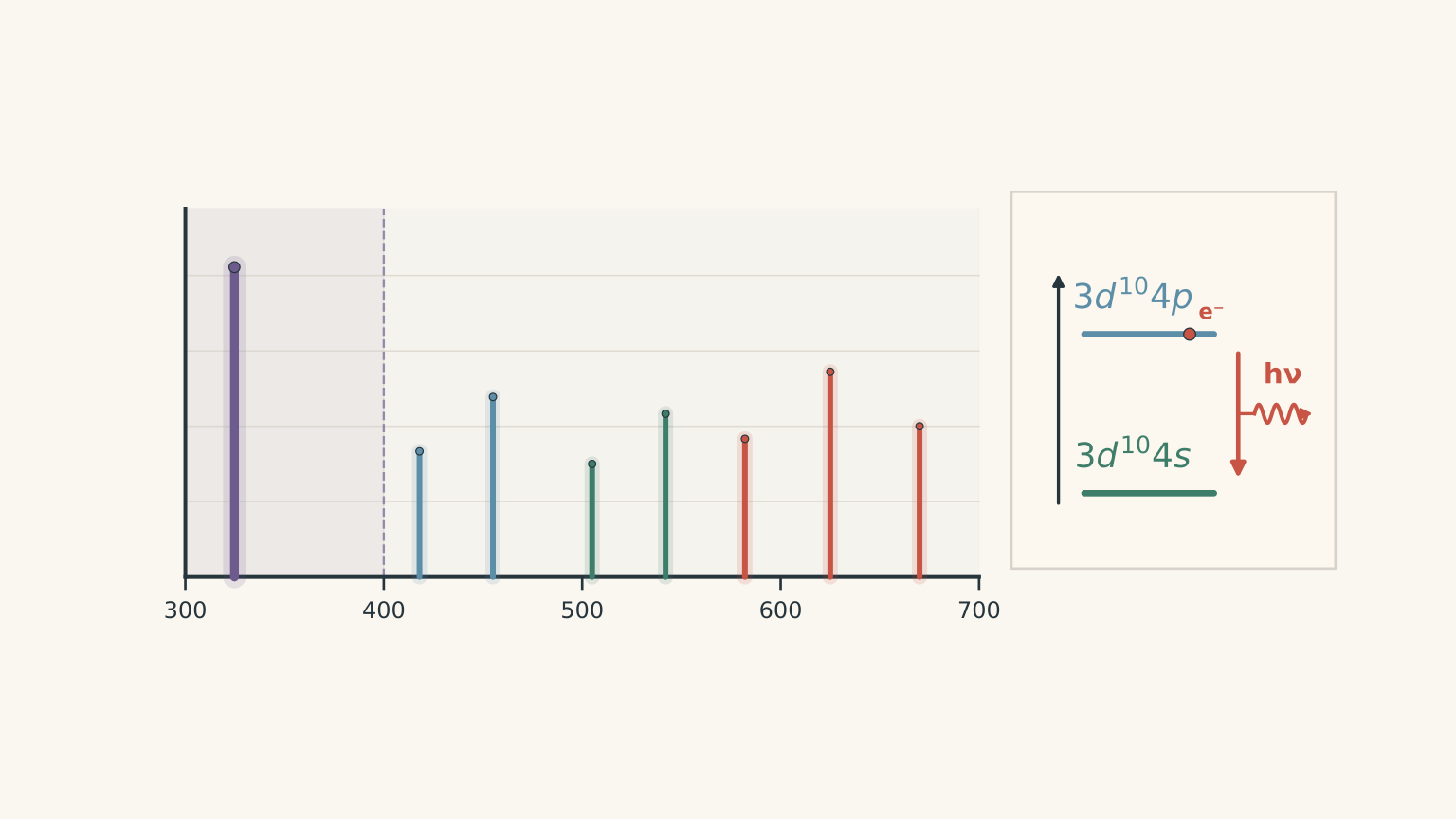
Due to technical limitations, this figure may display incorrectly or contain inaccuracies. Please check key details against your course materials.
There’s an important limitation here.
A single spectral line provides an energy difference. It doesn’t, by itself, prove the complete electronic configuration or identify which state is the ground state.
Historically, spectroscopists built energy-level schemes by comparing many spectral lines, identifying transitions that shared energy levels, and combining this evidence with atomic theory and ionisation measurements.
A one-line experiment cannot reliably reconstruct that entire scheme. The more complete method is to use a network of measured transitions and check that the proposed energy levels explain them consistently.
What the measured energy levels tell us
The following values come from the National Institute of Standards and Technology’s atomic spectroscopy compilations for neutral chromium and neutral copper.
| Atom | Configuration | Energy above ground state |
|---|---|---|
| Chromium | \([\mathrm{Ar}]\,3d^5\,4s^1\) | \(0\ \mathrm{cm^{-1}}\) |
| Chromium | \([\mathrm{Ar}]\,3d^4\,4s^2\) | \(7750.78\ \mathrm{cm^{-1}}\) |
| Copper | \([\mathrm{Ar}]\,3d^{10}\,4s^1\) | \(0\ \mathrm{cm^{-1}}\) |
| Copper | \([\mathrm{Ar}]\,3d^9\,4s^2\) | \(11202.565\ \mathrm{cm^{-1}}\) |
The listed values refer to the lowest identified energy level associated with each configuration. A configuration can have several different energy levels.
The unusual unit, \(\mathrm{cm^{-1}}\), is called a spectroscopic wavenumber. It is related to energy by:
\[ E=hc\tilde{\nu} \]
Here, \(\tilde{\nu}\) is the wavenumber, measured in inverse length. We must convert it to \(\mathrm{m^{-1}}\) when using SI values of \(h\) and \(c\).
An energy level at zero is the ground-state reference for that particular atom. A positive value means the atom has additional energy.
Notice the result: for both chromium and copper, the configuration predicted by the simple filling rule lies above the actual ground state.
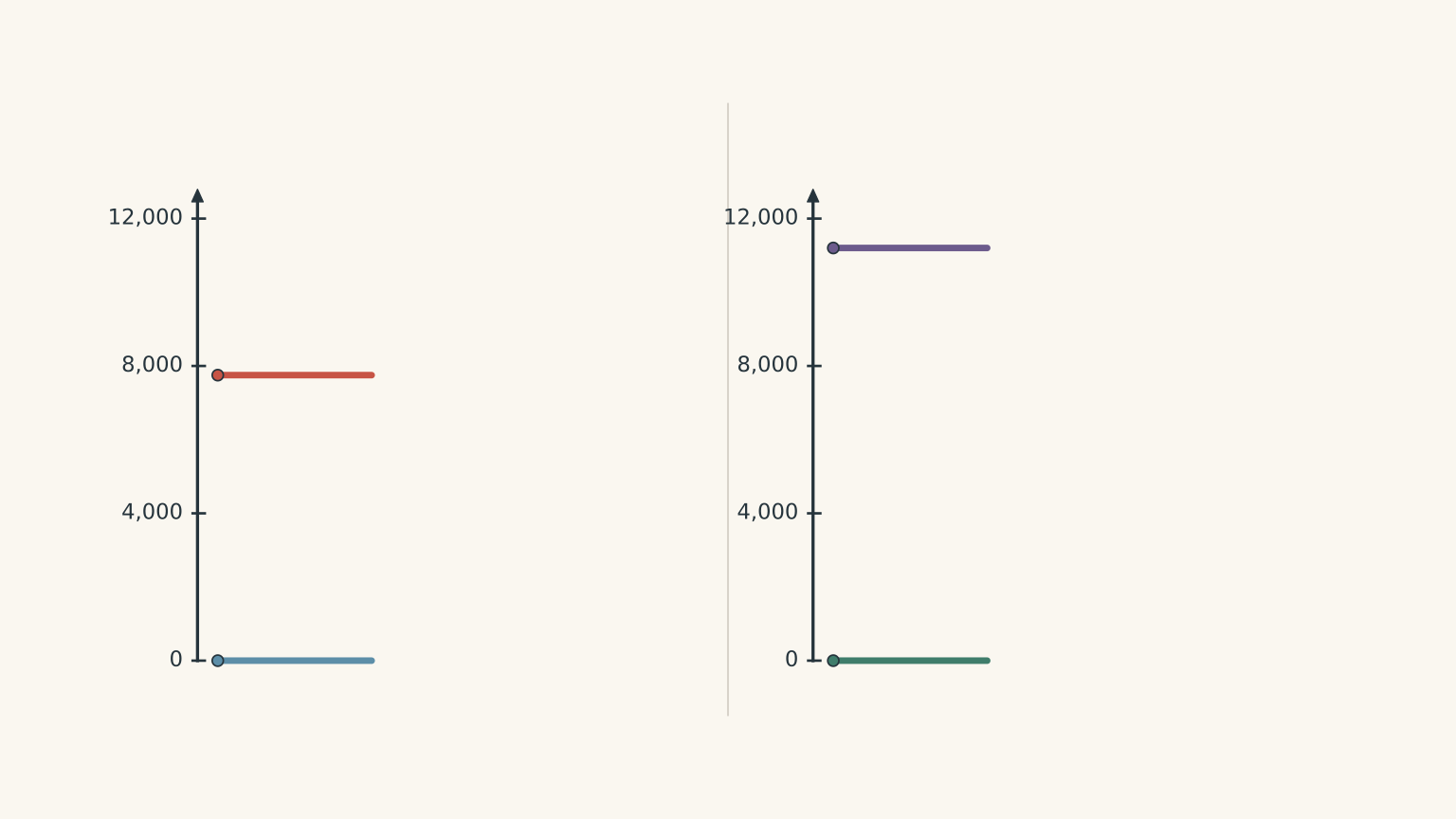
Due to technical limitations, this figure may display incorrectly or contain inaccuracies. Please check key details against your course materials.
Worked example: How much higher is chromium’s predicted configuration?
The lowest chromium level associated with \([\mathrm{Ar}]\,3d^4\,4s^2\) lies \(7750.78\ \mathrm{cm^{-1}}\) above its ground state. Calculate the energy difference in joules and electronvolts per atom.
Use \(1\ \mathrm{eV}=1.602\times10^{-19}\ \mathrm{J}\).
Step 1
\[ \begin{aligned} \Delta\tilde{\nu} &=7750.78\ \mathrm{cm^{-1}}\\ &=7.75078\times10^5\ \mathrm{m^{-1}} \end{aligned} \]
The factor of 100 appears because a metre contains 100 centimetres.
Step 2
\[ \begin{aligned} \Delta E&=hc\Delta\tilde{\nu}\\ &=(6.626\times10^{-34})\\ &\quad\times(2.998\times10^8)\\ &\quad\times(7.75078\times10^5)\\ &=1.54\times10^{-19}\ \mathrm{J} \end{aligned} \]
The constants carry their SI units, producing an energy in joules.
Step 3
\[ \begin{aligned} \Delta E &=\frac{1.54\times10^{-19}} {1.602\times10^{-19}}\\ &=0.961\ \mathrm{eV} \end{aligned} \]
The simple filling-rule configuration lies approximately \(0.961\ \mathrm{eV}\) above chromium’s ground state.
This is direct quantitative evidence that the proposed \(3d^4\,4s^2\) arrangement is not chromium’s lowest-energy state.
It doesn’t mean chromium atoms continually move electrons between the configurations at room temperature. The energy difference is substantial compared with ordinary thermal energy. Nor does the difference necessarily correspond to an allowed direct optical transition.
The useful conclusion is about the ordering of the atomic energy levels.
03Why doesn’t every atom favour a half-filled or full d subshell?
Here’s a prediction worth testing.
Chromium has a half-filled \(3d^5\) subshell and just one \(4s\) electron. Manganese, the next element, also has five \(3d\) electrons.
Should manganese move one of its \(4s\) electrons into \(3d\) as well?
No. Its actual ground-state configuration is:
\[ \mathrm{Mn}:\ [\mathrm{Ar}]\,3d^5\,4s^2 \]
Manganese already has the half-filled \(3d\) arrangement. Moving another electron into \(3d\) would produce \(3d^6\,4s^1\), not a half-filled subshell.
Now compare zinc with copper.
Zinc has:
\[ \mathrm{Zn}:\ [\mathrm{Ar}]\,3d^{10}\,4s^2 \]
It already has a completely filled \(3d\) subshell, and there is no advantage in forcing an electron into an eleventh \(3d\) position. The \(d\) subshell cannot hold more than ten electrons.
| Element | Atomic number | Ground-state configuration | Why it matters |
|---|---|---|---|
| Cr | 24 | \([\mathrm{Ar}]\,3d^5\,4s^1\) | Half-filled \(3d\), unusual \(4s^1\) |
| Mn | 25 | \([\mathrm{Ar}]\,3d^5\,4s^2\) | Half-filled \(3d\), normal \(4s^2\) |
| Cu | 29 | \([\mathrm{Ar}]\,3d^{10}\,4s^1\) | Filled \(3d\), unusual \(4s^1\) |
| Zn | 30 | \([\mathrm{Ar}]\,3d^{10}\,4s^2\) | Filled \(3d\), normal \(4s^2\) |
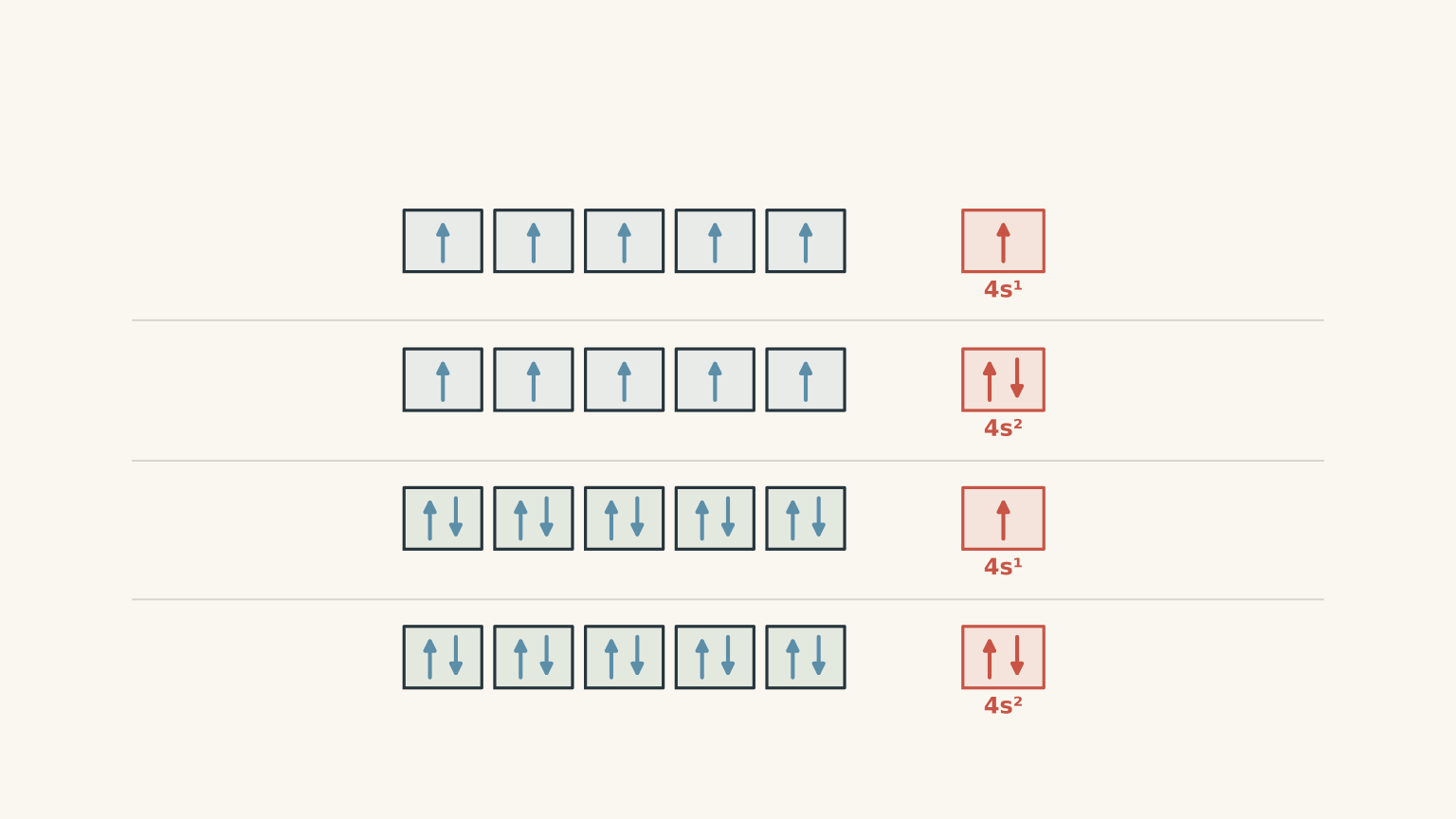
Due to technical limitations, this figure may display incorrectly or contain inaccuracies. Please check key details against your course materials.
This comparison exposes a common misconception.
It’s not correct to say that atoms always sacrifice an \(s\) electron to obtain a half-filled or full \(d\) subshell.
For chromium and copper, those arrangements happen to minimise the total energy. For other atoms, the balance can be different.
04What happens when chromium and copper form ions?
Now we need to separate two processes that often get mixed up:
- Filling orbitals to predict a neutral atom’s ground state.
- Removing electrons to form a positive ion.
The usual filling sequence starts \(4s\) before \(3d\), but for the first-row transition metals, electrons are removed from \(4s\) before \(3d\) when forming their ordinary ground-state cations.
Once the \(3d\) subshell is occupied, the relative energies and electron interactions have changed. The neutral-atom filling sequence isn’t a permanent ranking of how strongly every electron is held.
Start with chromium:
\[ \mathrm{Cr}:\ [\mathrm{Ar}]\,3d^5\,4s^1 \]
Removing one electron gives:
\[ \mathrm{Cr}^{+}:\ [\mathrm{Ar}]\,3d^5 \]
Removing another gives:
\[ \mathrm{Cr}^{2+}:\ [\mathrm{Ar}]\,3d^4 \]
Copper behaves similarly:
\[ \mathrm{Cu}:\ [\mathrm{Ar}]\,3d^{10}\,4s^1 \]
Its first electron is removed from \(4s\):
\[ \mathrm{Cu}^{+}:\ [\mathrm{Ar}]\,3d^{10} \]
Its second electron must come from \(3d\):
\[ \mathrm{Cu}^{2+}:\ [\mathrm{Ar}]\,3d^9 \]
The fact that \(\mathrm{Cu}^{+}\) has a full \(3d\) subshell does not make further ionisation impossible.
Removing another electron requires energy, and the next ground-state ion has a different configuration.
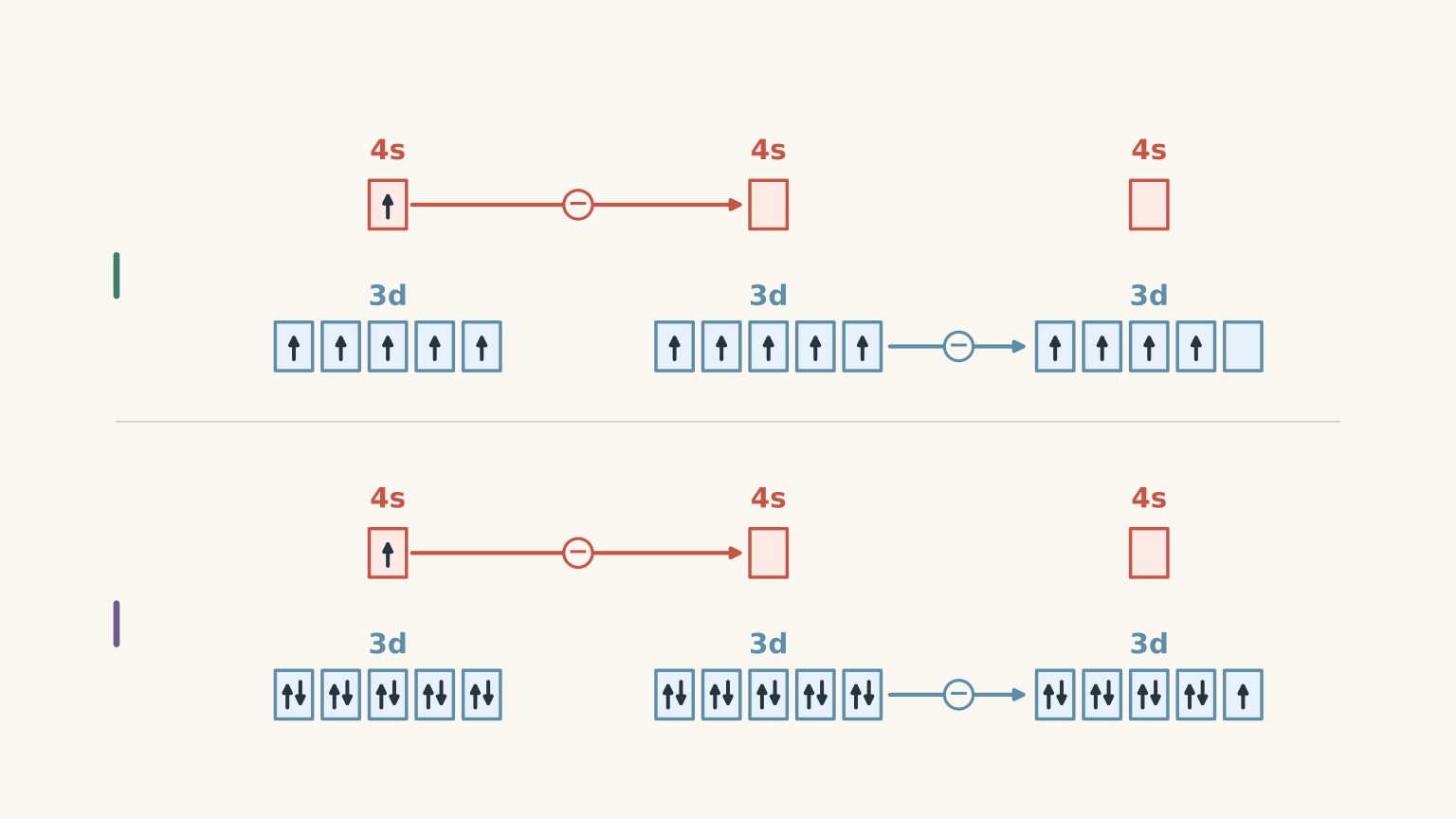
Due to technical limitations, this figure may display incorrectly or contain inaccuracies. Please check key details against your course materials.
Worked example: Predict the configurations of Cr³⁺ and Cu²⁺
Chromium has atomic number 24, and copper has atomic number 29. Determine the ground-state configurations of \(\mathrm{Cr}^{3+}\) and \(\mathrm{Cu}^{2+}\), then find the number of unpaired electrons in each ion.
Assume isolated ground-state ions and apply Hund’s rule to their \(3d\) orbitals.
Step 1
\[ \begin{aligned} \mathrm{Cr}:&\ [\mathrm{Ar}]\,3d^5\,4s^1\\ \mathrm{Cu}:&\ [\mathrm{Ar}]\,3d^{10}\,4s^1 \end{aligned} \]
Step 2
Chromium loses three:
\[ 24-3=21\text{ electrons} \]
Copper loses two:
\[ 29-2=27\text{ electrons} \]
Step 3
For chromium, one electron comes from \(4s\), followed by two from \(3d\).
\[ \mathrm{Cr}^{3+}:\ [\mathrm{Ar}]\,3d^3 \]
Check:
\[ 18+3=21\text{ electrons} \]
For copper, one electron comes from \(4s\), followed by one from \(3d\).
\[ \mathrm{Cu}^{2+}:\ [\mathrm{Ar}]\,3d^9 \]
Check:
\[ 18+9=27\text{ electrons} \]
Step 4
In \(3d^3\), the three electrons occupy three separate \(d\) orbitals, giving three unpaired electrons.
In \(3d^9\), four \(d\) orbitals contain paired electrons, while one contains a single electron, giving one unpaired electron.
Therefore:
\[ \begin{aligned} \mathrm{Cr}^{3+}&:\ 3\text{ unpaired}\\ \mathrm{Cu}^{2+}&:\ 1\text{ unpaired} \end{aligned} \]
The result is important because an atom’s neutral configuration doesn’t necessarily preserve its half-filled or completely filled \(3d\) arrangement after ionisation.
A practical decision method
When you encounter a configuration question involving chromium, copper, or their ions, use this sequence.
- Identify the atomic number and calculate the number of electrons.
- If the species is neutral chromium or copper, use its established exceptional ground-state configuration.
- If the species is a positive ion, begin with the neutral atom and remove electrons from \(4s\) before \(3d\).
- If orbital occupation is requested, apply Hund’s rule and the two-electron orbital limit.
- Check that all superscripts add to the required electron total.
One further distinction matters: these are rules for finding ground-state configurations. An atom that is already excited can undergo transitions and ionisation processes more complicated than simply erasing arrows from a fixed orbital diagram.
That becomes especially important when interpreting spectroscopy.
05Questions and solutions
Question 1
Chromium has atomic number 24, and copper has atomic number 29.
a) Write the actual ground-state electronic configurations of both neutral atoms using noble-gas notation.
b) State the configuration of \(\mathrm{Cu}^{+}\).
c) Explain why the usual orbital-filling sequence gives incorrect predictions for neutral chromium and copper.
Solution 1
The ground-state configurations are \(\mathrm{Cr}:[\mathrm{Ar}]\,3d^5\,4s^1\), \(\mathrm{Cu}:[\mathrm{Ar}]\,3d^{10}\,4s^1\), and \(\mathrm{Cu}^{+}:[\mathrm{Ar}]\,3d^{10}\).
Part a: Chromium contains 24 electrons, and copper contains 29.
\[ \begin{aligned} \mathrm{Cr}:&\ 18+5+1=24\\ \mathrm{Cu}:&\ 18+10+1=29 \end{aligned} \]
Both configurations have the correct number of electrons.
Part b: Copper loses its single \(4s\) electron to form \(\mathrm{Cu}^{+}\).
\[ \mathrm{Cu}^{+}:\ [\mathrm{Ar}]\,3d^{10} \]
This gives \(18+10=28\) electrons, as required.
Part c: The simplest filling rule would predict \(3d^4\,4s^2\) for chromium and \(3d^9\,4s^2\) for copper.
However, electron interactions make \(3d^5\,4s^1\) and \(3d^{10}\,4s^1\) lower in total energy for the respective neutral atoms.
The tempting mistake is to treat the \(4s\)-before-\(3d\) filling sequence as an absolute energy rule. It is a useful approximation, not an exact description of every ground state.
Question 2
A student compares chromium and manganese.
Both neutral atoms have five electrons in their \(3d\) subshells:
\[ \begin{aligned} \mathrm{Cr}:&\ [\mathrm{Ar}]\,3d^5\,4s^1\\ \mathrm{Mn}:&\ [\mathrm{Ar}]\,3d^5\,4s^2 \end{aligned} \]
The student predicts that chromium must always have more unpaired electrons than manganese because chromium has more unpaired electrons as a neutral atom.
a) Determine the number of unpaired electrons in each neutral atom.
b) Determine the ground-state configurations and unpaired-electron counts of \(\mathrm{Cr}^{2+}\) and \(\mathrm{Mn}^{2+}\).
c) Explain whether the student’s prediction remains correct after both atoms lose two electrons.
Assume isolated atoms and ions in their ground states.
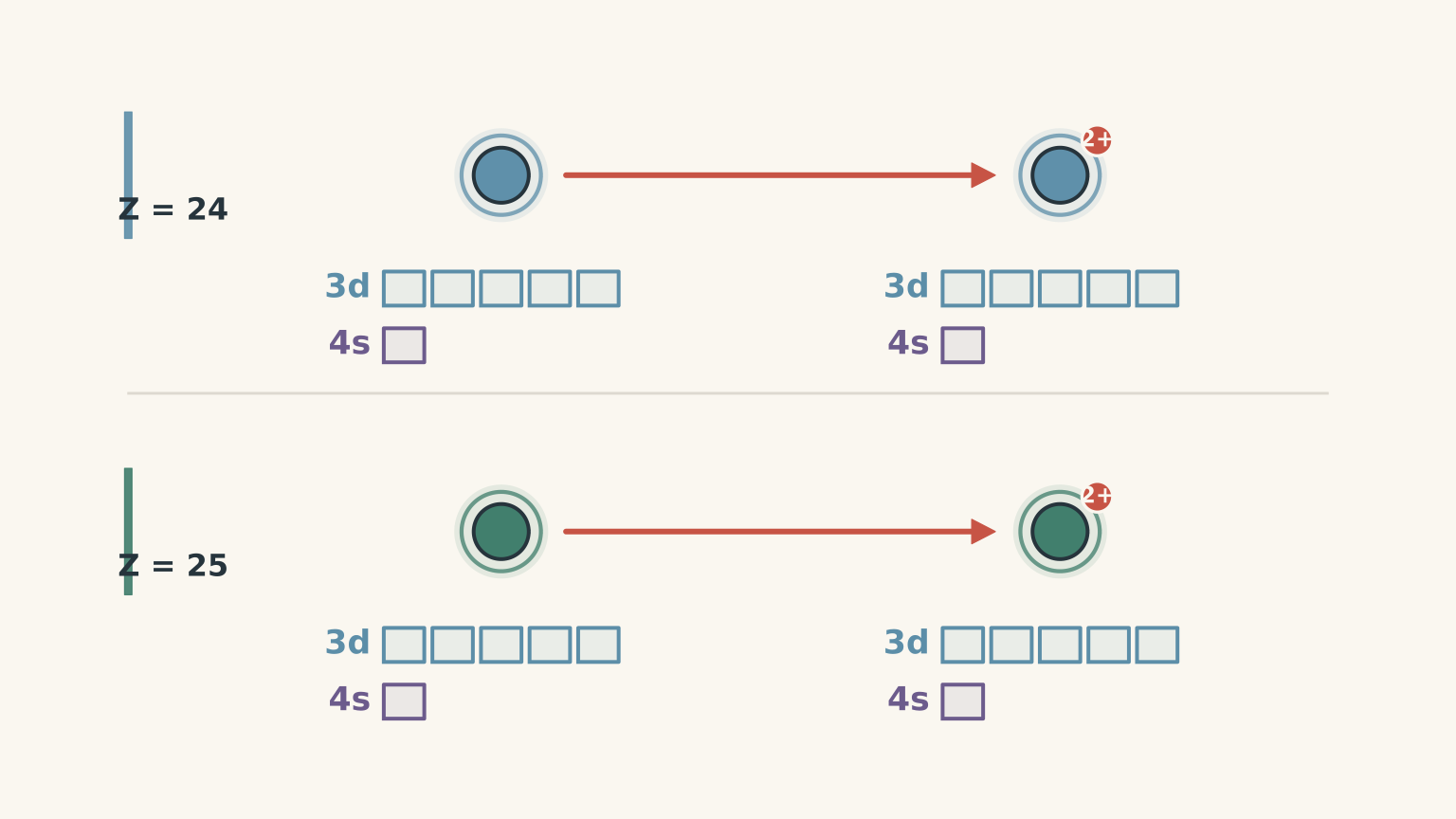
Due to technical limitations, this figure may display incorrectly or contain inaccuracies. Please check key details against your course materials.
Solution 2
The prediction reverses after ionisation: neutral chromium has more unpaired electrons than neutral manganese, but \(\mathrm{Cr}^{2+}\) has fewer unpaired electrons than \(\mathrm{Mn}^{2+}\).
Part a: Neutral chromium has six unpaired electrons. Neutral manganese has five.
Chromium has five singly occupied \(3d\) orbitals and one singly occupied \(4s\) orbital:
\[ 5+1=6\text{ unpaired electrons} \]
Manganese has five singly occupied \(3d\) orbitals, but its two \(4s\) electrons are paired.
It therefore has five unpaired electrons.
Part b: Removing two electrons gives:
\[ \begin{aligned} \mathrm{Cr}^{2+}:& \ [\mathrm{Ar}]\,3d^4\\ \mathrm{Mn}^{2+}:& \ [\mathrm{Ar}]\,3d^5 \end{aligned} \]
Chromium loses its one \(4s\) electron and then one \(3d\) electron.
Manganese loses both \(4s\) electrons, leaving its \(3d^5\) subshell intact.
Using Hund’s rule:
- \(\mathrm{Cr}^{2+}\) has four unpaired electrons.
- \(\mathrm{Mn}^{2+}\) has five unpaired electrons.
Part c: The student’s prediction is incorrect for the ions.
Although neutral chromium starts with more unpaired electrons, removing two electrons affects the two atoms differently.
Chromium has only one \(4s\) electron, so its second electron must be removed from \(3d\). Manganese has two \(4s\) electrons, so neither of its \(3d\) electrons needs to be removed when forming \(\mathrm{Mn}^{2+}\).
The exact point that changes the result is the different initial \(4s\) occupancy.
This is why unpaired-electron counts must be calculated from the configuration of the particular species, not carried over from its neutral atom.
Question 3
Two isolated gaseous ions have the same electronic configuration:
\[ \begin{aligned} \mathrm{Cu}^{+}:& \ [\mathrm{Ar}]\,3d^{10}\\ \mathrm{Zn}^{2+}:& \ [\mathrm{Ar}]\,3d^{10} \end{aligned} \]
Copper has 29 protons, and zinc has 30.
The measured energy required to remove another electron from each ion, producing the next ground-state ion, is:
| Ion | Ionisation energy |
|---|---|
| \(\mathrm{Cu}^{+}\) | \(20.292\ \mathrm{eV}\) |
| \(\mathrm{Zn}^{2+}\) | \(39.723\ \mathrm{eV}\) |
These are rounded experimental values from NIST.
Both ions are exposed separately to photons with energies of \(25.0\ \mathrm{eV}\).
a) Determine whether each ion can be ionised by absorbing one photon.
b) For any ionisation that occurs, calculate the maximum kinetic energy of the released electron, assuming negligible recoil and a ground-state final ion.
c) Explain why the two ions have different ionisation energies despite identical electron configurations.
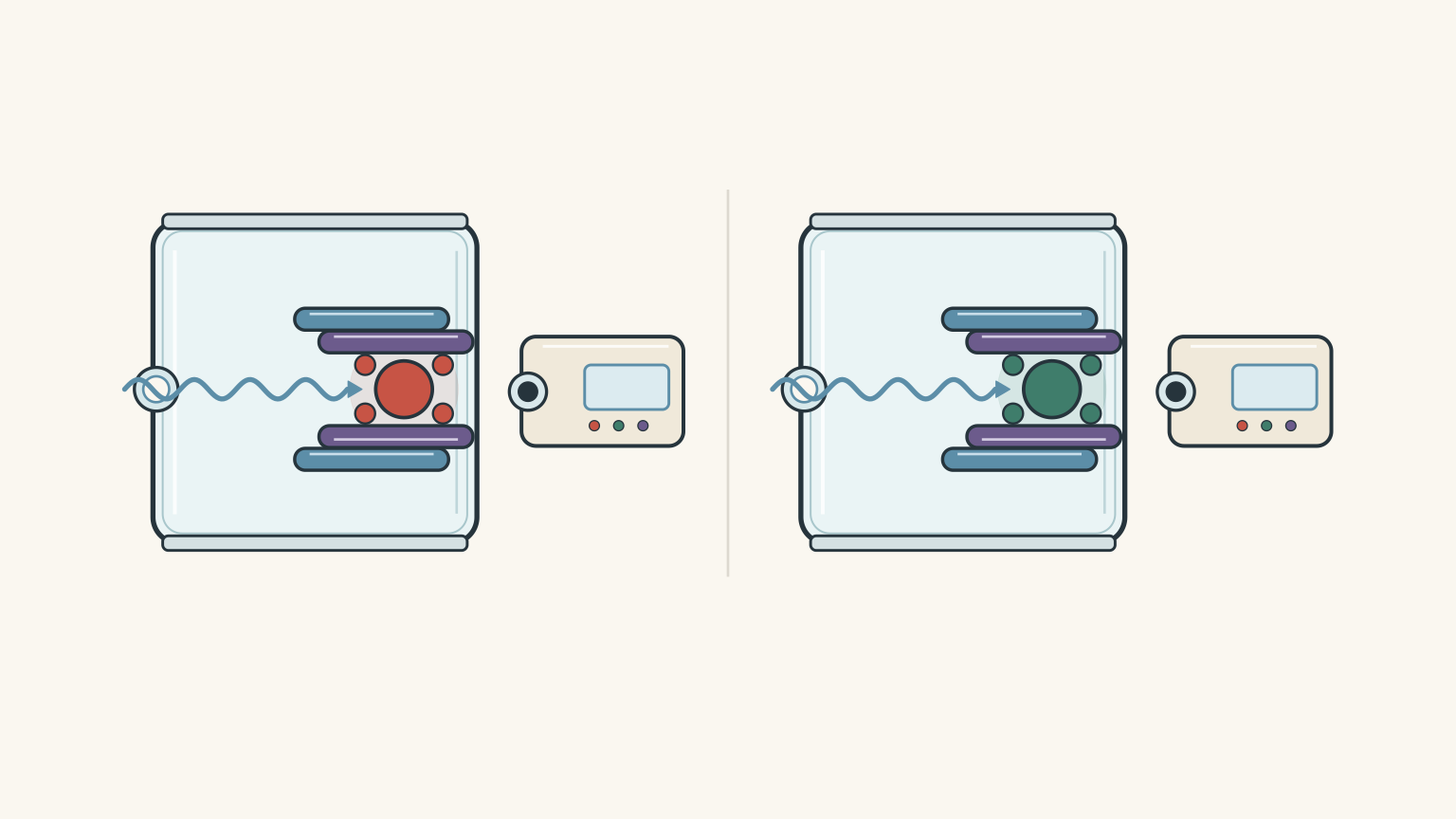
Due to technical limitations, this figure may display incorrectly or contain inaccuracies. Please check key details against your course materials.
Solution 3
The \(25.0\ \mathrm{eV}\) photon can ionise \(\mathrm{Cu}^{+}\), producing an electron with approximately \(4.71\ \mathrm{eV}\) of kinetic energy, but it cannot ionise \(\mathrm{Zn}^{2+}\) by the specified single-photon process.
Part a: Compare the incoming photon energy with each ionisation threshold.
For \(\mathrm{Cu}^{+}\):
\[ 25.0>20.292\ \mathrm{eV} \]
The photon supplies sufficient energy.
For \(\mathrm{Zn}^{2+}\):
\[ 25.0<39.723\ \mathrm{eV} \]
The photon does not supply enough energy to remove an electron.
Part b: The excess photon energy becomes kinetic energy of the released electron under the stated assumptions.
\[ \begin{aligned} E_k&=E_{\text{photon}}-E_{\text{ionisation}}\\ &=25.0-20.292\\ &=4.708\ \mathrm{eV}\\ &\approx4.71\ \mathrm{eV} \end{aligned} \]
The resulting ion is:
\[ \mathrm{Cu}^{2+}:\ [\mathrm{Ar}]\,3d^9 \]
For zinc, no electron is released by this single-photon process, so there is no corresponding photoelectron kinetic energy.
Part c: The two starting ions are isoelectronic, meaning they contain the same number of electrons and have the same configuration.
However, their nuclei are different.
Copper has 29 protons, while zinc has 30. The greater nuclear charge of zinc contributes to a stronger attraction between its nucleus and the electrons in the doubly charged ion.
The actual ionisation energies reflect the complete electron interactions and nuclear attraction, rather than the \(3d^{10}\) notation alone.
The tempting argument is that identical electronic configurations must mean identical energies. That fails because the electron configuration specifies occupation, not the full energy of the atom or ion.
Question 4
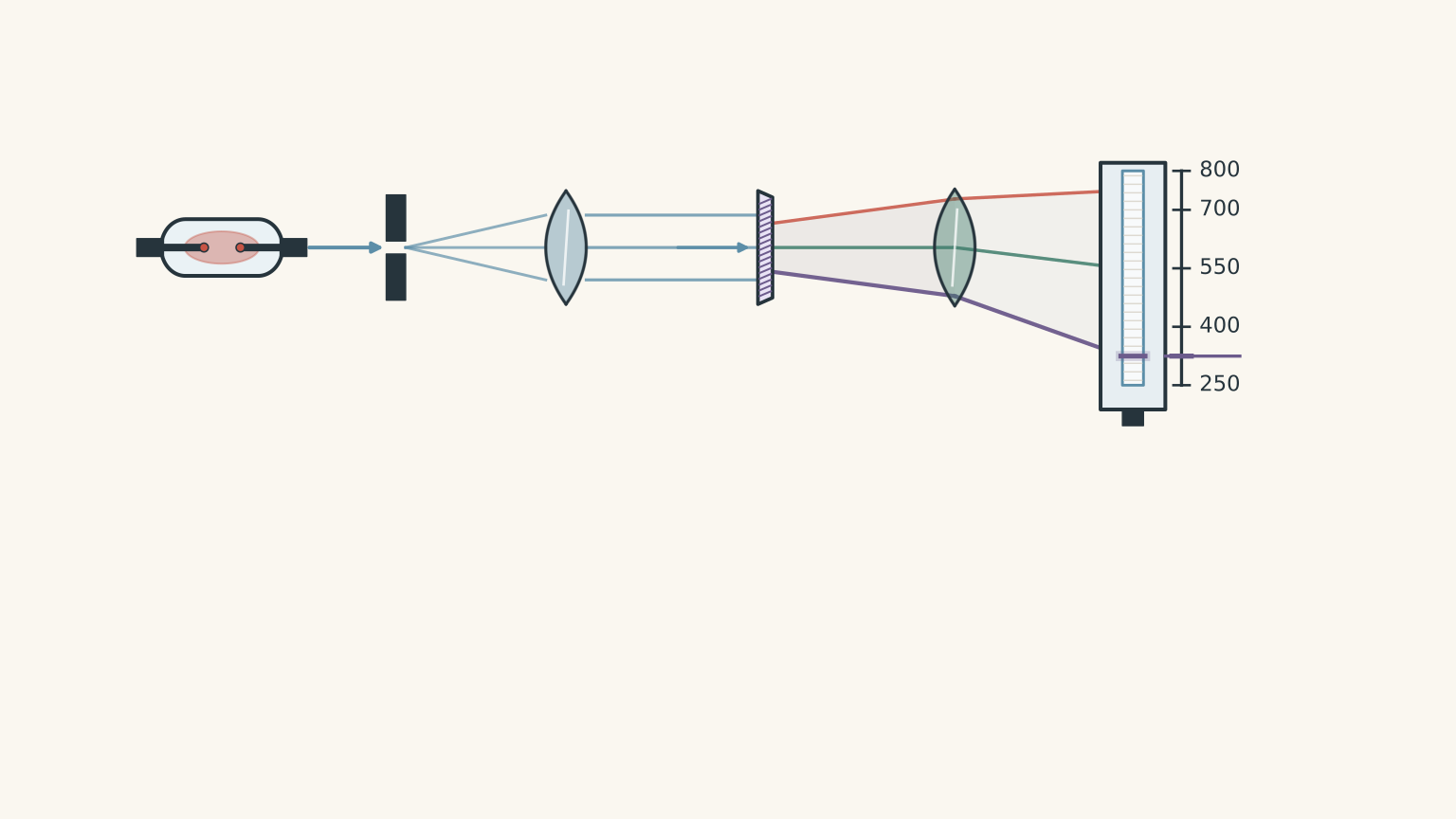
A spectrometer is used to investigate the unusual electronic configuration of neutral copper.
It detects a line at \(324.754\ \mathrm{nm}\), associated with a transition from \(3d^{10}4p\) to \(3d^{10}4s\).
Separate spectroscopic analysis places the lowest \(3d^94s^2\) level \(11202.565\ \mathrm{cm^{-1}}\) above the \(3d^{10}4s\) ground state.
However, the spectrometer detects wavelengths only between \(250\) and \(800\ \mathrm{nm}\).
A student argues:
“Because no emission line corresponding to the energy difference between these two configurations is observed, the \(3d^94s^2\) state probably doesn’t exist.”
a) Calculate the wavelength corresponding to an energy difference of \(11202.565\ \mathrm{cm^{-1}}\). Treat the wavelength as a vacuum wavelength.
b) Explain two independent reasons why the absence of the corresponding emission line does not disprove the higher energy level.
c) Describe how a more complete spectroscopic investigation could establish which configuration is the ground state.
Due to technical limitations, this figure may display incorrectly or contain inaccuracies. Please check key details against your course materials.
Solution 4
The energy difference corresponds to approximately \(892.65\ \mathrm{nm}\), outside the detector’s range. Even extending the wavelength range would not guarantee that a direct emission line exists between those two states.
Part a: Wavenumber is the reciprocal of wavelength.
\[ \tilde{\nu}=\frac{1}{\lambda} \]
Therefore:
\[ \begin{aligned} \lambda &=\frac{1}{11202.565\ \mathrm{cm^{-1}}}\\ &=8.9265\times10^{-5}\ \mathrm{cm}\\ &=892.65\ \mathrm{nm} \end{aligned} \]
This wavelength lies in the near-infrared region.
Part b: There are two separate limitations.
First, \(892.65\ \mathrm{nm}\) lies beyond the detector’s upper limit of \(800\ \mathrm{nm}\). The instrument cannot record a line at that wavelength even if one is emitted.
Second, not every pair of atomic energy levels is connected by a strong, permitted optical transition.
Atomic emission depends on quantum-mechanical transition rules, not just the energy difference between levels. In particular, the two configurations here do not have a strongly allowed direct electric-dipole transition between them.
That selection-rule detail is beyond the usual HSC treatment, but the experimental lesson is important: a missing line is not proof that an energy level is absent.
Part c: A stronger investigation would measure a wider range of wavelengths, identify multiple transitions involving shared energy levels, and use those measurements to reconstruct a consistent atomic energy-level scheme.
The investigation should also distinguish lines from neutral copper atoms from lines produced by copper ions or impurities.
Spectroscopists can then compare the observed level ordering with theoretical assignments and ionisation measurements.
The resulting atomic energy-level scheme identifies \(3d^{10}4s\) as the lowest state of neutral copper, while the lowest \(3d^94s^2\) level lies above it.
The student’s argument fails because it confuses an experiment’s ability to detect a transition with the existence of the energy levels themselves.
Question 5
An isolated neutral copper atom has several possible electronic states.
Use the following experimentally based energies, rounded for this question:
| State | Electronic configuration | Energy above neutral ground state |
|---|---|---|
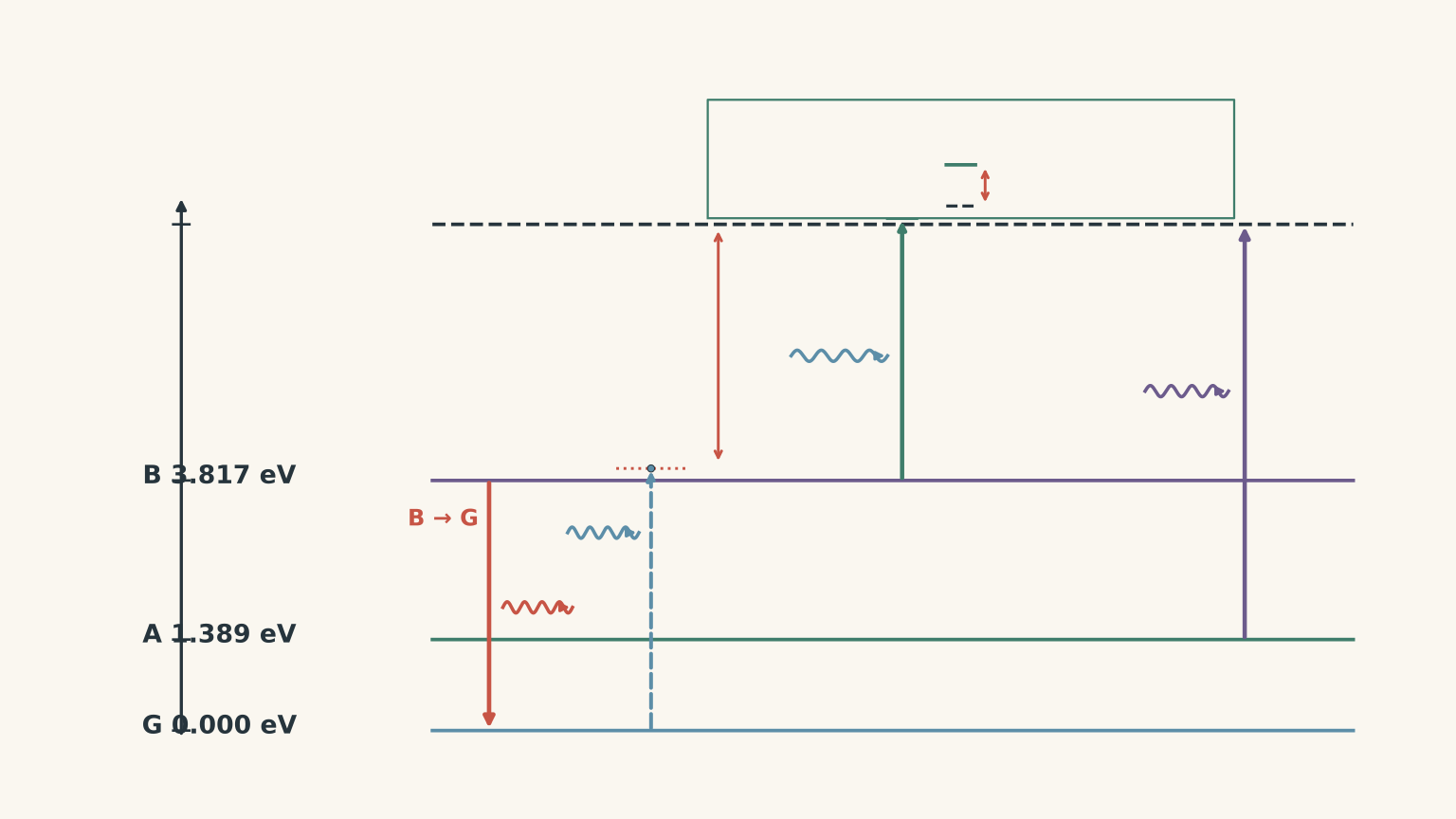
| G | \([\mathrm{Ar}]\,3d^{10}4s^1\) | \(0.000\ \mathrm{eV}\) |
| A | \([\mathrm{Ar}]\,3d^94s^2\) | \(1.389\ \mathrm{eV}\) |
| B | \([\mathrm{Ar}]\,3d^{10}4p^1\) | \(3.817\ \mathrm{eV}\) |
The minimum energy required to ionise state G into ground-state \(\mathrm{Cu}^{+}\) and a free electron with negligible kinetic energy is \(7.726\ \mathrm{eV}\).
Assume all specified states can be prepared, the relevant ionisation channels are accessible, and recoil is negligible. These assumptions let us examine energy conservation without needing detailed transition probabilities.
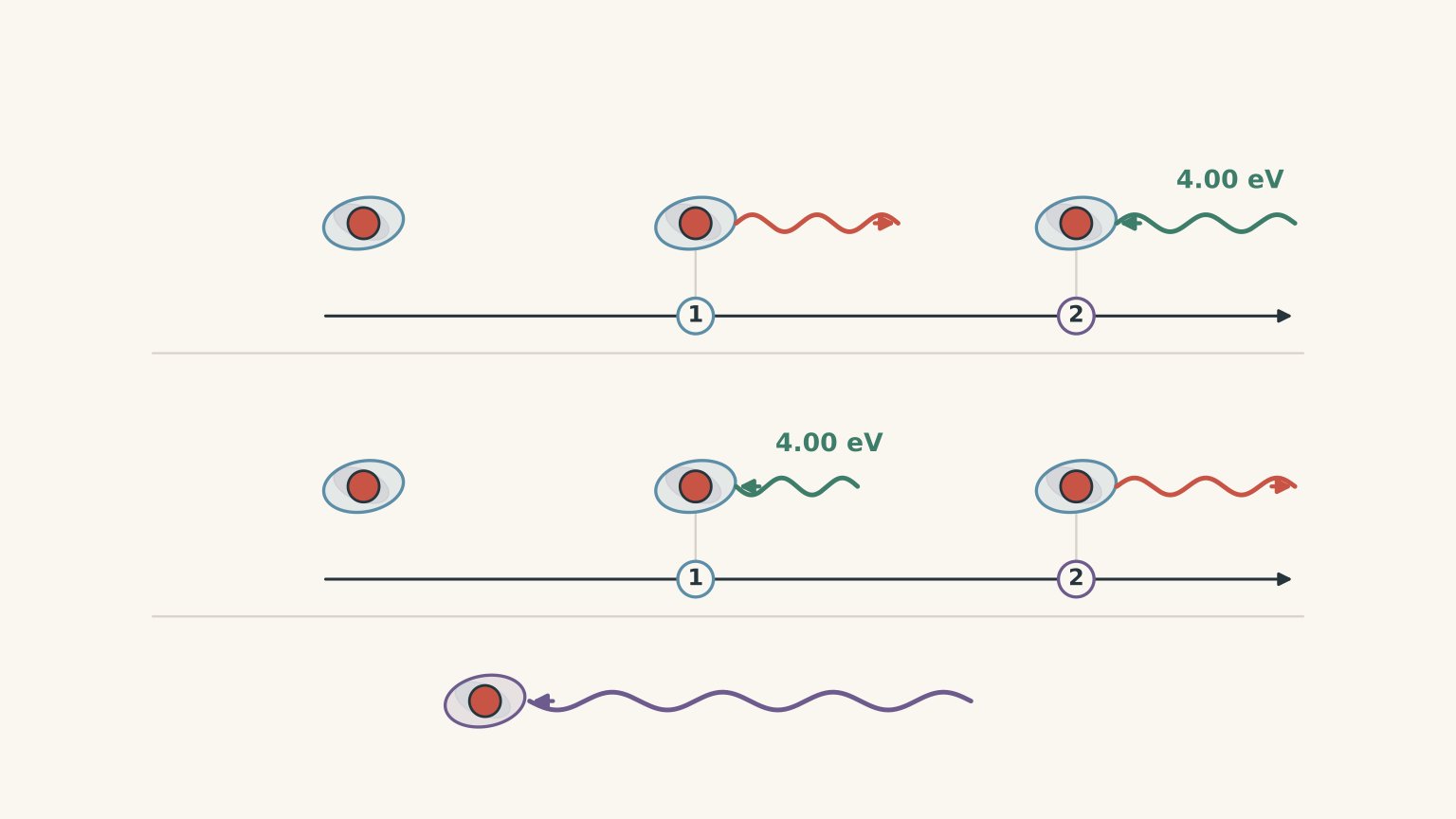
A copper atom starts in state B.
In Experiment 1, the atom emits a photon and returns to state G. Immediately afterwards, it absorbs a photon carrying \(4.00\ \mathrm{eV}\).
In Experiment 2, an otherwise identical atom absorbs the \(4.00\ \mathrm{eV}\) photon before it has emitted any photon and returned to state G.
a) Determine whether single-photon ionisation is energetically possible in each experiment. Calculate the released electron’s kinetic energy wherever ionisation to ground-state \(\mathrm{Cu}^{+}\) is possible.
b) A third atom is prepared in state A. Calculate the minimum additional energy required to ionise it into ground-state \(\mathrm{Cu}^{+}\) and a free electron.
c) A student argues that ionising state A into ground-state \(\mathrm{Cu}^{+}\) is impossible because removing a \(4s\) electron from \(3d^94s^2\) would leave \(3d^94s^1\), not \(3d^{10}\).
Explain why this argument does not follow from the usual \(4s\)-before-\(3d\) ionisation convention.
Due to technical limitations, this figure may display incorrectly or contain inaccuracies. Please check key details against your course materials.
Solution 5
Experiment 1 cannot ionise the atom with the \(4.00\ \mathrm{eV}\) photon, while Experiment 2 can energetically produce ground-state \(\mathrm{Cu}^{+}\) and a free electron with approximately \(0.091\ \mathrm{eV}\) of kinetic energy. State A requires a minimum of \(6.337\ \mathrm{eV}\) of additional energy to reach the same ionisation limit.
The crucial difference is the atom’s energy at the instant it absorbs the ionising photon.
Part a: Experiment 1
The atom begins in state B:
\[ E_B=3.817\ \mathrm{eV} \]
It then emits a photon and returns to state G.
The emitted photon carries away the difference:
\[ 3.817-0.000=3.817\ \mathrm{eV} \]
After emission, the atom has returned to its ground state.
Its ionisation threshold is once again:
\[ E_{\text{ionisation}}=7.726\ \mathrm{eV} \]
The incoming photon carries only \(4.00\ \mathrm{eV}\), so it cannot ionise the atom.
The tempting mistake is to add the earlier excitation energy to the later photon’s energy. That is incorrect because the earlier energy has already left the atom as emitted radiation.
Experiment 2
Here, the atom is still in state B when the \(4.00\ \mathrm{eV}\) photon arrives.
It already has \(3.817\ \mathrm{eV}\) of excitation energy relative to the neutral ground state.
The additional energy required to reach the ground-state ionisation limit is:
\[ \begin{aligned} E_{\text{required}} &=7.726-3.817\\ &=3.909\ \mathrm{eV} \end{aligned} \]
Because:
\[ 4.00>3.909\ \mathrm{eV} \]
ionisation is energetically possible.
The excess energy becomes the free electron’s kinetic energy:
\[ \begin{aligned} E_k&=4.00-3.909\\ &=0.091\ \mathrm{eV} \end{aligned} \]
The two experiments use the same incoming photon, but the order of events changes the energy available at the moment of absorption.
Part b: State A already has \(1.389\ \mathrm{eV}\) above the neutral ground state.
The additional energy required to reach the same ionisation limit is:
\[ \begin{aligned} E_{\text{required}} &=7.726-1.389\\ &=6.337\ \mathrm{eV} \end{aligned} \]
Therefore, the minimum additional energy is \(6.337\ \mathrm{eV}\), under the assumptions given.
This calculation concerns the energy difference between specified initial and final states. It does not establish how likely a particular photon-induced transition will be.
Part c: The student’s argument incorrectly treats an electron configuration as a fixed collection of occupied boxes that cannot rearrange during ionisation.
State A is an excited neutral-copper configuration:
\[ [\mathrm{Ar}]\,3d^94s^2 \]
The ordinary \(4s\)-before-\(3d\) ionisation rule is a useful convention for predicting the ground-state configurations of first-row transition-metal cations. It does not mean that electrons must retain all their original orbital occupations throughout every excited-state ionisation process.
An ionisation process can involve electron rearrangement. The final \(\mathrm{Cu}^{+}\) ion may occupy its ground state:
\[ \mathrm{Cu}^{+}:\ [\mathrm{Ar}]\,3d^{10} \]
provided the transition is physically accessible and energy is conserved.
The ground-state ion contains:
\[ 18+10=28\text{ electrons} \]
State A initially contains:
\[ 18+9+2=29\text{ electrons} \]
So the overall process removes exactly one electron. There is no electron-count contradiction.
The key is that a configuration describes an atomic state, not an unchangeable identity for each individual electron.
Due to technical limitations, this figure may display incorrectly or contain inaccuracies. Please check key details against your course materials.
The broader result is that electron configurations, excitation energies, and ionisation energies describe related but different things.
Knowing that chromium and copper have unusual ground states tells us which arrangement has the lowest total energy. Spectroscopy helps establish the ordering of the atomic levels, while ionisation measurements test the energy required to reach a different charged species.
The next useful connection is to magnetic behaviour: how these configurations determine the number of unpaired electrons, and why that number can change dramatically when a transition metal forms an ion. You can develop that reasoning in How to Find Unpaired Electrons in Atoms and Ions.