
How to Identify Implausible Empirical Formulae from Rounded Data
Learn how to interpret awkward mole ratios, recognise simple fractional relationships, and avoid forcing experimental data into an incorrect empirical formula. Includes worked HSC Chemistry examples and challenging practice questions with solutions.
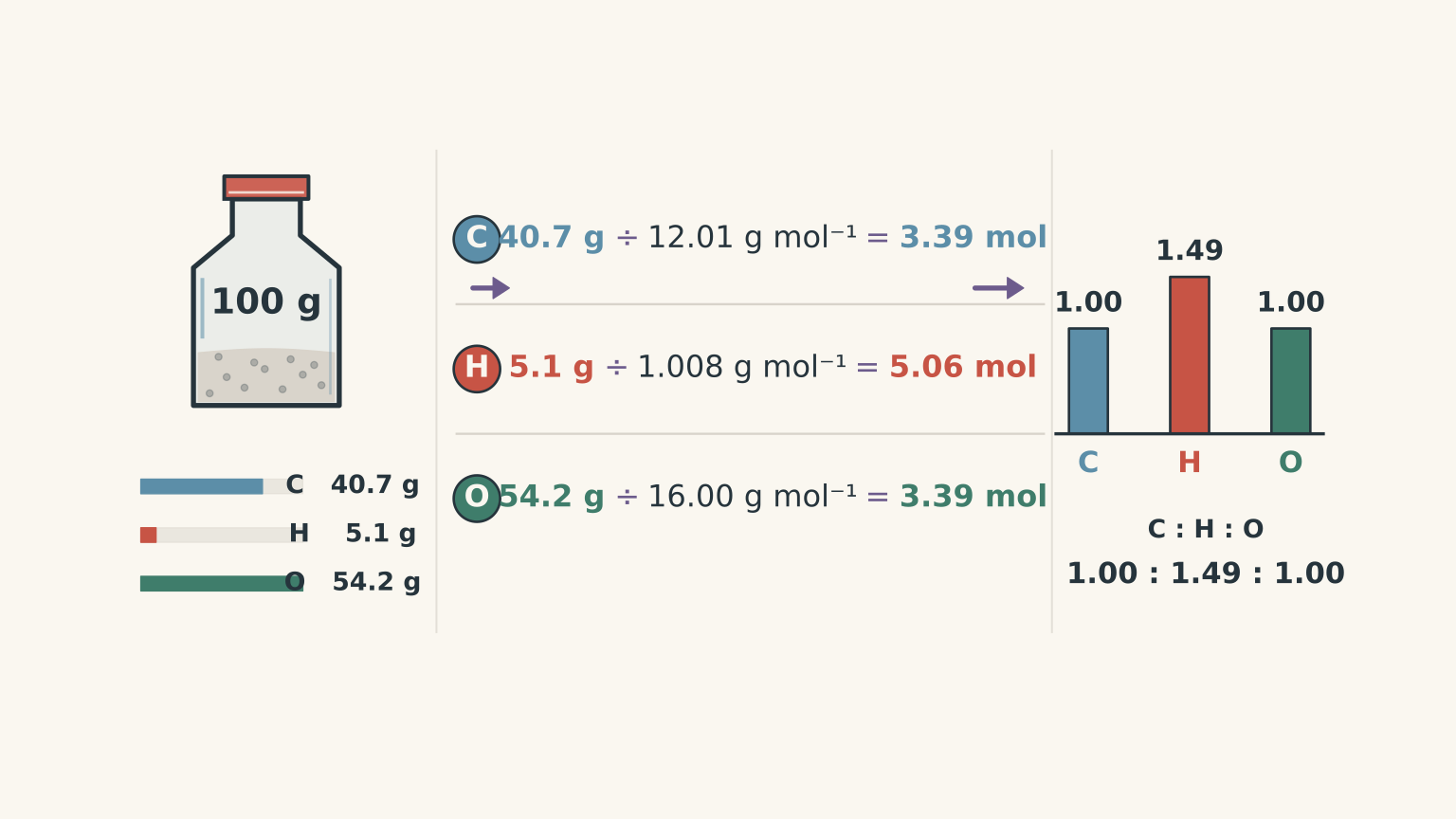
A sample is reported as 40.7% carbon, 5.1% hydrogen, and 54.2% oxygen. After converting the percentages into moles and dividing by the smallest value, you obtain the ratio:
\[ \mathrm{C:H:O}=1.00:1.49:1.00 \]
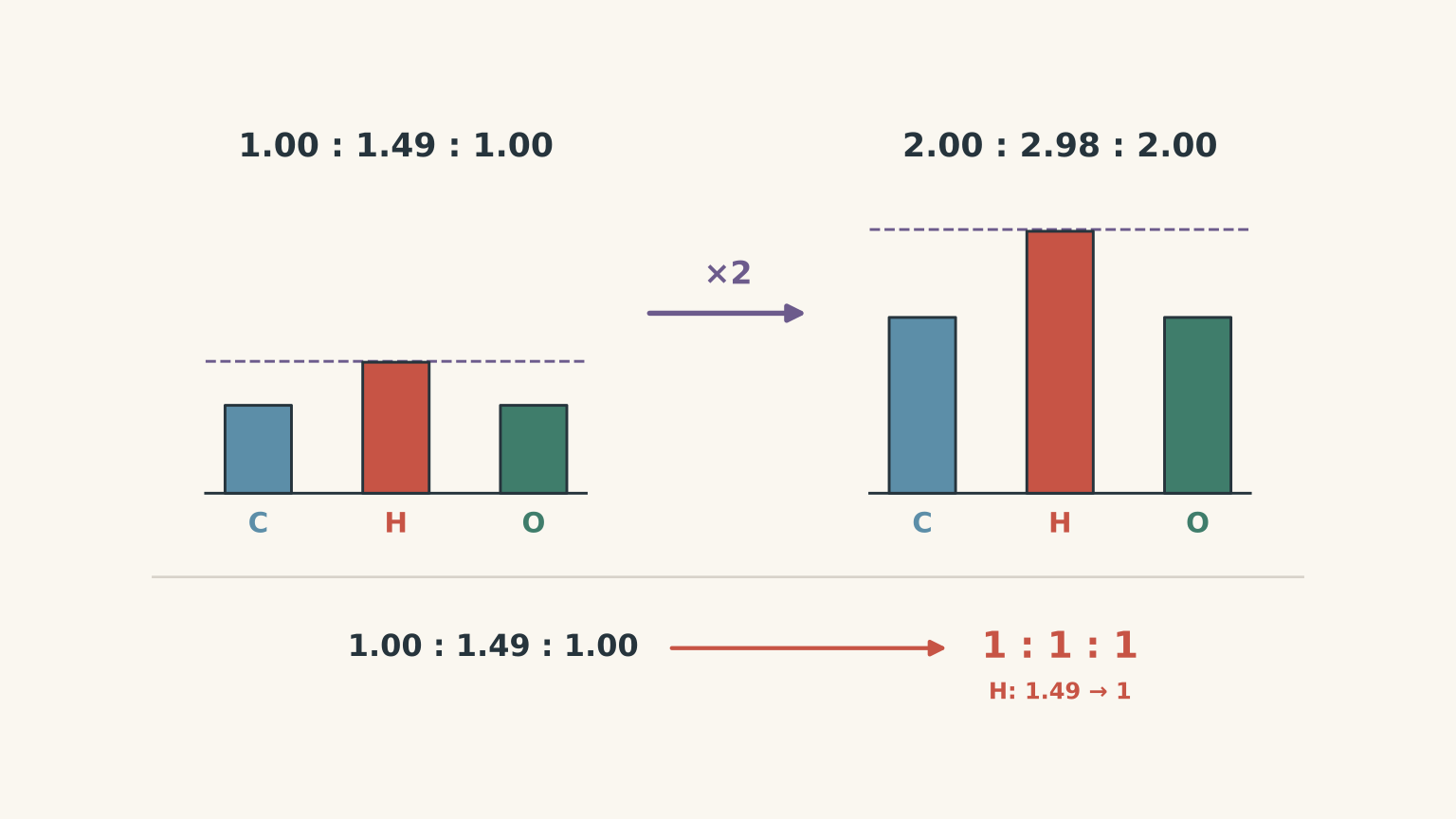
If you round each number to the nearest whole number, you get \(1:1:1\). That suggests the empirical formula \(\ce{CHO}\). But there’s a better interpretation: 1.49 is very close to 1.50, so doubling every ratio gives approximately \(2:3:2\).
The more appropriate empirical formula is therefore \(\ce{C2H3O2}\).
This illustrates an important skill in HSC Chemistry: you must decide whether a decimal mole ratio represents a genuine non-integer ratio or a small deviation caused by rounded experimental data.
An empirical formula becomes implausible when its subscripts require you to ignore significant differences in the calculated mole ratios. Rounding should simplify a justified ratio, not force the data to produce the formula you expect.
Due to technical limitations, this figure may display incorrectly or contain inaccuracies. Please check key details against your course materials.
01Why rounded mole ratios need careful interpretation
An empirical formula gives the simplest whole-number ratio of atoms in a compound.
For example, \(\ce{C2H4O2}\) has the empirical formula \(\ce{CH2O}\), because the subscripts can all be divided by two.
The difficulty is that experimental measurements rarely produce perfectly neat mole ratios. A compound might theoretically have a ratio of \(1:1.5:1\), but rounded percentage data could give you \(1:1.49:1.01\).
The small differences do not necessarily mean your calculation is wrong.
Think of a mole ratio like a recipe. If a recipe requires one cup of flour, one-and-a-half cups of sugar, and one cup of butter, you wouldn’t round the sugar down to one cup. You could double the entire recipe to obtain a clean ratio of \(2:3:2\).
The same principle applies to empirical formulae: multiply every mole ratio by the same number to obtain whole numbers.
The analogy has a limit, though. A recipe can be adjusted freely, whereas the actual atom ratio in a compound is fixed. Our calculated ratio is an estimate of that underlying composition, affected by measurement precision and rounding.
The difference between rounding and forcing a result
Consider three possible mole ratios.
| Calculated mole ratio | Appropriate interpretation | Result |
|---|---|---|
| \(1.00:2.01:0.99\) | Already very close to whole numbers | \(1:2:1\) |
| \(1.00:1.49:1.01\) | Middle value is close to 1.5 | \(2:3:2\) |
| \(1.00:1.08:1.00\) | Middle value is not close to 1 or 1.5 | Do not force a simple ratio |
The first two ratios have straightforward interpretations. The third needs further investigation.
Notice that the third example is not necessarily proof that the compound cannot exist. It tells you that the displayed data do not justify rounding the middle value to one.
That distinction is important when evaluating an empirical formula.
02A reliable method for checking empirical formulae
Use the following method whenever experimental percentages produce awkward mole ratios.
Step 1: Convert percentages into masses
If a compound contains 40% carbon, 6% hydrogen, and 54% oxygen, assume you have a 100 g sample.
This gives:
- Carbon: 40 g
- Hydrogen: 6 g
- Oxygen: 54 g
Using a 100 g sample makes the calculations easier because each percentage becomes the corresponding mass in grams.
Step 2: Convert each mass into moles
Use:
\[ n=\frac{m}{M} \]
Where:
- \(n\) is the amount of substance in moles (mol).
- \(m\) is the mass in grams (g).
- \(M\) is the molar mass in grams per mole (\(\mathrm{g\,mol^{-1}}\)).
You must calculate moles rather than compare the original masses. Different elements have different molar masses, so equal masses do not represent equal numbers of atoms.
Step 3: Divide every mole value by the smallest
This gives the simplest relative mole ratio.
For example, suppose your calculated mole amounts are:
\[ 3.00,\quad 4.50,\quad 3.00 \]
Dividing every value by 3.00 gives:
\[ 1.00:1.50:1.00 \]
Do not round the 1.50 to either one or two. It represents a fractional relationship that needs another step.
Step 4: Look for simple fractional relationships
Some common patterns are:
| Calculated ratio | Fractional relationship | Multiply every ratio by |
|---|---|---|
| 1.50 | \(3/2\) | 2 |
| 1.33 | \(4/3\) | 3 |
| 1.25 | \(5/4\) | 4 |
| 1.20 | \(6/5\) | 5 |
| 1.67 | \(5/3\) | 3 |
| 1.75 | \(7/4\) | 4 |
These are useful patterns to recognise in HSC examination questions.
They are approximations, not universal rounding rules. You still need to check whether the original data justify the proposed fraction.
Step 5: Multiply all ratios by the same number
Suppose your mole ratio is:
\[ 1.00:1.50:1.00 \]
Multiplying every value by two gives:
\[ 2.00:3.00:2.00 \]
The empirical formula is therefore \(\ce{C2H3O2}\), assuming the elements are carbon, hydrogen, and oxygen in that order.
You cannot multiply only the fractional value. Every element must be multiplied by the same factor, otherwise you change the relative composition.
Due to technical limitations, this figure may display incorrectly or contain inaccuracies. Please check key details against your course materials.
Step 6: Check whether the rounding is justified
This is the step that separates a reliable empirical formula from an implausible one.
After multiplying the ratios, compare each result with its nearest whole number.
For example:
\[ 2.00:2.98:2.02 \]
is very close to:
\[ 2:3:2 \]
The differences are small and consistent with rounded composition data.
However:
\[ 2.00:3.00:2.16 \]
is not convincingly close to:
\[ 2:3:2 \]
The oxygen ratio is 8% higher than the proposed value of two. Rounding 2.16 down to two would discard a substantial difference.
There is no universal percentage tolerance that makes every rounding decision correct. Consider the precision of the original measurements and any stated experimental uncertainty. A difference that is reasonable for approximate measurements might not be acceptable for highly precise data.
Carry extra digits through your calculations. Only round the final mole ratios when you have a defensible whole-number relationship.
03Worked example: Identifying a simple whole-number ratio
A compound contains 40.0% carbon, 6.7% hydrogen, and 53.3% oxygen by mass. Determine its empirical formula.
Step 1
The corresponding masses are:
- Carbon = 40.0 g
- Hydrogen = 6.7 g
- Oxygen = 53.3 g
Step 2
Use the molar masses:
- Carbon = \(12.01\ \mathrm{g\,mol^{-1}}\)
- Hydrogen = \(1.008\ \mathrm{g\,mol^{-1}}\)
- Oxygen = \(16.00\ \mathrm{g\,mol^{-1}}\)
\[ \begin{aligned} n(\ce C)&=\frac{40.0}{12.01}=3.33\\ n(\ce H)&=\frac{6.7}{1.008}=6.65\\ n(\ce O)&=\frac{53.3}{16.00}=3.33 \end{aligned} \]
Step 3
\[ \begin{aligned} \ce C &: \frac{3.33}{3.33}=1.00\\ \ce H &: \frac{6.65}{3.33}=2.00\\ \ce O &: \frac{3.33}{3.33}=1.00 \end{aligned} \]
The resulting ratio is:
\[ 1:2:1 \]
Step 4
The ratios are already whole numbers, so no further multiplication is needed.
The empirical formula is:
\[ \boxed{\ce{CH2O}} \]
The compound contains one carbon atom for every two hydrogen atoms and one oxygen atom in its simplest atomic ratio.
This is a straightforward example. The more difficult cases occur when one or more ratios are close to fractions rather than whole numbers.
04Worked example: Recognising a ratio close to 1.5
A compound contains 40.7% carbon, 5.1% hydrogen, and 54.2% oxygen by mass. Determine its empirical formula.
Step 1
The masses are:
- Carbon = 40.7 g
- Hydrogen = 5.1 g
- Oxygen = 54.2 g
Step 2
\[ \begin{aligned} n(\ce C)&=\frac{40.7}{12.01}=3.389\\ n(\ce H)&=\frac{5.1}{1.008}=5.060\\ n(\ce O)&=\frac{54.2}{16.00}=3.388 \end{aligned} \]
Step 3
\[ \begin{aligned} \ce C &: \frac{3.389}{3.388}=1.000\\ \ce H &: \frac{5.060}{3.388}=1.494\\ \ce O &: \frac{3.388}{3.388}=1.000 \end{aligned} \]
The ratio is approximately:
\[ 1.00:1.494:1.00 \]
Step 4
The hydrogen ratio is close to 1.5:
\[ 1.494\approx1.5 \]
This suggests multiplying every ratio by two.
\[ \begin{aligned} \ce C &: 1.000\times2=2.000\\ \ce H &: 1.494\times2=2.988\\ \ce O &: 1.000\times2=2.000 \end{aligned} \]
The resulting ratio is approximately:
\[ 2:3:2 \]
Step 5
The empirical formula is:
\[ \boxed{\ce{C2H3O2}} \]
The hydrogen ratio of 1.494 is only 0.006 away from 1.500. After multiplication, the result of 2.988 is also very close to three.
This is a justified approximation for the rounded composition data.
If you had rounded the original ratio directly to the nearest whole numbers, you would have obtained \(1:1:1\). That would have missed the underlying fractional relationship.
05When is an empirical formula actually implausible?
A useful way to check a proposed formula is to work backwards.
Once you have an empirical formula, its subscripts tell you the relative number of moles of each element.
Compare those numbers with your original calculated mole ratios.
For example, consider:
\[ 1.00:1.50:1.08 \]
Suppose someone proposes the empirical formula \(\ce{C2H3O2}\).
The formula requires a ratio of:
\[ 2:3:2 \]
But multiplying the original ratios by two gives:
\[ 2.00:3.00:2.16 \]
The oxygen value is not close enough to two to justify rounding.
The proposed formula is therefore not supported by these data.
If you treated the displayed ratio \(1.00:1.50:1.08\) as exact, you would need to multiply by 50 to obtain:
\[ 50:75:54 \]
That is a much larger ratio. However, this does not automatically establish \(\ce{C50H75O54}\) as the correct empirical formula either. The displayed ratios are themselves rounded measurements.
You need to consider whether the original data have enough precision to establish such a large ratio.
A practical diagnostic table
| What you observe | What it suggests | What you should do |
|---|---|---|
| Ratios close to whole numbers | A simple empirical formula | Round appropriately |
| A ratio close to 0.5, 1.5, or another simple fraction | A fractional relationship | Multiply all ratios by a common factor |
| One ratio remains noticeably different after scaling | The proposed formula may be incorrect | Recheck calculations and data |
| Very large subscripts are required | The data may not support a simple formula | Examine measurement uncertainty and sample purity |
| Different experimental runs produce inconsistent ratios | Possible experimental or sampling problem | Investigate before assigning a formula |
A large subscript is not automatically chemically impossible. Some compounds genuinely have large empirical formulae.
Likewise, a small subscript is not automatically correct just because it looks more familiar.
The key is consistency with the experimental evidence.
Check the assumptions behind the data
Before rejecting an unusual result, check the assumptions used in your calculation.
For a standard percentage-composition problem, you generally assume:
- The sample is pure.
- The sample is dry.
- All relevant elements have been included.
- The percentages represent the mass composition of the same compound.
- The measurements are sufficiently accurate to establish the calculated ratios.
For example, if a sample contains moisture but the analysis treats all its hydrogen and oxygen as belonging to the compound, the calculated mole ratios may be distorted.
An apparently implausible formula can therefore indicate a problem with the sample or experimental method rather than a mistake in the arithmetic.
06Empirical formulae are not molecular identities
There is another important distinction: an empirical formula does not necessarily tell you the molecular formula.
The empirical formula gives the simplest whole-number ratio of atoms. The molecular formula gives the actual number of each type of atom in a molecule.
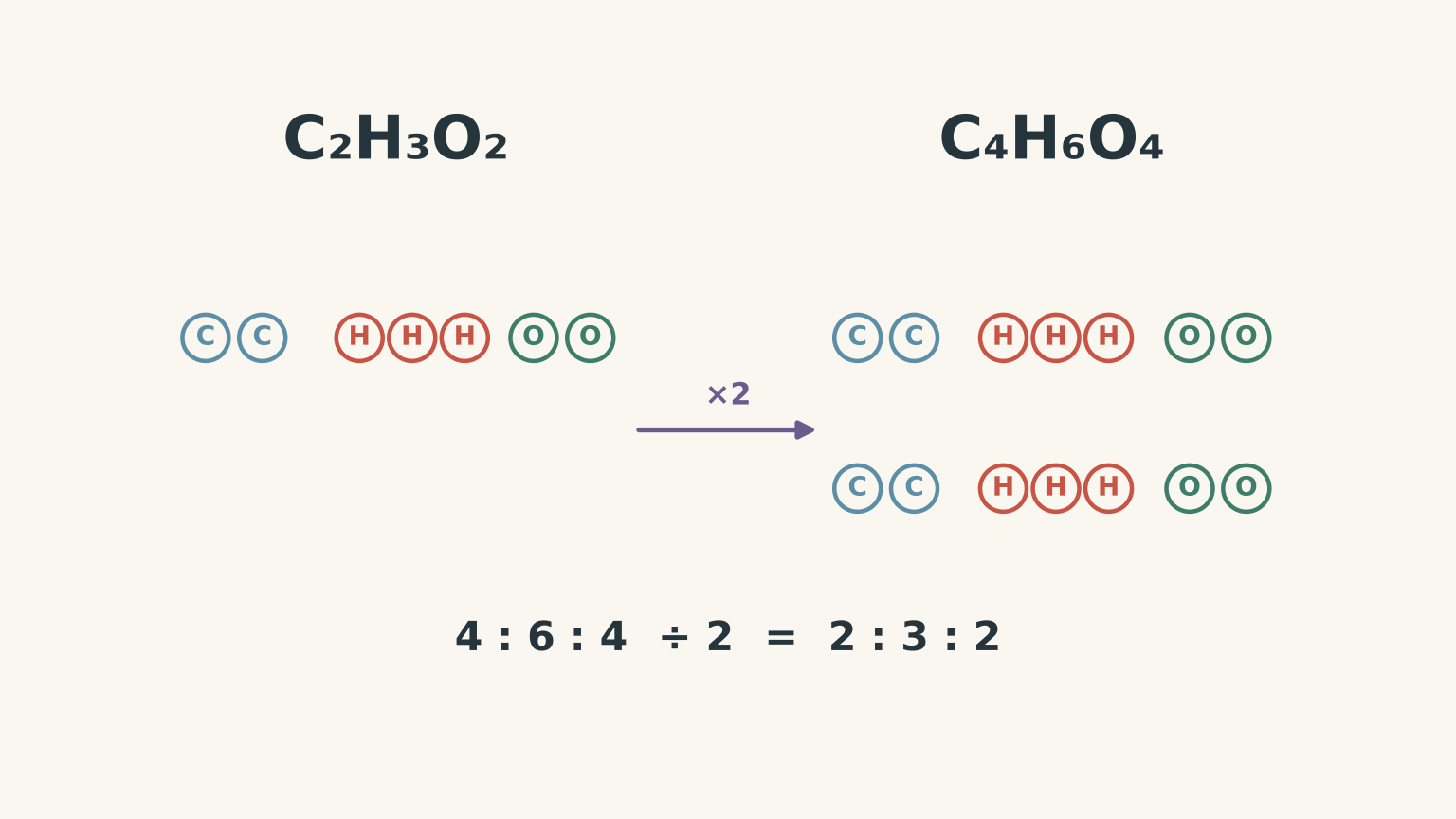
For example, these molecular formulae all have the same empirical formula:
\[ \ce{C2H3O2} \]
\[ \ce{C4H6O4} \]
\[ \ce{C6H9O6} \]
Each has the simplest ratio \(2:3:2\).
Elemental composition alone cannot distinguish between these molecular formulae.
Due to technical limitations, this figure may display incorrectly or contain inaccuracies. Please check key details against your course materials.
How do you determine the molecular formula?
You need an additional piece of information: the molar mass of the compound.
Calculate the empirical formula mass, then compare it with the experimentally determined molecular molar mass.
Use:
\[ n=\frac{\text{molecular molar mass}} {\text{empirical formula mass}} \]
The result should be a positive whole number, subject to experimental uncertainty.
For example, the empirical formula \(\ce{C2H3O2}\) has an empirical formula mass of:
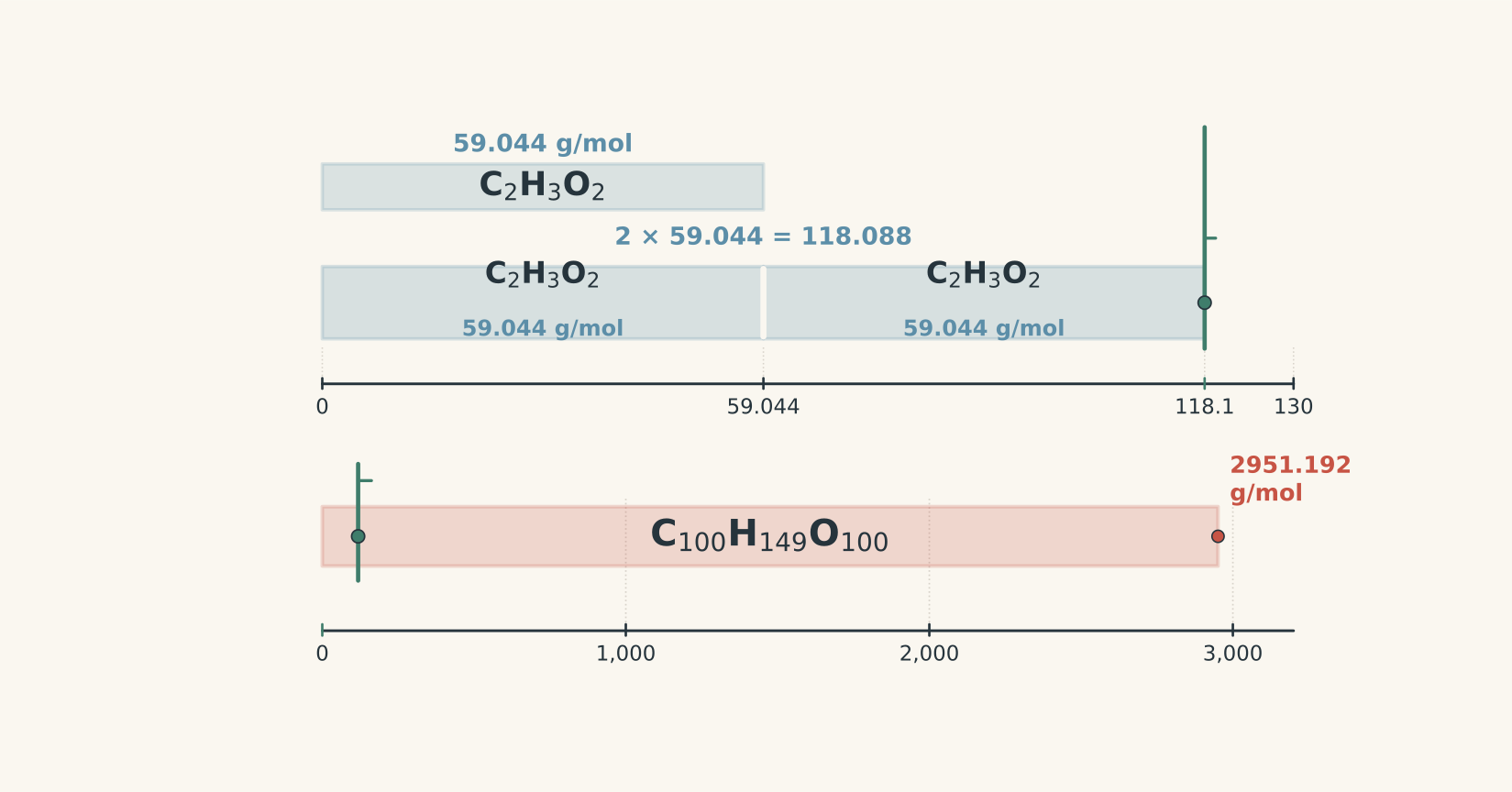
\[ \begin{aligned} M&=2(12.01)+3(1.008)+2(16.00)\\ &=59.044\ \mathrm{g\,mol^{-1}} \end{aligned} \]
If the measured molecular molar mass is approximately \(118.1\ \mathrm{g\,mol^{-1}}\):
\[ n=\frac{118.1}{59.044}\approx2 \]
Multiply every empirical subscript by two:
\[ \ce{C2H3O2}\times2=\ce{C4H6O4} \]
The molecular formula is \(\ce{C4H6O4}\).
This distinction also matters for ionic compounds. Ionic solids do not consist of discrete molecules in the same way as molecular substances. Their empirical formula represents the simplest ratio of ions in the ionic lattice, usually called a formula unit.
For a more detailed treatment of the calculation, see How to Find Molecular Formula from Empirical Formula and Molar Mass.
07Questions and solutions
The following questions progress from standard empirical formula calculations to situations where rounding, experimental uncertainty, and molecular mass must be considered together.
Question 1
A pure compound contains 52.1% carbon, 13.1% hydrogen, and 34.7% oxygen by mass.
Calculate its empirical formula.
Solution 1
The empirical formula is \(\ce{C2H6O}\).
Start by assuming a 100 g sample, giving masses of 52.1 g carbon, 13.1 g hydrogen, and 34.7 g oxygen.
Convert each mass into moles:
\[ \begin{aligned} n(\ce C)&=\frac{52.1}{12.01}=4.338\\ n(\ce H)&=\frac{13.1}{1.008}=12.996\\ n(\ce O)&=\frac{34.7}{16.00}=2.169 \end{aligned} \]
Divide each value by the smallest number, 2.169:
\[ \begin{aligned} \ce C &: \frac{4.338}{2.169}=2.00\\ \ce H &: \frac{12.996}{2.169}=5.99\\ \ce O &: \frac{2.169}{2.169}=1.00 \end{aligned} \]
The ratio is approximately:
\[ 2:6:1 \]
Therefore:
\[ \boxed{\ce{C2H6O}} \]
The hydrogen ratio is slightly below six, but the difference is small enough to be consistent with the rounded composition data.
Question 2
An unknown compound contains 40.9% carbon, 4.6% hydrogen, and 54.5% oxygen by mass.
A student calculates the mole ratio as:
\[ 1.00:1.34:1.00 \]
They suggest rounding this to \(1:1:1\).
Determine the correct empirical formula and explain why the student’s approach is incorrect.
Solution 2
The correct empirical formula is \(\ce{C3H4O3}\), not \(\ce{CHO}\).
The student’s mistake is rounding 1.34 directly to one rather than recognising that it is close to \(4/3\).
First, calculate the mole amounts:
\[ \begin{aligned} n(\ce C)&=\frac{40.9}{12.01}=3.406\\ n(\ce H)&=\frac{4.6}{1.008}=4.563\\ n(\ce O)&=\frac{54.5}{16.00}=3.406 \end{aligned} \]
Divide by the smallest value:
\[ 1.00:1.34:1.00 \]
The middle value is approximately:
\[ 1.34\approx\frac{4}{3} \]
Multiply every ratio by three:
\[ \begin{aligned} \ce C &: 1.00\times3=3.00\\ \ce H &: 1.34\times3=4.02\\ \ce O &: 1.00\times3=3.00 \end{aligned} \]
The resulting ratio is:
\[ 3:4:3 \]
Therefore:
\[ \boxed{\ce{C3H4O3}} \]
The tempting approach is to round every ratio to the nearest whole number. However, that ignores the possibility of simple fractional relationships.
Always check whether a ratio is close to a fraction before rounding it.
Question 3
An experimental analysis gives a compound the following composition:
| Element | Percentage by mass |
|---|---|
| Carbon | 39.0% |
| Hydrogen | 4.9% |
| Oxygen | 56.1% |
A student proposes the empirical formula \(\ce{C2H3O2}\).
Their normalised mole ratio is approximately:
\[ 1.00:1.50:1.08 \]
(a) Determine whether the proposed formula is supported by the data.
(b) Calculate the mole ratio after multiplying by two.
(c) Explain why it would be inappropriate to round the resulting oxygen ratio to two.
Solution 3
The proposed formula \(\ce{C2H3O2}\) is not justified by the experimental data.
(a) Check the proposed formula against the calculated ratio.
The empirical formula requires:
\[ 1:1.5:1 \]
However, the experimental ratio is:
\[ 1.00:1.50:1.08 \]
The oxygen ratio is noticeably higher than one.
(b) Multiply every ratio by two:
\[ \begin{aligned} \ce C &: 1.00\times2=2.00\\ \ce H &: 1.50\times2=3.00\\ \ce O &: 1.08\times2=2.16 \end{aligned} \]
The resulting ratio is:
\[ 2.00:3.00:2.16 \]
This is not sufficiently close to \(2:3:2\).
(c) Compare the oxygen value with the proposed whole number.
The difference is:
\[ 2.16-2.00=0.16 \]
As a percentage of the proposed value:
\[ \frac{0.16}{2.00}\times100=8.0\% \]
An 8% difference is too large to dismiss as ordinary rounding in data reported to three significant figures.
The student has forced the oxygen ratio to fit the proposed formula.
If the displayed ratio \(1.00:1.50:1.08\) were treated as exact, multiplying by 50 would produce \(50:75:54\). However, that large ratio should not automatically be reported as the empirical formula either, because the original values are rounded.
The correct conclusion is that the data do not justify the proposed small empirical formula. The experimental uncertainty, sample purity, and possibility of omitted elements should be investigated before assigning a formula.
Question 4
A pure molecular compound has the empirical formula \(\ce{C2H3O2}\).
An independent experiment determines its molecular molar mass to be \(118.1\ \mathrm{g\,mol^{-1}}\).
(a) Calculate the empirical formula mass.
(b) Determine the molecular formula.
(c) Explain why the empirical formula alone cannot establish the molecular identity of the compound.
Solution 4
The molecular formula is \(\ce{C4H6O4}\), but the empirical formula alone cannot identify the compound’s molecular structure.
(a) Calculate the empirical formula mass.
\[ \begin{aligned} M&=2(12.01)+3(1.008)+2(16.00)\\ &=59.044\ \mathrm{g\,mol^{-1}} \end{aligned} \]
(b) Calculate the multiplication factor.
\[ n=\frac{118.1}{59.044} \]
\[ n\approx2 \]
Multiply every subscript in the empirical formula by two:
\[ \ce{C2H3O2}\times2=\ce{C4H6O4} \]
Therefore, the molecular formula is:
\[ \boxed{\ce{C4H6O4}} \]
(c) Explain the limitation of the empirical formula.
The empirical formula only establishes the simplest atomic ratio.
Different molecular compounds can have the same empirical formula but different molecular formulae or arrangements of atoms.
The additional molar mass measurement establishes the number of empirical formula units in each molecule, but it does not establish the exact molecular structure or distinguish between possible structural isomers.
You need additional chemical evidence to identify the molecular structure.
Question 5
A pure molecular compound contains only carbon, hydrogen, and oxygen.
Two independent analyses produce a normalised mole ratio consistent with:
\[ \ce{C:H:O}=1.00:(1.49\pm0.02):1.00 \]
The stated uncertainty applies to the hydrogen-to-carbon ratio. The carbon and oxygen ratios are each consistent with 1.00 within their measurement uncertainty.
The measured molecular molar mass is:
\[ 118.1\ \mathrm{g\,mol^{-1}} \]
Two students propose different empirical formulae.
- Student A treats the displayed ratio as exact and proposes \(\ce{C100H149O100}\).
- Student B considers the stated uncertainty and proposes \(\ce{C2H3O2}\).
(a) Explain why both proposals initially appear reasonable from the displayed mole ratio.
(b) Use the molecular molar mass to determine which empirical formula is consistent with the complete set of evidence.
(c) Determine the molecular formula of the compound.
Solution 5
Student B’s empirical formula, \(\ce{C2H3O2}\), is supported by the complete evidence, and the molecular formula is \(\ce{C4H6O4}\).
The important distinction is that the calculated mole ratio has uncertainty, while the molecular molar mass provides an independent constraint.
(a) Examine the two proposed empirical formulae.
Student A treats the displayed ratio as exact:
\[ 1.00:1.49:1.00 \]
Multiplying every value by 100 gives:
\[ 100:149:100 \]
This produces:
\[ \ce{C100H149O100} \]
The arithmetic is correct if the displayed ratio is treated as exact.
Student B recognises that the hydrogen ratio has an uncertainty of \(\pm0.02\).
Its possible range is:
\[ 1.47\leq n_{\ce H}/n_{\ce C}\leq1.51 \]
The value 1.50 falls within this range.
Therefore, the simpler ratio:
\[ 1:1.5:1 \]
is consistent with the stated measurement uncertainty.
Multiplying by two gives:
\[ 2:3:2 \]
and the proposed empirical formula:
\[ \ce{C2H3O2} \]
Both students have interpreted the displayed central value mathematically, but Student A has treated a measured ratio as though it were exact.
(b) Use the molecular molar mass to test the candidates.
First, calculate the empirical formula mass for Student B’s proposal:
\[ \begin{aligned} M&=2(12.01)+3(1.008)+2(16.00)\\ &=59.044\ \mathrm{g\,mol^{-1}} \end{aligned} \]
Now consider Student A’s proposal:
\[ \ce{C100H149O100} \]
Its empirical formula mass would be:
\[ \begin{aligned} M={}&100(12.01)+149(1.008)\\ &+100(16.00) \end{aligned} \]
\[ M=2951.192\ \mathrm{g\,mol^{-1}} \]
This creates a problem.
The proposed empirical formula mass is much greater than the experimentally measured molecular molar mass of \(118.1\ \mathrm{g\,mol^{-1}}\).
A molecular formula must contain an integer number of empirical formula units. Its molar mass therefore cannot be smaller than the empirical formula mass.
Student A’s proposal is impossible for the stated molecular compound.
Student B’s proposal is consistent with both the composition uncertainty and the independent molar mass measurement.
(c) Calculate the molecular formula.
Divide the measured molecular molar mass by the empirical formula mass:
\[ n=\frac{118.1}{59.044} \]
\[ n\approx2 \]
Multiply the empirical subscripts by two:
\[ \ce{C2H3O2}\times2 =\ce{C4H6O4} \]
Therefore:
\[ \boxed{\ce{C4H6O4}} \]
This question demonstrates why you should not automatically treat every displayed decimal as an exact atom ratio.
A larger integer formula can reproduce the displayed decimal values, but that does not make it the correct empirical formula. Measurement uncertainty and independent experimental evidence must also be considered.
Due to technical limitations, this figure may display incorrectly or contain inaccuracies. Please check key details against your course materials.
08What to remember in an HSC Chemistry exam
When an empirical formula calculation produces awkward decimals, use this sequence:
- Convert every percentage into a mass using a 100 g sample.
- Convert each mass into moles using the appropriate molar mass.
- Divide all mole values by the smallest value.
- Look for simple fractional relationships before rounding.
- Multiply every ratio by the same factor to obtain whole numbers.
- Check that the final subscripts are consistent with the original data and their precision.
- If an independent molar mass is provided, use it to check the molecular formula.
Most importantly, don’t confuse a mathematically possible integer ratio with a chemically justified empirical formula.
A ratio of \(1.49\) might reasonably represent \(1.50\) when the measurements are sufficiently uncertain. A ratio of \(1.08\) should not automatically become \(1.00\).
The next useful skill is connecting the empirical formula to molecular mass. Once you can justify the simplest whole-number ratio, you can use independent molar mass data to determine how many empirical units make up an actual molecule.