
How to Find Keq When an Equilibrium Equation Is Multiplied by Two
Learn why multiplying every coefficient in a balanced equilibrium equation squares its equilibrium constant. Work through examples involving reaction reversal, temperature changes, and reaction quotients, then test your understanding with challenging HSC Chemistry questions.
Two chemistry students calculate the equilibrium constant for the same reaction. One gets \(K_c=2.00\times10^{-2}\). The other gets \(K_c=4.00\times10^{-4}\).
Both students claim their answer is correct.
Could they both be right?
Yes. If you multiply every coefficient in a balanced equilibrium equation by two, you must square the original equilibrium constant.
The rule is:
\[ \boxed{K_{\mathrm{new}}=(K_{\mathrm{original}})^2} \]
The reverse is also useful. If you halve every coefficient, take the square root of the original equilibrium constant.
The important detail is that the equilibrium constant belongs to the equation as written. Changing the coefficients changes its numerical value, even though the actual chemical equilibrium remains unchanged.
01Why does multiplying an equation by two square Keq?
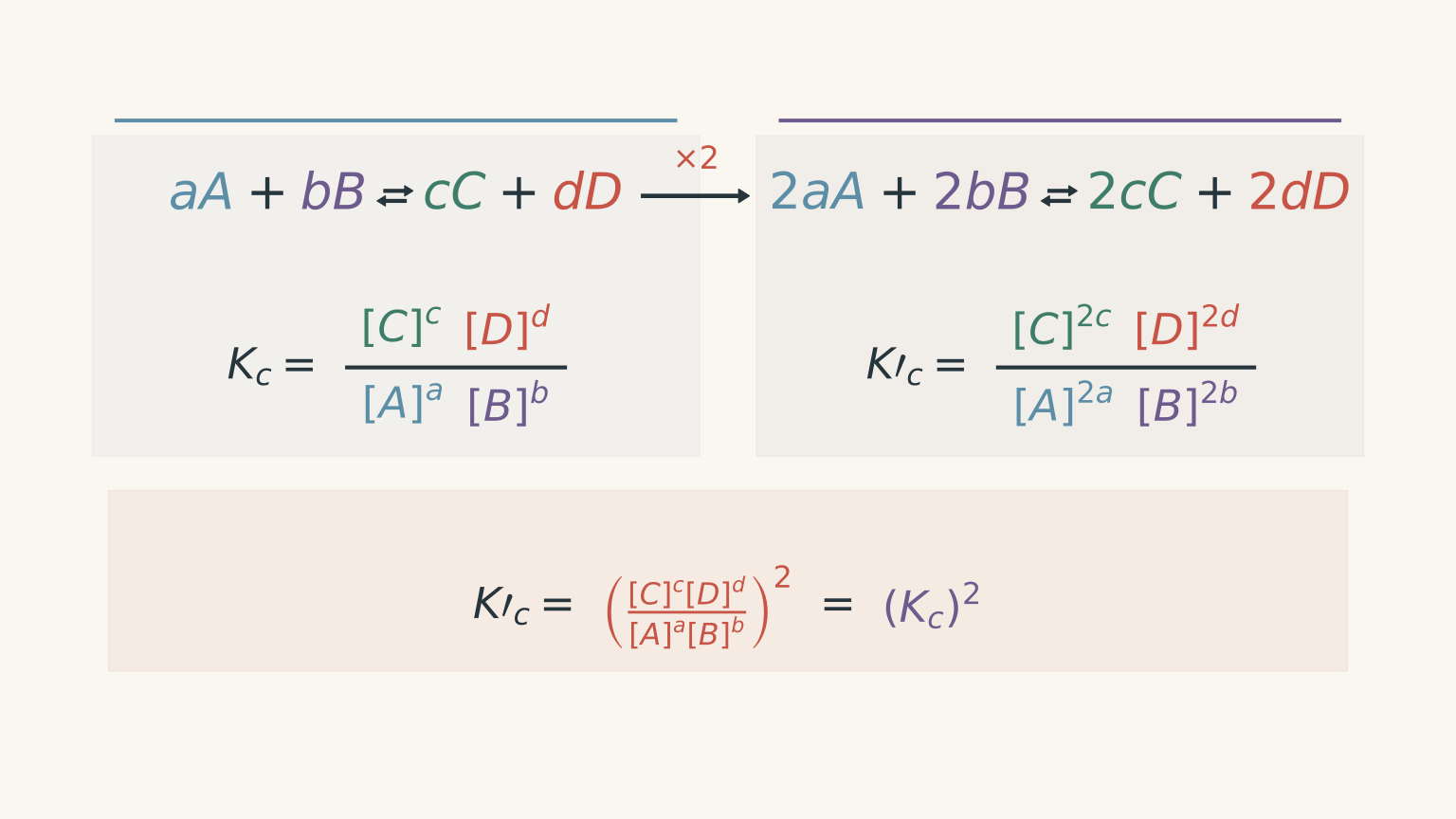
Start with a general reversible reaction:
\[ \mathrm{aA+bB\rightleftharpoons cC+dD} \]
Its concentration-based equilibrium expression is:
\[ K_c=\frac{[C]^c[D]^d}{[A]^a[B]^b} \]
The square brackets represent equilibrium concentrations in \(\mathrm{mol\,L^{-1}}\). The lowercase letters represent the coefficients in the balanced equation.
Notice something important: the coefficients become powers in the equilibrium expression.
Now multiply the entire balanced equation by two:
\[ \mathrm{2aA+2bB\rightleftharpoons 2cC+2dD} \]
Every coefficient has doubled, so every exponent in the equilibrium expression also doubles.
The new expression is:
\[ K'_c=\frac{[C]^{2c}[D]^{2d}} {[A]^{2a}[B]^{2b}} \]
We can rearrange this:
\[ K'_c= \left( \frac{[C]^c[D]^d} {[A]^a[B]^b} \right)^2 \]
But the expression inside the brackets is simply the original \(K_c\).
Therefore:
\[ \boxed{K'_c=(K_c)^2} \]
That’s the entire mathematical reason.
You aren’t doubling the concentrations or changing the amount of product. You’re changing the powers in the equilibrium expression.
Due to technical limitations, this figure may display incorrectly or contain inaccuracies. Please check key details against your course materials.
02A measurement puzzle: can two different Keq values describe the same mixture?
Let’s see how this works using a hypothetical investigation involving nitrogen dioxide and dinitrogen tetroxide.
The equilibrium is:
\[ \ce{N2O4(g) <=> 2NO2(g)} \]
Nitrogen dioxide is brown, while dinitrogen tetroxide is nearly colourless.
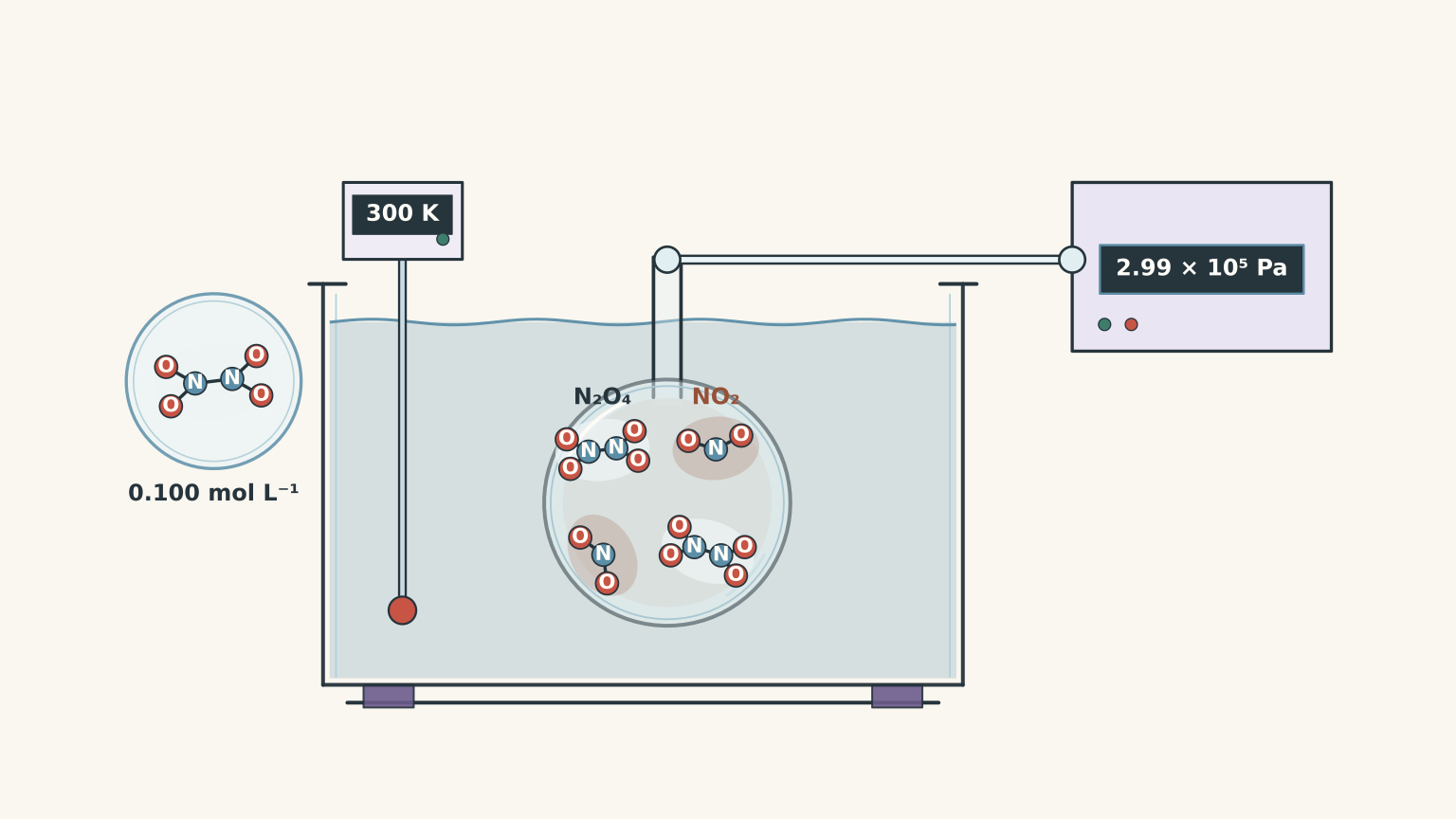
Imagine a sealed, rigid glass vessel containing an initially known concentration of \(\ce{N2O4}\). The vessel sits in a temperature-controlled bath, and a pressure sensor connects to it through a sealed tube.
The sensor measures the total gas pressure inside the vessel.
Due to technical limitations, this figure may display incorrectly or contain inaccuracies. Please check key details against your course materials.
What should happen as the reaction proceeds?
Predict what happens to the pressure if some \(\ce{N2O4}\) dissociates into \(\ce{NO2}\).
Each molecule of \(\ce{N2O4}\) produces two molecules of \(\ce{NO2}\).
The number of gas particles therefore increases.
Because the vessel has a fixed volume and temperature, an increase in the total number of gas particles produces an increase in pressure.
This gives us a way to investigate the equilibrium composition.
The measurement
For an illustrative dataset, suppose:
- Initial \(\ce{N2O4}\) concentration: \(0.100\ \mathrm{mol\,L^{-1}}\)
- Initial \(\ce{NO2}\) concentration: \(0\)
- Temperature: \(300\ \mathrm{K}\)
- Final measured pressure: \(2.99\times10^5\ \mathrm{Pa}\)
Assume ideal-gas behaviour and no other gases are present.
Using the ideal gas relationship:
\[ P=cRT \]
where \(P\) is pressure, \(c\) is total molar concentration, \(R\) is the gas constant, and \(T\) is absolute temperature.
The total equilibrium gas concentration is:
\[ \begin{aligned} c&=\frac{P}{RT}\\ &=\frac{2.99\times10^5}{8.314\times300}\\ &=120\ \mathrm{mol\,m^{-3}}\\ &=0.120\ \mathrm{mol\,L^{-1}} \end{aligned} \]
Now let \(x\) represent the concentration of \(\ce{N2O4}\) that dissociates.
The equilibrium concentrations are:
\[ [\ce{N2O4}]=0.100-x \]
\[ [\ce{NO2}]=2x \]
Therefore, the total concentration is:
\[ (0.100-x)+2x=0.100+x \]
We know this total is \(0.120\ \mathrm{mol\,L^{-1}}\).
So:
\[ 0.100+x=0.120 \]
\[ x=0.0200\ \mathrm{mol\,L^{-1}} \]
The equilibrium concentrations are therefore:
| Species | Equilibrium concentration |
|---|---|
| \(\ce{N2O4}\) | \(0.0800\ \mathrm{mol\,L^{-1}}\) |
| \(\ce{NO2}\) | \(0.0400\ \mathrm{mol\,L^{-1}}\) |
The pressure sensor hasn’t measured \(K_c\) directly. It has provided information that, together with the known initial composition and reaction stoichiometry, allows us to calculate the equilibrium concentrations.
A pressure reading alone would not identify both concentrations if the initial composition were unknown. Controlling the starting conditions fixes that problem.
Calculate Keq for the original equation
For:
\[ \ce{N2O4(g) <=> 2NO2(g)} \]
The equilibrium expression is:
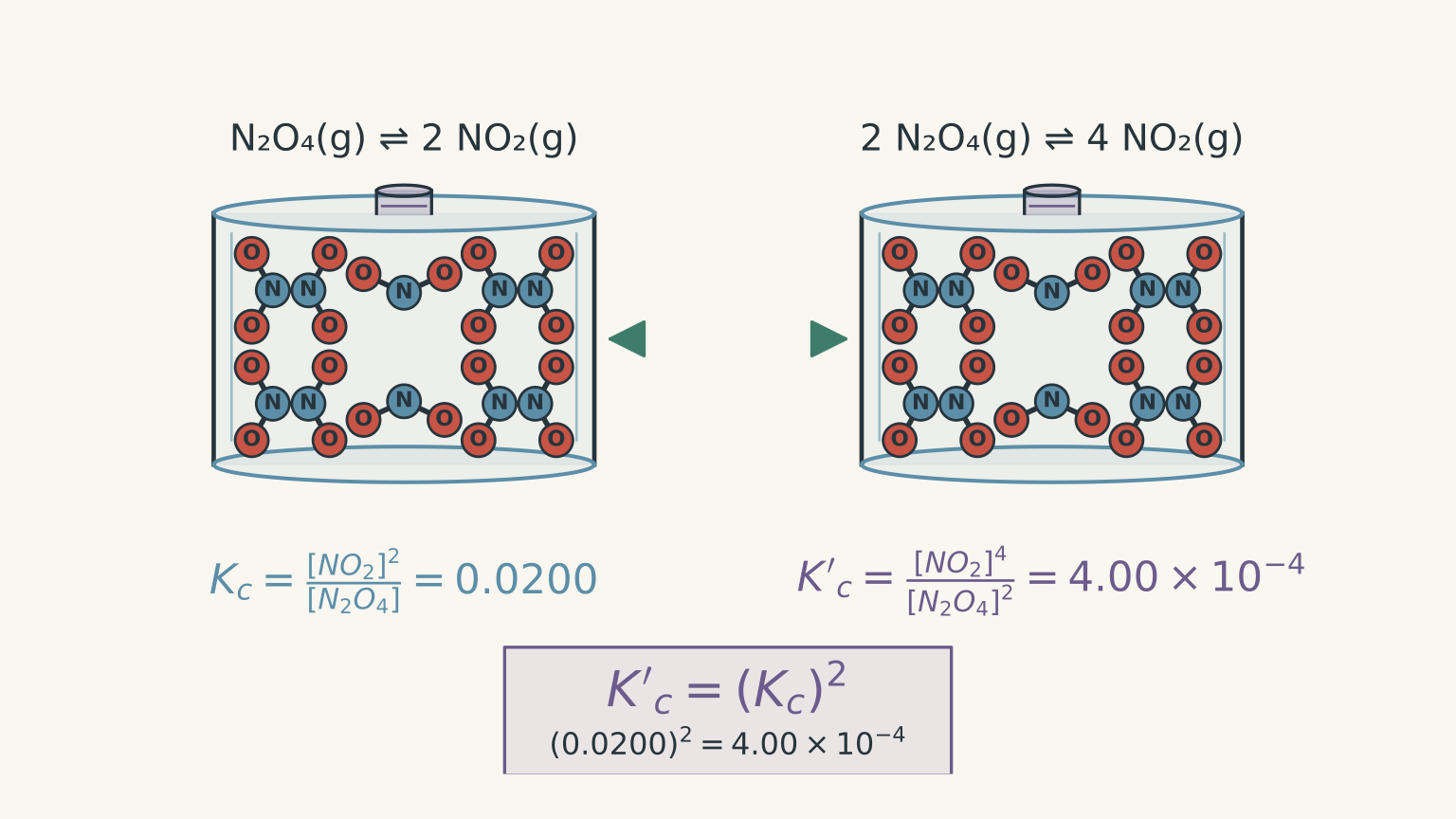
\[ K_c=\frac{[\ce{NO2}]^2}{[\ce{N2O4}]} \]
Substitute the equilibrium concentrations:
\[ \begin{aligned} K_c&=\frac{(0.0400)^2}{0.0800}\\ &=\frac{0.00160}{0.0800}\\ &=0.0200 \end{aligned} \]
Using the concentration-expression convention, the result has units of \(\mathrm{mol\,L^{-1}}\).
Now comes the interesting part.
What if we multiply the equation by two?
The same chemical reaction can be written:
\[ \ce{2N2O4(g) <=> 4NO2(g)} \]
The physical mixture has not changed. The temperature, vessel, pressure, and equilibrium concentrations are all identical.
However, the equilibrium expression is now:
\[ K'_c=\frac{[\ce{NO2}]^4}{[\ce{N2O4}]^2} \]
Substitute the same equilibrium concentrations:
\[ \begin{aligned} K'_c&=\frac{(0.0400)^4}{(0.0800)^2}\\ &=\frac{2.56\times10^{-6}}{0.00640}\\ &=4.00\times10^{-4} \end{aligned} \]
Notice that:
\[ (0.0200)^2=4.00\times10^{-4} \]
Both students were correct.
They calculated the equilibrium constant for two differently written equations describing the same physical equilibrium.
Due to technical limitations, this figure may display incorrectly or contain inaccuracies. Please check key details against your course materials.
03Why a smaller Keq does not necessarily mean a different equilibrium
This is where students sometimes make a surprisingly large mistake.
Suppose the original equilibrium constant is:
\[ K_c=0.20 \]
After multiplying the equation by two:
\[ K'_c=(0.20)^2=0.040 \]
The new equilibrium constant is smaller.
Does that mean the reaction has become more reactant-favoured?
No. Nothing about the physical equilibrium has changed.
The equation has simply been written using twice the stoichiometric coefficients.
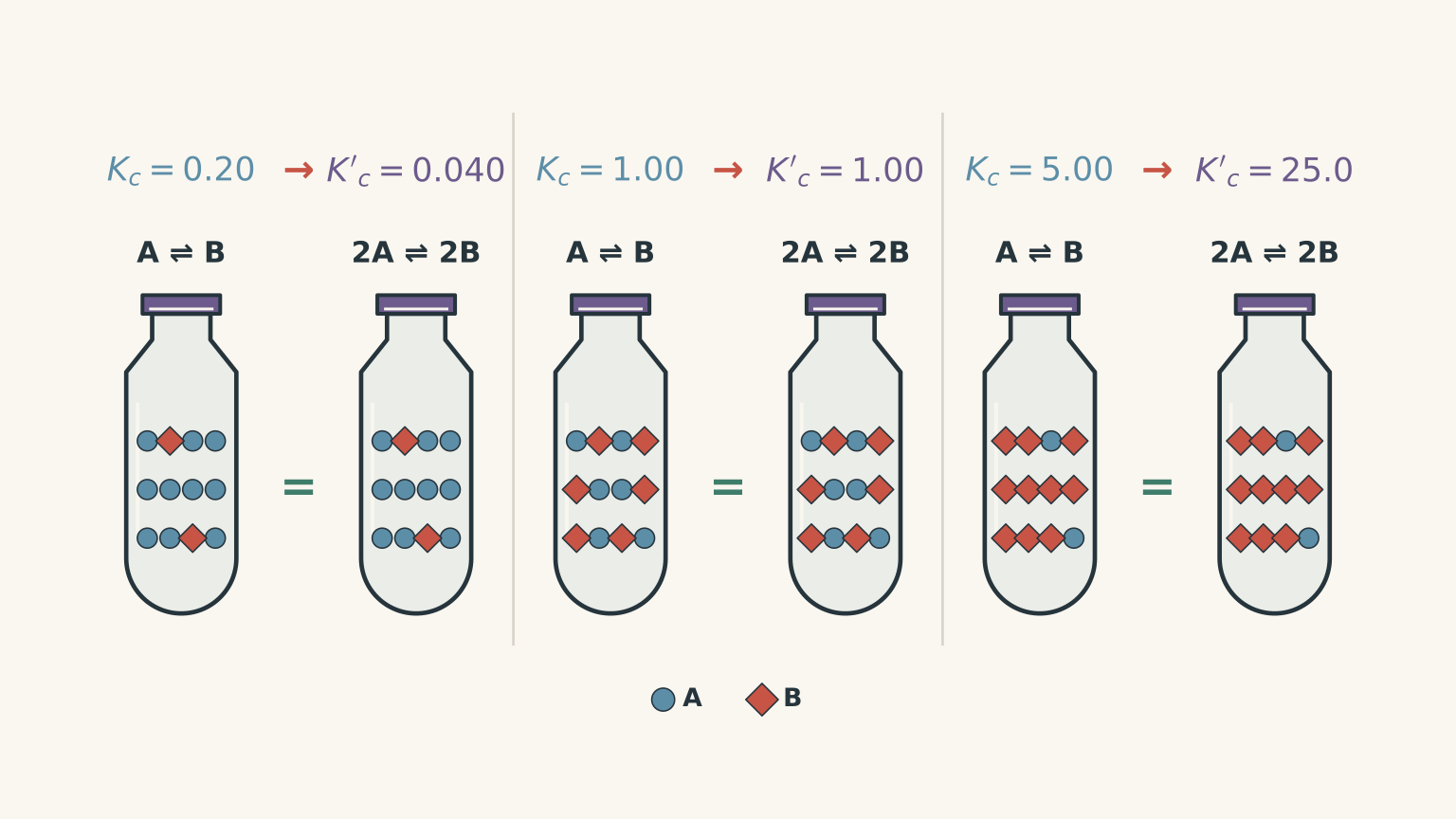
Consider three possibilities:
| Original \(K_c\) | New \(K'_c=K_c^2\) | What happens? |
|---|---|---|
| \(0.20\) | \(0.040\) | The numerical value decreases |
| \(1.00\) | \(1.00\) | The numerical value stays the same |
| \(5.00\) | \(25.0\) | The numerical value increases |
In all three cases, the physical equilibrium remains unchanged.
The useful observation is that squaring a positive number preserves whether it is above or below one.
- If the original \(K_c\) is below one, the squared value is also below one.
- If the original \(K_c\) is above one, the squared value is also above one.
- If the original \(K_c\) equals one, the squared value remains one.
So the broad interpretation of which side is favoured is preserved, even though the numerical value changes.
Due to technical limitations, this figure may display incorrectly or contain inaccuracies. Please check key details against your course materials.
This is why you should never compare equilibrium constant values without checking the chemical equations they belong to.
If you want to explore what a large equilibrium constant actually tells you about the amounts of reactants remaining, see Can Significant Reactants Remain When Keq Is Very Large?.
04What if the equation is reversed as well?
Multiplying an equation by two is only one possible change.
You might also be asked to reverse the equation.
For example:
\[ \ce{A <=> B} \]
has an equilibrium constant:
\[ K_c=\frac{[B]}{[A]} \]
If you reverse the reaction:
\[ \ce{B <=> A} \]
the expression becomes:
\[ K'_c=\frac{[A]}{[B]} \]
Therefore:
\[ \boxed{K'_c=\frac{1}{K_c}} \]
If you reverse the reaction and then multiply every coefficient by two, you apply both transformations.
\[ \boxed{K'_c=\frac{1}{(K_c)^2}} \]
This is worth remembering because exam questions sometimes combine reversing and multiplying equations.
A quick transformation table
| Change to the original equation | New equilibrium constant |
|---|---|
| Multiply all coefficients by 2 | \(K^2\) |
| Multiply all coefficients by 3 | \(K^3\) |
| Multiply all coefficients by \(n\) | \(K^n\) |
| Halve all coefficients | \(\sqrt K\) |
| Reverse the equation | \(\frac{1}{K}\) |
| Reverse and multiply by 2 | \(\frac{1}{K^2}\) |
The general rule is:
If every coefficient is multiplied by \(n\):
\[ \boxed{K_{\mathrm{new}}=K_{\mathrm{original}}^n} \]
If the reaction is reversed, take the reciprocal as well.
05Don’t forget pure solids and liquids
There is another detail worth checking before you calculate anything.
Pure solids and pure liquids are excluded from equilibrium constant expressions.
Consider:
\[ \ce{CaCO3(s) <=> CaO(s) + CO2(g)} \]
The equilibrium expression is:
\[ K_c=[\ce{CO2}] \]
Neither solid appears in the expression.
Now double the equation:
\[ \ce{2CaCO3(s) <=> 2CaO(s) + 2CO2(g)} \]
The new expression is:
\[ K'_c=[\ce{CO2}]^2 \]
Therefore:
\[ K'_c=(K_c)^2 \]
Even though the solid coefficients have doubled, you still leave the pure solids out of the expression.
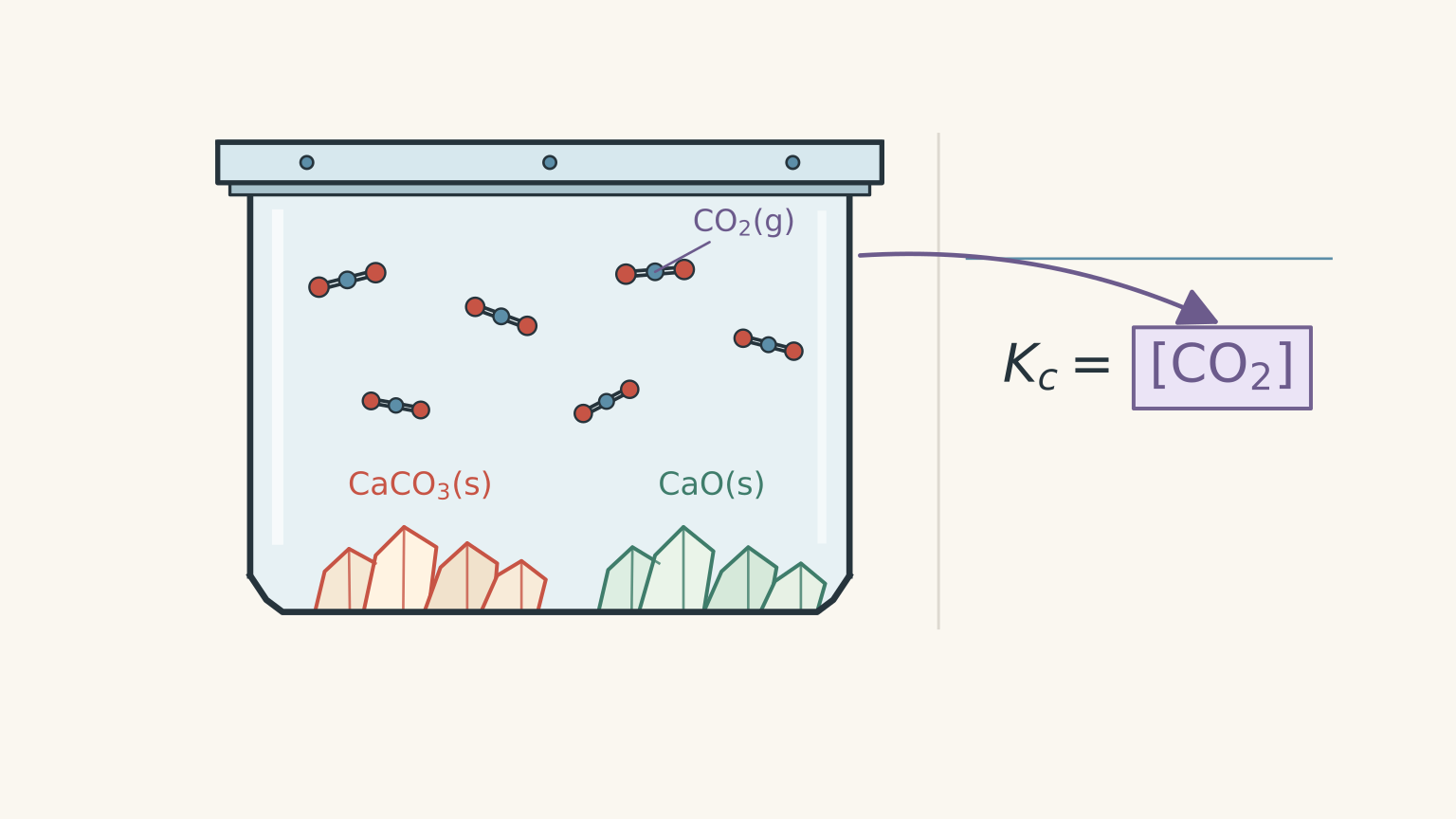
Due to technical limitations, this figure may display incorrectly or contain inaccuracies. Please check key details against your course materials.
If you need more practice constructing equilibrium expressions from experimental concentrations, see Determining Keq for the Iron(III) Thiocyanate Equilibrium.
06A reliable method for HSC exam questions
When you encounter a question asking for \(K_c\) after an equation has been multiplied by two, work through these steps.
Step 1: Write the original balanced equation.
Don’t start changing numbers until you know exactly which equation the supplied equilibrium constant belongs to.
Step 2: Identify the change.
Has the equation been multiplied, divided, reversed, or both multiplied and reversed?
Step 3: Apply the correct transformation.
For multiplication by two:
\[ K_{\mathrm{new}}=K_{\mathrm{original}}^2 \]
For reversal:
\[ K_{\mathrm{new}}=\frac{1}{K_{\mathrm{original}}} \]
For reversal followed by multiplication by two:
\[ K_{\mathrm{new}}=\frac{1}{(K_{\mathrm{original}})^2} \]
Step 4: Check the temperature.
The transformation assumes the original and new equilibrium constants refer to the same temperature.
If the temperature changes, the equilibrium constant for the original reaction may also change. You cannot simply square a value measured at one temperature and assume it applies at another.
Step 5: Check the expression and units.
Make sure the coefficients have become the correct exponents, and remember to exclude pure solids and liquids.
A note about units
In concentration-based \(K_c\) calculations using raw molar concentrations, the units follow from the powers in the expression.
For example:
\[ K_c=\frac{[\ce{NO2}]^2}{[\ce{N2O4}]} \]
has concentration units of \(\mathrm{mol\,L^{-1}}\).
After doubling:
\[ K'_c=\frac{[\ce{NO2}]^4}{[\ce{N2O4}]^2} \]
the corresponding units are:
\[ (\mathrm{mol\,L^{-1}})^2 \]
In the more rigorous thermodynamic definition, equilibrium constants are dimensionless because activities are used instead of raw concentrations. Some school questions also omit units by convention.
Follow the convention specified in your question, and don’t mix the two approaches.
07Worked examples
Worked example: Double the equation
At \(450\ \mathrm{K}\), the equilibrium constant for the reaction
\[ \ce{H2(g) + I2(g) <=> 2HI(g)} \]
is \(K_c=64.0\).
Calculate the equilibrium constant for:
\[ \ce{2H2(g) + 2I2(g) <=> 4HI(g)} \]
Step 1
Every coefficient in the original equation has been multiplied by two.
The reaction direction has not changed.
Step 2
\[ K'_c=(K_c)^2 \]
Step 3
\[ \begin{aligned} K'_c&=(64.0)^2\\ &=4096 \end{aligned} \]
The new equilibrium constant is:
\[ \boxed{K'_c=4.096\times10^3} \]
The important point is that we square the original value, not multiply it by two.
The physical equilibrium has not changed. Only the way the reaction is written has changed.
Worked example: Reverse the equation and then multiply by two
At a particular temperature, the equilibrium constant for:
\[ \ce{CaCO3(s) <=> CaO(s) + CO2(g)} \]
is:
\[ K_c=1.50\times10^{-2} \]
Calculate the equilibrium constant for:
\[ \ce{2CaO(s) + 2CO2(g) <=> 2CaCO3(s)} \]
Step 1
First, the reaction has been reversed.
Second, every coefficient has been multiplied by two.
We must apply both transformations.
Step 2
Reversing an equation means taking the reciprocal of its equilibrium constant.
\[ K_{\mathrm{reverse}}=\frac{1}{K_c} \]
Step 3
The equilibrium constant must now be squared:
\[ K'_{\mathrm{c}}= \left(\frac{1}{K_c}\right)^2 \]
Step 4
\[ \begin{aligned} K'_{\mathrm{c}} &=\left(\frac{1}{1.50\times10^{-2}}\right)^2\\ &=(66.67)^2\\ &=4.44\times10^3 \end{aligned} \]
Therefore:
\[ \boxed{K'_{\mathrm{c}}=4.44\times10^3} \]
Using the raw concentration convention, the new expression is:
\[ K'_c=\frac{1}{[\ce{CO2}]^2} \]
so its units are \((\mathrm{mol\,L^{-1}})^{-2}\).
Notice that neither \(\ce{CaCO3}\) nor \(\ce{CaO}\) appears in the expression. They are pure solids.
The tempting mistake here is to square the original value and then reverse the result incorrectly. The safe approach is to identify both transformations before doing any arithmetic.
08Questions and solutions
The following questions progress from a straightforward application of the squaring rule to problems involving reaction reversal, temperature, and the reaction quotient.
Question 1
At \(500\ \mathrm{K}\), the equilibrium constant for:
\[ \ce{H2(g) + I2(g) <=> 2HI(g)} \]
is \(K_c=7.00\).
Calculate the equilibrium constant for:
\[ \ce{2H2(g) + 2I2(g) <=> 4HI(g)} \]
Solution 1
The new equilibrium constant is:
\[ \boxed{K'_c=49.0} \]
Every coefficient in the original equation has been multiplied by two.
Therefore:
\[ K'_c=(K_c)^2 \]
Substitute:
\[ \begin{aligned} K'_c&=(7.00)^2\\ &=49.0 \end{aligned} \]
The original reaction and the new reaction describe the same chemical equilibrium. The new expression simply has doubled exponents.
Question 2
Consider the equilibrium:
\[ \ce{CaCO3(s) <=> CaO(s) + CO2(g)} \]
At a particular temperature:
\[ K_c=0.0800\ \mathrm{mol\,L^{-1}} \]
A student doubles the entire balanced equation:
\[ \ce{2CaCO3(s) <=> 2CaO(s) + 2CO2(g)} \]
Calculate the new equilibrium constant.
Explain why the solid substances do not appear in either equilibrium expression.
Solution 2
The new equilibrium constant is:
\[ \boxed{K'_c=6.40\times10^{-3}} \]
The original expression is:
\[ K_c=[\ce{CO2}] \]
The pure solids are excluded because their activities are constant.
After doubling the equation, the coefficient of \(\ce{CO2}\) becomes two:
\[ K'_c=[\ce{CO2}]^2 \]
Therefore:
\[ K'_c=(K_c)^2 \]
Substitute:
\[ \begin{aligned} K'_c&=(0.0800)^2\\ &=0.00640 \end{aligned} \]
The answer is:
\[ K'_c=6.40\times10^{-3} \]
Using raw molar concentrations, the new units are \((\mathrm{mol\,L^{-1}})^2\).
The important distinction is that doubling a solid’s coefficient does not make it appear in the equilibrium expression. Pure solids and liquids remain excluded.
Question 3
At \(700\ \mathrm{K}\), the equilibrium constant for:
\[ \ce{2SO2(g) + O2(g) <=> 2SO3(g)} \]
is:
\[ K_c=2.00\times10^3 \]
Calculate the equilibrium constant for:
\[ \ce{4SO3(g) <=> 4SO2(g) + 2O2(g)} \]
Explain why simply squaring the original equilibrium constant would give an incorrect result.
Solution 3
The new equilibrium constant is:
\[ \boxed{K'_c=2.50\times10^{-7}} \]
The new equation has undergone two changes:
- The original equation has been reversed.
- Every coefficient in the reversed equation has been multiplied by two.
We must account for both.
Step 1: Reverse the original equation.
Reversing an equilibrium equation means taking the reciprocal:
\[ K_{\mathrm{reverse}}=\frac{1}{K_c} \]
Step 2: Multiply the reversed equation by two.
Now square the reversed equilibrium constant:
\[ K'_c=\left(\frac{1}{K_c}\right)^2 \]
Step 3: Substitute the given value.
\[ \begin{aligned} K'_c&=\left(\frac{1}{2.00\times10^3}\right)^2\\ &=\frac{1}{4.00\times10^6}\\ &=2.50\times10^{-7} \end{aligned} \]
Therefore:
\[ \boxed{K'_c=2.50\times10^{-7}} \]
Using raw concentration units, the new expression has units of \((\mathrm{mol\,L^{-1}})^2\).
Simply squaring the original value would ignore the reversal. The correct transformation is the reciprocal of the original constant, followed by squaring.
Question 4
The equilibrium:
\[ \ce{N2O4(g) <=> 2NO2(g)} \]
has the following equilibrium constants:
| Temperature | Original \(K_c\) |
|---|---|
| \(300\ \mathrm{K}\) | \(2.00\times10^{-2}\) |
| \(400\ \mathrm{K}\) | \(8.00\times10^{-2}\) |
A student writes the doubled equation:
\[ \ce{2N2O4(g) <=> 4NO2(g)} \]
Another student compares the original \(K_c\) at \(400\ \mathrm{K}\) with the doubled \(K_c\) at \(300\ \mathrm{K}\), concluding that heating decreases the equilibrium constant.
Calculate the doubled equilibrium constant at both temperatures and explain the error in this conclusion.
Solution 4
The doubled equilibrium constants are:
\[ \boxed{K'_c(300\ \mathrm{K})=4.00\times10^{-4}} \]
and
\[ \boxed{K'_c(400\ \mathrm{K})=6.40\times10^{-3}} \]
The key is to apply the squaring rule separately at each temperature.
Step 1: Calculate the doubled equilibrium constant at \(300\ \mathrm{K}\).
\[ \begin{aligned} K'_c&=(2.00\times10^{-2})^2\\ &=4.00\times10^{-4} \end{aligned} \]
Step 2: Calculate the doubled equilibrium constant at \(400\ \mathrm{K}\).
\[ \begin{aligned} K'_c&=(8.00\times10^{-2})^2\\ &=6.40\times10^{-3} \end{aligned} \]
Step 3: Compare like with like.
For the original equation:
\[ 0.0200 \longrightarrow 0.0800 \]
For the doubled equation:
\[ 0.000400 \longrightarrow 0.00640 \]
Both comparisons show an increase in the equilibrium constant when the temperature increases.
The student’s mistake was comparing values calculated for different equation forms and different temperatures.
The equation-scaling rule does not allow you to ignore temperature. The original \(K_c\) must first be established at the relevant temperature before it can be squared.
Question 5
A gas-phase equilibrium is represented by:
\[ \ce{A(g) <=> 2B(g)} \]
At a constant temperature, its equilibrium constant is:
\[ K_c=4.00\ \mathrm{mol\,L^{-1}} \]
A mixture in a sealed vessel currently has:
\[ [A]=0.500\ \mathrm{mol\,L^{-1}} \]
\[ [B]=1.00\ \mathrm{mol\,L^{-1}} \]
The mixture is not necessarily at equilibrium.
Three students analyse the same mixture using different versions of the reaction.
Student 1 doubles the equation:
\[ \ce{2A(g) <=> 4B(g)} \]
They calculate a reaction quotient of:
\[ Q'_c=4.00\ (\mathrm{mol\,L^{-1}})^2 \]
They compare this with the original \(K_c=4.00\ \mathrm{mol\,L^{-1}}\) and conclude that the mixture is at equilibrium.
Student 2 correctly calculates the equilibrium constant for the doubled equation but is unsure whether the mixture will move forwards or backwards.
Student 3 reverses the doubled equation:
\[ \ce{4B(g) <=> 2A(g)} \]
They calculate:
\[ K''_c=0.0625\ (\mathrm{mol\,L^{-1}})^{-2} \]
and:
\[ Q''_c=0.250\ (\mathrm{mol\,L^{-1}})^{-2} \]
They conclude that the reaction proceeds in the reverse direction of their written equation.
Determine whether the original mixture is at equilibrium and predict its physical direction of change.
Evaluate all three students’ reasoning. Explain why the numerical equality claimed by Student 1 is misleading and whether Student 3’s conclusion contradicts the original reaction’s predicted direction.
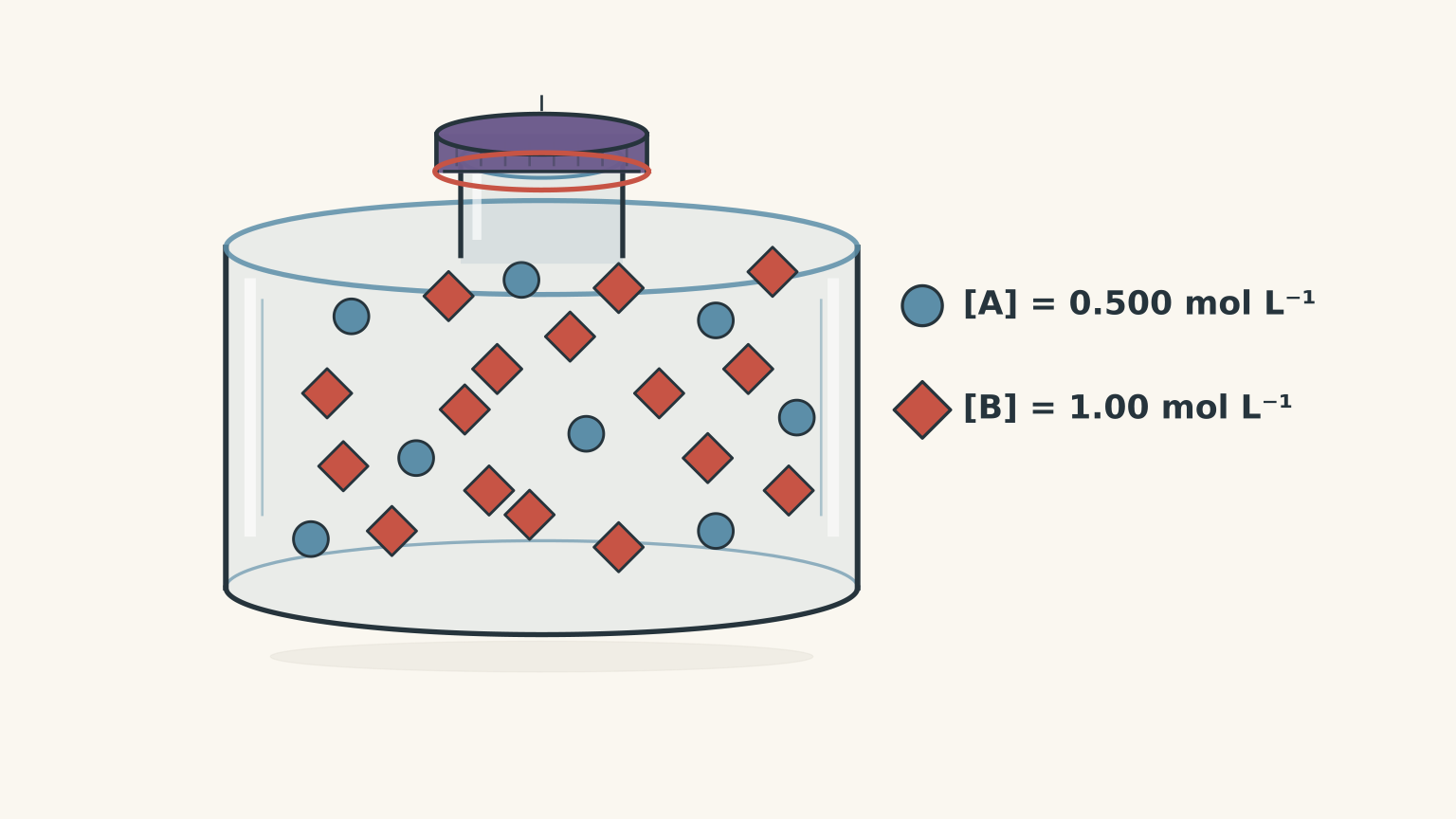
Due to technical limitations, this figure may display incorrectly or contain inaccuracies. Please check key details against your course materials.
Solution 5
The mixture is not at equilibrium. It will proceed towards the formation of more B, meaning the forward direction of the original reaction.
All three students can be reconciled once the reaction quotient and equilibrium constant are calculated using matching equation forms.
Step 1: Start with the original equation.
\[ \ce{A(g) <=> 2B(g)} \]
Its equilibrium expression is:
\[ K_c=\frac{[B]^2}{[A]} \]
The reaction quotient has the same mathematical expression, but uses the concentrations at the current moment rather than necessarily equilibrium concentrations:
\[ Q_c=\frac{[B]^2}{[A]} \]
Substitute the supplied concentrations:
\[ \begin{aligned} Q_c&=\frac{(1.00)^2}{0.500}\\ &=2.00\ \mathrm{mol\,L^{-1}} \end{aligned} \]
Compare this with the original equilibrium constant:
\[ Q_c=2.00<K_c=4.00 \]
Therefore, the reaction proceeds forwards to produce more B.
The mixture is not at equilibrium.
Step 2: Evaluate Student 1’s doubled equation.
The doubled equation is:
\[ \ce{2A(g) <=> 4B(g)} \]
The new equilibrium constant must be:
\[ K'_c=(K_c)^2 \]
Therefore:
\[ \begin{aligned} K'_c&=(4.00)^2\\ &=16.0\ (\mathrm{mol\,L^{-1}})^2 \end{aligned} \]
The reaction quotient must also be squared because its expression has the same doubled exponents:
\[ Q'_c=(Q_c)^2 \]
\[ \begin{aligned} Q'_c&=(2.00)^2\\ &=4.00\ (\mathrm{mol\,L^{-1}})^2 \end{aligned} \]
The correct comparison is:
\[ Q'_c=4.00<K'_c=16.0 \]
The reaction therefore proceeds forwards in the doubled equation as well.
Student 1 made a comparison error.
They compared the doubled reaction quotient with the original equilibrium constant. These quantities come from different expressions and have different concentration units.
The fact that both numbers happen to equal 4.00 does not make the mixture an equilibrium mixture.
Step 3: Evaluate Student 3’s reversed, doubled equation.
The reversed and doubled equation is:
\[ \ce{4B(g) <=> 2A(g)} \]
First, reverse the original equation’s equilibrium constant by taking its reciprocal.
Then square the result because the reversed equation has been doubled:
\[ K''_c=\left(\frac{1}{K_c}\right)^2 \]
Substitute:
\[ \begin{aligned} K''_c&=\left(\frac{1}{4.00}\right)^2\\ &=0.0625\ (\mathrm{mol\,L^{-1}})^{-2} \end{aligned} \]
The reaction quotient must undergo exactly the same transformations:
\[ Q''_c=\left(\frac{1}{Q_c}\right)^2 \]
\[ \begin{aligned} Q''_c&=\left(\frac{1}{2.00}\right)^2\\ &=0.250\ (\mathrm{mol\,L^{-1}})^{-2} \end{aligned} \]
Compare:
\[ Q''_c=0.250>K''_c=0.0625 \]
The reaction proceeds in the reverse direction of the equation Student 3 wrote.
But that reversed direction produces B.
It is therefore the same physical change predicted by the original equation.
Step 4: Reconcile the conclusions.
| Equation form | Reaction quotient | Equilibrium constant | Predicted direction |
|---|---|---|---|
| \(\ce{A <=> 2B}\) | \(2.00\) | \(4.00\) | Forwards |
| \(\ce{2A <=> 4B}\) | \(4.00\) | \(16.0\) | Forwards |
| \(\ce{4B <=> 2A}\) | \(0.250\) | \(0.0625\) | Reverse |
The three correctly matched comparisons all predict the same physical change.
The deeper lesson is that changing the way an equilibrium equation is written changes both \(Q\) and \(K\) in corresponding ways.
You must always compare a reaction quotient with the equilibrium constant belonging to the same balanced equation and temperature.
09What to remember for your HSC Chemistry exam
If an equilibrium equation is multiplied by two:
\[ \boxed{K_{\mathrm{new}}=(K_{\mathrm{original}})^2} \]
If it is multiplied by three:
\[ \boxed{K_{\mathrm{new}}=(K_{\mathrm{original}})^3} \]
If it is reversed:
\[ \boxed{K_{\mathrm{new}}=\frac{1}{K_{\mathrm{original}}}} \]
If it is reversed and multiplied by two:
\[ \boxed{K_{\mathrm{new}}=\frac{1}{(K_{\mathrm{original}})^2}} \]
Always check three things before accepting your answer:
- Equation: Have all coefficients been changed consistently?
- Temperature: Does the supplied equilibrium constant refer to the same temperature?
- Expression: Have you used the correct powers and excluded pure solids and liquids?
Once you understand why the coefficients become powers, these questions become much easier to manage.
The next useful step is learning how to use the reaction quotient \(Q\) alongside \(K_c\). That lets you determine not just the equilibrium constant, but also which direction a reaction will proceed when a mixture is not yet at equilibrium.