
How to Decide Reaction Direction When Q Is Smaller Than Keq
Learn why a reaction moves forwards when Q is smaller than Keq, how to construct the correct reaction quotient, and how to compare Q with Keq at the same temperature. Includes worked calculations, common misconceptions, and five progressively challenging HSC Chemistry questions with solutions.
A reaction mixture contains more product than either reactant. Does that mean the reaction must move backwards?
Not necessarily. Imagine an aqueous mixture containing iron(III) ions, thiocyanate ions, and the red complex ion \(\mathrm{FeSCN}^{2+}\). At 25°C, an analysis gives:
- \([\mathrm{Fe}^{3+}]=0.10\ \mathrm{mol\,L^{-1}}\)
- \([\mathrm{SCN}^{-}]=0.10\ \mathrm{mol\,L^{-1}}\)
- \([\mathrm{FeSCN}^{2+}]=0.20\ \mathrm{mol\,L^{-1}}\)
The product has the highest concentration. You might predict that the reaction will move backwards and produce more reactants.
But suppose \(K_c=50\ \mathrm{L\,mol^{-1}}\) at this temperature. The current reaction quotient is:
\[ Q_c=\frac{0.20}{0.10\times0.10} =20\ \mathrm{L\,mol^{-1}} \]
Since \(Q_c<K_c\), the net reaction moves forwards, producing more \(\mathrm{FeSCN}^{2+}\).
The important point is that reaction direction depends on the complete concentration expression, not on which substance has the highest concentration.
All numerical equilibrium constants and concentrations in this article are illustrative teaching data, not reported experimental measurements.
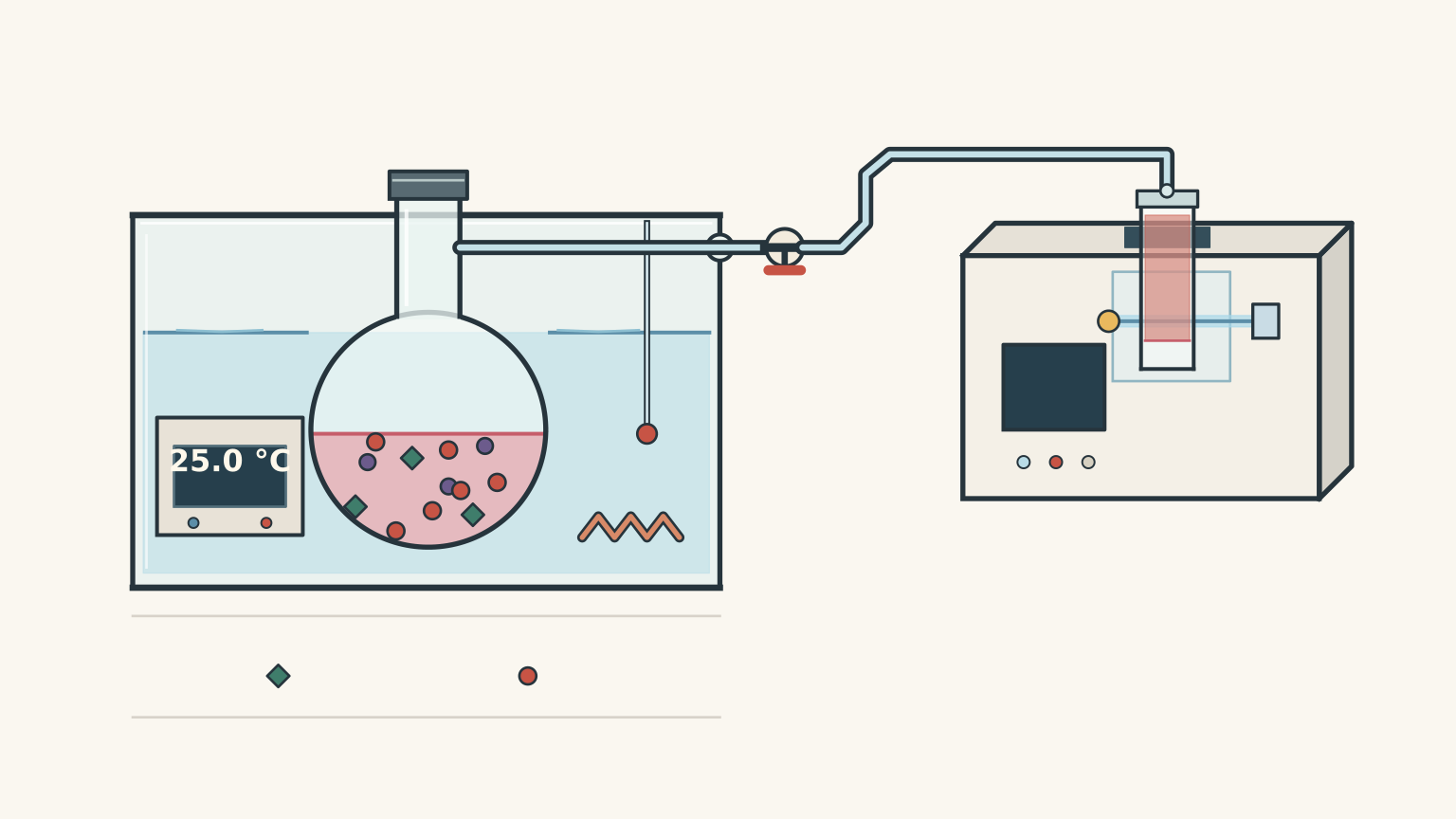
Due to technical limitations, this figure may display incorrectly or contain inaccuracies. Please check key details against your course materials.
01What does Q smaller than Keq actually mean?
The answer is straightforward:
\[ \boxed{Q_c<K_c\Rightarrow\text{net forward reaction}} \]
The reaction moves towards the products, consuming reactants and producing more products overall.
To understand why, you need to distinguish between two quantities.
- \(Q_c\), the reaction quotient, describes the concentrations present at a particular moment.
- \(K_c\), the equilibrium constant, describes the value of that same concentration expression when the reaction reaches equilibrium at a particular temperature.
Think of \(Q_c\) as the current measurement and \(K_c\) as the equilibrium benchmark.
When \(Q_c<K_c\), the current mixture has a smaller product-to-reactant ratio than the equilibrium mixture requires.
The forward reaction increases this ratio. Products form, reactants are consumed, and \(Q_c\) moves towards \(K_c\).
There are three possible comparisons:
| Comparison | Net reaction direction | What happens? |
|---|---|---|
| \(Q_c<K_c\) | Forward | More products form |
| \(Q_c>K_c\) | Reverse | More reactants form |
| \(Q_c=K_c\) | Neither direction overall | The system is at equilibrium |
At equilibrium, the forward and reverse reactions continue at equal rates. The reaction has not stopped.
This page focuses on the first case. For the broader three-way comparison, see Q vs Keq: How to Predict the Direction of Equilibrium.
02How to construct the correct reaction quotient
Before comparing \(Q_c\) with \(K_c\), you must write the correct expression.
Consider a general balanced reaction:
\[ \ce{aA + bB <=> cC + dD} \]
Its concentration reaction quotient is:
\[ Q_c=\frac{[C]^c[D]^d}{[A]^a[B]^b} \]
The expression follows the balanced chemical equation:
- Products go in the numerator.
- Reactants go in the denominator.
- Coefficients become powers.
- Pure solids and pure liquids are excluded.
The square brackets represent the current molar concentrations, measured in \(\mathrm{mol\,L^{-1}}\).
Why the coefficients matter
Consider:
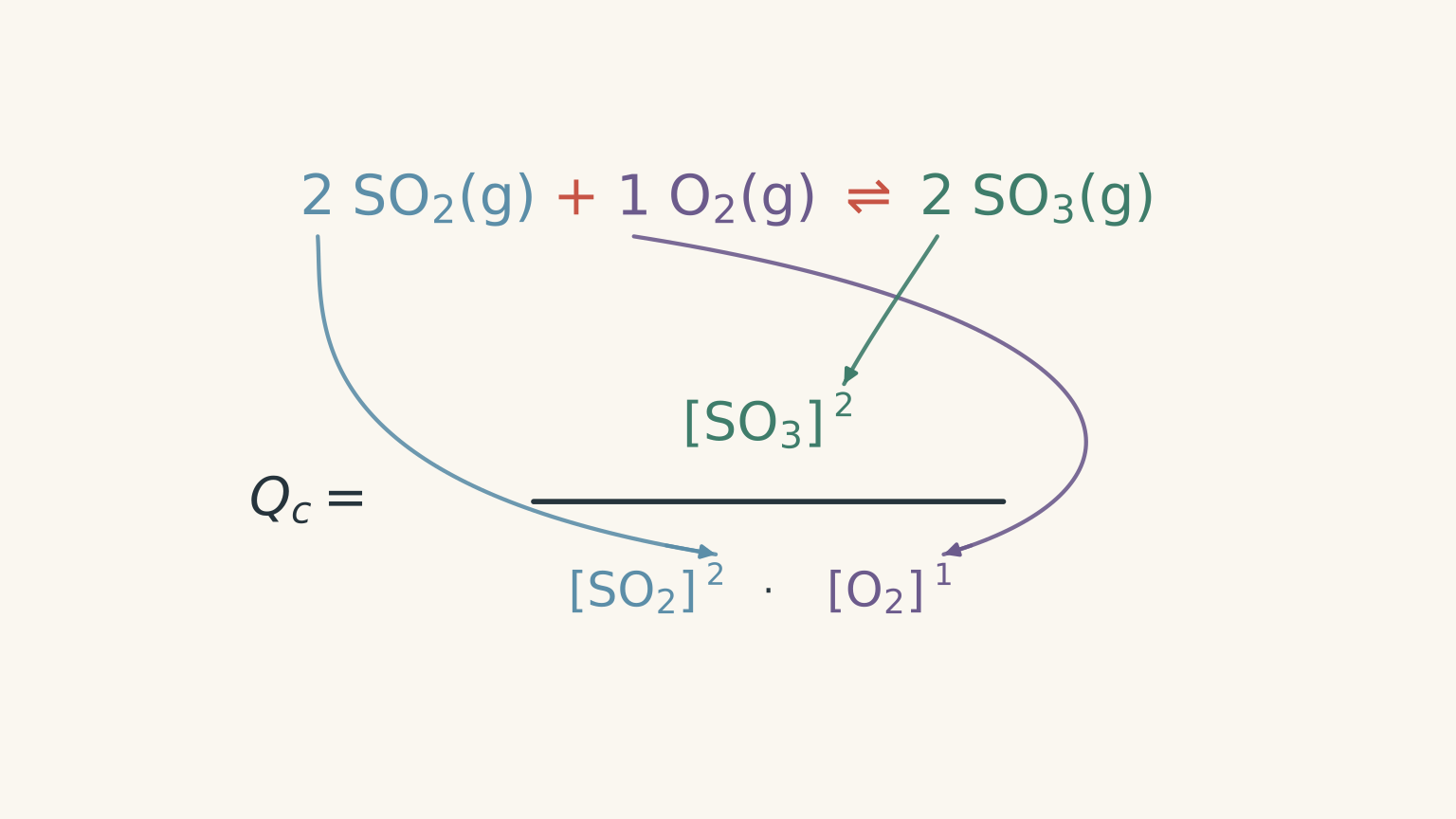
\[ \ce{2SO2(g) + O2(g) <=> 2SO3(g)} \]
The correct expression is:
\[ Q_c= \frac{[\ce{SO3}]^2} {[\ce{SO2}]^2[\ce{O2}]} \]
Notice that the coefficient of 2 becomes an exponent of 2.
You do not multiply the concentration by its coefficient. You raise the concentration to that power.
Due to technical limitations, this figure may display incorrectly or contain inaccuracies. Please check key details against your course materials.
Why some substances are excluded
Pure solids and pure liquids do not appear in the concentration equilibrium expression.
For example:
\[ \ce{CaCO3(s) <=> CaO(s) + CO2(g)} \]
The reaction quotient is simply:
\[ Q_c=[\ce{CO2}] \]
Neither solid appears in the expression.
This is important because including a solid’s concentration would give you an incorrect quotient.
Keep the reaction equation consistent
There is another detail worth remembering.
If you reverse a chemical equation, you must invert both its reaction quotient and its equilibrium constant.
For example:
\[ \ce{A <=> B} \]
has:
\[ Q_c=\frac{[B]}{[A]} \]
If you reverse it:
\[ \ce{B <=> A} \]
the new quotient becomes:
\[ Q_{c,\mathrm{rev}}=\frac{1}{Q_c} \]
The equilibrium constant also becomes:
\[ K_{c,\mathrm{rev}}=\frac{1}{K_c} \]
The physical mixture has not changed. Only the direction described as forwards has changed.
03Worked example: A product is more concentrated, but the reaction still moves forwards
Consider the equilibrium:
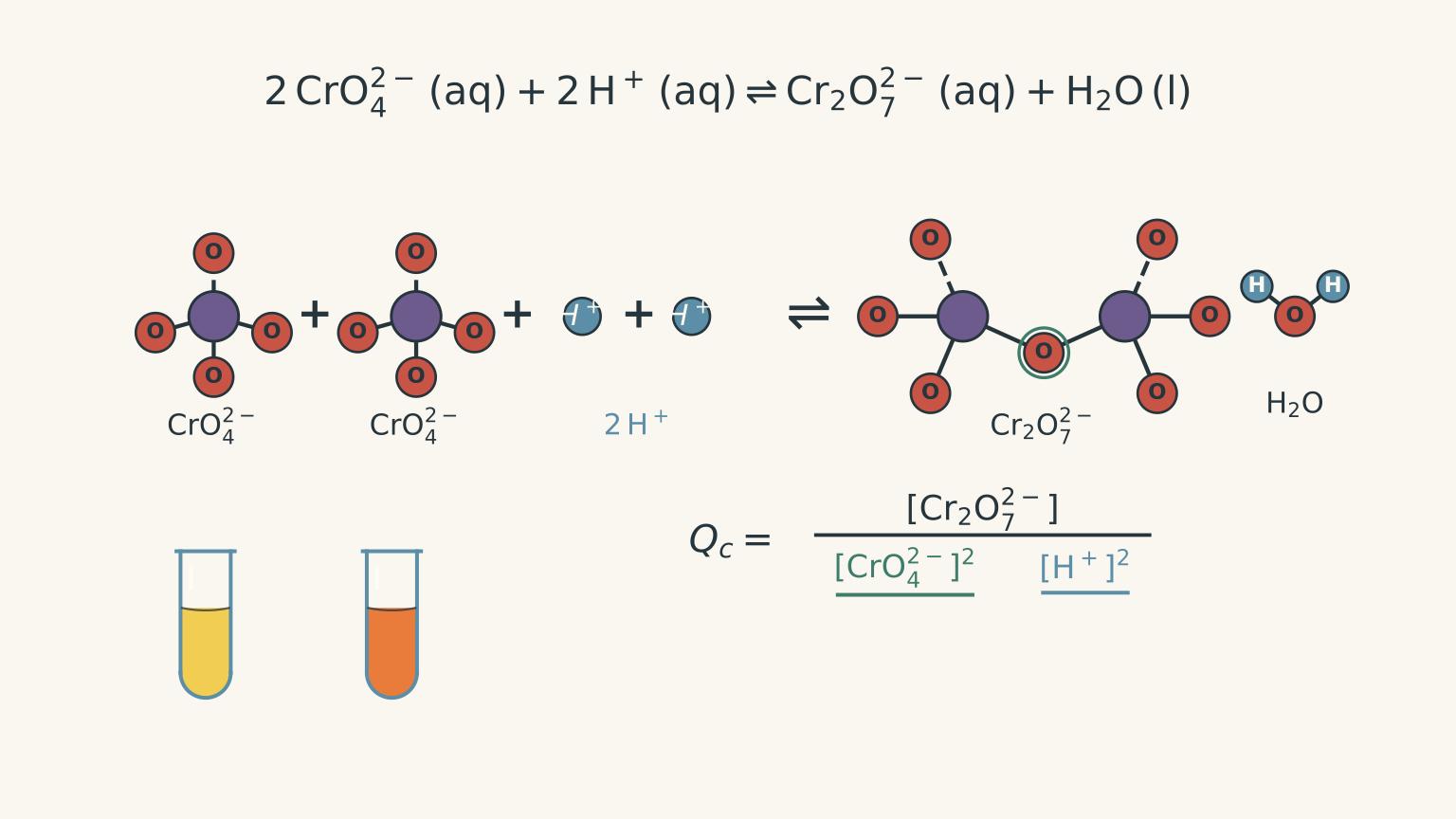
\[ \ce{2CrO4^2-(aq) + 2H+(aq) <=> Cr2O7^2-(aq) + H2O(l)} \]
At 25°C, suppose the equilibrium constant is:
\[ K_c=2.0\times10^3\ \mathrm{L^3\,mol^{-3}} \]
At a particular moment, the concentrations are:
| Species | Current concentration |
|---|---|
| \(\mathrm{CrO_{4}}^{2-}\) | \(0.10\ \mathrm{mol\,L^{-1}}\) |
| \(\mathrm{H}^{+}\) | \(0.20\ \mathrm{mol\,L^{-1}}\) |
| \(\mathrm{Cr_{2}O_{7}}^{2-}\) | \(0.40\ \mathrm{mol\,L^{-1}}\) |
Determine the reaction direction.
Step 1
The products go in the numerator, and the reactants go in the denominator.
The coefficient of 2 becomes an exponent of 2.
Pure liquid water is excluded.
\[ Q_c= \frac{[\mathrm{Cr_{2}O_{7}}^{2-}]} {[\mathrm{CrO_{4}}^{2-}]^2[\mathrm{H}^{+}]^2} \]
Step 2
\[ Q_c= \frac{0.40}{(0.10)^2(0.20)^2} \]
Calculate the denominator:
\[ (0.10)^2(0.20)^2=0.00040 \]
Therefore:
\[ Q_c=\frac{0.40}{0.00040} \]
\[ Q_c=1.0\times10^3\ \mathrm{L^3\,mol^{-3}} \]
Step 3
\[ Q_c=1.0\times10^3 \]
\[ K_c=2.0\times10^3 \]
Therefore:
\[ Q_c<K_c \]
Step 4
The net reaction moves forwards, towards dichromate ions.
The reaction consumes \(\mathrm{CrO_{4}}^{2-}\) and \(\mathrm{H}^{+}\), while producing more \(\mathrm{Cr_{2}O_{7}}^{2-}\).
Notice the interesting result: dichromate already has the highest concentration, but the reaction still moves forwards.
The squared concentrations in the denominator determine the result. Simply comparing the three concentrations would have led to the wrong prediction.
Due to technical limitations, this figure may display incorrectly or contain inaccuracies. Please check key details against your course materials.
04What the size of Q compared with Keq tells you
You might calculate a very small reaction quotient compared with the equilibrium constant and assume the reaction must undergo a massive change.
Be careful.
The comparison tells you the net reaction direction. It does not directly tell you:
- How much product will form.
- How much reactant will remain.
- How long the reaction will take.
- What percentage of the reactants will be consumed.
For example, suppose:
\[ Q_c=0.005 \]
and:
\[ K_c=0.50 \]
Then:
\[ \frac{Q_c}{K_c}=0.01 \]
The current quotient is 1% of its equilibrium value.
That does not mean the reaction is 1% complete, or that 99% of the reactants must be consumed.
Why not?
Because the quotient depends on several concentrations and their exponents. As the reaction proceeds, all those concentrations can change together.
To calculate the actual equilibrium concentrations, you need to use an ICE table and the equilibrium expression.
The reaction quotient alone cannot give you the amount of reaction progress.
Does a smaller Q mean a faster reaction?
No.
A small \(Q_c\) relative to \(K_c\) indicates a net forward reaction. It does not tell you how quickly that reaction occurs.
Reaction rate depends on kinetic factors, including concentrations, temperature, activation energy, and the reaction mechanism.
A mixture can have \(Q_c\ll K_c\) and still react relatively slowly.
05Temperature matters when comparing Q and Keq
This is one of the most important conditions in equilibrium calculations.
The equilibrium constant depends on temperature.
You must compare \(Q_c\) and \(K_c\) for the same reaction at the same temperature.
Consider what happens when the conditions change:
| Change | What happens to \(Q_c\)? | What happens to \(K_c\)? |
|---|---|---|
| Add reactant at constant temperature | Changes | Stays constant |
| Remove product at constant temperature | Changes | Stays constant |
| Change volume at constant temperature | May change | Stays constant |
| Change temperature | Recalculate using the current composition | Changes |
| Add a catalyst | No immediate change | Stays constant |
A particularly important situation occurs when temperature changes.
Imagine a mixture with \(Q_c=0.40\) at 400 K.
If the temperature increases to 500 K, you cannot automatically keep using the old equilibrium constant.
You must use the value of \(K_c\) at 500 K.
The reaction direction could even reverse if the new equilibrium constant is on the other side of the current quotient.
Also, keep the type of equilibrium expression consistent. Compare \(Q_c\) with \(K_c\), or \(Q_p\) with \(K_p\). Do not compare a concentration-based quotient with a pressure-based equilibrium constant.
06Worked example: What happens to Q when a gas mixture is compressed?
A change in volume can alter the reaction quotient before the reaction has time to respond.
Consider:
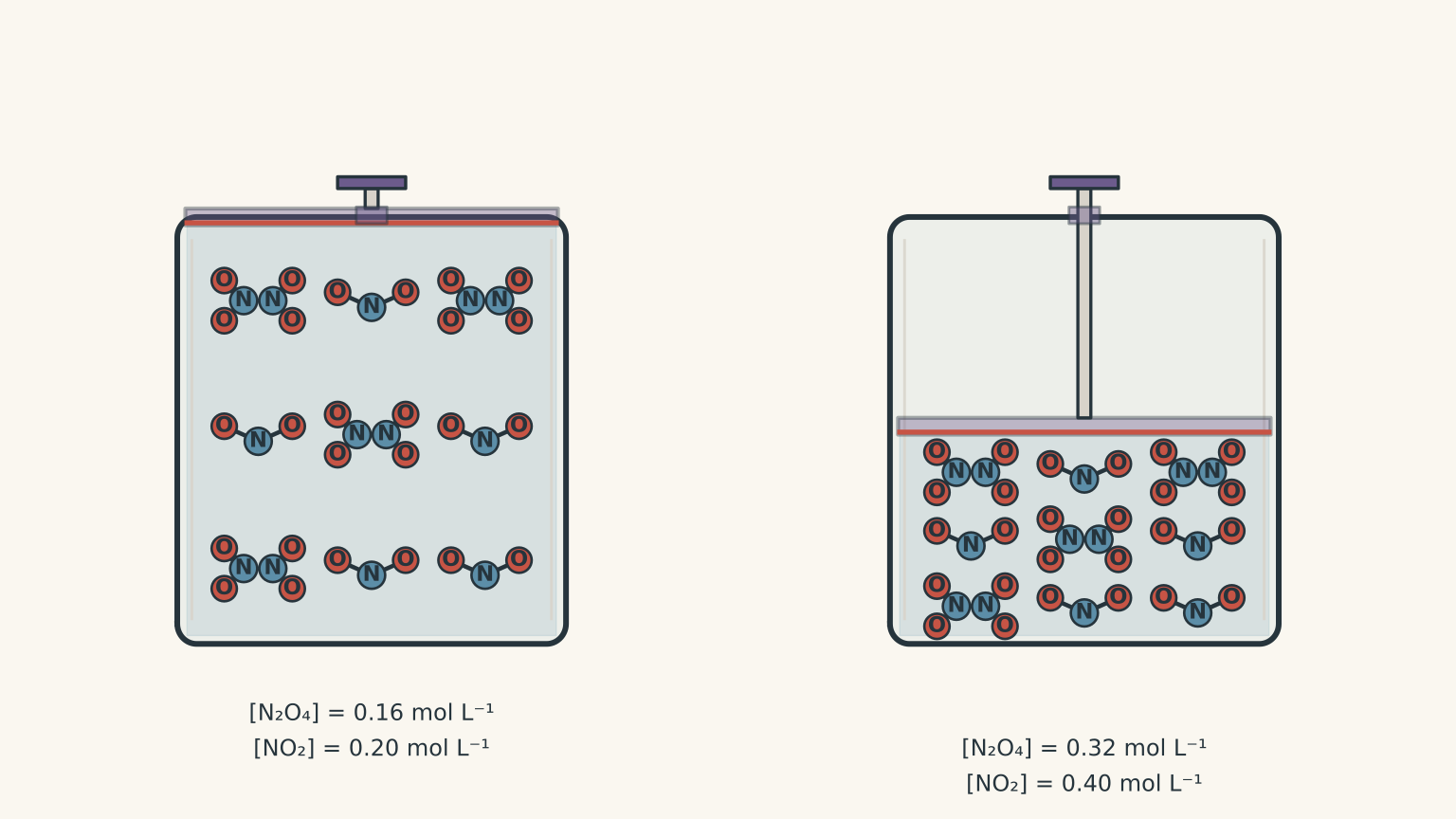
\[ \ce{N2O4(g) <=> 2NO2(g)} \]
At 350 K:
\[ K_c=0.25\ \mathrm{mol\,L^{-1}} \]
Initially, the mixture is at equilibrium:
\[ [\ce{N2O4}]=0.16\ \mathrm{mol\,L^{-1}} \]
\[ [\ce{NO2}]=0.20\ \mathrm{mol\,L^{-1}} \]
The vessel is then compressed to half its original volume, while the temperature remains constant.
Determine the net reaction direction immediately after compression.
Step 1
\[ Q_c=\frac{[\ce{NO2}]^2}{[\ce{N2O4}]} \]
Step 2
\[ Q_c=\frac{(0.20)^2}{0.16} \]
\[ Q_c=\frac{0.040}{0.16} =0.25\ \mathrm{mol\,L^{-1}} \]
This matches \(K_c\), so the initial mixture is at equilibrium.
Step 3
The volume has halved.
Before the reaction can respond, the number of moles of each gas remains unchanged. Therefore, both concentrations double.
\[ [\ce{N2O4}]=0.32\ \mathrm{mol\,L^{-1}} \]
\[ [\ce{NO2}]=0.40\ \mathrm{mol\,L^{-1}} \]
Step 4
\[ Q_c=\frac{(0.40)^2}{0.32} \]
\[ Q_c=\frac{0.160}{0.32} \]
\[ Q_c=0.50\ \mathrm{mol\,L^{-1}} \]
Step 5
\[ Q_c=0.50>K_c=0.25 \]
The net reaction moves backwards, towards \(\ce{N2O4}\).
More nitrogen dioxide is consumed, and more dinitrogen tetroxide forms.
Notice that \(K_c\) did not change. The temperature remained constant. Only the reaction quotient changed because the concentrations changed.
This is why you should recalculate Q after a volume change rather than automatically assuming its value stays the same.
Also, do not memorise a rule that compression always makes Q larger. The result depends on the stoichiometric powers in the expression.
Due to technical limitations, this figure may display incorrectly or contain inaccuracies. Please check key details against your course materials.
07A reliable method for exam questions
When a question asks you to determine the reaction direction, use this sequence.
- Write the balanced chemical equation.
- Construct the correct reaction quotient, including the appropriate exponents.
- Exclude pure solids and pure liquids.
- Substitute the current concentrations, not the original concentrations before a disturbance.
- Find the equilibrium constant for the same reaction at the same temperature.
- Compare Q with Keq.
- State the net reaction direction and identify which substances increase and decrease.
If \(Q<K_{\mathrm{eq}}\), the answer is forwards.
If \(Q>K_{\mathrm{eq}}\), the answer is backwards.
If \(Q=K_{\mathrm{eq}}\), there is no net shift.
The calculation is usually short. Getting the expression and conditions correct is where most of the thinking happens.
08Questions and solutions
The following questions build from a straightforward reaction quotient calculation to more demanding problems involving reaction coefficients, temperature changes, equilibrium concentrations, and changes in reaction direction.
All numerical equilibrium data are illustrative.
Question 1
Consider the equilibrium:
\[ \ce{H2(g) + Br2(g) <=> 2HBr(g)} \]
At 450 K, the equilibrium constant is \(K_c=16.0\).
At a particular instant, the concentrations are:
- \([\ce{H2}]=0.20\ \mathrm{mol\,L^{-1}}\)
- \([\ce{Br2}]=0.10\ \mathrm{mol\,L^{-1}}\)
- \([\ce{HBr}]=0.40\ \mathrm{mol\,L^{-1}}\)
Calculate \(Q_c\) and determine the net reaction direction.
Solution 1
The net reaction moves forwards, producing more hydrogen bromide.
Step 1: Write the reaction quotient.
\[ Q_c=\frac{[\ce{HBr}]^2} {[\ce{H2}][\ce{Br2}]} \]
Step 2: Substitute the current concentrations.
\[ Q_c=\frac{(0.40)^2}{(0.20)(0.10)} \]
\[ Q_c=\frac{0.16}{0.020} \]
\[ Q_c=8.0 \]
Step 3: Compare Q with K.
\[ Q_c=8.0<K_c=16.0 \]
Since the reaction quotient is smaller than the equilibrium constant, the net reaction proceeds forwards.
Hydrogen and bromine are consumed, while hydrogen bromide is produced.
Notice that the coefficient of 2 in front of HBr becomes an exponent of 2. Forgetting this would give you an incorrect quotient.
Question 2
Consider the equilibrium:
\[ \ce{2SO2(g) + O2(g) <=> 2SO3(g)} \]
At 700 K, suppose:
\[ K_c=60\ \mathrm{L\,mol^{-1}} \]
The current concentrations are:
- \([\ce{SO2}]=0.10\ \mathrm{mol\,L^{-1}}\)
- \([\ce{O2}]=0.050\ \mathrm{mol\,L^{-1}}\)
- \([\ce{SO3}]=0.20\ \mathrm{mol\,L^{-1}}\)
A student writes the reaction quotient as:
\[ Q_c=\frac{[\ce{SO3}]} {[\ce{SO2}][\ce{O2}]} \]
Calculate the correct reaction quotient, determine the net reaction direction, and explain why the student’s expression is incorrect.
Solution 2
The correct net reaction direction is backwards, towards sulfur dioxide and oxygen.
The student’s expression incorrectly omits the powers from the balanced equation.
Step 1: Construct the correct expression.
The balanced equation has a coefficient of 2 for both sulfur dioxide and sulfur trioxide.
Therefore:
\[ Q_c= \frac{[\ce{SO3}]^2} {[\ce{SO2}]^2[\ce{O2}]} \]
Step 2: Substitute the concentrations.
\[ Q_c= \frac{(0.20)^2} {(0.10)^2(0.050)} \]
\[ Q_c=\frac{0.040}{0.00050} \]
\[ Q_c=80\ \mathrm{L\,mol^{-1}} \]
Step 3: Compare with the equilibrium constant.
\[ Q_c=80>K_c=60 \]
The net reaction moves backwards.
More sulfur dioxide and oxygen form, while sulfur trioxide is consumed.
Step 4: Examine the student’s mistake.
Using the incorrect expression would give:
\[ Q_c=\frac{0.20}{0.10\times0.050} \]
\[ Q_c=40\ \mathrm{L\,mol^{-1}} \]
This would incorrectly suggest:
\[ Q_c<K_c \]
The student would predict the opposite reaction direction.
This is particularly dangerous in an exam because an incorrect expression can sometimes produce a believable numerical answer. Always construct the expression from the balanced equation before substituting values.
Question 3
Consider the equilibrium:
\[ \ce{PCl5(g) <=> PCl3(g) + Cl2(g)} \]
The equilibrium constants are:
| Temperature | \(K_c\) |
|---|---|
| 400 K | \(0.20\ \mathrm{mol\,L^{-1}}\) |
| 600 K | \(5.0\ \mathrm{mol\,L^{-1}}\) |
A mixture is currently at 400 K, with:
- \([\ce{PCl5}]=0.20\ \mathrm{mol\,L^{-1}}\)
- \([\ce{PCl3}]=0.30\ \mathrm{mol\,L^{-1}}\)
- \([\ce{Cl2}]=0.30\ \mathrm{mol\,L^{-1}}\)
A student calculates Q correctly but compares it with the equilibrium constant at 600 K.
Explain why this is incorrect, calculate the correct reaction direction, and identify the mistake in the student’s prediction.
Solution 3
The net reaction moves backwards, producing more phosphorus pentachloride.
The student uses the wrong equilibrium constant because the mixture is at 400 K, not 600 K.
Step 1: Write the reaction quotient.
\[ Q_c= \frac{[\ce{PCl3}][\ce{Cl2}]} {[\ce{PCl5}]} \]
Step 2: Substitute the concentrations.
\[ Q_c=\frac{(0.30)(0.30)}{0.20} \]
\[ Q_c=\frac{0.090}{0.20} \]
\[ Q_c=0.45\ \mathrm{mol\,L^{-1}} \]
Step 3: Select the equilibrium constant at the correct temperature.
The mixture is at 400 K, so:
\[ K_c=0.20\ \mathrm{mol\,L^{-1}} \]
Therefore:
\[ Q_c=0.45>K_c=0.20 \]
The net reaction moves backwards, towards \(\ce{PCl5}\).
Step 4: Explain the student’s mistake.
The student compares \(Q_c\) with \(K_c\) at 600 K:
\[ 0.45<5.0 \]
This would suggest a forward reaction, but it is not a valid comparison.
The equilibrium constant changes with temperature. A reaction quotient calculated for a mixture at 400 K must be compared with the equilibrium constant at 400 K.
The two values must describe the same reaction under the same temperature conditions.
Question 4
Consider a simple aqueous equilibrium:
\[ \ce{A(aq) <=> B(aq)} \]
At 25°C:
\[ K_c=0.20 \]
The initial concentrations are:
\[ [\ce{A}]=0.500\ \mathrm{mol\,L^{-1}} \]
\[ [\ce{B}]=0.0010\ \mathrm{mol\,L^{-1}} \]
Assume a closed solution at constant volume, with no other reactions occurring.
A student calculates that \(Q_c/K_c=0.010\) and concludes that only 1% of the initial reactant concentration will be consumed before equilibrium is reached.
(a) Calculate \(Q_c\) and determine the reaction direction.
(b) Calculate the equilibrium concentrations of A and B.
(c) Determine the percentage of the initial A concentration consumed. Explain why the student’s original conclusion is incorrect.
Solution 4
The reaction moves forwards, but the percentage of A consumed is 16.5%, not 1%.
The ratio \(Q_c/K_c\) does not represent the percentage of reaction progress.
Part (a): Calculate Q and determine direction.
The reaction quotient is:
\[ Q_c=\frac{[\ce{B}]}{[\ce{A}]} \]
Substitute the initial concentrations:
\[ Q_c=\frac{0.0010}{0.500} \]
\[ Q_c=0.0020 \]
Compare with \(K_c\):
\[ 0.0020<0.20 \]
Therefore, the reaction moves forwards.
Part (b): Calculate the equilibrium concentrations.
Let \(x\) represent the concentration of A converted into B.
Because the reaction has a 1:1 ratio, A decreases by \(x\), and B increases by \(x\).
The ICE table is:
| A | B | |
|---|---|---|
| Initial (M) | 0.500 | 0.0010 |
| Change (M) | \(-x\) | \(+x\) |
| Equilibrium (M) | \(0.500-x\) | \(0.0010+x\) |
At equilibrium:
\[ K_c=\frac{[\ce{B}]_{\mathrm{eq}}} {[\ce{A}]_{\mathrm{eq}}} \]
Substitute the equilibrium concentrations:
\[ 0.20=\frac{0.0010+x}{0.500-x} \]
Rearrange:
\[ 0.20(0.500-x)=0.0010+x \]
\[ 0.100-0.20x=0.0010+x \]
\[ 0.099=1.20x \]
\[ x=0.0825\ \mathrm{mol\,L^{-1}} \]
Now calculate both equilibrium concentrations.
For A:
\[ [\ce{A}]_{\mathrm{eq}}=0.500-0.0825 \]
\[ [\ce{A}]_{\mathrm{eq}}=0.4175\ \mathrm{mol\,L^{-1}} \]
For B:
\[ [\ce{B}]_{\mathrm{eq}}=0.0010+0.0825 \]
\[ [\ce{B}]_{\mathrm{eq}}=0.0835\ \mathrm{mol\,L^{-1}} \]
These values satisfy the equilibrium constant:
\[ K_c=\frac{0.0835}{0.4175}=0.20 \]
Part (c): Calculate the percentage of A consumed.
The initial concentration of A was \(0.500\ \mathrm{mol\,L^{-1}}\).
The concentration consumed was \(0.0825\ \mathrm{mol\,L^{-1}}\).
\[ \%\text{ consumed} = \frac{0.0825}{0.500}\times100 \]
\[ =16.5\% \]
The student incorrectly treated \(Q_c/K_c=0.010\) as a measure of percentage conversion.
In reality, it only describes the ratio between the current quotient and its equilibrium value.
The actual concentration change must be calculated using the equilibrium expression and the stoichiometric relationships.
Question 5
A sealed vessel contains a mixture of nitrogen, hydrogen, and ammonia at equilibrium:
\[ \ce{N2(g) + 3H2(g) <=> 2NH3(g)} \]
At 400 K, the equilibrium constant for the reaction as written is:
\[ K_c=0.80\ \mathrm{L^2\,mol^{-2}} \]
The following sequence occurs:
- The vessel is compressed to half its original volume while remaining at 400 K.
- The mixture is allowed to reach equilibrium again.
- The vessel is heated to 500 K while its volume remains constant.
At 500 K, the equilibrium constant for the original equation is:
\[ K_c=0.20\ \mathrm{L^2\,mol^{-2}} \]
A student argues:
“The compression makes the forward reaction occur. Therefore, the reaction should continue moving forwards after the temperature increase. Also, if I reverse the equation, the reaction direction should be unchanged.”
Determine the net reaction direction immediately after compression and immediately after heating.
Then rewrite the comparison using the reversed equation:
\[ \ce{2NH3(g) <=> N2(g) + 3H2(g)} \]
Explain why the student’s reasoning is incorrect.
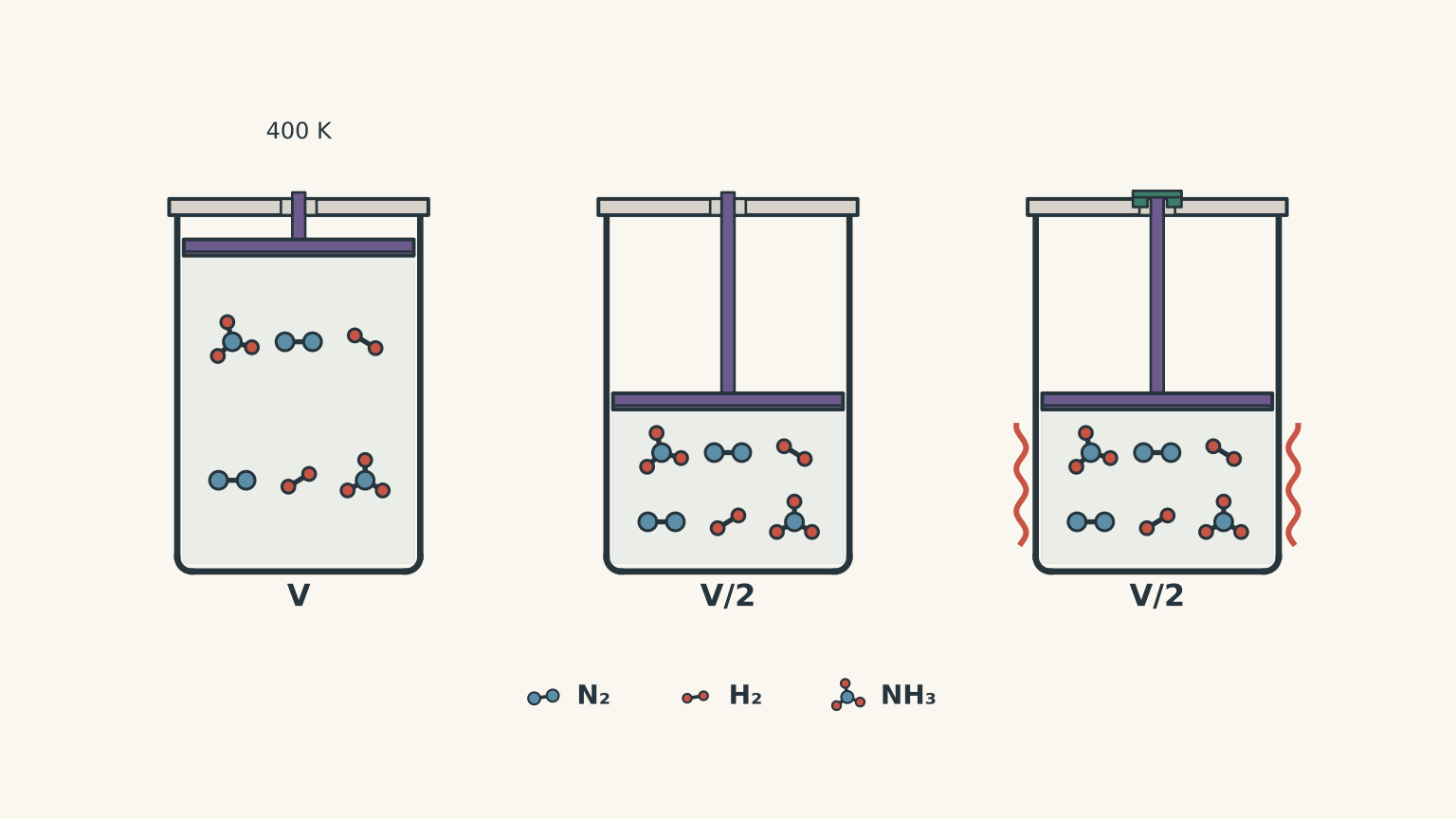
Due to technical limitations, this figure may display incorrectly or contain inaccuracies. Please check key details against your course materials.
Solution 5
The reaction initially moves forwards after compression, but moves backwards after heating.
The student’s mistake is assuming that the direction caused by one disturbance must continue after another disturbance. Each change requires a fresh comparison of Q with the appropriate K.
Part (a): Determine the direction immediately after compression.
Before compression, the mixture is at equilibrium at 400 K.
Therefore:
\[ Q_c=K_c=0.80\ \mathrm{L^2\,mol^{-2}} \]
The reaction quotient is:
\[ Q_c= \frac{[\ce{NH3}]^2} {[\ce{N2}][\ce{H2}]^3} \]
When the volume is halved, all gas concentrations double immediately, before the reaction has time to respond.
Therefore:
\[ [\ce{NH3}]'=2[\ce{NH3}] \]
\[ [\ce{N2}]'=2[\ce{N2}] \]
\[ [\ce{H2}]'=2[\ce{H2}] \]
Substitute these changes into the reaction quotient:
\[ Q_c'= \frac{(2[\ce{NH3}])^2} {(2[\ce{N2}])(2[\ce{H2}])^3} \]
Simplifying:
\[ Q_c'=\frac{4}{16}Q_c \]
\[ Q_c'=\frac14(0.80) \]
\[ Q_c'=0.20\ \mathrm{L^2\,mol^{-2}} \]
Compare with the unchanged equilibrium constant at 400 K:
\[ Q_c'=0.20<K_c=0.80 \]
Therefore, the net reaction moves forwards.
More ammonia forms, consuming nitrogen and hydrogen.
Part (b): Determine what happens after the mixture reaches equilibrium again.
The system is allowed to reach equilibrium at 400 K.
Therefore, its reaction quotient returns to:
\[ Q_c=K_c=0.80\ \mathrm{L^2\,mol^{-2}} \]
This is the starting point for the temperature change.
Part (c): Determine the direction immediately after heating.
The vessel is heated to 500 K while its volume remains constant.
Before the reaction has time to respond, the concentrations remain unchanged.
Therefore, the numerical value of the reaction quotient is still:
\[ Q_c=0.80\ \mathrm{L^2\,mol^{-2}} \]
However, the equilibrium constant has changed:
\[ K_c=0.20\ \mathrm{L^2\,mol^{-2}} \]
Now compare:
\[ Q_c=0.80>K_c=0.20 \]
The net reaction moves backwards.
More nitrogen and hydrogen form, while ammonia is consumed.
The direction has reversed compared with the immediate response to compression.
Part (d): Repeat the comparison using the reversed equation.
The reversed reaction is:
\[ \ce{2NH3(g) <=> N2(g) + 3H2(g)} \]
Reversing the equation inverts the reaction quotient:
\[ Q_{c,\mathrm{rev}}=\frac{1}{Q_c} \]
It also inverts the equilibrium constant:
\[ K_{c,\mathrm{rev}}=\frac{1}{K_c} \]
At 500 K:
\[ Q_{c,\mathrm{rev}}=\frac{1}{0.80} \]
\[ Q_{c,\mathrm{rev}}=1.25\ \mathrm{mol^2\,L^{-2}} \]
The reversed equilibrium constant is:
\[ K_{c,\mathrm{rev}}=\frac{1}{0.20} \]
\[ K_{c,\mathrm{rev}}=5.0\ \mathrm{mol^2\,L^{-2}} \]
Compare:
\[ Q_{c,\mathrm{rev}}=1.25<K_{c,\mathrm{rev}}=5.0 \]
Therefore, the reaction moves forwards when written in the reversed orientation.
That means:
\[ \ce{2NH3(g) -> N2(g) + 3H2(g)} \]
This is exactly the same physical direction as the backwards reaction in the original equation.
The student’s second mistake was assuming that reversing a chemical equation leaves the meaning of forwards and backwards unchanged.
It does not. The physical change is the same, but the labels depend on how the equation is written.
The key lesson is that every disturbance needs a fresh calculation or comparison. Compression changes Q, temperature changes K, and reversing the equation inverts both.
09What to learn next
Once you can determine the reaction direction, the next challenge is calculating how far the reaction proceeds.
That requires an ICE table, where you track the changes in reactant and product concentrations until the equilibrium expression equals \(K_c\).
You should also be comfortable calculating the concentrations immediately after mixing solutions, before using them to calculate Q.
For that specific situation, continue with How to Calculate Q Immediately After Two Solutions Are Mixed.
The distinction is important: comparing Q with Keq tells you which way the reaction moves. Solving the equilibrium expression tells you where it eventually ends up.