
How to Find Keq for the Reverse of a Reaction | HSC Chemistry
Learn how to calculate the equilibrium constant for a reversed reaction using the reciprocal rule. Includes worked examples covering equilibrium expressions, solids, changing coefficients, and temperature effects.
A sealed vessel contains an equilibrium mixture of dinitrogen tetroxide and nitrogen dioxide at 298 K. For the reaction
\[ \ce{N2O4(g) <=> 2NO2(g)} \]
a student calculates \(K_c=0.040\).
The next question writes the same reaction backwards:
\[ \ce{2NO2(g) <=> N2O4(g)} \]
What is the new equilibrium constant? Do you keep 0.040, change it to −0.040, or calculate something else?
The answer is the reciprocal:
\[ \boxed{K_{c,\mathrm{reverse}}=\frac{1}{K_{c,\mathrm{forward}}}=25} \]
This rule applies provided both equilibrium constants refer to the same temperature.
The important detail is that reversing a chemical equation changes its equilibrium expression. It does not change the physical equilibrium mixture.
01Why does reversing a reaction invert Keq?
An equilibrium constant describes a particular ratio of product and reactant concentrations for the balanced equation as written.
Consider the general reversible reaction:
\[ aA+bB\rightleftharpoons cC+dD \]
Its forward equilibrium expression is:
\[ K_{c,\mathrm{forward}} = \frac{[C]^c[D]^d}{[A]^a[B]^b} \]
Products go in the numerator, reactants go in the denominator, and the coefficients become powers.
Now reverse the equation:
\[ cC+dD\rightleftharpoons aA+bB \]
The new products and reactants have swapped positions. Therefore:
\[ K_{c,\mathrm{reverse}} = \frac{[A]^a[B]^b}{[C]^c[D]^d} \]
Compare this with the original expression. The numerator and denominator have simply swapped.
Therefore:
\[ \boxed{K_{c,\mathrm{reverse}}=\frac{1}{K_{c,\mathrm{forward}}}} \]
There is no extra negative sign. An equilibrium constant is a positive ratio, not a signed quantity.
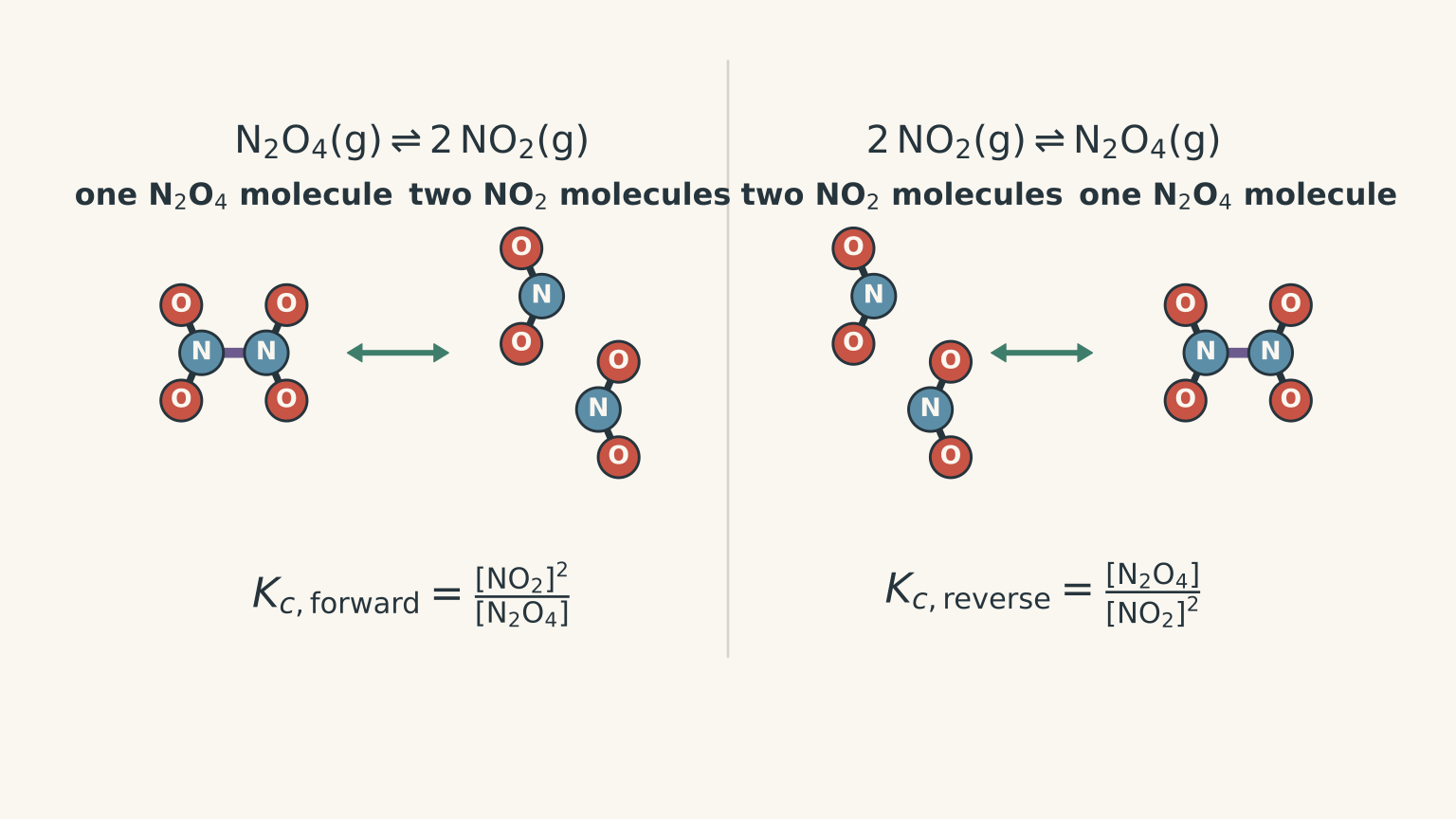
Due to technical limitations, this figure may display incorrectly or contain inaccuracies. Please check key details against your course materials.
Why the same equilibrium mixture gives two different constants
This is the part that can feel strange at first.
Imagine measuring the concentrations in an equilibrium mixture. You obtain exactly the same results whether you describe the reaction forwards or backwards.
You do not need to change the concentrations or run another experiment.
What changes is the mathematical expression used to describe the mixture.
For the nitrogen dioxide equilibrium:
Forward reaction:
\[ \ce{N2O4(g) <=> 2NO2(g)} \]
\[ K_{c,\mathrm{forward}} = \frac{[\ce{NO2}]^2}{[\ce{N2O4}]} \]
Reverse reaction:
\[ \ce{2NO2(g) <=> N2O4(g)} \]
\[ K_{c,\mathrm{reverse}} = \frac{[\ce{N2O4}]}{[\ce{NO2}]^2} \]
The concentrations are identical in both expressions. Only their positions have changed.
This is why the constants are reciprocals.
02Worked example: Finding the reverse constant from experimental data
Consider how an experiment could establish the concentrations needed to calculate the reverse equilibrium constant.
A possible experimental setup uses a sealed optical cell containing a mixture of \(\ce{N2O4}\) and \(\ce{NO2}\). The cell sits inside a temperature-controlled bath at 298 K.
A light source sends a beam through the cell towards a detector. Nitrogen dioxide absorbs visible light, while dinitrogen tetroxide is colourless. A calibrated optical measurement can therefore be used to determine the equilibrium concentration of \(\ce{NO2}\).
Simply judging the brown colour by eye would not provide sufficiently reliable concentration measurements. Lighting conditions and the distance travelled by the light would affect the apparent colour.
Using a fixed optical path and a calibration measurement provides a more useful numerical result.
The detector does not measure \(K_c\) directly. It provides information about the equilibrium concentration of \(\ce{NO2}\). The remaining concentration can then be calculated using conservation of atoms and the balanced equation.
Worked example: Calculate Keq for the reverse nitrogen dioxide reaction
A sealed vessel initially contains \(0.060\ \mathrm{mol\,L^{-1}}\) of \(\ce{N2O4}\) and no \(\ce{NO2}\).
The vessel is maintained at 298 K until equilibrium is established. An optical measurement determines that:
\[ [\ce{NO2}]_{\mathrm{eq}} =0.040\ \mathrm{mol\,L^{-1}} \]
Calculate \(K_c\) for the reverse reaction:
\[ \ce{2NO2(g) <=> N2O4(g)} \]
Step 1
The original forward reaction is:
\[ \ce{N2O4(g) <=> 2NO2(g)} \]
For every mole of \(\ce{N2O4}\) that decomposes, two moles of \(\ce{NO2}\) form.
Let \(x\) represent the concentration of \(\ce{N2O4}\) consumed.
| Species | Initial (M) | Change (M) | Equilibrium (M) |
|---|---|---|---|
| \(\ce{N2O4}\) | 0.060 | \(-x\) | \(0.060-x\) |
| \(\ce{NO2}\) | 0.000 | \(+2x\) | \(2x\) |
Step 2
We know:
\[ 2x=0.040 \]
Therefore:
\[ x=0.020 \]
The equilibrium concentration of \(\ce{N2O4}\) is:
\[ [\ce{N2O4}]_{\mathrm{eq}} =0.060-0.020 \]
\[ =0.040\ \mathrm{mol\,L^{-1}} \]
We now have both equilibrium concentrations.
Step 3
The reaction we need is:
\[ \ce{2NO2(g) <=> N2O4(g)} \]
The product is \(\ce{N2O4}\), so it belongs in the numerator.
The reactant is \(\ce{NO2}\), with a coefficient of 2, so its concentration is squared.
\[ K_{c,\mathrm{reverse}} = \frac{[\ce{N2O4}]}{[\ce{NO2}]^2} \]
Step 4
\[ K_{c,\mathrm{reverse}} = \frac{0.040}{(0.040)^2} \]
\[ =\frac{0.040}{0.0016} \]
\[ \boxed{K_{c,\mathrm{reverse}}=25} \]
If formal concentration units are required, the reverse expression has units of \(\mathrm{L\,mol^{-1}}\).
Step 5
For the forward reaction:
\[ K_{c,\mathrm{forward}} = \frac{(0.040)^2}{0.040} =0.040 \]
Taking the reciprocal:
\[ \frac{1}{0.040}=25 \]
Both methods give the same answer.
The experiment has produced one equilibrium mixture, but the two possible ways of writing its reaction give reciprocal equilibrium constants.
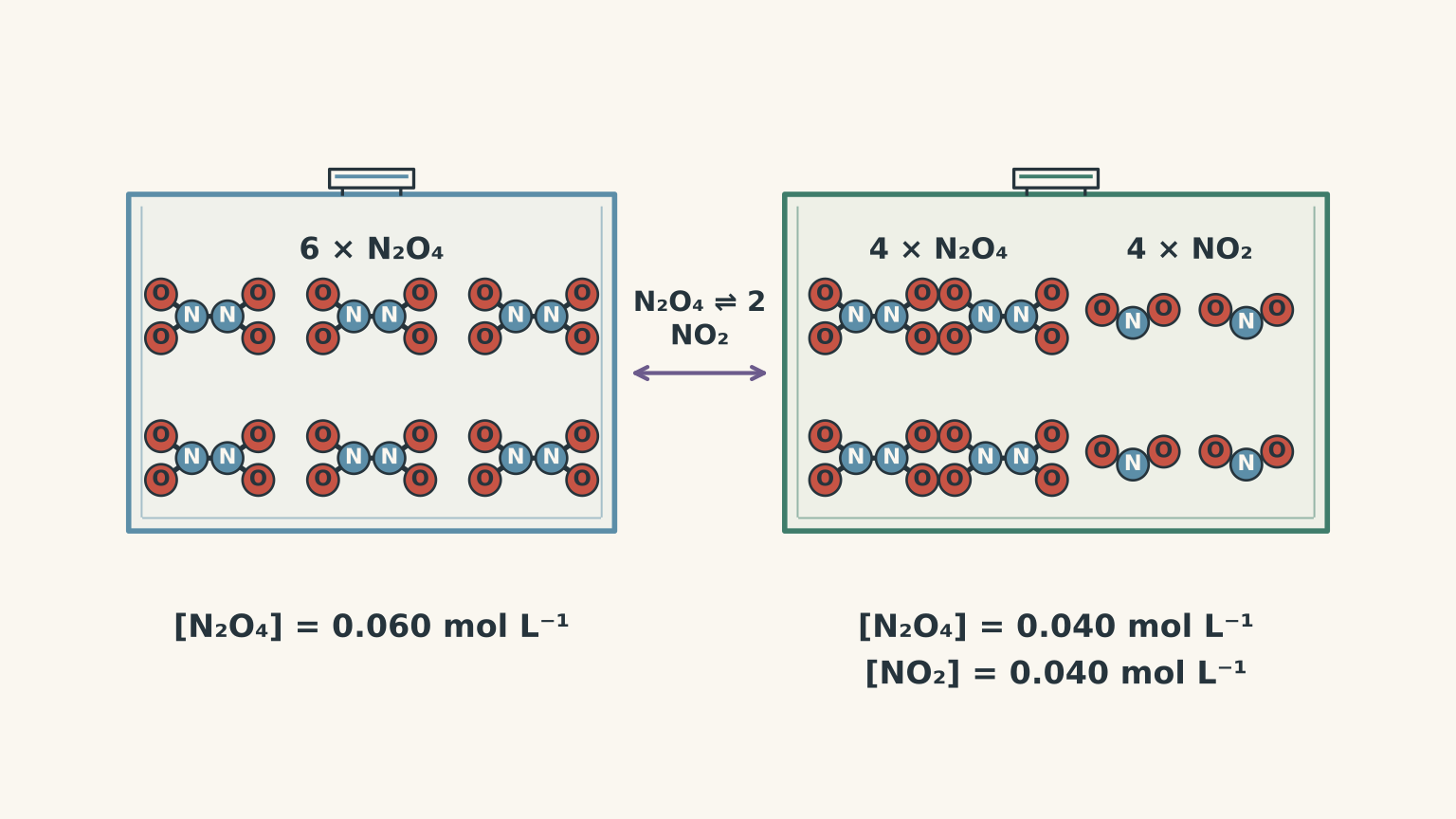
Due to technical limitations, this figure may display incorrectly or contain inaccuracies. Please check key details against your course materials.
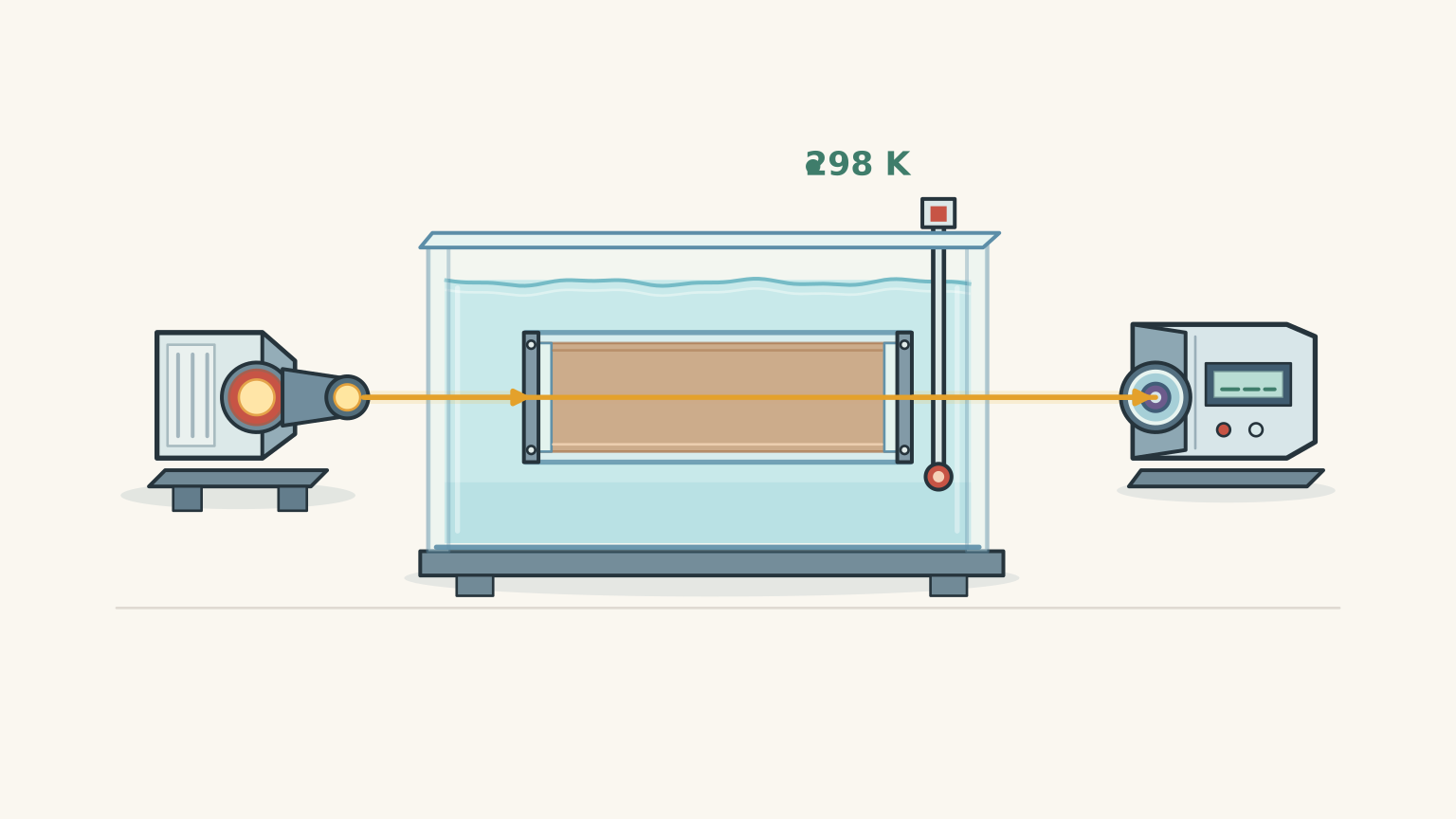
Due to technical limitations, this figure may display incorrectly or contain inaccuracies. Please check key details against your course materials.
03A second complication: What if the reaction contains solids?
Pure solids and pure liquids are excluded from equilibrium expressions.
This rule still applies when you reverse the equation.
Worked example: Reverse a heterogeneous equilibrium
At 850°C, the decomposition reaction
\[ \ce{CaCO3(s) <=> CaO(s) + CO2(g)} \]
has an equilibrium constant of:
\[ K_{c,\mathrm{forward}}=0.30 \]
Determine \(K_c\) for the reverse reaction:
\[ \ce{CaO(s) + CO2(g) <=> CaCO3(s)} \]
Assume both pure solids are present at equilibrium.
Step 1
The forward reaction produces solid calcium oxide and gaseous carbon dioxide.
Pure solids are excluded, so:
\[ K_{c,\mathrm{forward}}=[\ce{CO2}] \]
Step 2
The reverse reaction produces solid calcium carbonate.
Again, pure solids are excluded.
Therefore:
\[ K_{c,\mathrm{reverse}} = \frac{1}{[\ce{CO2}]} \]
Notice that the solid calcium carbonate does not appear in the numerator.
Step 3
\[ K_{c,\mathrm{reverse}} = \frac{1}{0.30} \]
\[ \boxed{K_{c,\mathrm{reverse}}=3.33} \]
The reverse equilibrium constant is approximately \(3.3\).
Its formal concentration unit is \(\mathrm{L\,mol^{-1}}\).
The common mistake here is to include the solid concentrations when reversing the reaction.
Reversing an equation does not change the rules for constructing its equilibrium expression. Pure solids and liquids remain excluded.
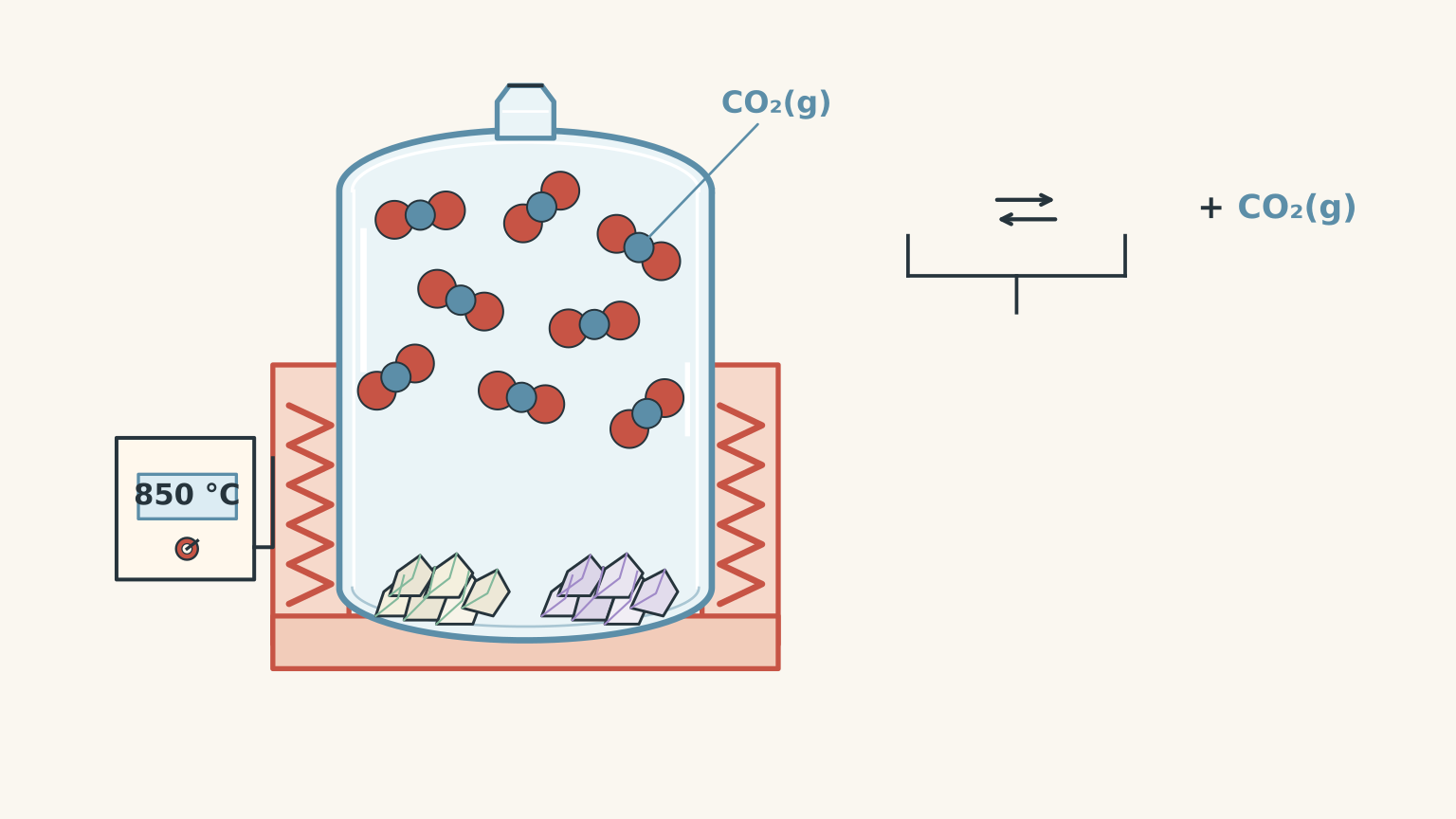
Due to technical limitations, this figure may display incorrectly or contain inaccuracies. Please check key details against your course materials.
04The temperature condition you cannot ignore
There is one important restriction on the reciprocal rule:
The forward and reverse equilibrium constants must refer to the same temperature.
An equilibrium constant is temperature-dependent.
Suppose the forward nitrogen dioxide reaction has the following illustrative values:
| Temperature | \(K_{c,\mathrm{forward}}\) | \(K_{c,\mathrm{reverse}}\) |
|---|---|---|
| 298 K | 0.040 | 25 |
| 400 K | 0.10 | 10 |
These values are illustrative, not experimental reference data.
Notice that the reciprocal relationship holds in each row:
At 298 K:
\[ K_{c,\mathrm{reverse}}=\frac{1}{0.040}=25 \]
At 400 K:
\[ K_{c,\mathrm{reverse}}=\frac{1}{0.10}=10 \]
You cannot use the forward constant at 298 K to calculate the reverse constant at 400 K.
The reciprocal must be taken using the forward constant at the temperature being considered.
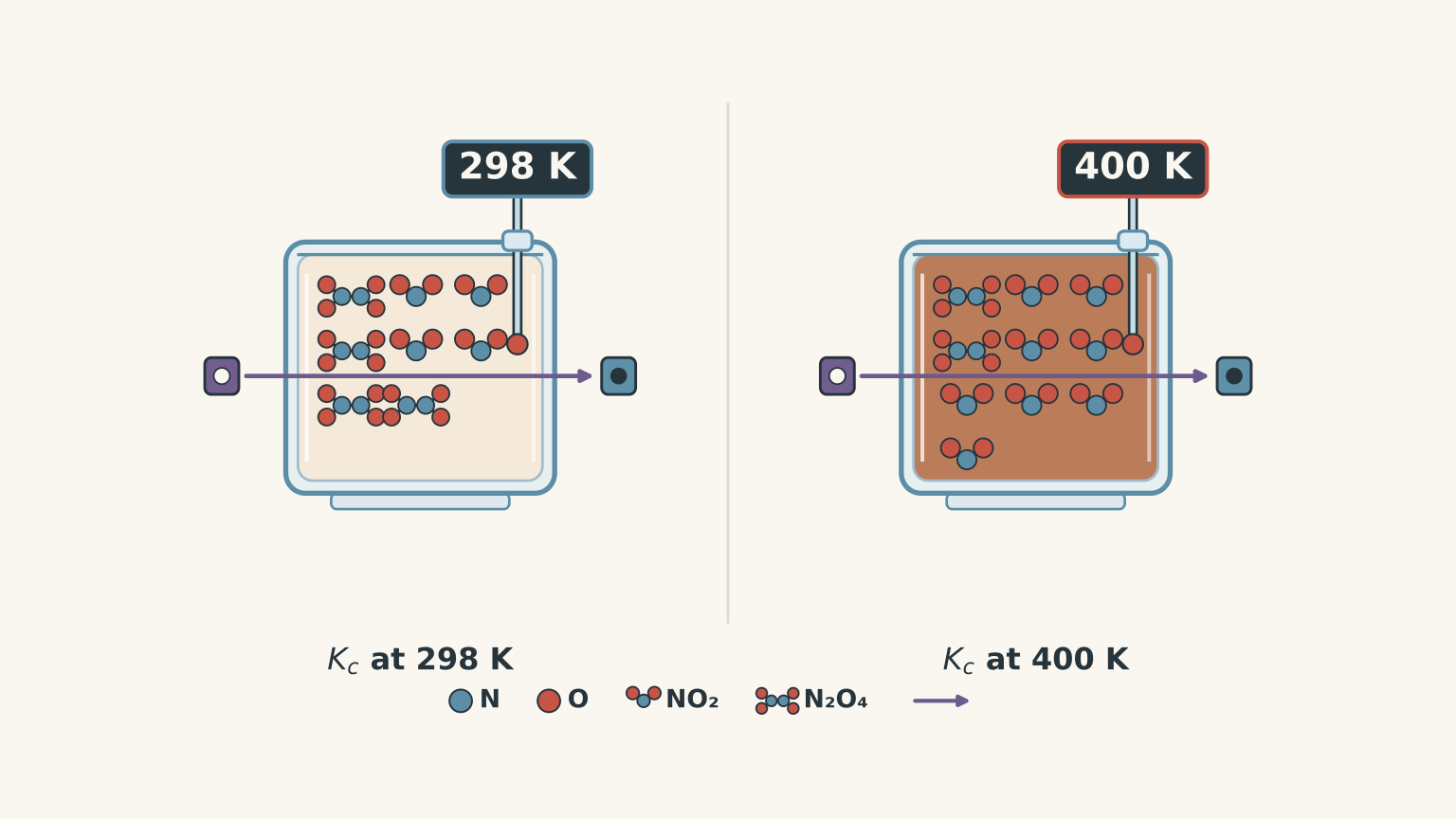
Due to technical limitations, this figure may display incorrectly or contain inaccuracies. Please check key details against your course materials.
What happens when temperature increases?
The forward dissociation of dinitrogen tetroxide is endothermic:
\[ \ce{N2O4(g) + heat <=> 2NO2(g)} \]
Increasing temperature favours the endothermic forward reaction.
Consequently:
- The forward equilibrium constant increases.
- The reverse equilibrium constant decreases.
- The two constants remain reciprocals at the new temperature.
If you are given \(K_c\) for the forward reaction at 298 K but asked for the reverse constant at 400 K, you cannot calculate an exact numerical answer without additional information.
You would need the forward equilibrium constant at 400 K or sufficient thermodynamic information to determine it.
Also remember that reversing an equation changes the sign of its enthalpy change:
\[ \Delta H_{\mathrm{reverse}} = -\Delta H_{\mathrm{forward}} \]
This is different from what happens to \(K_c\). The equilibrium constant does not become negative; it becomes its reciprocal.
05Reversing a reaction is different from changing its coefficients
Another common HSC Chemistry trap is confusing reversing an equation with multiplying or dividing its coefficients.
These are separate operations.
| Change to the balanced equation | Effect on \(K_c\) |
|---|---|
| Reverse the equation | \(1/K_c\) |
| Multiply every coefficient by 2 | \(K_c^2\) |
| Multiply every coefficient by 3 | \(K_c^3\) |
| Divide every coefficient by 2 | \(\sqrt{K_c}\) |
| Reverse and then multiply every coefficient by 2 | \((1/K_c)^2\) |
For example, suppose:
\[ \ce{H2(g) + Cl2(g) <=> 2HCl(g)} \]
has an equilibrium constant of \(K_c=0.50\).
Simply reversing the equation gives:
\[ \ce{2HCl(g) <=> H2(g) + Cl2(g)} \]
The new constant is:
\[ K_c=\frac{1}{0.50}=2.0 \]
But suppose the question instead asks for:
\[ \ce{4HCl(g) <=> 2H2(g) + 2Cl2(g)} \]
This equation has been reversed and then multiplied by 2.
Therefore:
\[ K_{c,\mathrm{new}}=2.0^2 \]
\[ \boxed{K_{c,\mathrm{new}}=4.0} \]
This is why you should always write out the exact balanced equation requested before calculating its equilibrium constant.
06Interpreting the reverse equilibrium constant
What does it mean if the forward constant is very small but the reverse constant is very large?
It means the reverse reaction, as written, has a more product-favoured equilibrium expression at that temperature.
For example:
\[ K_{c,\mathrm{forward}}=0.040 \]
gives:
\[ K_{c,\mathrm{reverse}}=25 \]
However, there is an important limitation.
A large equilibrium constant does not mean that the reaction proceeds to completion. Nor does \(K_c=25\) mean there is 25 times as much product as reactant.
The equilibrium expression contains concentrations raised to powers determined by the balanced equation.
For the reverse nitrogen dioxide reaction:
\[ K_{c,\mathrm{reverse}} = \frac{[\ce{N2O4}]}{[\ce{NO2}]^2} \]
The value 25 describes this particular concentration ratio, not a simple comparison of the amounts of the two substances.
Remember these three points:
- \(K_c>1\) generally indicates that products are favoured for the equation as written.
- \(K_c<1\) generally indicates that reactants are favoured for the equation as written.
- Neither value tells you that the reaction has gone to completion.
07Questions and solutions
Question 1
At 700 K, the reaction
\[ \ce{NO2(g) + CO(g) <=> NO(g) + CO2(g)} \]
has an equilibrium constant of \(K_c=8.0\).
Calculate the equilibrium constant for:
\[ \ce{NO(g) + CO2(g) <=> NO2(g) + CO(g)} \]
State whether the reverse constant has a unit.
Solution 1
The reverse equilibrium constant is:
\[ \boxed{K_{c,\mathrm{reverse}}=0.125} \]
The second equation is exactly the reverse of the first, with no changes to its coefficients.
Therefore:
\[ K_{c,\mathrm{reverse}} = \frac{1}{K_{c,\mathrm{forward}}} \]
Substituting:
\[ K_{c,\mathrm{reverse}} = \frac{1}{8.0} \]
\[ =0.125 \]
There is no concentration unit in this case because the total stoichiometric powers of the gaseous products and reactants are equal.
The important point is that reversing the equation requires the reciprocal, not a negative sign.
Question 2
A sealed vessel contains the following heterogeneous equilibrium at a constant temperature:
\[ \ce{C(s) + CO2(g) <=> 2CO(g)} \]
At equilibrium, the measured concentrations are:
\[ [\ce{CO}]=0.60\ \mathrm{mol\,L^{-1}} \]
\[ [\ce{CO2}]=0.20\ \mathrm{mol\,L^{-1}} \]
Solid carbon remains present throughout the experiment.
Calculate \(K_c\) for the reverse reaction:
\[ \ce{2CO(g) <=> C(s) + CO2(g)} \]
Explain why the solid carbon does not appear in the expression.
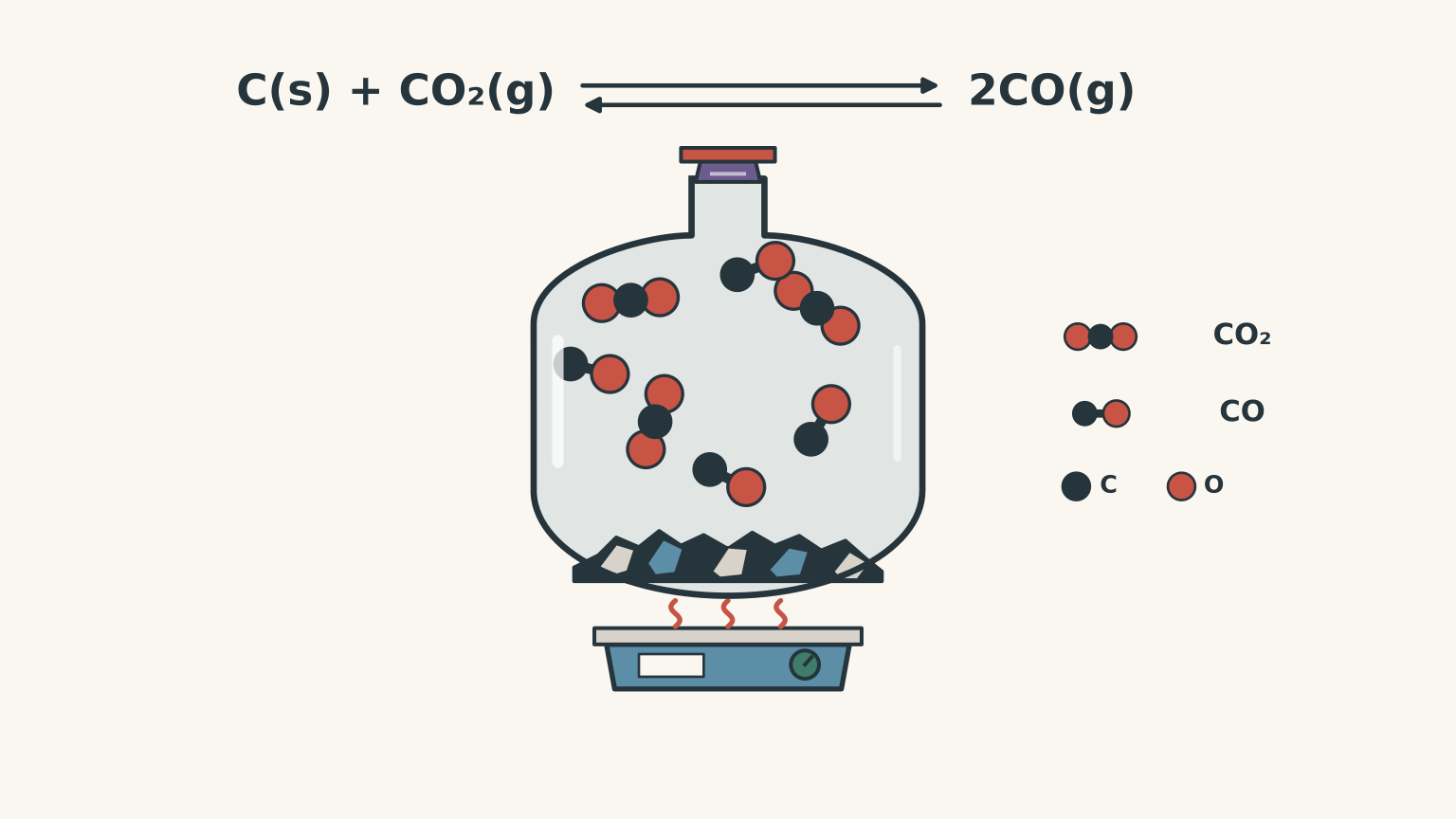
Due to technical limitations, this figure may display incorrectly or contain inaccuracies. Please check key details against your course materials.
Solution 2
The reverse equilibrium constant is:
\[ \boxed{K_{c,\mathrm{reverse}}=0.56\ \mathrm{L\,mol^{-1}}} \]
First, construct the expression for the reverse reaction.
The equation is:
\[ \ce{2CO(g) <=> C(s) + CO2(g)} \]
Pure solids are excluded from equilibrium expressions.
Therefore:
\[ K_{c,\mathrm{reverse}} = \frac{[\ce{CO2}]}{[\ce{CO}]^2} \]
Substitute the equilibrium concentrations:
\[ K_{c,\mathrm{reverse}} = \frac{0.20}{(0.60)^2} \]
\[ =\frac{0.20}{0.36} \]
\[ =0.5556 \]
Therefore:
\[ \boxed{K_{c,\mathrm{reverse}}=0.56\ \mathrm{L\,mol^{-1}}} \]
The tempting mistake is to include \([\ce{C}]\) in the numerator because carbon appears as a product.
However, pure solids are omitted regardless of which side of the equation they occupy.
You can also check the result using the forward expression:
\[ K_{c,\mathrm{forward}} = \frac{[\ce{CO}]^2}{[\ce{CO2}]} \]
\[ =\frac{0.36}{0.20}=1.8 \]
Taking the reciprocal:
\[ \frac{1}{1.8}=0.5556 \]
The result is consistent.
Question 3
At 700 K, the following equilibrium is established:
\[ \ce{CO(g) + H2O(g) <=> CO2(g) + H2(g)} \]
The measured equilibrium concentrations are:
| Substance | Equilibrium concentration (mol L\(^{-1}\)) |
|---|---|
| \(\ce{CO}\) | 0.15 |
| \(\ce{H2O}\) | 0.30 |
| \(\ce{CO2}\) | 0.45 |
| \(\ce{H2}\) | 0.20 |
A student argues that the forward equilibrium constant must be 3.0 because the concentration of \(\ce{CO2}\) is three times the concentration of \(\ce{CO}\).
Calculate both the forward and reverse equilibrium constants, and explain the error in the student’s reasoning.
Solution 3
The correct equilibrium constants are:
\[ \boxed{K_{c,\mathrm{forward}}=2.0} \]
and
\[ \boxed{K_{c,\mathrm{reverse}}=0.50} \]
The student’s calculation is incorrect because it ignores the other two substances in the equilibrium expression.
For the forward reaction:
\[ K_{c,\mathrm{forward}} = \frac{[\ce{CO2}][\ce{H2}]} {[\ce{CO}][\ce{H2O}]} \]
Substitute all four equilibrium concentrations:
\[ K_{c,\mathrm{forward}} = \frac{(0.45)(0.20)} {(0.15)(0.30)} \]
\[ =\frac{0.090}{0.045} \]
\[ =2.0 \]
Now reverse the equation:
\[ \ce{CO2(g) + H2(g) <=> CO(g) + H2O(g)} \]
The reverse expression is:
\[ K_{c,\mathrm{reverse}} = \frac{[\ce{CO}][\ce{H2O}]} {[\ce{CO2}][\ce{H2}]} \]
Substituting:
\[ K_{c,\mathrm{reverse}} = \frac{(0.15)(0.30)} {(0.45)(0.20)} \]
\[ =\frac{0.045}{0.090} \]
\[ =0.50 \]
The two constants are reciprocals:
\[ \frac{1}{2.0}=0.50 \]
The student’s mistake was comparing only two concentrations instead of using the complete equilibrium expression.
An equilibrium constant is not simply the ratio of the largest product concentration to the largest reactant concentration.
Question 4
At 450 K, the reaction
\[ \ce{H2(g) + Cl2(g) <=> 2HCl(g)} \]
has an equilibrium constant of:
\[ K_c=0.50 \]
Determine the equilibrium constant for the reaction:
\[ \ce{4HCl(g) <=> 2H2(g) + 2Cl2(g)} \]
Explain why simply taking the reciprocal of the original constant does not give the final answer.
Solution 4
The equilibrium constant for the requested reaction is:
\[ \boxed{K_{c,\mathrm{new}}=4.0} \]
There are two changes to the original equation.
First, the reaction is reversed.
The reverse reaction is:
\[ \ce{2HCl(g) <=> H2(g) + Cl2(g)} \]
Its equilibrium constant is:
\[ K_{c,\mathrm{reverse}} = \frac{1}{0.50} =2.0 \]
Second, every coefficient is doubled:
\[ \ce{4HCl(g) <=> 2H2(g) + 2Cl2(g)} \]
When every coefficient in a balanced equation is multiplied by 2, the new equilibrium constant is the square of the original constant.
Therefore:
\[ K_{c,\mathrm{new}} = (2.0)^2 \]
\[ \boxed{K_{c,\mathrm{new}}=4.0} \]
The tempting answer is 2.0, because that is the reciprocal of the original constant.
However, that value belongs to the equation with coefficients \(2,1,1\), not the equation with coefficients \(4,2,2\).
Always check whether the requested equation has also been multiplied or divided by a common factor.
Question 5
At 300 K, the following reaction has an equilibrium constant of:
\[ K_{c,\mathrm{forward}}=0.080\ \mathrm{mol\,L^{-1}} \]
\[ \ce{PCl5(g) <=> PCl3(g) + Cl2(g)} \]
The forward dissociation reaction is endothermic.
A student is asked to determine \(K_c\) at 400 K for the reaction:
\[ \ce{2PCl3(g) + 2Cl2(g) <=> 2PCl5(g)} \]
The student calculates:
\[ K_c= \left(\frac{1}{0.080}\right)^2 =156.25 \]
and claims this is the exact answer.
Evaluate the student’s conclusion.
Determine the strongest conclusion that can be made using the information provided. Explain what additional information would be required to calculate an exact numerical value.
Solution 5
The student’s answer is not an exact answer for 400 K.
The available information allows us to conclude that:
\[ \boxed{K_{c,400\,\mathrm K}<156.25} \]
However, the exact value cannot be calculated from the information provided.
There are two changes to consider: reversing and doubling the equation, and changing the temperature.
Step 1: Calculate the constant for the reverse reaction at 300 K.
The original reaction is:
\[ \ce{PCl5(g) <=> PCl3(g) + Cl2(g)} \]
Reversing it gives:
\[ \ce{PCl3(g) + Cl2(g) <=> PCl5(g)} \]
Therefore:
\[ K_{c,\mathrm{reverse},300\,\mathrm K} = \frac{1}{0.080} \]
\[ =12.5 \]
Step 2: Account for the doubled coefficients.
The requested equation is:
\[ \ce{2PCl3(g) + 2Cl2(g) <=> 2PCl5(g)} \]
This is twice the reverse equation.
Therefore, at 300 K:
\[ K_{c,\mathrm{new},300\,\mathrm K} = (12.5)^2 \]
\[ =156.25 \]
The student’s calculation is correct for 300 K.
Step 3: Consider the temperature change.
The forward dissociation reaction is endothermic:
\[ \ce{PCl5(g) + heat <=> PCl3(g) + Cl2(g)} \]
Increasing the temperature favours the forward reaction.
Therefore:
\[ K_{c,\mathrm{forward},400\,\mathrm K} > K_{c,\mathrm{forward},300\,\mathrm K} \]
In other words:
\[ K_{c,\mathrm{forward},400\,\mathrm K} >0.080 \]
Step 4: Apply the reciprocal rule at 400 K.
The reverse equilibrium constant must now be calculated using the forward constant at 400 K.
Since the forward constant has increased, its reciprocal must have decreased.
Therefore:
\[ K_{c,\mathrm{reverse},400\,\mathrm K}<12.5 \]
Step 5: Account for the doubled equation again.
The requested equation has twice the coefficients of the reverse reaction.
Therefore:
\[ K_{c,\mathrm{new},400\,\mathrm K} = (K_{c,\mathrm{reverse},400\,\mathrm K})^2 \]
Since the reverse constant is now smaller than 12.5:
\[ \boxed{K_{c,\mathrm{new},400\,\mathrm K}<156.25} \]
The exact value requires the forward equilibrium constant at 400 K, or sufficient thermodynamic data to calculate it.
The student’s mistake was not the reciprocal rule or the coefficient-scaling rule. Both were applied correctly.
The mistake was using a constant measured at 300 K to answer a question about 400 K.
This is the important distinction: reversing an equation changes the equilibrium constant, but changing the temperature changes which equilibrium constant applies in the first place.
08What to remember for your HSC Chemistry exam
When asked to find \(K_{eq}\) for the reverse of a reaction, use this sequence:
- Write the balanced equation exactly as requested.
- Construct the equilibrium expression, placing products in the numerator and reactants in the denominator.
- Turn coefficients into powers and omit pure solids and liquids.
- If the new equation is exactly the reverse, take the reciprocal of the original equilibrium constant.
- If coefficients have also been multiplied or divided, adjust the equilibrium constant accordingly.
- Check that both constants refer to the same temperature.
- Interpret the result in terms of the complete equilibrium expression, not simply the relative amounts of products and reactants.
For the broader skill of constructing equilibrium expressions, calculating equilibrium concentrations, and comparing \(Q_c\) with \(K_c\), see Keq Calculations and Reaction Direction | HSC Chemistry.
If you want to see how experimental measurements can be converted into equilibrium concentrations before calculating \(K_{eq}\), the iron(III) thiocyanate equilibrium experiment provides a useful next example.
Once you can confidently reverse an equilibrium constant, the next step is learning how to use the correct \(K_c\) to predict which direction a disturbed equilibrium mixture will move.