
Proton Affinity: Why Gas-Phase and Aqueous Basicity Differ
Explore how proton affinity measures the strength of gas-phase bases, and why the presence of water can reverse the basicity ranking of amines. Learn how electron-donating effects, solvation, and thermodynamic stability explain the difference.
Imagine comparing four nitrogen bases: ammonia, methylamine, dimethylamine, and trimethylamine. Which would you predict is the strongest base?
If you focus on the number of methyl groups attached to nitrogen, trimethylamine looks like the obvious winner. Each methyl group donates electron density towards nitrogen, making its lone pair more available to accept a proton.
In the gas phase, that prediction is correct. In water, however, dimethylamine is the stronger base.
The molecules haven’t changed. The environment has.
This is the central idea behind proton affinity: a molecule’s ability to accept a proton depends on how that protonation is measured, and the surrounding solvent can substantially change the result.
A syllabus note: Proton affinity is an extension topic beyond the required NSW Year 12 Chemistry 2025 syllabus. It builds on your knowledge of acid-base reactions, conjugate acid-base pairs, and equilibrium, but is not itself a required syllabus assessment outcome.
Due to technical limitations, this figure may display incorrectly or contain inaccuracies. Please check key details against your course materials.
01Start with the familiar acid-base model
You already know that a Brønsted-Lowry base is a substance that accepts a proton, \(\mathrm{H}^{+}\).
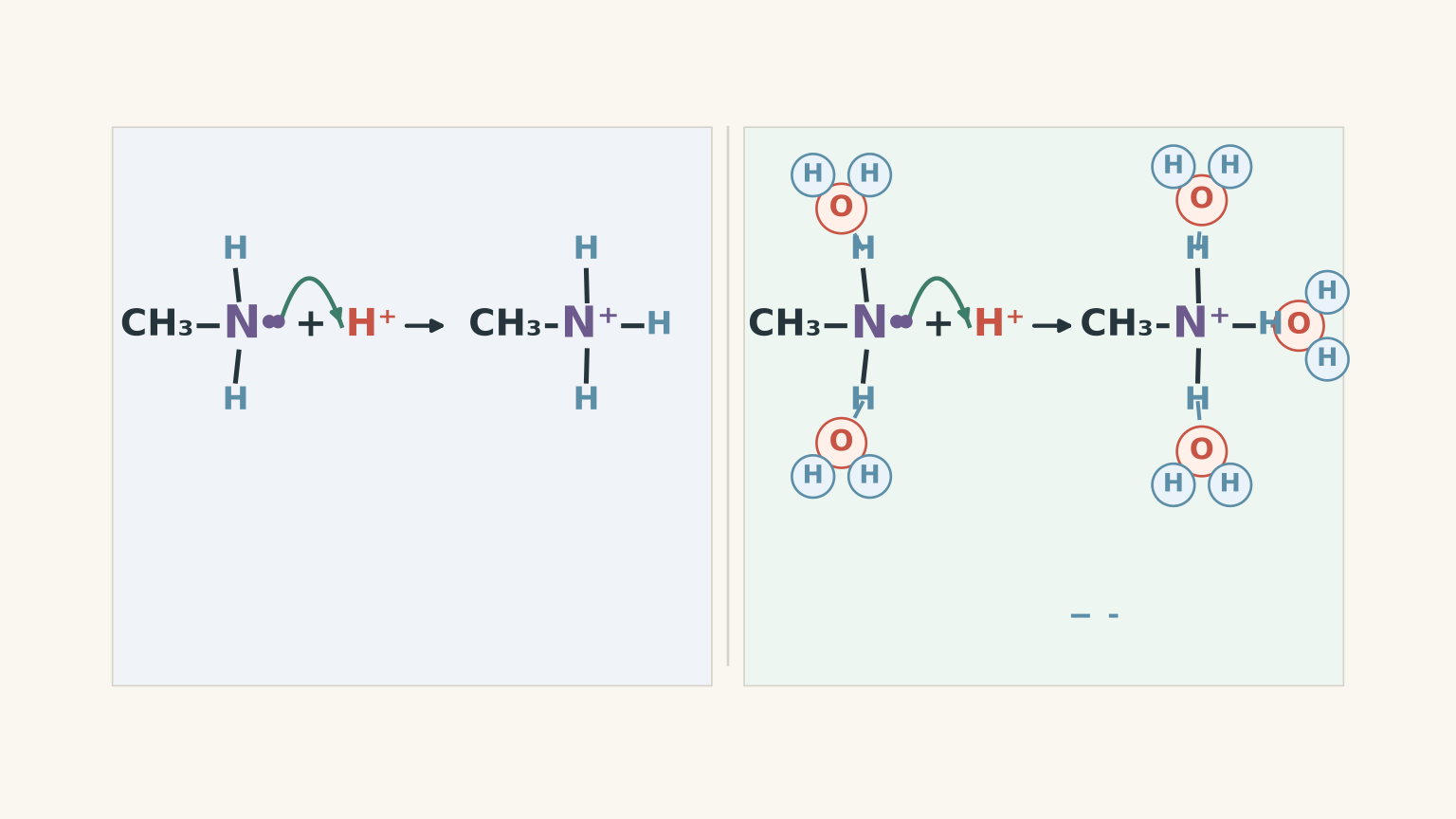
Consider methylamine, \(\ce{CH3NH2}\). Its nitrogen atom has a lone pair of electrons that can form a bond with an incoming proton.
The reaction produces methylammonium:
\[ \ce{CH3NH2 + H+ -> CH3NH3+} \]
Methylamine is the base, and methylammonium is its conjugate acid.
This is the same proton-transfer idea you use when analysing acid-base reactions in the HSC course. The important question here is what happens when the reaction takes place in different environments.
What happens in water?
In an aqueous solution, a base can accept a proton from water:
\[ \ce{B(aq) + H2O(l) <=> BH+(aq) + OH-(aq)} \]
Here:
- \(\ce{B}\) represents the base.
- \(\ce{BH+}\) is its conjugate acid.
- \(\ce{OH-}\) is the hydroxide ion produced.
- The double arrow represents a reversible reaction at equilibrium.
The equilibrium constant for this reaction is the base ionisation constant, \(K_b\):
\[ K_b=\frac{[\ce{BH+}][\ce{OH-}]}{[\ce{B}]} \]
A larger \(K_b\) means the equilibrium favours the protonated form more strongly. The base is therefore stronger in water.
This is the aqueous model you use when investigating natural buffer systems. For example, the bicarbonate buffer in blood involves reversible proton transfer between bicarbonate and carbonic acid. Its behaviour depends on aqueous equilibria, not on how strongly an isolated bicarbonate ion accepts a proton in a vacuum.
Proton affinity introduces a different way of measuring proton acceptance. To understand it, we first need to remove the water.
02Proton affinity: measuring proton acceptance in the gas phase
Imagine placing a neutral base and a proton together in an environment containing no solvent molecules.
The protonation reaction is:
\[ \ce{B(g) + H+(g) -> BH+(g)} \]
The symbol \((g)\) indicates that the species are in the gas phase.
There are no surrounding water molecules to stabilise the reactants or products. We are examining the energetics of protonation for isolated gas-phase species.
The quantity used to describe this process is called proton affinity, abbreviated PA.
IUPAC defines proton affinity as the negative of the enthalpy change for the gas-phase protonation reaction.
Mathematically:
\[ \boxed{\mathrm{PA}(B)=-\Delta H^\circ_{\mathrm{prot}}} \]
Where:
- \(\mathrm{PA}(B)\) is the proton affinity of base B, measured in \(\mathrm{kJ\,mol^{-1}}\).
- \(\Delta H^\circ_{\mathrm{prot}}\) is the standard enthalpy change for protonating B in the gas phase.
- The negative sign means that an exothermic protonation reaction produces a positive proton affinity.
The definition follows the IUPAC Gold Book.
What does a larger proton affinity mean?
Suppose two bases have proton affinities of 800 and 950 kJ mol⁻¹.
The second base has the higher proton affinity. Its protonation reaction releases more enthalpy per mole.
A higher PA therefore indicates more favourable proton acceptance on an enthalpy basis.
For example:
| Proton affinity | Protonation enthalpy |
|---|---|
| 800 kJ mol⁻¹ | −800 kJ mol⁻¹ |
| 950 kJ mol⁻¹ | −950 kJ mol⁻¹ |
The second reaction is more exothermic by 150 kJ mol⁻¹.
Notice that proton affinity is an energy measurement, not an equilibrium constant.
There is a related quantity called gas-phase basicity (GB). It is defined using the Gibbs free energy change rather than enthalpy:
\[ \mathrm{GB}(B)=-\Delta G^\circ_{\mathrm{prot}} \]
This distinction matters because Gibbs free energy includes both enthalpy and entropy:
\[ \Delta G^\circ=\Delta H^\circ-T\Delta S^\circ \]
Here, \(T\) is absolute temperature in kelvin, and \(\Delta S^\circ\) is the standard entropy change.
PA and GB are therefore related, but they are not interchangeable. For the amines we will compare, both measurements give the same ranking.
03Why do methyl groups increase proton affinity?
Return to the four nitrogen bases:
- Ammonia: \(\ce{NH3}\)
- Methylamine: \(\ce{CH3NH2}\)
- Dimethylamine: \(\ce{(CH3)2NH}\)
- Trimethylamine: \(\ce{(CH3)3N}\)
Each successive molecule has one more methyl group attached to nitrogen.
The key is the inductive effect.
The electron-donating effect of methyl groups
A methyl group, \(\ce{CH3}\), is electron donating through the sigma-bond framework.
It pushes electron density towards the nitrogen atom. This is called the positive inductive effect, or \(+I\) effect.
As more methyl groups are attached, they generally increase electron density around nitrogen.
When nitrogen accepts a proton, it develops a positive formal charge. Electron-donating methyl groups also help stabilise the resulting positively charged conjugate acid.
There are therefore two related benefits:
- The nitrogen environment becomes more electron rich.
- The positive charge in the protonated molecule is stabilised by the attached alkyl groups.
In the gas phase, there is no water to counteract these electronic effects.
We would therefore expect proton affinity to increase as methyl groups are added.
Experimental values support this prediction.
Comparing gas-phase and aqueous measurements
The following data compare proton affinity, gas-phase basicity, and the aqueous pKa of each conjugate acid.
| Base | PA (kJ mol⁻¹) | GB (kJ mol⁻¹) | pKa of conjugate acid in water |
|---|---|---|---|
| \(\ce{NH3}\) | 853.6 | 819.0 | 9.25 |
| \(\ce{CH3NH2}\) | 899.0 | 864.5 | 10.66 |
| \(\ce{(CH3)2NH}\) | 929.5 | 896.5 | 10.73 |
| \(\ce{(CH3)3N}\) | 948.9 | 918.1 | 9.80 |
The gas-phase values are evaluated data from the NIST Chemistry WebBook, based on the thermochemical evaluation by Hunter and Lias (1998).
The aqueous pKa values are experimental values at 25°C reported in Khalili, Henni, and East (2009), Journal of Molecular Structure: THEOCHEM.
The table reveals two different rankings.
Gas-phase proton acceptance, from strongest to weakest:
\[ \ce{(CH3)3N > (CH3)2NH > CH3NH2 > NH3} \]
Aqueous basicity, from strongest to weakest:
\[ \ce{(CH3)2NH > CH3NH2 > (CH3)3N > NH3} \]
The rankings are not the same.
Trimethylamine has the highest proton affinity, but dimethylamine is the strongest base in water.
So what changes when we introduce water?
04Solvation: why water changes the ranking
Water is not simply a background liquid in which reactions happen.
Water molecules interact with dissolved substances, surrounding them and stabilising them. This process is called solvation.
When the solvent is water, it is specifically called hydration.
These interactions can change the relative stability of the reactants and products in an acid-base reaction.
How does water stabilise a protonated amine?
Water is a polar molecule.
Its oxygen atom carries a partial negative charge, while its hydrogen atoms carry partial positive charges.
When an amine accepts a proton, its nitrogen becomes positively charged. Water molecules can orient their partially negative oxygen atoms towards this positive region.
They can also form hydrogen bonds with N-H groups in the protonated amine.
These interactions help stabilise the conjugate acid in solution.
Now consider what happens as we replace nitrogen’s hydrogen atoms with methyl groups.
| Neutral base | Conjugate acid | Number of N-H bonds in conjugate acid |
|---|---|---|
| \(\ce{NH3}\) | \(\ce{NH4+}\) | 4 |
| \(\ce{CH3NH2}\) | \(\ce{CH3NH3+}\) | 3 |
| \(\ce{(CH3)2NH}\) | \(\ce{(CH3)2NH2+}\) | 2 |
| \(\ce{(CH3)3N}\) | \(\ce{(CH3)3NH+}\) | 1 |
As more methyl groups are added, two things happen:
- There are fewer N-H bonds available to form hydrogen bonds with water.
- The larger methyl groups create more steric crowding around the positively charged nitrogen region.
This can make it harder for water molecules to approach and stabilise the protonated species.
The result is that the protonated tertiary amine, trimethylammonium, receives less effective hydration than its less substituted counterparts.
This is an important part of why trimethylamine loses its position as the strongest base when we move into water.
Why isn’t ammonia the strongest aqueous base?
There is a tempting conclusion here.
If ammonium, \(\ce{NH4+}\), has four N-H bonds and can interact strongly with water, shouldn’t ammonia be the strongest base in water?
No.
We need to consider both competing effects.
The first is the inductive effect. Adding methyl groups makes the nitrogen environment more electron rich and helps stabilise the protonated form.
The second is hydration. Replacing N-H bonds with methyl groups reduces some of the favourable interactions between the protonated species and water.
These effects work against each other.
Ammonia benefits from strong hydration of its conjugate acid, but it has no electron-donating methyl groups.
Trimethylamine benefits from three electron-donating methyl groups, but its conjugate acid is less effectively hydrated.
Dimethylamine provides a particularly favourable balance between these effects.
It has enough methyl substitution to increase electron donation, while retaining two N-H bonds in its conjugate acid.
That combination helps explain why it has the highest aqueous pKa in this series.
Importantly, the number of N-H bonds is a useful structural clue, not a complete mathematical explanation. The neutral amines are also hydrated, and the actual equilibrium depends on the relative solvation of all participating species.
The deeper explanation: compare the whole reaction
This is the most important refinement to the simple hydration model.
You cannot determine aqueous basicity just by asking how strongly water stabilises the conjugate acid.
Water also interacts with the original neutral base.
The relevant question is:
How does hydration change the relative Gibbs free energy of the products compared with the reactants?
We can represent this using a thermodynamic cycle.
For the formal protonation reaction:
\[ \ce{B(g) + H+(g) -> BH+(g)} \]
the corresponding aqueous protonation process has a free energy change that includes the solvation of all three species.
\[ \begin{aligned} \Delta G^\circ_{\mathrm{aq}} ={}&\Delta G^\circ_{\mathrm{gas}}\\ &+\Delta G^\circ_{\mathrm{hyd}}(\ce{BH+})\\ &-\Delta G^\circ_{\mathrm{hyd}}(\ce{B})\\ &-\Delta G^\circ_{\mathrm{hyd}}(\mathrm{H}^{+}) \end{aligned} \]
Here, \(\Delta G^\circ_{\mathrm{hyd}}\) is the Gibbs free energy change when a species transfers from the gas phase into water.
The aqueous \(\mathrm{H}^{+}\) in this thermodynamic description represents the hydrated proton, not an isolated proton floating freely through water.
This equation is a thermodynamic bookkeeping model. It assumes consistent standard states and temperature for the gas-phase and aqueous quantities.
For comparing two bases in the same solvent, the proton hydration term is common and cancels when considering their relative protonation energies.
The important point is that we must compare the hydration of the neutral base with the hydration of its conjugate acid.
This explains why simply comparing proton affinities cannot give us a reliable aqueous ranking.
Computational research into methylamine basicity has also identified solvation free energies as essential to explaining the change in basicity between the gas and aqueous phases (Kawata et al., 1996).
There is another useful connection here.
The pKa of a conjugate acid is related to the Gibbs free energy of its dissociation:
\[ \Delta G^\circ_{\mathrm{diss}}=2.303RT\,pK_a \]
Here:
- \(R\) is the gas constant, \(8.314\ \mathrm{J\,mol^{-1}\,K^{-1}}\).
- \(T\) is the absolute temperature in kelvin.
- \(pK_a\) describes the acid dissociation equilibrium of the conjugate acid.
A higher pKa means the conjugate acid is less willing to donate its proton. Its corresponding base is therefore stronger.
For more practice connecting pKa to the proportions of different species in solution, see Acid-Base Speciation Diagrams: Reading Species vs pH.
05Worked example 1: Comparing gas-phase proton affinities
Question: Ammonia has a proton affinity of 853.6 kJ mol⁻¹, while methylamine has a proton affinity of 899.0 kJ mol⁻¹.
Calculate the standard enthalpy change for protonation of each molecule and determine which is the stronger proton acceptor in the gas phase.
Step 1
\[ \mathrm{PA}=-\Delta H^\circ_{\mathrm{prot}} \]
Rearrange:
\[ \Delta H^\circ_{\mathrm{prot}}=-\mathrm{PA} \]
Step 2
\[ \begin{aligned} \Delta H^\circ_{\mathrm{prot}} &=-853.6\\ &=-853.6\ \mathrm{kJ\,mol^{-1}} \end{aligned} \]
Step 3
\[ \begin{aligned} \Delta H^\circ_{\mathrm{prot}} &=-899.0\\ &=-899.0\ \mathrm{kJ\,mol^{-1}} \end{aligned} \]
Step 4
\[ \begin{aligned} \text{Difference} &=899.0-853.6\\ &=45.4\ \mathrm{kJ\,mol^{-1}} \end{aligned} \]
Conclusion: Methylamine has the higher proton affinity. Its gas-phase protonation releases 45.4 kJ mol⁻¹ more enthalpy than ammonia protonation.
This supports the idea that the electron-donating methyl group helps stabilise the protonated molecule.
However, this result does not establish which molecule is the stronger base in water. We have not accounted for hydration.
06Worked example 2: Comparing aqueous basicity using pKa
Question: At 25°C, the pKa values of dimethylammonium and trimethylammonium are 10.73 and 9.80, respectively.
Calculate the ratio of their base ionisation constants, \(K_b\), and determine which neutral amine is the stronger aqueous base.
Step 1
At 25°C:
\[ pK_a+pK_b=14.00 \]
Step 2
\[ \begin{aligned} pK_b&=14.00-10.73\\ &=3.27 \end{aligned} \]
Step 3
\[ \begin{aligned} pK_b&=14.00-9.80\\ &=4.20 \end{aligned} \]
Step 4
Using \(K_b=10^{-pK_b}\):
For dimethylamine:
\[ K_b=10^{-3.27}=5.4\times10^{-4} \]
For trimethylamine:
\[ K_b=10^{-4.20}=6.3\times10^{-5} \]
Step 5
\[ \begin{aligned} \frac{K_b(\text{dimethylamine})} {K_b(\text{trimethylamine})} &=\frac{5.4\times10^{-4}} {6.3\times10^{-5}}\\ &\approx8.6 \end{aligned} \]
Conclusion: Dimethylamine is approximately 8.6 times stronger than trimethylamine as an aqueous base, according to their \(K_b\) values.
The result is interesting because trimethylamine has the higher gas-phase proton affinity.
Water changes the relative stability of the protonated species, making dimethylamine the stronger base in aqueous solution.
07Common misconceptions
| Tempting conclusion | What is actually happening |
|---|---|
| The highest proton affinity always means the strongest base. | PA describes gas-phase protonation enthalpy, not aqueous basicity. |
| More methyl groups always produce a stronger base. | The inductive effect helps, but hydration can change the ranking in water. |
| Only the stability of the conjugate acid matters. | Aqueous basicity depends on the relative free energies of reactants and products, including their solvation. |
| A higher pKa means a stronger acid. | A higher pKa means a weaker acid. For conjugate acids, this corresponds to a stronger base. |
| A slower protonation reaction means a weaker base. | Reaction rate and equilibrium position describe different properties. |
A useful decision rule is:
- If you are comparing isolated gas-phase protonation, consider proton affinity or gas-phase basicity.
- If you are comparing bases in water, use \(K_b\) or the pKa of their conjugate acids.
- If the rankings differ, investigate how the solvent stabilises the reactants and products.
The solvent levelling effect explores another way in which the surrounding solvent influences acid-base behaviour.
08Questions and solutions
The following questions move from interpreting experimental data to analysing the thermodynamics of solvation. The final problem combines gas-phase basicity and hydration free energies.
Question 1
Ammonia has a conjugate-acid pKa of 9.25, while methylamine has a conjugate-acid pKa of 10.66 at 25°C.
Identify the stronger aqueous base and explain your answer using the relationship between pKa and pKb.
Solution 1
Methylamine is the stronger aqueous base. Its conjugate acid has the higher pKa, meaning it is a weaker acid and is less likely to donate its proton.
Using:
\[ pK_a+pK_b=14.00 \]
For ammonia:
\[ pK_b=14.00-9.25=4.75 \]
For methylamine:
\[ pK_b=14.00-10.66=3.34 \]
A lower pKb corresponds to a larger \(K_b\).
We can also compare the equilibrium constants:
\[ \begin{aligned} \frac{K_b(\ce{CH3NH2})}{K_b(\ce{NH3})} &=10^{4.75-3.34}\\ &=10^{1.41}\\ &\approx25.7 \end{aligned} \]
Methylamine is approximately 25.7 times stronger than ammonia as an aqueous base under these conditions.
The key is to remember that pKa measures the acidity of the conjugate acid, not the basicity of the original molecule directly.
Question 2
A researcher compares four nitrogen bases and obtains the following data:
| Base | Proton affinity (kJ mol⁻¹) | Aqueous conjugate-acid pKa |
|---|---|---|
| Ammonia | 853.6 | 9.25 |
| Methylamine | 899.0 | 10.66 |
| Dimethylamine | 929.5 | 10.73 |
| Trimethylamine | 948.9 | 9.80 |
(a) Rank the four bases from strongest to weakest in the gas phase using proton affinity.
(b) Rank the same bases from strongest to weakest in aqueous solution using their conjugate-acid pKa values.
(c) Explain why trimethylamine changes position in the rankings, even though it has the highest proton affinity.
Solution 2
(a) Trimethylamine is the strongest gas-phase proton acceptor, followed by dimethylamine, methylamine, and ammonia.
A higher proton affinity corresponds to a more exothermic gas-phase protonation reaction.
The ranking is:
\[ \ce{(CH3)3N > (CH3)2NH > CH3NH2 > NH3} \]
(b) Dimethylamine is the strongest aqueous base, followed by methylamine, trimethylamine, and ammonia.
A higher conjugate-acid pKa indicates a weaker conjugate acid and therefore a stronger base.
The aqueous ranking is:
\[ \ce{(CH3)2NH > CH3NH2 > (CH3)3N > NH3} \]
(c) The change occurs because the solvent stabilises the protonated molecules differently.
In the gas phase, additional methyl groups donate electron density and help stabilise the positively charged conjugate acid. Trimethylamine therefore has the highest proton affinity.
In water, the protonated species also interact with surrounding water molecules.
Trimethylammonium has only one N-H bond and three methyl groups. These methyl groups create steric crowding and reduce the effectiveness of hydration around the charged region.
Dimethylammonium retains two N-H bonds and has less methyl-group crowding. It receives more favourable hydration while still benefiting from electron donation by its methyl groups.
The balance of electronic effects and solvation makes dimethylamine the strongest aqueous base.
The important distinction is that gas-phase proton acceptance and aqueous basicity describe different thermodynamic environments.
Question 3
Two separate aqueous solutions are prepared at 25°C:
- Solution A contains 0.0100 mol L⁻¹ dimethylamine, with \(K_b=5.4\times10^{-4}\).
- Solution B contains 0.100 mol L⁻¹ trimethylamine, with \(K_b=6.3\times10^{-5}\).
Assume ideal dilute-solution behaviour and ignore the contribution from water autoionisation.
Determine which solution has the higher equilibrium hydroxide concentration.
Solution 3
Solution B, containing trimethylamine, has the slightly higher hydroxide concentration. Although dimethylamine is the stronger base, the trimethylamine solution is ten times more concentrated.
We need to account for both concentration and base strength.
Step 1: Write the equilibrium expression.
For either base:
\[ \ce{B + H2O <=> BH+ + OH-} \]
Let \(x\) represent the equilibrium hydroxide concentration in mol L⁻¹.
If the initial base concentration is \(C\):
\[ K_b=\frac{x^2}{C-x} \]
Rearranging:
\[ x^2+K_bx-K_bC=0 \]
Step 2: Calculate the hydroxide concentration in Solution A.
For dimethylamine:
\[ K_b=5.4\times10^{-4} \]
\[ C=0.0100\ \mathrm{mol\,L^{-1}} \]
Using the positive solution of the quadratic equation:
\[ x=\frac{-K_b+\sqrt{K_b^2+4K_bC}}{2} \]
Substituting:
\[ \begin{aligned} x&=\frac{-5.4\times10^{-4}}{2}\\ &\quad+\frac{\sqrt{ (5.4\times10^{-4})^2+ 4(5.4\times10^{-4})(0.0100)}}{2}\\ &\approx2.07\times10^{-3}\ \mathrm{mol\,L^{-1}} \end{aligned} \]
Therefore:
\[ [\ce{OH-}]_A\approx2.07\times10^{-3}\ \mathrm{mol\,L^{-1}} \]
Step 3: Calculate the hydroxide concentration in Solution B.
For trimethylamine:
\[ K_b=6.3\times10^{-5} \]
\[ C=0.100\ \mathrm{mol\,L^{-1}} \]
Again:
\[ x=\frac{-K_b+\sqrt{K_b^2+4K_bC}}{2} \]
Substituting:
\[ \begin{aligned} x&=\frac{-6.3\times10^{-5}}{2}\\ &\quad+\frac{\sqrt{ (6.3\times10^{-5})^2+ 4(6.3\times10^{-5})(0.100)}}{2}\\ &\approx2.48\times10^{-3}\ \mathrm{mol\,L^{-1}} \end{aligned} \]
Therefore:
\[ [\ce{OH-}]_B\approx2.48\times10^{-3}\ \mathrm{mol\,L^{-1}} \]
Step 4: Compare the results.
\[ 2.48\times10^{-3}>2.07\times10^{-3} \]
Solution B has the higher hydroxide concentration.
This does not mean trimethylamine has become the stronger base. It means its higher initial concentration has more than compensated for its smaller \(K_b\) in this comparison.
The distinction is important: base strength is an equilibrium property, while the pH of a particular solution also depends on concentration.
Question 4
A student performs a rapid-mixing experiment involving dimethylamine and trimethylamine in water.
Under the experimental conditions, trimethylamine appears to react more slowly with a particular proton donor.
The student concludes:
“Trimethylamine must be a weaker base because it accepts protons more slowly.”
Evaluate this conclusion. Explain the difference between reaction rate and aqueous basicity, and identify what measurement would establish which amine is the stronger aqueous base.
Solution 4
The student’s conclusion is not justified by the reaction rate alone. A slower protonation reaction does not necessarily mean a less favourable protonation equilibrium.
Reaction rate and equilibrium position measure different things.
Reaction rate depends on how quickly reactants can pass through the activation barrier to form products.
Steric crowding around a tertiary amine can affect how easily a proton donor approaches nitrogen. It can therefore influence the rate of proton transfer.
Aqueous basicity, however, is determined by the relative Gibbs free energies of the reactants and products at equilibrium.
A reaction can be slow in both directions and still have an equilibrium that strongly favours products.
To establish the relative aqueous basicity, we need to measure the equilibrium constant or the pKa of each conjugate acid.
For the methylamine series:
\[ pK_a(\ce{(CH3)2NH2+})=10.73 \]
\[ pK_a(\ce{(CH3)3NH+})=9.80 \]
Dimethylamine is therefore the stronger aqueous base.
Its conjugate acid is less acidic, meaning the equilibrium favours its protonated form more strongly relative to the unprotonated amine.
The kinetic observation might help explain differences in reaction speed, but it cannot replace an equilibrium measurement.
Question 5
Consider two hypothetical neutral bases, X and Y, at 298 K.
A researcher determines their gas-phase protonation Gibbs free energies:
\[ \ce{X(g) + H+(g) -> XH+(g)} \]
\[ \Delta G^\circ_{\mathrm{gas}}(X) =-40\ \mathrm{kJ\,mol^{-1}} \]
For Y:
\[ \ce{Y(g) + H+(g) -> YH+(g)} \]
\[ \Delta G^\circ_{\mathrm{gas}}(Y) =-28\ \mathrm{kJ\,mol^{-1}} \]
Therefore, gas-phase protonation is more favourable for X by 12 kJ mol⁻¹.
The researcher then supplies the following hypothetical hydration free energies.
Each value describes the Gibbs free energy change when the corresponding gas-phase species transfers into water.
| Species | Hydration free energy (kJ mol⁻¹) |
|---|---|
| X(g) | −70 |
| XH⁺(g) | −80 |
| Y(g) | −50 |
| YH⁺(g) | −90 |
Assume:
- All values refer to the same temperature and consistent standard states.
- The hydration free energy of the proton is identical in both comparisons.
- There is no ion pairing or other additional interaction that changes the comparison.
(a) Determine which base has the more favourable aqueous protonation free energy.
(b) Calculate the relative hydration contribution to protonation for X and Y, excluding the common proton hydration term.
(c) Explain why comparing only the hydration free energies of XH⁺ and YH⁺ would give an incomplete explanation.
Solution 5
Y is the stronger aqueous base, even though X has the more favourable gas-phase protonation free energy. The difference arises because hydration favours the protonation of Y more strongly relative to its neutral form.
This question tests an important idea: you must compare the hydration of the neutral base and its conjugate acid, not just the hydration of the positive ion.
(a) Determine the aqueous protonation free energy.
The thermodynamic cycle gives:
\[ \begin{aligned} \Delta G^\circ_{\mathrm{aq}} ={}&\Delta G^\circ_{\mathrm{gas}}\\ &+\Delta G^\circ_{\mathrm{hyd}}(\ce{BH+})\\ &-\Delta G^\circ_{\mathrm{hyd}}(\ce{B})\\ &-\Delta G^\circ_{\mathrm{hyd}}(\mathrm{H}^{+}) \end{aligned} \]
The proton hydration contribution is identical for both bases, so we can leave it out when comparing their relative values.
For X:
\[ \begin{aligned} \Delta G^\circ_{\mathrm{aq}}(X) &=-40+(-80)-(-70)\\ &=-50\ \mathrm{kJ\,mol^{-1}} \end{aligned} \]
For Y:
\[ \begin{aligned} \Delta G^\circ_{\mathrm{aq}}(Y) &=-28+(-90)-(-50)\\ &=-68\ \mathrm{kJ\,mol^{-1}} \end{aligned} \]
These values exclude the common proton hydration contribution.
Since:
\[ -68<-50 \]
protonation of Y is more favourable in water.
The difference is:
\[ 68-50=18\ \mathrm{kJ\,mol^{-1}} \]
Therefore, Y has an aqueous protonation free energy that is 18 kJ mol⁻¹ more favourable than X, relative to the common proton contribution.
(b) Compare the hydration contributions.
For X:
\[ \begin{aligned} \Delta G^\circ_{\mathrm{hyd,relative}}(X) &=-80-(-70)\\ &=-10\ \mathrm{kJ\,mol^{-1}} \end{aligned} \]
For Y:
\[ \begin{aligned} \Delta G^\circ_{\mathrm{hyd,relative}}(Y) &=-90-(-50)\\ &=-40\ \mathrm{kJ\,mol^{-1}} \end{aligned} \]
Hydration therefore favours protonation of Y by an additional:
\[ 40-10=30\ \mathrm{kJ\,mol^{-1}} \]
This additional stabilisation is greater than X’s original 12 kJ mol⁻¹ gas-phase advantage.
The aqueous ranking consequently reverses.
(c) Explain why comparing only the conjugate acids is incomplete.
A tempting approach would be to compare the hydration free energies of XH⁺ and YH⁺.
YH⁺ has the more negative hydration free energy:
\[ -90<-80 \]
It is therefore more strongly stabilised by water in absolute terms.
However, the neutral bases are also hydrated.
X receives 70 kJ mol⁻¹ of stabilisation from hydration, while Y receives only 50 kJ mol⁻¹.
This difference matters because the aqueous equilibrium depends on the relative stability of the initial and final states.
Y’s conjugate acid receives much more additional stabilisation relative to its neutral base. That is what allows Y to overcome its disadvantage in the gas phase.
The final lesson is that the strongest base is not necessarily the molecule whose conjugate acid is most strongly hydrated. It is the molecule whose protonation is most favourable after accounting for all relevant interactions.
These hypothetical values are teaching data, not experimental measurements. The same thermodynamic reasoning applies to interpreting real gas-phase and aqueous basicity measurements.
This is the foundation for the next step: using aqueous pKa values to predict the proportions of conjugate acid and base present at a particular pH. That connection becomes especially useful when analysing acid-base speciation and designing or explaining buffer systems.