
HSC Chemistry Calculations: How to Show Your Working
Learn how to structure complete HSC Chemistry calculations, from choosing balanced equations and applying mole ratios to showing conversions, units, and multi-step working. Includes worked examples and challenging exam-style questions with detailed solutions.
An HSC Chemistry question asks you to calculate the mass of carbon dioxide produced when 5.00 g of calcium carbonate reacts with excess hydrochloric acid. You work out 2.20 g. But what should actually appear on your exam paper? Is writing 2.20 g enough, or should you show every calculation that led to it?
The safest approach is to make your chemical reasoning visible. Show the balanced equation, convert the known quantity into moles, apply the mole ratio, and convert into the quantity requested. Include units and enough intermediate working for someone else to follow your method.
This guide shows exactly what that looks like, including worked examples, common mistakes, and increasingly challenging HSC-style questions.
Syllabus note (November 2026): The Chemistry Stage 6 Syllabus (2017) remains the taught course until the new Chemistry 11-12 Syllabus (2025) is implemented in 2028. The new syllabus begins for Year 11 in Term 1, 2028, and has its first HSC examination in 2029. The calculation methods in this guide are presented for the current HSC Chemistry context. You can check the NSW Chemistry syllabus implementation information.
01What should you show in an HSC Chemistry calculation?
A good calculation is a chain of connected steps. Each step should answer a different question:
- Which chemical reaction is taking place?
- How many moles of the known substance are present?
- What mole ratio connects the known substance to the substance being calculated?
- How many moles of the target substance are produced or consumed?
- How do you convert that amount into the requested quantity?
This process is called stoichiometry. It describes the quantitative relationships between reactants and products in a balanced chemical equation.
Why do we use moles rather than jumping straight between masses?
Because chemical equations describe relationships between particles. A mole is a convenient counting unit that connects those particles to quantities we can measure in a laboratory, such as mass and solution volume.
Think of a balanced equation as a recipe. If a reaction requires two moles of one substance for every mole of another, that ratio must be respected.
The analogy has a limit, though. Chemical coefficients count particles or moles, not grams. Different substances have different molar masses, so a 1:2 mole ratio does not necessarily mean a 1:2 mass ratio.
1. Write the correct balanced chemical equation
Start by identifying the reaction described in the question.
For example, calcium carbonate reacts with hydrochloric acid according to:
\[ \ce{CaCO3 + 2HCl -> CaCl2 + H2O + CO2} \]
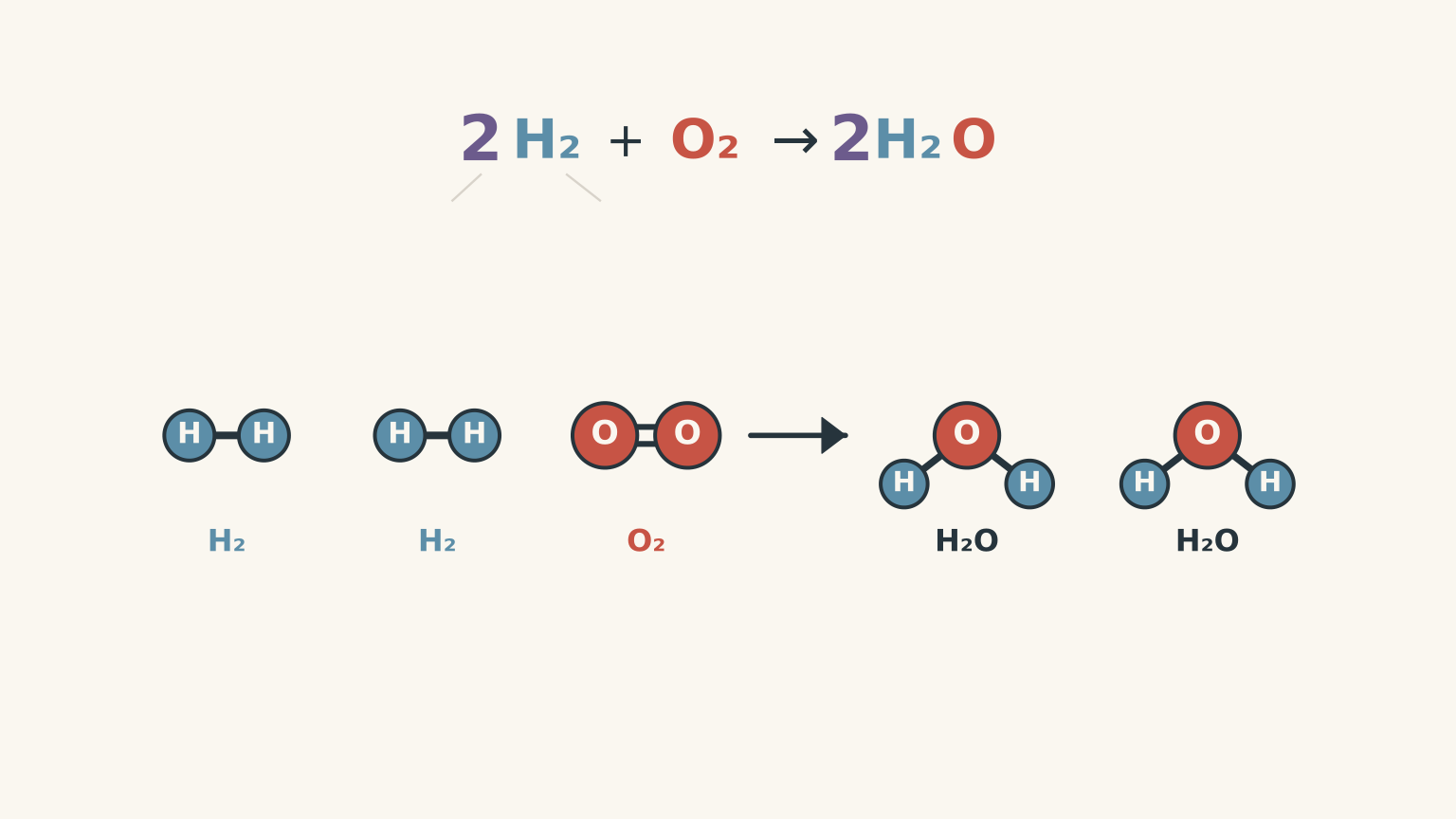
The coefficients tell you that:
- 1 mole of \(\ce{CaCO3}\) reacts with 2 moles of \(\ce{HCl}\).
- 1 mole of \(\ce{CaCO3}\) produces 1 mole of \(\ce{CO2}\).
Notice that the coefficient of calcium carbonate is 1, and the coefficient of carbon dioxide is also 1.
That gives you a 1:1 mole ratio between those two substances.
Predict something: Does the subscript 2 in \(\ce{CO2}\) mean that two moles of carbon dioxide are produced?
No. The subscript tells you that each carbon dioxide molecule contains two oxygen atoms. The coefficient tells you how many molecules, or moles, participate in the reaction.
This distinction is essential. Mole ratios come from coefficients, not subscripts.
Due to technical limitations, this figure may display incorrectly or contain inaccuracies. Please check key details against your course materials.
Also pay attention to the conditions in the question. The same substance can participate in different reactions.
For example:
With hydrochloric acid:
\[ \ce{CaCO3 + 2HCl -> CaCl2 + H2O + CO2} \]
When heated:
\[ \ce{CaCO3 -> CaO + CO2} \]
Both reactions produce carbon dioxide, but the other products are different. Choosing the wrong equation means using the wrong chemical relationships, even if your arithmetic is perfect.
Always use the reaction that matches the question.
2. Convert the known quantity into moles
Once you have the balanced equation, identify what information the question gives you.
The most common conversions are:
| Information given | Formula |
|---|---|
| Mass and molar mass | \(n=\frac{m}{M}\) |
| Concentration and volume | \(n=cV\) |
| Gas volume and molar volume | \(n=\frac{V}{V_m}\) |
The symbols mean:
- \(n\) = amount of substance, in mol.
- \(m\) = mass, in g.
- \(M\) = molar mass, in g mol\(^{-1}\).
- \(c\) = concentration, in mol L\(^{-1}\).
- \(V\) = volume, in L.
- \(V_m\) = molar volume, in L mol\(^{-1}\).
For a mass calculation, you need the molar mass. Calculate it by adding the relative atomic masses of all atoms in the chemical formula.
For a solution calculation, remember that the volume must be in litres when using concentration in mol L\(^{-1}\).
For example:
\[ 25.00\text{ mL}=0.02500\text{ L} \]
Putting 25.00 directly into \(n=cV\) when the concentration is in mol L\(^{-1}\) gives an answer that is 1000 times too large.
Show your conversion rather than silently changing the units.
3. Apply the mole ratio explicitly
This is where many otherwise correct calculations go wrong.
Suppose the balanced equation is:
\[ \ce{H2SO4 + 2NaOH -> Na2SO4 + 2H2O} \]
The coefficients show that:
\[ 1\text{ mol }\ce{H2SO4} : 2\text{ mol }\ce{NaOH} \]
If you know the amount of sulfuric acid, you can calculate the amount of sodium hydroxide using:
\[ n(B)=n(A)\times \frac{\text{coefficient of B}} {\text{coefficient of A}} \]
Here, \(A\) is the known substance and \(B\) is the substance being calculated.
For sulfuric acid and sodium hydroxide:
\[ n(\ce{NaOH})= n(\ce{H2SO4})\times\frac{2}{1} \]
Write this ratio in your working.
Don’t simply multiply by two without showing where the two came from. The balanced equation is the justification.
4. Convert into the quantity requested
After finding the required number of moles, check what the question actually asks for.
| Quantity required | Formula |
|---|---|
| Mass | \(m=nM\) |
| Concentration | \(c=\frac{n}{V}\) |
| Solution volume | \(V=\frac{n}{c}\) |
| Gas volume | \(V=nV_m\) |
For gas calculations, use the molar volume appropriate to the temperature and pressure specified in the question. Do not automatically assume a particular molar volume.
The important idea is that the mole ratio usually gives you an amount in moles. You may need another calculation to reach the final answer.
5. Include units and report a sensible final answer
Units are part of the calculation, not decoration.
They help you identify mistakes before you finish.
For example:
\[ \frac{\mathrm{g}}{\mathrm{g\,mol^{-1}}} =\mathrm{mol} \]
And:
\[ \mathrm{mol\,L^{-1}}\times\mathrm{L} =\mathrm{mol} \]
If your calculation is supposed to produce moles but your units do not simplify to mol, revisit your formula or substitution.
A few other habits are worth developing:
- Carry extra decimal places through intermediate calculations.
- Round only your final answer.
- Match significant figures to the precision of the supplied data.
- Include the appropriate unit in your final answer.
- If the question asks for a mass, don’t finish with an answer in moles.
You do not need to write every calculator button you press. You do need to show the formula, substitution, important intermediate values, and final result.
02Worked examples
Let’s put the method into practice.
Worked example: Calculating the mass of carbon dioxide
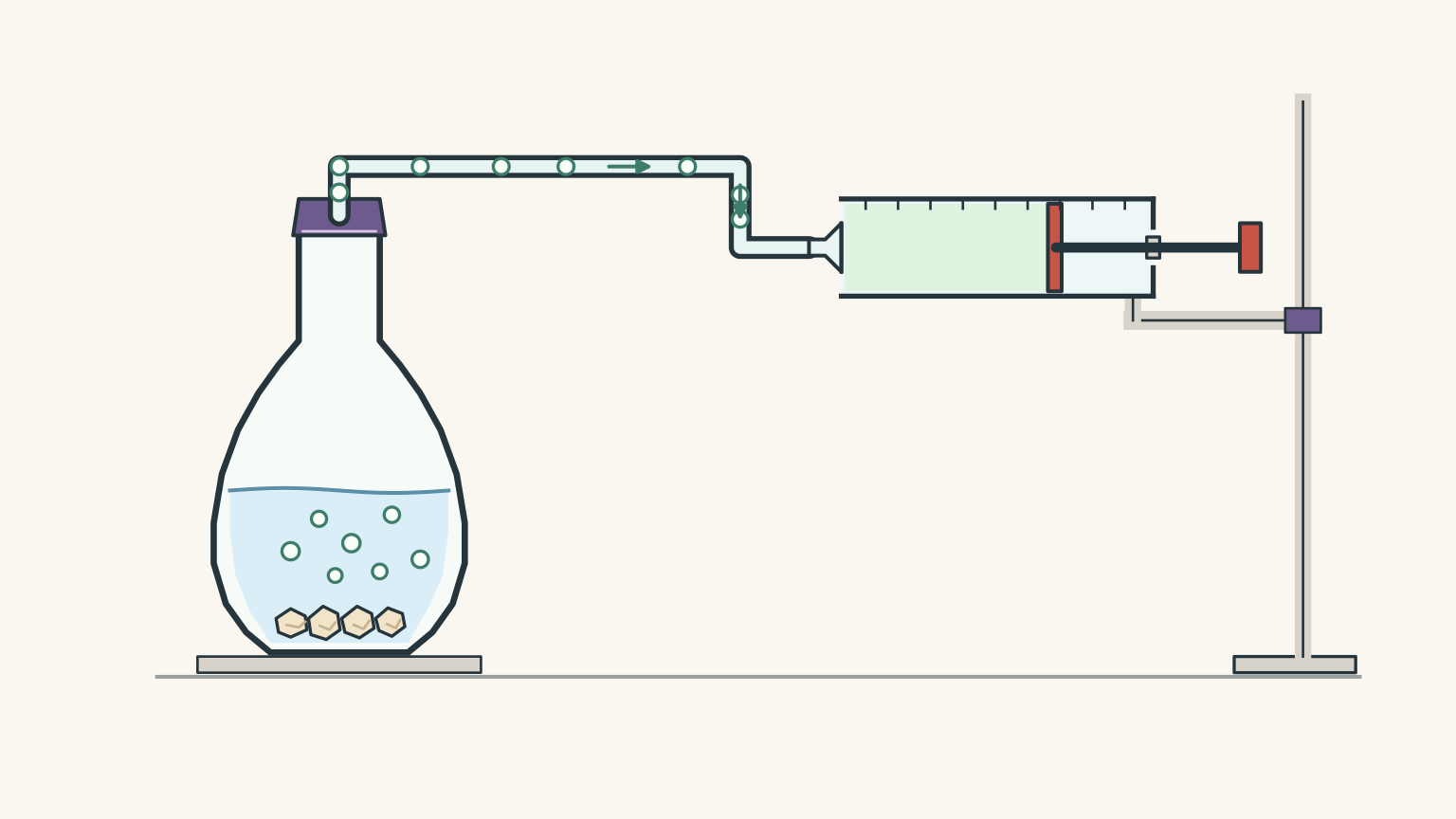
A 5.00 g sample of calcium carbonate reacts completely with excess hydrochloric acid. Calculate the mass of carbon dioxide produced.
Use:
- Molar mass of \(\ce{CaCO3}\) = 100.1 g mol\(^{-1}\).
- Molar mass of \(\ce{CO2}\) = 44.01 g mol\(^{-1}\).
Step 1
\[ \ce{CaCO3 + 2HCl -> CaCl2 + H2O + CO2} \]
The equation shows a 1:1 mole ratio between calcium carbonate and carbon dioxide.
Step 2
We are given the mass, so use:
\[ n=\frac{m}{M} \]
Substitute:
\[ n(\ce{CaCO3})= \frac{5.00}{100.1} \]
\[ =0.04995\text{ mol} \]
Step 3
From the balanced equation:
\[ 1\text{ mol }\ce{CaCO3} : 1\text{ mol }\ce{CO2} \]
Therefore:
\[ n(\ce{CO2})=0.04995\text{ mol} \]
Step 4
Use:
\[ m=nM \]
Substitute:
\[ m(\ce{CO2})=0.04995\times44.01 \]
\[ =2.198\text{ g} \]
Step 5
\[ \boxed{m(\ce{CO2})=2.20\text{ g}} \]
The reaction produces 2.20 g of carbon dioxide.
Notice that we could use the full 5.00 g of calcium carbonate because hydrochloric acid is in excess. All the calcium carbonate reacts.
Due to technical limitations, this figure may display incorrectly or contain inaccuracies. Please check key details against your course materials.
Worked example: Calculating the mass of sodium hydroxide
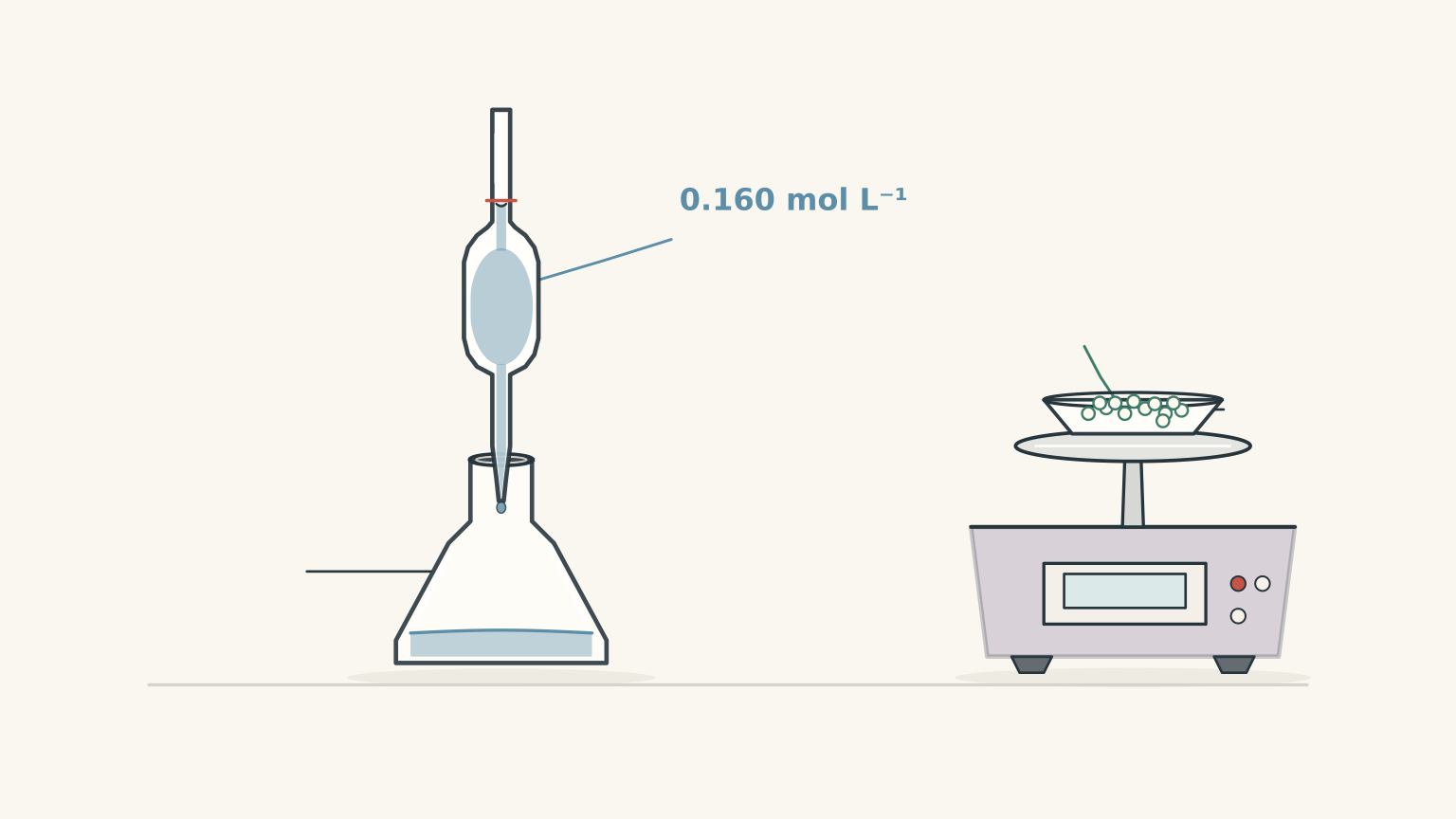
A student has 25.00 mL of 0.160 mol L\(^{-1}\) sulfuric acid. Calculate the mass of sodium hydroxide required to neutralise it completely.
Use a molar mass of 40.00 g mol\(^{-1}\) for \(\ce{NaOH}\).
Step 1
\[ \ce{H2SO4 + 2NaOH -> Na2SO4 + 2H2O} \]
The equation tells us that one mole of sulfuric acid reacts with two moles of sodium hydroxide.
This ratio is important because sulfuric acid can donate two hydrogen ions per molecule.
Step 2
\[ 25.00\text{ mL}=0.02500\text{ L} \]
Step 3
We know the concentration and volume, so use:
\[ n=cV \]
Substitute:
\[ n(\ce{H2SO4})= 0.160\times0.02500 \]
\[ =0.00400\text{ mol} \]
Step 4
From the equation:
\[ n(\ce{NaOH})= 0.00400\times\frac{2}{1} \]
\[ =0.00800\text{ mol} \]
Step 5
Use:
\[ m=nM \]
Substitute:
\[ m(\ce{NaOH})= 0.00800\times40.00 \]
\[ =0.320\text{ g} \]
Step 6
\[ \boxed{m(\ce{NaOH})=0.320\text{ g}} \]
You need 0.320 g of sodium hydroxide to completely neutralise the sulfuric acid.
This calculation involves more decisions than the first example. You had to convert millilitres into litres, use concentration to find moles, apply a 1:2 mole ratio, and then convert moles into mass.
That is exactly why writing every important step matters.
Due to technical limitations, this figure may display incorrectly or contain inaccuracies. Please check key details against your course materials.
03What does a complete calculation look like to a marker?
There is no universal rule that one calculation line earns one mark. The marking criteria depend on the particular question.
However, a strong response should make the following evidence visible.
An illustrative marking guide
This is an original teaching checklist, not an official NESA mark allocation.
| Evidence being assessed | What your working should show |
|---|---|
| Correct reaction | Appropriate chemical equation and balanced coefficients |
| Correct initial conversion | Formula, substitution, units, and calculated moles |
| Correct mole ratio | Explicit use of the coefficients in the balanced equation |
| Correct final conversion | Appropriate formula and substitution for the requested quantity |
| Correct reporting | Final answer, appropriate units, and sensible significant figures |
For example, compare these two responses to the calcium carbonate question.
Response A:
\[ 2.20\text{ g} \]
Response B:
\[ \ce{CaCO3 + 2HCl -> CaCl2 + H2O + CO2} \]
\[ n(\ce{CaCO3})=\frac{5.00}{100.1} =0.04995\text{ mol} \]
\[ n(\ce{CO2})=0.04995\times\frac{1}{1} =0.04995\text{ mol} \]
\[ m(\ce{CO2})=0.04995\times44.01 =2.20\text{ g} \]
Response B makes the reasoning visible. If the final answer were incorrect because of an arithmetic error, the earlier steps would still show which parts of the method were correct.
That is the point of showing working. You are communicating your chemistry, not simply displaying a calculator result.
04Common mistakes in HSC Chemistry calculations
Before attempting the practice questions, look out for these mistakes.
Using the wrong mole ratio
A balanced equation might show a 1:2 ratio between two substances.
Do not automatically use a 1:1 ratio just because you have calculated the moles of one reactant.
Always return to the equation.
Confusing coefficients with subscripts
In:
\[ \ce{H2SO4 + 2NaOH -> Na2SO4 + 2H2O} \]
The coefficient of sodium hydroxide is 2. The subscript 2 in sulfuric acid is part of its chemical formula.
The coefficient determines the mole ratio.
Forgetting to convert millilitres into litres
When using \(n=cV\), make sure the volume is in litres if concentration is in mol L\(^{-1}\).
This is one of the easiest mistakes to make under exam pressure.
Using the mass of an impure sample directly
If a question gives percentage purity, calculate the mass of the actual substance first.
For example, an 80.0% pure 10.0 g sample contains:
\[ 10.0\times0.800=8.00\text{ g} \]
You must use 8.00 g in the mole calculation, not 10.0 g.
Ignoring the limiting reagent
If a question gives quantities of two reactants, you cannot automatically assume that both react completely.
You must determine which reactant runs out first. This is the limiting reagent.
The amount of product is determined by the limiting reagent, not necessarily by whichever reactant appears first in the equation.
Rounding too early
Keep additional decimal places during intermediate calculations.
If you round the number of moles too aggressively, small errors can accumulate through a multi-step calculation.
Round your final answer to an appropriate number of significant figures.
05Questions and solutions
The following questions progress from a standard HSC calculation to more challenging problems involving purity, limiting reagents, titration, and mixtures.
Try each question before reading its solution. Pay particular attention to the information that must appear between the starting data and the final answer.
Question 1
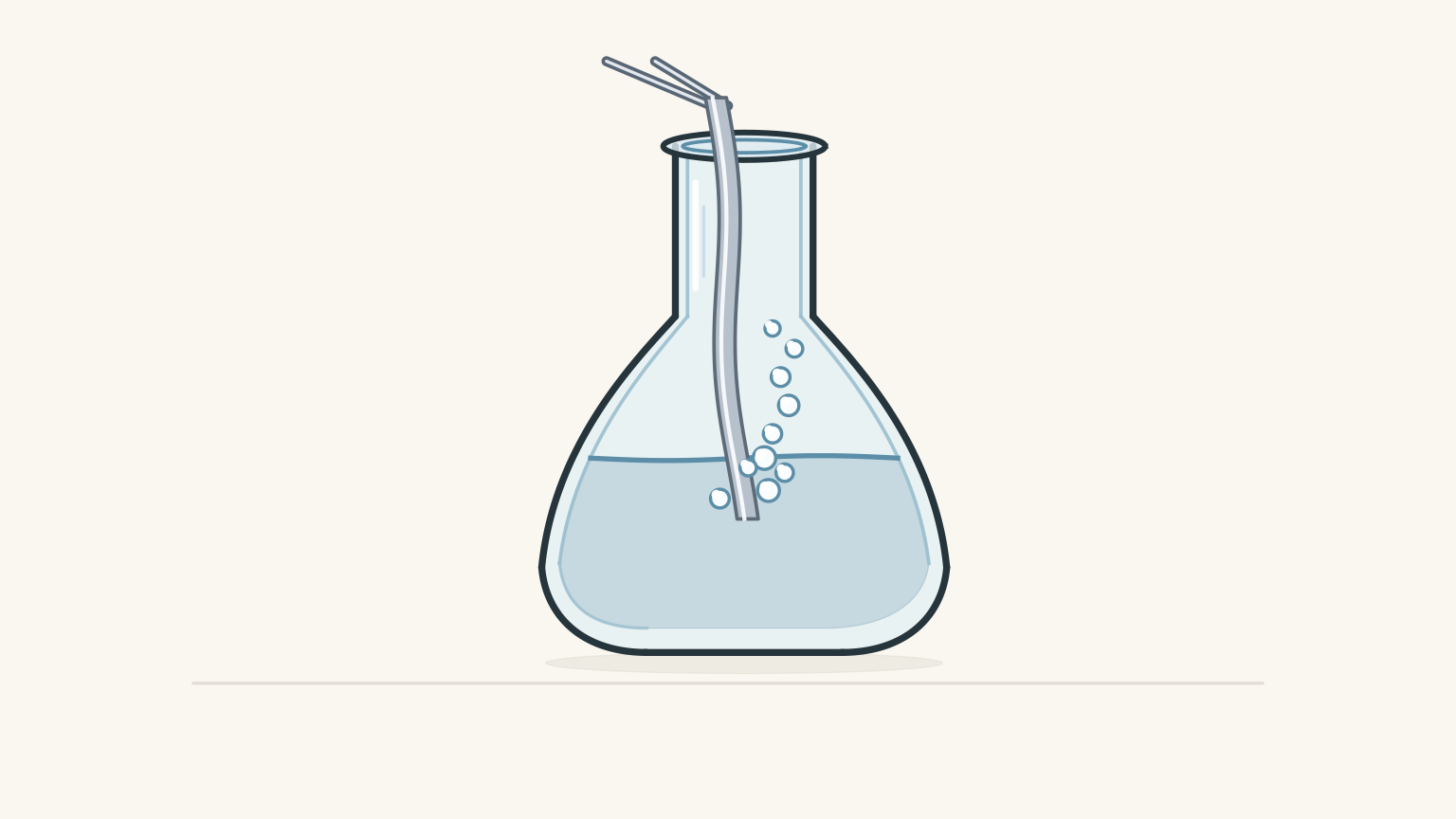
A 3.60 g strip of magnesium reacts completely with excess hydrochloric acid.
Calculate the mass of magnesium chloride produced.
Use:
- \(M(\ce{Mg})=24.3\text{ g mol}^{-1}\)
- \(M(\ce{MgCl2})=95.2\text{ g mol}^{-1}\)
Due to technical limitations, this figure may display incorrectly or contain inaccuracies. Please check key details against your course materials.
Solution 1
The mass of magnesium chloride produced is 14.1 g.
We need to convert the magnesium mass into moles, use the balanced equation to find the moles of magnesium chloride, and then calculate its mass.
Step 1: Write the balanced equation.
\[ \ce{Mg + 2HCl -> MgCl2 + H2} \]
The mole ratio between magnesium and magnesium chloride is 1:1.
Step 2: Calculate the moles of magnesium.
\[ n=\frac{m}{M} \]
\[ n(\ce{Mg})=\frac{3.60}{24.3} \]
\[ =0.148\text{ mol} \]
Step 3: Apply the mole ratio.
\[ n(\ce{MgCl2})= 0.148\times\frac{1}{1} \]
\[ =0.148\text{ mol} \]
Step 4: Calculate the mass of magnesium chloride.
\[ m=nM \]
\[ m(\ce{MgCl2})=0.148148\ldots\times95.2 \]
\[ =14.1\text{ g} \]
The final answer is:
\[ \boxed{14.1\text{ g}} \]
Notice that the coefficient of hydrochloric acid is 2, but the coefficient of magnesium chloride is 1.
You should not use the 1:2 ratio when calculating the product from magnesium. The relevant ratio is magnesium to magnesium chloride, which is 1:1.
Question 2
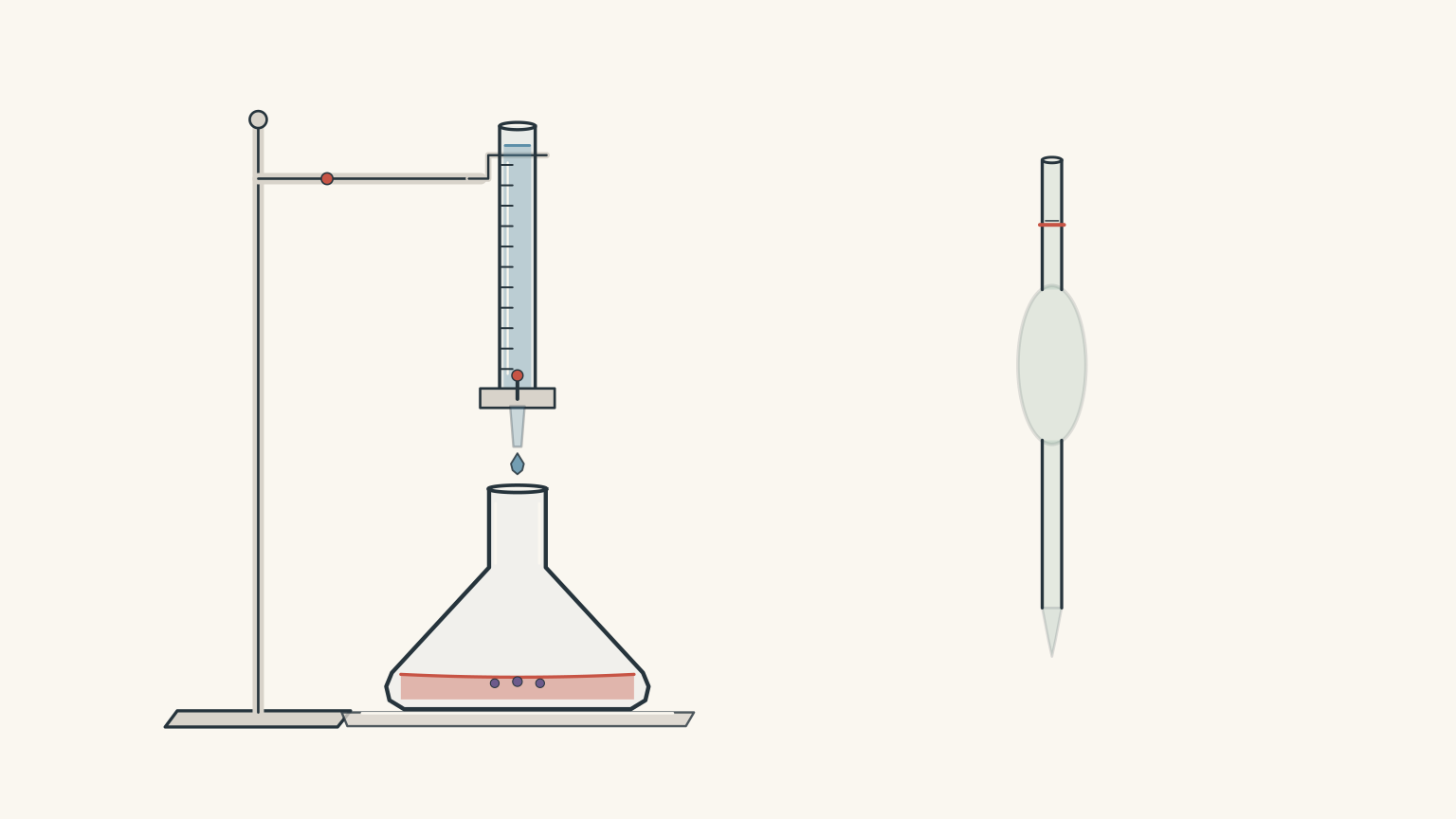
A student uses a 25.00 mL sample of sulfuric acid with a concentration of 0.180 mol L\(^{-1}\).
The acid is titrated with sodium hydroxide solution of concentration 0.150 mol L\(^{-1}\).
Calculate the volume of sodium hydroxide required for complete neutralisation.
Due to technical limitations, this figure may display incorrectly or contain inaccuracies. Please check key details against your course materials.
Solution 2
The volume of sodium hydroxide required is 60.0 mL.
This calculation requires three stages: finding the acid moles, applying the mole ratio, and converting the sodium hydroxide moles into a solution volume.
Step 1: Write the balanced equation.
\[ \ce{H2SO4 + 2NaOH -> Na2SO4 + 2H2O} \]
The mole ratio is:
\[ \ce{H2SO4}:\ce{NaOH}=1:2 \]
Step 2: Convert the acid volume into litres.
\[ 25.00\text{ mL}=0.02500\text{ L} \]
Step 3: Calculate the moles of sulfuric acid.
\[ n=cV \]
\[ n(\ce{H2SO4})= 0.180\times0.02500 \]
\[ =0.00450\text{ mol} \]
Step 4: Calculate the moles of sodium hydroxide.
\[ n(\ce{NaOH})= 0.00450\times\frac{2}{1} \]
\[ =0.00900\text{ mol} \]
Step 5: Calculate the volume of sodium hydroxide.
Rearrange the concentration formula:
\[ V=\frac{n}{c} \]
Substitute:
\[ V(\ce{NaOH})= \frac{0.00900}{0.150} \]
\[ =0.0600\text{ L} \]
Convert to millilitres:
\[ 0.0600\times1000=60.0\text{ mL} \]
Therefore:
\[ \boxed{V(\ce{NaOH})=60.0\text{ mL}} \]
The volume is greater than the original acid volume because the sodium hydroxide solution is less concentrated, and two moles of sodium hydroxide are required for every mole of sulfuric acid.
Question 3
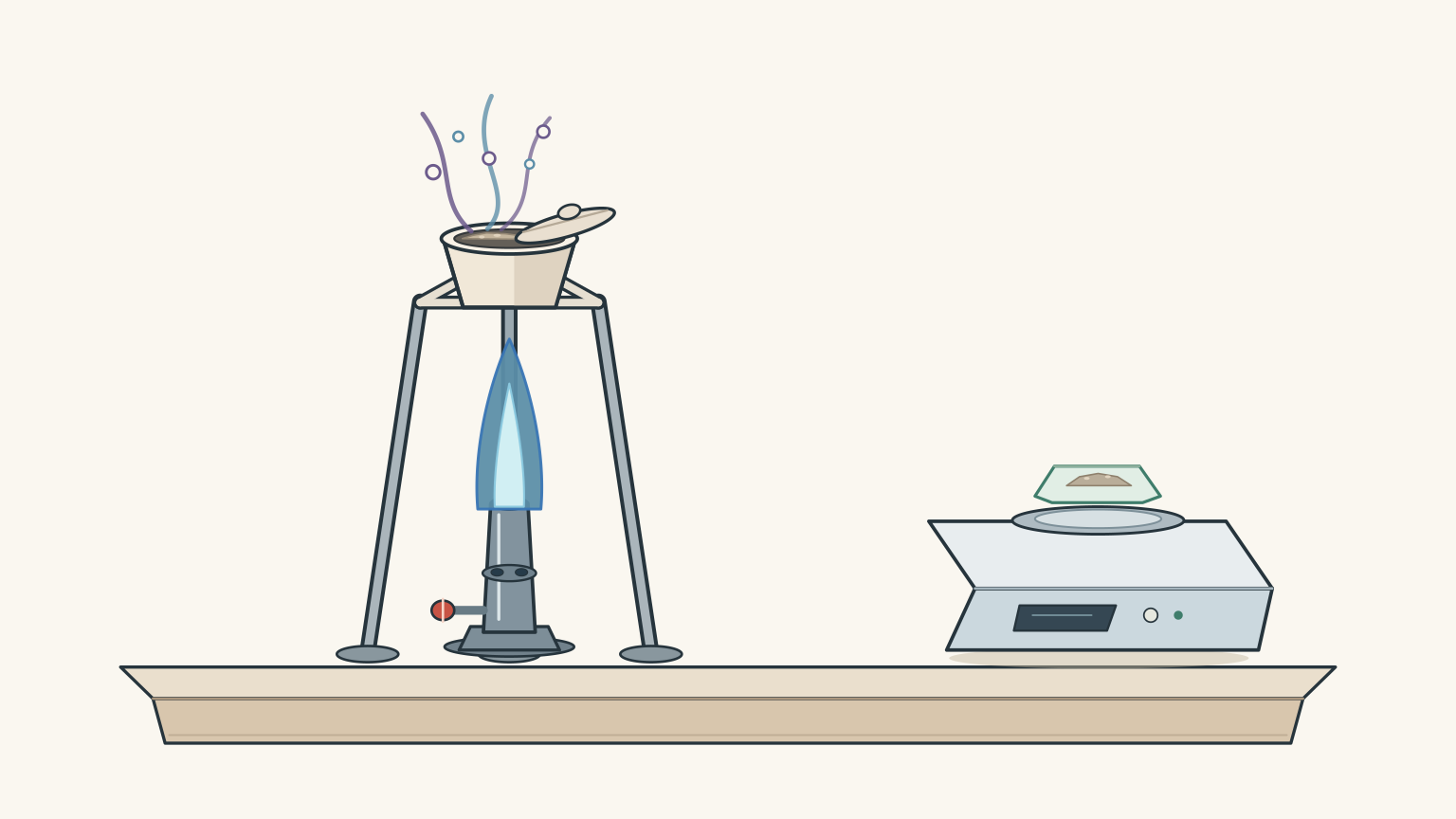
A limestone sample has a total mass of 8.00 g and contains 87.5% calcium carbonate by mass.
The sample is heated until all the calcium carbonate decomposes.
Calculate the mass of carbon dioxide released.
Explain why the total sample mass cannot be used directly in the mole calculation.
Use:
- \(M(\ce{CaCO3})=100.1\text{ g mol}^{-1}\)
- \(M(\ce{CO2})=44.01\text{ g mol}^{-1}\)
Assume all other substances in the sample are inert.
Due to technical limitations, this figure may display incorrectly or contain inaccuracies. Please check key details against your course materials.
Solution 3
The sample releases 3.08 g of carbon dioxide. Only 87.5% of the original sample is calcium carbonate, so the impurity mass must be excluded before calculating moles.
Step 1: Write the balanced decomposition equation.
\[ \ce{CaCO3 -> CaO + CO2} \]
The mole ratio between calcium carbonate and carbon dioxide is 1:1.
Step 2: Calculate the actual mass of calcium carbonate.
Percentage purity is:
\[ \%\text{ purity}= \frac{\text{mass of pure substance}} {\text{total sample mass}}\times100 \]
Rearranging:
\[ m(\ce{CaCO3})= 8.00\times\frac{87.5}{100} \]
\[ =7.00\text{ g} \]
Step 3: Calculate the moles of calcium carbonate.
\[ n=\frac{m}{M} \]
\[ n(\ce{CaCO3})= \frac{7.00}{100.1} \]
\[ =0.06993\text{ mol} \]
Step 4: Apply the mole ratio.
\[ n(\ce{CO2})= 0.06993\times\frac{1}{1} \]
\[ =0.06993\text{ mol} \]
Step 5: Calculate the mass of carbon dioxide.
\[ m=nM \]
\[ m(\ce{CO2})= 0.06993\times44.01 \]
\[ =3.078\text{ g} \]
Therefore:
\[ \boxed{m(\ce{CO2})=3.08\text{ g}} \]
The original 8.00 g includes 1.00 g of inert impurities. Those impurities do not contribute to the carbon dioxide produced.
Using the full sample mass would overestimate the amount of calcium carbonate and therefore the amount of carbon dioxide.
Question 4
A reaction mixture contains 0.0300 mol of sodium carbonate and 0.0500 mol of hydrochloric acid.
The reaction is:
\[ \ce{Na2CO3 + 2HCl -> 2NaCl + H2O + CO2} \]
(a) Identify the limiting reagent.
(b) Calculate the mass of carbon dioxide produced.
(c) A student calculates the carbon dioxide amount using all 0.0300 mol of sodium carbonate. Explain why this is incorrect.
Use \(M(\ce{CO2})=44.01\text{ g mol}^{-1}\).
Solution 4
Hydrochloric acid is the limiting reagent, and 1.10 g of carbon dioxide is produced. Although sodium carbonate and carbon dioxide have a 1:1 mole ratio, not all the sodium carbonate can react because there is insufficient hydrochloric acid.
Step 1: Identify the mole ratio.
From the balanced equation:
\[ 1\text{ mol }\ce{Na2CO3} : 2\text{ mol }\ce{HCl} \]
To completely react with 0.0300 mol of sodium carbonate, the required amount of hydrochloric acid would be:
\[ n(\ce{HCl})= 0.0300\times\frac{2}{1} \]
\[ =0.0600\text{ mol} \]
However, only 0.0500 mol is available.
Therefore, hydrochloric acid is the limiting reagent.
Step 2: Calculate the amount of sodium carbonate that actually reacts.
Using the available hydrochloric acid:
\[ n(\ce{Na2CO3})= 0.0500\times\frac{1}{2} \]
\[ =0.0250\text{ mol} \]
There was initially 0.0300 mol of sodium carbonate, so 0.0050 mol remains unreacted.
Step 3: Calculate the moles of carbon dioxide.
The mole ratio between hydrochloric acid and carbon dioxide is 2:1.
\[ n(\ce{CO2})= 0.0500\times\frac{1}{2} \]
\[ =0.0250\text{ mol} \]
Step 4: Calculate the mass of carbon dioxide.
\[ m=nM \]
\[ m(\ce{CO2})= 0.0250\times44.01 \]
\[ =1.10025\text{ g} \]
Therefore:
\[ \boxed{m(\ce{CO2})=1.10\text{ g}} \]
Why the student’s method is incorrect
The student has correctly identified a 1:1 ratio between sodium carbonate and carbon dioxide.
The problem is the assumption that all the sodium carbonate reacts.
The 0.0300 mol of sodium carbonate would produce 0.0300 mol of carbon dioxide only if there were enough hydrochloric acid to react with all of it.
There isn’t.
The limiting reagent determines the maximum amount of product. In this case, hydrochloric acid runs out first, so the calculation must begin with the 0.0500 mol of hydrochloric acid.
Question 5
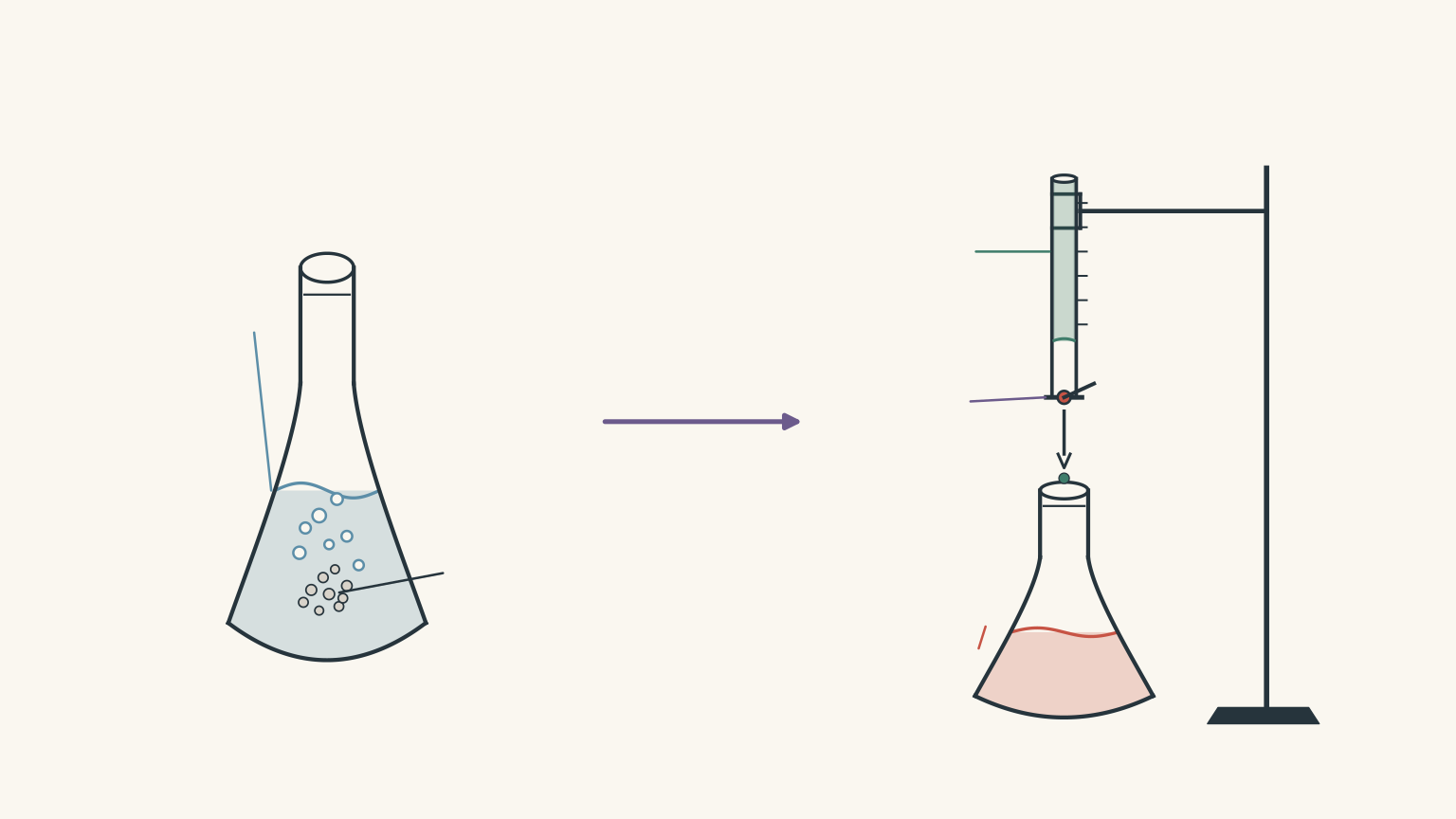
A 2.00 g solid sample contains only magnesium and magnesium oxide.
The sample is added to 250.0 mL of 0.500 mol L\(^{-1}\) hydrochloric acid. Both solids react completely.
The reactions are:
\[ \ce{Mg + 2HCl -> MgCl2 + H2} \]
\[ \ce{MgO + 2HCl -> MgCl2 + H2O} \]
After the reactions are complete, the excess hydrochloric acid is neutralised by adding 25.00 mL of 0.200 mol L\(^{-1}\) sodium hydroxide.
Calculate the percentage by mass of magnesium in the original sample.
A student argues that the amount of hydrochloric acid consumed can be used directly to calculate the amount of magnesium.
Explain why this reasoning is incomplete.
Assume:
- Both magnesium and magnesium oxide react completely.
- The entire remaining acid is accounted for by the neutralisation measurement.
- No other reactions occur.
- The acid-base neutralisation is represented by a 1:1 mole ratio.
Use:
- \(M(\ce{Mg})=24.3\text{ g mol}^{-1}\)
- \(M(\ce{MgO})=40.3\text{ g mol}^{-1}\)
Due to technical limitations, this figure may display incorrectly or contain inaccuracies. Please check key details against your course materials.
Solution 5
The original sample contains 31.7% magnesium by mass.
The important point is that magnesium and magnesium oxide both consume two moles of hydrochloric acid per mole of solid. The titration therefore tells us the combined amount of the two substances, not the amount of magnesium alone.
We need to use the acid consumption and the total sample mass as two independent pieces of information.
Step 1: Calculate the initial moles of hydrochloric acid.
Convert the volume:
\[ 250.0\text{ mL}=0.2500\text{ L} \]
Use:
\[ n=cV \]
\[ n(\ce{HCl})_{\text{initial}} =0.500\times0.2500 \]
\[ =0.1250\text{ mol} \]
Step 2: Calculate the moles of sodium hydroxide used in the titration.
\[ n=cV \]
\[ n(\ce{NaOH})= 0.200\times0.02500 \]
\[ =0.005000\text{ mol} \]
The neutralisation reaction is:
\[ \ce{HCl + NaOH -> NaCl + H2O} \]
The mole ratio is 1:1.
Therefore, the remaining hydrochloric acid is:
\[ n(\ce{HCl})_{\text{remaining}} =0.005000\text{ mol} \]
Step 3: Calculate the hydrochloric acid consumed by the original sample.
\[ n(\ce{HCl})_{\text{consumed}} = 0.1250-0.005000 \]
\[ =0.1200\text{ mol} \]
Step 4: Determine the combined moles of magnesium and magnesium oxide.
Look at the two original reactions.
\[ \ce{Mg + 2HCl -> MgCl2 + H2} \]
\[ \ce{MgO + 2HCl -> MgCl2 + H2O} \]
Both reactions consume two moles of hydrochloric acid per mole of solid.
Therefore:
\[ n(\ce{Mg})+n(\ce{MgO}) = \frac{0.1200}{2} \]
\[ =0.06000\text{ mol} \]
This is the first important relationship.
Step 5: Set up a second equation using the total sample mass.
Let:
- \(x\) = moles of magnesium.
- \(y\) = moles of magnesium oxide.
We know:
\[ x+y=0.06000 \]
We also know that the total sample mass is 2.00 g.
Using mass = moles × molar mass:
\[ 24.3x+40.3y=2.00 \]
We now have two simultaneous equations:
\[ x+y=0.06000 \]
\[ 24.3x+40.3y=2.00 \]
Step 6: Solve for the amount of magnesium oxide.
From the first equation:
\[ x=0.06000-y \]
Substitute into the mass equation:
\[ 24.3(0.06000-y)+40.3y=2.00 \]
Expand:
\[ 1.458-24.3y+40.3y=2.00 \]
Collect terms:
\[ 16.0y=0.542 \]
\[ y=0.033875\text{ mol} \]
Now calculate the moles of magnesium:
\[ x=0.06000-0.033875 \]
\[ x=0.026125\text{ mol} \]
Step 7: Calculate the mass of magnesium.
\[ m=nM \]
\[ m(\ce{Mg})= 0.026125\times24.3 \]
\[ =0.6348\text{ g} \]
Step 8: Calculate the percentage by mass.
\[ \%\ce{Mg}= \frac{m(\ce{Mg})} {m(\text{original sample})}\times100 \]
Substitute:
\[ \%\ce{Mg}= \frac{0.6348}{2.00}\times100 \]
\[ =31.74\% \]
Therefore:
\[ \boxed{\%\ce{Mg}=31.7\%} \]
Why the student’s reasoning is incomplete
The student correctly recognises that the hydrochloric acid consumption can be used to calculate the total amount of solid that reacted.
However, the student cannot assume that all the hydrochloric acid reacted with magnesium.
Magnesium oxide also reacts with hydrochloric acid, and it consumes exactly the same number of moles of acid per mole of solid.
This creates the crucial distinction:
- The titration determines the combined moles of magnesium and magnesium oxide.
- The total sample mass provides a second independent relationship.
- Together, these two relationships allow us to determine the individual amounts.
If you assumed that all 0.06000 mol of solid was magnesium, its calculated mass would only be 1.458 g. That contradicts the known 2.00 g sample mass.
The remaining mass must be accounted for by magnesium oxide.
This is why the second equation is essential. The titration alone cannot distinguish between the two substances.
06Where to take your calculation skills next
The most useful habit to develop is recognising that a chemistry calculation is rarely just about choosing a formula.
You need to identify the reaction, understand the quantities involved, and decide which relationships connect the information to the answer.
Once that becomes routine, more complicated problems become manageable. You can apply the same approach to dilution, titration, percentage purity, limiting reagents, reaction yields, and calorimetry.
For more practice:
- Solution dilution calculations for HSC Chemistry explores concentration and volume relationships.
- Heat of Combustion: Calculations for HSC Chemistry applies multi-step calculations to energy released during combustion.
- What Is Working Scientifically in HSC Physics and Chemistry? explores the broader skill of communicating scientific methods and reasoning.
When you practise, don’t just check whether your final number is correct. Check whether someone else could follow your equation choice, mole conversions, ratios, and units without having to guess what you did.
That is what good HSC Chemistry working should achieve.