
How to Answer 4-6 Mark HSC Physics Questions: Examples
Learn how to structure strong 4-6 mark HSC Physics responses using clear scientific reasoning, annotated worked examples, and challenging practice questions with detailed solutions.
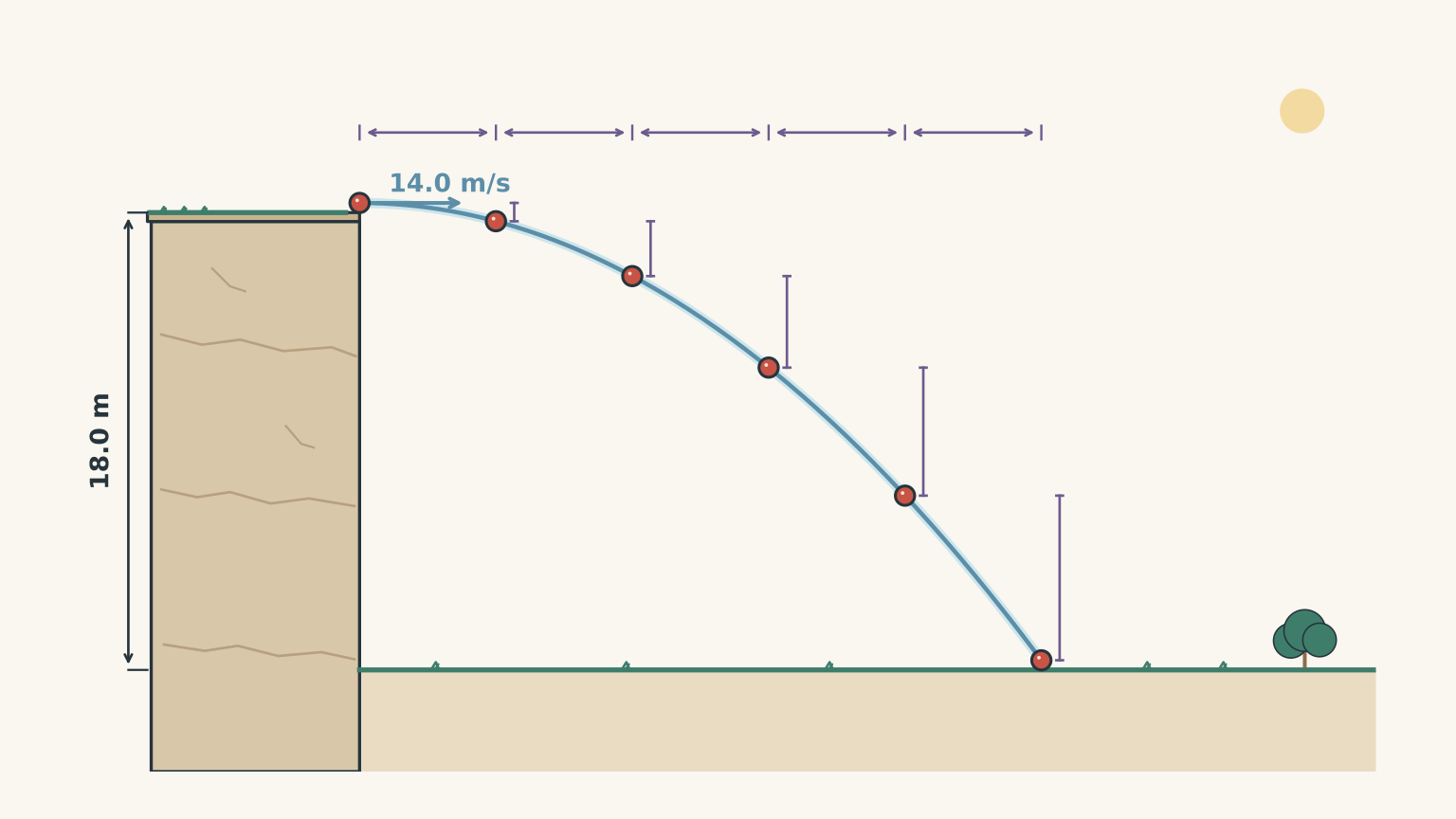
A ball leaves a ledge 18.0 m above the ground at 14.0 m/s, horizontally. Before calculating, predict: if its launch speed doubled, would the time taken to hit the ground also double?
No. Assuming air resistance is negligible, the vertical motion determines how long the ball takes to fall. Its horizontal speed determines how far it travels during that time.
That distinction is simple to understand, but explaining it properly takes a few linked steps. This is exactly what a 4-6 mark HSC Physics question tests: can you identify the relevant physics, apply it to the situation, and explain why the result follows?
The difference between a response that sounds scientific and one that demonstrates genuine understanding is often the reasoning between two statements.
Due to technical limitations, this figure may display incorrectly or contain inaccuracies. Please check key details against your course materials.
01What does a strong 4-6 mark Physics answer look like?
A common mistake is to assume that a six-mark question needs six sentences, or that writing more automatically means earning more marks.
Neither is true.
A strong response makes four things clear:
- The answer: Directly address what the question is asking.
- The physics principle: Identify the relevant law, relationship, or model.
- The application: Explain how that principle operates under the specific conditions in the question.
- The evidence: Support the explanation with calculations, units, directions, observations, or information from the supplied stimulus.
Think of these as links in a chain. If one is missing, the conclusion might be correct, but the reasoning supporting it is incomplete.
For example, consider a satellite travelling in a circular orbit.
An incomplete response might say:
“Gravity keeps the satellite moving in a circular orbit.”
This identifies the relevant force, but doesn’t explain how gravity produces circular motion.
A stronger response would say:
“Earth’s gravitational force acts towards its centre and provides the resultant centripetal force on the satellite. This produces an acceleration directed towards the centre of the orbit, continuously changing the direction of the satellite’s velocity. Because this acceleration is perpendicular to its instantaneous velocity, its speed remains constant in a circular orbit.”
Notice the difference. The second response explains the cause, the physical mechanism, and the resulting motion.
You don’t need complicated vocabulary to do this. You need to connect the physics correctly.
What NESA’s marking feedback tells us
NESA’s 2025 HSC Physics marking feedback specifically highlights several features of stronger responses:
- Logical sequencing of information.
- Accurate scientific terminology.
- Clear cause-and-effect relationships.
- Proper use of information in the supplied stimulus.
- Full working in calculations, including formulas and substitution.
- Correct units and directions for vector quantities.
- Answers that address every part of the question.
It also identifies common problems, including general statements without sufficient detail, incomplete explanations, and calculations without clear working.
One important distinction: NESA’s marking guidelines identify criteria for individual marks or mark ranges. Sample answers are not necessarily complete or exemplary responses. There is no universal rule that one sentence equals one mark.
You can read the official feedback in the 2025 HSC Physics exam pack.
02Start by unpacking the question
Before writing anything, spend a few seconds identifying exactly what the question requires.
A useful approach is to separate four things.
1. The command verb
What are you being asked to do? Calculate, explain, describe, analyse, or evaluate?
2. The physical situation
Which object or system are you discussing? What is happening to it?
3. The conditions
Are there assumptions such as negligible air resistance, constant velocity, a uniform magnetic field, or a frictionless surface?
4. The required outcome
Are you finding a numerical value, explaining a change, comparing two situations, or making a judgement?
A question can contain several requirements. Don’t answer only the first one you notice.
Command verbs: what changes in your answer?
You don’t need to memorise an entirely new response structure for every command verb. However, you do need to understand what each one demands.
| Command verb | What your response needs to do |
|---|---|
| Describe | Identify relevant features or explain what happens in the correct sequence. |
| Explain | Establish the cause-and-effect relationship using relevant physics. |
| Analyse | Examine relationships, patterns, or evidence to establish how different features are connected. |
| Evaluate / Assess | Make a supported judgement using relevant evidence and criteria. |
| Calculate | Show the formula, substitution, working, units, and final result. |
| Justify | Give a conclusion and support it with appropriate physical reasoning or evidence. |
Pay particular attention to the difference between describe and explain.
Suppose a question asks you to explain why a current is induced in a coil when a magnet moves towards it.
A description might say:
“The magnet approaches the coil, and a current is produced.”
An explanation needs another layer:
“As the magnet approaches, the magnetic flux through the coil changes. According to Faraday’s law, this changing magnetic flux induces an electromotive force (emf), which produces a current in the closed circuit.”
The second answer explains why the observation occurs.
03Build the physics reasoning before writing
For an explanation question, organise your thinking in this order:
Physical condition → governing principle → resulting interaction or change → observed outcome.
This prevents you from jumping straight from a fact to a conclusion.
Consider three examples.
| Situation | Governing physics | Result |
|---|---|---|
| A net force acts on an object. | Newton’s second law: the resultant force produces acceleration. | The object’s velocity changes. |
| A satellite travels in a circular orbit. | Gravity provides the centripetal resultant force. | The satellite’s velocity continuously changes direction. |
| A magnet moves relative to a conducting coil. | Faraday’s law links induced emf to changing magnetic flux. | An emf and, in a closed circuit, an induced current are produced. |
The important part is understanding the connection.
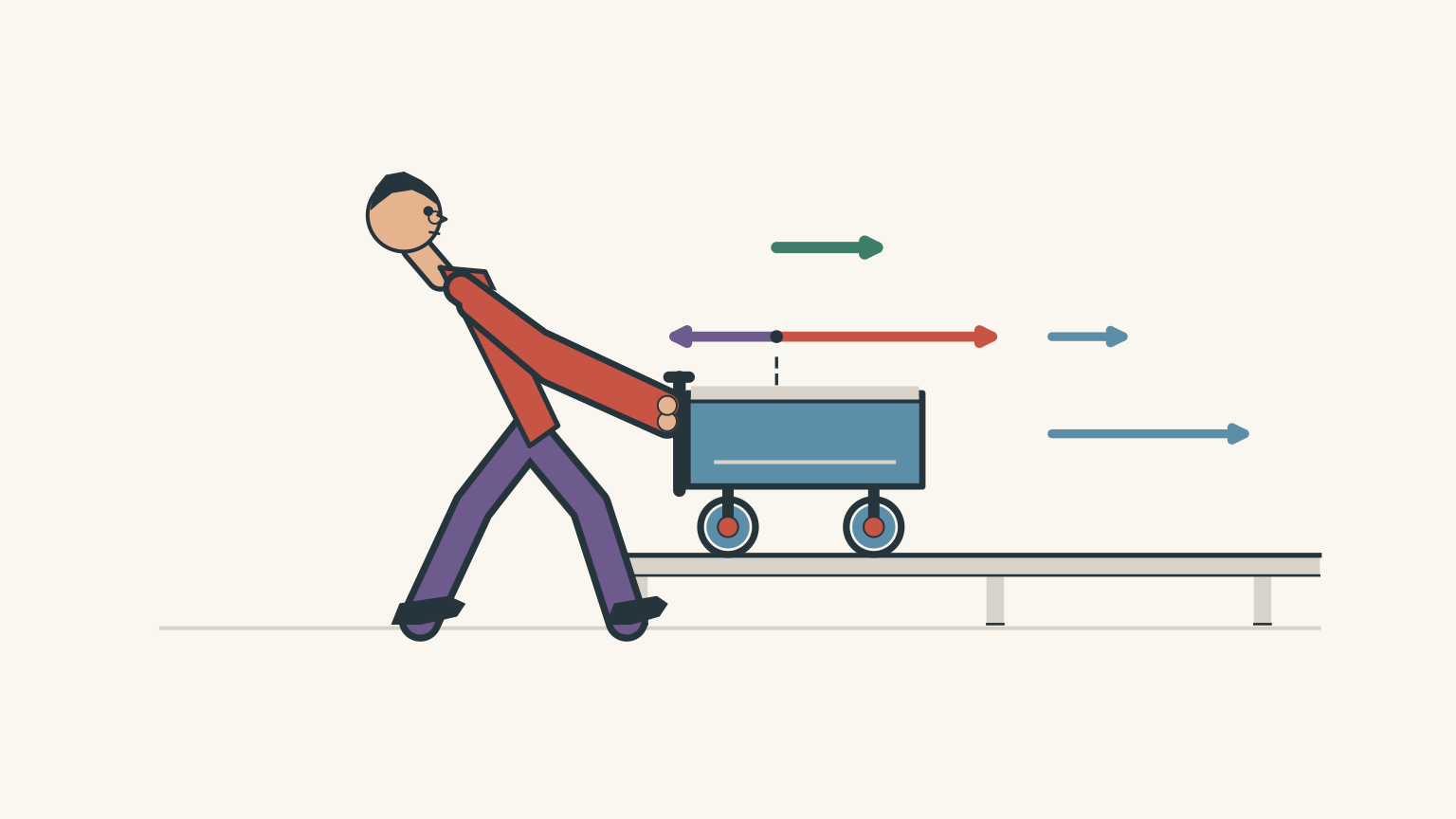
For instance, Newton’s second law is not simply a formula to insert numbers into. It tells you that the acceleration of an object depends on its resultant force and mass:
\[ F_{\text{net}}=ma \]
Here, \(F_{\text{net}}\) is the resultant force in newtons, \(m\) is mass in kilograms, and \(a\) is acceleration in metres per second squared.
If the question asks why an object accelerates, you must explain what produces its resultant force. Quoting \(F=ma\) alone doesn’t establish that.
Due to technical limitations, this figure may display incorrectly or contain inaccuracies. Please check key details against your course materials.
A useful rule for calculation questions
A calculation can also be a form of extended reasoning.
Don’t jump straight to the calculator. Make the mathematical model visible.
Use this sequence:
- Identify the known quantities and the unknown.
- Select an equation that describes the relevant physical relationship.
- Rearrange the equation if necessary.
- Substitute values with units.
- Calculate the result.
- State what the result means, including its direction where relevant.
For example, if you calculate an acceleration of \(3.0\ \mathrm{m\,s^{-2}}\), don’t simply write the number. Explain whether the acceleration is forwards, backwards, upwards, or downwards if the question requires that information.
Also, distinguish between quantities that sound similar. Speed is a scalar; velocity includes direction. A force has both magnitude and direction.
If a question supplies a constant that differs from the value on your formula sheet, pay attention to the question’s instructions. The tutorgum guide Which Physics Constants Should You Use in HSC Questions? explains how to handle that situation.
04Worked example 1: Projectile motion from a horizontal platform
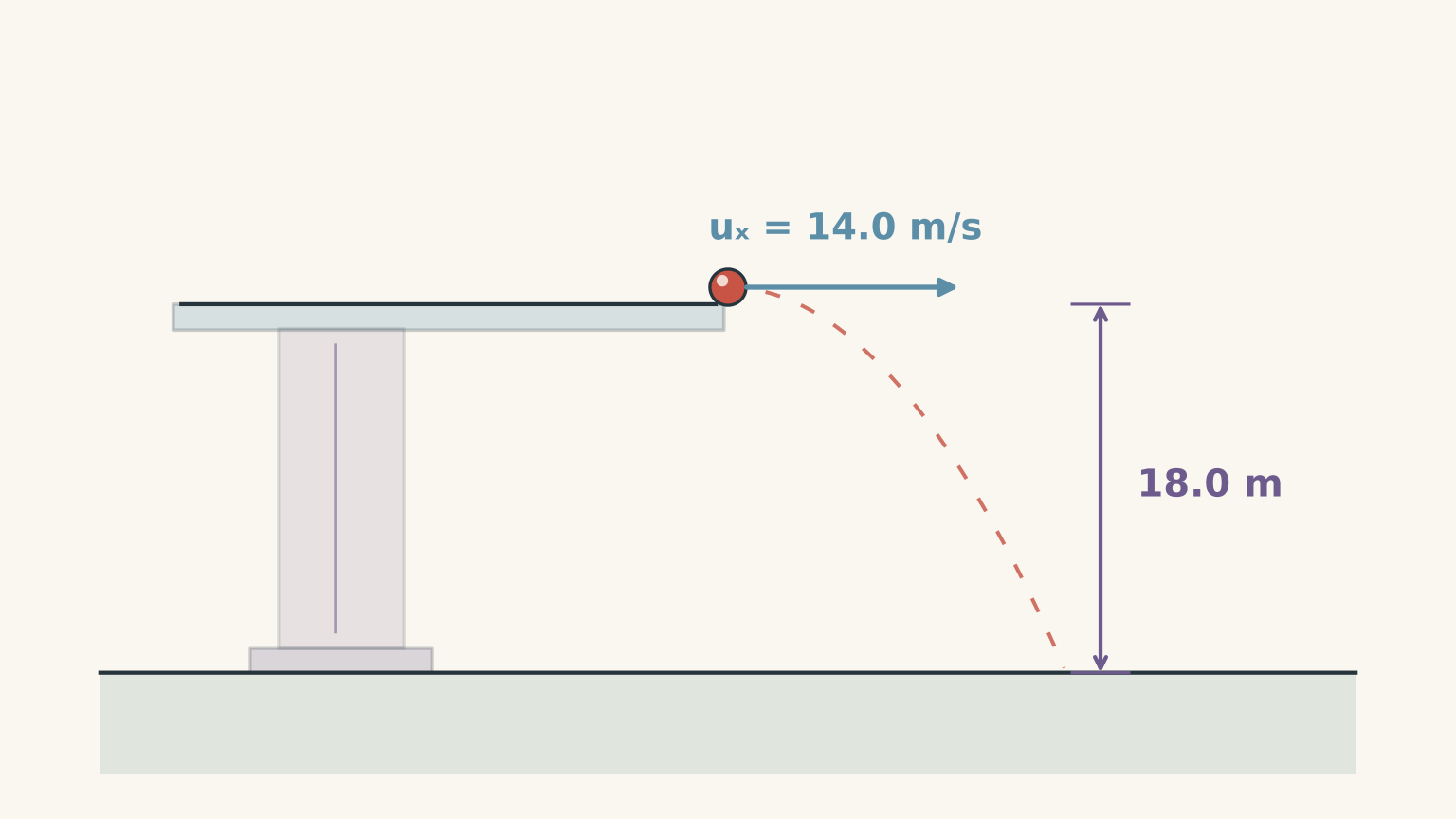
A ball leaves a horizontal platform 18.0 m above level ground with an initial horizontal velocity of 14.0 m/s.
Assume air resistance is negligible.
Calculate:
(a) The time taken for the ball to reach the ground.
(b) The horizontal distance travelled before landing.
Explain why the horizontal velocity remains constant throughout the motion.
(4 marks)
Solution
Step 1
This is the most important decision in the question.
The ball has an initial horizontal velocity of 14.0 m/s, but its initial vertical velocity is zero.
Gravity produces a constant downward acceleration of \(9.8\ \mathrm{m\,s^{-2}}\).
We can therefore calculate the time using the vertical motion equation:
\[ s_y=u_yt+\frac12 at^2 \]
Taking downwards as positive:
\[ 18.0=0+\frac12(9.8)t^2 \]
Rearranging:
\[ t=\sqrt{\frac{36.0}{9.8}} \]
\[ \boxed{t=1.92\ \mathrm{s}} \]
Step 2
Newton’s first law states that an object maintains constant velocity unless acted on by a resultant external force.
With air resistance neglected, there is no horizontal resultant force acting on the ball.
Therefore, its horizontal acceleration is zero, and its horizontal velocity remains 14.0 m/s throughout the flight.
Step 3
Since horizontal velocity is constant:
\[ x=v_xt \]
Using the unrounded time:
\[ x=14.0\times1.9166 \]
\[ \boxed{x=26.8\ \mathrm{m}} \]
Step 4
The ball takes approximately 1.92 seconds to reach the ground and travels 26.8 m horizontally.
Its horizontal velocity remains constant because there is no horizontal resultant force, while its vertical velocity increases because gravity continuously accelerates it downwards.
Why this response works
There are several important things happening here.
- The horizontal and vertical motions are treated separately.
- The correct initial vertical velocity is identified.
- Newton’s first law is used to explain constant horizontal velocity.
- The calculations show the equations and substitutions.
- The final values include units and answer the actual question.
Compare this with:
“The ball falls because of gravity and travels forwards at 14 m/s.”
That statement is broadly correct, but it doesn’t calculate the requested quantities or explain the relationship between the two directions of motion.
A correct physical idea is only useful when you develop it far enough to answer the question.
Due to technical limitations, this figure may display incorrectly or contain inaccuracies. Please check key details against your course materials.
05Worked example 2: A satellite in circular orbit
A satellite travels in a circular orbit around Earth.
Its orbital radius, measured from Earth’s centre, is \(7.00\times10^6\ \mathrm{m}\).
The gravitational parameter for Earth is:
\[ GM=3.986\times10^{14}\ \mathrm{m^3\,s^{-2}} \]
Calculate:
(a) The satellite’s orbital speed.
(b) The time taken to complete one orbit.
Explain why the satellite’s speed remains constant while its velocity changes.
Assume a circular orbit with negligible atmospheric drag and no thrust from the satellite.
(6 marks)
Solution
Step 1
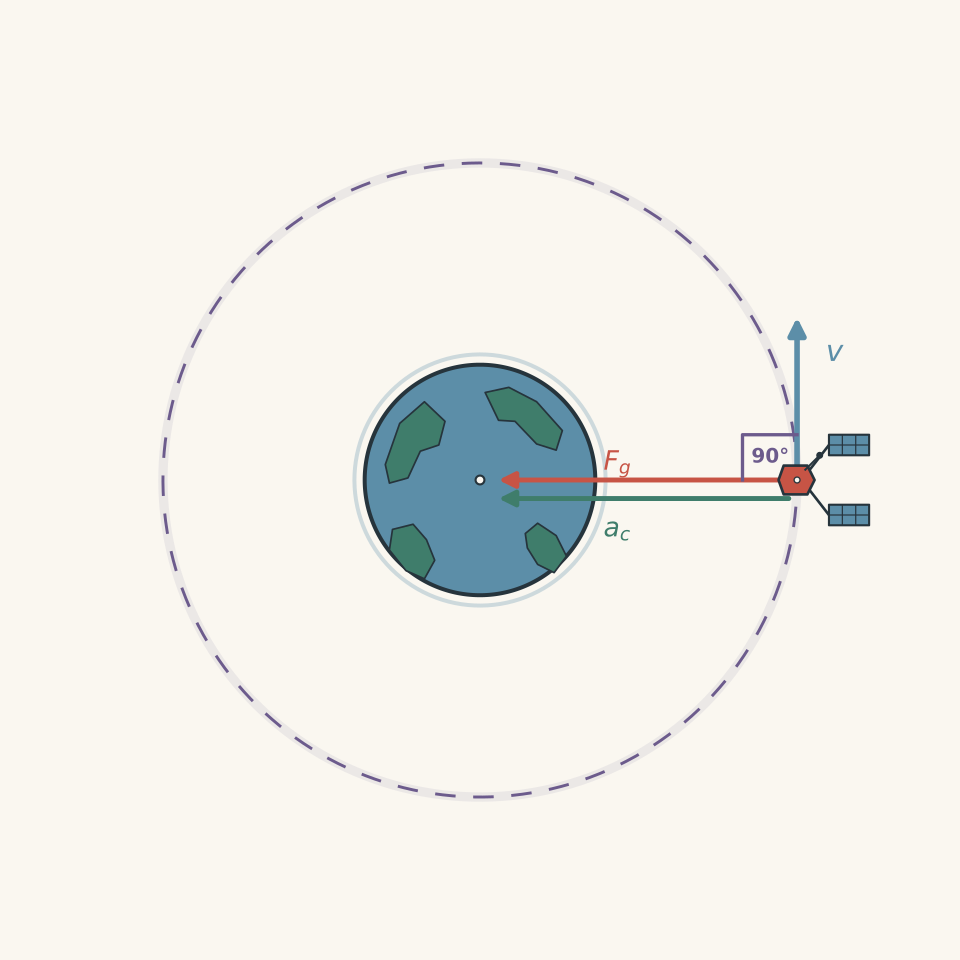
The satellite travels in a circular orbit, so it requires a resultant force directed towards the centre of the circle.
This is the centripetal resultant force.
In this situation, Earth’s gravitational attraction provides that force.
Newton’s law of universal gravitation gives:
\[ F_g=\frac{GMm}{r^2} \]
The centripetal force required for circular motion is:
\[ F_c=\frac{mv^2}{r} \]
Here:
- \(G\) is the universal gravitational constant.
- \(M\) is Earth’s mass.
- \(m\) is the satellite’s mass.
- \(r\) is the orbital radius.
- \(v\) is the satellite’s orbital speed.
Since gravity provides the centripetal resultant force:
\[ \frac{GMm}{r^2}=\frac{mv^2}{r} \]
Step 2
Cancel the satellite’s mass and rearrange:
\[ \frac{GM}{r}=v^2 \]
Therefore:
\[ v=\sqrt{\frac{GM}{r}} \]
Substitute the supplied values:
\[ v=\sqrt{ \frac{3.986\times10^{14}} {7.00\times10^6} } \]
\[ \boxed{v=7.55\times10^3\ \mathrm{m\,s^{-1}}} \]
Step 3
The orbital period is the time required to complete one revolution.
The distance travelled in one circular orbit is its circumference:
\[ d=2\pi r \]
Since speed is distance divided by time:
\[ T=\frac{2\pi r}{v} \]
Substituting:
\[ T=\frac{2\pi(7.00\times10^6)} {7.55\times10^3} \]
\[ T=5.83\times10^3\ \mathrm{s} \]
Converting into minutes:
\[ T=\frac{5.83\times10^3}{60} \]
\[ \boxed{T=97.2\ \mathrm{minutes}} \]
Step 4
The gravitational force acts continuously towards Earth’s centre.
For a circular orbit, this force is perpendicular to the satellite’s instantaneous velocity.
A force perpendicular to velocity changes the direction of motion without changing the speed.
Consequently, the satellite maintains a constant speed while its velocity changes direction continuously.
Why this response works
This question requires more than selecting two formulas.
The important reasoning is the connection between universal gravitation and circular motion.
The response establishes why the two force equations can be equated, uses that relationship to calculate speed, and then applies circular geometry to calculate the period.
Finally, it explains the difference between speed and velocity.
A common mistake is to describe centripetal force as an additional force acting on the satellite.
It isn’t an extra force. Centripetal force describes the role played by the resultant inward force. Here, that force is gravity.
This is the sort of distinction that makes an explanation more precise.

Due to technical limitations, this figure may display incorrectly or contain inaccuracies. Please check key details against your course materials.
Due to technical limitations, this figure may display incorrectly or contain inaccuracies. Please check key details against your course materials.
06A quick check before moving on
Once you’ve written a 4-6 mark response, read it again and ask:
- Have I answered every part of the question?
- Have I identified the relevant physical principle?
- Have I explained how that principle applies to this particular situation?
- Have I included the necessary calculation, evidence, or observation?
- Are my units and directions correct?
- Does my final statement actually answer the question?
One particularly useful check is to look for unexplained jumps.
If you’ve written “therefore the object accelerates”, ask yourself whether you’ve explained what produces the resultant force.
If you’ve written “therefore an emf is induced”, ask whether you’ve explained why the magnetic flux changes.
If you’ve written “therefore the satellite maintains constant speed”, ask whether you’ve explained the direction of the gravitational force relative to its velocity.
Those missing connections are often where an otherwise reasonable response becomes incomplete.
07Questions and solutions
The following five questions give you an opportunity to apply the same reasoning to different areas of Physics.
Question 1 is a relatively straightforward exam-style calculation. Questions 2-4 require you to connect multiple ideas. Question 5 is deliberately more demanding: it combines electromagnetic induction, Lenz’s law, and conservation of energy.
Try each question before reading its solution.
Question 1
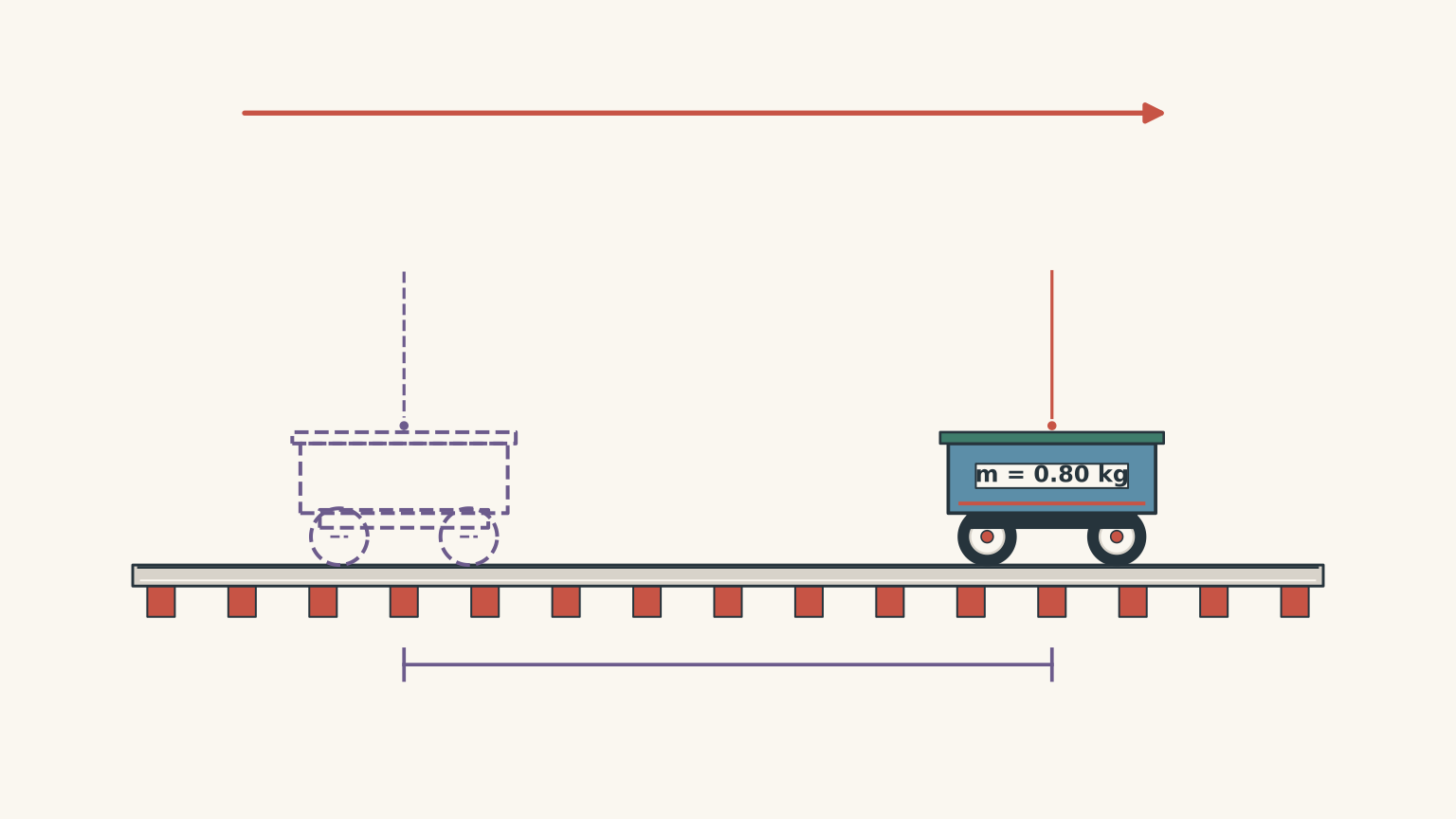
A trolley of mass 0.80 kg travels east along a horizontal track.
Its velocity increases from 2.0 m/s east to 8.0 m/s east over a period of 3.0 seconds.
Calculate:
(a) Its average acceleration.
(b) The average resultant horizontal force acting on it.
(4 marks)
Due to technical limitations, this figure may display incorrectly or contain inaccuracies. Please check key details against your course materials.
Solution 1
The trolley’s average acceleration is \(2.0\ \mathrm{m\,s^{-2}}\) east, and its average resultant horizontal force is \(1.6\ \mathrm{N}\) east.
Step 1: Calculate the average acceleration.
Acceleration is the rate of change of velocity:
\[ a=\frac{\Delta v}{\Delta t} \]
The change in velocity is:
\[ \Delta v=8.0-2.0=6.0\ \mathrm{m\,s^{-1}} \]
Therefore:
\[ a=\frac{6.0}{3.0} \]
\[ \boxed{a=2.0\ \mathrm{m\,s^{-2}}\ \text{east}} \]
Step 2: Apply Newton’s second law.
The resultant force is:
\[ F_{\text{net}}=ma \]
Substituting:
\[ F_{\text{net}}=0.80\times2.0 \]
\[ \boxed{F_{\text{net}}=1.6\ \mathrm{N}\ \text{east}} \]
The force is directed east because the trolley’s velocity is increasing in the eastward direction.
The question asks for the resultant force, not necessarily the applied force. If friction or other forces are present, their effects are already included in the resultant.
Question 2
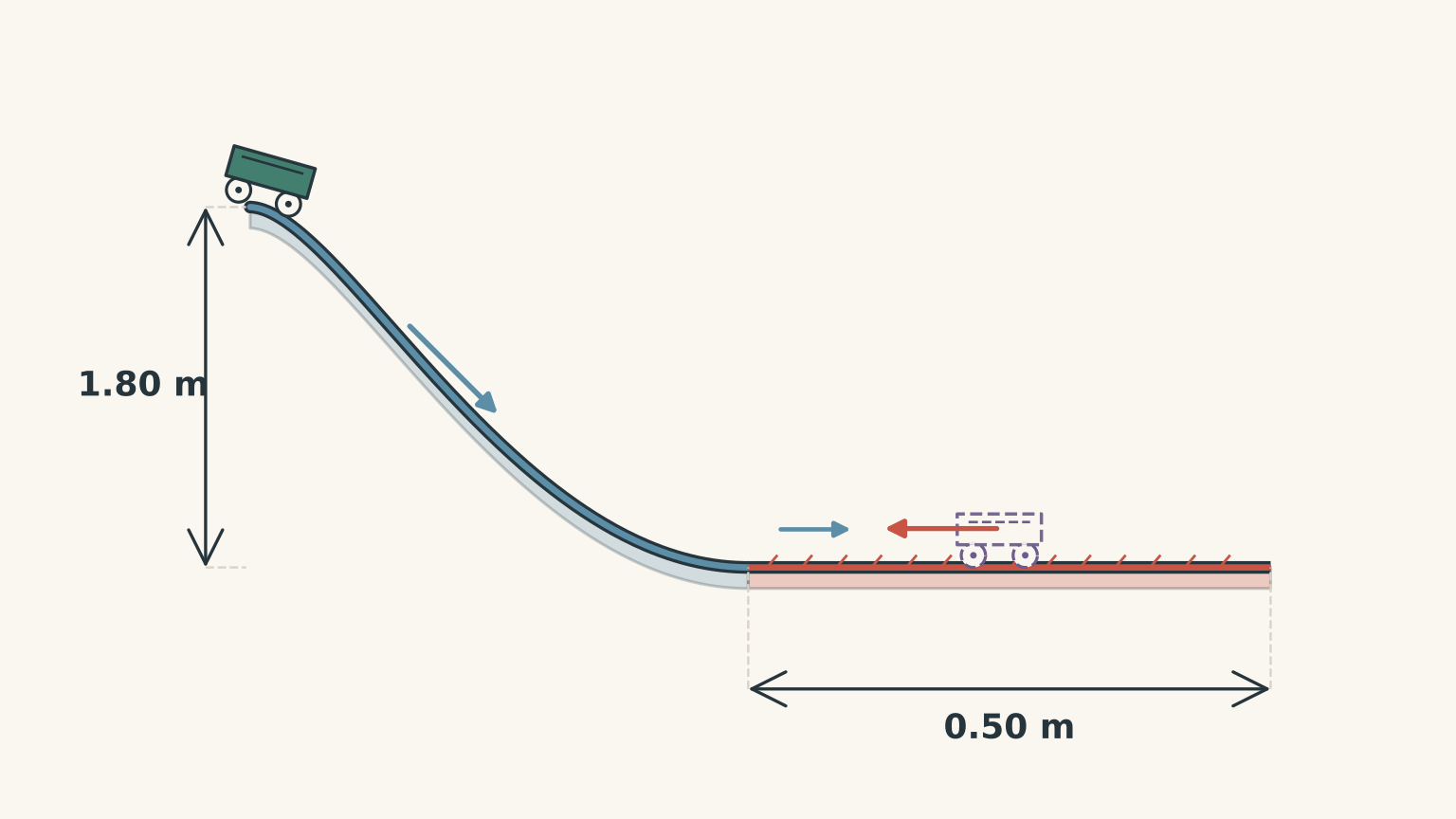
A trolley of mass 0.40 kg is released from rest at the top of a track.
It descends through a vertical height of 1.80 m along a frictionless section before entering a horizontal rough section of length 0.50 m.
The rough section exerts a constant frictional force of 0.80 N on the trolley.
Calculate:
(a) The trolley’s speed as it enters the rough section.
(b) Its speed as it leaves the rough section.
Explain the energy transformations that occur throughout the motion.
Assume that the trolley does not lose contact with the track and that friction acts only on the horizontal section. Use \(g=9.8\ \mathrm{m\,s^{-2}}\).
(5 marks)
Due to technical limitations, this figure may display incorrectly or contain inaccuracies. Please check key details against your course materials.
Solution 2
The trolley enters the rough section at approximately \(5.94\ \mathrm{m\,s^{-1}}\) and leaves at approximately \(5.77\ \mathrm{m\,s^{-1}}\).
Step 1: Apply conservation of mechanical energy to the frictionless descent.
At the starting point, the trolley has gravitational potential energy but no kinetic energy because it is released from rest.
As it descends, gravitational potential energy is converted into kinetic energy.
Therefore:
\[ mgh=\frac12 mv_1^2 \]
Here, \(m\) is the trolley’s mass, \(h\) is the vertical drop, and \(v_1\) is its speed at the bottom.
The mass cancels:
\[ v_1=\sqrt{2gh} \]
Substituting:
\[ v_1=\sqrt{2(9.8)(1.80)} \]
\[ \boxed{v_1=5.94\ \mathrm{m\,s^{-1}}} \]
Step 2: Calculate the energy lost through friction.
The work done by friction is:
\[ W_f=-Fd \]
The negative sign indicates that friction acts against the direction of motion.
Substituting:
\[ W_f=-0.80(0.50) \]
\[ W_f=-0.40\ \mathrm{J} \]
Step 3: Calculate the kinetic energy after the rough section.
The trolley enters the rough section with kinetic energy equal to its initial gravitational potential energy:
\[ E_{k,1}=mgh \]
\[ E_{k,1}=0.40(9.8)(1.80) \]
\[ E_{k,1}=7.056\ \mathrm{J} \]
The final kinetic energy is:
\[ E_{k,2}=7.056-0.40 \]
\[ E_{k,2}=6.656\ \mathrm{J} \]
Step 4: Calculate the final speed.
Using:
\[ E_k=\frac12 mv^2 \]
Rearrange:
\[ v_2=\sqrt{\frac{2E_{k,2}}{m}} \]
Substitute:
\[ v_2=\sqrt{\frac{2(6.656)}{0.40}} \]
\[ \boxed{v_2=5.77\ \mathrm{m\,s^{-1}}} \]
Step 5: Explain the energy transformations.
During the descent, gravitational potential energy is converted into kinetic energy.
On the rough section, friction does negative work on the trolley. Some of its mechanical energy is converted into thermal energy in the trolley and track.
The trolley therefore leaves the rough section with less kinetic energy and a lower speed.
Importantly, total energy is still conserved. It is the mechanical energy of the trolley that decreases, not the total energy of the complete system.
The tempting mistake here is to apply conservation of mechanical energy over the entire track without accounting for friction. The frictional section changes which energy transformations must be included.
Question 3
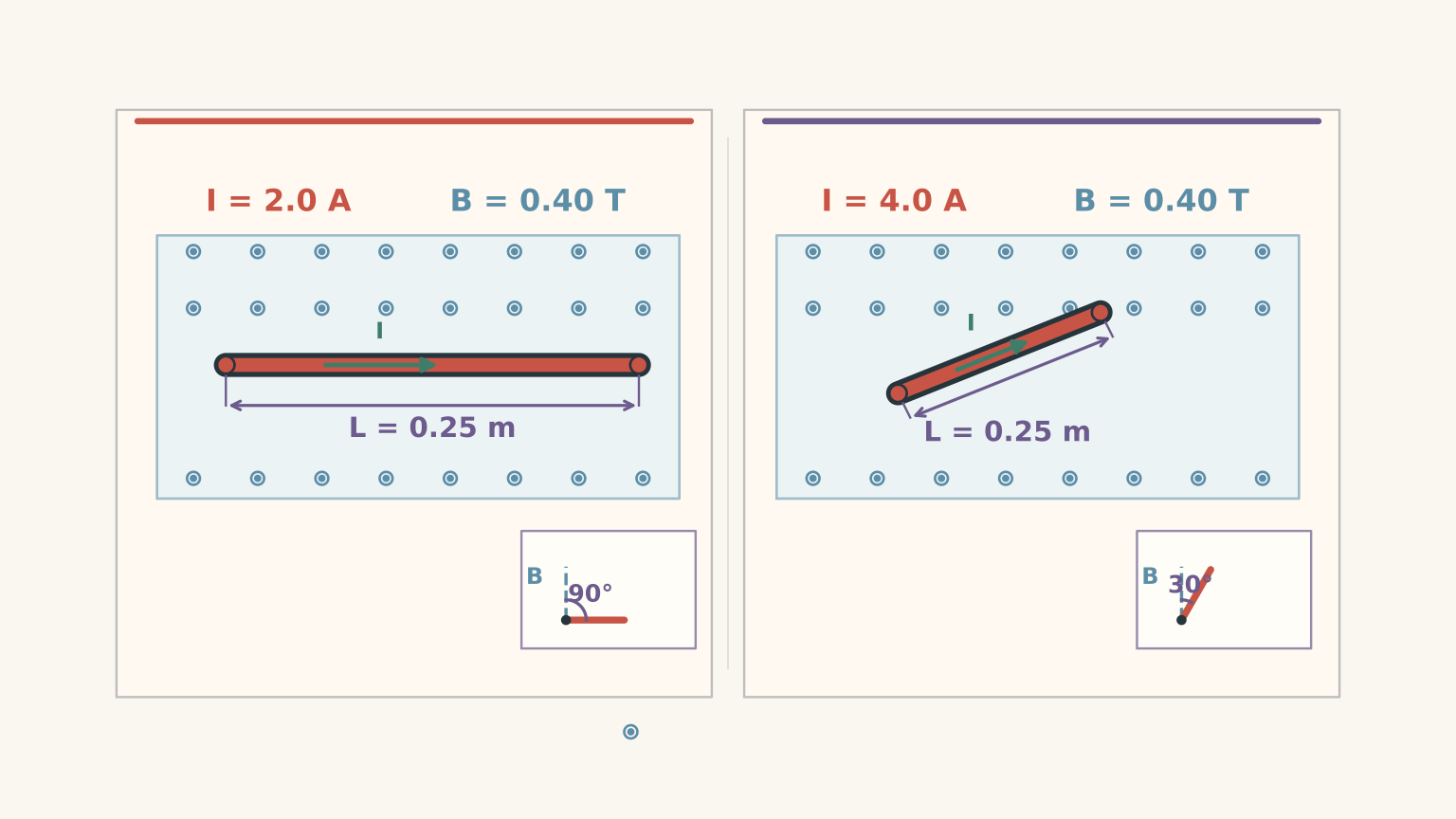
A straight conducting wire of length 0.25 m is placed in a uniform magnetic field of strength 0.40 T.
Initially, a current of 2.0 A flows through the wire perpendicular to the magnetic field.
The wire is then repositioned so that the angle between the current direction and the magnetic field is 30°. At the same time, the current is increased to 4.0 A.
Calculate the magnetic force on the wire in both situations.
Explain why the magnitude of the force remains unchanged despite the current doubling.
Assume the entire wire is within the uniform magnetic field.
(5 marks)
Due to technical limitations, this figure may display incorrectly or contain inaccuracies. Please check key details against your course materials.
Solution 3
The magnetic force is \(0.20\ \mathrm{N}\) in both situations.
Step 1: Identify the relevant equation.
The magnetic force on a straight current-carrying conductor in a uniform magnetic field is:
\[ F=BIL\sin\theta \]
Where:
- \(F\) is magnetic force in newtons.
- \(B\) is magnetic flux density in tesla.
- \(I\) is current in amperes.
- \(L\) is the length of conductor within the field in metres.
- \(\theta\) is the angle between the current direction and magnetic field.
Step 2: Calculate the initial force.
Initially, the current is perpendicular to the magnetic field.
Therefore:
\[ \theta=90^\circ \]
Substitute:
\[ F_1=0.40(2.0)(0.25)\sin90^\circ \]
Since \(\sin90^\circ=1\):
\[ \boxed{F_1=0.20\ \mathrm{N}} \]
Step 3: Calculate the new force.
The current increases to 4.0 A, but the angle decreases to 30°.
Substituting:
\[ F_2=0.40(4.0)(0.25)\sin30^\circ \]
Since \(\sin30^\circ=0.5\):
\[ F_2=0.40(4.0)(0.25)(0.5) \]
\[ \boxed{F_2=0.20\ \mathrm{N}} \]
Step 4: Explain why the force is unchanged.
Although the current doubles, the sine of the angle between the conductor and magnetic field decreases from 1 to 0.5.
These two changes cancel each other out in the magnetic force equation.
Consequently, the magnitude of the magnetic force remains unchanged.
The important lesson is that the magnetic force depends on more than current and field strength. The relative orientation of the conductor and magnetic field also matters.
A response that only says “the current doubles, so the force doubles” ignores the change in angle.
Question 4
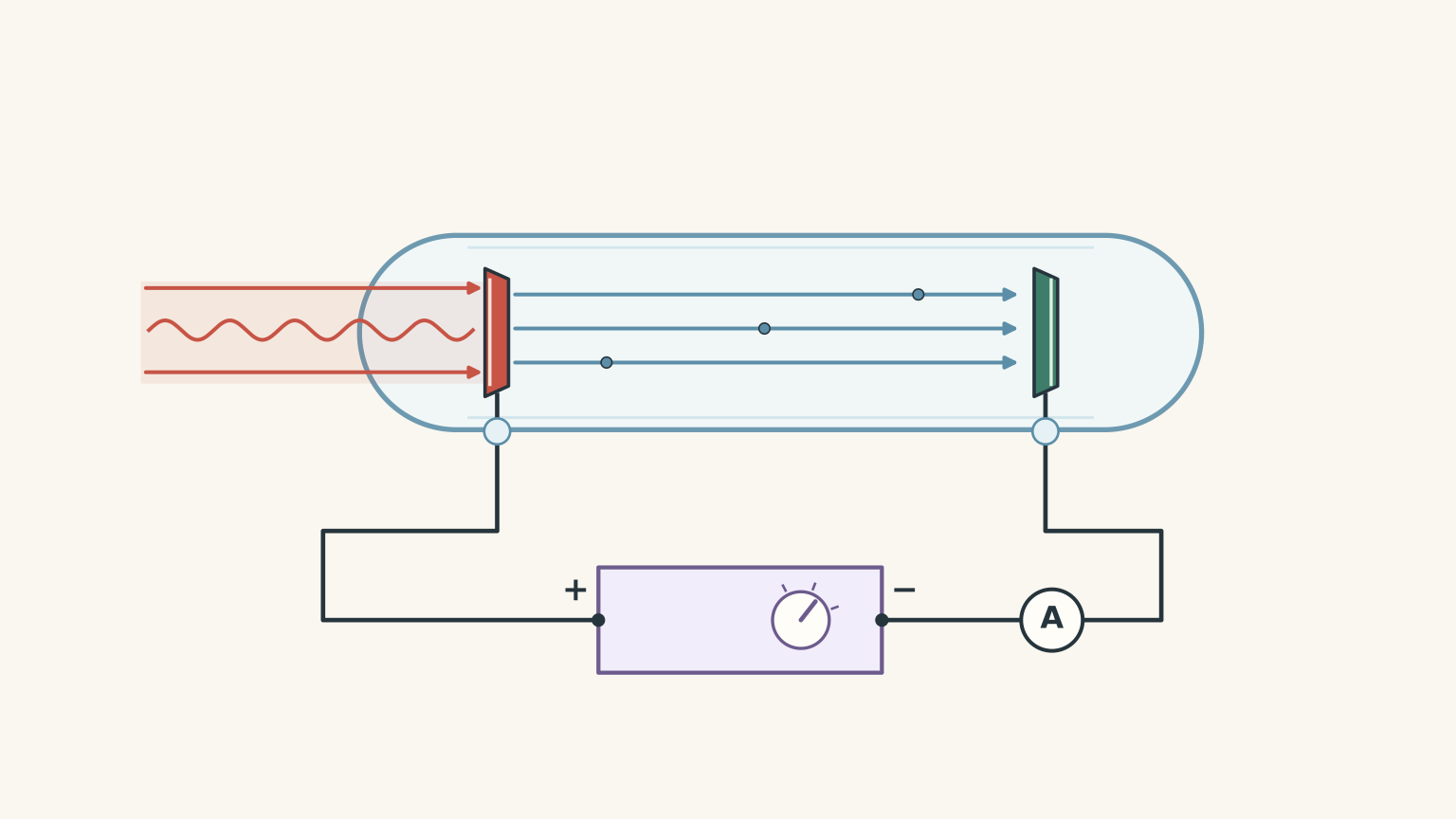
A metal surface has a work function of \(3.30\times10^{-19}\ \mathrm{J}\).
Monochromatic light of frequency \(8.00\times10^{14}\ \mathrm{Hz}\) is directed onto the surface.
Use:
\[ h=6.63\times10^{-34}\ \mathrm{J\,s} \]
\[ e=1.60\times10^{-19}\ \mathrm{C} \]
Calculate:
(a) The maximum kinetic energy of the emitted photoelectrons.
(b) The stopping potential required to prevent the fastest photoelectrons from reaching the collector.
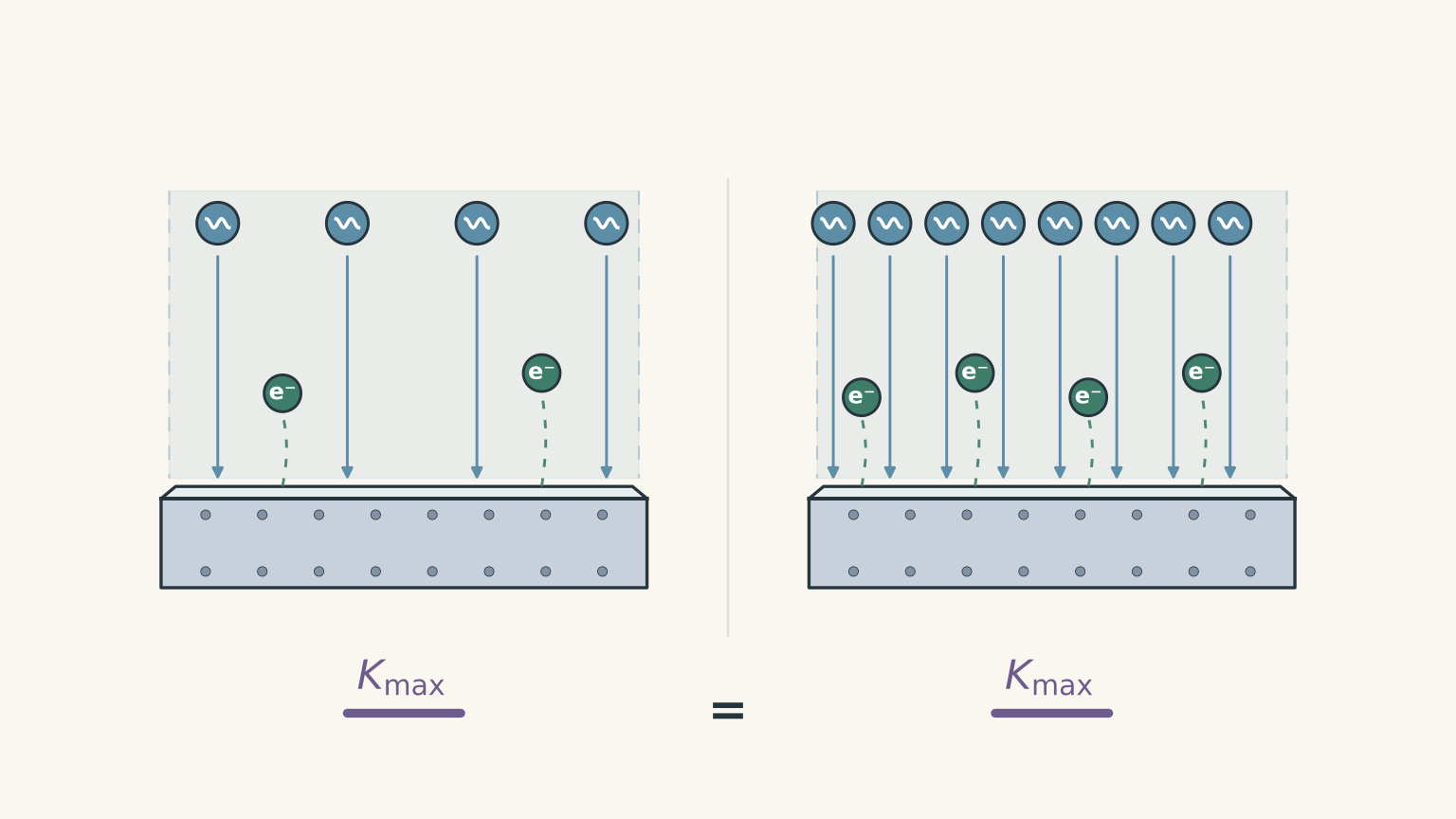
(c) Explain what happens to the maximum kinetic energy and photocurrent if the light intensity is doubled while its frequency remains constant.
Assume the frequency is above the threshold frequency and the collection system operates without current saturation.
(6 marks)
Due to technical limitations, this figure may display incorrectly or contain inaccuracies. Please check key details against your course materials.
Solution 4
The maximum kinetic energy is \(2.00\times10^{-19}\ \mathrm{J}\), and the stopping potential is approximately \(1.25\ \mathrm{V}\). Doubling the intensity increases the photocurrent but does not change the maximum kinetic energy or stopping potential.
Step 1: Calculate the energy of an incident photon.
The photon model of light states that the energy of each photon depends on its frequency:
\[ E=hf \]
Where \(E\) is photon energy, \(h\) is Planck’s constant, and \(f\) is frequency.
Substitute:
\[ E=(6.63\times10^{-34}) (8.00\times10^{14}) \]
\[ E=5.304\times10^{-19}\ \mathrm{J} \]
Step 2: Calculate the maximum kinetic energy.
The photoelectric equation is:
\[ K_{\max}=hf-W \]
Here, \(W\) is the work function, which is the minimum energy required to remove an electron from the metal.
Substituting:
\[ K_{\max}=5.304\times10^{-19} -3.30\times10^{-19} \]
\[ \boxed{K_{\max}=2.00\times10^{-19}\ \mathrm{J}} \]
The emitted electrons have a range of kinetic energies, but this is the maximum value.
Step 3: Calculate the stopping potential.
The stopping potential is the reverse potential difference required to prevent even the fastest emitted electrons from reaching the collector.
The electrical potential energy change is related to the electron’s kinetic energy by:
\[ eV_s=K_{\max} \]
Rearranging:
\[ V_s=\frac{K_{\max}}{e} \]
Substituting:
\[ V_s= \frac{2.00\times10^{-19}} {1.60\times10^{-19}} \]
\[ \boxed{V_s=1.25\ \mathrm{V}} \]
Step 4: Explain the effect of doubling light intensity.
The energy of an individual photon is:
\[ E=hf \]
Because the frequency remains constant, the energy of each photon remains constant.
Increasing light intensity increases the number of photons arriving at the metal per second.
Since the frequency is already above the threshold frequency, more photons can produce more emitted electrons per second.
Therefore:
- The photocurrent increases.
- The maximum kinetic energy remains unchanged.
- The stopping potential remains unchanged.
This is an important distinction between the particle model of light and a common misconception.
Increasing intensity does not make individual photons more energetic. Increasing frequency does.
Due to technical limitations, this figure may display incorrectly or contain inaccuracies. Please check key details against your course materials.
Question 5
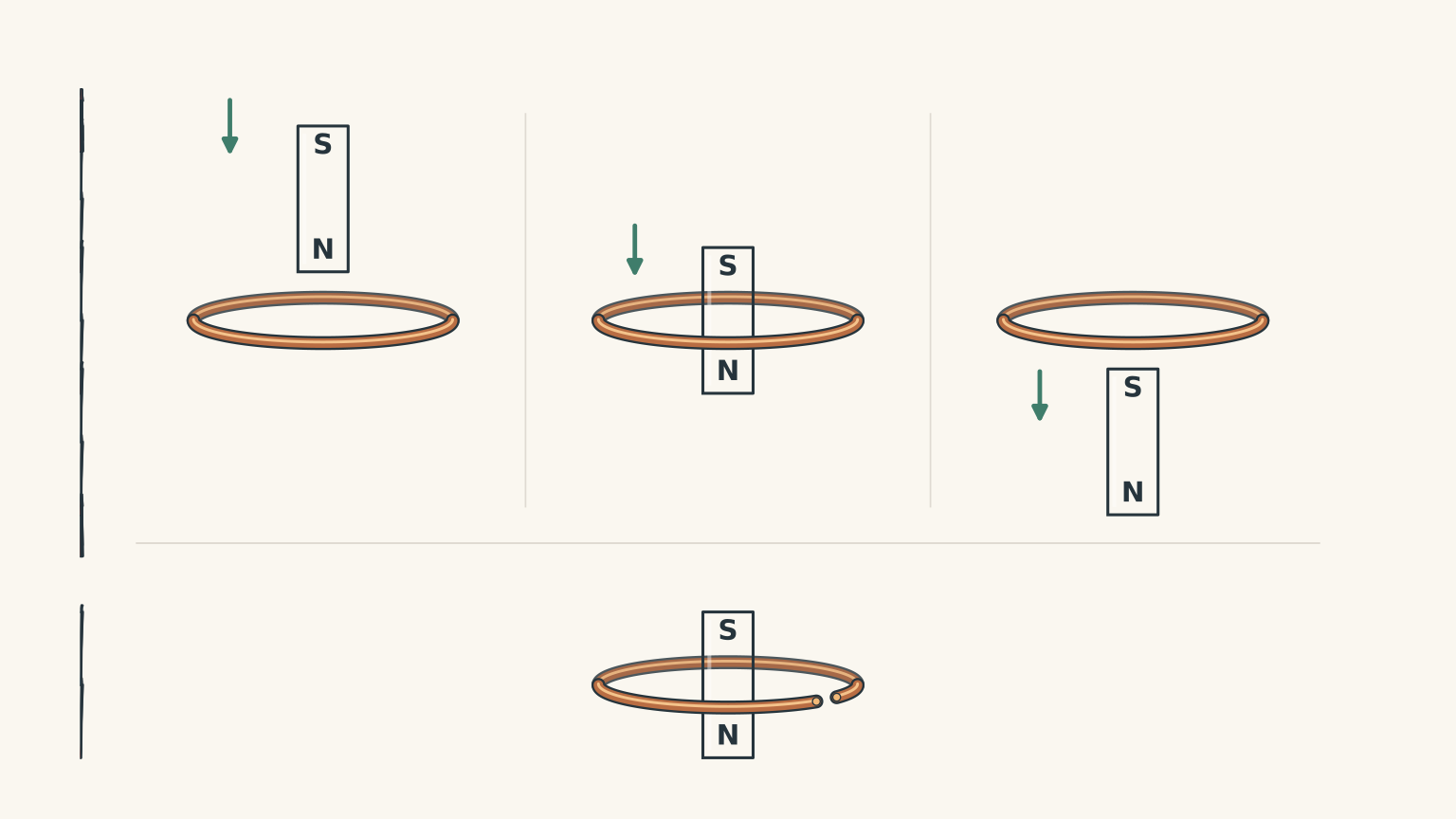
A bar magnet falls vertically through a horizontal copper ring.
The magnet’s north pole points downwards, so it enters the ring first. The ring is initially a complete conducting loop.
An identical ring has a narrow cut through its circumference, creating an open circuit.
Assume:
- The magnet moves along the central axis of each ring.
- Air resistance is negligible.
- The complete ring has negligible self-inductance, so its induced current follows the instantaneous induced emf.
- The magnet does not physically touch either ring.
A student argues:
“The magnetic braking force must be greatest when the centre of the magnet is in the plane of the ring, because that is when the magnetic flux through the ring is greatest.”
Assess this statement.
Explain:
(a) What happens to the magnetic flux and induced current as the magnet approaches the complete ring.
(b) What happens at the instant the magnet’s centre is in the plane of the ring.
(c) Why the induced current reverses after the magnet passes through the ring, and what happens to the magnetic force.
(d) Why the cut ring produces a different result.
(e) How energy is transferred during the magnet’s fall.
(6 marks)
Due to technical limitations, this figure may display incorrectly or contain inaccuracies. Please check key details against your course materials.
Solution 5
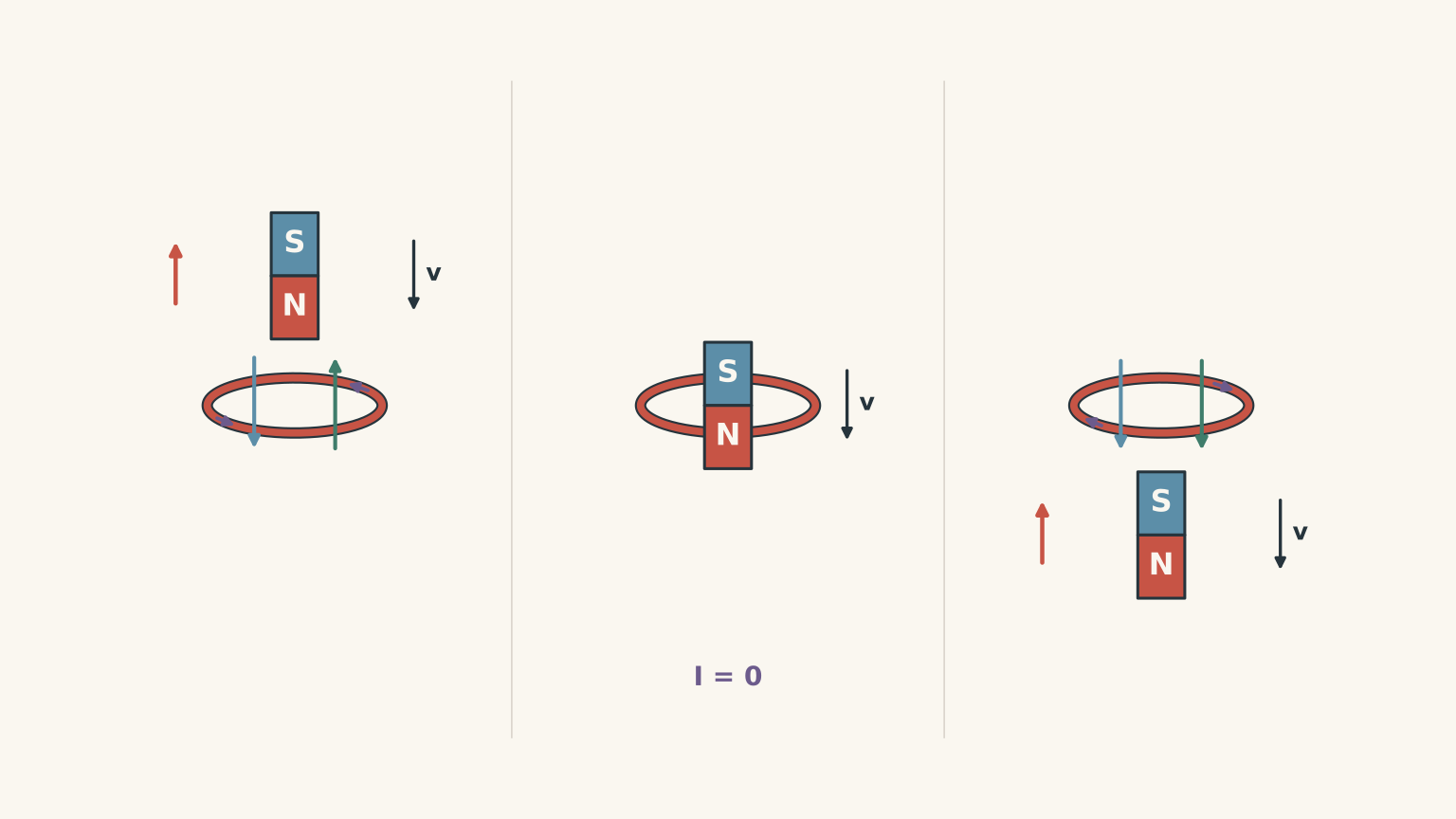
The student’s statement is incorrect. Maximum magnetic flux does not mean maximum induced emf or maximum magnetic braking force. At the instant the magnet’s centre is aligned with the complete ring, the flux is at its maximum, but its rate of change is zero. Under the stated assumptions, the induced current and magnetic braking force are therefore momentarily zero.
Step 1: Explain what happens as the magnet approaches the complete ring.
As the north pole approaches the ring, the magnetic flux through the ring increases.
Faraday’s law states that the induced emf is proportional to the rate of change of magnetic flux:
\[ \mathcal{E}=-\frac{d\Phi_B}{dt} \]
Where:
- \(\mathcal{E}\) is induced electromotive force in volts.
- \(\Phi_B\) is magnetic flux through the ring in webers.
- \(t\) is time in seconds.
The negative sign represents Lenz’s law.
Lenz’s law states that the induced current produces a magnetic field that opposes the change in magnetic flux that produced it.
As the downward magnetic flux increases, the induced current produces an upward magnetic field.
This makes the ring repel the approaching north pole, producing an upward magnetic force that opposes the magnet’s downward motion.
This is magnetic braking.
Step 2: Explain what happens when the magnet’s centre reaches the ring plane.
This is the crucial part of the question.
At this instant, the magnetic flux through the ring is at its maximum.
However, maximum flux does not mean maximum rate of change of flux.
Because the magnet is passing through the centre of the ring, the arrangement is momentarily symmetric. The flux reaches a maximum and then begins to decrease.
At the precise maximum, its instantaneous rate of change is zero:
\[ \frac{d\Phi_B}{dt}=0 \]
Therefore, Faraday’s law gives:
\[ \mathcal{E}=0 \]
With negligible self-inductance, the induced current is also zero at that instant.
Consequently, there is no instantaneous magnetic braking force from the induced current.
This is where the student’s reasoning fails. They have confused the amount of magnetic flux with how quickly that flux changes.
Step 3: Explain what happens after the magnet passes through the ring.
Once the magnet moves below the ring, the downward magnetic flux begins to decrease.
According to Lenz’s law, the induced current reverses direction to produce a magnetic field that opposes this decrease.
The ring now produces a magnetic field that attracts the magnet’s upper south pole.
This attraction acts upwards, opposing the magnet’s continued downward motion.
Notice the important result:
The induced current reverses direction, but the magnetic braking force continues to oppose the magnet’s motion.
Due to technical limitations, this figure may display incorrectly or contain inaccuracies. Please check key details against your course materials.
Step 4: Compare the complete ring with the cut ring.
Faraday’s law still predicts an induced emf when the magnet moves relative to the cut ring.
However, the cut ring has no continuous conducting path.
There is therefore no sustained circulating induced current.
Without that current, the ring cannot produce a comparable induced magnetic field or magnetic braking force.
The magnet consequently falls much closer to its unimpeded motion through the cut ring than through the complete ring.
Step 5: Explain the energy transformations.
As the magnet falls, its gravitational potential energy decreases.
Some of this energy becomes kinetic energy as the magnet accelerates downwards.
In the complete ring, the induced current encounters electrical resistance. Electrical energy is converted into thermal energy in the ring through resistive heating.
The upward magnetic braking force also does negative work on the falling magnet, reducing the kinetic energy it would otherwise gain.
In the cut ring, there is no sustained circulating current and therefore no comparable resistive heating caused by magnetic induction.
Total energy is conserved in both situations, but the energy transfers are different.
Why this is a harder question
The tempting answer is that the greatest magnetic flux should produce the greatest magnetic effect.
But Faraday’s law depends on the rate of change of flux, not simply the magnitude of the flux.
The question also requires you to track the system through time:
- Increasing flux produces an induced current in one direction.
- Maximum flux produces zero instantaneous induced emf under the stated conditions.
- Decreasing flux produces a current in the opposite direction.
- The magnetic force opposes the magnet’s downward motion on both sides of the ring.
- Opening the circuit prevents sustained circulating current and substantially changes the energy transfer.
Knowing Faraday’s law and Lenz’s law separately is not enough. You must apply both to the changing physical situation and then connect the result to conservation of energy.
That is what makes this a demanding extended response.
08The main habits to take into your next Physics exam
When you encounter a 4-6 mark question, don’t immediately start writing everything you remember about the topic.
Instead:
- Identify exactly what the question asks.
- Write down the relevant physical principle.
- Work out how the principle applies to the specific conditions.
- Include the necessary calculations, evidence, and observations.
- Finish with a direct answer that addresses the question.
Remember these distinctions:
| Tempting mistake | Better approach |
|---|---|
| Naming a law without applying it. | Explain what the law predicts in the given situation. |
| Writing a long paragraph of related facts. | Include only information that helps answer the question. |
| Giving a numerical answer without working. | Show the equation, substitution, units, and result. |
| Treating speed and velocity as interchangeable. | Account for direction whenever discussing velocity or acceleration. |
| Ignoring information in a graph or stimulus. | Refer directly to the supplied evidence. |
| Assuming more detail always means more marks. | Prioritise complete, accurate reasoning. |
If you consistently understand the physics but struggle to express it in written responses, practising with feedback can help identify exactly where your explanations are incomplete. tutorgum offers online HSC Physics tutoring for Year 11 and 12 students, with a focus on developing understanding and applying it to exam-style questions.
The next skill to develop is interpreting experimental data and graphs. The same reasoning applies: identify the pattern, connect it to the physical model, and explain what the evidence actually supports.