
Should You Drop HSC Physics or Chemistry After a Bad Term?
A disappointing term doesn't automatically mean you should drop Physics or Chemistry. Learn how to identify underlying knowledge gaps, assess your alternatives, check university requirements, and understand NSW HSC subject-change rules before making your decision.
A bad term in HSC Physics or Chemistry does not automatically mean you should drop the subject. It means you need to work out why your results are poor, whether the problem can be fixed, and whether continuing is still the best use of your time.
If you’ve struggled with one assessment, dropping the subject is probably premature. If you’ve struggled across several topics, lost interest in the subject itself, and are consistently sacrificing time you need for other courses, changing your subjects might be the smarter decision.
The important distinction is between a subject you currently find difficult and a subject that genuinely isn’t right for you.
01The decision: should you keep Physics or Chemistry?
Start with three possible outcomes.
Keep the subject and work on your weaknesses if:
- Your poor result came from one assessment or a small number of topics.
- You understand the underlying concepts but struggle with particular skills, such as algebra, chemical equations, or interpreting graphs.
- You still enjoy the subject when you understand what’s happening.
- The subject is relevant to your intended university course or future study.
Give yourself a short recovery period before deciding if:
- Your results have been inconsistent.
- You aren’t sure whether the problem is your understanding, study technique, or workload.
- You haven’t yet tried addressing the specific gaps identified by your teacher.
- You enjoy some parts of the subject but find others frustrating.
Seriously consider dropping the subject if:
- Your difficulties have continued across multiple assessments and topics.
- You’ve made a genuine effort to improve but still struggle with the fundamental way the subject works.
- You consistently dislike the material, not just the assessments.
- Keeping the subject is taking time away from courses that better match your strengths and interests.
- Your intended university pathway doesn’t require the subject, and you have a suitable alternative.
Should you keep the subject?
- Start: diagnose the problem
Look beyond one percentage: consider assessment patterns, teacher feedback and how well you understand the material.
Identify what is actually making Physics or Chemistry difficult.
- One-off assessment problem
Your understanding is mostly sound, but one test, topic or exam technique affected your result.
NEXT: Review mistakes, feedback and assessment technique. Keep the subject and address specific weaknesses.
- Identifiable knowledge gaps
You can identify missing foundations, such as algebra, chemical equations, terminology or graph interpretation.
NEXT: Target those gaps with teacher support, focused revision and practice. Give yourself a short recovery period.
- Persistent difficulty with core thinking
Difficulties continue across multiple topics and assessments despite a genuine effort to improve.
The fundamental problem-solving or conceptual approach remains frustrating.
NEXT: Seriously consider a subject change if the subject remains a poor fit.
- Excessive workload
The subject takes time away from other courses, commitments or your ability to study effectively.
NEXT: Review your workload and study balance. Try a realistic recovery period; consider changing subjects if the load remains unsustainable.
- Before making the final decision
UNIVERSITY: Check prerequisites and assumed knowledge for your intended courses. Will dropping this subject restrict your options?
HSC ELIGIBILITY: Confirm your remaining units satisfy HSC requirements and that your revised subject combination is valid.
SCHOOL ADVICE: Discuss the change, available alternatives and timing with your school adviser.
FINAL CHOICE: Keep and review, undertake targeted recovery, or change subjects with a suitable alternative.
Due to technical limitations, this figure may display incorrectly or contain inaccuracies. Please check key details against your course materials.
There is no magic percentage that tells you when to drop Physics or Chemistry. A student who receives 45% but understands the concepts and has a clear plan to address their mistakes may be in a better position than someone receiving 65% who has fundamental gaps and no interest in continuing.
Your mark is evidence. It isn’t a verdict.
02First, work out why your results are poor
Before making a decision, look at your actual assessment paper.
A mark on its own doesn’t tell you much. You need to understand where you lost marks and whether those mistakes are likely to happen again.
There are several common reasons for disappointing results.
| What happened in the assessment? | What it might indicate | What to do |
|---|---|---|
| You understood the questions but made algebra mistakes. | A mathematical skills gap. | Practise rearranging equations and checking calculations. |
| You memorised definitions but couldn’t explain unfamiliar situations. | Weak conceptual understanding. | Rebuild the underlying ideas and practise applying them. |
| You understood the content but ran out of time. | An exam technique or time-management problem. | Practise timed questions and improve question selection. |
| You struggled with one particular topic. | A localised knowledge gap. | Revise the prerequisites and topic content. |
| You struggled across several unrelated topics. | Potentially broader knowledge gaps or a mismatch with the subject. | Investigate the pattern with your teacher. |
| You rarely complete homework or revision because you dislike the subject. | An interest or workload problem. | Consider whether continuing is worth the opportunity cost. |
One particularly important distinction is between not understanding something and not knowing how to apply it.
For example, you might understand Newton’s laws but struggle to decide which forces belong on a free-body diagram. In Chemistry, you might understand what a reaction does but struggle to translate its balanced equation into a mole calculation.
Both problems can be addressed. Neither automatically means you should drop the subject.
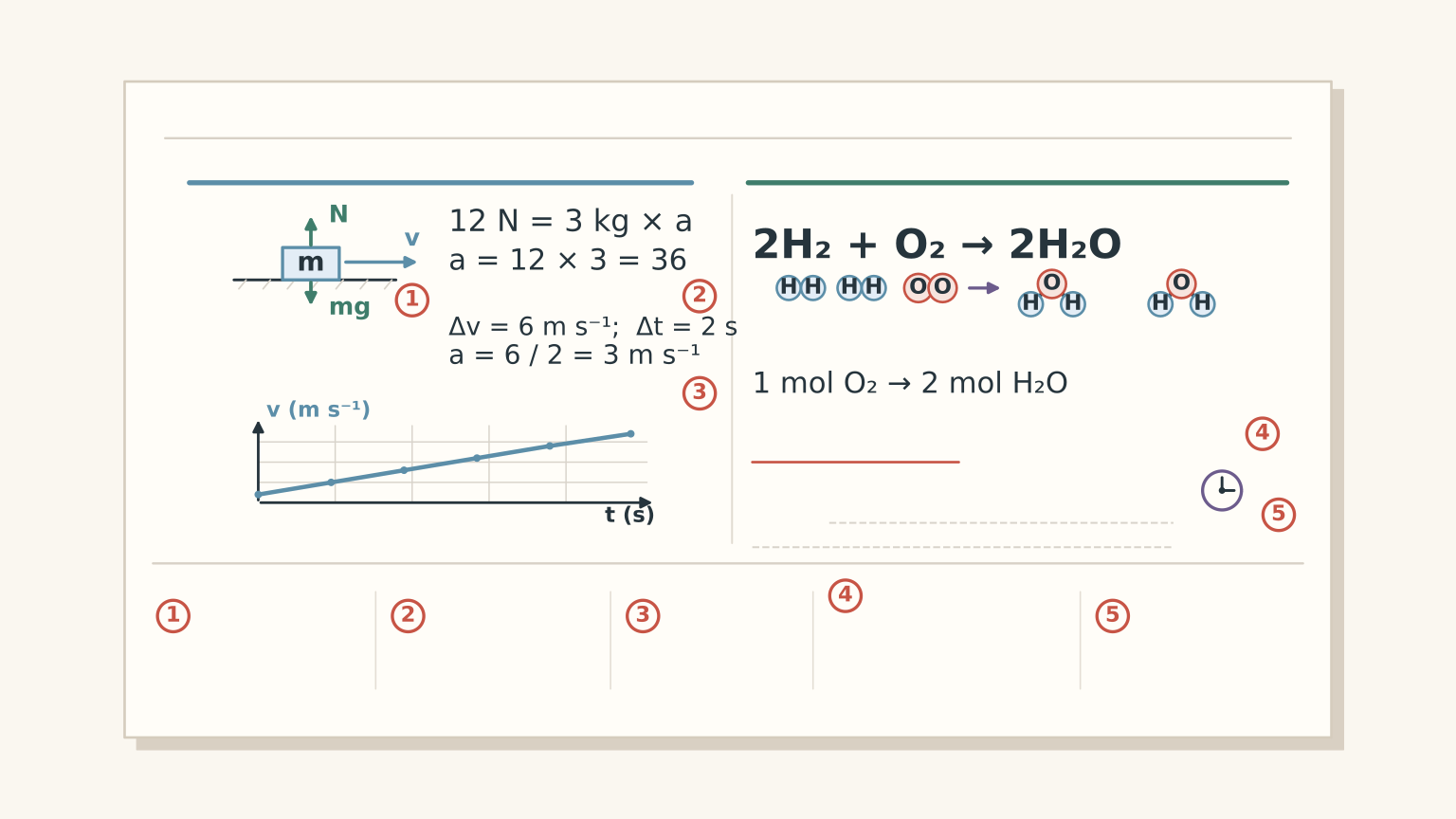
Due to technical limitations, this figure may display incorrectly or contain inaccuracies. Please check key details against your course materials.
Before making your decision, ask your teacher:
- Which specific syllabus outcomes am I struggling with?
- Are my mistakes concentrated in a few topics or spread throughout the course?
- What knowledge should I revise before attempting the next topic?
- Is there a realistic way to catch up before the next assessment?
If you’re dealing with a particularly disappointing result, our guide on How to Recover After a Bad HSC Assessment explains how to review your mistakes and turn feedback into a practical study plan.
03Physics and Chemistry require different kinds of thinking
You might be struggling with both subjects, but that doesn’t mean they’re difficult for the same reason.
Understanding what each subject actually asks you to do can help you decide which one deserves your time.
When should you keep HSC Physics?
Physics is about building mathematical models to explain how the physical world behaves.
You regularly need to:
- Translate a written situation into a physical model.
- Identify relevant forces, fields, or energy transfers.
- Choose an appropriate physical relationship.
- Rearrange equations and substitute values correctly.
- Interpret graphs, experimental data, and diagrams.
- Explain why a particular physical process occurs.
A common problem is confusing mathematical difficulty with an inability to understand Physics.
Suppose you’re studying motion and forces. You understand that an object accelerates when there is a resultant force, but you struggle to resolve forces into components or rearrange equations.
That is a mathematical skills problem. Improving your algebra and vector skills may make a substantial difference to your Physics results.
On the other hand, if you consistently dislike constructing physical models, interpreting unfamiliar situations, and explaining how physical laws connect to observations, you may have a more fundamental problem with the subject.
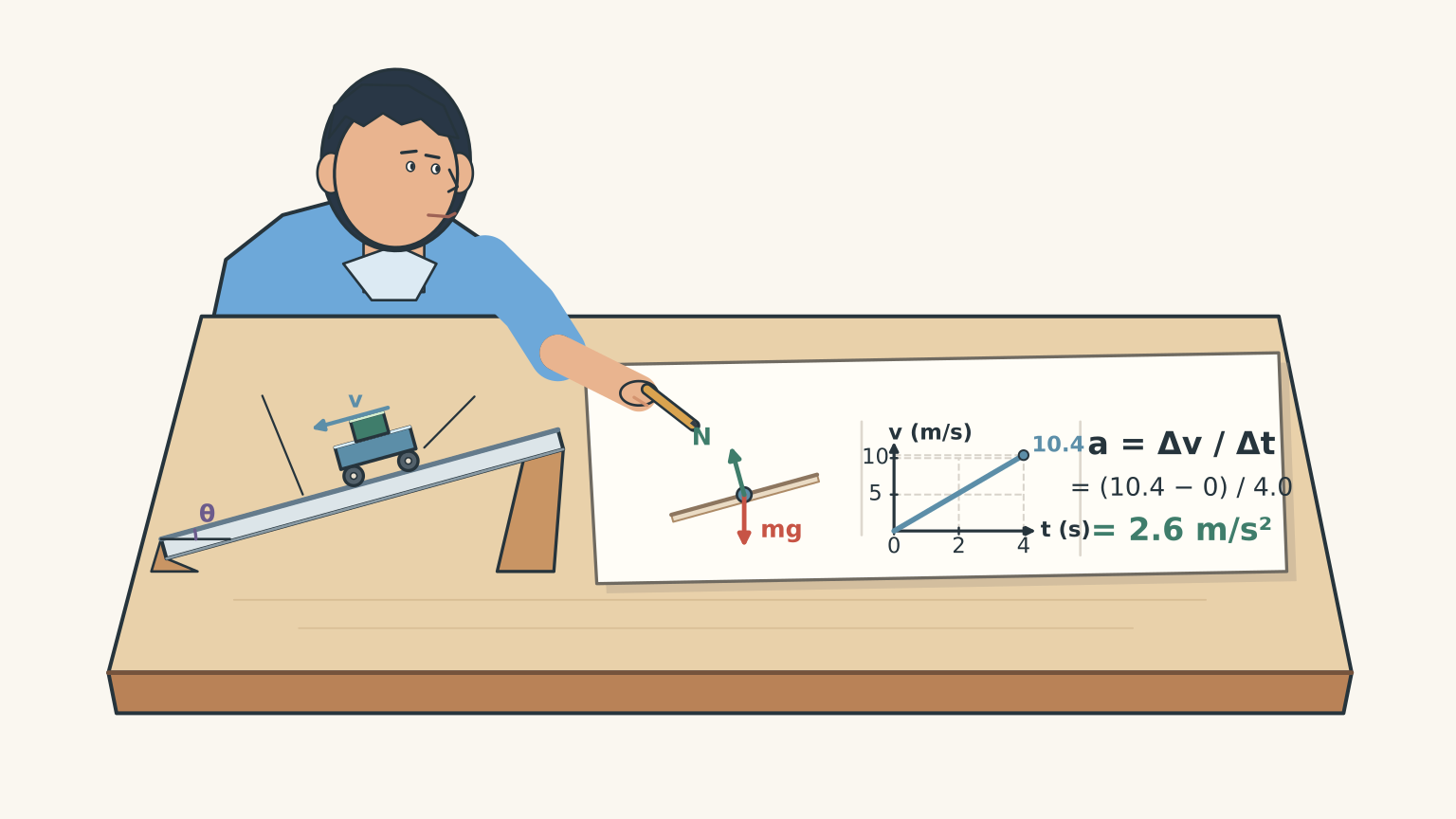
Due to technical limitations, this figure may display incorrectly or contain inaccuracies. Please check key details against your course materials.
Physics is worth keeping if:
- You enjoy understanding why physical phenomena occur.
- You can follow the underlying concepts, even when calculations are difficult.
- You are willing to improve your mathematical fluency.
- You may need Physics for your intended university pathway.
When should you keep HSC Chemistry?
Chemistry requires you to connect three different ways of describing the chemical world:
- What you observe in an experiment.
- What is happening between particles and atoms.
- How those changes are represented using chemical symbols, equations, and calculations.
For example, you might observe a reaction producing a gas. You then need to understand the particle-level changes that caused the gas to form and represent those changes using a balanced chemical equation.
Chemistry also involves quantitative skills, including:
- The mole concept.
- Stoichiometric calculations.
- Concentration calculations.
- Chemical equations and formula writing.
- Interpreting experimental data.
- Explaining chemical trends and behaviour.
A common misconception is that Chemistry is mainly about memorising reactions and definitions.
Memorisation helps, but it won’t carry you through unfamiliar questions. You need to understand why chemical processes occur and how different representations describe the same process.
For instance, if you understand the mole concept but consistently make mistakes converting between mass, moles, and concentration, you have a specific mathematical gap to address.
If you dislike connecting particle-level explanations with chemical observations, however, the problem might be more about subject fit.
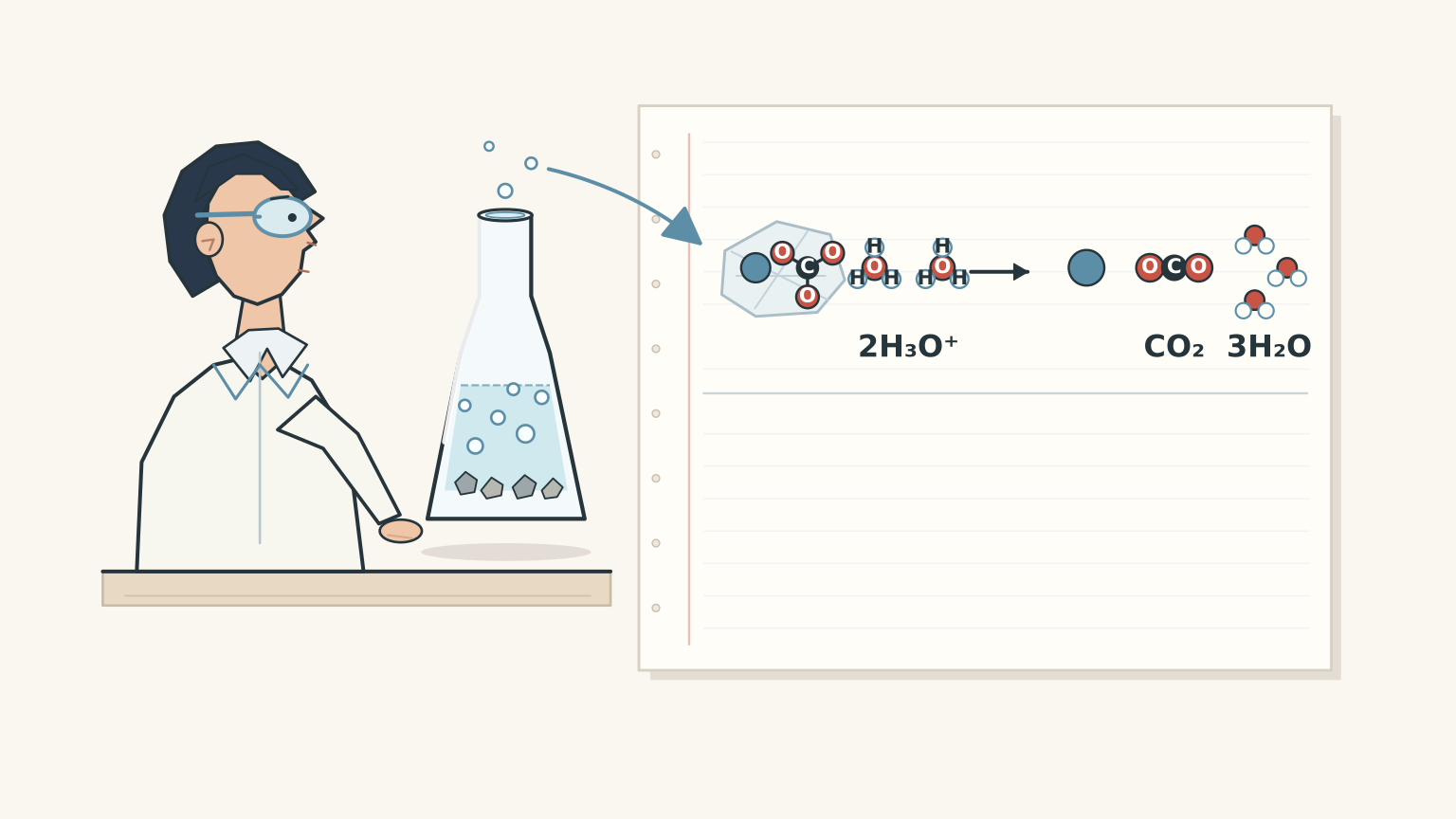
Due to technical limitations, this figure may display incorrectly or contain inaccuracies. Please check key details against your course materials.
Chemistry is worth keeping if:
- You enjoy understanding how substances interact and change.
- You find particle-level explanations interesting.
- You’re comfortable developing your skills with equations and quantitative problems.
- Chemistry is relevant to your intended university pathway.
Which subject is the better fit?
Use this comparison to think about what you actually enjoy.
| Consideration | Physics | Chemistry |
|---|---|---|
| Main focus | Motion, forces, energy, fields, and physical systems | Chemical structures, reactions, and chemical systems |
| Mathematical demands | Algebra, vectors, graphs, and quantitative modelling | Ratios, mole calculations, equations, and quantitative analysis |
| Conceptual demands | Applying physical laws to unfamiliar situations | Connecting observations with particle-level models |
| Common difficulty | Turning a physical situation into a mathematical model | Moving between chemical equations, particles, and calculations |
| Useful strengths | Logical reasoning, mathematical fluency, and modelling | Pattern recognition, careful reasoning, and symbolic understanding |
Neither subject is automatically easier.
A student who finds mathematical modelling enjoyable might prefer Physics. Someone who enjoys explaining reactions and understanding chemical systems might prefer Chemistry.
The better choice is the one that matches your interests, abilities, and future plans, not necessarily the one with the higher mark this term.
04Give yourself a short recovery trial before dropping either subject
If you’re genuinely unsure, don’t make the decision immediately.
Instead, run a short, structured recovery trial over approximately three weeks. This gives you evidence about whether your difficulties are improving when you address them properly.
Week 1: Identify your biggest knowledge gaps
Choose two or three specific areas where you lost marks.
For Physics, these might include:
- Rearranging equations.
- Resolving vectors.
- Interpreting graphs.
- Applying physical laws to unfamiliar situations.
For Chemistry, they might include:
- Writing chemical formulae.
- Balancing equations.
- Converting between mass and moles.
- Understanding particle-level explanations.
Don’t try to revise the entire syllabus at once. Start with the skills that are preventing you from understanding later material.
Week 2: Practise the skills you identified
Work through examples, then attempt questions without looking at the solutions.
Pay attention to whether you can explain why a method works.
If you can follow a worked example but cannot start a similar question independently, you probably haven’t mastered the skill yet.
Try questions that change the wording or context slightly. This helps distinguish genuine understanding from memorising a procedure.
Week 3: Test yourself without assistance
Complete a short set of unfamiliar questions under realistic assessment conditions.
Then evaluate your progress.
Ask yourself:
- Can I now explain the concepts without relying on my notes?
- Can I identify which method to use in an unfamiliar question?
- Am I making fewer repeated mistakes?
- Do I feel more comfortable studying this subject?
- Is the time required reasonable alongside my other HSC courses?
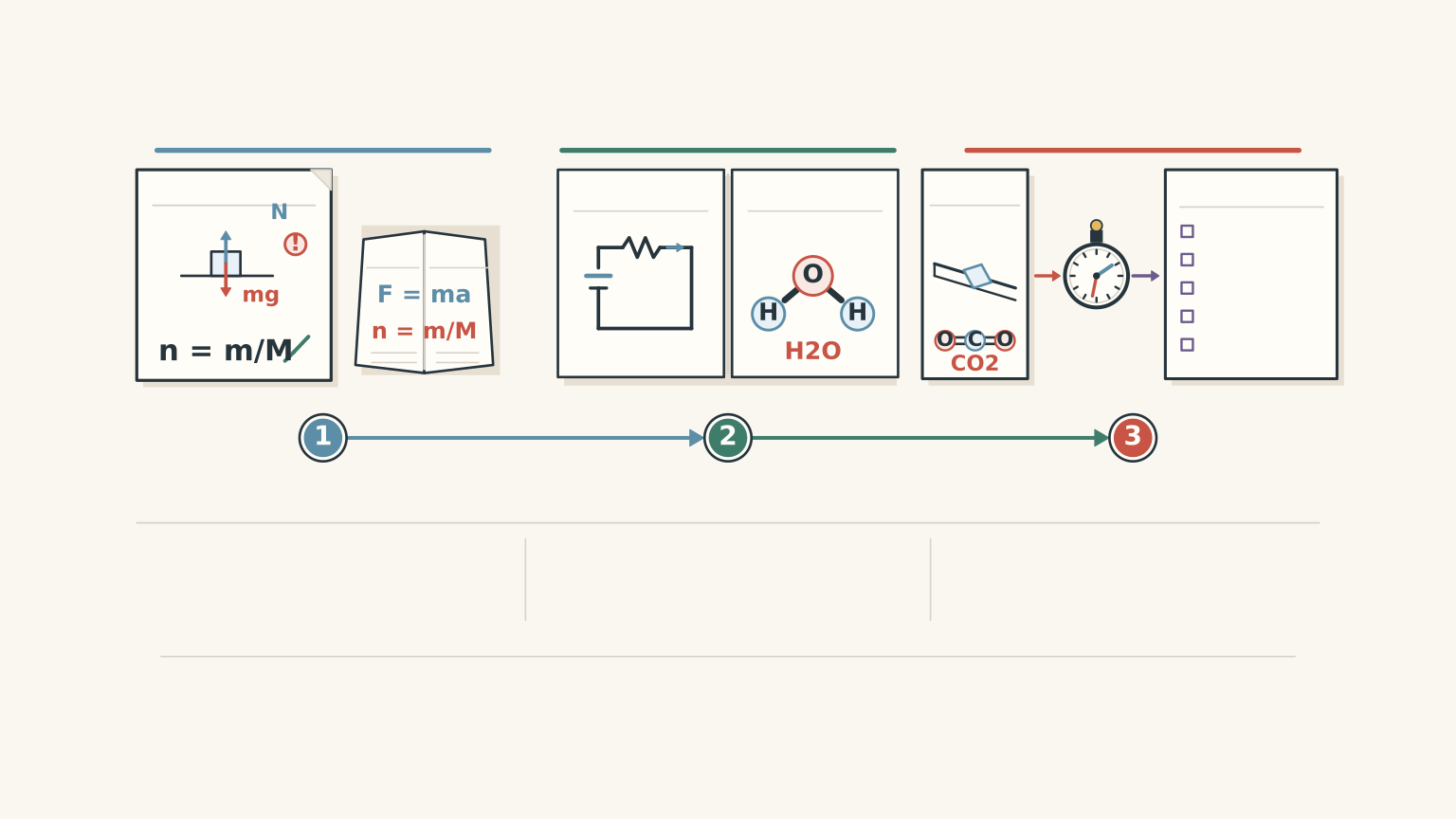
Due to technical limitations, this figure may display incorrectly or contain inaccuracies. Please check key details against your course materials.
If your understanding improves and you still enjoy the subject, that’s a good reason to continue.
If you’ve made a genuine effort, received useful feedback, and still dislike the core material, dropping the subject becomes a more reasonable option.
Remember, this trial isn’t an official NESA requirement. It’s a way to make a more informed decision.
05What would you replace the subject with?
Dropping Physics or Chemistry only makes sense if the alternative improves your overall study pattern.
Don’t choose a replacement simply because somebody tells you it’s easier.
Instead, consider three things.
1. Your strengths
Which subjects suit the way you learn?
If you enjoy writing, research, and analysing social issues, a humanities subject might be a better fit.
If you enjoy practical applications and developing industry-related skills, a suitable VET course might be worth investigating.
If you enjoy mathematical problem-solving, you may prefer to direct more of your study time towards Mathematics Advanced or Extension.
2. Your future study plans
Check the entry requirements for the actual university courses you’re considering.
Some university degrees have subject prerequisites. Others list assumed knowledge or recommended study.
These aren’t necessarily the same thing.
- A prerequisite may be a formal requirement for admission.
- Assumed knowledge describes material you are expected to understand when starting the degree.
- Recommended study indicates preparation that may be useful but isn’t necessarily compulsory.
Don’t assume that every science or engineering degree requires both Physics and Chemistry. Requirements vary between universities and courses.
Check the relevant university course information before dropping a subject that might affect your options.
3. Your overall workload
Consider how much time you’re spending on each subject.
If Physics is taking six hours of independent study each week and you’re still struggling, ask whether that time would be better spent improving your other subjects.
However, don’t assume that dropping a course automatically gives you a better HSC result.
You need to use the additional time effectively. Otherwise, you have simply reduced your subject load without improving your preparation.
Don’t choose based on scaling alone
Physics sometimes attracts attention because of its historically high scaled means.
However, scaling isn’t a bonus that students receive simply for choosing a difficult subject.
UAC’s scaling process considers the academic performance of the students taking each course. A course’s scaling can change between years, and a high scaled mean doesn’t guarantee that an individual student will receive a high scaled mark.
The practical lesson is straightforward: choose subjects in which you can perform well, rather than keeping a subject purely because of its reputation for scaling. UAC explains the process of scaling and ATAR calculation.
06Check your HSC units before dropping a subject
This is one of the most important practical considerations.
In NSW, the HSC has minimum study-pattern requirements. Dropping a subject without checking your remaining units can put your HSC eligibility at risk.
NESA requires the following:
| Requirement | Minimum |
|---|---|
| Preliminary study pattern (usually Year 11) | 12 units |
| HSC study pattern (usually Year 12) | 10 units |
| Board Developed courses in each pattern | 6 units |
| Board Developed English | 2 units |
| Additional Board Developed courses | 4 units |
| Courses worth 2 units or more | 3 courses |
| Different subject areas | 4 |
There are also limits on the number of Science units you can study: a maximum of 6 Preliminary Science units and 7 HSC Science units.
These requirements apply to the NSW HSC, not overseas senior secondary qualifications. NESA’s pattern of study rules provide the official requirements.
HSC eligibility and ATAR eligibility are different
You also need to distinguish between qualifying for the HSC and qualifying for an ATAR.
For an ATAR, UAC requires you to satisfactorily complete:
- At least 10 units of HSC Board Developed courses.
- At least 2 units of English.
- At least three Board Developed courses worth 2 units or more.
- Courses from at least four subject areas.
Your ATAR is calculated using your best 2 units of English and your best 8 remaining units.
Neither Physics nor Chemistry is individually compulsory for an ATAR.
However, if you drop a 2-unit course and end up with only 8 units of Board Developed courses, you will no longer meet the standard 10-unit ATAR eligibility requirement unless you add another eligible course.
Check the requirements with your school before making any changes. UAC’s ATAR eligibility rules explain the distinction.
Worked scenario: dropping Physics in Year 11
Imagine a student studying six 2-unit Preliminary courses:
| Subject | Units |
|---|---|
| English Standard | 2 |
| Mathematics Advanced | 2 |
| Physics | 2 |
| Chemistry | 2 |
| Business Studies | 2 |
| Modern History | 2 |
| Total | 12 |
The student receives a disappointing Physics result and decides to drop it.
Their remaining pattern now contains:
\[ 12-2=10\text{ units} \]
That is a problem.
Ten units meets the numerical minimum for the HSC pattern in Year 12, but it does not meet the 12-unit minimum for the Preliminary pattern in Year 11.
The student would need to add another suitable course or make an alternative arrangement approved by the school.
Now consider the same pattern in Year 12.
If the student drops Physics, they have 10 remaining units. Provided the other HSC requirements are satisfied, this could meet the numerical minimum for their HSC pattern.
The same subject change can therefore have different consequences depending on when it happens.
Always calculate your remaining units before submitting a subject-change request.
07What are the actual NSW rules for dropping HSC Physics or Chemistry?
The process depends on whether you’re changing a Preliminary course in Year 11 or withdrawing from an HSC course in Year 12.
These are NESA rules, not the rules of overseas qualifications or private examination systems.
If you’re in Year 11
Preliminary course changes are at the principal’s discretion.
Your principal must be satisfied that you can demonstrate achievement of the outcomes and content of the replacement course and satisfactorily complete it in the time available.
This means changing subjects partway through Year 11 isn’t automatically approved.
For example, switching from Physics to another course may require you to catch up on content that your new class has already covered.
Your school may also have its own internal subject-change deadlines.
If you’re in Year 12
Changing into a different HSC course is more complicated.
Under NESA’s current rules, the principal must be satisfied that:
- You have satisfactorily demonstrated achievement of the Preliminary course outcomes and content, or equivalent, for the subject you want to enter.
- You can complete all the HSC course requirements, including assessment requirements.
- The change will not create problems with your HSC eligibility or pattern of study.
You cannot be entered into a new HSC course after 30 June in the HSC examination year.
Withdrawing from an existing HSC course is a separate process. NESA allows students to withdraw before the HSC written examination, subject to the school’s withdrawal procedures.
If the withdrawal occurs before the deadline for submission of HSC school assessment data, the school processes it through Schools Online. After that deadline, the school must email NESA.
For the 2027 HSC, the current school assessment mark submission deadline is 14 September 2027. This is an administrative submission date, not the deadline for entering a new HSC course. NESA’s course-change rules and HSC key dates explain the relevant procedures.
NESA’s published course-change rules do not specify a standard subject-withdrawal fee. Ask your school whether any school-specific administrative charges or course-related costs apply.
Which syllabus will your cohort study?
There is another detail worth checking before changing subjects: Physics and Chemistry are moving to new NSW syllabuses in different years.
As at 15 November 2026, the implementation schedule is:
| Year you start Year 11 | Physics syllabus | Chemistry syllabus |
|---|---|---|
| 2026 | 2017 syllabus | 2017 syllabus |
| 2027 | 2025 syllabus | 2017 syllabus |
| 2028 | 2025 syllabus | 2025 syllabus |
The first HSC examination under the new Physics syllabus is in 2028.
The first HSC examination under the new Chemistry syllabus is in 2029.
This means that a student starting Year 11 in 2027 will study the new Physics syllabus but the existing Chemistry syllabus.
Don’t assume that the two subjects are changing at the same time. Make sure your revision materials, course information, and study plans match the syllabus for your actual cohort.
You can check the implementation schedules through NESA’s Physics 11-12 syllabus and Chemistry 11-12 syllabus.
08A final checklist before you make your decision
Before dropping either subject, make sure you can answer these questions.
- [ ] Have I reviewed more than one assessment?
- [ ] Do I understand exactly where I’m losing marks?
- [ ] Have I identified whether my weaknesses are fixable?
- [ ] Have I tried addressing those weaknesses with a specific study plan?
- [ ] Do I still enjoy the subject’s underlying concepts?
- [ ] Have I checked whether my intended university course requires or assumes knowledge of this subject?
- [ ] Do I have a suitable replacement subject?
- [ ] Will my revised subject pattern meet the Preliminary or HSC unit requirements?
- [ ] Will I remain eligible for an ATAR, if I want one?
- [ ] Have I discussed the change with my teachers, careers adviser, and principal?
- [ ] Do I understand the relevant course-change deadlines?
If several answers are uncertain, don’t rush into a decision.
A conversation with your Physics or Chemistry teacher can help establish whether you’re dealing with a recoverable knowledge gap or a more persistent problem with the course.
If you decide to continue, targeted support can help you address specific weaknesses rather than repeatedly revising material you already understand. tutorgum offers online tutoring in HSC Physics, Chemistry, and Mathematics Extension 1 and 2.
09So, should you drop HSC Physics or Chemistry?
If your only reason is that you received a disappointing mark, give yourself time to investigate and address the problem first.
If you have persistent difficulties, no longer enjoy the subject, and have a better alternative that fits your future plans and HSC requirements, dropping it may be the right decision.
The aim isn’t to study the most difficult combination of subjects or to collect the highest number of units.
It’s to build a study pattern that meets your HSC requirements, supports your future options, and gives you a realistic opportunity to perform well across your remaining courses.
Make that decision using evidence from your assessments, your experience of the subjects, and the actual requirements of your next step.