
How to Balance Nuclear Equations for HSC Chemistry
Learn how to construct balanced nuclear equations by conserving nucleon number and charge. Includes alpha, beta, gamma, bombardment reactions, worked examples, and HSC-style practice.
A radioactive nucleus changes into something else, but the equation can’t just be guessed from the name of the radiation. Suppose uranium-238 emits an alpha particle. Does the new nucleus still have 92 protons? If four particles leave the nucleus, should its mass number drop by four, its atomic number drop by four, or something different?
The reliable way through every nuclear equation is to keep track of two separate totals: the number of nucleons and the electric charge. Once those two totals balance, the missing nucleus or particle is usually forced.
01The two things a nuclear equation must conserve
Start by picturing a nucleus as a crowded group of protons and neutrons.
A proton contributes:
- 1 to the nucleon number
- +1 to the nuclear charge
A neutron contributes:
- 1 to the nucleon number
- 0 to the nuclear charge
We describe a nucleus using isotope notation:
\[
{}^{A}_{Z}\mathrm{X}
\]
where:
- \(A\) is the mass number, which is the total number of protons and neutrons
- \(Z\) is the atomic number, which is the number of protons
- \(\mathrm{X}\) is the element symbol
For example,
\[
{}^{238}_{92}\mathrm{U}
\]
has 92 protons and \(238 – 92 = 146\) neutrons.
The atomic number is especially important because it determines the element. A nucleus with 92 protons is uranium. Change the proton number to 90, and it is no longer uranium.
If isotope notation still feels unfamiliar, it is worth reviewing why isotopes can contain different numbers of neutrons in Stable and Unstable Isotopes Explained for HSC Chemistry.
Think of a nuclear equation as two-column bookkeeping
A useful first model is to treat a nuclear equation like a slightly obsessive accountant.
There are two columns to balance:
| Quantity | What you add |
|---|---|
| Nucleon number | Top numbers, \(A\) |
| Charge number | Bottom numbers, \(Z\) |
Whatever enters on the left must equal whatever appears on the right.
The analogy is useful because it stops you guessing. But it has a limit. Nuclear reactions can release energy, so this does not mean the actual rest mass in kilograms stays exactly unchanged. What is conserved in these HSC balancing problems is nucleon number and electric charge.
02Alpha decay
An alpha particle is a helium-4 nucleus:
\[
{}^{4}_{2}\mathrm{He}
\]
It contains two protons and two neutrons.
Now return to uranium-238. Before doing any calculation, predict what should happen to its atomic number when it emits an alpha particle.
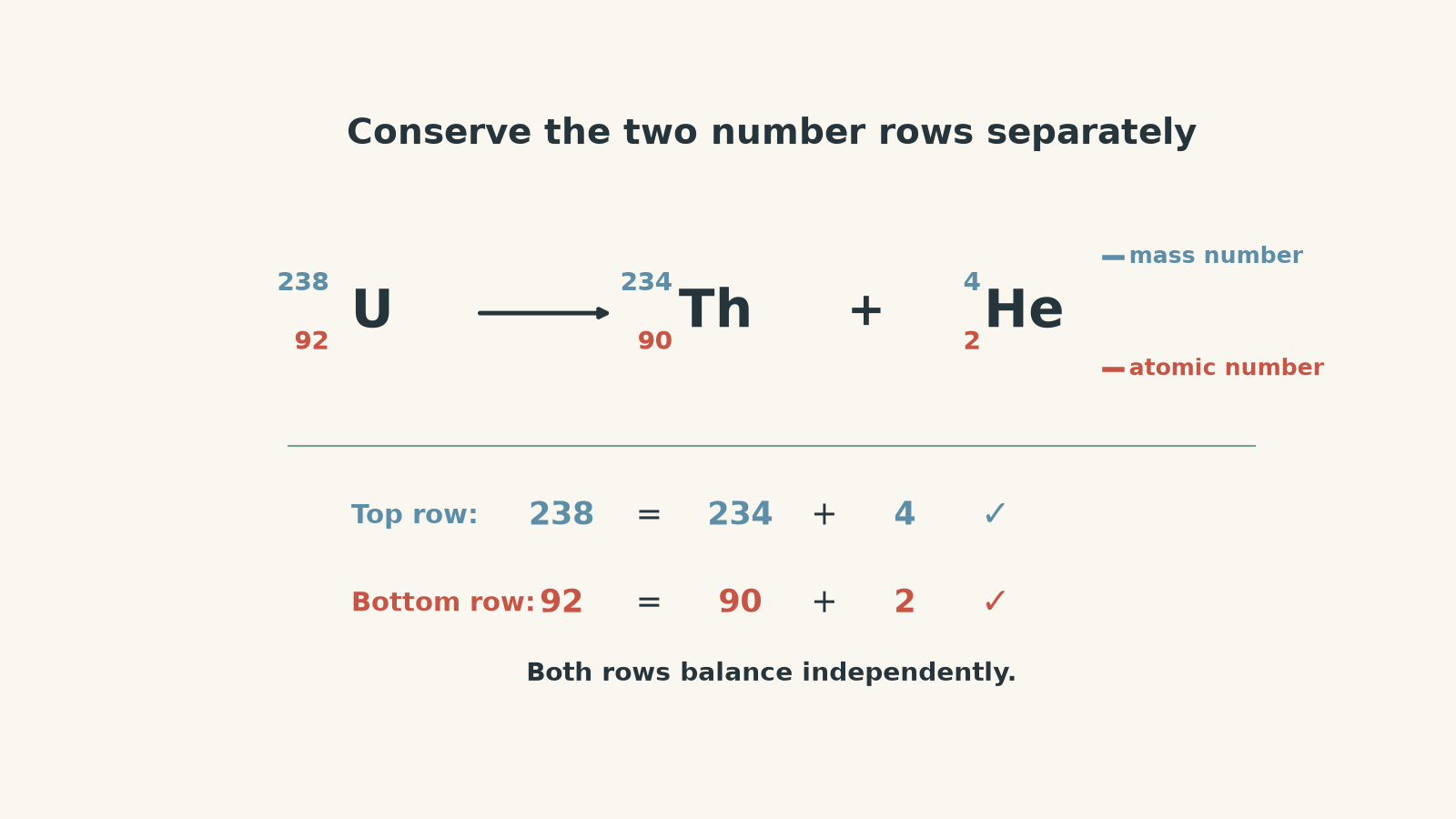
Two protons leave with the alpha particle, so the daughter nucleus must have two fewer protons. Its atomic number falls from 92 to 90.
The decay is:
\[
{}^{238}_{92}\mathrm{U}
\rightarrow
{}^{234}_{90}\mathrm{Th}
+
{}^{4}_{2}\mathrm{He}
\]
Check the top numbers:
\[
238 = 234 + 4
\]
Check the bottom numbers:
\[
92 = 90 + 2
\]
Both balance.
The daughter nucleus has atomic number 90, so it must be thorium.
Decision rule for alpha decay
When a nucleus emits an alpha particle:
\[
A \rightarrow A – 4
\]
and
\[
Z \rightarrow Z – 2
\]
That means the daughter is always a different element.
Worked example: Alpha decay of radium-226
Write the balanced nuclear equation for the alpha decay of radium-226.
Step 1
Radium has atomic number 88:
\[
{}^{226}_{88}\mathrm{Ra}
\]
Step 2
\[
{}^{226}_{88}\mathrm{Ra}
\rightarrow
{}^{A}_{Z}\mathrm{X}
+
{}^{4}_{2}\mathrm{He}
\]
Step 3
\[
226 = A + 4
\]
so
\[
A = 222
\]
Step 4
\[
88 = Z + 2
\]
so
\[
Z = 86
\]
Atomic number 86 is radon.
Therefore,
\[
{}^{226}_{88}\mathrm{Ra}
\rightarrow
{}^{222}_{86}\mathrm{Rn}
+
{}^{4}_{2}\mathrm{He}
\]
The result means one radium-226 nucleus has become a radon-222 nucleus after losing two protons and two neutrons together.
03Beta-minus decay
Beta decay is where the bookkeeping starts to feel strange.
Suppose carbon-14 undergoes beta-minus decay. Its mass number remains 14, but its atomic number increases from 6 to 7.
At first, that can seem impossible. How can a nucleus gain a proton without gaining another nucleon?
Inside the nucleus, a neutron changes into a proton. In a more complete description,
\[
n \rightarrow p + e^- + \bar{\nu}_e
\]
where \(e^-\) is an electron and \(\bar{\nu}_e\) is an electron antineutrino.
For HSC nuclear-equation balancing, the beta particle is written as:
\[
{}^{0}_{-1}e
\]
Its nucleon number is 0 because the electron is not a proton or neutron. Its charge number is \(-1\).
Carbon-14 therefore decays as:
\[
{}^{14}_{6}\mathrm{C}
\rightarrow
{}^{14}_{7}\mathrm{N}
+
{}^{0}_{-1}e
\]
Check the nucleon numbers:
\[
14 = 14 + 0
\]
Check the charge numbers:
\[
6 = 7 + (-1)
\]
So both totals are conserved.
The antineutrino is often omitted from simplified HSC balancing equations because it contributes 0 to both \(A\) and \(Z\). It matters in a more complete particle-physics description, but it does not change these two balancing totals.
The tempting mistake
A student might think beta-minus emission removes an electron from the atom, so the nucleus should become more positive without changing its element.
That would be reasonable if the electron had originally been sitting in an electron shell. It wasn’t.
The beta electron is produced during the nuclear process. A neutron in the nucleus changes into a proton, so the nucleus gains one proton. That is why \(Z\) increases by 1.
For a fuller comparison of alpha, beta, and gamma processes, see Alpha, Beta and Gamma Radiation for HSC Chemistry.
04Beta-plus decay
In beta-plus decay, the emitted particle is a positron:
\[
{}^{0}_{+1}e
\]
A positron has the same mass as an electron but the opposite electric charge.
Inside the nucleus, a proton changes into a neutron. In a more complete description,
\[
p \rightarrow n + e^+ + \nu_e
\]
Because one proton becomes a neutron:
- \(A\) stays unchanged
- \(Z\) decreases by 1
For example:
\[
{}^{22}_{11}\mathrm{Na}
\rightarrow
{}^{22}_{10}\mathrm{Ne}
+
{}^{0}_{+1}e
\]
The nucleon numbers balance:
\[
22 = 22 + 0
\]
The charge numbers balance:
\[
11 = 10 + 1
\]
So beta-plus decay moves the nucleus one atomic number lower.
05Gamma emission
Gamma radiation creates another common trap because the nucleus emits energy without losing any protons or neutrons.
A gamma photon is represented as:
\[
{}^{0}_{0}\gamma
\]
Imagine a nucleus in an excited energy state after another nuclear event. It is a bit like someone sitting awkwardly on the top bunk when the bottom bunk is free. The nucleus can move to a lower-energy state by releasing a gamma photon.
Unlike someone climbing out of bed, though, no nucleons leave the nucleus. That is where the analogy stops.
A simplified gamma transition can be written as:
\[
{}^{A}_{Z}\mathrm{X}^{*}
\rightarrow
{}^{A}_{Z}\mathrm{X}
+
{}^{0}_{0}\gamma
\]
The asterisk indicates an excited nuclear state.
Neither \(A\) nor \(Z\) changes.
That means gamma emission alone does not change the isotope into another element.
06A compact decay table
| Process | Emitted particle | Change in \(A\) | Change in \(Z\) |
|---|---|---|---|
| Alpha | \({}^{4}_{2}\mathrm{He}\) | \(-4\) | \(-2\) |
| Beta-minus | \({}^{0}_{-1}e\) | \(0\) | \(+1\) for the daughter |
| Beta-plus | \({}^{0}_{+1}e\) | \(0\) | \(-1\) for the daughter |
| Gamma | \({}^{0}_{0}\gamma\) | \(0\) | \(0\) |
Notice that the beta-minus particle has \(Z=-1\), but the daughter nucleus increases its atomic number by 1. Those two statements describe different parts of the equation.
07Other nuclear reactions use the same bookkeeping
The conservation rules are not limited to spontaneous radioactive decay.
A nucleus can be struck by another particle, producing a different nucleus and one or more outgoing particles. These are often called bombardment or transmutation reactions.
The method does not change:
- Add all mass numbers on each side.
- Add all charge numbers on each side.
- Use the missing \(A\) and \(Z\) values to identify the unknown particle or nucleus.
Worked example: Find the particle produced in a bombardment reaction
Complete the nuclear equation:
\[
{}^{27}_{13}\mathrm{Al}
+
{}^{4}_{2}\mathrm{He}
\rightarrow
{}^{30}_{15}\mathrm{P}
+
{}^{A}_{Z}\mathrm{X}
\]
Step 1
The total on the left is:
\[
27 + 4 = 31
\]
So:
\[
31 = 30 + A
\]
Therefore:
\[
A = 1
\]
Step 2
The total charge number on the left is:
\[
13 + 2 = 15
\]
Therefore:
\[
15 = 15 + Z
\]
so:
\[
Z = 0
\]
Step 3
A particle with \(A=1\) and \(Z=0\) is a neutron:
\[
{}^{1}_{0}n
\]
The completed equation is:
\[
{}^{27}_{13}\mathrm{Al}
+
{}^{4}_{2}\mathrm{He}
\rightarrow
{}^{30}_{15}\mathrm{P}
+
{}^{1}_{0}n
\]
The reaction has rearranged the nucleons. None have disappeared, and the total electric charge is unchanged.
08A method that works when you are stuck
When an unfamiliar nuclear equation appears, avoid trying to recognise it from memory.
Write two equations instead.
For a general reaction,
\[
{}^{A_1}_{Z_1}\mathrm{X}
\rightarrow
{}^{A_2}_{Z_2}\mathrm{Y}
+
{}^{A_3}_{Z_3}\mathrm{P}
\]
conservation of nucleon number gives:
\[
A_1 = A_2 + A_3
\]
and conservation of charge gives:
\[
Z_1 = Z_2 + Z_3
\]
For reactions with particles on both sides, simply add every \(A\) value and every \(Z\) value on each side.
Only after finding the unknown atomic number should you use the periodic table to identify the element.
That order matters. Guessing the element first is an easy way to make the equation fit your guess instead of the physics.
09Mass number is not the same thing as mass
This distinction is easy to miss.
If an alpha-decay equation has mass numbers that total 238 on both sides, it is tempting to say, “The mass is exactly conserved.”
That is not what the numbers show.
The mass number \(A\) is a count of nucleons. It has no unit. It is not a measurement of the nucleus’s mass in kilograms or atomic mass units.
In nuclear reactions, the total rest mass of the products can differ slightly from the total rest mass of the reactants. That difference is connected to energy through:
\[
E = mc^2
\]
For balancing HSC nuclear equations, the important rule is therefore:
Conserve total nucleon number and total electric charge. Do not interpret balanced mass numbers as proof that the measured mass is unchanged.
10Questions and solutions
Question 1
Polonium-210 undergoes alpha decay. Write the balanced nuclear equation and identify the daughter element.
Solution 1
The daughter is lead-206, and the balanced equation is:
\[
{}^{210}_{84}\mathrm{Po}
\rightarrow
{}^{206}_{82}\mathrm{Pb}
+
{}^{4}_{2}\mathrm{He}
\]
Alpha decay removes two protons and two neutrons.
For the nucleon numbers:
\[
210 = 206 + 4
\]
For the charge numbers:
\[
84 = 82 + 2
\]
Atomic number 82 belongs to lead, so the daughter nucleus is lead-206. A common mistake is to subtract 4 from both \(A\) and \(Z\). Only \(A\) falls by 4. The atomic number falls by 2 because an alpha particle contains only two protons.
Question 2
Carbon-14 undergoes beta-minus decay. Explain why the daughter nucleus has atomic number 7 rather than 5, and write the balanced equation.
Solution 2
The daughter has atomic number 7 because a neutron changes into a proton during beta-minus decay, so the nucleus gains one proton.
The equation is:
\[
{}^{14}_{6}\mathrm{C}
\rightarrow
{}^{14}_{7}\mathrm{N}
+
{}^{0}_{-1}e
\]
The mass number remains unchanged:
\[
14 = 14 + 0
\]
The charge number also balances:
\[
6 = 7 + (-1)
\]
The tempting mistake is to think that emitting a negatively charged particle must make \(Z\) decrease. Instead, the emitted electron carries charge \(-1\), while the daughter nucleus has gained a proton. Together, those changes conserve the total charge.
Question 3
A radioactive nucleus undergoes the reaction:
\[
{}^{60}_{27}\mathrm{Co}
\rightarrow
{}^{60}_{28}\mathrm{Ni}
+
\mathrm{X}
\]
Identify \(\mathrm{X}\) using nucleon number and charge conservation.
Solution 3
\(\mathrm{X}\) is a beta-minus particle, \({}^{0}_{-1}e\).
For the nucleon number:
\[
60 = 60 + A_{\mathrm{X}}
\]
so:
\[
A_{\mathrm{X}} = 0
\]
For the charge number:
\[
27 = 28 + Z_{\mathrm{X}}
\]
so:
\[
Z_{\mathrm{X}} = -1
\]
Therefore:
\[
{}^{60}_{27}\mathrm{Co}
\rightarrow
{}^{60}_{28}\mathrm{Ni}
+
{}^{0}_{-1}e
\]
The unchanged mass number and one-unit increase in the daughter’s atomic number are the characteristic bookkeeping pattern of beta-minus decay.
Question 4
Complete the nuclear reaction:
\[
{}^{19}_{9}\mathrm{F}
+
{}^{1}_{1}\mathrm{H}
\rightarrow
{}^{16}_{8}\mathrm{O}
+
\mathrm{X}
\]
Identify \(\mathrm{X}\) and explain how you know.
Solution 4
\(\mathrm{X}\) is an alpha particle, \({}^{4}_{2}\mathrm{He}\).
First balance the nucleon numbers:
\[
19 + 1 = 16 + A_{\mathrm{X}}
\]
\[
20 = 16 + A_{\mathrm{X}}
\]
so:
\[
A_{\mathrm{X}} = 4
\]
Now balance the charge numbers:
\[
9 + 1 = 8 + Z_{\mathrm{X}}
\]
\[
10 = 8 + Z_{\mathrm{X}}
\]
so:
\[
Z_{\mathrm{X}} = 2
\]
A particle with \(A=4\) and \(Z=2\) is a helium-4 nucleus:
\[
{}^{4}_{2}\mathrm{He}
\]
The completed equation is:
\[
{}^{19}_{9}\mathrm{F}
+
{}^{1}_{1}\mathrm{H}
\rightarrow
{}^{16}_{8}\mathrm{O}
+
{}^{4}_{2}\mathrm{He}
\]
This question cannot safely be solved by recognising a decay pattern because it is a nuclear reaction involving an incoming proton. Direct conservation is the more reliable method.
Question 5
A student writes:
\[
{}^{A}_{Z}\mathrm{X}
\rightarrow
{}^{A}_{Z-1}\mathrm{Y}
+
{}^{0}_{-1}e
\]
They claim this represents beta-minus decay because an electron has been emitted.
Is the equation possible as written? Explain using conservation laws, then state what atomic number the daughter should have in beta-minus decay.
Solution 5
The equation is not balanced as written. In beta-minus decay, the daughter should have atomic number \(Z+1\), not \(Z-1\).
Check the charge number in the student’s equation.
The left side has:
\[
Z
\]
The right side has:
\[
(Z-1) + (-1) = Z-2
\]
So charge is not conserved.
For beta-minus decay, the correct general form is:
\[
{}^{A}_{Z}\mathrm{X}
\rightarrow
{}^{A}_{Z+1}\mathrm{Y}
+
{}^{0}_{-1}e
\]
because:
\[
(Z+1)+(-1)=Z
\]
The trap is to focus only on the negative charge of the emitted electron. The electron is only one part of the process. Inside the nucleus, a neutron has also become a proton, which raises the daughter’s atomic number by 1.
Question 6
Consider the balanced equation:
\[
{}^{238}_{92}\mathrm{U}
\rightarrow
{}^{234}_{90}\mathrm{Th}
+
{}^{4}_{2}\mathrm{He}
\]
A student argues, “The top numbers add to 238 on both sides, so this proves the total mass before and after the decay is exactly equal.”
Assess the student’s reasoning.
Solution 6
The student’s conclusion is incorrect. The equation proves conservation of nucleon number, not exact equality of measured rest mass.
The mass numbers do balance:
\[
238 = 234 + 4
\]
That tells us the total number of protons and neutrons has been accounted for.
However, \(238\), \(234\), and \(4\) are mass numbers, not measured masses. Nuclear binding energies differ between the parent nucleus and the products, so their total rest masses need not be exactly equal.
The difference in rest mass is associated with released or absorbed energy through:
\[
E = mc^2
\]
The correct conclusion is that the reaction conserves total nucleon number and electric charge. Balancing those quantities is enough to construct the nuclear equation, but it does not establish that the reactants and products have exactly equal masses.
Once you can balance nuclear equations reliably, the next useful step is to connect the equation to the physical type of radiation being produced. The equation tells you what changed inside the nucleus. The properties of alpha, beta, and gamma radiation then tell you what that emitted radiation will do as it travels through matter.