
Atomic Radius Trends and Electron Configuration for HSC Chemistry
Learn how valence-shell arrangements, shielding, and nuclear attraction explain atomic-radius trends across periods and down groups.
Sodium and magnesium both have their outer electrons in the third shell. Magnesium also has one extra proton and one extra electron. So which atom should be larger?
A common prediction is magnesium: more electrons must mean a bigger electron cloud. But the opposite is true. A magnesium atom is smaller than a sodium atom.
That result tells us something important. Atomic radius is not controlled by electron number alone. It comes from a competition between how far the outer electrons are from the nucleus and how strongly the nucleus attracts them.
01What actually controls the size of an atom?
Picture the nucleus pulling on the atom’s outermost electrons.
Two things matter most:
- Number of occupied electron shells: more shells place the outer electrons further from the nucleus.
- Attraction between the nucleus and the outer electrons: a stronger attraction pulls the electron cloud closer to the nucleus.
Those two effects explain the main atomic-radius trends in the periodic table.
Before we use them, we need to know where the outer electrons actually are.
02Electron configuration tells you where the atom ends
An electron configuration describes how electrons are arranged around the nucleus.
For example, sodium has 11 electrons:
\[
\ce{Na}: 1s^2\,2s^2\,2p^6\,3s^1
\]
The highest occupied shell is shell 3, so sodium’s valence shell is the third shell.
Magnesium has 12 electrons:
\[
\ce{Mg}: 1s^2\,2s^2\,2p^6\,3s^2
\]
Its valence shell is also shell 3.
The valence shell is simply the highest occupied principal electron shell. Its electrons are called valence electrons.
For quick comparisons, shell notation can also help:
| Atom | Shell arrangement | Valence shell |
|---|---|---|
| Li | 2, 1 | 2 |
| Na | 2, 8, 1 | 3 |
| K | 2, 8, 8, 1 | 4 |
| Mg | 2, 8, 2 | 3 |
| Cl | 2, 8, 7 | 3 |
Notice what happens down Group 1. Lithium, sodium, and potassium have similar valence-shell arrangements, but each step down adds another occupied shell.
That is our first clue about why atoms get larger down a group.
03Shielding weakens the nucleus’s pull on outer electrons
Suppose the nucleus is trying to attract a valence electron, but several occupied shells sit between them.
Those inner electrons reduce the strength of the attraction experienced by the outer electron. This effect is called shielding or screening.
You can picture the nucleus as someone trying to get the attention of a friend across a packed school hall. The more people standing between them, the less direct the interaction feels.
The analogy has a limit. Electrons do not literally block electrostatic attraction like people blocking your view. Shielding comes from the way electron-electron repulsion changes the net electrostatic attraction experienced by an electron.
The important idea is:
More occupied inner shells generally mean more shielding of the valence electrons.
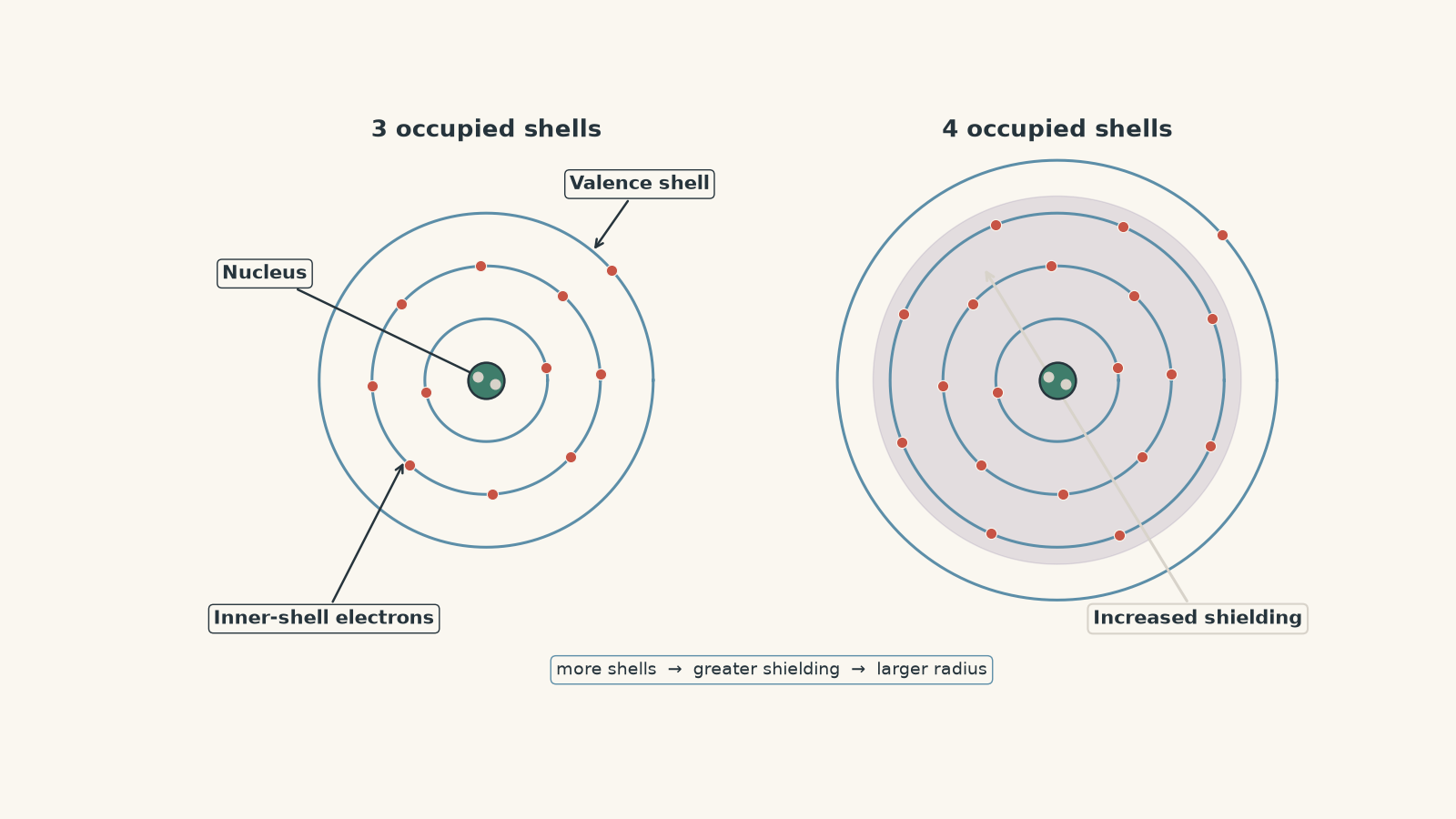
This gives us the basic competition:
- more protons in the nucleus increase attraction;
- more inner-shell electrons increase shielding;
- a higher valence shell places electrons further from the nucleus.
Now we can explain the periodic trends.
04Why atomic radius decreases across a period
Consider sodium and chlorine.
Their electron configurations are:
\[
\ce{Na}: 1s^2\,2s^2\,2p^6\,3s^1
\]
\[
\ce{Cl}: 1s^2\,2s^2\,2p^6\,3s^2\,3p^5
\]
Both atoms have their valence electrons in shell 3.
Before reading on, predict which is larger.
Sodium is larger.
As we move from sodium towards chlorine across Period 3, the number of protons increases. Sodium has 11 protons, while chlorine has 17.
Electrons are also being added, but they are mainly being added to the same principal shell. No new occupied inner shell appears.
The inner-shell configuration remains:
\[
1s^2\,2s^2\,2p^6
\]
So the shielding provided by the inner electrons changes much less than the nuclear charge does.
Electrons within the valence shell do shield one another to some extent, so it would be inaccurate to say that shielding is completely constant. But the extra shielding is not enough to cancel the increasing attraction from the growing positive charge of the nucleus.
The result is a stronger net attraction between the nucleus and the valence electrons.
The electron cloud is pulled closer.
So, in general:
Atomic radius decreases from left to right across a period.
Worked example: Which is larger, magnesium or chlorine?
Compare the atomic radii of neutral magnesium and chlorine atoms using their electron configurations.
Step 1
Magnesium is:
\[
\ce{Mg}: 1s^2\,2s^2\,2p^6\,3s^2
\]
Chlorine is:
\[
\ce{Cl}: 1s^2\,2s^2\,2p^6\,3s^2\,3p^5
\]
Both have valence electrons in shell 3.
Step 2
Magnesium has 12 protons. Chlorine has 17.
Chlorine therefore has the greater positive nuclear charge.
Step 3
Both atoms have the same filled inner shells, \(1s^2\,2s^2\,2p^6\). Their inner-electron shielding is therefore similar.
Step 4
Chlorine’s greater nuclear charge produces a stronger attraction for electrons in the same principal shell.
Therefore:
\[
r(\ce{Mg}) > r(\ce{Cl})
\]
where \(r\) represents atomic radius.
Magnesium has the larger atomic radius. The key is not that magnesium has fewer electrons. It is that its shell 3 electrons experience a weaker attraction to the nucleus.
Worked example: Order sodium, aluminium, and sulfur by atomic radius
Arrange \(\ce{Na}\), \(\ce{Al}\), and \(\ce{S}\) from largest to smallest atomic radius.
Step 1
All three are in Period 3, so their valence electrons occupy the third shell.
Step 2
Their proton numbers are:
- \(\ce{Na}\): 11
- \(\ce{Al}\): 13
- \(\ce{S}\): 16
The positive nuclear charge increases across the period.
Step 3
No new inner electron shell is added as we move from sodium to sulfur. The increased number of valence electrons provides some extra shielding, but not enough to cancel the increasing nuclear attraction.
Step 4
The increasing nuclear attraction pulls the valence shell progressively closer.
Therefore:
\[
r(\ce{Na}) > r(\ce{Al}) > r(\ce{S})
\]
Sodium is largest, sulfur is smallest, and aluminium lies between them.
05Why atomic radius increases down a group
Now compare lithium and potassium.
Lithium has:
\[
\ce{Li}: 1s^2\,2s^1
\]
Potassium has:
\[
\ce{K}: 1s^2\,2s^2\,2p^6\,3s^2\,3p^6\,4s^1
\]
Potassium has far more protons than lithium. If nuclear charge were the only factor, you might expect potassium to pull its electrons in much more strongly and be smaller.
It doesn’t.
Potassium is much larger.
Why? Its valence electron occupies shell 4 rather than shell 2. It starts much further from the nucleus, and there are several occupied inner shells between the nucleus and that electron.
Those inner electrons produce substantial shielding.
So although nuclear charge increases down the group, two other effects become stronger:
- the valence shell is further from the nucleus;
- shielding increases because more inner shells are occupied.
Together, these effects outweigh the increasing nuclear charge.
Therefore:
Atomic radius generally increases down a group.
This is why:
\[
r(\ce{Li}) < r(\ce{Na}) < r(\ce{K})
\]
Worked example: Why is potassium larger than sodium?
Compare the atomic radii of neutral sodium and potassium atoms.
Step 1
Sodium is \(2,8,1\), while potassium is \(2,8,8,1\).
Step 2
Sodium’s valence electron is in shell 3.
Potassium’s valence electron is in shell 4.
Step 3
Potassium has an additional occupied inner shell. Its valence electron is therefore more strongly shielded from the nucleus.
Step 4
Potassium does have more protons, but its valence electron is both further from the nucleus and more strongly shielded.
Therefore:
\[
r(\ce{K}) > r(\ce{Na})
\]
Potassium is larger because adding another occupied shell has a greater effect on atomic size than the accompanying increase in nuclear charge.
06The two trends come from different balances
It helps to keep the reasoning separate.
| Movement in periodic table | What changes most importantly? | Effect on radius |
|---|---|---|
| Across a period, left to right | Nuclear charge increases while valence electrons remain in the same principal shell | Radius generally decreases |
| Down a group | A new occupied shell is added and shielding increases | Radius generally increases |
A useful decision rule is:
- same period: look mainly at increasing nuclear attraction;
- same group: look mainly at added shells and increased shielding.
Do not memorise “left is big, down is big” without the mechanism. HSC questions can give you electron configurations instead of a familiar periodic table position, and then the mechanism is what lets you reconstruct the trend.
07The tempting mistake: more electrons means a larger atom
This mistake feels reasonable.
If an atom contains more electrons, shouldn’t they take up more room?
Sometimes adding electrons is associated with a larger radius, but electron count alone does not determine atomic size.
Compare sodium and chlorine again. Chlorine has six more electrons than sodium, yet chlorine is smaller.
Why? Those extra electrons are being added to the same valence shell while the nucleus gains six extra protons. The stronger nuclear attraction pulls the shell inward.
Now compare sodium and potassium. Potassium has more electrons and is larger, but not simply because it has more electrons. Potassium is larger because it has an additional occupied shell and greater shielding.
The useful question is never just:
How many electrons are there?
Ask instead:
Which shell contains the valence electrons, how much shielding is present, and how strongly does the nucleus attract that shell?
08Atomic radius is not a hard edge
So far, we have spoken as though an atom were a tiny ball with a sharply defined surface.
That model is useful, but it is not exact.
An electron is described by a probability distribution rather than a fixed circular orbit, so an atom has no perfectly sharp outer boundary. Scientists therefore infer atomic radii from measurements such as distances between nuclei in bonded atoms.
Different definitions, including covalent, metallic, and van der Waals radii, can produce different numerical values.
For HSC trend questions, the important point is that the broad pattern still holds:
- atomic radius generally decreases across a period;
- atomic radius generally increases down a group.
“Generally” matters. Real measured data can contain irregularities, particularly when different types of radius or more complex electron structures are involved.
09What if the atoms are diagonally separated?
Suppose one atom is both further right and further down than another.
Now the simple trends compete.
Moving right tends to decrease radius. Moving down tends to increase it.
For example, if atom X is one period below but several groups to the right of atom Y, you should not blindly declare one trend the winner unless the electron configurations, supplied data, or other information justify it.
This is a useful limit on the model:
Periodic trends are strongest as comparison rules when the atoms are in the same period or the same group.
For diagonal comparisons, reason from electron configuration first. If two effects oppose one another and the question supplies experimental data, use the data rather than forcing a memorised trend to give an answer it cannot securely provide.
10A reliable HSC comparison method
When comparing neutral atomic radii, use this sequence.
- Identify the highest occupied electron shell. A higher shell number usually means a substantially larger atom.
- Compare shielding. More occupied inner shells increase shielding of the valence electrons.
- Compare nuclear charge. More protons create a stronger attraction for electrons.
- Ask whether the atoms are in the same period or group. This tells you which effect is likely to dominate.
- State the mechanism, not just the direction. Explain why the electron cloud is pulled inward or extends further outward.
That final step is important. “Radius decreases across a period” states a pattern. “Increasing nuclear charge attracts electrons in the same principal shell more strongly, while shielding changes relatively little” explains it.
11Questions and solutions
Question 1
A neutral phosphorus atom and a neutral aluminium atom are both in Period 3. Which has the larger atomic radius? Explain your reasoning using electron configuration, shielding, and nuclear charge.
Solution 1
Aluminium has the larger atomic radius.
Both atoms have their valence electrons in shell 3:
\[
\ce{Al}: 1s^2\,2s^2\,2p^6\,3s^2\,3p^1
\]
\[
\ce{P}: 1s^2\,2s^2\,2p^6\,3s^2\,3p^3
\]
Their inner-shell electron arrangements are the same, so their inner-electron shielding is similar.
Phosphorus has 15 protons, while aluminium has 13. The greater nuclear charge of phosphorus attracts electrons in the third shell more strongly.
Therefore phosphorus’s electron cloud is pulled closer to the nucleus:
\[
r(\ce{Al}) > r(\ce{P})
\]
The trap is to argue that phosphorus must be larger because it contains more electrons. Across a period, the increasing nuclear attraction is more important than the increase in electron number.
Question 2
Two neutral atoms have the following electron configurations:
\[
\text{X}: 1s^2\,2s^2\,2p^6\,3s^1
\]
\[
\text{Y}: 1s^2\,2s^2\,2p^6\,3s^2\,3p^6\,4s^1
\]
Which atom has the larger atomic radius, and what feature of the configurations provides the strongest evidence?
Solution 2
Y has the larger atomic radius because its valence electron occupies a higher principal shell.
X has its valence electron in shell 3, while Y has its valence electron in shell 4.
Y also has an additional occupied inner shell. This increases shielding of the valence electron from the positive nucleus.
Although Y has a greater nuclear charge, its outer electron is further from the nucleus and more strongly shielded.
Therefore:
\[
r(\text{Y}) > r(\text{X})
\]
The strongest clue is the change from a shell 3 valence electron to a shell 4 valence electron. This tells us that an additional occupied shell has been added.
Question 3
A student makes this claim:
“Silicon must be larger than aluminium because silicon has one more electron, so its electron cloud takes up more space.”
Evaluate the claim and give the correct comparison.
Solution 3
The claim is incorrect. Aluminium has the larger atomic radius.
Aluminium and silicon are both in Period 3:
\[
\ce{Al}: [\ce{Ne}]\,3s^2\,3p^1
\]
\[
\ce{Si}: [\ce{Ne}]\,3s^2\,3p^2
\]
The notation \([\ce{Ne}]\) represents the common inner-shell arrangement \(1s^2\,2s^2\,2p^6\).
Silicon has one additional proton as well as one additional electron. The new electron is added to the same principal shell rather than creating a new occupied shell.
The inner-electron shielding is therefore similar, while silicon has the greater nuclear charge. Its valence electrons experience a stronger attraction towards the nucleus.
Thus:
\[
r(\ce{Al}) > r(\ce{Si})
\]
The misconception is treating electron number as the controlling variable. Atomic radius depends on the balance between shell number, shielding, and nuclear attraction.
Question 4
Three neutral atoms have shell arrangements:
- A: \(2,8,1\)
- B: \(2,8,6\)
- C: \(2,8,8,1\)
Rank A, B, and C from largest to smallest atomic radius. Explain both comparisons rather than relying only on periodic-table direction.
Solution 4
The order is \(C > A > B\).
A and B both have valence electrons in shell 3. B has more protons than A, while no additional inner shell has been added. The greater nuclear charge in B pulls its shell 3 electrons closer, so:
\[
r(A) > r(B)
\]
C has its valence electron in shell 4. Compared with A, C has an additional occupied electron shell and increased shielding.
Although C also has more protons, its valence electron is further from the nucleus and more heavily shielded. Therefore:
\[
r(C) > r(A)
\]
Combining the two comparisons gives:
\[
r(C) > r(A) > r(B)
\]
The useful feature of this question is that electron number rises from A to B and again from A to C, but for different reasons. A to B adds electrons within the same valence shell. A to C adds an entirely new occupied shell.
Question 5
Atom P has its valence electrons in shell 2 and lies towards the left of its period. Atom Q has its valence electrons in shell 3 and lies considerably further to the right of its period.
A student says, “Q must be larger because any period 3 atom is larger than any period 2 atom.”
Is that conclusion justified from this information alone? Explain what can and cannot be concluded using atomic-radius trends.
Solution 5
No. The conclusion is not fully justified from the information given.
Moving from shell 2 to shell 3 tends to increase atomic radius because the valence electrons are further from the nucleus and experience more shielding.
However, moving substantially to the right across a period tends to decrease atomic radius because nuclear charge increases while electrons are being added to the same principal shell.
For P and Q, those effects oppose one another:
- Q’s extra occupied shell tends to make Q larger.
- Q’s position further to the right means greater nuclear charge, which tends to make Q smaller.
Without the specific identities, electron configurations, or suitable experimental data, the basic periodic trends alone do not establish which effect is large enough to dominate.
The trap is turning two useful trends into an absolute rule. “Down means larger” and “right means smaller” are strongest when making same-group or same-period comparisons. A diagonal comparison can require more information.
12What this idea lets you explain next
Atomic-radius trends are really the first application of a broader idea: valence electrons respond to both nuclear attraction and shielding.
That same competition helps explain why ionisation energy generally rises across a period and falls down a group. If a valence electron is held closer to the nucleus and attracted more strongly, removing it usually requires more energy.
It also prepares you for ionic radius. When an atom loses or gains electrons, the balance between electron-electron repulsion, shielding, occupied shells, and nuclear attraction changes again. At that point, simply knowing where an element sits on the periodic table is no longer enough. You need to track what has happened to its electron configuration.