
First Ionisation Energy Trends for HSC Chemistry
Learn how nuclear charge, electron distance, shielding, and subshell structure explain first ionisation-energy trends and key exceptions.
Sodium has 11 protons. Neon has only 10. So if more protons means a stronger pull on electrons, sodium should hold its outer electron more tightly than neon.
It doesn’t.
Sodium’s outer electron is much easier to remove. That apparent contradiction is the reason ionisation-energy trends are worth learning: nuclear charge matters, but so do the electron’s distance from the nucleus and the shielding caused by other electrons.
Before reading on, predict this: which should have the higher first ionisation energy, sodium or magnesium?
Both outer electrons are in the third shell. Magnesium has one extra proton. If nothing else changes much, magnesium should hold its outer electron more strongly. That prediction is correct.
Now we can build the rule properly.
01What first ionisation energy measures
Imagine trying to pull one electron away from an atom. The nucleus attracts that electron because the nucleus is positively charged and the electron is negatively charged.
If the attraction is strong, removing the electron takes more energy. If the attraction is weak, it takes less.
First ionisation energy is the energy required to remove one electron from each atom in one mole of gaseous atoms:
\[
\ce{X(g) -> X+(g) + e-}
\]
It is usually measured in \(\text{kJ mol}^{-1}\).
The word first matters. We are removing the first electron from a neutral atom, not removing an electron from an ion.
The word gaseous matters too. Ionisation-energy data describe isolated gaseous atoms, so forces between neighbouring particles in a solid or liquid aren’t part of the measurement.
02The three factors controlling first ionisation energy
For HSC Chemistry, most first ionisation-energy comparisons begin with three questions:
- How strong is the nuclear charge?
- How far is the outer electron from the nucleus?
- How much shielding lies between that electron and the nucleus?
These factors act at the same time.
1. Nuclear charge
Every proton contributes positive charge to the nucleus.
An atom with 12 protons has a more positively charged nucleus than an atom with 11 protons. If the electrons being compared are at similar distances and experience similar shielding, the atom with more protons attracts its outer electron more strongly.
So:
greater nuclear charge tends to increase first ionisation energy.
The phrase “tends to” is important. Nuclear charge is not the only factor.
2. Distance from the nucleus
Electrostatic attraction becomes weaker as two charged particles get further apart.
An electron in the fourth principal energy level is generally further from the nucleus than one in the third principal energy level. The more distant electron therefore feels a weaker attraction to the nucleus, all else being similar.
So:
greater distance tends to decrease first ionisation energy.
You can picture this like trying to hold onto someone’s sleeve. If they’re standing right beside you, you can hold on fairly effectively. If your arm somehow becomes three metres long, the situation becomes much less convincing.
The analogy only goes so far. Atomic attraction is electrostatic, not somebody physically grabbing an electron with an unusually long arm.
3. Electron shielding
An outer electron isn’t attracted to a bare nucleus. Other electrons are sitting between it and the nucleus.
Inner-shell electrons repel outer electrons and reduce how strongly the outer electrons experience the positive nuclear charge. This effect is called shielding.
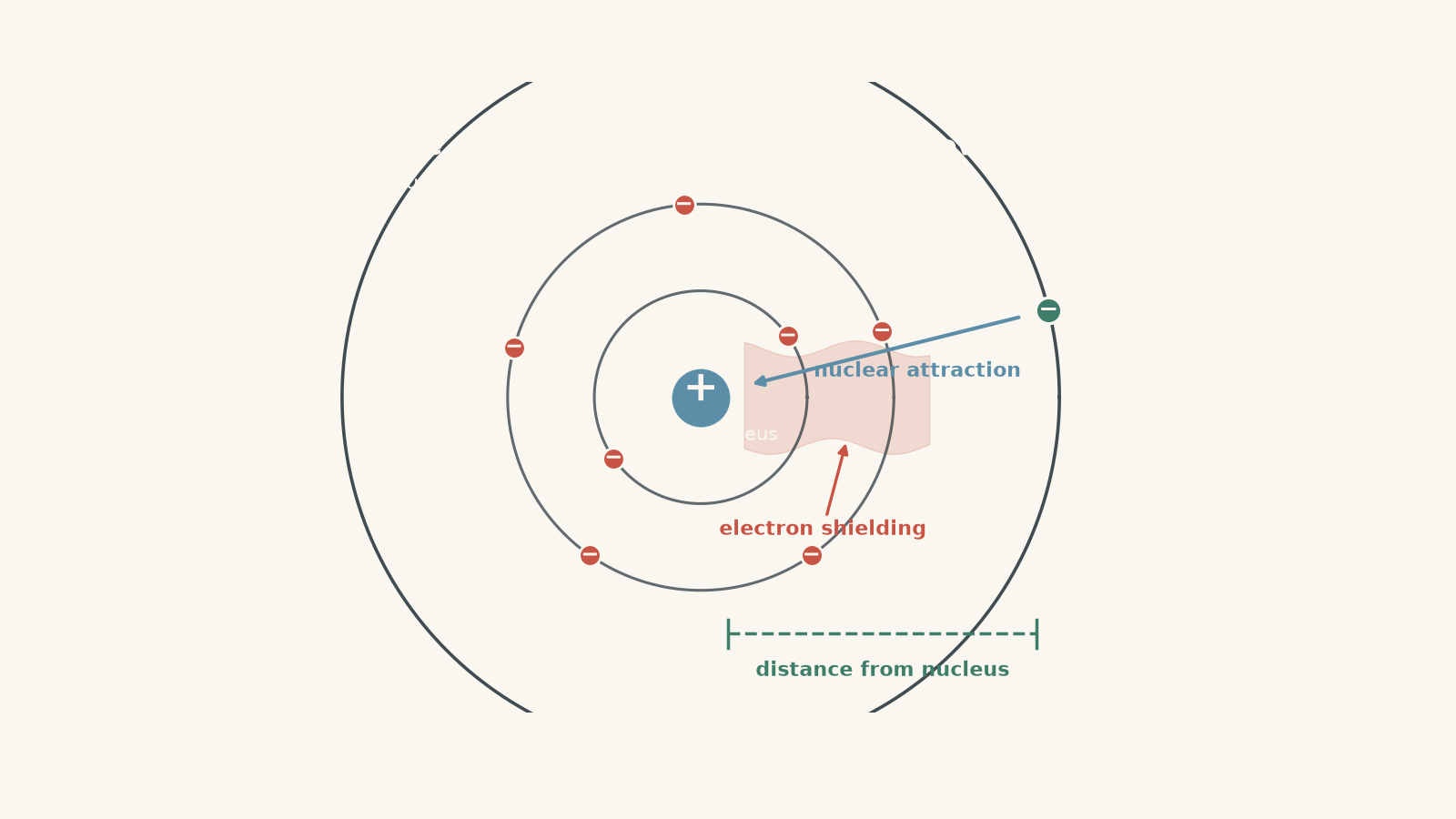
More inner shells usually mean more shielding.
So:
greater shielding tends to decrease first ionisation energy.
Sometimes this is described using effective nuclear charge, meaning the net positive attraction experienced by an electron after the effects of shielding are considered. You don’t need to pretend the inner electrons completely cancel particular protons. Shielding is an electrostatic effect, and that simple subtraction model would be too crude.
03Why first ionisation energy generally increases across a period
Consider sodium and magnesium.
Their electron configurations are:
- \(\ce{Na}\): \(2,8,1\)
- \(\ce{Mg}\): \(2,8,2\)
Both atoms lose an electron from the third principal energy level.
Moving from sodium to magnesium:
- nuclear charge increases from \(+11\) to \(+12\)
- the outer electron remains in the third shell
- the number of filled inner shells stays the same
The extra proton therefore increases the attraction on the outer electrons. The electron cloud also contracts somewhat, so the outer electrons are held more tightly.
This leads to the general trend:
first ionisation energy generally increases from left to right across a period.
Shielding doesn’t literally remain identical across a period because additional electrons are being added. However, those extra electrons are mainly entering the same principal shell and shield one another less effectively than inner-shell electrons do. The increasing nuclear charge is usually the dominant effect.
Worked example: sodium or magnesium?
Predict which element has the higher first ionisation energy, sodium or magnesium, and explain your reasoning.
Step 1
Both atoms lose their first electron from the third principal energy level. They also have the same two occupied inner shells.
Step 2
Sodium has 11 protons, while magnesium has 12.
Step 3
Their outer electrons experience similar core-electron shielding. Magnesium’s greater nuclear charge pulls its electron cloud in more strongly, so its outer electron is also slightly closer to the nucleus.
Step 4
Magnesium should have the higher first ionisation energy because its outer electron experiences a stronger attraction to the nucleus.
The measured values support this:
\[
\begin{aligned}
\ce{Na}:&\quad 496\ \text{kJ mol}^{-1}\\
\ce{Mg}:&\quad 738\ \text{kJ mol}^{-1}
\end{aligned}
\]
The difference means more energy is required to remove one mole of outer electrons from gaseous magnesium atoms than from gaseous sodium atoms.
04Why first ionisation energy generally decreases down a group
Now compare lithium and sodium:
- \(\ce{Li}\): \(2,1\)
- \(\ce{Na}\): \(2,8,1\)
Sodium has many more protons. Does that mean sodium must have the higher first ionisation energy?
No.
Its outer electron occupies the third principal energy level rather than the second. It is further from the nucleus and is shielded by an extra occupied shell.
Those two effects outweigh the increase in nuclear charge.
So:
first ionisation energy generally decreases down a group.
The pattern can be summarised like this:
| Change | Nuclear charge | Distance of outer electron | Shielding | General effect on first ionisation energy |
|---|---|---|---|---|
| Across a period, left to right | Increases | Generally decreases slightly | Changes only moderately | Increases |
| Down a group | Increases | Increases substantially | Increases substantially | Decreases |
| Moving to a new period | Increases | Jumps to a new principal shell | Increases | Often drops sharply |
That final row explains our opening puzzle.
Neon has the electron configuration \(2,8\). Sodium is \(2,8,1\).
Although sodium has one extra proton, its electron being removed is now in a completely new shell. It is further from the nucleus and shielded by the filled inner shells.
The result is a dramatic decrease in first ionisation energy from neon to sodium.
05A useful decision method
When comparing two first ionisation energies, don’t start with “which element is further right?” Start with the electrons.
Ask:
1. Which electron is being removed?
Identify its principal energy level and, if necessary, its subshell.
2. How does nuclear charge change?
More protons increase attraction.
3. How does distance change?
An electron in a higher principal energy level is usually further from the nucleus and easier to remove.
4. How does shielding change?
Extra inner shells provide substantial additional shielding.
For most straightforward periodic comparisons, those four questions are enough.
But there is a catch.
06The simple trend has exceptions
Suppose you compare magnesium and aluminium.
Aluminium has one more proton than magnesium, so the simple across-period rule predicts a higher first ionisation energy for aluminium.
Instead:
\[
\begin{aligned}
\ce{Mg}:&\quad 738\ \text{kJ mol}^{-1}\\
\ce{Al}:&\quad 578\ \text{kJ mol}^{-1}
\end{aligned}
\]
Aluminium is easier to ionise.
The three-factor model has not suddenly become useless. It is simply incomplete. To explain the local exception, we need to look at subshells.
Magnesium has the outer configuration:
\[
\ce{Mg}: 3s^2
\]
Aluminium has:
\[
\ce{Al}: 3s^2 3p^1
\]
The electron removed from aluminium is a \(3p\) electron. A \(3p\) electron is higher in energy and, on average, less strongly attracted to the nucleus than a \(3s\) electron in the same principal shell. It is therefore easier to remove.
Worked example: why does aluminium break the simple trend?
Magnesium has a first ionisation energy of about \(738\ \text{kJ mol}^{-1}\), while aluminium has a value of about \(578\ \text{kJ mol}^{-1}\). Explain why aluminium’s value is lower even though aluminium has a greater nuclear charge.
Step 1
Moving from magnesium to aluminium increases nuclear charge. If the electrons being removed were otherwise equivalent, aluminium should have the higher first ionisation energy.
Step 2
Magnesium loses a \(3s\) electron:
\[
\ce{Mg}: 3s^2
\]
Aluminium loses a \(3p\) electron:
\[
\ce{Al}: 3s^2 3p^1
\]
Step 3
The aluminium \(3p\) electron is higher in energy and less strongly held than magnesium’s \(3s\) electron.
Step 4
The greater ease of removing aluminium’s \(3p\) electron outweighs the increase in nuclear charge.
Therefore aluminium has the lower first ionisation energy.
The important point isn’t to abandon the periodic trend. It is to recognise when two neighbouring elements differ in the type of electron being removed.
07Another exception: phosphorus and sulfur
A second common dip occurs when electrons begin pairing within a \(p\) subshell.
The relevant outer configurations are:
\[
\ce{P}: 3s^2 3p^3
\]
and
\[
\ce{S}: 3s^2 3p^4
\]
The three \(3p\) electrons in phosphorus can occupy three separate \(p\) orbitals before any pairing occurs. In sulfur, the fourth \(3p\) electron must pair with another electron in one orbital.
Paired electrons repel each other. That extra electron-electron repulsion makes one of sulfur’s paired electrons slightly easier to remove.
So sulfur’s first ionisation energy is slightly lower than phosphorus’s, despite sulfur having the greater nuclear charge.
This isn’t a failure of electrostatic reasoning. It is more detailed electrostatic reasoning.
08The most tempting misconception: “more protons means higher ionisation energy”
This prediction feels sensible because protons attract electrons.
But it ignores the location of the electron.
Compare neon and sodium:
\[
\ce{Ne}: 2,8
\]
\[
\ce{Na}: 2,8,1
\]
Sodium has the greater nuclear charge, but its first electron is removed from a new, more distant shell that is strongly shielded by ten inner electrons.
So a better rule is:
Greater nuclear charge increases ionisation energy only when changes in distance, shielding, and electron configuration don’t outweigh it.
That is why memorising arrows on the periodic table isn’t enough. The arrows summarise the result. The electron structure explains it.
09Reading an ionisation-energy pattern
If you are given a section of the periodic table or a graph of first ionisation energy, look for three levels of structure.
First, find the large overall pattern:
- values generally rise across a period
- values generally fall down a group
- values drop strongly when a new period begins
Then look for small local deviations.
In Periods 2 and 3, common deviations occur when:
- the electron removed changes from an \(s\) subshell to a higher-energy \(p\) subshell
- electron pairing begins in the \(p\) subshell
Finally, explain the pattern rather than merely describing it. A strong HSC response connects the observation to nuclear charge, electron distance, shielding, and, where needed, subshell structure.
10Questions and solutions
Question 1
Potassium and calcium are both in Period 4. Predict which has the higher first ionisation energy and explain your answer using electron structure.
Solution 1
Calcium has the higher first ionisation energy.
Potassium has the outer configuration \(4s^1\), while calcium has \(4s^2\). In both atoms, the electron removed is from the fourth principal energy level, and the amount of inner-shell shielding is similar.
Calcium has 20 protons compared with potassium’s 19. Its greater nuclear charge therefore attracts its \(4s\) electrons more strongly.
Because the distance and shielding are broadly similar while nuclear charge increases, more energy is required to remove calcium’s first electron.
The trap is to focus only on both elements being in the same period. The useful explanation is why movement across that period raises the attraction on the outer electron.
Question 2
Rank lithium, sodium, and potassium from lowest to highest first ionisation energy. Explain the trend.
Solution 2
The order from lowest to highest first ionisation energy is
\[
\ce{K < Na < Li}
\]
All three elements are in Group 1, so each loses one outer \(s\) electron.
Moving from lithium to sodium to potassium adds a new occupied principal energy level each time. The outer electron therefore becomes further from the nucleus and experiences more shielding from inner electrons.
Nuclear charge also increases down the group, but the increased distance and shielding have the greater effect. The nucleus attracts the outer electron less strongly, so less energy is required to remove it.
A common mistake is to argue that potassium must have the highest ionisation energy because it has the most protons. That considers nuclear charge without considering where the outer electron actually is.
Question 3
A student writes:
“First ionisation energy must increase from magnesium to aluminium because aluminium has one extra proton and both elements are in Period 3.”
Explain why this prediction fails.
Solution 3
The prediction fails because the electron removed from aluminium is in a different subshell from the electron removed from magnesium. Aluminium has a lower first ionisation energy than magnesium.
Their outer configurations are:
\[
\ce{Mg}: 3s^2
\]
\[
\ce{Al}: 3s^2 3p^1
\]
Aluminium does have a greater nuclear charge. However, its first electron is removed from the \(3p\) subshell rather than the \(3s\) subshell.
The \(3p\) electron is higher in energy and is less strongly attracted to the nucleus than a \(3s\) electron. It is therefore easier to remove.
So the change in subshell outweighs the effect of aluminium’s extra proton.
The student’s general trend is useful, but applying it without checking the electron configuration hides an important exception.
Question 4
Element X and element Y are consecutive elements in the same period. Y has one more proton than X, and no new principal energy level begins at Y. However, Y has a slightly lower first ionisation energy than X.
Give two different electron-configuration changes that could produce this result.
Solution 4
Two possible explanations are a change from removing an \(s\) electron to removing a \(p\) electron, or the beginning of electron pairing within a \(p\) subshell.
In the first case, X could have a filled \(s\) subshell and Y could contain its first \(p\) electron. The \(p\) electron is higher in energy and less strongly held, so Y may be easier to ionise despite its greater nuclear charge. Magnesium and aluminium show this type of behaviour.
In the second case, X could have a half-filled \(p\) subshell, while Y has one additional \(p\) electron that must pair in an already occupied orbital. Repulsion between the paired electrons makes one easier to remove. Phosphorus and sulfur show this type of behaviour.
The key is that the information “Y has more protons” is not enough. The identity and arrangement of the electron being removed can produce a local decrease within the overall increasing trend.
Question 5
Two students are comparing the first ionisation energies of two unknown main-group elements.
Element A has 16 protons, and its outer electrons occupy the third principal energy level.
Element B has 17 protons, and its outer electrons also occupy the third principal energy level.
Student 1 argues that B must have the higher first ionisation energy because its nuclear charge is greater.
Student 2 argues that no prediction can be made unless the exact measured ionisation energies are provided.
Decide what can reasonably be predicted from the information given, and explain any limitation in the prediction.
Solution 5
Element B can reasonably be predicted to have the higher first ionisation energy, although the prediction should be checked against the detailed subshell configurations before treating the across-period trend as an exception-free rule.
The elements are sulfur, with 16 protons, and chlorine, with 17 protons.
Their outer configurations are:
\[
\ce{S}: 3s^2 3p^4
\]
\[
\ce{Cl}: 3s^2 3p^5
\]
Both lose an electron from the \(3p\) subshell. Moving from sulfur to chlorine increases nuclear charge without adding a new principal energy level. Their core shielding is similar, and chlorine’s electron cloud is pulled more strongly towards its nucleus.
Therefore the greater nuclear attraction in chlorine leads to a higher first ionisation energy.
Student 1 reaches the correct prediction, but the reasoning “more protons means higher ionisation energy” is too broad. It would fail for a comparison such as magnesium and aluminium.
Student 2 is too cautious. Exact data aren’t required whenever the electron configurations give enough information to make a justified prediction.
The useful habit is to check nuclear charge, distance, shielding, and the type of electron being removed before deciding which effect dominates.
11Where this leads next
First ionisation energy tells you how tightly a neutral atom holds its easiest electron to remove. Once that idea is secure, successive ionisation energies become much easier to interpret.
Removing a second, third, or fourth electron changes the species each time, and eventually an electron must be removed from an inner shell. The enormous jump in energy at that point can reveal how many valence electrons the atom originally had.
So the same ideas continue to do the work: nuclear attraction, distance, shielding, and electron configuration. The difference is that the atom itself is now changing after every electron you remove.