
Reactivity of Elements with Water: HSC Chemistry Guide
Learn how periodic position and electron configuration help predict how elements react with water, including key trends, exceptions, and HSC-style reasoning.
Drop a small piece of sodium into water and the reaction is fast enough to be obvious. Put magnesium into cold water and, at first glance, almost nothing seems to happen. Aluminium is even stranger: it sits there looking unreactive, despite being a metal that can lose electrons quite readily.
So what should you predict for potassium, calcium, or an unfamiliar element further down a group?
Start with this question: when a metal reacts with water, what actually has to happen to its electrons?
The metal must lose electrons. Water accepts those electrons, hydrogen gas forms, and the metal is oxidised. Once you see the reaction as an electron-transfer problem, periodic trends become useful rather than something to memorise.
01The basic pattern: metals must give up electrons
Picture an atom with one electron sitting relatively far from the nucleus. If removing that electron is fairly easy, the atom has a good starting point for reacting with water.
For example, sodium has the electron configuration:
\[
\ce{Na}: 1s^2 2s^2 2p^6 3s^1
\]
That final \(3s^1\) electron is sodium’s single valence electron. Sodium can lose it to form \(\mathrm{Na}^{+}\):
\[
\ce{Na -> Na+ + e-}
\]
The electron does not simply disappear. In a reaction with water, it is transferred to water molecules. The overall reaction is:
\[
\ce{2Na(s) + 2H2O(l) -> 2NaOH(aq) + H2(g)}
\]
Sodium is oxidised, while hydrogen in water is reduced.
A useful way to separate those processes is with half-equations:
\[
\ce{2Na -> 2Na+ + 2e-}
\]
\[
\ce{2H2O + 2e- -> H2 + 2OH-}
\]
Combine them and you recover the overall equation.
So the first mental model is simple:
A metal tends to react more readily with water when it can lose its valence electrons more easily.
That model will take us a long way. It is not the whole story, though.
02Why Group 1 metals become more reactive down the group
Compare lithium, sodium, and potassium:
| Element | Electron configuration | Outer electron |
|---|---|---|
| Lithium | \(1s^2 2s^1\) | \(2s^1\) |
| Sodium | \([\ce{Ne}]3s^1\) | \(3s^1\) |
| Potassium | \([\ce{Ar}]4s^1\) | \(4s^1\) |
Each atom has one valence electron, so each tends to form a \(+1\) ion.
The general reaction with water is:
\[
\ce{2M(s) + 2H2O(l) -> 2MOH(aq) + H2(g)}
\]
where \(M\) represents a Group 1 metal.
Now predict: which should react more vigorously with water, lithium or potassium?
It is tempting to say lithium because it is smaller, so perhaps it can “get closer” to the water. That is not the important factor.
Potassium reacts more vigorously.
As you move down Group 1:
- atoms gain additional occupied electron shells
- the valence electron is further from the nucleus
- inner electrons provide more shielding
- the attraction between the nucleus and the valence electron becomes weaker
- first ionisation energy generally decreases
The first ionisation energy is the energy required to remove one electron from each atom in one mole of gaseous atoms.
Because potassium’s outer electron is easier to remove than lithium’s, potassium can be oxidised more readily.
So:
\[
\text{Group 1 reactivity with water increases down the group.}
\]
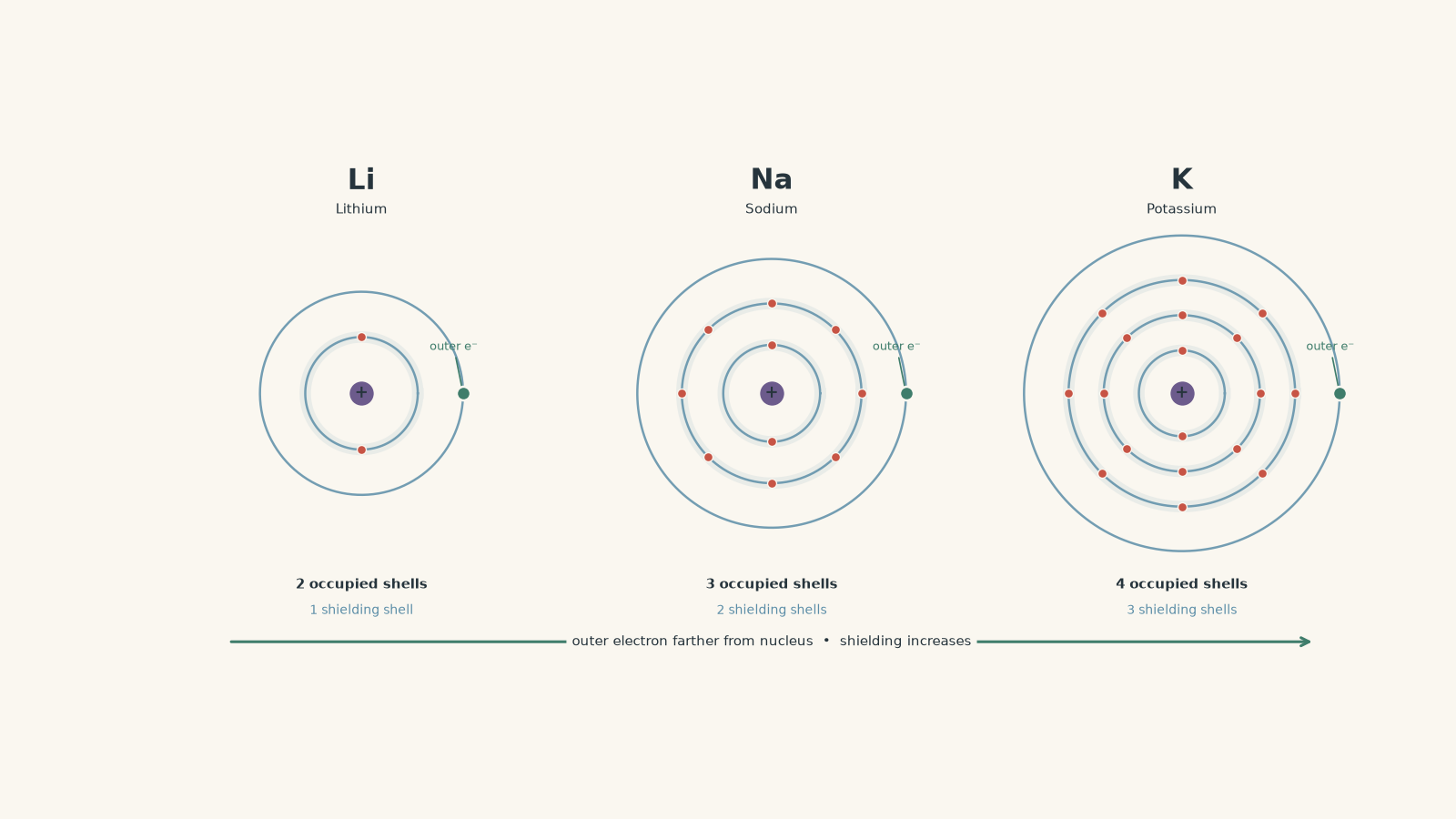
The diagram gives you a useful picture, but do not interpret shielding as if inner electrons form a solid wall. Electron shielding describes how other electrons reduce the effective attraction experienced by an outer electron.
Application: predicting rubidium
Suppose you have not memorised anything about rubidium’s reaction with water.
Rubidium is below potassium in Group 1. Its outer electron occupies an even higher principal energy level and experiences substantial shielding from inner electrons.
You should therefore predict that rubidium loses its outer electron very readily and reacts with water more vigorously than potassium.
You did not need to memorise a separate fact about rubidium. Periodic position and electron configuration gave you the prediction.
03Group 2 follows a similar trend, but the reactions are different
Group 2 metals have two valence electrons.
For example:
\[
\ce{Mg}: [\ce{Ne}]3s^2
\]
\[
\ce{Ca}: [\ce{Ar}]4s^2
\]
They usually form \(2+\) ions by losing both outer electrons:
\[
\ce{M -> M^2+ + 2e-}
\]
For Group 2 metals that react readily with cold water, the general equation is:
\[
\ce{M(s) + 2H2O(l) -> M(OH)2 + H2(g)}
\]
Calcium, for example, reacts with water:
\[
\ce{Ca(s) + 2H2O(l) -> Ca(OH)2 + H2(g)}
\]
Moving down Group 2, the outer electrons are further from the nucleus and more shielded. The first and second ionisation energies generally decrease, making electron loss easier.
So the broad trend is again:
\[
\text{Group 2 reactivity increases down the group.}
\]
But there is an important detail. The top of Group 2 does not behave like the bottom.
Beryllium does not react appreciably with water under ordinary conditions. Magnesium reacts only very slowly with cold water, although it reacts much more readily with steam. Calcium, strontium, and barium react increasingly readily with cold water.
That means “Group 2 metals react with water” is too crude as a statement. Temperature and surface chemistry matter.
Worked example: Which reacts more readily with cold water?
Magnesium and calcium are both Group 2 metals. Predict which reacts more readily with cold water, and explain your answer using atomic structure.
Step 1
Calcium is below magnesium in Group 2.
Step 2
Magnesium is:
\[
\ce{Mg}: [\ce{Ne}]3s^2
\]
Calcium is:
\[
\ce{Ca}: [\ce{Ar}]4s^2
\]
Calcium’s two valence electrons occupy the fourth principal energy level, while magnesium’s occupy the third.
Step 3
Calcium has more occupied shells. Its valence electrons are further from the nucleus and experience greater shielding.
They are therefore easier to remove.
Step 4
Calcium reacts more readily with cold water than magnesium.
Calcium undergoes:
\[
\ce{Ca(s) + 2H2O(l) -> Ca(OH)2 + H2(g)}
\]
The result reflects the lower energy required to remove calcium’s valence electrons compared with magnesium’s.
04Magnesium shows why conditions matter
If periodic trends say calcium is more reactive than magnesium, that part is straightforward.
But why can magnesium react with steam even though its reaction with cold water is extremely slow?
With steam, magnesium reacts according to:
\[
\ce{Mg(s) + H2O(g) -> MgO(s) + H2(g)}
\]
Increasing the temperature gives reacting particles more kinetic energy. A greater proportion of collisions can overcome the activation energy for the reaction.
This is an important distinction:
- periodic position helps predict the underlying tendency of an element to lose electrons
- reaction conditions affect whether the reaction proceeds at an observable rate
Do not confuse thermodynamic tendency with reaction rate. A reaction can be energetically favourable yet still be slow because it has a substantial activation energy or because the surface is protected.
05Aluminium is the trap in the simple model
Now compare sodium, magnesium, and aluminium across Period 3.
Their electron configurations end like this:
\[
\ce{Na}: 3s^1
\]
\[
\ce{Mg}: 3s^2
\]
\[
\ce{Al}: 3s^2 3p^1
\]
As you move from sodium to magnesium to aluminium, nuclear charge increases. The outer electrons are in the same principal shell, so shielding does not increase enough to cancel that stronger nuclear attraction.
You might therefore expect it to become progressively harder for these atoms to lose electrons.
That is useful as a first prediction. Sodium reacts rapidly with cold water, while magnesium is much less reactive with cold water.
Then aluminium ruins the neat pattern.
Aluminium often appears to show little or no reaction with water at room temperature. You might conclude that aluminium itself is simply incapable of reacting.
That conclusion is wrong.
The oxide layer changes what you observe
Aluminium rapidly develops a thin, adherent layer of aluminium oxide on its surface.
This layer separates the aluminium metal underneath from the surrounding water. The observed reaction is therefore controlled not just by the electron configuration of aluminium atoms, but by whether the reactants can actually come into contact.
Think of it like someone who is willing to reply to a message but has accidentally blocked the other person’s number. Their willingness is no longer the main issue. Contact has been prevented.
In this analogy:
- the aluminium metal is the person who could react
- the water is the person trying to make contact
- the oxide layer is the block preventing direct interaction
The analogy breaks because an oxide layer is a physical and chemical solid barrier, not a decision-making person. The useful point is simply that surface access can control observed reactivity.
This gives us a better model:
Electron configuration and periodic position help predict an element’s tendency to undergo oxidation, but observed reaction with water can also depend on activation energy, temperature, and protective surface layers.
That is much closer to the chemistry you actually need.
06Do not force one trend across the entire periodic table
A common mistake is to look at a period and assume every element should fit into one smooth “reaction with water” trend.
That does not work.
The reason is that different types of elements can undergo completely different chemistry with water.
Metals
Reactive metals can transfer electrons to water, producing hydrogen gas.
For example:
\[
\ce{2K + 2H2O -> 2KOH + H2}
\]
and:
\[
\ce{Ca + 2H2O -> Ca(OH)2 + H2}
\]
Less reactive metals
Many metals do not react detectably with cold water. Some can react with steam, while others are too resistant under ordinary conditions.
The fact that an element is a metal does not automatically mean it will react with cold water.
Non-metals
Non-metals cannot simply be treated as if they are weak versions of Group 1 metals. Their chemistry involves different electron-transfer processes.
Chlorine is a useful example. It reacts reversibly with water:
\[
\ce{Cl2 + H2O <=> HCl + HClO}
\]
This is not the same reaction pattern as a metal producing hydrogen gas and a metal hydroxide.
So when you are asked to predict reaction with water, first ask what sort of element you are dealing with.
07A reliable prediction method
For HSC questions, use this sequence rather than trying to remember a huge list.
1. Locate the element
Identify its group and period.
Group position tells you how many valence electrons are present for the main-group elements. Period tells you the highest occupied principal energy level.
2. Write or infer the outer electron configuration
For example:
- Group 1: \(ns^1\)
- Group 2: \(ns^2\)
Here, \(n\) represents the principal energy level containing the valence electrons.
3. Decide what electron change is required
A Group 1 metal needs to lose one electron.
A Group 2 metal needs to lose two.
Ask how strongly those electrons are held.
4. Apply periodic trends
Down a group:
- atomic radius generally increases
- shielding increases
- attraction between the nucleus and valence electrons weakens
- ionisation energy generally decreases
- metallic reactivity generally increases
Across a period from left to right:
- effective nuclear attraction generally increases
- atomic radius generally decreases
- ionisation energy generally increases
- losing electrons generally becomes more difficult
5. Check for complications
Before announcing a final prediction, ask:
- Is there a protective oxide layer?
- Is the question about cold water or steam?
- Is the substance actually a metal?
- Does the reaction involve a different mechanism?
This final step is what stops a simple periodic trend becoming an overconfident wrong answer.
08Worked example: comparing three unfamiliar metals
Three elements have the following outer electron configurations:
- Element X: \(4s^1\)
- Element Y: \(5s^1\)
- Element Z: \(4s^2\)
Predict which would most likely react most vigorously with cold water, assuming the elements show normal main-group behaviour and there is no protective surface layer.
Step 1
X and Y have \(ns^1\) configurations, so they are Group 1 metals.
Z has an \(ns^2\) configuration, so it is a Group 2 metal.
Step 2
Y’s valence electron is in the fifth principal energy level, while X’s is in the fourth.
Y therefore has an additional occupied shell. Its valence electron is further from the nucleus and more strongly shielded.
Step 3
Both X and Y need to lose only one electron to form stable \(+1\) ions.
Z must lose two electrons to form its usual \(2+\) ion, and Group 2 metals generally hold their valence electrons more strongly than the neighbouring Group 1 metals in a comparable period.
Step 4
Element Y should react most vigorously with cold water.
Its \(5s^1\) valence electron is relatively easy to remove, so oxidation of the metal should occur readily.
The important reasoning is not “bigger atom equals faster reaction”. The useful chain is:
\[
\text{more shells} \rightarrow \text{greater shielding and distance} \rightarrow \text{weaker attraction} \rightarrow \text{easier electron loss}
\]
09The biggest misconception: “reactivity is just ionisation energy”
Ionisation energy is extremely useful, but treating it as the only factor causes problems.
For a metal-water reaction to occur, several energy changes are involved. The metal atoms must lose electrons, chemical bonds must be broken and formed, ions interact with surrounding water molecules, and the reaction must pass through an activated state.
You do not need to calculate all of these contributions every time you compare Group 1 metals. The periodic trend in ionisation energy gives the correct broad prediction there.
But you should remember the limitation:
Lower ionisation energy helps explain why electron loss becomes easier. It does not, by itself, determine every observed reaction rate.
Aluminium’s protective oxide layer is the classic warning sign. Magnesium’s very different behaviour in cold water and steam is another.
10Comparing the patterns
| Situation | Useful prediction | Main reason |
|---|---|---|
| Down Group 1 | Reaction with water becomes more vigorous | Valence electron is further from the nucleus and more shielded, so it is easier to remove |
| Down Group 2 | Reaction with water generally becomes easier | Two valence electrons become easier to remove as shielding and atomic radius increase |
| Across the metallic part of a period | Tendency to lose electrons generally decreases | Increasing nuclear attraction holds valence electrons more strongly |
| Magnesium: cold water vs steam | Much faster reaction with steam | Higher temperature helps overcome the activation energy |
| Aluminium in water | Often little visible reaction | Protective oxide layer limits contact between metal and water |
Notice that the table contains both periodic explanations and reaction-condition explanations. Strong HSC answers know when each is needed.
11Questions and solutions
Question 1
Lithium and potassium are both placed in Group 1.
Predict which reacts more vigorously with water and explain your prediction using electron configuration, shielding, and ionisation energy.
Solution 1
Potassium reacts more vigorously with water than lithium.
Both elements have one valence electron and form \(+1\) ions by losing that electron. Lithium has the outer configuration \(2s^1\), while potassium has \(4s^1\).
Potassium has more occupied electron shells. Its valence electron is further from the nucleus and experiences greater shielding from inner electrons. The electrostatic attraction between the nucleus and the outer electron is therefore weaker.
As a result, potassium has a lower first ionisation energy and can be oxidised more readily.
Both reactions follow the general pattern:
\[
\ce{2M + 2H2O -> 2MOH + H2}
\]
but potassium reacts more vigorously because its valence electron is easier to remove.
The trap is to argue only that potassium is “bigger”. Atomic radius matters because it contributes to weaker attraction for the outer electron. The electron-loss explanation is the important part.
Question 2
A student claims:
“Magnesium and calcium are both Group 2 metals, so they should react with cold water at about the same rate because they both have two valence electrons.”
Explain why this claim is incorrect.
Solution 2
The claim is incorrect because having the same number of valence electrons does not mean those electrons are held equally strongly. Calcium reacts with cold water more readily than magnesium.
Magnesium has the outer configuration \(3s^2\), while calcium has \(4s^2\).
Calcium has an additional occupied electron shell, so its valence electrons are further from the nucleus and experience greater shielding. The attraction between the nucleus and these electrons is therefore weaker.
Calcium’s first and second ionisation energies are lower than magnesium’s, making formation of \(\mathrm{Ca}^{2+}\) easier.
Calcium reacts with cold water according to:
\[
\ce{Ca + 2H2O -> Ca(OH)2 + H2}
\]
Magnesium reacts only very slowly with cold water under ordinary conditions, although it reacts more readily with steam.
The misconception is treating the number of valence electrons as the only variable. Position down the group changes how strongly those electrons are held.
Question 3
Element A has the outer electron configuration \(3s^1\). Element B has the outer electron configuration \(4s^1\).
Both are added separately to water under identical conditions.
Predict which element reacts more vigorously. Then explain why comparing only their nuclear charges would lead to the wrong prediction.
Solution 3
Element B should react more vigorously with water.
Both elements are Group 1 metals because each has an \(ns^1\) outer configuration. Element A has its valence electron in the third principal energy level, while B has its valence electron in the fourth.
B does have a larger nuclear charge. If nuclear charge were the only factor, you might expect its outer electron to be held more strongly.
However, B also has an additional occupied shell. Its outer electron is further from the nucleus and is shielded by more inner electrons. These effects outweigh the increase in nuclear charge for the valence electron.
The first ionisation energy therefore decreases down Group 1, making B’s outer electron easier to remove.
The reactions have the general form:
\[
\ce{2M + 2H2O -> 2MOH + H2}
\]
Element B is expected to react more vigorously because oxidation of B requires less energy to remove its valence electron.
The trap is comparing nuclear charge without considering distance and shielding.
Question 4
A clean piece of metal Q has the electron configuration \([\ce{Ne}]3s^2 3p^1\).
A student predicts that Q should react readily with water because it is a metal and can lose its three valence electrons. In an experiment, however, little visible reaction occurs at room temperature.
Identify Q and explain why the observation does not prove that periodic trends have failed.
Solution 4
Q is aluminium, and the weak visible reaction is mainly explained by its protective aluminium oxide surface layer rather than by an inability of aluminium atoms to undergo oxidation.
The configuration
\[
[\ce{Ne}]3s^2 3p^1
\]
contains 13 electrons, so Q is aluminium.
Aluminium can lose three valence electrons to form \(\mathrm{Al}^{3+}\). However, exposed aluminium rapidly forms a thin, adherent oxide layer on its surface.
That oxide layer reduces direct contact between aluminium metal and water. The observed rate can therefore be very low even though aluminium is capable of oxidation.
This does not mean periodic trends are useless. Periodic trends describe factors such as atomic radius, shielding, and ionisation energy that influence electron loss. They do not automatically account for surface barriers or activation energy.
The student’s hidden assumption was that the water had unrestricted access to bare aluminium metal.
Question 5
Two unknown main-group metals, R and S, are in the same group.
R is in Period 3 and S is in Period 5. Both form \(2+\) ions.
A student says S should be less reactive because its nucleus contains more protons and therefore attracts electrons more strongly.
Evaluate the student’s reasoning and predict which metal should react more readily with water, assuming neither develops a protective coating.
Solution 5
S should generally react more readily with water, and the student’s reasoning is incomplete because it ignores atomic radius and shielding.
Because both metals form \(2+\) ions and are in the same main group, they are consistent with Group 2 behaviour.
R has valence electrons in the third principal energy level, while S has valence electrons in the fifth.
S does have more protons. However, it also has more occupied electron shells. Its valence electrons are further from the nucleus and experience much greater shielding from inner electrons.
The effective attraction experienced by the outer electrons therefore decreases sufficiently down the group for the first and second ionisation energies to fall overall.
S can consequently lose its two valence electrons more readily.
For a Group 2 metal that reacts with cold water, the general reaction is:
\[
\ce{M + 2H2O -> M(OH)2 + H2}
\]
The student’s argument contains a real factor, increasing nuclear charge, but treats it in isolation. Periodic predictions require you to consider nuclear charge, shielding, and distance together.
Question 6
Metal T lies below magnesium in Group 2. It reacts readily with cold water.
Metal U is located to the right of magnesium in the same period and appears not to react with water at room temperature.
A student concludes:
“T must have a lower ionisation energy than U, so ionisation energy completely explains both observations.”
Explain what can reasonably be inferred from the periodic positions, and identify why the student’s conclusion goes too far.
Solution 6
It is reasonable to predict that T loses its valence electrons more readily than magnesium, but ionisation energy alone cannot completely explain the observed reactions of T and U.
Moving down Group 2 increases atomic radius and electron shielding. The outer electrons are held less strongly, so ionisation energies generally decrease. That supports the prediction that T can be oxidised more readily and may react with cold water more strongly than magnesium.
Moving to the right across a period generally increases effective nuclear attraction and makes electron removal less favourable. That also helps explain why a neighbouring metal may be less willing to lose electrons.
However, the observed rate of reaction with water depends on more than isolated-atom ionisation energies. It can also depend on:
- activation energy
- the physical state and temperature of the water
- the structure and stability of reaction products
- protective oxide layers on the metal surface
- whether water can contact the underlying metal
If U is aluminium, for example, its oxide layer can strongly suppress the visible reaction with water.
The student’s main mistake is changing a useful trend into a complete explanation. Ionisation energy helps predict electron loss, but observed reactivity is the result of the whole chemical process.
12What this lets you predict next
The same reasoning extends well beyond reactions with water.
Once you can connect electron configuration to electron loss, you can explain why metallic reactivity changes down a group, why ionisation energy follows periodic trends, and why some metals are much stronger reducing agents than others.
The next useful step is to connect these ideas to redox reactions and standard reduction potentials. Periodic position gives you an atomic-scale reason why electron transfer might be favourable. Electrochemical data then gives you a more precise way to compare how strongly different species tend to gain or lose electrons.