
Newton’s Second Law for HSC Physics: Net Force and Acceleration
Learn how net force, mass, and acceleration are connected through Newton's second law, with worked examples, misconceptions, and HSC-style practice.
A trolley is moving to the right. You stop pushing it, but it keeps rolling for a while. Does that mean there must still be a force pushing it forwards?
It’s tempting to say yes. After all, it’s still moving right. But Newton’s second law says something more useful: net force controls acceleration, not motion itself. An object can move right while the net force is zero, or even while the net force points left.
That distinction is the key to using
\[
F_{\text{net}} = ma
\]
properly.
01Start with what a force actually changes
Imagine an empty shopping trolley and a trolley loaded with 40 kg of groceries.
You give each trolley the same push. Which one changes its motion more quickly?
The empty trolley does. The same push produces a larger acceleration because there is less mass to accelerate.
Now keep the trolley the same, but push twice as hard. What happens?
Its acceleration doubles, provided the other forces stay the same.
These two observations give us the basic pattern behind Newton’s second law:
- more net force means more acceleration
- more mass means less acceleration for the same net force
The word net is doing a lot of work here.
02The net force is the force that survives
Suppose you push a trolley forwards with \(40\text{ N}\), while friction pushes backwards with \(15\text{ N}\).
You should not put \(40\text{ N}\) into \(F = ma\).
You first combine all the forces, taking their directions into account:
\[
F_{\text{net}} = 40 – 15 = 25\text{ N}
\]
So the trolley behaves as though one unopposed force of \(25\text{ N}\) acts forwards.
That does not mean the other forces have disappeared. It means their combined effect on the trolley’s acceleration is equivalent to a single \(25\text{ N}\) force.
A useful mental picture is a tug-of-war. One side pulls with \(500\text{ N}\), and the other pulls with \(450\text{ N}\). There may be \(950\text{ N}\) worth of pulling happening, but the rope doesn’t accelerate as though \(950\text{ N}\) acts in one direction. The relevant force is the difference, \(50\text{ N}\).
The analogy breaks if you imagine net force as a separate physical force. It isn’t. Net force is the vector sum of the real forces acting on an object.
03Newton’s second law
For the constant-mass situations used throughout HSC mechanics,
\[
\vec{F}_{\text{net}} = m\vec{a}
\]
where:
- \(\vec{F}_{\text{net}}\) is the net force on the object, measured in newtons (\(\text{N}\))
- \(m\) is the object’s mass, measured in kilograms (\(\text{kg}\))
- \(\vec{a}\) is its acceleration, measured in metres per second squared (\(\text{m s}^{-2}\))
The arrows remind us that force and acceleration are vectors. They have both magnitude and direction.
One newton is defined so that
\[
1\text{ N} = 1\text{ kg m s}^{-2}.
\]
So if a net force of \(1\text{ N}\) acts on a \(1\text{ kg}\) mass, its acceleration is \(1\text{ m s}^{-2}\).
What the equation is really saying
Rearranging Newton’s second law gives
\[
a = \frac{F_{\text{net}}}{m}.
\]
This makes the relationships easier to see.
| Change | Effect on acceleration |
|---|---|
| Double \(F_{\text{net}}\), keep \(m\) constant | \(a\) doubles |
| Halve \(F_{\text{net}}\), keep \(m\) constant | \(a\) halves |
| Double \(m\), keep \(F_{\text{net}}\) constant | \(a\) halves |
| \(F_{\text{net}} = 0\) | \(a = 0\) |
That final row causes one of the most common mistakes in mechanics.
04Zero net force does not mean zero velocity
Suppose a hockey puck is sliding to the right at \(6\text{ m s}^{-1}\). Imagine an ideal surface with no friction.
If the net force becomes zero, what happens next?
A common prediction is that the puck slows down because “there’s nothing pushing it anymore”.
Newton’s second law gives a different answer:
\[
F_{\text{net}} = 0
\]
so
\[
a = 0.
\]
Zero acceleration means the velocity does not change. The puck continues travelling at \(6\text{ m s}^{-1}\) to the right.
A net force is required to change velocity, not to maintain a constant velocity.
This gives us three important possibilities:
- zero velocity and zero net force: an object can remain at rest
- non-zero velocity and zero net force: an object can move at constant velocity
- non-zero net force: the object’s velocity changes
That change could mean speeding up, slowing down, changing direction, or some combination of these.
05Force points with acceleration, not necessarily velocity
Here is another prediction worth making.
A car is travelling east but braking. Which way is its acceleration?
The car’s velocity is east, but its speed is decreasing. Its acceleration therefore points west.
Newton’s second law tells us that the net force must also point west.
So this statement is correct:
The net force and acceleration always point in the same direction.
This statement is not:
The net force always points in the direction the object is moving.
An object can be moving one way while accelerating the other way.
That is exactly what happens whenever something slows down in a straight line.
06How to use \(F_{\text{net}} = ma\) without getting lost
Most Newton’s second law questions become much easier if you follow the same sequence.
1. Choose the object
Decide exactly what system you are analysing.
If the question is about the acceleration of a box, draw forces acting on the box, not forces the box exerts on other objects.
2. Identify the forces acting on it
Depending on the situation, these could include:
- weight
- normal force
- tension
- friction
- drag
- thrust
- an applied push or pull
3. Choose a positive direction
For one-dimensional motion, you might choose right as positive or upwards as positive.
Then give forces signs according to their directions.
4. Add the forces to find \(F_{\text{net}}\)
Do this before using Newton’s second law.
For example, with right positive,
\[
F_{\text{net}} = F_{\text{push}} – F_{\text{friction}}.
\]
5. Apply \(F_{\text{net}} = ma\)
Then solve for the unknown.
This order matters. A force given in the question is not automatically the net force.
07Worked example: acceleration of a trolley
A \(10.0\text{ kg}\) trolley is pushed horizontally to the right with a force of \(42\text{ N}\). Friction acts to the left with a force of \(12\text{ N}\). Calculate the trolley’s acceleration.
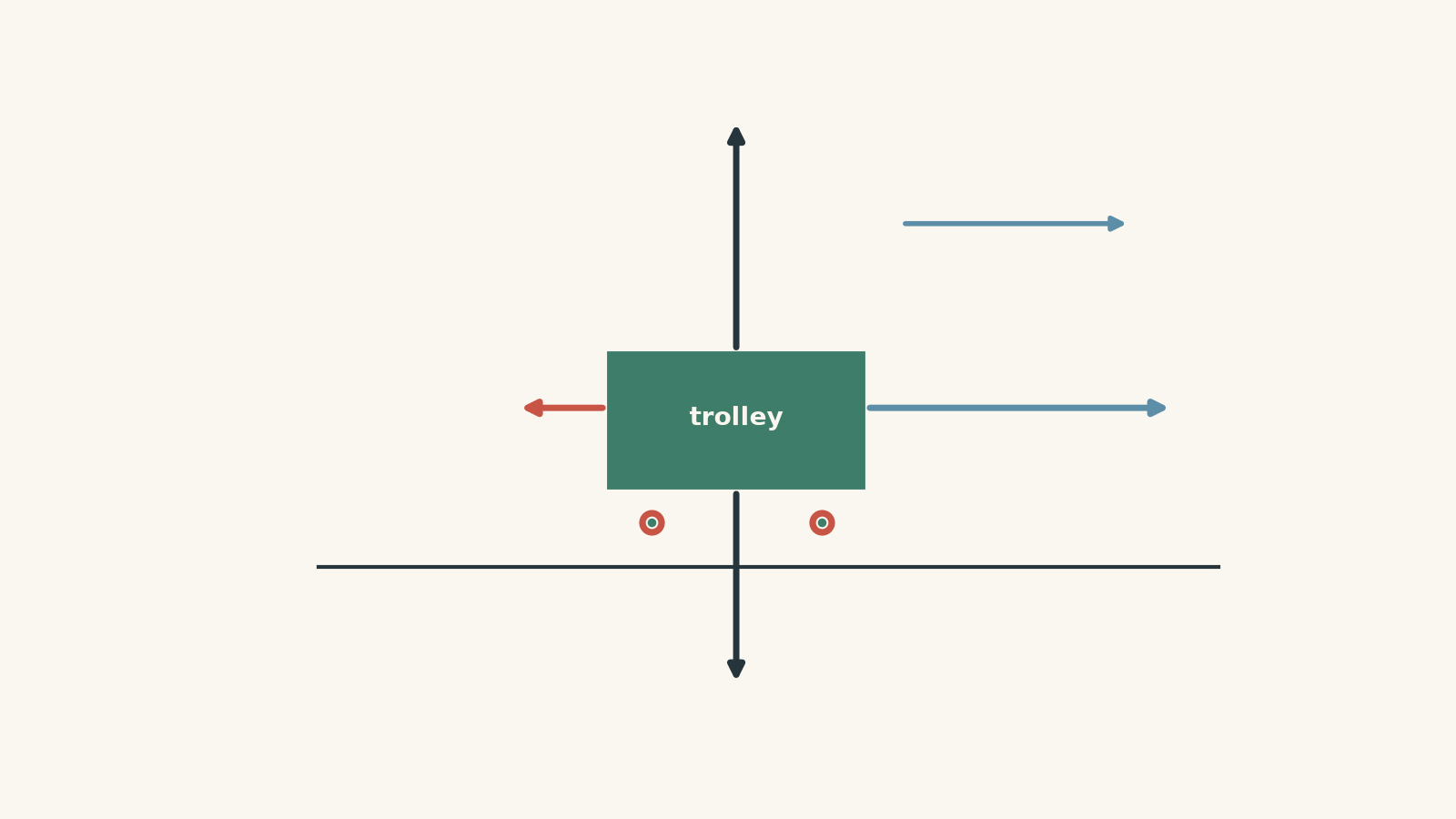
Step 1
Take right as positive.
Step 2
The applied force and friction act in opposite directions:
\[
F_{\text{net}} = 42 – 12 = 30\text{ N}.
\]
The net force is \(30\text{ N}\) to the right.
The vertical forces do not affect the horizontal acceleration. On a level surface with no vertical acceleration, the upward normal force balances the downward weight.
Step 3
\[
F_{\text{net}} = ma
\]
so
\[
a = \frac{F_{\text{net}}}{m}
= \frac{30}{10.0}
= 3.0\text{ m s}^{-2}.
\]
The trolley accelerates at
\[
\boxed{3.0\text{ m s}^{-2}\text{ to the right}}.
\]
This means its velocity changes by \(3.0\text{ m s}^{-1}\) towards the right every second.
Notice that we used \(30\text{ N}\), not the \(42\text{ N}\) applied force. Newton’s second law uses the net force.
08Sometimes you need acceleration before force
Newton’s second law questions often combine with kinematics.
If a question gives the change in velocity and the time taken, you may first need
\[
a = \frac{\Delta v}{\Delta t},
\]
where \(\Delta v\) is the change in velocity and \(\Delta t\) is the time interval.
Then you can use \(F_{\text{net}} = ma\).
Worked example: finding a driving force
A \(1200\text{ kg}\) car increases its speed in a straight line from \(8.0\text{ m s}^{-1}\) to \(14.0\text{ m s}^{-1}\) in \(3.0\text{ s}\). A total resistive force of \(900\text{ N}\) acts against the motion. Calculate the driving force produced by the car.
Step 1
The change in velocity is
\[
\Delta v = 14.0 – 8.0 = 6.0\text{ m s}^{-1}.
\]
Therefore,
\[
a = \frac{\Delta v}{\Delta t}
= \frac{6.0}{3.0}
= 2.0\text{ m s}^{-2}.
\]
Step 2
\[
F_{\text{net}} = ma
= 1200(2.0)
= 2400\text{ N}.
\]
So the car needs a net forwards force of \(2400\text{ N}\).
Step 3
Let \(F_{\text{drive}}\) be the forwards driving force.
Taking forwards as positive,
\[
F_{\text{net}} = F_{\text{drive}} – F_{\text{resistive}}.
\]
Substituting,
\[
2400 = F_{\text{drive}} – 900.
\]
Therefore,
\[
F_{\text{drive}} = 3300\text{ N}.
\]
The driving force is
\[
\boxed{3.3\times10^3\text{ N forwards}}.
\]
The important point is that \(2400\text{ N}\) is the net force, not the engine’s driving force. The engine must provide \(3300\text{ N}\) because \(900\text{ N}\) of that is opposed by resistance.
09Balanced vertical forces do not mean every force is balanced
Consider the trolley from the first example.
Its weight acts downwards. The floor’s normal force acts upwards. If those two forces are equal, the vertical net force is zero.
At the same time, the trolley can have a non-zero horizontal net force.
So you should think about Newton’s second law separately in each direction:
\[
\sum F_x = ma_x
\]
and
\[
\sum F_y = ma_y.
\]
An object does not have to be “balanced” or “unbalanced” in every direction at once.
For a car accelerating along a flat road, for example:
- vertical net force can be zero
- horizontal net force can be forwards
The car therefore has zero vertical acceleration but non-zero horizontal acceleration.
10Mass is resistance to acceleration
In this context, mass tells you how difficult it is to change an object’s velocity.
Suppose a \(20\text{ N}\) net force acts on two objects.
For a \(2.0\text{ kg}\) object,
\[
a = \frac{20}{2.0} = 10\text{ m s}^{-2}.
\]
For a \(10.0\text{ kg}\) object,
\[
a = \frac{20}{10.0} = 2.0\text{ m s}^{-2}.
\]
The force is identical, but the larger mass accelerates less.
This property is called inertia. Greater mass means greater resistance to changes in velocity.
Be careful with the wording. A more massive object does not somehow “use up” force. The same net force simply produces less acceleration.
11The most tempting mistake: treating every force as \(ma\)
Suppose a \(5.0\text{ kg}\) box is pushed right with \(30\text{ N}\) while friction acts left with \(10\text{ N}\).
A student writes
\[
30 = 5a.
\]
Why is that wrong?
Because the \(30\text{ N}\) push is only one force acting on the box.
The correct equation is
\[
30 – 10 = 5a,
\]
so
\[
a = 4.0\text{ m s}^{-2}.
\]
A useful habit is to mentally read Newton’s second law as
sum of all forces acting on the object = mass times acceleration
rather than simply “force equals mass times acceleration”.
In one dimension, you will often write this explicitly as
\[
\sum F = ma.
\]
12Signs are telling you direction
Suppose you choose right as positive and calculate
\[
a = -2.5\text{ m s}^{-2}.
\]
The negative sign does not mean your acceleration is somehow “less than no acceleration”.
It means the acceleration points opposite to your chosen positive direction. In this case, it is \(2.5\text{ m s}^{-2}\) to the left.
The same applies to net force.
If
\[
F_{\text{net}} = -18\text{ N},
\]
then the net force is \(18\text{ N}\) in the negative direction.
Do not throw away a negative sign just because the question asks for a magnitude. Interpret the direction first.
13Questions and solutions
Question 1
A \(6.0\text{ kg}\) box is pulled horizontally to the right with a force of \(25\text{ N}\). Friction acts to the left with a force of \(7.0\text{ N}\).
Calculate the magnitude and direction of the box’s acceleration.
Solution 1
The acceleration is \(\boxed{3.0\text{ m s}^{-2}}\) to the right.
Taking right as positive, the net force is
\[
F_{\text{net}} = 25 – 7.0 = 18\text{ N}.
\]
Using Newton’s second law,
\[
F_{\text{net}} = ma
\]
gives
\[
a = \frac{F_{\text{net}}}{m}
= \frac{18}{6.0}
= 3.0\text{ m s}^{-2}.
\]
The box accelerates right because the rightward pulling force is larger than the leftward friction force.
The tempting mistake is to use \(25\text{ N}\) directly in \(F = ma\). That would ignore friction. Newton’s second law requires the net force.
Question 2
A cyclist and bicycle have a combined mass of \(80\text{ kg}\). They accelerate forwards at \(1.5\text{ m s}^{-2}\). Air resistance and other resistive forces total \(40\text{ N}\) backwards.
Calculate the forwards propulsive force acting on the cyclist and bicycle.
Solution 2
The forwards propulsive force is \(\boxed{160\text{ N}}\).
First find the net force required:
\[
F_{\text{net}} = ma
= 80(1.5)
= 120\text{ N}.
\]
The net force must therefore be \(120\text{ N}\) forwards.
Let \(F_{\text{prop}}\) be the forwards propulsive force. Taking forwards as positive,
\[
F_{\text{net}} = F_{\text{prop}} – F_{\text{resistive}}.
\]
Substituting,
\[
120 = F_{\text{prop}} – 40,
\]
so
\[
F_{\text{prop}} = 160\text{ N}.
\]
The propulsive force must be larger than the net force because some of it is opposed by resistance.
Question 3
Two laboratory carts experience the same net force. Cart A has mass \(0.50\text{ kg}\), while Cart B has mass \(1.5\text{ kg}\).
Cart A accelerates at \(6.0\text{ m s}^{-2}\).
Determine the acceleration of Cart B without first being told the net force.
Solution 3
Cart B accelerates at \(\boxed{2.0\text{ m s}^{-2}}\).
For the same net force,
\[
a = \frac{F_{\text{net}}}{m}.
\]
Cart B has three times the mass of Cart A:
\[
\frac{1.5}{0.50} = 3.
\]
Its acceleration must therefore be one-third as large:
\[
a_B = \frac{6.0}{3}
= 2.0\text{ m s}^{-2}.
\]
You can also verify this by finding the common net force from Cart A:
\[
F_{\text{net}} = ma
= 0.50(6.0)
= 3.0\text{ N}.
\]
Then
\[
a_B = \frac{3.0}{1.5}
= 2.0\text{ m s}^{-2}.
\]
The governing idea is that acceleration is inversely proportional to mass when net force is fixed. Three times the mass does not require some new version of Newton’s law. It simply produces one-third of the acceleration.
Question 4
A skateboarder is travelling to the right at \(5.0\text{ m s}^{-1}\). At one instant, the horizontal forces acting on the skateboarder and board are \(100\text{ N}\) to the right and \(140\text{ N}\) to the left.
The total mass of the skateboarder and board is \(50\text{ kg}\).
Calculate the acceleration and state whether the skateboarder is speeding up or slowing down at that instant.
Solution 4
The acceleration is \(\boxed{0.80\text{ m s}^{-2}}\) to the left, and the skateboarder is slowing down.
Taking right as positive,
\[
F_{\text{net}} = 100 – 140 = -40\text{ N}.
\]
Newton’s second law gives
\[
a = \frac{F_{\text{net}}}{m}
= \frac{-40}{50}
= -0.80\text{ m s}^{-2}.
\]
The negative sign means the acceleration points left.
The skateboarder’s velocity is currently to the right, while the acceleration is to the left. Because the acceleration opposes the velocity, the skateboarder’s speed decreases.
The trap is to assume that force must point right because the skateboarder is moving right. Newton’s second law links net force to acceleration, not directly to velocity.
Question 5
A \(70\text{ kg}\) passenger stands on a scale inside a lift. At one instant, the scale exerts an upward normal force of \(720\text{ N}\) on the passenger.
Use \(g = 9.8\text{ m s}^{-2}\).
Calculate the passenger’s acceleration, including its direction. Can you determine from this information alone whether the lift is moving upwards or downwards?
Solution 5
The passenger’s acceleration is approximately \(\boxed{0.49\text{ m s}^{-2}}\) upwards, but the lift’s direction of motion cannot be determined from this information alone.
The passenger’s weight is
\[
F_g = mg
= 70(9.8)
= 686\text{ N}.
\]
The scale’s normal force is \(720\text{ N}\) upwards.
Taking upwards as positive,
\[
F_{\text{net}} = 720 – 686
= 34\text{ N}.
\]
Newton’s second law gives
\[
a = \frac{F_{\text{net}}}{m}
= \frac{34}{70}
\approx 0.49\text{ m s}^{-2}.
\]
Therefore, the acceleration is upwards.
However, upward acceleration does not prove that the lift is moving upwards. It could be:
- moving upwards and speeding up
- moving downwards and slowing down
Acceleration tells us how velocity is changing, not necessarily which way the object is currently moving.
This is why identifying acceleration direction from the forces is not enough to identify velocity direction.
Question 6
A \(4.0\text{ kg}\) object has an acceleration of \(2.0\text{ m s}^{-2}\) due east.
Three forces acting on it are:
- \(12\text{ N}\) east
- \(8.0\text{ N}\) west
- \(5.0\text{ N}\) north
A fourth force also acts on the object.
Determine the magnitude and direction of the fourth force.
Solution 6
The fourth force has magnitude \(\boxed{6.4\text{ N}}\) and acts approximately \(\boxed{51^\circ\text{ south of east}}\).
The required net force comes from Newton’s second law.
Because the acceleration is \(2.0\text{ m s}^{-2}\) east,
\[
\vec{F}_{\text{net}} = m\vec{a}.
\]
Therefore,
\[
F_{\text{net}} = 4.0(2.0)
= 8.0\text{ N east}.
\]
Now combine the three known forces.
Horizontally,
\[
F_x = 12 – 8.0 = 4.0\text{ N east}.
\]
Vertically,
\[
F_y = 5.0\text{ N north}.
\]
But the final net force must be \(8.0\text{ N}\) east with no north-south component.
The fourth force must therefore add another \(4.0\text{ N}\) east and cancel the \(5.0\text{ N}\) northward force. Its components are
\[
F_{4x} = 4.0\text{ N east}
\]
and
\[
F_{4y} = 5.0\text{ N south}.
\]
Its magnitude is
\[
F_4
= \sqrt{(4.0)^2 + (5.0)^2}
= \sqrt{41}
\approx 6.4\text{ N}.
\]
Its direction relative to east is
\[
\theta
= \tan^{-1}\left(\frac{5.0}{4.0}\right)
\approx 51^\circ.
\]
So the fourth force is approximately
\[
\boxed{6.4\text{ N at }51^\circ\text{ south of east}}.
\]
The difficult part is noticing that Newton’s second law is a vector equation. It is not enough for the force magnitudes to add to \(ma\). Their vector sum must have the same direction as the acceleration.
14Where Newton’s second law takes you next
Once \(F_{\text{net}} = ma\) is secure, many mechanics problems stop being separate topics.
Friction problems become questions about which forces contribute to the net force. Lift problems become vertical applications of the same equation. Circular motion adds a new twist: the acceleration can exist even when speed stays constant, because velocity is changing direction. Gravitational and electric field problems use forces that may change with position, but the immediate effect is still found by asking the same question:
What is the net force on the object, and therefore what acceleration must it have?
That is the habit worth keeping. Do not start by hunting for a formula. Identify the object, identify the forces, add them as vectors, and then connect the resulting net force to the acceleration.