
Newton’s Third Law: Action-Reaction Pairs Explained
Learn how to identify Newton's third law force pairs, understand why equal and opposite forces act on different objects, and avoid common HSC mistakes.
A small car and a heavy truck collide. During the crash, the truck pushes hard on the car. Which force is bigger: the force of the truck on the car, or the force of the car on the truck?
It is tempting to say the truck exerts the bigger force. It is heavier, it may barely slow down, and the car may be badly damaged.
Newton’s third law says something more surprising: the two forces are always equal in magnitude and opposite in direction.
That does not mean the car and truck experience the same acceleration, or the same damage. The key is that the two forces act on different objects.
That one idea solves most Newton’s third law questions.
01Start with two objects interacting
Imagine you are standing on a skateboard and push on a solid wall.
Your hands push the wall forwards. At the same time, the wall pushes you backwards. You roll away from it.
Before going further, predict this: if you push twice as hard on the wall, what happens to the force of the wall on you?
It also doubles.
There aren’t two separate events where you push first and the wall responds later. The forces are part of the same interaction. As soon as you exert a force on the wall, the wall exerts an equal and opposite force on you.
We can write this as:
\[
\vec F_{A\text{ on }B}=-\vec F_{B\text{ on }A}
\]
Here:
- \(\vec F_{A\text{ on }B}\) is the force exerted by object \(A\) on object \(B\)
- \(\vec F_{B\text{ on }A}\) is the force exerted by object \(B\) on object \(A\)
- the minus sign means the forces point in opposite directions
Their magnitudes are equal:
\[
F_{A\text{ on }B}=F_{B\text{ on }A}
\]
This is Newton’s third law.
02How to identify a third-law pair
Every third-law pair has four important features.
| Feature | What to look for |
|---|---|
| Same interaction | Both forces come from the same contact or long-range interaction |
| Same two objects | If \(A\) pushes \(B\), the partner force is \(B\) pushing \(A\) |
| Equal magnitude | The two force values are the same |
| Opposite direction | The forces point in opposite directions |
There is one more feature that causes most of the confusion:
The two forces act on different objects.
Suppose a hand pushes a wall.
- Force 1: hand pushes wall.
- Force 2: wall pushes hand.
The first force belongs on a force diagram of the wall. The second belongs on a force diagram of the hand.
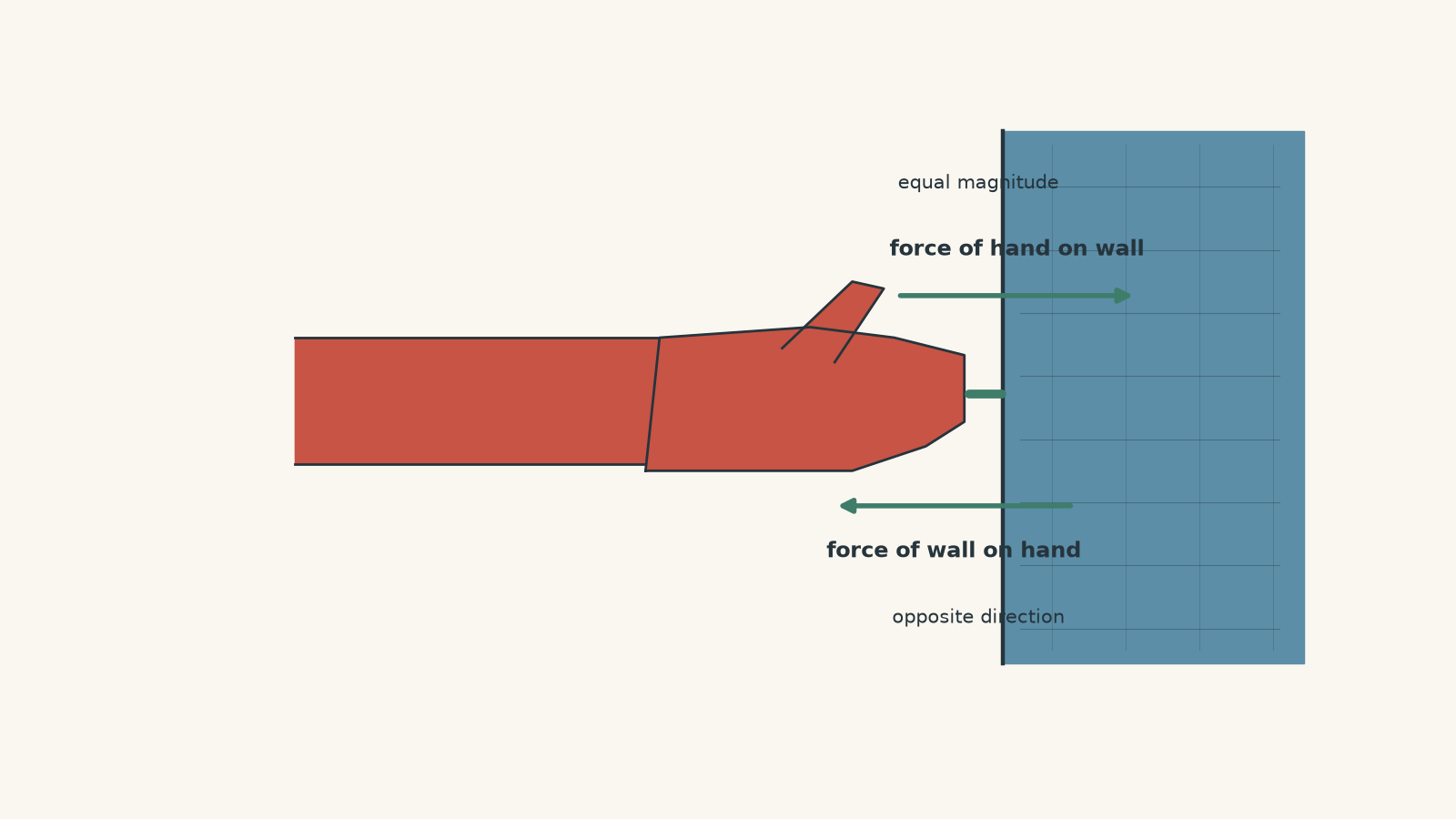
A useful test is to say the force names aloud:
“Force of A on B.”
Then swap the objects:
“Force of B on A.”
If swapping the two objects gives the second force, you probably have a third-law pair.
03Why the forces do not cancel
This is the most important misconception to fix.
You might reason:
“If every force has an equal and opposite force, shouldn’t every net force be zero?”
No.
Forces only cancel when they act on the same object.
Newton’s second law tells us:
\[
\vec F_{\text{net}}=m\vec a
\]
where \(\vec F_{\text{net}}\) is the vector sum of all forces acting on one chosen object, \(m\) is that object’s mass, and \(\vec a\) is its acceleration.
A third-law pair cannot cancel in the force sum for one object because one member of the pair acts on one object and the other member acts on another.
Consider the skateboard example again.
The wall experiences a force from you. You experience a force from the wall.
When finding your acceleration, you include the force of the wall on you. You do not also include your force on the wall, because that force acts on the wall.
This is why free-body diagrams are so useful. A free-body diagram contains only forces acting on the object being analysed.
04Equal forces do not mean equal accelerations
Return to the car and truck collision.
Suppose the truck exerts a force of \(12\,000\text{ N}\) on the car.
Newton’s third law immediately tells us that the car exerts a force of \(12\,000\text{ N}\) on the truck in the opposite direction.
But Newton’s second law gives:
\[
a=\frac{F_{\text{net}}}{m}
\]
So if the masses are different, equal interaction forces can produce very different accelerations.
A lighter object usually has a larger acceleration for the same net force.
This is similar to two people on wheeled chairs pushing against each other’s hands. Each feels the same size force, but if one person and chair have much less mass, that person accelerates more.
That picture has a limit. Real chairs have friction, people can push against the floor, and the forces may change during the push. Newton’s third law itself does not depend on the chairs being frictionless.
Worked example: Pushing away from a wall
A student and scooter have a combined mass of \(60\text{ kg}\). The student pushes horizontally on a wall with a force of \(120\text{ N}\) towards the east. Ignore other horizontal forces.
Determine the force exerted by the wall on the student and the student’s horizontal acceleration.
Step 1
The student exerts a \(120\text{ N}\) force on the wall towards the east.
Newton’s third law says the wall exerts an equal force in the opposite direction:
\[
F_{\text{wall on student}}=120\text{ N west}
\]
Step 2
The horizontal force acting on the student and scooter is \(120\text{ N}\) west.
Using Newton’s second law:
\[
F_{\text{net}}=ma
\]
where \(F_{\text{net}}=120\text{ N}\) and \(m=60\text{ kg}\).
Step 3
\[
\begin{aligned}
a&=\frac{F_{\text{net}}}{m}\\
&=\frac{120}{60}\\
&=2.0\text{ m s}^{-2}
\end{aligned}
\]
So the student accelerates at:
\[
\boxed{2.0\text{ m s}^{-2}\text{ west}}
\]
The student’s push on the wall does not cancel the wall’s push on the student. The student’s force acts on the wall, while the wall’s force acts on the student.
05A common trap: weight and normal force
A book rests motionless on a table.
Two main forces act on the book:
- Earth’s gravitational force on the book, downwards
- the table’s normal force on the book, upwards
If the book is at rest, these forces may have equal magnitudes.
Are they a Newton’s third-law pair?
No.
Both forces act on the book, so they cannot be a third-law pair.
They may cancel when calculating the net force on the book, but that is a Newton’s second law statement, not a Newton’s third law pair.
The third-law partner of the gravitational force of Earth on the book is the gravitational force of the book on Earth.
The third-law partner of the normal force of the table on the book is the contact force of the book on the table.
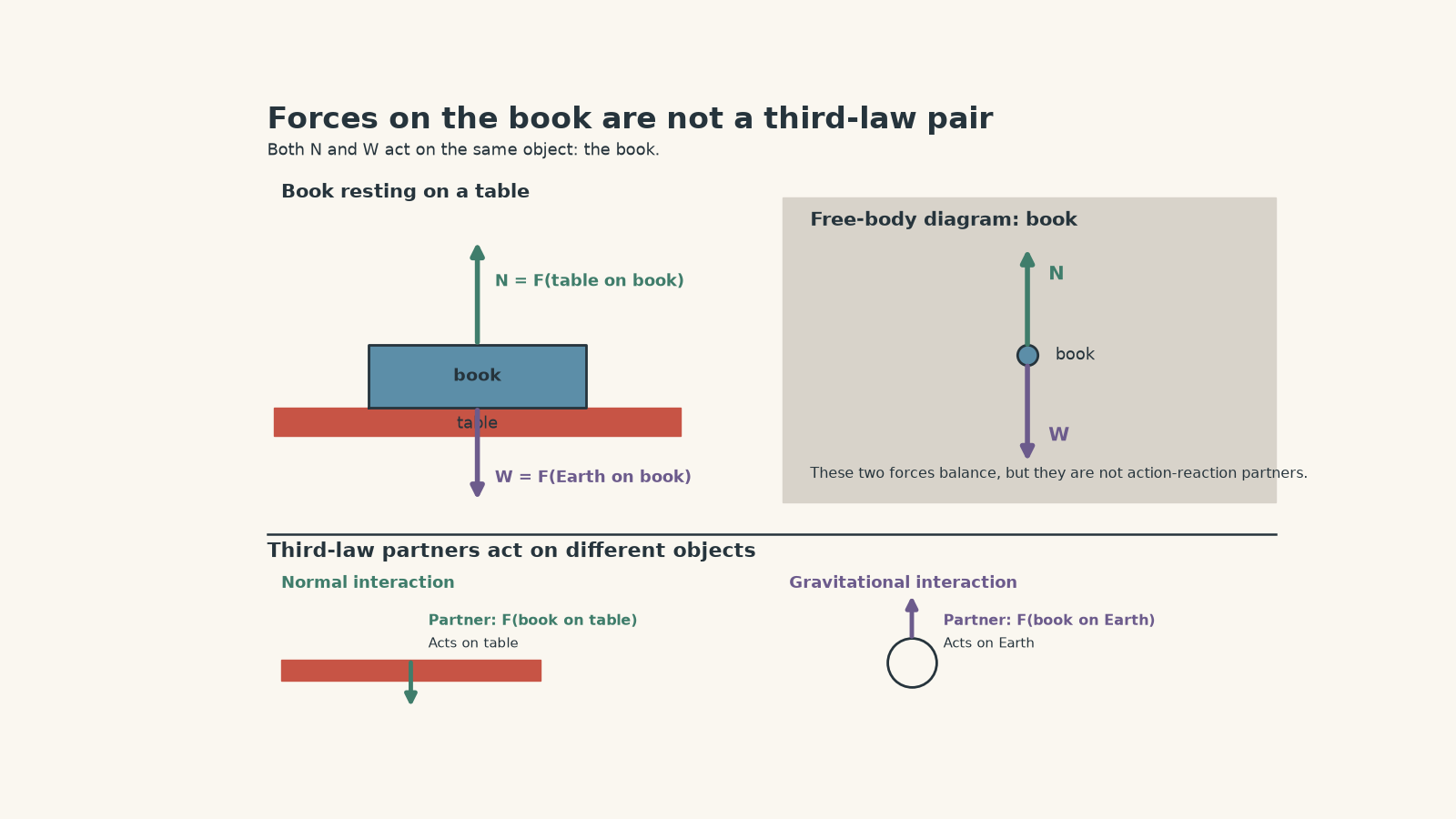
This gives you a strong exam test:
If both arrows are drawn on the same free-body diagram, they are not a Newton’s third-law pair.
06The two objects can accelerate differently
The equality in Newton’s third law applies to force, not acceleration.
Worked example: Two trolleys push apart
Two trolleys are initially held together with a compressed spring between them. Trolley A has mass \(2.0\text{ kg}\), and trolley B has mass \(5.0\text{ kg}\). When released on a nearly frictionless track, trolley A accelerates at \(3.0\text{ m s}^{-2}\) to the left.
Determine the force exerted on trolley A and the acceleration of trolley B.
Step 1
For trolley A:
\[
F_{\text{net}}=ma
\]
Substituting \(m=2.0\text{ kg}\) and \(a=3.0\text{ m s}^{-2}\):
\[
\begin{aligned}
F_{\text{net,A}}&=(2.0)(3.0)\\
&=6.0\text{ N}
\end{aligned}
\]
So trolley B, through the spring interaction, exerts a \(6.0\text{ N}\) force on trolley A to the left.
Step 2
Trolley A must exert an equal and opposite force on trolley B:
\[
F_{\text{A on B}}=6.0\text{ N right}
\]
Step 3
For trolley B:
\[
\begin{aligned}
a_B&=\frac{F_{\text{net,B}}}{m_B}\\
&=\frac{6.0}{5.0}\\
&=1.2\text{ m s}^{-2}
\end{aligned}
\]
Therefore:
\[
\boxed{a_B=1.2\text{ m s}^{-2}\text{ right}}
\]
The forces are equal, but the accelerations are not. Trolley A has the smaller mass, so the same interaction force produces the larger acceleration.
07“Action” does not happen before “reaction”
The phrase action-reaction pair can accidentally suggest a time sequence.
It can sound as though object A acts first, then object B notices and reacts.
That is not what Newton’s third law means.
The two forces occur as part of the same interaction. Neither force has a special status as the original one. You could call either force the “action” and the other the “reaction”.
For that reason, thinking in terms of interaction pairs is often clearer.
For example, when a swimmer pushes water backwards:
- the swimmer exerts a backward force on the water
- the water exerts a forward force on the swimmer
The swimmer moves forwards because the forward force of the water acts on the swimmer.
Saying “the swimmer pushes themselves forwards” hides the actual interaction and often leads to mistakes.
08Contact is not required
Newton’s third law also applies when objects are not touching.
If Earth pulls a falling ball down gravitationally, the ball pulls Earth up gravitationally with exactly the same force magnitude.
That can sound ridiculous because Earth does not visibly fly upwards.
But again, equal force does not mean equal acceleration.
Earth’s mass is enormously greater than the ball’s mass, so:
\[
a=\frac{F}{m}
\]
gives Earth an extremely tiny acceleration.
The same principle applies to electric and magnetic interactions. A third-law pair is not restricted to pushes and pulls between touching surfaces.
09A reliable method for HSC questions
When a question asks about Newton’s third law, use this sequence:
- Name the two interacting objects.
- State the force of object A on object B.
- Swap the object names to identify the paired force of B on A.
- Make the directions opposite.
- Keep the magnitudes equal.
- If calculating acceleration, choose one object and include only forces acting on that object.
Be especially suspicious when you see two forces that happen to have equal magnitudes and opposite directions. That alone does not make them a third-law pair.
The question is always: what object does each force act on?
10Questions and solutions
Question 1
A laptop rests on a horizontal desk. The desk exerts an upward force of \(18\text{ N}\) on the laptop.
Identify the Newton’s third-law partner of this force.
Solution 1
The laptop exerts an \(18\text{ N}\) downward force on the desk.
The original force is the desk on the laptop, so the third-law partner must swap the same two objects: laptop on the desk.
The forces have equal magnitudes and opposite directions:
\[
F_{\text{desk on laptop}}=F_{\text{laptop on desk}}=18\text{ N}
\]
The laptop’s weight is not the third-law partner of the normal force. Weight and normal force both act on the laptop, while the two members of a third-law pair act on different objects.
Question 2
A swimmer pushes water backwards with a force of \(75\text{ N}\).
State the force exerted by the water on the swimmer, and explain how this force helps the swimmer accelerate forwards.
Solution 2
The water exerts a \(75\text{ N}\) force forwards on the swimmer.
The swimmer-water interaction forms a Newton’s third-law pair:
\[
F_{\text{swimmer on water}}=75\text{ N backward}
\]
and therefore:
\[
F_{\text{water on swimmer}}=75\text{ N forward}
\]
The swimmer’s acceleration depends on the net force acting on the swimmer. The backward force exerted by the swimmer acts on the water, so it does not cancel the water’s forward force in the swimmer’s free-body diagram.
If the water’s forward force is greater than any opposing horizontal forces, the swimmer has a net forward force and therefore accelerates forwards.
Question 3
During a collision, a \(900\text{ kg}\) car and a \(3600\text{ kg}\) truck exert forces of magnitude \(18\,000\text{ N}\) on each other.
Ignoring other forces during the short collision interval, determine the magnitude of the acceleration of each vehicle. Explain why the different accelerations do not contradict Newton’s third law.
Solution 3
The car accelerates at \(20\text{ m s}^{-2}\), while the truck accelerates at \(5.0\text{ m s}^{-2}\), in opposite directions.
Newton’s third law gives equal interaction forces:
\[
F_{\text{truck on car}}=F_{\text{car on truck}}=18\,000\text{ N}
\]
For the car:
\[
\begin{aligned}
a_{\text{car}}&=\frac{F}{m}\\
&=\frac{18\,000}{900}\\
&=20\text{ m s}^{-2}
\end{aligned}
\]
For the truck:
\[
\begin{aligned}
a_{\text{truck}}&=\frac{F}{m}\\
&=\frac{18\,000}{3600}\\
&=5.0\text{ m s}^{-2}
\end{aligned}
\]
The different accelerations do not contradict Newton’s third law because the law says the forces are equal, not the accelerations.
Newton’s second law explains the difference. For the same force magnitude, the smaller mass has the larger acceleration.
Question 4
A \(4.0\text{ kg}\) box sits on the floor of a lift travelling upwards at constant velocity. Take \(g=9.8\text{ m s}^{-2}\).
A student says:
“The normal force and weight are equal and opposite, so they must be a Newton’s third-law pair.”
Determine the normal force on the box and assess the student’s reasoning.
Solution 4
The normal force is \(39.2\text{ N}\) upwards, but the student’s identification of the forces as a third-law pair is incorrect.
The lift has constant velocity, so the box has zero acceleration:
\[
a=0
\]
Therefore its net vertical force is zero:
\[
F_{\text{net}}=ma=0
\]
The box’s weight is:
\[
\begin{aligned}
F_g&=mg\\
&=(4.0)(9.8)\\
&=39.2\text{ N downward}
\end{aligned}
\]
For the net force to be zero, the floor must exert a normal force of:
\[
\boxed{39.2\text{ N upward}}
\]
The two forces are equal and opposite, but both act on the box. They can therefore cancel in the net force calculation, but they cannot be a third-law pair.
The third-law partner of the floor’s force on the box is the box’s force on the floor.
The third-law partner of Earth’s gravitational force on the box is the box’s gravitational force on Earth.
The trap is assuming that “equal and opposite” automatically means Newton’s third law. The objects involved matter just as much as the magnitudes and directions.
Question 5
A person stands on a wheeled platform and pulls horizontally on a rope attached to a rigid wall. The wall remains stationary while the person and platform accelerate towards it.
A student argues:
“The person pulls the wall, and the wall pulls the person with an equal force. Those forces cancel, so the person shouldn’t move.”
Explain precisely what is wrong with this argument. Then state a condition under which the combined system of the person, platform, wall, and Earth could have zero net external horizontal force even though the person still moves towards the wall.
Solution 5
The forces do not cancel on the person because they act on different objects. The person can accelerate towards the wall even though the interaction forces are equal. For a larger system containing both sides of an interaction, those forces become internal and can cancel in the force balance for the whole system.
The person’s pull through the rope ultimately exerts a force on the wall. The wall-rope system exerts an equal and opposite force on the person.
These form a Newton’s third-law pair, but:
- one force acts on the wall
- the other acts on the person
When analysing the person and platform, only the force acting on the person-platform system belongs in its horizontal force sum. If that force is not balanced by another horizontal force, the person and platform accelerate.
The student’s error is treating forces on different objects as if they were both acting on the person.
Now enlarge the system to include the person, platform, wall, and Earth. The forces between parts of that system, including the person-wall interaction and forces transmitted through the floor and Earth, can be classified as internal forces.
If no external object exerts a net horizontal force on this combined system, then:
\[
F_{\text{external, net}}=0
\]
The total momentum of the complete system remains constant. That does not require every part of the system to remain stationary. The person can move one way while other parts of the system acquire compensating momentum.
This is the next useful step beyond Newton’s third law: deciding whether forces are internal or external to a chosen system. That idea connects directly to free-body diagrams, Newton’s second law, and conservation of momentum.