
Average Power in HSC Physics: Energy Change Over Time
Learn how to calculate and compare average power using energy change divided by time, with worked HSC Physics examples and common misconceptions.
Two students carry identical boxes up the same flight of stairs. They lift the same mass through the same height, so they do the same amount of work. One takes 6 seconds. The other takes 15 seconds.
Who is working at the greater power?
Predict before reading on. The first student is more powerful in the physics sense, not because they do more work, but because they transfer the same amount of energy in less time. Power is about how quickly energy is transferred.
That distinction is the whole point of average power.
01Same energy, different rate
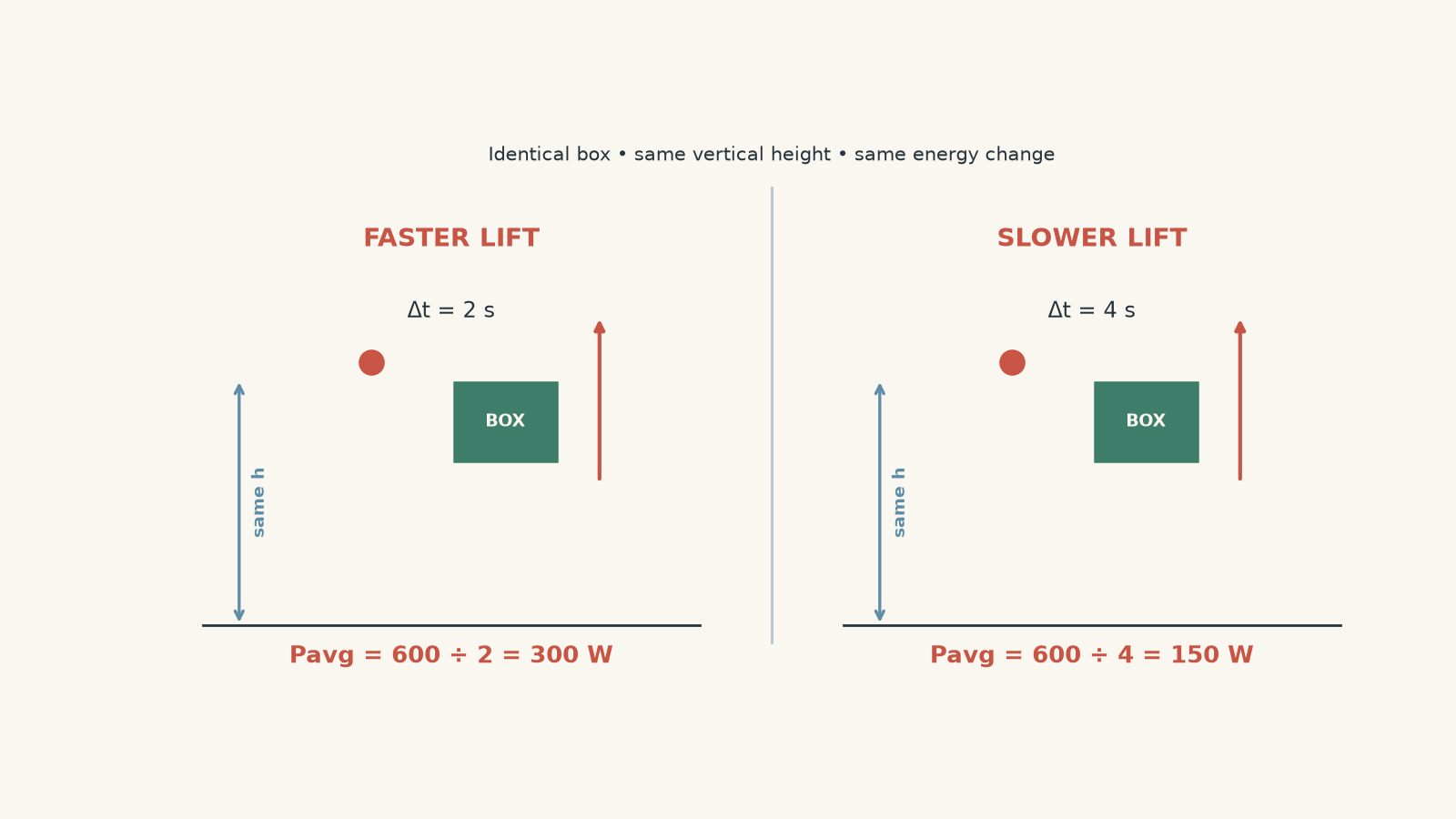
Imagine lifting a 10 kg school bag from the floor onto a high shelf. The important energy change is the increase in gravitational potential energy.
If you lift it slowly, the bag gains a certain amount of gravitational potential energy. If you lift it quickly to exactly the same shelf, it gains the same amount.
The energy change hasn’t changed. The time has.
That is what power measures.
A useful first model is:
Power tells you how fast energy is being transferred or transformed.
If 600 J of energy is transferred in 3 s, the rate is 200 J every second. If the same 600 J is transferred in 12 s, the rate is only 50 J every second.
We write average power as
\[
P_{\text{avg}}=\frac{\Delta E}{\Delta t}
\]
where:
- \(P_{\text{avg}}\) is the average power, measured in watts (W)
- \(\Delta E\) is the relevant energy transferred or changed, measured in joules (J)
- \(\Delta t\) is the time interval, measured in seconds (s)
One watt means one joule per second:
\[
1\text{ W}=1\text{ J s}^{-1}
\]
So a 500 W device transfers energy at an average rate of 500 J each second.
02Power and work are closely connected
Work is a way of transferring energy.
If a force does an amount of work \(W\) over a time interval \(\Delta t\), the average power associated with that work is
\[
P_{\text{avg}}=\frac{W}{\Delta t}
\]
This looks slightly different from
\[
P_{\text{avg}}=\frac{\Delta E}{\Delta t}
\]
but the idea is the same: energy transferred divided by time taken.
Be careful about what energy you are tracking. For example, if an object is lifted, some work done by an external force may become gravitational potential energy. If there are also frictional losses or changes in kinetic energy, you need to include those effects when the question requires them.
The equation is simple. Choosing the correct energy change is usually the harder part.
03Worked example: lifting a bag
A student lifts a 15 kg bag vertically by 1.8 m in 3.0 s. Calculate the average power used to increase the bag’s gravitational potential energy. Use \(g=9.8\text{ m s}^{-2}\).
Step 1
The bag gains gravitational potential energy. Near Earth’s surface,
\[
\Delta U_g=mg\Delta h
\]
where \(m\) is mass in kilograms, \(g\) is gravitational field strength in \(\text{m s}^{-2}\), and \(\Delta h\) is the vertical height change in metres.
If this equation needs a refresher, see Gravitational Potential Energy Near Earth for HSC Physics.
Step 2
\[
\Delta U_g=(15)(9.8)(1.8)=264.6\text{ J}
\]
Step 3
\[
P_{\text{avg}}
=\frac{\Delta U_g}{\Delta t}
=\frac{264.6}{3.0}
=88.2\text{ W}
\]
The average power is therefore
\[
\boxed{88\text{ W}}
\]
This means the bag gains gravitational potential energy at an average rate of about 88 J each second.
Notice what would happen if the same bag reached the same height in 1.5 s. The energy change would still be 264.6 J, but the average power would double.
04More work does not automatically mean more power
This is the most tempting misconception.
Suppose one motor transfers 10 000 J of energy, while another transfers only 8000 J. Is the first motor necessarily operating at greater average power?
No. You haven’t been told the times.
For example:
- 10 000 J in 20 s gives \(500\text{ W}\)
- 8000 J in 8 s gives \(1000\text{ W}\)
The second motor transfers less total energy, but it transfers that energy much faster.
So when comparing power, never compare energy alone.
You need the ratio
\[
\frac{\text{energy transferred}}{\text{time taken}}
\]
A useful way to think about this is filling buckets from two taps. Knowing which tap fills more water tells you nothing about its flow rate unless you also know how long each tap was running. The analogy breaks because water is a physical substance while energy is not, but the rate idea is the same.
05HSC questions may hide the energy change
A question will not always hand you \(\Delta E\).
Instead, it might tell you that an object:
- rises through a height
- speeds up or slows down
- does both at once
- receives a known amount of work
Your job is to work out the relevant energy change first.
For motion near Earth’s surface, two common energy expressions are
\[
\Delta U_g=mg\Delta h
\]
and
\[
\Delta K=\frac{1}{2}m(v_f^2-v_i^2)
\]
where \(v_i\) is the initial speed and \(v_f\) is the final speed, both measured in \(\text{m s}^{-1}\).
If both gravitational potential energy and kinetic energy increase, and other energy transfers are being neglected, then the mechanical energy increase is
\[
\Delta E_{\text{mech}}=\Delta U_g+\Delta K
\]
You can then divide that energy change by the elapsed time.
Worked example: climbing while speeding up
A cyclist and bicycle have a combined mass of 78 kg. Over 20 s, they climb vertically by 14 m while increasing their speed from \(3.0\text{ m s}^{-1}\) to \(9.0\text{ m s}^{-1}\). Ignore resistive energy losses. Calculate the average rate at which the cyclist increases the mechanical energy of the cyclist-bike-Earth system.
Step 1
The cyclist gains gravitational potential energy because the height increases, and kinetic energy because the speed increases.
Step 2
\[
\Delta U_g
=mg\Delta h
=(78)(9.8)(14)
=10\,701.6\text{ J}
\]
Step 3
\[
\begin{aligned}
\Delta K
&=\frac{1}{2}m(v_f^2-v_i^2)\\
&=\frac{1}{2}(78)(9.0^2-3.0^2)\\
&=2808\text{ J}
\end{aligned}
\]
Step 4
\[
\begin{aligned}
\Delta E_{\text{mech}}
&=\Delta U_g+\Delta K\\
&=10\,701.6+2808\\
&=13\,509.6\text{ J}
\end{aligned}
\]
Step 5
\[
\begin{aligned}
P_{\text{avg}}
&=\frac{\Delta E_{\text{mech}}}{\Delta t}\\
&=\frac{13\,509.6}{20}\\
&=675.48\text{ W}
\end{aligned}
\]
So the average rate of increase in mechanical energy is
\[
\boxed{6.8\times10^2\text{ W}}
\]
or about \(0.68\text{ kW}\).
This result does not mean the cyclist’s body produces only 675 W of total power. We deliberately ignored other energy transfers such as heating due to air resistance, rolling resistance, and processes inside the body. The calculation tells us only the average rate at which the specified mechanical energy increases.
That limitation matters whenever you use \(P=\Delta E/\Delta t\): first decide exactly which energy transfer the question is asking about.
06Average power does not describe every instant
Suppose a motor transfers 6000 J over 4 s.
Its average power is
\[
P_{\text{avg}}=\frac{6000}{4}=1500\text{ W}
\]
That does not prove that the motor operated at exactly 1500 W during every moment of those 4 seconds.
It might have produced:
- 1000 W at one instant
- 2200 W at another
- smaller or larger values elsewhere
The average only tells you the total energy transfer divided by the total time.
Think of average speed on a car trip. An average speed of \(60\text{ km h}^{-1}\) doesn’t mean the speedometer stayed at 60 for the whole trip. Average power works in the same way.
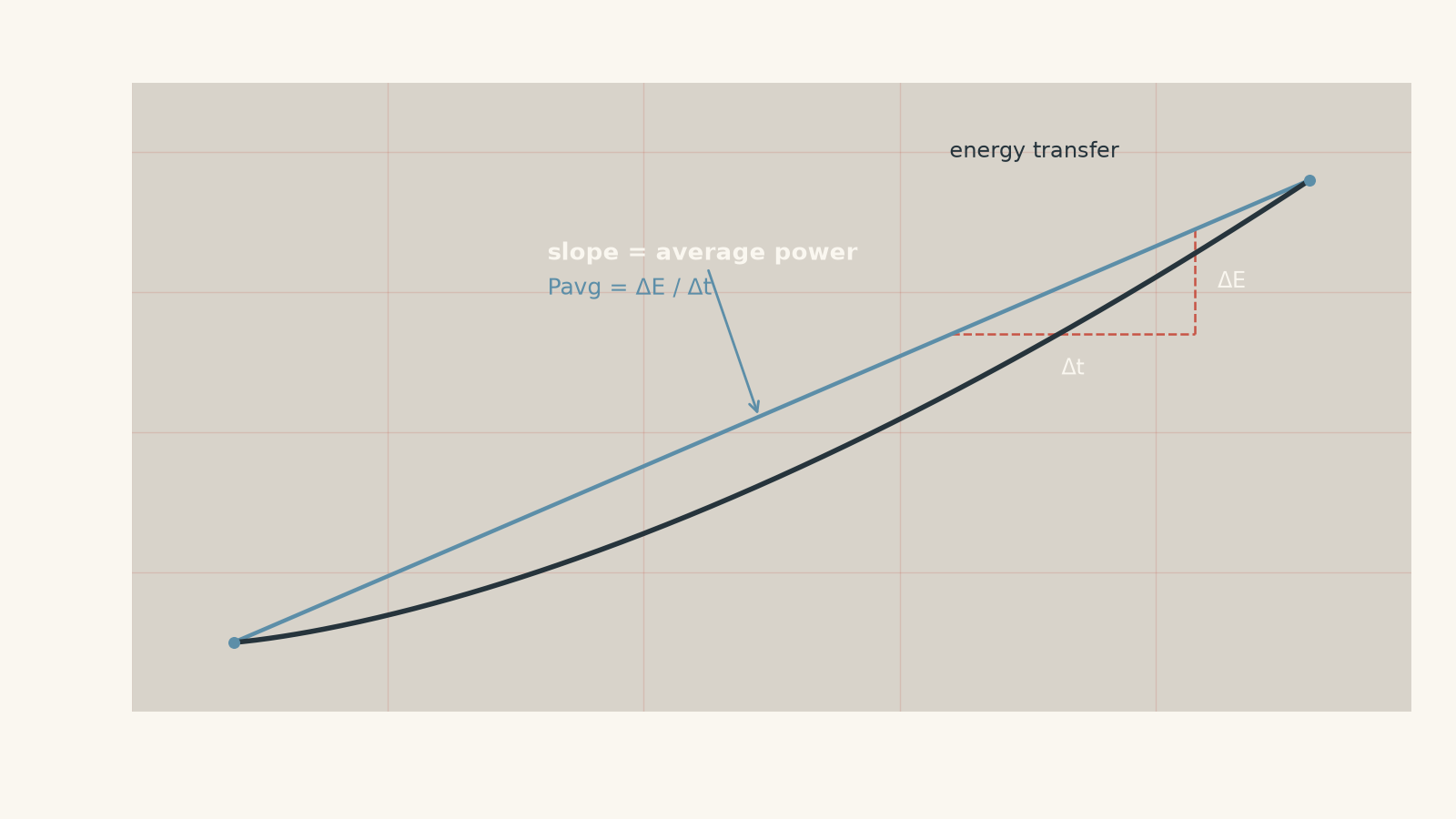
This graph gives another useful way to picture average power. On a graph of energy against time, average power is the slope between two chosen points:
\[
P_{\text{avg}}=\frac{\Delta E}{\Delta t}
\]
A steeper overall slope means energy is being transferred at a greater average rate.
07A reliable method for average-power questions
When you see a power calculation, use this order:
- Identify the energy transfer or energy change. Is it work, gravitational potential energy, kinetic energy, or a combination?
- Calculate that energy in joules.
- Find the matching time interval in seconds.
- Use \(P_{\text{avg}}=\Delta E/\Delta t\).
- Check the unit. Your answer should normally be in watts or kilowatts.
- Interpret the result. A value of 2.4 kW means an average energy-transfer rate of 2400 J per second.
That first step prevents most mistakes.
08Questions and solutions
Question 1
A winch transfers \(18\text{ kJ}\) of energy while lifting a load over 12 s. Calculate its average power during the lift.
Solution 1
The average power is \(1.5\text{ kW}\).
Power is the energy transferred per unit time. First convert \(18\text{ kJ}\) to joules:
\[
18\text{ kJ}=18\,000\text{ J}
\]
Then
\[
\begin{aligned}
P_{\text{avg}}
&=\frac{\Delta E}{\Delta t}\\
&=\frac{18\,000}{12}\\
&=1500\text{ W}\\
&=1.5\text{ kW}
\end{aligned}
\]
The winch therefore transfers energy at an average rate of 1500 J each second.
Question 2
Student A has a mass of 60 kg and climbs a staircase with a vertical height of 4.0 m in 6.0 s. Student B has a mass of 75 kg and climbs the same staircase in 8.0 s.
Ignoring changes in kinetic energy, which student increases their gravitational potential energy at the greater average rate? Use \(g=9.8\text{ m s}^{-2}\).
Solution 2
Student A has the greater average power, about \(392\text{ W}\), compared with \(368\text{ W}\) for Student B.
The tempting prediction is that Student B must have the greater power because Student B has more mass and therefore gains more gravitational potential energy. That ignores the extra time taken.
For Student A:
\[
\begin{aligned}
\Delta U_{g,A}
&=m_Ag\Delta h\\
&=(60)(9.8)(4.0)\\
&=2352\text{ J}
\end{aligned}
\]
so
\[
P_A=\frac{2352}{6.0}=392\text{ W}
\]
For Student B:
\[
\begin{aligned}
\Delta U_{g,B}
&=(75)(9.8)(4.0)\\
&=2940\text{ J}
\end{aligned}
\]
so
\[
P_B=\frac{2940}{8.0}=367.5\text{ W}
\]
Student B gains more gravitational potential energy, but Student A does so quickly enough to have the greater average power.
Question 3
A 1000 kg lift rises 15 m in 30 s. During the same interval, its speed increases from \(2.0\text{ m s}^{-1}\) to \(5.0\text{ m s}^{-1}\).
Ignoring friction and other energy losses, calculate the average rate at which the lift’s mechanical energy increases.
Solution 3
The lift’s mechanical energy increases at an average rate of \(5.25\text{ kW}\).
Both gravitational potential energy and kinetic energy increase, so using only \(mgh\) would miss part of the energy change.
The gravitational potential energy increase is
\[
\Delta U_g=(1000)(9.8)(15)=147\,000\text{ J}
\]
The kinetic energy increase is
\[
\begin{aligned}
\Delta K
&=\frac{1}{2}m(v_f^2-v_i^2)\\
&=\frac{1}{2}(1000)(5.0^2-2.0^2)\\
&=10\,500\text{ J}
\end{aligned}
\]
Therefore,
\[
\Delta E_{\text{mech}}
=147\,000+10\,500
=157\,500\text{ J}
\]
and
\[
\begin{aligned}
P_{\text{avg}}
&=\frac{157\,500}{30}\\
&=5250\text{ W}\\
&=5.25\text{ kW}
\end{aligned}
\]
The lift gains mechanical energy at an average rate of 5.25 kJ each second.
Question 4
Motor A transfers energy at 4.0 kW for 1.0 s and then at 1.0 kW for another 6.0 s.
Motor B transfers energy at a constant 2.0 kW for 5.0 s.
Which motor has the greater average power over its complete operating interval? Both motors transfer the same total amount of energy.
Solution 4
Motor B has the greater average power: \(2.0\text{ kW}\), compared with about \(1.43\text{ kW}\) for Motor A.
Motor A briefly reaches the greater power, but peak power is not the same thing as average power.
For Motor A, the energy transferred during the first interval is
\[
E_1=P_1t_1=(4000)(1.0)=4000\text{ J}
\]
During the second interval,
\[
E_2=P_2t_2=(1000)(6.0)=6000\text{ J}
\]
so its total energy transfer is
\[
E_A=4000+6000=10\,000\text{ J}
\]
over a total time of
\[
t_A=1.0+6.0=7.0\text{ s}
\]
Therefore,
\[
P_{\text{avg},A}
=\frac{10\,000}{7.0}
\approx1429\text{ W}
=1.43\text{ kW}
\]
Motor B transfers the same 10 000 J in 5.0 s:
\[
P_{\text{avg},B}
=\frac{10\,000}{5.0}
=2000\text{ W}
=2.0\text{ kW}
\]
Motor B has the greater average power because it transfers the same total energy in less total time. Motor A’s short 4.0 kW interval does not determine its average.
Question 5
A powered platform lifts a load from ground level to a balcony and later lowers it back to its starting height. The complete journey takes 40 s.
A student argues:
“The load finishes at the same height, so its change in gravitational potential energy is zero. Therefore the platform’s average power for the complete journey must be zero.”
Is that conclusion justified?
Solution 5
No. A zero net change in the load’s gravitational potential energy does not, by itself, prove that the platform’s average power is zero.
The load finishes where it started, so over the complete journey
\[
\Delta U_g=0
\]
and therefore the average rate of change of gravitational potential energy over that entire interval is
\[
\frac{\Delta U_g}{\Delta t}
=\frac{0}{40}
=0\text{ W}
\]
But that is not automatically the same as the average power supplied by the platform’s motor.
During the upward trip, the motor transfers energy to the system. During the downward trip, gravitational potential energy decreases. That released energy could be transferred back to the motor, converted into electrical energy by regenerative braking, or dissipated as thermal energy.
Without knowing those energy transfers, the motor’s net work and average power cannot be determined.
The trap is treating one particular energy change, gravitational potential energy, as though it represented every energy transfer in the system. The equation \(P_{\text{avg}}=\Delta E/\Delta t\) only works after you have identified the correct \(\Delta E\).
09From average power to power at an instant
Average power compares an energy transfer across a finite time interval. Once that idea is clear, the next step is asking what happens as that interval becomes extremely short.
That leads to instantaneous power, which describes the rate of energy transfer at a particular moment. For a force acting along an object’s direction of motion, this can lead to the relationship \(P=Fv\).
The underlying idea has not changed. Power is still a rate. You are simply moving from “how quickly was energy transferred over this interval?” to “how quickly is energy being transferred right now?”