
Closed Systems in Collisions: When Momentum Is Conserved
Learn how to define a system boundary in collisions and decide whether momentum conservation is valid. Includes worked examples, external impulse, and common HSC traps.
Two dynamics carts collide on a track. During the collision, each cart experiences a large force from the other cart. So why can we often say that the total momentum stays constant?
The answer depends on what you choose to call the system.
If your system contains only one cart, the force from the other cart is external, so that cart’s momentum changes. If your system contains both carts, the collision forces are internal. They can transfer momentum between the carts without changing the total momentum of the two-cart system.
That gives us the real question to ask in collision problems:
What is inside the system boundary, and is there any significant external impulse acting across that boundary?
01Start by drawing the boundary
Imagine two carts, A and B, moving along a horizontal track.
Before worrying about equations, mentally draw a loop around both carts.
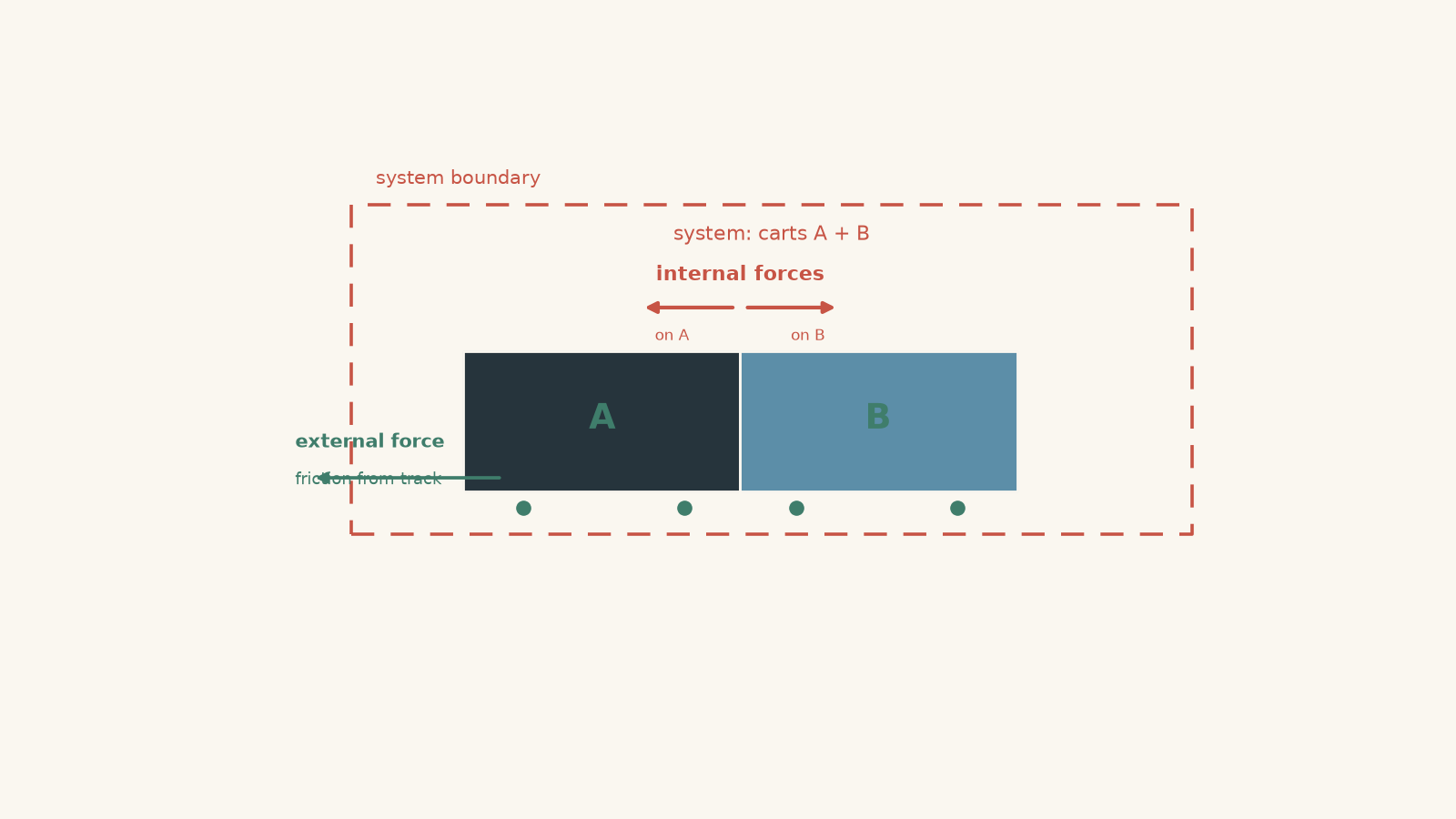
Everything inside that loop belongs to the system. Forces between objects inside the loop are internal forces. Forces caused by something outside the loop are external forces.
Suppose cart A hits cart B. During contact:
- A pushes B.
- B pushes A.
- The forces are equal in magnitude and opposite in direction, by Newton’s third law.
A student might now say, “The forces cancel, so neither cart changes momentum.”
That’s the tempting mistake.
The forces do not cancel on each individual cart. Cart A feels the force from B, so A’s momentum changes. Cart B feels the force from A, so B’s momentum changes too.
The forces cancel only when we consider the total momentum change of the combined A + B system.
That is the point of choosing the system boundary carefully.
02Internal forces can redistribute momentum
Momentum is
\[
p = mv
\]
where:
- \(p\) is momentum in \(\text{kg m s}^{-1}\),
- \(m\) is mass in \(\text{kg}\),
- \(v\) is velocity in \(\text{m s}^{-1}\).
Momentum is a vector, so direction matters. In one-dimensional problems, we normally choose one direction as positive and use negative velocities for motion in the opposite direction.
For a two-object system, the total momentum is
\[
p_{\text{total}} = m_Av_A + m_Bv_B
\]
During a collision, cart A might lose momentum while cart B gains momentum. Conservation of momentum does not mean every object’s momentum stays unchanged.
It means that, under the right conditions,
\[
\Delta p_A + \Delta p_B = 0
\]
so
\[
p_{\text{total, initial}} = p_{\text{total, final}}
\]
The momentum is being shuffled around inside the system rather than created or destroyed.
Think of two people transferring money between their bank accounts. One balance falls while the other rises. If no money enters or leaves the pair of accounts, their combined balance stays the same.
Here, the individual account balances represent the objects’ momenta. The combined balance represents total system momentum.
The analogy has a limit: momentum is a vector, not money, so signs and directions matter.
03What actually determines whether momentum is conserved?
It is common to hear the rule:
Momentum is conserved in a closed system.
For collision calculations, we need a more precise version.
The impulse-momentum relationship for a system is
\[
\Delta p_{\text{system}} = J_{\text{external}}
\]
where \(J_{\text{external}}\) is the net external impulse acting on the system.
Impulse is
\[
J = F_{\text{net}}\Delta t
\]
for a constant net force, where:
- \(J\) is impulse in \(\text{N s}\), equivalent to \(\text{kg m s}^{-1}\),
- \(F_{\text{net}}\) is net force in \(\text{N}\),
- \(\Delta t\) is the time interval in \(\text{s}\).
So the most useful collision rule is:
\[
J_{\text{external}} \approx 0
\quad \Rightarrow \quad
\Delta p_{\text{system}} \approx 0
\]
and therefore
\[
p_{\text{initial}} \approx p_{\text{final}}
\]
For exact conservation, the net external impulse must be zero. In real experiments, we often use momentum conservation as a very good approximation because the external impulse during the short collision is tiny compared with the momenta involved.
That distinction matters.
04A force can exist without ruining the collision model
Suppose two carts collide on a track with a small amount of friction.
Does friction mean momentum conservation is automatically forbidden?
No.
The relevant quantity is not simply whether an external force exists. It is the external impulse during the time interval you are analysing.
Imagine the friction force on the two-cart system is \(0.20\text{ N}\), and the collision lasts only \(0.010\text{ s}\). Its impulse is
\[
J = F\Delta t = (0.20)(0.010) = 0.0020\text{ N s}
\]
If the carts have momenta of around \(1\text{ kg m s}^{-1}\), an external impulse of \(0.0020\text{ kg m s}^{-1}\) is very small.
Momentum is not perfectly conserved, but treating it as conserved may be an excellent approximation over the collision itself.
Now watch what happens if you analyse ten seconds of motion instead. The same friction force would produce a much larger impulse.
So whether conservation is a useful model depends on both the system boundary and the time interval.
05The system boundary changes the answer
Suppose a \(0.80\text{ kg}\) cart A strikes a stationary \(1.20\text{ kg}\) cart B.
Consider two possible systems.
System 1: cart A only
The force from cart B acts on cart A from outside this system.
Therefore the contact force is external to the cart-A system, and cart A’s momentum is not conserved.
System 2: carts A and B together
Now the force of A on B and the force of B on A both occur inside the boundary.
They are internal forces.
If external impulses from friction, air resistance, and other surroundings are negligible during the collision, the total momentum of A + B is conserved.
This is why writing “momentum is conserved” without identifying the system is incomplete.
06A quick decision rule
Before using a momentum conservation equation, make three checks.
| Check | Ask yourself | Why it matters |
|---|---|---|
| 1. Boundary | Which objects are inside my system? | Determines which forces are internal and external |
| 2. Direction | What direction will I call positive? | Momentum is a vector |
| 3. External impulse | Is the net external impulse negligible during the interval? | Determines whether total system momentum is constant |
Only after those checks should you write
\[
\sum p_i = \sum p_f
\]
07Worked example: two carts stick together
A \(0.60\text{ kg}\) cart travels to the right at \(3.0\text{ m s}^{-1}\) and collides with a stationary \(0.90\text{ kg}\) cart. They stick together. External impulse during the collision is negligible. Find their common velocity immediately after the collision.
Step 1
Take both carts as the system. The collision forces are therefore internal. Take right as positive.
Because the external impulse is negligible, total momentum is conserved.
Step 2
\[
\begin{aligned}
p_i &= m_1v_1 + m_2v_2 \\
&= (0.60)(3.0) + (0.90)(0) \\
&= 1.8\text{ kg m s}^{-1}
\end{aligned}
\]
Step 3
The carts stick together, so their combined mass is
\[
0.60 + 0.90 = 1.50\text{ kg}
\]
If their common final velocity is \(v\),
\[
p_f = (1.50)v
\]
Step 4
\[
\begin{aligned}
p_i &= p_f \\
1.8 &= 1.50v \\
v &= 1.2\text{ m s}^{-1}
\end{aligned}
\]
The carts move together at \(1.2\text{ m s}^{-1}\) to the right.
The first cart lost momentum, while the second gained momentum. What stayed constant was their combined momentum.
08Worked example: deciding whether an external force matters
A \(0.50\text{ kg}\) cart moves right at \(4.0\text{ m s}^{-1}\) and collides with a \(0.70\text{ kg}\) cart moving left at \(1.0\text{ m s}^{-1}\). The collision lasts \(0.040\text{ s}\). During the collision, an external resistive force of \(0.30\text{ N}\) acts to the left on the combined two-cart system.
Immediately after the collision, the \(0.50\text{ kg}\) cart moves left at \(0.50\text{ m s}^{-1}\). Find the velocity of the \(0.70\text{ kg}\) cart, including the effect of the external force.
Step 1
\[
\begin{aligned}
p_i &= m_1v_1 + m_2v_2 \\
&= (0.50)(4.0) + (0.70)(-1.0) \\
&= 2.0 – 0.70 \\
&= 1.30\text{ kg m s}^{-1}
\end{aligned}
\]
Step 2
The force acts left, so it is negative.
\[
\begin{aligned}
J_{\text{external}} &= F_{\text{external}}\Delta t \\
&= (-0.30)(0.040) \\
&= -0.012\text{ N s}
\end{aligned}
\]
Since \(1\text{ N s} = 1\text{ kg m s}^{-1}\),
\[
J_{\text{external}} = -0.012\text{ kg m s}^{-1}
\]
Step 3
\[
\begin{aligned}
p_f &= p_i + J_{\text{external}} \\
&= 1.30 – 0.012 \\
&= 1.288\text{ kg m s}^{-1}
\end{aligned}
\]
Notice that we did not set \(p_i=p_f\). The system received a non-zero external impulse.
Step 4
Let the second cart’s final velocity be \(v_2\).
\[
\begin{aligned}
1.288 &= (0.50)(-0.50) + (0.70)v_2 \\
1.288 &= -0.25 + 0.70v_2 \\
1.538 &= 0.70v_2 \\
v_2 &= 2.20\text{ m s}^{-1}
\end{aligned}
\]
The \(0.70\text{ kg}\) cart moves at approximately \(2.20\text{ m s}^{-1}\) to the right.
If we had ignored the external force completely, we would have obtained a slightly different answer. Here the correction is small because the collision is brief, but the exact momentum of the chosen system is not conserved.
09The most tempting misconception: “external force means no momentum conservation”
This rule is too crude:
“If an external force acts, momentum isn’t conserved.”
A better statement is:
The total momentum changes according to the net external impulse.
That gives us several important cases.
If the net external force is zero throughout the interval, then the external impulse is zero, so momentum is conserved.
If external forces exist but cancel to give zero net external force, momentum can still be conserved.
If a small external force acts for a very short time, momentum may be approximately conserved.
If a significant external force acts for long enough to produce a substantial impulse, momentum is not conserved for that chosen system over that interval.
10Don’t confuse vertical forces with horizontal momentum
Consider two carts colliding horizontally on a level track.
Gravity acts downward. The track’s normal force acts upward.
Should those forces stop us conserving horizontal momentum?
Usually not.
The vertical forces may approximately balance, giving negligible net vertical impulse. More importantly, if we’re analysing horizontal momentum, we care about the external impulse in the horizontal direction.
So the more precise one-dimensional statement is
\[
\Delta p_x = J_{\text{external},x}
\]
If the net external horizontal impulse is negligible,
\[
p_{x,i} \approx p_{x,f}
\]
even though large vertical forces such as weight and the normal force are present.
This is why force diagrams and momentum equations should not be treated as unrelated topics.
11The collision itself is not an external force
Students sometimes see a large collision force and conclude that momentum cannot be conserved because “there’s a massive force”.
Ask: massive force from what?
If cart A and cart B are both inside the system, the force of A on B and the force of B on A are internal.
They may be thousands of times larger than friction. That doesn’t stop total system momentum being conserved.
In fact, those large internal forces are exactly how momentum is transferred rapidly from one object to the other.
The system’s total momentum only changes because of impulse delivered from outside the boundary.
12Questions and solutions
Question 1
A \(2.0\text{ kg}\) trolley moving at \(1.5\text{ m s}^{-1}\) to the right collides with a stationary \(1.0\text{ kg}\) trolley. The trolleys stick together. External horizontal impulse during the collision is negligible.
Find their velocity immediately after the collision.
Solution 1
The joined trolleys move at \(1.0\text{ m s}^{-1}\) to the right.
Both trolleys are included in the system, and the external horizontal impulse is negligible, so total momentum is conserved.
Taking right as positive,
\[
\begin{aligned}
p_i &= m_1v_1+m_2v_2 \\
&= (2.0)(1.5)+(1.0)(0) \\
&= 3.0\text{ kg m s}^{-1}
\end{aligned}
\]
After the collision, the total mass is \(3.0\text{ kg}\). Therefore,
\[
\begin{aligned}
p_i &= p_f \\
3.0 &= (3.0)v \\
v &= 1.0\text{ m s}^{-1}
\end{aligned}
\]
The positive result means the combined trolley system moves to the right.
The key point is that neither trolley’s individual momentum is conserved. The total momentum of both trolleys together is conserved.
Question 2
Two skaters push apart while initially stationary on nearly frictionless ice. Skater A has mass \(55\text{ kg}\) and moves west at \(2.4\text{ m s}^{-1}\) after the push. Skater B has mass \(75\text{ kg}\).
Find skater B’s velocity. Then explain why the momentum of skater A alone is not conserved even though the momentum of the two-skater system is approximately conserved.
Solution 2
Skater B moves east at \(1.76\text{ m s}^{-1}\), and A’s momentum alone is not conserved because the force from B is external to a system containing only A.
Take east as positive. Skater A therefore has velocity \(-2.4\text{ m s}^{-1}\).
The system begins at rest, so
\[
p_i=0
\]
For both skaters together, external horizontal impulse is negligible. Therefore,
\[
\begin{aligned}
0 &= m_Av_A+m_Bv_B \\
0 &= (55)(-2.4)+(75)v_B \\
0 &= -132+75v_B \\
v_B &= \frac{132}{75} \\
&=1.76\text{ m s}^{-1}
\end{aligned}
\]
The positive velocity means skater B moves east.
If we choose only A as the system, B is outside the boundary. B’s push on A is therefore an external force on the A-only system, giving A an impulse and changing A’s momentum.
If we instead include both skaters, their forces on each other are internal. Those internal forces transfer equal and opposite amounts of momentum between them, while the total remains approximately zero.
Question 3
Two carts collide on a horizontal track. A student measures their total momentum as \(0.84\text{ kg m s}^{-1}\) immediately before the collision and \(0.81\text{ kg m s}^{-1}\) immediately after it.
The collision lasts \(0.025\text{ s}\).
The student says, “Momentum conservation has failed, so Newton’s laws must not apply perfectly during collisions.”
Determine the average net external force on the two-cart system during the measured interval, assuming the measurements are exact. Explain what is wrong with the student’s conclusion.
Solution 3
The average net external force is \(1.2\text{ N}\) opposite to the original positive direction, and the measurements do not show any failure of Newton’s laws. They show that the chosen system received an external impulse.
The momentum change is
\[
\begin{aligned}
\Delta p &= p_f-p_i \\
&=0.81-0.84 \\
&=-0.030\text{ kg m s}^{-1}
\end{aligned}
\]
Using
\[
\Delta p=F_{\text{avg}}\Delta t
\]
gives
\[
\begin{aligned}
F_{\text{avg}}
&=\frac{\Delta p}{\Delta t}\\
&=\frac{-0.030}{0.025}\\
&=-1.2\text{ N}
\end{aligned}
\]
The negative sign shows that the average external force acted opposite to the chosen positive direction.
The student’s mistake is assuming that total momentum must stay constant in every collision. Momentum is conserved for a system only when the net external impulse is zero, or approximately conserved when that impulse is negligible.
A change of \(0.030\text{ kg m s}^{-1}\) is completely consistent with Newton’s laws if an external impulse of \(-0.030\text{ N s}\) acted on the system.
Question 4
A cart rolls towards a rigid wall and rebounds. A student wants to use conservation of momentum to find the cart’s speed after the collision.
They define the system as the cart only and argue:
“The wall exerts a force on the cart, but the cart exerts an equal and opposite force on the wall. Those forces cancel, so the cart’s momentum must be conserved.”
Explain why this argument is incorrect. Then describe a larger system for which momentum conservation could be valid, assuming external impulse on that larger system is negligible.
Solution 4
The argument is incorrect because the force exerted by the cart on the wall does not act on the cart-only system. For the cart alone, the wall’s force is external, so the cart receives an impulse and its momentum changes.
Newton’s third-law force pair acts on different objects:
- the wall pushes the cart,
- the cart pushes the wall.
If the system contains only the cart, only the first of those forces acts on an object inside the boundary. There is therefore no cancellation within the cart-only system.
The cart reverses direction, so its momentum clearly changes. For example, if its momentum changes from \(+p\) before impact to \(-p\) after impact, then
\[
\Delta p=-p-(+p)=-2p
\]
The wall must have supplied that impulse to the cart.
A larger system could include the cart, wall, and Earth. The force between the cart and wall would then be internal to the chosen system. The wall is attached to Earth, so the momentum transferred from the cart ultimately produces an unimaginably small change in Earth’s velocity because Earth’s mass is enormous.
If the net external impulse on this larger system is negligible, the total momentum of the entire larger system is conserved.
The trap is thinking that Newton’s third-law forces always cancel in a momentum calculation. They cancel as internal forces only when both objects experiencing the force pair are inside the chosen system.
Question 5
Two carts collide on a track. Over the \(0.015\text{ s}\) collision, the total external horizontal force on the two-cart system varies with time but has an average value of zero.
A student says, “We cannot conserve momentum because there were moments during the collision when the external force was not zero.”
Is the student correct? Explain using impulse rather than relying on a memorised rule.
Solution 5
No. If the net external impulse over the collision interval is zero, the total momentum at the end of the interval equals the total momentum at the start, even if the external force was not zero at every instant.
For a varying force, the momentum change is determined by the total impulse:
\[
\Delta p_{\text{system}}=J_{\text{external}}
\]
Impulse depends on the accumulated effect of force over time. If the positive and negative external impulses cancel so that
\[
J_{\text{external}}=0
\]
then
\[
\Delta p_{\text{system}}=0
\]
and therefore
\[
p_f=p_i
\]
The student’s hidden assumption is that the external force must equal zero at every moment. That condition is sufficient for momentum conservation, but it is stronger than necessary.
What actually matters between the chosen initial and final times is the net external impulse.
13What this lets you do next
Once you can define a system boundary, collision equations stop being something you apply automatically.
You can decide why momentum should be conserved, which objects must appear in the momentum equation, and when an external force is small enough to ignore.
That same system thinking becomes especially useful when you move to two-dimensional collisions, explosions, recoil, and impulse-time graphs. In each case, the central question stays the same: what crosses the system boundary, and how much momentum does it transfer?