
Conservation of Momentum in One Dimension for HSC Physics
Learn how to solve one-dimensional momentum problems using signed velocities, consistent direction conventions, and conservation of momentum. Includes worked examples, common mistakes, and HSC-style practice.
A trolley moving to the right collides with another trolley and bounces back to the left. If you treat every speed as positive, your momentum calculation can suddenly look as though momentum has appeared from nowhere.
The problem isn’t conservation of momentum. It’s the signs.
Before doing any collision calculation in one dimension, you need to make one decision: which direction will be positive? Once that choice is fixed, every velocity in the problem must obey it.
01Momentum needs a direction
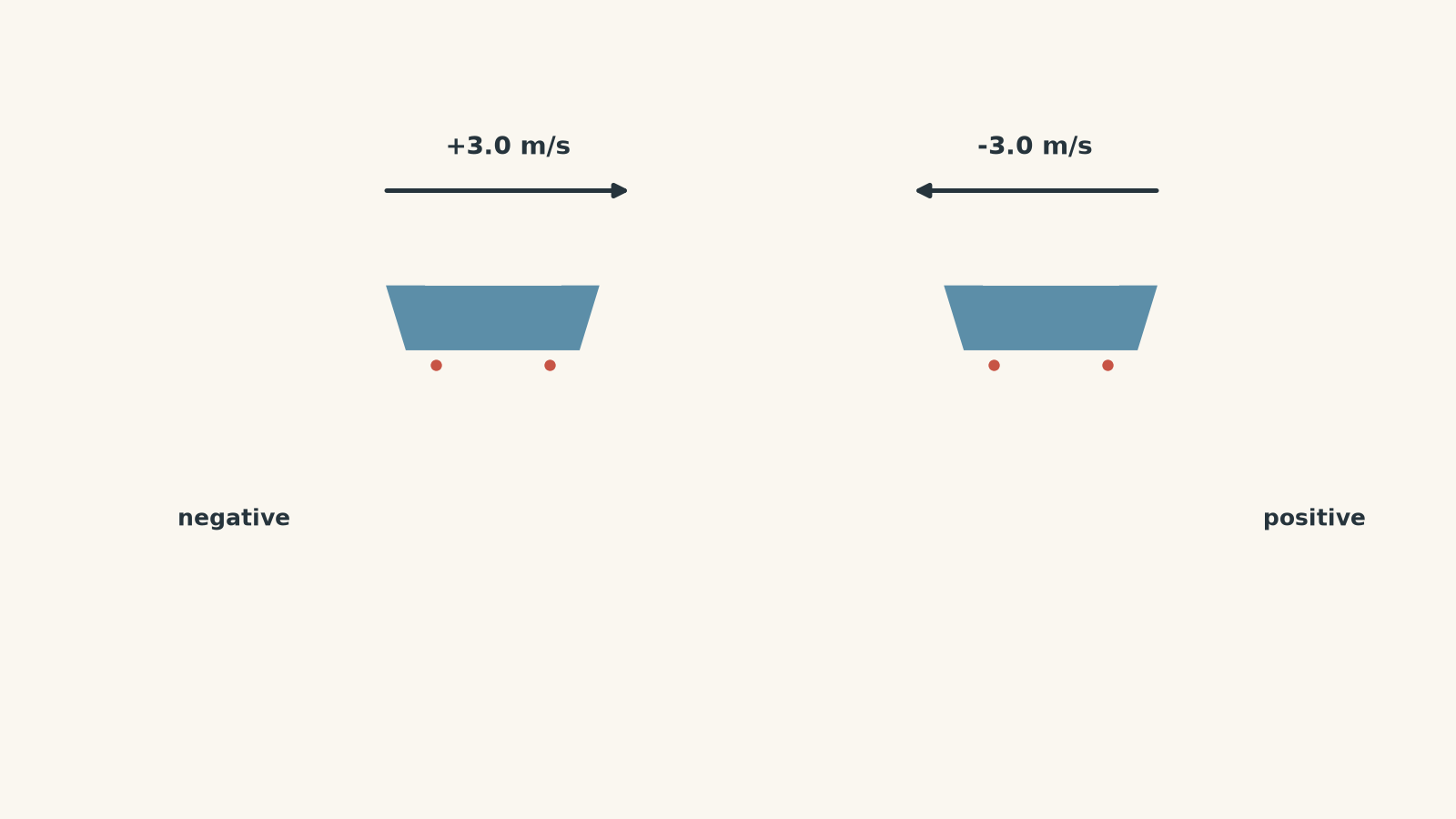
Imagine a 2.0 kg trolley moving at 3.0 m/s to the right. Its momentum has magnitude
\[
p = mv = (2.0)(3.0) = 6.0\ \text{kg m s}^{-1}.
\]
Now imagine an identical trolley moving at the same speed to the left.
Does it have the same momentum?
Not quite. It has the same magnitude of momentum, but the opposite direction.
Momentum is a vector quantity. In a one-dimensional problem, we represent its direction using a sign.
Suppose we choose right as positive:
- motion to the right has positive velocity
- motion to the left has negative velocity
So the two momenta are
\[
p_{\text{right}} = (2.0)(+3.0) = +6.0\ \text{kg m s}^{-1}
\]
and
\[
p_{\text{left}} = (2.0)(-3.0) = -6.0\ \text{kg m s}^{-1}.
\]
The minus sign doesn’t mean the trolley has “less than zero momentum”. It records direction.
Your choice of positive direction is arbitrary
You could choose left as positive instead. Physics doesn’t care.
What matters is consistency.
If right is positive at the start of a calculation, it must still be positive after the collision. You can’t change the sign convention halfway through because an object changes direction.
A useful way to think about the sign is as a direction label attached to every velocity. Once you’ve chosen the labels, don’t peel them off when the calculation gets inconvenient.
02What conservation of momentum actually says
Suppose two objects interact during a collision. If the net external impulse on the system is negligible, the total momentum of the system remains constant.
In one dimension,
\[
p_{\text{before}} = p_{\text{after}}.
\]
For two objects, A and B,
\[
m_Au_A + m_Bu_B = m_Av_A + m_Bv_B.
\]
Here:
- \(m_A\) and \(m_B\) are the masses of objects A and B, measured in kilograms
- \(u_A\) and \(u_B\) are their velocities before the interaction, measured in metres per second
- \(v_A\) and \(v_B\) are their velocities after the interaction
- every velocity carries a positive or negative sign according to your chosen direction
The symbols \(u\) and \(v\) are just a common convention for initial and final velocity.
Notice what is being conserved: the total momentum of the system.
The momentum of an individual object can change dramatically. One trolley may stop, reverse direction, or speed up. During the interaction, momentum is transferred between the objects.
Equal and opposite momenta can cancel
Suppose two identical 0.50 kg trolleys approach each other at 2.0 m/s.
Choose right as positive. Their velocities are therefore \(+2.0\) m/s and \(-2.0\) m/s.
Their total momentum is
\[
p_{\text{total}}
= (0.50)(+2.0) + (0.50)(-2.0)
= 1.0 – 1.0
= 0\ \text{kg m s}^{-1}.
\]
Both trolleys are moving, but the system’s total momentum is zero.
That’s an important distinction. Zero total momentum does not mean nothing is moving. It means the signed momenta cancel.
03A reliable method for one-dimensional problems
For almost every HSC-style one-dimensional momentum calculation, use this sequence.
- Choose a positive direction. Write it down.
- Assign a signed velocity to every object before and after the interaction.
- Write the conservation equation before substituting numbers.
- Substitute the signed velocities.
- Solve algebraically.
- Interpret the sign of your answer.
That last step matters.
If you chose right as positive and calculate
\[
v=-4.2\ \text{m s}^{-1},
\]
the answer is not “negative 4.2 m/s” with no further thought. It means the object travels at 4.2 m/s to the left.
Worked example: Two trolleys stick together
A 0.80 kg trolley travels to the right at 3.0 m/s and collides with a stationary 1.20 kg trolley. They lock together after the collision. Find their final velocity.
Step 1
Take right as positive.
Therefore,
\[
u_A=+3.0\ \text{m s}^{-1}, \qquad u_B=0.
\]
Because the trolleys lock together, they have the same final velocity \(v\).
Step 2
\[
m_Au_A+m_Bu_B=(m_A+m_B)v.
\]
Step 3
\[
(0.80)(+3.0)+(1.20)(0)
=(0.80+1.20)v.
\]
So,
\[
2.4=2.00v.
\]
Step 4
\[
v=1.2\ \text{m s}^{-1}.
\]
The positive result means the joined trolleys move to the right at 1.2 m/s.
The speed has decreased because the original momentum is now shared by a larger total mass. Momentum is conserved, but kinetic energy does not have to be conserved in a collision where objects stick together.
04Reversing direction is where signs become crucial
Now consider a collision in which one object rebounds.
Suppose you chose right as positive and an object initially moves right at 8.0 m/s. After the collision, it travels left at 3.0 m/s.
Its velocities are
\[
u=+8.0\ \text{m s}^{-1}
\]
and
\[
v=-3.0\ \text{m s}^{-1}.
\]
A common mistake is to write \(v=+3.0\) m/s because “3.0 m/s is the final speed”.
That throws away the direction.
The momentum equation needs velocity, not speed.
Think about what happened physically. The object didn’t merely slow from 8 to 3. It passed through zero velocity and ended up travelling the other way. Its momentum has changed from positive to negative.
Worked example: A ball rebounds from a trolley
A 0.15 kg ball travels to the right at 12 m/s and strikes a stationary 0.40 kg trolley. After the collision, the ball rebounds to the left at 4.0 m/s. Find the trolley’s final velocity.
Step 1
Take right as positive.
For the ball,
\[
u_b=+12\ \text{m s}^{-1}, \qquad v_b=-4.0\ \text{m s}^{-1}.
\]
For the trolley,
\[
u_t=0.
\]
Let its final velocity be \(v_t\).
Step 2
\[
m_bu_b+m_tu_t=m_bv_b+m_tv_t.
\]
Step 3
\[
(0.15)(+12)+(0.40)(0)
=(0.15)(-4.0)+(0.40)v_t.
\]
Therefore,
\[
1.80=-0.60+0.40v_t.
\]
So,
\[
2.40=0.40v_t.
\]
Step 4
\[
v_t=+6.0\ \text{m s}^{-1}.
\]
The trolley moves to the right at 6.0 m/s.
Notice why the trolley receives more than the ball’s initial momentum of \(+1.80\ \text{kg m s}^{-1}\). The ball finishes with negative momentum:
\[
p_{b,\text{final}}=(0.15)(-4.0)
=-0.60\ \text{kg m s}^{-1}.
\]
For the system to retain its original total momentum of \(+1.80\ \text{kg m s}^{-1}\), the trolley must finish with
\[
p_{t,\text{final}}=+2.40\ \text{kg m s}^{-1}.
\]
Then
\[
-0.60+2.40=+1.80\ \text{kg m s}^{-1}.
\]
This is exactly the kind of collision where ignoring signs gives a plausible-looking but wrong answer.
05Don’t decide the direction before solving
Suppose a question asks for an unknown final velocity. You might look at the diagram and think, “It’ll probably keep moving right.”
Don’t build that guess into the algebra.
Instead, choose right as positive and call the unknown velocity \(v\). Solve for \(v\) with no sign attached in advance.
If the calculation gives
\[
v=-2.5\ \text{m s}^{-1},
\]
the mathematics has told you that your object travels left.
A negative result is information, not an error.
This is particularly useful when two objects approach each other. Depending on their masses and velocities, the total momentum might point in either direction.
Worked example: Which way do joined vehicles move?
A 1200 kg vehicle travels east at 18 m/s. A 900 kg vehicle travels west at 8.0 m/s. They collide and remain together. Find the velocity of the joined vehicles immediately after the collision.
Before calculating, predict the direction. The first vehicle has the larger mass and the larger speed, so you might expect the joined vehicles to move east. The calculation will test that prediction.
Step 1
Therefore,
\[
u_A=+18\ \text{m s}^{-1}
\]
and
\[
u_B=-8.0\ \text{m s}^{-1}.
\]
Step 2
Because the vehicles remain together,
\[
m_Au_A+m_Bu_B=(m_A+m_B)v.
\]
Step 3
\[
(1200)(+18)+(900)(-8.0)
=(1200+900)v.
\]
So,
\[
21600-7200=2100v,
\]
\[
14400=2100v.
\]
Step 4
\[
v=6.86\ \text{m s}^{-1}.
\]
To an appropriate number of significant figures,
\[
v=6.9\ \text{m s}^{-1}.
\]
The result is positive, so the joined vehicles move east at 6.9 m/s.
Our prediction about the direction was correct, but the equation is what establishes it.
06Three tempting mistakes
Mistake 1: Treating every speed as positive
If an object moves left after the collision, its velocity must have the sign corresponding to left.
With right chosen as positive,
\[
v_{\text{left}}<0.
\]
Writing every velocity as a positive number effectively tells the equation that every object is travelling in the same direction.
Mistake 2: Conserving each object’s momentum separately
Momentum conservation applies to the whole chosen system, not normally to each object inside it.
During a collision,
\[
p_{A,\text{before}} \ne p_{A,\text{after}}
\]
and
\[
p_{B,\text{before}} \ne p_{B,\text{after}}
\]
are perfectly possible.
What matters is
\[
p_{A,\text{before}}+p_{B,\text{before}}
=
p_{A,\text{after}}+p_{B,\text{after}}.
\]
The objects exert forces on each other and exchange momentum.
Mistake 3: Assuming momentum is always conserved for the objects you were given
The simple equation
\[
p_{\text{before}}=p_{\text{after}}
\]
requires the total external impulse on your chosen system to be negligible during the interval considered.
In a short collision between trolleys on a nearly level track, that can be a good model because the collision forces between the trolleys are much larger than the small external horizontal forces during the brief collision.
But suppose one trolley is being pulled by an external cord throughout the interaction. Then the two-trolley system receives an external impulse. You cannot automatically set its before and after momenta equal.
This gives you an important decision rule:
Before using conservation of momentum, decide what your system is and whether a significant external impulse acts on it.
07A sign table can prevent most errors
For a complicated question, write the signs before doing any arithmetic.
For example, if right is positive:
| Quantity | Physical motion | Signed velocity |
|---|---|---|
| \(u_A\) | A initially moves right | positive |
| \(u_B\) | B initially moves left | negative |
| \(v_A\) | A rebounds left | negative |
| \(v_B\) | direction unknown | solve for it |
This takes a few seconds and prevents a very common failure: correctly remembering the conservation equation but feeding it the wrong velocities.
08Questions and solutions
Question 1
Two trolleys move along the same straight track. Trolley A has mass 0.80 kg and travels to the right at 2.5 m/s. Trolley B has mass 0.50 kg and travels to the left at 1.2 m/s.
Taking right as positive, calculate the total momentum of the two-trolley system.
Solution 1
The total momentum is \(+1.4\ \text{kg m s}^{-1}\), so the system’s net momentum points to the right.
Momentum is calculated using \(p=mv\), with the velocity signs carrying the directions.
For trolley A,
\[
p_A=(0.80)(+2.5)
=+2.0\ \text{kg m s}^{-1}.
\]
For trolley B,
\[
p_B=(0.50)(-1.2)
=-0.60\ \text{kg m s}^{-1}.
\]
Therefore,
\[
p_{\text{total}}
=+2.0-0.60
=+1.4\ \text{kg m s}^{-1}.
\]
The trap is adding the magnitudes \(2.0+0.60\). The trolleys move in opposite directions, so their momenta partially cancel.
Question 2
A 2.0 kg trolley moves to the right at 4.0 m/s and collides with a 3.0 kg trolley moving to the left at 1.0 m/s. They lock together.
Find their common velocity immediately after the collision.
Solution 2
The joined trolleys move to the right at \(1.0\ \text{m s}^{-1}\).
Take right as positive. Then
\[
u_A=+4.0\ \text{m s}^{-1},
\qquad
u_B=-1.0\ \text{m s}^{-1}.
\]
Conservation of momentum gives
\[
m_Au_A+m_Bu_B=(m_A+m_B)v.
\]
Substituting,
\[
(2.0)(+4.0)+(3.0)(-1.0)
=(2.0+3.0)v.
\]
Therefore,
\[
8.0-3.0=5.0v,
\]
\[
5.0=5.0v,
\]
so
\[
v=+1.0\ \text{m s}^{-1}.
\]
The positive sign means right. Although trolley B initially travels left, trolley A contributes more positive momentum than B contributes negative momentum.
Question 3
A 0.50 kg cart travels to the right at 6.0 m/s and collides with a stationary 0.75 kg cart. After the collision, the 0.50 kg cart rebounds to the left at 1.5 m/s.
Calculate the final velocity of the 0.75 kg cart.
Solution 3
The 0.75 kg cart moves to the right at \(5.0\ \text{m s}^{-1}\).
Take right as positive.
The initial total momentum is
\[
p_i=(0.50)(+6.0)+(0.75)(0)
=3.0\ \text{kg m s}^{-1}.
\]
Apply conservation of momentum:
\[
m_Au_A+m_Bu_B=m_Av_A+m_Bv_B.
\]
Substituting the rebound velocity \(v_A=-1.5\ \text{m s}^{-1}\),
\[
(0.50)(+6.0)
=
(0.50)(-1.5)+(0.75)v_B.
\]
Therefore,
\[
3.0=-0.75+0.75v_B,
\]
\[
3.75=0.75v_B,
\]
so
\[
v_B=+5.0\ \text{m s}^{-1}.
\]
The positive sign means the second cart travels right. The key trap is treating the rebound velocity as \(+1.5\ \text{m s}^{-1}\). Rebounding reverses the velocity sign.
Question 4
Two carts have a total momentum of \(+1.50\ \text{kg m s}^{-1}\) just before they collide. During the collision, an external device applies an average force of 0.80 N to the left for 0.15 s.
Taking right as positive, determine the total momentum of the carts immediately after the collision. Explain why simply setting \(p_{\text{before}}=p_{\text{after}}\) would fail.
Solution 4
The carts have a final total momentum of \(+1.38\ \text{kg m s}^{-1}\) because the external force gives the system a leftward impulse.
The impulse supplied by an external force changes the system’s total momentum:
\[
\Delta p=F\Delta t.
\]
Right is positive, so the leftward force is
\[
F=-0.80\ \text{N}.
\]
The impulse is therefore
\[
\Delta p
=(-0.80)(0.15)
=-0.12\ \text{N s}.
\]
Since \(1\ \text{N s}=1\ \text{kg m s}^{-1}\),
\[
\Delta p=-0.12\ \text{kg m s}^{-1}.
\]
Using
\[
\Delta p=p_f-p_i,
\]
we get
\[
-0.12=p_f-(+1.50).
\]
Therefore,
\[
p_f=+1.38\ \text{kg m s}^{-1}.
\]
The carts still have net momentum to the right, but slightly less than before.
The simple conservation equation would fail because the chosen two-cart system receives a non-negligible external impulse. The forces the carts exert on each other are internal to the system and cancel when considering total momentum, but the external device is not part of that internal interaction.
Question 5
An isolated one-dimensional system contains two objects.
Object A has mass 0.40 kg and initially travels to the right at 5.0 m/s. Object B has mass 0.60 kg and initially travels to the left at 1.0 m/s.
After they collide, a motion sensor reports that object A has a speed of 1.0 m/s and object B has a speed of 3.0 m/s, but a fault in the sensor means their final directions were not recorded.
Determine the final direction of each object.
Solution 5
Object A must travel to the left at 1.0 m/s, while object B must travel to the right at 3.0 m/s.
Take right as positive.
First calculate the initial total momentum:
\[
p_i
=(0.40)(+5.0)+(0.60)(-1.0).
\]
Therefore,
\[
p_i=2.0-0.60
=+1.40\ \text{kg m s}^{-1}.
\]
Because the system is isolated,
\[
p_f=+1.40\ \text{kg m s}^{-1}.
\]
The measured final speeds tell us the magnitudes of the velocities, but not their signs.
For object A,
\[
v_A=\pm1.0\ \text{m s}^{-1},
\]
and for object B,
\[
v_B=\pm3.0\ \text{m s}^{-1}.
\]
Test the combination in which A travels left and B travels right:
\[
p_f=(0.40)(-1.0)+(0.60)(+3.0).
\]
This gives
\[
p_f=-0.40+1.80
=+1.40\ \text{kg m s}^{-1}.
\]
This matches the initial momentum exactly.
So,
\[
v_A=-1.0\ \text{m s}^{-1},
\qquad
v_B=+3.0\ \text{m s}^{-1}.
\]
The important idea is that speed data alone are not enough for a momentum calculation. Momentum depends on velocity, so direction must be known or deduced. Here, conservation of momentum supplies the missing directional information.
09Where this leads next
Signed momentum gives you a clean way to analyse any one-dimensional interaction where objects can approach, separate, stop, or reverse direction. The same bookkeeping becomes even more useful when you study impulse, because impulse explains how an external force changes a system’s momentum rather than conserving it.
The next step is to connect the two statements
\[
\Delta p=F\Delta t
\]
and
\[
p_{\text{before}}=p_{\text{after}}.
\]
They aren’t competing rules. The first tells you how momentum changes when there is an external impulse. The second is the special case where that external impulse is zero or negligible.