
Conservation of Momentum in Two Dimensions for HSC Physics
Learn how to conserve momentum separately in perpendicular directions, resolve vectors into components, and avoid common two-dimensional collision mistakes.
A hockey puck slides east, hits another puck, and the two shoot off at an angle. You already know momentum is conserved in a collision, but there is an obvious problem: momentum now points in different directions. You can’t just add the speeds.
Before reading on, predict this: if the total eastward momentum is unchanged in a collision, does that automatically mean the total northward momentum is unchanged too?
Yes, provided the system experiences negligible external impulse. The key is that momentum is a vector. Conservation applies to the whole vector, which means its perpendicular components are conserved separately. In practice, we usually choose an \(x\)-direction and a \(y\)-direction, then solve two simpler one-dimensional momentum problems.
01The basic idea: split the motion into two directions
Imagine watching a drone fly diagonally north-east. You could describe its velocity in two equivalent ways:
- one diagonal velocity vector, or
- an eastward velocity component plus a northward velocity component.
The same idea works for momentum.
Momentum is
\[
\vec p = m\vec v
\]
where \(\vec p\) is momentum in \(\mathrm{kg\,m\,s^{-1}}\), \(m\) is mass in kilograms, and \(\vec v\) is velocity in \(\mathrm{m\,s^{-1}}\).
Because velocity has direction, momentum has direction too.
Suppose an object has velocity \(v\) at an angle \(\theta\) above the positive \(x\)-axis. Its velocity components are
\[
v_x = v\cos\theta
\]
and
\[
v_y = v\sin\theta.
\]
Its momentum components are therefore
\[
p_x = mv\cos\theta
\]
and
\[
p_y = mv\sin\theta.
\]
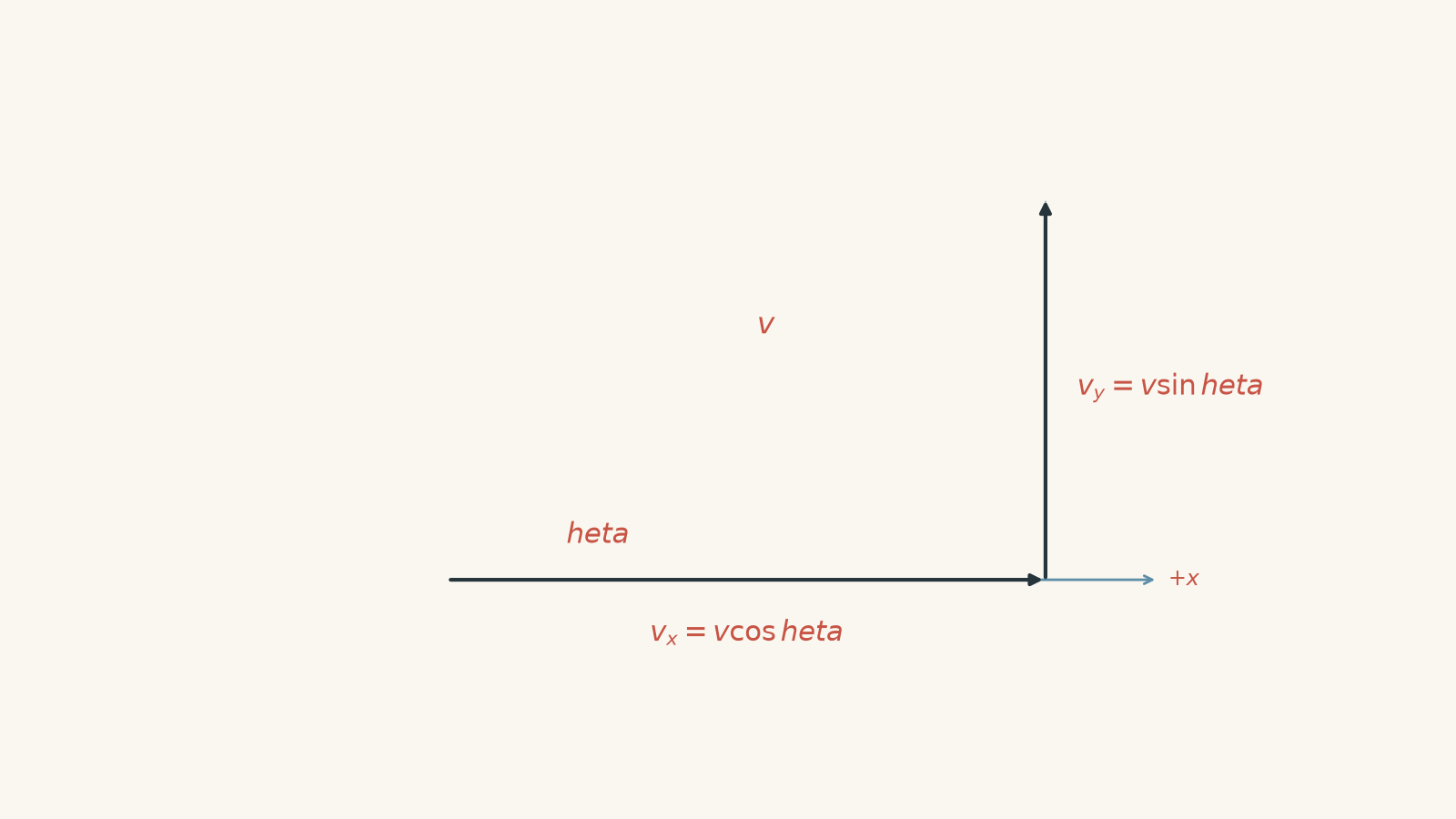
The picture to keep in your head is simple: the diagonal momentum is one arrow, but we are describing that arrow using two perpendicular measurements.
This doesn’t mean the object somehow has two separate momenta. The \(x\)- and \(y\)-components are just two parts of the same momentum vector.
02Why can we conserve \(x\) and \(y\) momentum separately?
For a system with negligible external impulse,
\[
\vec p_{\text{initial}} = \vec p_{\text{final}}.
\]
A vector equality means both its components must be equal. So
\[
p_{x,\text{initial}} = p_{x,\text{final}}
\]
and
\[
p_{y,\text{initial}} = p_{y,\text{final}}.
\]
For several objects, this becomes
\[
\sum p_{x,\text{initial}} = \sum p_{x,\text{final}}
\]
and
\[
\sum p_{y,\text{initial}} = \sum p_{y,\text{final}}.
\]
That is the entire method underneath two-dimensional momentum questions.
A mildly ridiculous analogy is splitting a restaurant bill into food and drinks. If the total bill before and after checking the receipt is unchanged, then both categories must reconcile separately. You can’t fix a missing $20 food charge by claiming there is an extra $20 of drinks if those categories are being tracked independently.
The analogy breaks because momentum components are not physical categories. They are mathematical components of one vector. But the bookkeeping idea is useful.
03Choosing signs before calculating
Most mistakes in two-dimensional momentum questions are not really momentum mistakes. They are sign mistakes.
Choose your positive directions before doing any calculations. A common choice is:
- right or east: \(+x\)
- left or west: \(-x\)
- up or north: \(+y\)
- down or south: \(-y\)
Then stick to that choice.
For example, an object travelling at \(10\ \mathrm{m\,s^{-1}}\), \(40^\circ\) north of west has
\[
v_x = -10\cos40^\circ
\]
and
\[
v_y = 10\sin40^\circ.
\]
The cosine isn’t negative because cosine is doing something unusual. The \(x\)-component is negative because the object travels west, which we chose as the negative \(x\)-direction.
A useful component table
For complicated collisions, organise the information before writing a conservation equation.
| Object | \(p_x\) | \(p_y\) |
|---|---|---|
| Object A initially | \(m_Av_{Ax}\) | \(m_Av_{Ay}\) |
| Object B initially | \(m_Bv_{Bx}\) | \(m_Bv_{By}\) |
| Object A finally | \(m_Av’_{Ax}\) | \(m_Av’_{Ay}\) |
| Object B finally | \(m_Bv’_{Bx}\) | \(m_Bv’_{By}\) |
The prime symbol simply means “after the interaction”.
You then conserve each column separately.
04Worked example: two pucks stick together
A \(0.40\ \mathrm{kg}\) puck travels east at \(5.0\ \mathrm{m\,s^{-1}}\). It collides with a \(0.30\ \mathrm{kg}\) puck travelling north at \(4.0\ \mathrm{m\,s^{-1}}\). The pucks stick together. Find their final velocity.
Step 1
Take east as \(+x\) and north as \(+y\).
For the \(0.40\ \mathrm{kg}\) puck,
\[
p_{1x} = mv = (0.40)(5.0) = 2.0\ \mathrm{kg\,m\,s^{-1}}
\]
and
\[
p_{1y}=0.
\]
For the \(0.30\ \mathrm{kg}\) puck,
\[
p_{2x}=0
\]
and
\[
p_{2y}=(0.30)(4.0)=1.2\ \mathrm{kg\,m\,s^{-1}}.
\]
So the total initial momentum components are
\[
p_x=2.0\ \mathrm{kg\,m\,s^{-1}}, \qquad
p_y=1.2\ \mathrm{kg\,m\,s^{-1}}.
\]
Step 2
The combined mass after the collision is
\[
m=0.40+0.30=0.70\ \mathrm{kg}.
\]
In the \(x\)-direction,
\[
2.0=(0.70)v_x,
\]
so
\[
v_x=2.86\ \mathrm{m\,s^{-1}}.
\]
In the \(y\)-direction,
\[
1.2=(0.70)v_y,
\]
so
\[
v_y=1.71\ \mathrm{m\,s^{-1}}.
\]
Step 3
Using Pythagoras,
\[
v=\sqrt{v_x^2+v_y^2}
=\sqrt{(2.86)^2+(1.71)^2}
=3.33\ \mathrm{m\,s^{-1}}.
\]
Step 4
Measured north of east,
\[
\tan\theta=\frac{v_y}{v_x}
=\frac{1.71}{2.86},
\]
so
\[
\theta=31.0^\circ.
\]
The final velocity is therefore approximately
\[
\boxed{3.33\ \mathrm{m\,s^{-1}}\text{ at }31.0^\circ\text{ north of east}}.
\]
The result makes physical sense. There was initially both eastward and northward momentum, so the joined pucks must move in a direction containing both components.
05The most tempting mistake: conserving speed instead of momentum
Suppose two identical balls approach a collision at different angles. A student might think, “The total speed before should equal the total speed after because momentum is conserved.”
It sounds plausible, but it is wrong.
Momentum is
\[
\vec p=m\vec v,
\]
so both mass and the direction of velocity matter. Momentum conservation does not say that individual speeds remain unchanged. It does not even say that kinetic energy remains unchanged.
In an inelastic collision, kinetic energy can decrease while momentum remains conserved.
The reliable question is not:
What happens to the speeds?
It is:
What are the total \(x\)- and \(y\)-momentum components before and after the interaction?
06Don’t conserve magnitudes
Here is another trap.
Suppose the initial total momentum is
\[
\vec p=(3,4)\ \mathrm{kg\,m\,s^{-1}}.
\]
Its magnitude is
\[
|\vec p|=\sqrt{3^2+4^2}=5\ \mathrm{kg\,m\,s^{-1}}.
\]
Would a final momentum of
\[
\vec p=(-3,4)\ \mathrm{kg\,m\,s^{-1}}
\]
satisfy momentum conservation?
No.
Both vectors have magnitude \(5\ \mathrm{kg\,m\,s^{-1}}\), but they point in different directions. The \(x\)-component has changed from \(+3\) to \(-3\ \mathrm{kg\,m\,s^{-1}}\).
Conservation of momentum requires the vector to remain unchanged, not just its magnitude.
07Worked example: find an unknown velocity after a collision
A \(0.60\ \mathrm{kg}\) object A travels east at \(6.0\ \mathrm{m\,s^{-1}}\). A \(0.40\ \mathrm{kg}\) object B travels at \(5.0\ \mathrm{m\,s^{-1}}\), \(60^\circ\) north of west.
They collide. After the collision, object A travels at \(4.0\ \mathrm{m\,s^{-1}}\), \(30^\circ\) north of east.
Assuming external impulse is negligible, find the final velocity of object B.
Step 1
For A,
\[
p_{Ax}=(0.60)(6.0)=3.60\ \mathrm{kg\,m\,s^{-1}},
\]
and
\[
p_{Ay}=0.
\]
Step 2
Because B initially travels north of west, its \(x\)-component is negative and its \(y\)-component is positive.
\[
v_{Bx}=-5.0\cos60^\circ=-2.50\ \mathrm{m\,s^{-1}},
\]
\[
v_{By}=5.0\sin60^\circ=4.33\ \mathrm{m\,s^{-1}}.
\]
Therefore,
\[
p_{Bx}=(0.40)(-2.50)=-1.00\ \mathrm{kg\,m\,s^{-1}},
\]
\[
p_{By}=(0.40)(4.33)=1.73\ \mathrm{kg\,m\,s^{-1}}.
\]
The total initial momentum is therefore
\[
p_{x,\text{initial}}=3.60-1.00=2.60\ \mathrm{kg\,m\,s^{-1}},
\]
\[
p_{y,\text{initial}}=1.73\ \mathrm{kg\,m\,s^{-1}}.
\]
Step 3
Its final velocity components are
\[
v’_{Ax}=4.0\cos30^\circ=3.46\ \mathrm{m\,s^{-1}},
\]
\[
v’_{Ay}=4.0\sin30^\circ=2.00\ \mathrm{m\,s^{-1}}.
\]
Hence,
\[
p’_{Ax}=(0.60)(3.46)=2.08\ \mathrm{kg\,m\,s^{-1}},
\]
\[
p’_{Ay}=(0.60)(2.00)=1.20\ \mathrm{kg\,m\,s^{-1}}.
\]
Step 4
In the \(x\)-direction,
\[
2.60=2.08+p’_{Bx},
\]
so
\[
p’_{Bx}=0.52\ \mathrm{kg\,m\,s^{-1}}.
\]
In the \(y\)-direction,
\[
1.73=1.20+p’_{By},
\]
so
\[
p’_{By}=0.53\ \mathrm{kg\,m\,s^{-1}}.
\]
Step 5
Since B has mass \(0.40\ \mathrm{kg}\),
\[
v’_{Bx}=\frac{0.52}{0.40}=1.30\ \mathrm{m\,s^{-1}},
\]
\[
v’_{By}=\frac{0.53}{0.40}=1.33\ \mathrm{m\,s^{-1}}.
\]
Step 6
\[
v’_B=\sqrt{(1.30)^2+(1.33)^2}
=1.86\ \mathrm{m\,s^{-1}}.
\]
The direction is
\[
\tan\theta=\frac{1.33}{1.30},
\]
giving
\[
\theta\approx45.6^\circ.
\]
So B’s final velocity is approximately
\[
\boxed{1.86\ \mathrm{m\,s^{-1}}\text{ at }45.6^\circ\text{ north of east}}.
\]
Notice what happened to B’s \(x\)-direction. It was initially travelling west, but after the collision it travels east. The signs in the component equations reveal that change automatically.
08A reliable method for any two-dimensional momentum problem
For most HSC problems, use this sequence:
- Choose \(+x\) and \(+y\). Usually right and up are convenient.
- Draw or mentally identify every velocity direction.
- Resolve angled velocities into components.
- Multiply velocity components by mass to obtain momentum components.
- Add all initial \(x\)-momentum values.
- Add all initial \(y\)-momentum values.
- Conserve \(x\)-momentum.
- Conserve \(y\)-momentum.
- Solve for the unknown components.
- Recombine components only at the end, using Pythagoras and trigonometry if a magnitude and direction are required.
There is a reason to delay finding the final magnitude. Conservation works most cleanly on components. Trying to work with diagonal magnitudes from the start usually creates unnecessary geometry.
09When is momentum actually conserved?
The statement “momentum is conserved” always refers to a chosen system.
For a system,
\[
\Delta\vec p=\vec J_{\text{ext}},
\]
where \(\vec J_{\text{ext}}\) is the net external impulse.
If the external impulse is zero or negligible during the interaction,
\[
\Delta\vec p\approx0,
\]
so total momentum is approximately conserved.
This matters in collisions because the forces the objects exert on each other are internal forces. They can dramatically alter the momentum of each individual object while leaving the total momentum of the whole system unchanged.
For example, if two pucks collide on a nearly frictionless surface, choosing both pucks as the system often makes momentum conservation useful.
If you choose only one puck as your system, the force from the other puck is external to that system. That puck’s momentum is generally not conserved.
10What if there is an external impulse in only one direction?
This is where separating \(x\) and \(y\) becomes even more useful.
Imagine a ball striking a smooth vertical wall. During the collision, the wall exerts a strong horizontal force on the ball. If other impulses are negligible, the external impulse is mainly horizontal.
You should predict that:
- the horizontal momentum of the ball can change,
- the vertical momentum may remain approximately unchanged.
So it is possible for momentum to be conserved in one component but not the other for a chosen system.
That isn’t a contradiction. The component form of the impulse-momentum relationship is
\[
\Delta p_x=J_x
\]
and
\[
\Delta p_y=J_y.
\]
If \(J_y=0\), then \(p_y\) is conserved even if \(J_x\neq0\).
This idea becomes especially useful when analysing collisions with walls, angled surfaces, or systems subject to external forces.
11Questions and solutions
Question 1
A \(0.50\ \mathrm{kg}\) object travels at \(8.0\ \mathrm{m\,s^{-1}}\), \(30^\circ\) north of east. Calculate its \(x\)- and \(y\)-momentum components.
Solution 1
The momentum components are \(\boxed{3.46\ \mathrm{kg\,m\,s^{-1}}\text{ east}}\) and \(\boxed{2.00\ \mathrm{kg\,m\,s^{-1}}\text{ north}}\).
First find the total momentum magnitude:
\[
p=mv=(0.50)(8.0)=4.0\ \mathrm{kg\,m\,s^{-1}}.
\]
The components are
\[
p_x=p\cos30^\circ
=(4.0)\cos30^\circ
=3.46\ \mathrm{kg\,m\,s^{-1}},
\]
and
\[
p_y=p\sin30^\circ
=(4.0)\sin30^\circ
=2.00\ \mathrm{kg\,m\,s^{-1}}.
\]
Both components are positive because the object travels north and east. The common trap is to use \(8.0\ \mathrm{m\,s^{-1}}\) directly as momentum. Momentum also depends on mass.
Question 2
A \(0.20\ \mathrm{kg}\) puck travels east at \(6.0\ \mathrm{m\,s^{-1}}\) and collides with a stationary \(0.30\ \mathrm{kg}\) puck. They stick together.
Find the magnitude and direction of their final velocity.
Solution 2
The joined pucks move \(\boxed{2.4\ \mathrm{m\,s^{-1}}\text{ east}}\).
Initially, all momentum is in the \(x\)-direction:
\[
p_{x,\text{initial}}=(0.20)(6.0)=1.2\ \mathrm{kg\,m\,s^{-1}}.
\]
There is no initial \(y\)-momentum:
\[
p_{y,\text{initial}}=0.
\]
The total final mass is
\[
m=0.20+0.30=0.50\ \mathrm{kg}.
\]
Conserving \(x\)-momentum,
\[
1.2=(0.50)v_x,
\]
so
\[
v_x=2.4\ \mathrm{m\,s^{-1}}.
\]
Conserving \(y\)-momentum gives
\[
0=(0.50)v_y,
\]
so
\[
v_y=0.
\]
Therefore, the final velocity is purely eastward. A two-dimensional method is still valid even when one component happens to be zero.
Question 3
A \(0.40\ \mathrm{kg}\) puck travels east at \(5.0\ \mathrm{m\,s^{-1}}\). It collides and sticks to a \(0.60\ \mathrm{kg}\) puck travelling south at \(2.0\ \mathrm{m\,s^{-1}}\).
Find the magnitude and direction of their final velocity.
Solution 3
The combined puck moves at \(\boxed{2.33\ \mathrm{m\,s^{-1}}}\), approximately \(\boxed{31.0^\circ\text{ south of east}}\).
Take east as \(+x\) and north as \(+y\).
The initial \(x\)-momentum is
\[
p_x=(0.40)(5.0)=2.0\ \mathrm{kg\,m\,s^{-1}}.
\]
The second puck travels south, so its \(y\)-momentum is negative:
\[
p_y=(0.60)(-2.0)=-1.2\ \mathrm{kg\,m\,s^{-1}}.
\]
The joined mass is
\[
m=0.40+0.60=1.00\ \mathrm{kg}.
\]
Therefore,
\[
v_x=\frac{2.0}{1.00}=2.0\ \mathrm{m\,s^{-1}},
\]
and
\[
v_y=\frac{-1.2}{1.00}=-1.2\ \mathrm{m\,s^{-1}}.
\]
The speed is
\[
v=\sqrt{(2.0)^2+(-1.2)^2}
=2.33\ \mathrm{m\,s^{-1}}.
\]
For the direction,
\[
\tan\theta=\frac{|v_y|}{|v_x|}
=\frac{1.2}{2.0},
\]
so
\[
\theta=31.0^\circ.
\]
Because \(v_x\) is positive and \(v_y\) is negative, the direction is south of east. The negative sign is not a negative speed. It tells us the direction of the \(y\)-component.
Question 4
A stationary object explodes into three fragments on a horizontal surface. Fragment A has momentum
\[
\vec p_A=(4.0,\,3.0)\ \mathrm{kg\,m\,s^{-1}},
\]
and fragment B has momentum
\[
\vec p_B=(-1.0,\,2.0)\ \mathrm{kg\,m\,s^{-1}}.
\]
External impulse during the explosion is negligible.
Find the momentum vector of fragment C, then calculate its magnitude and direction.
Solution 4
Fragment C has momentum \(\boxed{\vec p_C=(-3.0,\,-5.0)\ \mathrm{kg\,m\,s^{-1}}}\), with magnitude \(\boxed{5.83\ \mathrm{kg\,m\,s^{-1}}}\), directed approximately \(\boxed{59.0^\circ\text{ south of west}}\).
The object was initially stationary, so its total initial momentum was zero:
\[
\vec p_{\text{initial}}=(0,0).
\]
Momentum conservation therefore requires
\[
\vec p_A+\vec p_B+\vec p_C=(0,0).
\]
For the \(x\)-direction,
\[
4.0+(-1.0)+p_{Cx}=0,
\]
so
\[
p_{Cx}=-3.0\ \mathrm{kg\,m\,s^{-1}}.
\]
For the \(y\)-direction,
\[
3.0+2.0+p_{Cy}=0,
\]
so
\[
p_{Cy}=-5.0\ \mathrm{kg\,m\,s^{-1}}.
\]
The magnitude is
\[
p_C=\sqrt{(-3.0)^2+(-5.0)^2}
=\sqrt{34}
=5.83\ \mathrm{kg\,m\,s^{-1}}.
\]
The reference angle is
\[
\tan\theta=\frac{5.0}{3.0},
\]
giving
\[
\theta=59.0^\circ.
\]
Both components are negative, so the vector points south-west.
A tempting shortcut is to add the magnitudes of A and B and give C the opposite magnitude. That fails because A and B point in different directions. Their components must be added first.
Question 5
Two objects collide on a horizontal surface. Measurements give the total momentum of the two-object system immediately before the collision as
\[
\vec p_i=(6.0,\,2.0)\ \mathrm{kg\,m\,s^{-1}}
\]
and immediately after the collision as
\[
\vec p_f=(6.0,\,1.4)\ \mathrm{kg\,m\,s^{-1}}.
\]
A student says, “The experiment approximately confirms conservation of momentum because the \(x\)-momentum stayed exactly the same.”
Assess the student’s statement. Determine the external impulse implied by the measurements.
Solution 5
The student’s conclusion is incomplete: the measurements show conservation of momentum in the \(x\)-direction, but not for the total two-dimensional momentum vector. The measured change corresponds to an external impulse of \(\boxed{(0,\,-0.60)\ \mathrm{N\,s}}\).
The change in momentum is
\[
\Delta\vec p=\vec p_f-\vec p_i.
\]
Therefore,
\[
\Delta\vec p
=(6.0-6.0,\ 1.4-2.0)
=(0,\,-0.60)\ \mathrm{kg\,m\,s^{-1}}.
\]
Since impulse equals change in momentum,
\[
\vec J_{\text{ext}}
=\Delta\vec p
=(0,\,-0.60)\ \mathrm{N\,s}.
\]
The zero \(x\)-component means there was no measured net external impulse in the \(x\)-direction. However, the negative \(y\)-component means the system lost \(0.60\ \mathrm{kg\,m\,s^{-1}}\) of \(y\)-momentum.
So the complete momentum vector was not conserved for the chosen system unless the difference can be explained by experimental uncertainty. Simply checking one component is not enough.
Question 6
A ball approaches a smooth vertical wall with velocity components
\[
v_x=7.0\ \mathrm{m\,s^{-1}}, \qquad
v_y=3.0\ \mathrm{m\,s^{-1}}.
\]
After bouncing from the wall, its velocity components are measured as
\[
v’_x=-5.0\ \mathrm{m\,s^{-1}}, \qquad
v’_y=3.0\ \mathrm{m\,s^{-1}}.
\]
A student argues that the result violates conservation of momentum because the ball’s \(x\)-momentum changed.
Is the student correct? Explain what can and cannot be concluded without knowing the ball’s mass.
Solution 6
The student is not correct to claim that momentum conservation has been violated. The ball’s momentum is not conserved by itself because the wall exerts an external impulse on the ball. Without the ball’s mass, we can determine the direction and relative form of that impulse, but not its numerical magnitude.
For a ball of mass \(m\), its change in \(x\)-momentum would be
\[
\Delta p_x
=m(v’_x-v_x)
=m(-5.0-7.0)
=-12m\ \mathrm{kg\,m\,s^{-1}}.
\]
Its change in \(y\)-momentum would be
\[
\Delta p_y
=m(v’_y-v_y)
=m(3.0-3.0)
=0.
\]
So the external impulse on the ball is
\[
\vec J=(-12m,\,0)\ \mathrm{N\,s}.
\]
The wall supplies a horizontal impulse that reverses and reduces the ball’s horizontal velocity component. There is no measured change in its vertical momentum component.
Momentum conservation would need to be applied to a larger system that includes the wall and, ultimately, whatever supports the wall. The ball loses horizontal momentum, while the rest of that larger system gains corresponding momentum.
This question exposes an important hidden assumption: saying “momentum is conserved” is never enough on its own. You must first ask, momentum of what system?
12What this method lets you do next
Two-dimensional momentum is really vector conservation written in a convenient form. Once you can separate a collision into \(x\)- and \(y\)-components, you can analyse much more than two objects bouncing around a flat surface.
The same reasoning lets you handle explosions, recoil in different directions, oblique collisions, and situations where an external impulse acts in only one direction. It also connects directly to the vector form of impulse,
\[
\vec J=\Delta\vec p,
\]
which explains not just whether momentum changes, but which component changes and why.