
Elastic Collisions: Momentum and Kinetic Energy for HSC Physics
Learn how to solve elastic collision problems by conserving both momentum and kinetic energy, with worked examples, common traps, and HSC-style practice.
Two carts collide on a nearly frictionless track. Before the collision, you can calculate their total momentum. After the collision, the total momentum is the same. So far, so good.
But here is the puzzle: sometimes the carts bounce apart, and sometimes they hit, crumple, and move together. Momentum can be conserved in both cases. What extra condition makes a collision elastic?
Before reading on, predict this. Two identical carts are involved. Cart A moves towards stationary cart B. They collide perfectly elastically. What happens afterwards?
A common guess is that both carts move forward together, each more slowly than A was moving. That can conserve momentum. But it cannot also conserve kinetic energy. In a perfectly elastic collision between identical masses, A stops and B leaves with A’s original velocity.
That second conservation law is the key.
01What an elastic collision has to conserve
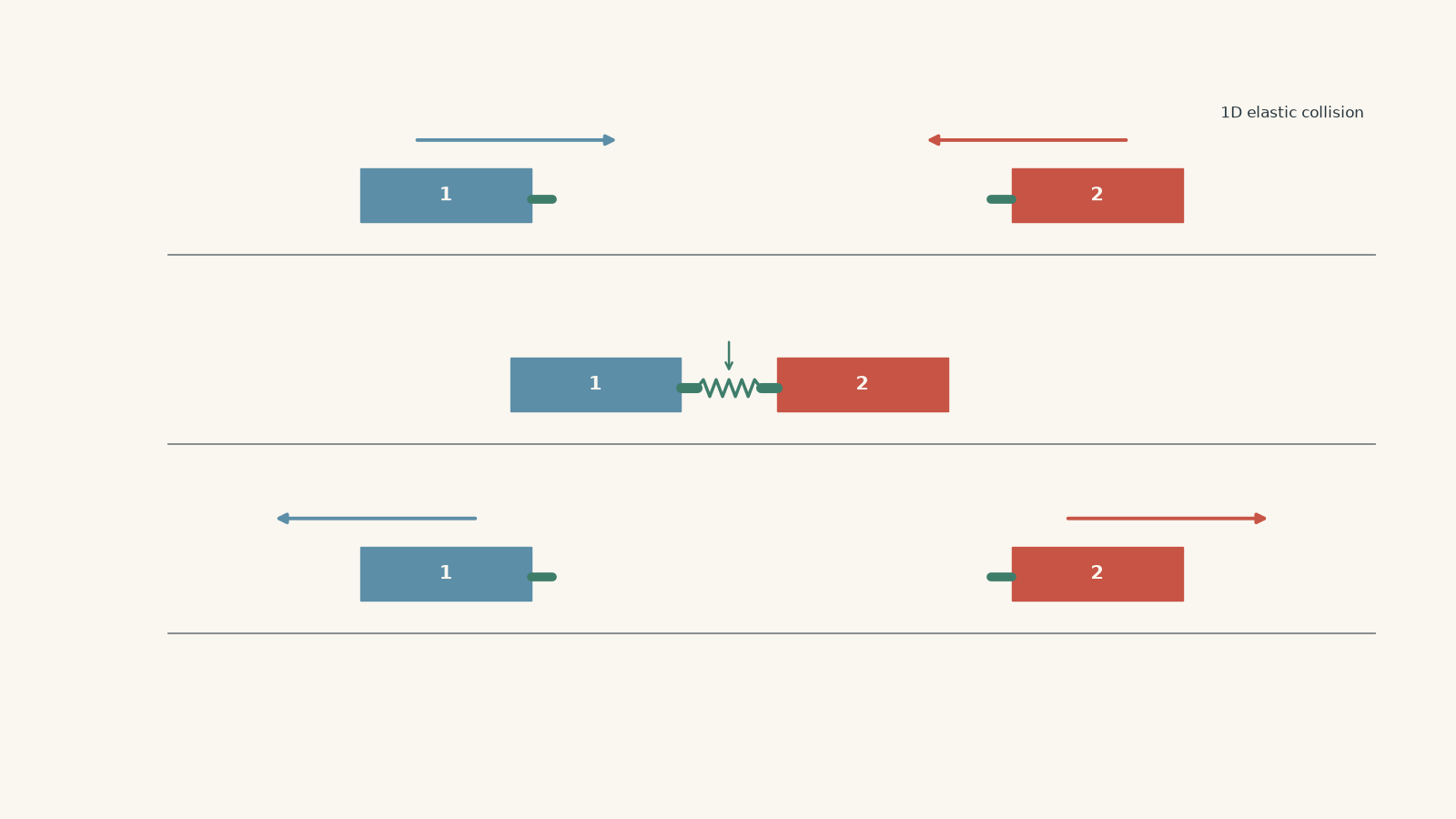
Picture the collision in three stages.
- The objects approach.
- They interact for a very short time, compressing or deforming slightly as they exert forces on each other.
- They separate.
If external forces have negligible impulse during the collision, the total momentum of the system is conserved.
For two objects moving along one line,
\[
m_1u_1+m_2u_2=m_1v_1+m_2v_2
\]
where:
- \(m_1\) and \(m_2\) are the masses in kilograms
- \(u_1\) and \(u_2\) are the initial velocities in metres per second
- \(v_1\) and \(v_2\) are the final velocities in metres per second
Velocity has direction, so signs matter. You might choose motion to the right as positive and motion to the left as negative.
Momentum conservation alone does not make the collision elastic.
For a perfectly elastic collision, the system’s total kinetic energy is also unchanged:
\[
\frac{1}{2}m_1u_1^2+\frac{1}{2}m_2u_2^2
=
\frac{1}{2}m_1v_1^2+\frac{1}{2}m_2v_2^2
\]
Kinetic energy is measured in joules (J).
Notice an important difference. Velocity keeps its sign in the momentum equation, but velocity is squared in the kinetic energy equation. An object travelling at \(-4.0\text{ m s}^{-1}\) has negative momentum if right is positive, but its kinetic energy is still positive.
02Why momentum conservation is not enough
Suppose two \(1.0\text{ kg}\) objects approach each other at equal speeds of \(3.0\text{ m s}^{-1}\), then stick together.
Choose right as positive:
\[
u_1=+3.0\text{ m s}^{-1},\qquad u_2=-3.0\text{ m s}^{-1}
\]
Their initial momentum is
\[
p_i=(1.0)(3.0)+(1.0)(-3.0)=0
\]
If they stick and stop, their final momentum is also zero.
Momentum is perfectly conserved.
Now check kinetic energy:
\[
K_i=\frac{1}{2}(1.0)(3.0)^2+\frac{1}{2}(1.0)(3.0)^2=9.0\text{ J}
\]
Their final kinetic energy is
\[
K_f=0
\]
So this collision is not elastic.
The missing \(9.0\text{ J}\) has not disappeared. Total energy is still conserved. Some of the initial kinetic energy has been transformed into internal energy, deformation, sound, heating, and other forms.
This is the tempting misconception to avoid:
Momentum conserved does not mean kinetic energy conserved.
For an isolated collision, momentum is conserved whether the collision is elastic or inelastic. Elasticity tells you what happens to the system’s kinetic energy.
03A useful physical model
Imagine two spring-loaded trolleys colliding.
As they meet, their springs compress. Some kinetic energy temporarily becomes elastic potential energy. If the springs return all of that stored energy to the trolleys, with no energy left as permanent deformation, heating, or other internal changes, the total kinetic energy after the collision can equal the total kinetic energy before it.
That gives a useful picture of a perfectly elastic collision.
The picture is simplified, though. Real objects contain enormous numbers of particles, and collision energy can move into vibration, rotation, sound, deformation, and thermal motion. “Perfectly elastic” is an ideal model. Some real collisions approximate it closely enough for the model to be useful.
04How to solve a one-dimensional elastic collision
An elastic collision gives you two conservation equations:
\[
m_1u_1+m_2u_2=m_1v_1+m_2v_2
\]
and
\[
\frac{1}{2}m_1u_1^2+\frac{1}{2}m_2u_2^2
=
\frac{1}{2}m_1v_1^2+\frac{1}{2}m_2v_2^2
\]
Usually the masses and initial velocities are known, and the two final velocities are unknown.
That looks unpleasant because the kinetic energy equation contains squares. There is a useful result that follows from combining the two conservation laws.
For a one-dimensional perfectly elastic collision,
\[
v_1-v_2=-(u_1-u_2)
\]
In words:
relative velocity of separation = relative velocity of approach
For example, if one object gains on another at \(7.0\text{ m s}^{-1}\) before an elastic collision, they separate from each other at \(7.0\text{ m s}^{-1}\) afterwards.
This relation is not an extra law. It comes from conserving both momentum and kinetic energy.
Where the relative-velocity result comes from
Start with momentum conservation:
\[
m_1u_1+m_2u_2=m_1v_1+m_2v_2
\]
Rearrange:
\[
m_1(u_1-v_1)=m_2(v_2-u_2)
\]
Now start with kinetic energy conservation. The factors of \(\frac12\) cancel:
\[
m_1u_1^2+m_2u_2^2=m_1v_1^2+m_2v_2^2
\]
Rearrange and factor the differences of two squares:
\[
m_1(u_1-v_1)(u_1+v_1)
=
m_2(v_2-u_2)(v_2+u_2)
\]
The momentum equation tells us that
\[
m_1(u_1-v_1)=m_2(v_2-u_2)
\]
For an actual collision in which the velocities change, those matching factors can be cancelled. This gives
\[
u_1+v_1=v_2+u_2
\]
and therefore
\[
v_1-v_2=-(u_1-u_2)
\]
The minus sign matters. The objects are approaching before the collision and separating afterwards.
05Worked example: identical carts
Two \(0.50\text{ kg}\) carts move on a straight track. Cart A travels at \(4.0\text{ m s}^{-1}\) to the right and collides elastically with stationary cart B. Find the velocity of each cart after the collision.
Step 1
Take right as positive.
\[
m_1=m_2=0.50\text{ kg},\qquad
u_1=4.0\text{ m s}^{-1},\qquad
u_2=0
\]
Step 2
\[
(0.50)(4.0)+(0.50)(0)
=
0.50v_1+0.50v_2
\]
So
\[
2.0=0.50v_1+0.50v_2
\]
Dividing by \(0.50\),
\[
v_1+v_2=4.0
\]
Step 3
\[
v_1-v_2=-(u_1-u_2)
\]
Therefore,
\[
v_1-v_2=-(4.0-0)=-4.0
\]
Step 4
We have
\[
\begin{aligned}
v_1+v_2&=4.0\\
v_1-v_2&=-4.0
\end{aligned}
\]
Adding them gives
\[
2v_1=0
\]
so
\[
v_1=0
\]
Then
\[
v_2=4.0\text{ m s}^{-1}
\]
Step 5
Cart A stops, and cart B moves to the right at \(4.0\text{ m s}^{-1}\).
The moving cart has effectively transferred its motion to the identical stationary cart.
Check the kinetic energy:
\[
K_i=\frac12(0.50)(4.0)^2=4.0\text{ J}
\]
and
\[
K_f=\frac12(0.50)(0)^2+\frac12(0.50)(4.0)^2=4.0\text{ J}
\]
Both momentum and kinetic energy are conserved.
06What changes when the masses are different?
If the masses are equal, the velocity swap is neat. It is also dangerous to memorise, because it only works in that special case.
Predict what happens if a light moving cart hits a much heavier stationary cart elastically. Does the light cart keep moving forwards?
It can actually rebound.
Think about a table-tennis ball striking something much more massive. The massive object barely changes velocity, while the light object can reverse direction. Momentum is still conserved because the heavier object’s small velocity change can carry significant momentum.
The equations, not the word “bounce”, decide the result.
Worked example: unequal masses moving towards each other
A \(0.20\text{ kg}\) cart travels to the right at \(6.0\text{ m s}^{-1}\). A \(0.30\text{ kg}\) cart travels to the left at \(2.0\text{ m s}^{-1}\). They collide elastically in one dimension. Find their final velocities.
Step 1
Take right as positive.
\[
u_1=+6.0\text{ m s}^{-1},\qquad
u_2=-2.0\text{ m s}^{-1}
\]
Step 2
\[
(0.20)(6.0)+(0.30)(-2.0)
=
0.20v_1+0.30v_2
\]
So
\[
1.20-0.60=0.20v_1+0.30v_2
\]
and therefore
\[
0.60=0.20v_1+0.30v_2
\]
The momentum of the system is \(+0.60\text{ kg m s}^{-1}\), so its net momentum is to the right.
Step 3
\[
v_1-v_2=-(u_1-u_2)
\]
Substitute:
\[
v_1-v_2=-[6.0-(-2.0)]=-8.0
\]
Therefore,
\[
v_2=v_1+8.0
\]
Step 4
\[
0.60=0.20v_1+0.30(v_1+8.0)
\]
\[
0.60=0.20v_1+0.30v_1+2.40
\]
\[
-1.80=0.50v_1
\]
so
\[
v_1=-3.6\text{ m s}^{-1}
\]
Then
\[
v_2=-3.6+8.0=4.4\text{ m s}^{-1}
\]
Step 5
Initially,
\[
\begin{aligned}
K_i
&=\frac12(0.20)(6.0)^2+\frac12(0.30)(-2.0)^2\\
&=3.60+0.60\\
&=4.20\text{ J}
\end{aligned}
\]
Finally,
\[
\begin{aligned}
K_f
&=\frac12(0.20)(-3.6)^2+\frac12(0.30)(4.4)^2\\
&=1.296+2.904\\
&=4.20\text{ J}
\end{aligned}
\]
The result is consistent with a perfectly elastic collision.
The \(0.20\text{ kg}\) cart reverses direction and leaves at \(3.6\text{ m s}^{-1}\). The \(0.30\text{ kg}\) cart reverses its original direction and leaves at \(4.4\text{ m s}^{-1}\).
07Three checks that catch most collision mistakes
1. Decide your positive direction before substituting
A speed is always positive. A velocity can be positive or negative.
If right is positive, an object travelling left at \(5.0\text{ m s}^{-1}\) has
\[
v=-5.0\text{ m s}^{-1}
\]
Putting \(+5.0\) into the momentum equation would describe a completely different motion.
2. Do not give kinetic energy a direction
Kinetic energy is a scalar.
If
\[
v=-5.0\text{ m s}^{-1}
\]
then
\[
v^2=(-5.0)^2=25\text{ m}^2\text{ s}^{-2}
\]
not \(-25\text{ m}^2\text{ s}^{-2}\).
3. Check both conservation laws
A proposed answer can conserve momentum and still be impossible for a perfectly elastic collision.
Suppose two identical carts have initial velocities \(4.0\text{ m s}^{-1}\) and \(0\), then someone claims both move at \(2.0\text{ m s}^{-1}\) afterwards.
Momentum works:
\[
m(4.0)=m(2.0)+m(2.0)
\]
But kinetic energy does not.
Initially,
\[
K_i=\frac12m(4.0)^2=8m
\]
Finally,
\[
K_f=2\left(\frac12m(2.0)^2\right)=4m
\]
Half the kinetic energy is missing from the final motion. The claimed result could describe an inelastic interaction with energy transferred elsewhere, but not a perfectly elastic collision.
08What about collisions in two dimensions?
Momentum is a vector, so in two dimensions you conserve its components separately:
\[
p_{x,i}=p_{x,f}
\]
and
\[
p_{y,i}=p_{y,f}
\]
For a perfectly elastic collision, you must also conserve total kinetic energy.
The kinetic energy equation does not need separate \(x\) and \(y\) versions. Each object’s kinetic energy depends on its total speed:
\[
K=\frac12mv^2
\]
where
\[
v^2=v_x^2+v_y^2
\]
So a two-dimensional elastic collision usually gives you:
- conservation of momentum in the \(x\)-direction
- conservation of momentum in the \(y\)-direction
- conservation of total kinetic energy
The one-dimensional “relative speed of approach equals relative speed of separation” shortcut should not be blindly applied to arbitrary two-dimensional motion. In two dimensions, work with momentum components and kinetic energy unless the geometry gives you a simpler route.
09Questions and solutions
Question 1
A \(0.40\text{ kg}\) cart travels right at \(5.0\text{ m s}^{-1}\) and collides with a stationary \(0.40\text{ kg}\) cart. After the collision, the first cart is stationary and the second travels right at \(5.0\text{ m s}^{-1}\).
Show whether the collision is consistent with being perfectly elastic.
Solution 1
Yes. The collision conserves both total momentum and total kinetic energy, so the stated motion is consistent with a perfectly elastic collision.
Take right as positive.
Initial momentum:
\[
\begin{aligned}
p_i
&=(0.40)(5.0)+(0.40)(0)\\
&=2.0\text{ kg m s}^{-1}
\end{aligned}
\]
Final momentum:
\[
\begin{aligned}
p_f
&=(0.40)(0)+(0.40)(5.0)\\
&=2.0\text{ kg m s}^{-1}
\end{aligned}
\]
Momentum is conserved.
Initial kinetic energy:
\[
\begin{aligned}
K_i
&=\frac12(0.40)(5.0)^2\\
&=5.0\text{ J}
\end{aligned}
\]
Final kinetic energy:
\[
\begin{aligned}
K_f
&=\frac12(0.40)(0)^2+\frac12(0.40)(5.0)^2\\
&=5.0\text{ J}
\end{aligned}
\]
Kinetic energy is also conserved.
This is the equal-mass velocity-swap case. Checking only momentum would not have been enough to establish elasticity.
Question 2
A \(0.30\text{ kg}\) puck moves right at \(4.0\text{ m s}^{-1}\) and collides elastically head-on with a \(0.10\text{ kg}\) puck initially at rest.
Calculate the final velocity of each puck.
Solution 2
The \(0.30\text{ kg}\) puck moves right at \(2.0\text{ m s}^{-1}\), and the \(0.10\text{ kg}\) puck moves right at \(6.0\text{ m s}^{-1}\).
Take right as positive.
Momentum conservation gives
\[
(0.30)(4.0)+(0.10)(0)
=
0.30v_1+0.10v_2
\]
so
\[
1.20=0.30v_1+0.10v_2
\]
For a one-dimensional elastic collision,
\[
v_1-v_2=-(u_1-u_2)
\]
Therefore,
\[
v_1-v_2=-(4.0-0)=-4.0
\]
so
\[
v_2=v_1+4.0
\]
Substitute this into the momentum equation:
\[
\begin{aligned}
1.20
&=0.30v_1+0.10(v_1+4.0)\\
&=0.40v_1+0.40
\end{aligned}
\]
Hence,
\[
0.80=0.40v_1
\]
and
\[
v_1=2.0\text{ m s}^{-1}
\]
Then
\[
v_2=2.0+4.0=6.0\text{ m s}^{-1}
\]
The lighter puck ends up moving faster than the original incoming puck. That does not violate energy conservation because it has only one-third of the incoming puck’s mass.
A kinetic-energy check confirms the result:
\[
K_i=\frac12(0.30)(4.0)^2=2.4\text{ J}
\]
and
\[
\begin{aligned}
K_f
&=\frac12(0.30)(2.0)^2+\frac12(0.10)(6.0)^2\\
&=0.60+1.80\\
&=2.40\text{ J}
\end{aligned}
\]
Question 3
A student analyses a collision between two carts and calculates
\[
p_i=1.8\text{ kg m s}^{-1},\qquad
p_f=1.8\text{ kg m s}^{-1}
\]
and
\[
K_i=3.6\text{ J},\qquad
K_f=2.9\text{ J}
\]
The student concludes, “The calculation must be wrong because energy has not been conserved.”
Evaluate this conclusion.
Solution 3
The conclusion is not justified. The data show that momentum is conserved but kinetic energy is not, which is possible for an inelastic collision.
The student has confused kinetic energy with total energy.
The momentum values are equal:
\[
p_i=p_f=1.8\text{ kg m s}^{-1}
\]
so the measurements are consistent with an isolated system during the collision.
The decrease in kinetic energy is
\[
\Delta K=K_f-K_i=2.9-3.6=-0.7\text{ J}
\]
So \(0.7\text{ J}\) of kinetic energy has been transferred into other forms of energy.
For example, it may have become internal energy associated with deformation, heating, vibration, or sound.
Total energy is still conserved. The collision is simply not perfectly elastic.
The trap is assuming that momentum conservation automatically requires kinetic energy conservation. It does not.
Question 4
A \(0.20\text{ kg}\) cart moving right at \(3.0\text{ m s}^{-1}\) collides head-on with a stationary \(0.50\text{ kg}\) cart. The collision is perfectly elastic.
Without assuming that the first cart continues to the right, calculate both final velocities and explain the direction of the first cart.
Solution 4
The \(0.20\text{ kg}\) cart rebounds at \(1.29\text{ m s}^{-1}\) to the left, while the \(0.50\text{ kg}\) cart moves right at \(1.71\text{ m s}^{-1}\).
Take right as positive.
Momentum conservation gives
\[
(0.20)(3.0)+(0.50)(0)
=
0.20v_1+0.50v_2
\]
so
\[
0.60=0.20v_1+0.50v_2
\]
For the elastic collision,
\[
v_1-v_2=-(u_1-u_2)
\]
so
\[
v_1-v_2=-3.0
\]
and therefore
\[
v_2=v_1+3.0
\]
Substitute into the momentum equation:
\[
\begin{aligned}
0.60
&=0.20v_1+0.50(v_1+3.0)\\
&=0.70v_1+1.50
\end{aligned}
\]
Therefore,
\[
-0.90=0.70v_1
\]
so
\[
v_1=-1.29\text{ m s}^{-1}
\]
Then
\[
v_2=-1.29+3.0=1.71\text{ m s}^{-1}
\]
The negative sign for \(v_1\) means the first cart rebounds to the left.
The first cart is lighter than the stationary target. In an elastic head-on collision, the heavier target can reverse the lighter incoming object’s velocity while still taking enough momentum to move forwards.
The important point is that direction must come from the calculation. Assuming both final velocities are positive would remove a physically possible outcome before the conservation laws have had a chance to decide it.
Question 5
Two identical smooth pucks collide elastically on a horizontal surface. Before the collision, puck A moves east at speed \(u\), while puck B is stationary. After the collision, both pucks are moving, with A having velocity \(\vec v_A\) and B having velocity \(\vec v_B\).
Show that the two final velocity vectors must be perpendicular.
Solution 5
The final velocity vectors are perpendicular: \(\vec v_A\cdot\vec v_B=0\).
Let each puck have mass \(m\).
Initially, the total momentum is
\[
m\vec u
\]
where \(\vec u\) is A’s initial velocity.
After the collision, momentum conservation gives
\[
m\vec u=m\vec v_A+m\vec v_B
\]
Cancel \(m\):
\[
\vec u=\vec v_A+\vec v_B
\]
Now take the squared magnitude of both sides:
\[
u^2=\left|\vec v_A+\vec v_B\right|^2
\]
Using the vector identity for the squared magnitude of a sum,
\[
u^2=v_A^2+v_B^2+2\vec v_A\cdot\vec v_B
\]
Because the collision is elastic, kinetic energy is also conserved:
\[
\frac12mu^2
=
\frac12mv_A^2+\frac12mv_B^2
\]
Cancel \(\frac12m\):
\[
u^2=v_A^2+v_B^2
\]
Compare the two expressions for \(u^2\):
\[
v_A^2+v_B^2+2\vec v_A\cdot\vec v_B
=
v_A^2+v_B^2
\]
Therefore,
\[
2\vec v_A\cdot\vec v_B=0
\]
so
\[
\vec v_A\cdot\vec v_B=0
\]
A zero dot product means the velocity vectors are perpendicular.
The result depends on several hidden conditions: the masses are identical, one puck starts at rest, and the collision is elastic. Remove one of those conditions and the \(90^\circ\) conclusion does not generally follow.
Question 6
A cart of mass \(m\) travels right at speed \(u\) and collides elastically head-on with a stationary cart of mass \(M\).
For the moving cart after the collision,
\[
v=\frac{m-M}{m+M}u
\]
Use this result to determine what happens when:
- \(M=m\)
- \(M>m\)
- \(M\) becomes extremely large compared with \(m\)
Explain why the limiting case is physically sensible.
Solution 6
When \(M=m\), the incoming cart stops. When \(M>m\), it rebounds. As \(M\) becomes much larger than \(m\), its final velocity approaches \(-u\).
The final velocity is
\[
v=\frac{m-M}{m+M}u
\]
For \(M=m\),
\[
v=\frac{m-m}{m+m}u=0
\]
so the incoming cart stops. This agrees with the equal-mass velocity-transfer result.
For \(M>m\), the numerator \(m-M\) is negative while the denominator \(m+M\) is positive. Therefore,
\[
v<0
\]
The incoming cart reverses direction.
Now consider the limit in which \(M\) is much larger than \(m\). Divide the fraction by \(M\):
\[
v=
\frac{\frac{m}{M}-1}{\frac{m}{M}+1}u
\]
As \(M\) becomes extremely large,
\[
\frac{m}{M}\rightarrow 0
\]
so
\[
v\rightarrow\frac{-1}{1}u=-u
\]
The small cart approaches with speed \(u\) and leaves in the opposite direction with nearly the same speed.
That makes physical sense. An enormously massive target changes its velocity by an extremely small amount, so from the small cart’s point of view it behaves almost like a rigid wall. In the ideal elastic limit, the cart rebounds without losing kinetic energy.
The subtle point is that the massive target is not literally unaffected unless its mass is treated as infinite. For any finite \(M\), it receives some momentum and kinetic energy.
10Where this idea leads next
Elastic collisions give you an unusually strong set of constraints. Momentum conservation tells you how the system’s motion is redistributed, while kinetic energy conservation rules out outcomes that would require some of that motion energy to remain as deformation, heat, or other internal energy.
That prepares you for a more general way to classify collisions. In an isolated system, momentum is the quantity you expect to conserve. The next decision is what happens to kinetic energy: if it is also conserved, the collision is elastic; if it decreases, the collision is inelastic.
Once that distinction is secure, collision problems stop being about hunting for the “right formula”. They become a question of choosing the system, setting a direction convention, and deciding exactly which conservation laws the physical situation allows you to use.