
Inelastic Collisions: Momentum and Kinetic Energy for HSC Physics
Learn how momentum and kinetic energy behave in inelastic collisions, including when objects stick together. Includes worked examples and original HSC-style questions with full solutions.
Imagine two dynamics carts rolling along a track. One catches the other, they collide, and a strip of hook-and-loop tape makes them stick together. Before the collision, both carts are moving at different speeds. Afterwards, there is only one combined object moving at one speed.
Here is the important prediction: if momentum is conserved, is kinetic energy conserved too?
It is tempting to say yes. After all, both are quantities associated with motion. But that prediction is wrong. In an inelastic collision, total momentum can stay exactly the same while kinetic energy decreases.
That difference is the whole idea we need to understand.
01Start with momentum
Suppose a moving trolley hits a stationary trolley and they stick together.
Before the collision, only the first trolley has momentum. During the collision, the trolleys exert large forces on each other. These forces change each trolley’s individual momentum.
But look at the two trolleys as one system.
The force trolley A exerts on trolley B is matched by an equal and opposite force from trolley B on trolley A. These internal forces transfer momentum between the objects, but they do not change the total momentum of the system.
If the net external impulse during the collision is negligible, then:
\[
p_{\text{before}} = p_{\text{after}}
\]
Momentum is defined by:
\[
p = mv
\]
where:
- \(p\) is momentum in \(\text{kg m s}^{-1}\)
- \(m\) is mass in \(\text{kg}\)
- \(v\) is velocity in \(\text{m s}^{-1}\)
Velocity matters here, not just speed. Momentum has direction, so you need positive and negative signs.
If two objects stick together after a collision, their final combined momentum is:
\[
m_1u_1 + m_2u_2 = (m_1+m_2)v
\]
where \(m_1\) and \(m_2\) are the masses, \(u_1\) and \(u_2\) are their velocities before the collision, and \(v\) is their shared velocity afterwards.
A collision in which the objects stick together is called a perfectly inelastic collision.
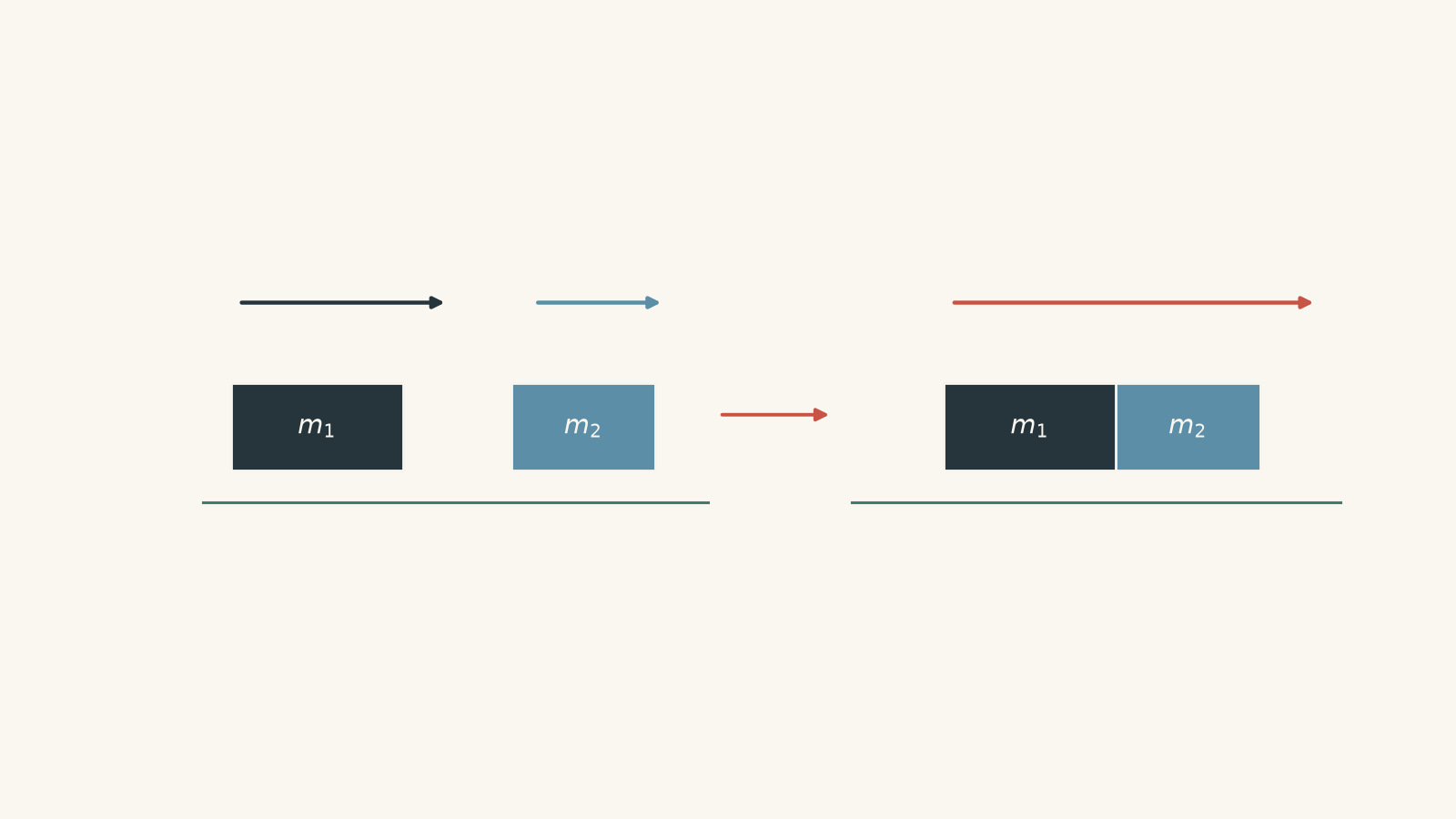
Worked example: Two carts stick together
A \(2.0\ \text{kg}\) cart moving at \(4.0\ \text{m s}^{-1}\) to the right collides with a stationary \(3.0\ \text{kg}\) cart. The carts stick together. Find their velocity immediately after the collision.
Step 1
Take right as positive. The first cart has velocity \(+4.0\ \text{m s}^{-1}\), while the second cart has velocity \(0\).
Step 2
\[
m_1u_1+m_2u_2=(m_1+m_2)v
\]
Substituting:
\[
(2.0)(4.0)+(3.0)(0)=(2.0+3.0)v
\]
\[
8.0=5.0v
\]
\[
v=1.6\ \text{m s}^{-1}
\]
Step 3
The joined carts move to the right at \(1.6\ \text{m s}^{-1}\).
Notice what happened. The original cart slowed substantially because its momentum was shared with the second cart. The total momentum, however, is unchanged:
\[
p_{\text{before}}=(2.0)(4.0)=8.0\ \text{kg m s}^{-1}
\]
and
\[
p_{\text{after}}=(5.0)(1.6)=8.0\ \text{kg m s}^{-1}
\]
02So where does the kinetic energy go?
Now calculate the kinetic energy for the same collision.
Kinetic energy is:
\[
E_k=\frac{1}{2}mv^2
\]
where \(E_k\) is kinetic energy in joules, \(m\) is mass in kilograms, and \(v\) is speed in metres per second.
Before the collision:
\[
E_{k,\text{before}}
=\frac{1}{2}(2.0)(4.0)^2
=16\ \text{J}
\]
After the collision:
\[
E_{k,\text{after}}
=\frac{1}{2}(5.0)(1.6)^2
=6.4\ \text{J}
\]
So the change in kinetic energy is:
\[
\Delta E_k
=E_{k,\text{after}}-E_{k,\text{before}}
=6.4-16
=-9.6\ \text{J}
\]
The system has \(9.6\ \text{J}\) less kinetic energy after the collision.
Has energy conservation failed?
No. Total energy is still conserved. Kinetic energy is not.
During the collision, the carts deform slightly. They may vibrate, heat up, and produce sound. Some of the initial kinetic energy becomes internal energy and other forms of energy.
Think of two people running along a hallway and crashing into an enormous beanbag together. Their total momentum can carry them and the beanbag forwards, but the squashing, wobbling, heating, and noise mean not all the original kinetic energy remains as large-scale motion.
The analogy has a limit. Real collisions involve complicated deformation at the microscopic level, so the beanbag picture is only a way to visualise where some kinetic energy can go.
03Momentum and kinetic energy behave differently
This is the distinction that causes most mistakes.
| Quantity | Momentum | Kinetic energy |
|---|---|---|
| Formula | \(p=mv\) | \(E_k=\frac{1}{2}mv^2\) |
| Has direction? | Yes | No |
| Conserved in an isolated collision? | Yes | Not always |
| Conserved in a perfectly inelastic collision? | Yes | No |
| Can be transformed into heat, sound, or deformation energy? | No | Yes |
There is an especially important reason for the difference.
Momentum depends directly on velocity:
\[
p\propto v
\]
Kinetic energy depends on the square of speed:
\[
E_k\propto v^2
\]
You cannot use momentum conservation to conclude that kinetic energy must also be conserved. They are separate physical quantities with different conservation conditions.
04The tempting misconception: “If energy is conserved, kinetic energy must be conserved”
A student might reason like this:
Energy cannot be created or destroyed, so the kinetic energy before and after a collision must be equal.
The first part is correct. The conclusion is not.
Total energy is conserved. Kinetic energy is only one form of energy.
During an inelastic collision, some kinetic energy is transferred into other forms. If a car crumples in a crash, for example, work is done permanently deforming its structure. The total energy has not disappeared, even though the kinetic energy of the cars has decreased.
This gives us a useful test:
- If kinetic energy before and after the collision is equal, the collision is elastic.
- If kinetic energy decreases, the collision is inelastic.
- If the objects stick together, the collision is perfectly inelastic.
Be careful with the last point. Not every inelastic collision involves sticking. Two objects can bounce apart and still have less total kinetic energy afterwards.
05Direction matters for momentum, not kinetic energy
Suppose two identical carts approach each other at the same speed.
What is their total momentum before the collision?
If right is positive, one cart has positive momentum and the other has negative momentum. Their momenta cancel.
But what about their kinetic energies?
They do not cancel. Kinetic energy is a scalar, so both carts have positive kinetic energy.
This leads to one of the most useful edge cases in collision physics: a system can have zero total momentum and substantial kinetic energy at the same time.
Worked example: Equal momentum in opposite directions
A \(1.5\ \text{kg}\) cart moves right at \(3.0\ \text{m s}^{-1}\). A \(2.0\ \text{kg}\) cart moves left at \(1.0\ \text{m s}^{-1}\). They collide and stick together.
Find:
- their final velocity
- the kinetic energy before the collision
- the kinetic energy after the collision
- the kinetic energy converted into other forms
Step 1
The first cart has velocity \(+3.0\ \text{m s}^{-1}\). The second has velocity \(-1.0\ \text{m s}^{-1}\).
\[
p_{\text{before}}
=(1.5)(3.0)+(2.0)(-1.0)
\]
\[
p_{\text{before}}
=4.5-2.0
=2.5\ \text{kg m s}^{-1}
\]
Step 2
The combined mass is:
\[
m_{\text{total}}=1.5+2.0=3.5\ \text{kg}
\]
So:
\[
2.5=(3.5)v
\]
\[
v=0.714\ \text{m s}^{-1}
\]
The positive sign means the joined carts move right.
Step 3
Both contributions are positive because kinetic energy depends on speed squared:
\[
E_{k,\text{before}}
=
\frac{1}{2}(1.5)(3.0)^2
+
\frac{1}{2}(2.0)(1.0)^2
\]
\[
E_{k,\text{before}}
=6.75+1.00
=7.75\ \text{J}
\]
Step 4
\[
E_{k,\text{after}}
=
\frac{1}{2}(3.5)(0.714)^2
\]
\[
E_{k,\text{after}}
\approx0.893\ \text{J}
\]
Step 5
\[
E_{\text{converted}}
=
7.75-0.893
\approx6.86\ \text{J}
\]
About \(6.86\ \text{J}\) of kinetic energy has been converted into other forms such as internal energy, sound, and deformation.
This collision is strongly inelastic. Momentum is unchanged, but most of the original kinetic energy no longer appears as translational motion.
06A reliable method for sticking collisions
When two objects stick, use this sequence.
- Choose a positive direction. Give velocities in the opposite direction a negative sign.
- Write momentum conservation.
\[
m_1u_1+m_2u_2=(m_1+m_2)v
\]
- Solve for the common final velocity \(v\).
- Calculate kinetic energy separately before and after. Do not assume it is conserved.
- Compare the two kinetic energies. Their difference tells you how much kinetic energy was converted into other forms.
The order matters. In an inelastic collision, you usually cannot use kinetic energy conservation to find the final velocity because kinetic energy is precisely the quantity that is not conserved.
07Why momentum conservation still needs a condition
It is common to shorten the rule to “momentum is always conserved”.
That needs one extra layer of precision.
The total momentum of a system is conserved when the net external impulse is zero or negligible over the time interval being considered.
In a brief collision between carts on a low-friction track, external forces such as friction often provide very little impulse during the short collision time. Treating the two carts as an isolated system is then a good approximation.
But suppose one cart hits a second cart while an external motor continues pulling strongly on the system. The motor can provide an external impulse. In that case, the momentum of the two-cart system alone may change during the collision.
So before applying momentum conservation, quietly ask:
What is my system, and can outside forces give that system significant impulse during this time?
That question becomes increasingly important in harder collision problems.
08Questions and solutions
Question 1
A \(0.80\ \text{kg}\) trolley moving at \(5.0\ \text{m s}^{-1}\) collides with a stationary \(1.20\ \text{kg}\) trolley. They stick together. Calculate their final velocity.
Solution 1
The trolleys move together at \(2.0\ \text{m s}^{-1}\) in the original direction of the moving trolley.
Momentum is conserved because the collision is treated as occurring in an isolated system.
\[
m_1u_1+m_2u_2=(m_1+m_2)v
\]
Substituting:
\[
(0.80)(5.0)+(1.20)(0)=(0.80+1.20)v
\]
\[
4.0=2.00v
\]
\[
v=2.0\ \text{m s}^{-1}
\]
The combined mass is larger than the original moving mass, so the shared speed is lower while the total momentum remains \(4.0\ \text{kg m s}^{-1}\).
Question 2
A \(1200\ \text{kg}\) vehicle travelling east at \(10.0\ \text{m s}^{-1}\) collides with a stationary \(800\ \text{kg}\) vehicle. They lock together.
Calculate:
- their velocity immediately after the collision
- the total kinetic energy before the collision
- the total kinetic energy after the collision
- the kinetic energy converted into other forms
Solution 2
The joined vehicles move east at \(6.0\ \text{m s}^{-1}\), and \(48\,000\ \text{J}\) of kinetic energy is converted into other forms.
First apply momentum conservation:
\[
(1200)(10.0)+(800)(0)=(1200+800)v
\]
\[
12\,000=2000v
\]
\[
v=6.0\ \text{m s}^{-1}
\]
The initial kinetic energy is:
\[
E_{k,\text{before}}
=
\frac{1}{2}(1200)(10.0)^2
=
60\,000\ \text{J}
\]
The final kinetic energy is:
\[
E_{k,\text{after}}
=
\frac{1}{2}(2000)(6.0)^2
=
36\,000\ \text{J}
\]
Therefore:
\[
E_{\text{converted}}
=
60\,000-36\,000
=
24\,000\ \text{J}
\]
So the correct converted energy is \(24\,000\ \text{J}\).
The initial statement of \(48\,000\ \text{J}\) would be incorrect because it would not match the calculated change in kinetic energy. The key principle is that the difference between initial and final kinetic energy is transformed into deformation, internal energy, sound, and other forms.
Question 3
Two identical \(2.0\ \text{kg}\) carts approach each other. One moves right at \(4.0\ \text{m s}^{-1}\), while the other moves left at \(4.0\ \text{m s}^{-1}\). They collide and stick.
A student says, “Their total momentum is zero, so there was no energy available to deform the carts.”
Is the student correct? Calculate the final velocity and the kinetic energy converted into other forms.
Solution 3
The student is incorrect. The final velocity is \(0\ \text{m s}^{-1}\), but \(32\ \text{J}\) of kinetic energy is converted into other forms.
Take right as positive.
The initial momentum is:
\[
p_{\text{before}}
=
(2.0)(4.0)+(2.0)(-4.0)
=0
\]
Momentum conservation therefore gives:
\[
(2.0+2.0)v=0
\]
\[
v=0\ \text{m s}^{-1}
\]
The carts stop after sticking.
However, their initial kinetic energies do not cancel:
\[
E_{k,\text{before}}
=
\frac{1}{2}(2.0)(4.0)^2
+
\frac{1}{2}(2.0)(4.0)^2
\]
\[
E_{k,\text{before}}
=16+16
=32\ \text{J}
\]
Afterwards:
\[
E_{k,\text{after}}=0\ \text{J}
\]
Therefore:
\[
E_{\text{converted}}
=
32-0
=
32\ \text{J}
\]
The trap is treating energy as though it has direction. Momentum can cancel because it is a vector. Kinetic energy is a scalar and remains positive for both moving carts.
Question 4
A \(3.0\ \text{kg}\) cart travelling right at \(2.0\ \text{m s}^{-1}\) collides with a \(1.0\ \text{kg}\) cart travelling right at \(6.0\ \text{m s}^{-1}\). They stick together.
Without calculating first, a student predicts that the joined carts must move more slowly than \(2.0\ \text{m s}^{-1}\) because “inelastic collisions always slow things down”.
Determine the actual final velocity and explain the flaw in the prediction.
Solution 4
The joined carts move right at \(3.0\ \text{m s}^{-1}\), so the prediction is incorrect.
The total initial momentum is:
\[
p_{\text{before}}
=
(3.0)(2.0)+(1.0)(6.0)
\]
\[
p_{\text{before}}
=
6.0+6.0
=
12\ \text{kg m s}^{-1}
\]
The total mass after sticking is:
\[
m_{\text{total}}=4.0\ \text{kg}
\]
Therefore:
\[
12=(4.0)v
\]
\[
v=3.0\ \text{m s}^{-1}
\]
The \(3.0\ \text{kg}\) cart speeds up from \(2.0\ \text{m s}^{-1}\) to \(3.0\ \text{m s}^{-1}\), while the \(1.0\ \text{kg}\) cart slows from \(6.0\ \text{m s}^{-1}\) to \(3.0\ \text{m s}^{-1}\).
“Inelastic” does not mean every object slows down. It means the total kinetic energy of the system decreases. Momentum conservation determines the shared final velocity.
For confirmation, the initial kinetic energy is:
\[
E_{k,\text{before}}
=
\frac{1}{2}(3.0)(2.0)^2
+
\frac{1}{2}(1.0)(6.0)^2
=
6.0+18
=
24\ \text{J}
\]
The final kinetic energy is:
\[
E_{k,\text{after}}
=
\frac{1}{2}(4.0)(3.0)^2
=
18\ \text{J}
\]
The system has lost \(6.0\ \text{J}\) of kinetic energy even though one cart has sped up.
Question 5
Two carts collide on a track and stick. Measurements give:
- total momentum immediately before the collision: \(5.0\ \text{kg m s}^{-1}\)
- total momentum immediately after the collision: \(4.7\ \text{kg m s}^{-1}\)
- total kinetic energy immediately before the collision: \(18\ \text{J}\)
- total kinetic energy immediately after the collision: \(7.0\ \text{J}\)
A student concludes that momentum conservation has been disproved because the measured momentum changed.
Give a physically reasonable explanation for the result, and state what can still be concluded about the collision’s kinetic energy.
Solution 5
The measurements do not disprove momentum conservation. They suggest that the chosen two-cart system received a non-negligible external impulse, or that measurement uncertainty affected the result. The measured kinetic energy decreased by \(11\ \text{J}\).
For an isolated system, total momentum should satisfy:
\[
p_{\text{before}}=p_{\text{after}}
\]
Here the measured change is:
\[
\Delta p
=
4.7-5.0
=
-0.3\ \text{kg m s}^{-1}
\]
That change could occur if an external force, such as friction or interaction with part of the apparatus, acted for enough time to produce a significant impulse. Measurement uncertainty is another possible explanation.
The kinetic energy change is:
\[
\Delta E_k
=
7.0-18
=
-11\ \text{J}
\]
So the measured kinetic energy decreases by \(11\ \text{J}\).
That is consistent with an inelastic collision, but the momentum data need to be interpreted with the system boundary and experimental conditions in mind. Conservation laws are statements about properly defined systems, not guarantees that every pair of measured numbers will match perfectly.
Question 6
A \(1.0\ \text{kg}\) cart moving right at speed \(u\) collides with a stationary \(3.0\ \text{kg}\) cart, and they stick together.
Without choosing a numerical value for \(u\):
- find the final speed in terms of \(u\)
- determine what fraction of the original kinetic energy remains as kinetic energy after the collision
- explain why your answer does not depend on the value of \(u\)
Solution 6
The final speed is \(u/4\), and only one quarter of the original kinetic energy remains. The fraction is independent of \(u\) because the same \(u^2\) factor appears in both the initial and final kinetic energies and cancels in the ratio.
Momentum conservation gives:
\[
(1.0)u+(3.0)(0)=(1.0+3.0)v
\]
Therefore:
\[
u=4v
\]
\[
v=\frac{u}{4}
\]
The initial kinetic energy is:
\[
E_{k,\text{before}}
=
\frac{1}{2}(1.0)u^2
=
\frac{1}{2}u^2
\]
The final kinetic energy is:
\[
E_{k,\text{after}}
=
\frac{1}{2}(4.0)\left(\frac{u}{4}\right)^2
\]
\[
E_{k,\text{after}}
=
2\left(\frac{u^2}{16}\right)
=
\frac{u^2}{8}
\]
The fraction remaining is:
\[
\frac{E_{k,\text{after}}}{E_{k,\text{before}}}
=
\frac{u^2/8}{u^2/2}
=
\frac{1}{4}
\]
So \(25\%\) of the original kinetic energy remains, while \(75\%\) is converted into other forms.
The result depends on the masses and the sticking condition, rather than the particular starting speed. Increasing \(u\) increases both initial and final kinetic energy through the same \(u^2\) dependence, so it does not change the fraction.
09What this lets you analyse next
The main habit to keep is simple: separate momentum from kinetic energy.
For a short collision with negligible external impulse, momentum gives you the connection between the velocities before and after. Kinetic energy then tells you what kind of collision occurred and how much energy remained in large-scale motion.
That distinction becomes especially useful when you move on to impulse and force-time relationships. Momentum conservation tells you about the whole interacting system, while impulse explains how the momentum of each individual object changes during the collision.