
Mechanical vs Electromagnetic Waves for HSC Physics
Learn how mechanical and electromagnetic waves differ in their need for a medium, what actually oscillates, and how both behave as waves.
A phone alarm is ringing inside a sealed chamber. Beside it, the phone screen is flashing. Now imagine the air is gradually pumped out.
Predict what happens. Does the sound disappear? Does the light disappear too?
The sound becomes weaker because sound needs matter to carry its disturbance. In an ideal vacuum, it cannot travel from the phone to the outside. The light is different. It can cross the vacuum because an electromagnetic wave does not need a material medium.
That difference sounds simple, but it controls a lot of wave physics. To use it properly, you need to know what is actually moving in each type of wave.
01What does a wave actually transport?
Start with a rope stretched across a room. Flick one end upwards once. A pulse travels along the rope.
It looks as though something has raced from one end to the other, but mark one small section of rope and watch it carefully. That section moves up and down, then returns roughly to where it started. It does not travel across the room with the pulse.
The disturbance moves. Energy moves with it. The material itself mostly oscillates around an equilibrium position, meaning its normal position before the disturbance arrived.
This is the basic idea of a wave:
A wave transfers energy through a disturbance without requiring a net transfer of matter from the source to the destination.
For a mechanical wave, the disturbance occurs in matter. For an electromagnetic wave, the disturbance occurs in electric and magnetic fields.
That is the key contrast.
02Mechanical waves need a medium
A medium is the material through which a mechanical wave travels.
For example:
- sound can travel through air, water, and solids
- a pulse can travel along a rope
- seismic waves travel through the Earth
- waves can travel across the surface of water
Why does matter need to be there?
Imagine a row of people doing a stadium wave. Each person moves briefly, then sits back down. The pattern travels around the stadium even though nobody has to sprint around the seats.
For a mechanical wave, the people represent particles of the medium. One part of the medium is disturbed, forces between neighbouring particles disturb the next part, and so the disturbance propagates.
The analogy has limits. Real particles don’t watch their neighbour and decide to stand up. Their motion comes from physical forces between particles, and real mechanical waves can move through three-dimensional materials rather than a neat row of seats.
Still, it gives us the important idea: no particles means there is nobody to pass the mechanical disturbance along.
That is why ordinary sound cannot travel through a vacuum.
Transverse and longitudinal mechanical waves
Mechanical waves don’t all make particles move in the same direction.
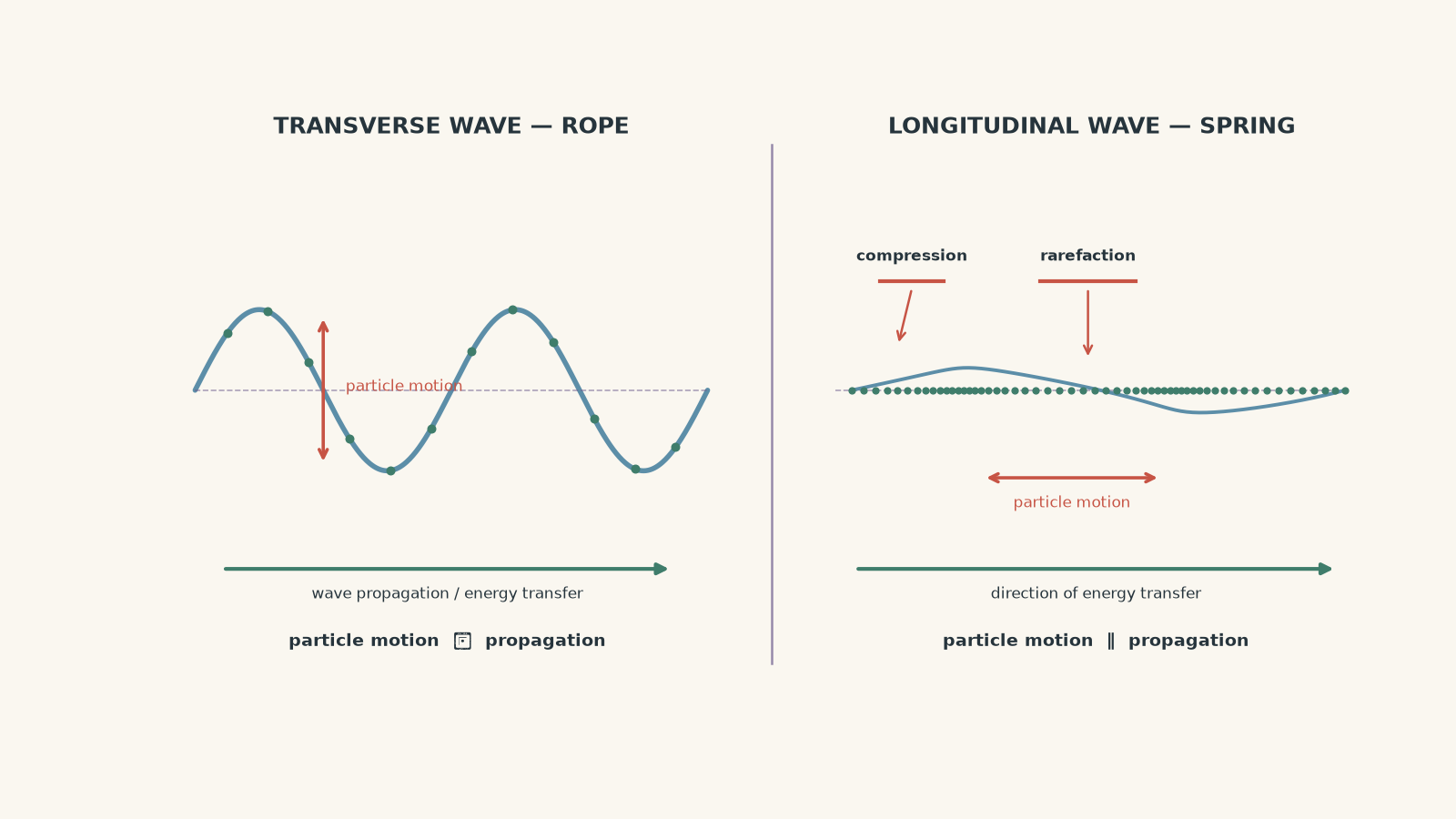
In a transverse wave, particles oscillate perpendicular to the direction the wave travels.
A wave on a stretched rope is a good example. If the wave moves horizontally while the rope moves up and down, particle motion and wave motion are perpendicular.
In a longitudinal wave, particles oscillate parallel to the direction the wave travels.
Sound in air is the standard example. Air molecules move backwards and forwards, creating alternating regions of:
- compression, where particles are temporarily closer together
- rarefaction, where particles are temporarily further apart
The molecules don’t travel all the way from the speaker to your ear. They oscillate locally while the pressure disturbance travels through the air.
One detail is worth keeping clean: surface water waves are often drawn as simple transverse waves, but actual water particles can follow more complicated circular or elliptical paths. A rope is a better example when you want a genuinely simple transverse mechanical wave.
03Electromagnetic waves don’t need matter
Now return to the evacuated chamber.
If light doesn’t need particles to pass the disturbance from neighbour to neighbour, what is oscillating?
The answer is the electromagnetic field.
An electromagnetic wave contains changing:
- electric field \(E\)
- magnetic field \(B\)
For the simple plane-wave model used in HSC Physics, these fields oscillate perpendicular to each other and perpendicular to the direction the wave travels.
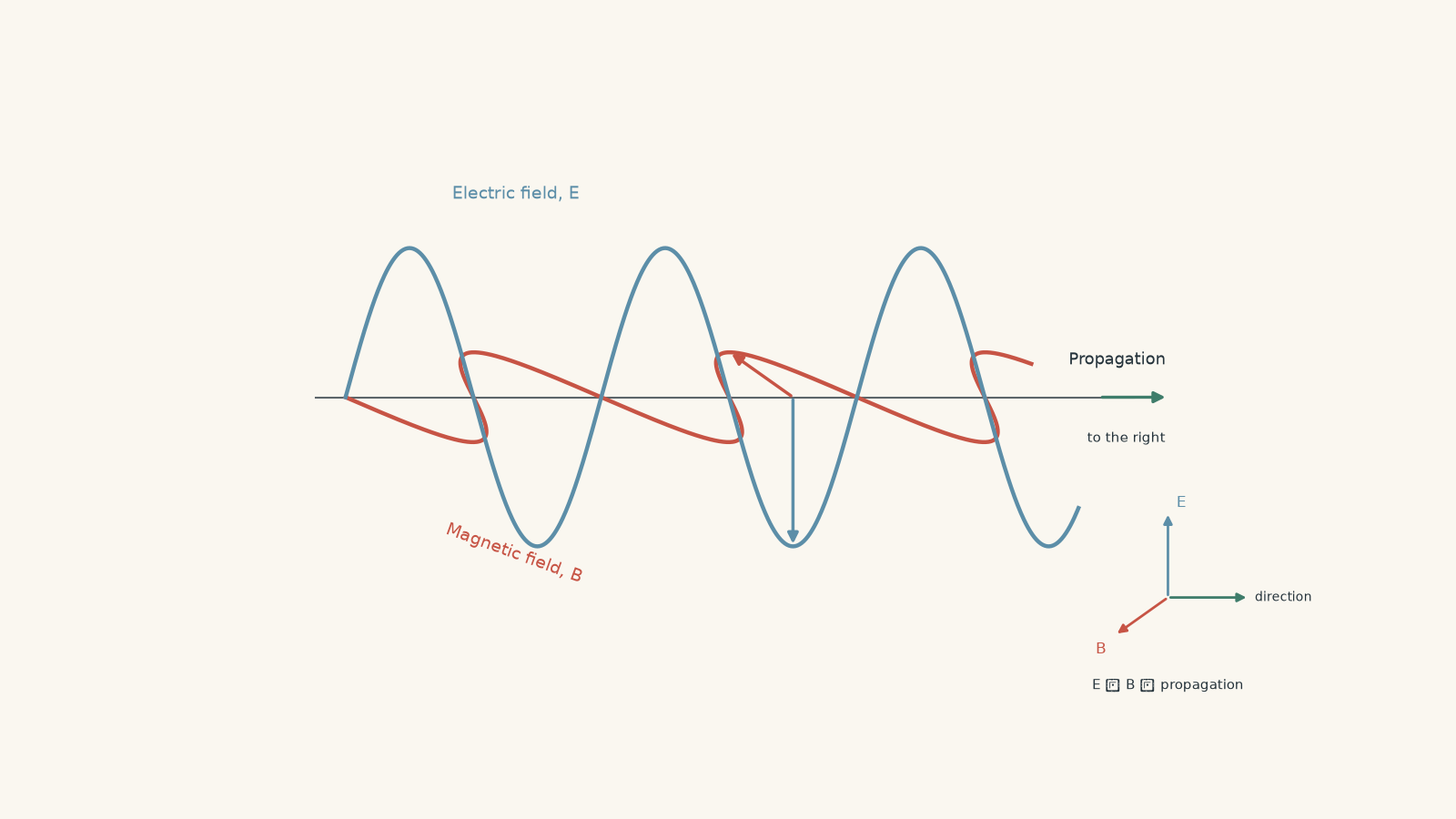
This makes electromagnetic waves transverse waves.
You may hear the simplified statement that “a changing electric field creates a magnetic field, and a changing magnetic field creates an electric field”. The more precise statement is that electric and magnetic fields are coupled by Maxwell’s equations, allowing an electromagnetic disturbance to propagate even when no material particles are present.
So an electromagnetic wave does not need a material medium.
That includes:
- radio waves
- microwaves
- infrared
- visible light
- ultraviolet
- X-rays
- gamma rays
In a vacuum, all electromagnetic waves travel at the speed of light:
\[
c = 3.00 \times 10^8\ \text{m s}^{-1}
\]
where \(c\) is the speed of electromagnetic radiation in a vacuum.
A common misconception: “No medium” does not mean “no interaction with matter”
Electromagnetic waves can travel through a vacuum, but they can also travel through materials.
Visible light travels through air, glass, and water, for example. When an electromagnetic wave enters a material, it interacts with the material’s charged particles. Its speed can change, and the wave may also be reflected, refracted, absorbed, or transmitted.
So the correct distinction is:
Mechanical waves require matter. Electromagnetic waves do not require matter.
It is not:
Mechanical waves travel through matter, whereas electromagnetic waves only travel through empty space.
04The comparison you should be able to explain
| Feature | Mechanical wave | Electromagnetic wave |
|---|---|---|
| Requires a material medium? | Yes | No |
| Can travel through a vacuum? | No | Yes |
| What oscillates? | Particles of the medium | Electric and magnetic fields |
| Transfers energy? | Yes | Yes |
| Transfers matter from source to destination? | No net transfer of matter | No material medium is required |
| Can be transverse? | Yes | Yes |
| Can be longitudinal? | Yes | No, electromagnetic waves are transverse |
| Speed | Depends on properties of the medium | \(3.00 \times 10^8\ \text{m s}^{-1}\) in vacuum, generally different in materials |
| Examples | Sound, rope waves, seismic waves | Radio, microwaves, visible light, X-rays |
There is one particularly useful consequence here. If somebody simply tells you that a wave is transverse, you cannot immediately conclude that it is electromagnetic. Rope waves are transverse too.
However, if a wave is travelling through a true vacuum, it cannot be a mechanical wave.
05Both types still obey the basic wave relationship
Despite their physical differences, mechanical and electromagnetic waves can both be described using quantities such as frequency, wavelength, period, and speed.
The fundamental relationship is:
\[
v = f\lambda
\]
where:
- \(v\) is wave speed in metres per second (\(\text{m s}^{-1}\))
- \(f\) is frequency in hertz (\(\text{Hz}\))
- \(\lambda\) is wavelength in metres (\(\text{m}\))
Frequency tells you how many complete oscillations occur each second.
Wavelength is the distance between equivalent points on consecutive waves. For a transverse wave, you might measure crest to crest. For a longitudinal sound wave, you could measure from one compression to the next.
Worked example: Finding the wavelength of sound
A sound wave has a frequency of \(680\ \text{Hz}\) and travels through air at \(340\ \text{m s}^{-1}\). Calculate its wavelength.
Step 1
\[
v = f\lambda
\]
We know the speed and frequency, so rearrange for wavelength:
\[
\lambda = \frac{v}{f}
\]
Step 2
\[
\lambda = \frac{340\ \text{m s}^{-1}}{680\ \text{s}^{-1}}
= 0.500\ \text{m}
\]
Step 3
The wavelength is:
\[
\boxed{\lambda = 0.500\ \text{m}}
\]
For this longitudinal sound wave, successive compressions are \(0.500\ \text{m}\) apart.
Notice that this calculation doesn’t tell us why sound needs air. The equation describes the wave once it exists. The need for a medium comes from the physical mechanism carrying the disturbance.
06What happens when a wave enters a different medium?
Suppose a wave crosses from one material into another.
Its frequency normally stays the same, because the source is still oscillating at the same rate.
Its speed may change, because wave speed depends on the environment through which it is propagating.
Therefore, from \(v=f\lambda\), its wavelength must change if its speed changes.
This idea applies to both mechanical and electromagnetic waves.
Worked example: A radio wave enters a material
A radio wave of frequency \(1.00 \times 10^8\ \text{Hz}\) travels through a vacuum and then enters a material in which its speed is \(2.00 \times 10^8\ \text{m s}^{-1}\).
Calculate its wavelength:
- in the vacuum
- inside the material
Step 1
In a vacuum,
\[
v = c = 3.00 \times 10^8\ \text{m s}^{-1}
\]
so:
\[
\lambda_{\text{vac}}
= \frac{v}{f}
= \frac{3.00 \times 10^8}{1.00 \times 10^8}
= 3.00\ \text{m}
\]
Step 2
The source has not changed, so the frequency remains:
\[
f = 1.00 \times 10^8\ \text{Hz}
\]
Step 3
\[
\lambda_{\text{material}}
= \frac{v}{f}
= \frac{2.00 \times 10^8}{1.00 \times 10^8}
= 2.00\ \text{m}
\]
Therefore:
\[
\boxed{\lambda_{\text{vac}} = 3.00\ \text{m}}
\]
and
\[
\boxed{\lambda_{\text{material}} = 2.00\ \text{m}}
\]
The wave slows when it enters the material. Its frequency stays fixed, so its wavelength becomes shorter.
There is another useful point hidden here: calling electromagnetic radiation a wave does not mean it must have a mechanical medium. The equation \(v=f\lambda\) describes both types of wave even though the physical disturbances are different.
07“Denser means slower” is not a safe wave rule
Students sometimes memorise that waves slow down in a denser medium.
Don’t.
For electromagnetic waves, light often travels more slowly through materials such as glass than through air or vacuum. That can make the shortcut feel convincing.
Then sound ruins it.
Sound travels at roughly \(340\ \text{m s}^{-1}\) in air but can travel at several thousand metres per second in many solids.
How can a wave travel faster in a material that is much denser?
Mechanical-wave speed depends on more than density. It also depends on how strongly the material resists deformation. Solids tend to be much stiffer than gases, allowing disturbances to be passed between neighbouring particles very quickly.
The exact speed relationship depends on the type of mechanical wave and the properties of the medium. There is no universal rule that greater density alone means a slower wave.
When you cross a boundary, use the physics of that particular wave rather than a memorised “denser or less dense” shortcut.
08Wave behaviour they have in common
Mechanical and electromagnetic waves are physically different, but many familiar wave behaviours apply to both.
Reflection
A wave can bounce from a boundary.
Examples include an echo from a wall and light reflecting from a mirror.
Refraction
A wave can change direction when its speed changes as it crosses a boundary at an angle.
Both mechanical and electromagnetic waves can refract.
Diffraction
A wave can spread after passing through an opening or around an obstacle.
Diffraction is strongest when the opening or obstacle is similar in size to the wavelength.
Interference
Two waves can overlap. Their displacements or field values combine according to the principle of superposition, producing constructive or destructive interference.
These behaviours are properties of waves more generally. They don’t tell you by themselves whether the wave is mechanical or electromagnetic.
Polarisation gives you more information
Polarisation selects the direction in which a transverse wave oscillates.
Electromagnetic waves can be polarised because they are transverse.
Transverse mechanical waves can also be polarised in principle. Longitudinal waves, such as ordinary sound in air, cannot be polarised in this sense because their oscillation is parallel to their direction of travel.
So even polarisation is not simply a rule saying “electromagnetic wave”. Its deeper significance is that it provides evidence that a wave is transverse.
09Questions and solutions
Question 1
A student creates a pulse by flicking one end of a stretched rope. The pulse travels \(5.0\ \text{m}\) along the rope.
State whether the pulse is mechanical or electromagnetic, and explain whether the individual pieces of rope also travel \(5.0\ \text{m}\).
Solution 1
The pulse is a mechanical wave, and the pieces of rope do not travel \(5.0\ \text{m}\) with it.
The rope is the material medium. Individual sections of rope move away from their equilibrium positions and then return, while the disturbance and its energy propagate along the rope.
The tempting mistake is to treat the motion of the wave pattern as the motion of the matter itself. A travelling wave can carry energy over a large distance while particles of its medium undergo only local oscillations.
Question 2
A longitudinal wave travels along a spring at \(12.0\ \text{m s}^{-1}\). The source completes \(4.00\) oscillations each second.
Calculate the wavelength and explain what the wavelength represents physically.
Solution 2
The wavelength is \(3.00\ \text{m}\), representing the distance between neighbouring equivalent points such as consecutive compressions.
The frequency is:
\[
f = 4.00\ \text{Hz}
\]
Using:
\[
v=f\lambda
\]
we rearrange:
\[
\lambda = \frac{v}{f}
\]
and substitute:
\[
\lambda
= \frac{12.0\ \text{m s}^{-1}}{4.00\ \text{s}^{-1}}
= 3.00\ \text{m}
\]
Therefore:
\[
\boxed{\lambda = 3.00\ \text{m}}
\]
Because the wave is longitudinal, it is better to picture this as \(3.00\ \text{m}\) from one compression to the next rather than trying to draw conventional transverse crests.
Question 3
A microwave has a frequency of \(2.50 \times 10^9\ \text{Hz}\).
Calculate its wavelength in a vacuum, where its speed is \(3.00 \times 10^8\ \text{m s}^{-1}\). Then explain why this calculation is possible even though no material medium is present.
Solution 3
The wavelength is \(0.120\ \text{m}\), and no material medium is required because the propagating disturbance consists of electric and magnetic fields rather than oscillating matter.
Using:
\[
v=f\lambda
\]
gives:
\[
\lambda
= \frac{v}{f}
= \frac{3.00 \times 10^8\ \text{m s}^{-1}}
{2.50 \times 10^9\ \text{s}^{-1}}
= 0.120\ \text{m}
\]
Therefore:
\[
\boxed{\lambda = 0.120\ \text{m}}
\]
The equation \(v=f\lambda\) is a general wave relationship. It does not require the wave to be mechanical. Here the electric and magnetic fields oscillate as the electromagnetic wave propagates through the vacuum.
Question 4
A beam of electromagnetic radiation travels from a vacuum into a transparent material. Its speed decreases from \(3.00 \times 10^8\ \text{m s}^{-1}\) to \(1.80 \times 10^8\ \text{m s}^{-1}\).
A student says:
“Because the wave is now travelling through matter, the material must have become the medium that is required for the wave to exist.”
Evaluate this statement. Also determine the ratio of the wavelength in the material to the wavelength in the vacuum.
Solution 4
The statement is incorrect. The material affects the electromagnetic wave’s propagation, but the material is not a required mechanical medium.
An electromagnetic wave can exist and propagate through a vacuum. When it enters matter, interactions with the material can change its speed, wavelength, direction, and intensity. That does not mean matter has become necessary for the wave’s existence.
The frequency remains constant at the boundary. Using \(v=f\lambda\):
\[
\lambda_{\text{vac}}=\frac{v_{\text{vac}}}{f}
\]
and:
\[
\lambda_{\text{material}}=\frac{v_{\text{material}}}{f}
\]
Therefore:
\[
\frac{\lambda_{\text{material}}}{\lambda_{\text{vac}}}
=
\frac{v_{\text{material}}}{v_{\text{vac}}}
=
\frac{1.80\times10^8}{3.00\times10^8}
=0.600
\]
So:
\[
\boxed{\frac{\lambda_{\text{material}}}{\lambda_{\text{vac}}}=0.600}
\]
The wavelength inside the material is \(60.0\%\) of its vacuum wavelength.
The important distinction is between interacting with matter and requiring matter in order to propagate.
Question 5
A sound wave moves from air into a solid and increases in speed. A light wave moves from air into a transparent solid and decreases in speed.
A student argues that one of these observations must be wrong because “a denser medium should affect every wave in the same way”.
Explain why both observations can be correct. State what happens to the wavelength of each wave if its frequency remains constant.
Solution 5
Both observations can be correct because the speed of a wave depends on the physical mechanism that carries that particular wave, not on density alone.
For the sound wave, the disturbance is mechanical. Its speed depends on properties of the material including its resistance to deformation and its density. Many solids are extremely stiff compared with air, so sound can travel faster through them despite their greater density.
For the electromagnetic wave, propagation through matter involves interactions between the electromagnetic field and charged particles in the material. Its speed can therefore be lower in the solid than in air.
For both waves:
\[
v=f\lambda
\]
and the frequency remains constant at the boundary.
For the sound wave, \(v\) increases while \(f\) stays constant, so:
\[
\boxed{\lambda\text{ increases}}
\]
For the light wave, \(v\) decreases while \(f\) stays constant, so:
\[
\boxed{\lambda\text{ decreases}}
\]
The trap is assuming that the label “denser” gives enough information to predict wave speed. It does not. You need to know the type of wave and the relevant physical properties of the material.
Question 6
An explosion occurs far from a spacecraft in a region of space that is effectively a vacuum. Instruments on the spacecraft detect a flash of visible light but no sound.
A student concludes:
“The explosion transferred electromagnetic energy to the spacecraft but definitely transferred no mechanical energy.”
Is that conclusion justified?
Solution 6
The conclusion is too strong. The absence of sound shows that an ordinary sound wave could not propagate across the vacuum, but it does not prove that no mechanical energy could ever reach the spacecraft.
Sound is a mechanical wave and requires a material medium. With essentially no matter between the explosion and spacecraft, there is no continuous medium to carry an acoustic disturbance.
Visible light is electromagnetic, so it can propagate across the vacuum and be detected.
However, matter ejected by the explosion could potentially travel through space and later collide with the spacecraft. That matter could transfer kinetic energy mechanically on impact.
So the evidence supports the narrower conclusion:
No ordinary sound wave travelled through the vacuum, while electromagnetic radiation did.
It does not justify the broader claim that mechanical energy could never be transferred by any mechanism.
10Where this distinction takes you next
Once you know what is oscillating, several later wave ideas become easier to organise.
If matter is oscillating, the properties of that matter help determine the wave’s speed and behaviour. If electric and magnetic fields are oscillating, the wave can cross empty space, which is why radiation from the Sun and distant stars can reach Earth.
From here, the useful next step is to study what happens when waves meet boundaries or one another: reflection, refraction, diffraction, interference, and polarisation. Those behaviours are shared in important ways, but the mechanical or electromagnetic nature of the wave tells you what physical process is happening underneath.