
Wave Amplitude and Displacement Explained for HSC Physics
Learn how equilibrium, instantaneous displacement, and maximum displacement relate in wave motion, with worked examples and HSC-style practice.
A point on a wave can have zero displacement and still belong to a wave with a large amplitude. That sounds contradictory at first. If the point is sitting exactly on the middle line, hasn’t the wave disappeared there?
Predict this before reading on: a point on a string is crossing its middle position as fast as it can. At that instant, is its displacement zero, maximum, or somewhere in between?
Its displacement is zero. The point is at its equilibrium position. Its speed can still be large because displacement tells us where the point is, not how fast it is moving.
That distinction is the key to understanding equilibrium, instantaneous displacement, and maximum displacement.
01Start with one point on the wave
Imagine a long rope stretched horizontally. Before anyone moves it, every point on the rope sits along a straight line.
Now shake one end up and down. A wave travels along the rope, while individual pieces of rope move above and below their original positions.
Pick one tiny point on the rope and follow only that point.
It might move like this:
- start on the middle line
- move 2 cm above it
- move 4 cm above it
- return through the middle
- move 4 cm below it
- return again
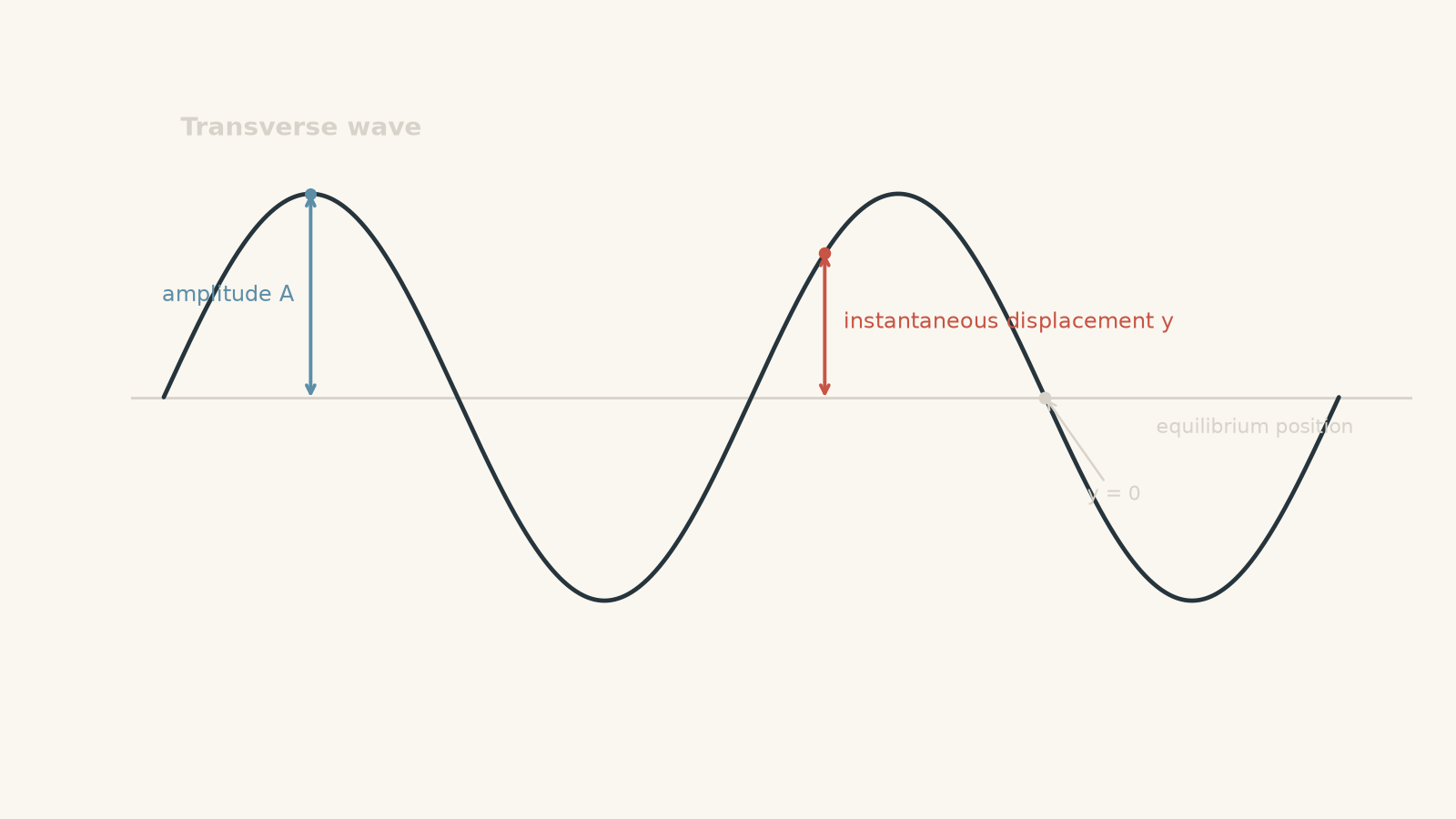
The middle line gives us our reference. The point’s position relative to that line gives us its displacement.
02Equilibrium is the reference position
The equilibrium position is the position a particle in the medium would occupy when it is not displaced by the wave.
For our stretched rope, equilibrium is the straight position of the rope before the disturbance arrives.
We normally assign this position a displacement of zero:
\[
y = 0
\]
Here, \(y\) is the displacement of the particle from equilibrium, measured in metres (m).
The equilibrium position is important because displacement is not usually measured from the floor, the desk, or some other arbitrary point. It is measured from the particle’s own undisturbed position.
Suppose a rope is hanging 1.2 m above the floor. If a point on the rope is momentarily 3 cm above its equilibrium position, its displacement is \(+0.03\) m. Its displacement is not 1.23 m.
The floor is irrelevant to the wave motion.
Equilibrium does not mean “stopped”
A common mistake is to think that when a particle reaches equilibrium, it must stop there.
For an oscillating particle, the opposite is often true.
Think about a playground swing. At the two extreme positions, the swing pauses briefly before reversing direction. As it passes through the middle, it is moving fastest.
For a particle undergoing simple harmonic motion, the same pattern occurs:
| Position | Displacement magnitude | Typical speed |
|---|---|---|
| At equilibrium | Zero | Maximum |
| Between equilibrium and an extreme | Between zero and maximum | Between zero and maximum |
| At an extreme | Maximum | Zero |
The table describes ideal simple harmonic motion. Not every possible wave motion has exactly this velocity pattern, but it is the model used for sinusoidal waves in HSC Physics.
03Instantaneous displacement tells you where the particle is now
The instantaneous displacement is the particle’s displacement from equilibrium at one particular instant.
If upward is chosen as positive, then:
- a point 2 cm above equilibrium has displacement \(+2\) cm
- a point 2 cm below equilibrium has displacement \(-2\) cm
- a point exactly at equilibrium has displacement \(0\)
The sign matters because displacement has direction.
The word instantaneous matters too. The value can change continuously as the particle oscillates.
Imagine checking someone’s location during a very repetitive date where they walk exactly 5 m either side of a table. Their current distance and direction from the table might be \(+3\) m right now, even though they are capable of reaching \(+5\) m. The first number is their current displacement. The second tells you the largest displacement their strange date permits.
The analogy breaks because wave particles do not deliberately walk backwards and forwards, and wave motion can involve much smaller distances. But it separates the two ideas nicely: current position is not the same thing as maximum possible displacement.
04Maximum displacement is the amplitude
Now suppose our point on the rope moves between \(+4\) cm and \(-4\) cm.
Its greatest possible displacement from equilibrium has a magnitude of 4 cm.
That value is the amplitude, \(A\).
\[
A = \text{maximum magnitude of displacement from equilibrium}
\]
More precisely, if the particle’s displacement is represented by \(y\),
\[
A = \max |y|
\]
The absolute value symbols mean that we care about the size of the displacement, not its positive or negative direction.
So if a particle reaches:
\[
y_{\max}=+0.040\text{ m}
\]
and
\[
y_{\min}=-0.040\text{ m},
\]
then its amplitude is
\[
A=0.040\text{ m}.
\]
Amplitude is normally given as a positive quantity.
Don’t measure amplitude from crest to trough
This mistake is extremely tempting because the full height of a wave is visually obvious.
If a wave extends 6 cm above equilibrium and 6 cm below equilibrium, the crest-to-trough distance is 12 cm.
But the amplitude is only:
\[
A=6\text{ cm}.
\]
The crest-to-trough distance is \(2A\).
A useful decision rule is:
Amplitude is measured from equilibrium to an extreme, not from one extreme to the other.
05The three quantities side by side
| Quantity | Meaning | Can change with time for one particle? | Can be negative? |
|---|---|---|---|
| Equilibrium position | Reference position when undisturbed | No, in the basic model | Not treated as a displacement |
| Instantaneous displacement \(y\) | Current displacement from equilibrium | Yes | Yes |
| Maximum displacement, or amplitude \(A\) | Largest magnitude of displacement | Usually fixed for an ideal constant-amplitude wave | No |
For a particle in a sinusoidal wave,
\[
-A \leq y \leq A.
\]
So if \(A=5.0\) cm, an instantaneous displacement of \(+3.0\) cm is possible. So is \(-4.7\) cm.
An instantaneous displacement of \(+6.0\) cm is not possible unless the amplitude changes.
06Worked example: Reading displacement and amplitude
A point on a vibrating string moves between 3.5 cm above its equilibrium position and 3.5 cm below it. At one particular instant, the point is 1.2 cm below equilibrium. Determine its instantaneous displacement and its maximum displacement.
Step 1
Take upward as positive. Downward displacement is therefore negative.
Step 2
The point is 1.2 cm below equilibrium, so
\[
y=-1.2\text{ cm}.
\]
Step 3
The point reaches 3.5 cm on either side of equilibrium, so
\[
A=3.5\text{ cm}.
\]
The maximum displacement is therefore 3.5 cm.
Step 4
The value \(-1.2\) cm describes where the point is at that instant. The value 3.5 cm describes the largest displacement the point reaches during its oscillation.
Notice that the amplitude is not \(-3.5\) cm when the point reaches the lower extreme. Amplitude is the magnitude of maximum displacement, so it remains positive.
07Describing displacement mathematically
For a sinusoidal wave, displacement varies smoothly between \(+A\) and \(-A\).
One possible mathematical description is
\[
y(x,t)=A\sin(kx-\omega t),
\]
where:
- \(y(x,t)\) is the instantaneous displacement in metres
- \(A\) is the amplitude in metres
- \(x\) is position along the direction the wave travels, in metres
- \(t\) is time in seconds
- \(k\) is the wave number in radians per metre
- \(\omega\) is the angular frequency in radians per second
You do not need the sine function to define displacement or amplitude. The equation simply makes the earlier picture precise.
Since the sine function can only have values between \(-1\) and \(+1\),
\[
-1\leq\sin(kx-\omega t)\leq1.
\]
Multiplying by \(A\) gives
\[
-A\leq y\leq A.
\]
That is why \(A\) is the maximum magnitude of the displacement.
Worked example: Finding an instantaneous displacement
A transverse wave is described by
\[
y(x,t)=0.030\sin(4\pi x-10\pi t),
\]
where \(x\) and \(y\) are measured in metres and \(t\) is measured in seconds. Find the amplitude and the instantaneous displacement at \(x=0.125\) m and \(t=0.050\) s.
Step 1
Compare the equation with
\[
y=A\sin(kx-\omega t).
\]
The coefficient in front of the sine function is the amplitude:
\[
A=0.030\text{ m}.
\]
So the maximum displacement is 0.030 m, or 3.0 cm.
Step 2
\[
4\pi x-10\pi t
=4\pi(0.125)-10\pi(0.050)
\]
\[
=0.5\pi-0.5\pi
=0.
\]
Step 3
\[
y=0.030\sin(0)=0.
\]
Therefore,
\[
y=0\text{ m}.
\]
Step 4
At that particular place and time, the particle is passing through its equilibrium position. The wave’s amplitude is still 0.030 m.
A zero instantaneous displacement does not mean that the wave has zero amplitude.
08A wave moves through the medium, but the particles do not travel with it
This distinction becomes especially useful when looking at a snapshot of a transverse wave.
The wave shape might appear to travel to the right. Individual particles of the string, however, move mostly up and down.
So when a point on the graph is 2 cm above equilibrium, the graph is telling you the displacement of a particle at that position. It is not saying that the particle has travelled horizontally with the crest.
For a transverse wave:
- wave propagation and particle displacement are perpendicular
For a longitudinal wave:
- wave propagation and particle displacement are parallel
The ideas of equilibrium, instantaneous displacement, and maximum displacement still apply in both cases.
A longitudinal wave is harder to sketch because the particles move backwards and forwards along the same direction that the wave travels. A displacement-position graph can still show positive and negative particle displacements, even though the physical medium does not literally form a wavy up-and-down shape.
09The most important misconception: zero displacement does not mean no wave
Consider a snapshot of a sinusoidal wave. Several points may lie exactly on the equilibrium line.
It is tempting to say, “There is no disturbance at those points.”
But displacement gives only one piece of information.
A particle at equilibrium can be moving through equilibrium. One moment later, its displacement will no longer be zero.
In a sinusoidal travelling wave, a zero-displacement point can therefore be part of a perfectly ordinary wave with non-zero amplitude and energy.
This also explains why you cannot determine amplitude from one instantaneous displacement measurement unless that measurement happens to be taken at an extreme.
Suppose you measure
\[
y=2.0\text{ cm}.
\]
Can you conclude that \(A=2.0\) cm?
No. You only know that
\[
A\geq2.0\text{ cm}.
\]
The particle might later reach 3 cm, 5 cm, or some other larger magnitude.
10Questions and solutions
Question 1
A point on a string has an equilibrium position of \(y=0\). At one instant it is 2.4 cm above equilibrium. The wave has an amplitude of 5.0 cm.
State the point’s instantaneous displacement and maximum displacement.
Solution 1
The instantaneous displacement is \(+2.4\) cm, and the maximum displacement is \(5.0\) cm.
Taking upward as positive, the particle’s current position gives
\[
y=+2.4\text{ cm}.
\]
The amplitude gives the maximum magnitude of its displacement:
\[
A=5.0\text{ cm}.
\]
The particle is therefore partway between equilibrium and its positive extreme. Its current displacement does not need to equal the amplitude.
Question 2
A particle in a sinusoidal wave moves between \(y=+8.0\) mm and \(y=-8.0\) mm.
A student says, “The amplitude is 16 mm because the particle moves through a total vertical range of 16 mm.”
Is the student correct? Determine the amplitude and explain the mistake.
Solution 2
No. The amplitude is \(8.0\) mm.
Amplitude is measured from equilibrium to one extreme:
\[
A=8.0\text{ mm}.
\]
The distance between the two extreme positions is
\[
(+8.0)-(-8.0)=16.0\text{ mm},
\]
which is equal to \(2A\).
The student has confused the full extreme-to-extreme range with maximum displacement from equilibrium.
Question 3
A wave is described by
\[
y(x,t)=0.020\sin(5\pi x-4\pi t),
\]
where displacement \(y\) and position \(x\) are in metres and time \(t\) is in seconds.
Determine:
- the maximum displacement
- the instantaneous displacement at \(x=0.10\) m and \(t=0\)
- whether the particle is at equilibrium at that instant
Solution 3
The maximum displacement is \(0.020\) m, the instantaneous displacement is \(0.020\) m, and the particle is not at equilibrium.
The amplitude is the coefficient of the sine function:
\[
A=0.020\text{ m}.
\]
At \(x=0.10\) m and \(t=0\),
\[
y=0.020\sin(5\pi(0.10)-4\pi(0))
\]
\[
=0.020\sin\left(\frac{\pi}{2}\right)
=0.020(1)
=0.020\text{ m}.
\]
The equilibrium position corresponds to \(y=0\). Since
\[
y=+0.020\text{ m},
\]
the particle is at its positive extreme instead.
The result also equals \(+A\), confirming that this is a maximum positive displacement.
Question 4
At a particular instant, two points on the same sinusoidal wave have displacements
\[
y_P=0
\]
and
\[
y_Q=+3.0\text{ cm}.
\]
A student argues that point \(Q\) must have the larger amplitude because its displacement is larger at that instant.
The wave has constant amplitude along this section of the medium. Evaluate the student’s reasoning.
Solution 4
The student’s reasoning is incorrect. Both points have the same amplitude because the problem states that the wave has constant amplitude along that section.
Instantaneous displacement tells us each particle’s position at one particular instant. It does not generally tell us its maximum displacement.
Point \(P\) happens to be at equilibrium:
\[
y_P=0.
\]
Point \(Q\) happens to be above equilibrium:
\[
y_Q=+3.0\text{ cm}.
\]
Those values describe their current positions, not separate wave amplitudes.
In fact, point \(P\) may later reach exactly the same positive and negative extremes as point \(Q\). The tempting mistake is to treat a snapshot of displacement as though it showed each particle’s full range of motion.
Question 5
A sensor records the displacement of one point on a string. During the first 0.20 s of recording, the largest measured displacement magnitude is 4.0 mm.
A student concludes that the wave amplitude must be 4.0 mm.
Is that conclusion justified from the information given?
Solution 5
No. The data only establish that the amplitude is at least 4.0 mm.
The sensor has observed
\[
|y|_{\max,\text{ observed}}=4.0\text{ mm}.
\]
But amplitude is the actual maximum magnitude of displacement over the oscillation:
\[
A=\max|y|.
\]
Unless the 0.20 s interval is known to include an extreme position, the particle might later reach a displacement larger than 4.0 mm.
Therefore,
\[
A\geq4.0\text{ mm}.
\]
If the recording covered at least a complete oscillation of a steady sinusoidal wave, then the largest measured magnitude should reveal the amplitude. Without that extra information, equating the largest observed so far displacement with the true maximum displacement is an unsupported assumption.
Question 6
A point on a string is instantaneously at \(y=0\). Another point on the same string is instantaneously at \(y=A\), where \(A\) is the wave amplitude.
A student claims that the point at \(y=A\) is “more affected by the wave” because its displacement is greater.
For a sinusoidal wave, explain why instantaneous displacement alone cannot support that conclusion. Include what can be said about the motion of each particle at that instant.
Solution 6
Instantaneous displacement alone cannot measure how strongly a particle is participating in the wave. Both particles can belong to the same wave and have the same amplitude even though their instantaneous displacements are different.
For the first particle,
\[
y=0.
\]
It is at equilibrium. In ideal sinusoidal motion, its speed has maximum magnitude as it passes through this position.
For the second particle,
\[
y=A.
\]
It is at a maximum positive displacement. At that instant, its velocity is zero because it is about to reverse direction.
So the particle with zero displacement may actually be moving faster than the particle at maximum displacement.
The student’s mistake is treating displacement as a complete description of the particle’s motion. It is only its position relative to equilibrium at one instant. To describe the motion more fully, we also need quantities such as velocity, frequency, phase, and eventually energy.
That is the useful next step: once equilibrium and displacement are clear, phase tells us where different particles are within their oscillations, while period and frequency tell us how quickly those oscillations repeat.