
Wave Reflection: Direction, Boundaries and Phase in HSC Physics
Learn how waves reflect at boundaries, how to determine reflected direction, and why fixed and free boundaries produce different phase behaviour.
Flick a taut rope upward so a single hump travels towards a wall. If the rope is tied firmly to the wall, the hump comes back as a dip. Put the end through a light ring that can slide vertically, and the hump can come back upright.
Same rope. Same incoming pulse. Different boundary.
Reflection therefore has two separate questions to answer: where does the reflected wave go, and what happens to its phase when it reflects? Mixing those questions together causes most reflection mistakes.
01Reflected direction: measure from the normal
Imagine a straight water wave approaching the side of a tank. Before it hits, predict the reflected direction.
You might picture the wave “bouncing off” the wall like a ball. That picture is useful, with one important condition: the angles are measured from a line perpendicular to the boundary, not from the boundary itself.
That perpendicular line is called the normal.
The angle of incidence, \(i\), is the angle between the incident direction and the normal. The angle of reflection, \(r\), is the angle between the reflected direction and the normal.
For reflection from a flat, stationary boundary,
\[
i=r
\]
This is the law of reflection.
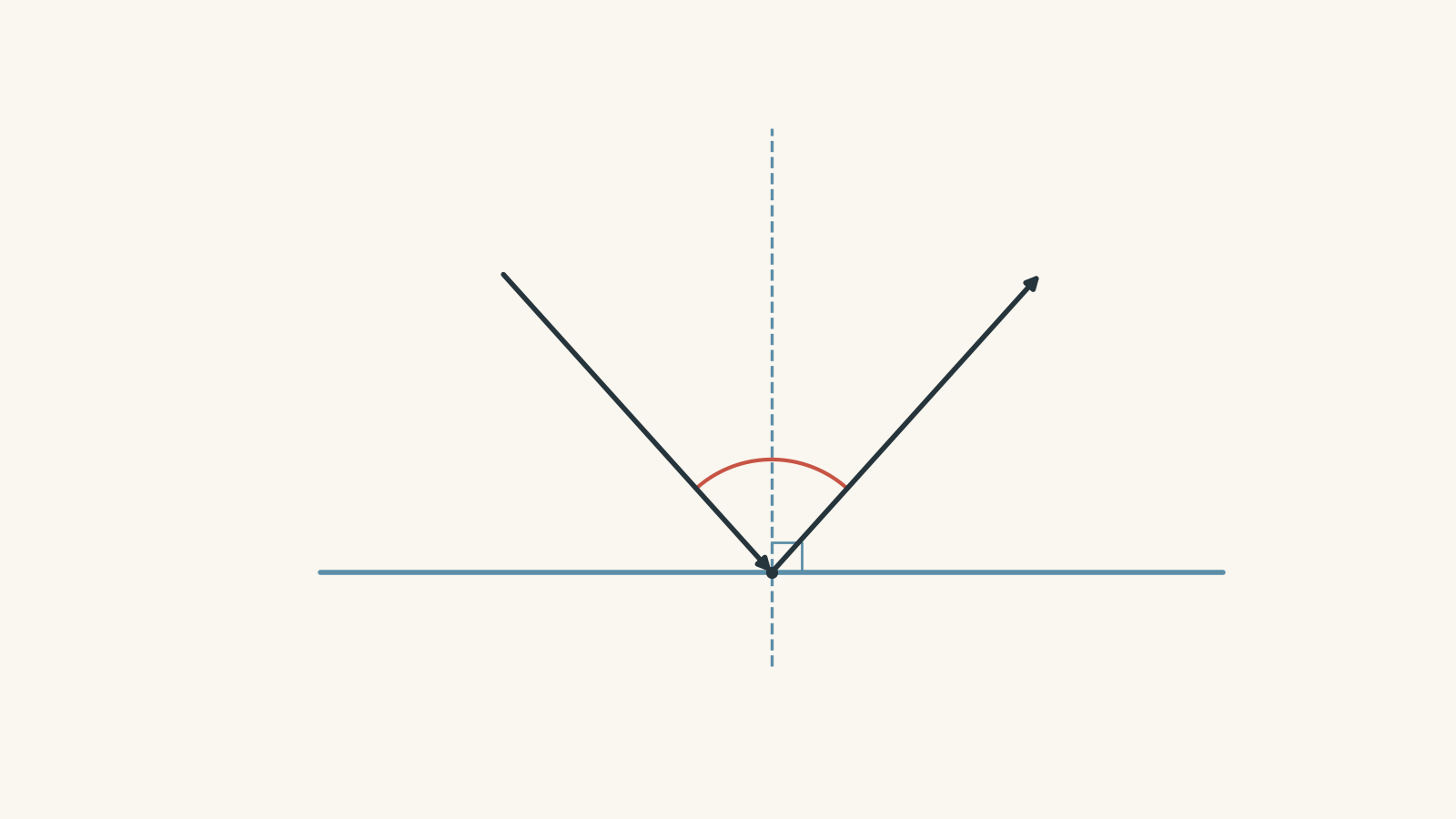
A common HSC trap is to give the angle to the surface instead.
If a wave approaches at \(20^\circ\) to the boundary, is its angle of incidence \(20^\circ\)?
No. The boundary and normal are at \(90^\circ\), so
\[
i=90^\circ-20^\circ=70^\circ
\]
The reflected ray is therefore also \(70^\circ\) to the normal, or \(20^\circ\) to the boundary.
Rays and wavefronts are not the same thing
A ray shows the direction in which the wave travels.
A wavefront joins points at the same phase, such as a line through several crests. The direction of travel is perpendicular to the wavefront.
So if a diagram gives you wavefronts rather than arrows, don’t immediately measure their angle and call it the angle of incidence. First imagine, or draw, a ray perpendicular to the wavefront.
Worked example: Which way does the reflected wave travel?
A straight water-wave ray approaches a wall at \(34^\circ\) to the wall. Determine the angle of incidence and the angle the reflected ray makes with the wall.
Step 1
The normal is perpendicular to the wall, so
\[
i=90^\circ-34^\circ=56^\circ
\]
Step 2
\[
r=i=56^\circ
\]
Step 3
\[
90^\circ-56^\circ=34^\circ
\]
The reflected wave travels at \(56^\circ\) to the normal, which is \(34^\circ\) to the wall.
The important idea is the symmetry. The incoming and reflected rays are mirror images about the normal.
02Why a fixed end flips a wave pulse
Direction is only half the story. A reflected wave can also change its orientation, or more formally, its phase.
Picture an upward pulse moving along a string towards an end that is tied firmly to a wall.
Before reading on, predict what the returning pulse looks like. Does it return upward or downward?
It returns downward.
The reason comes from the rule imposed by the boundary. At a fixed end, the attachment point cannot move. Its displacement must remain
\[
y=0
\]
at every instant.
Suppose an upward incident pulse reaches the wall. On its own, that pulse would try to pull the endpoint upward. That isn’t allowed. The reflected disturbance must therefore provide an opposite displacement so that the incident and reflected waves combine to keep the endpoint at zero.
The result is an inverted reflected pulse.
A crest returns as a trough, and a trough returns as a crest.
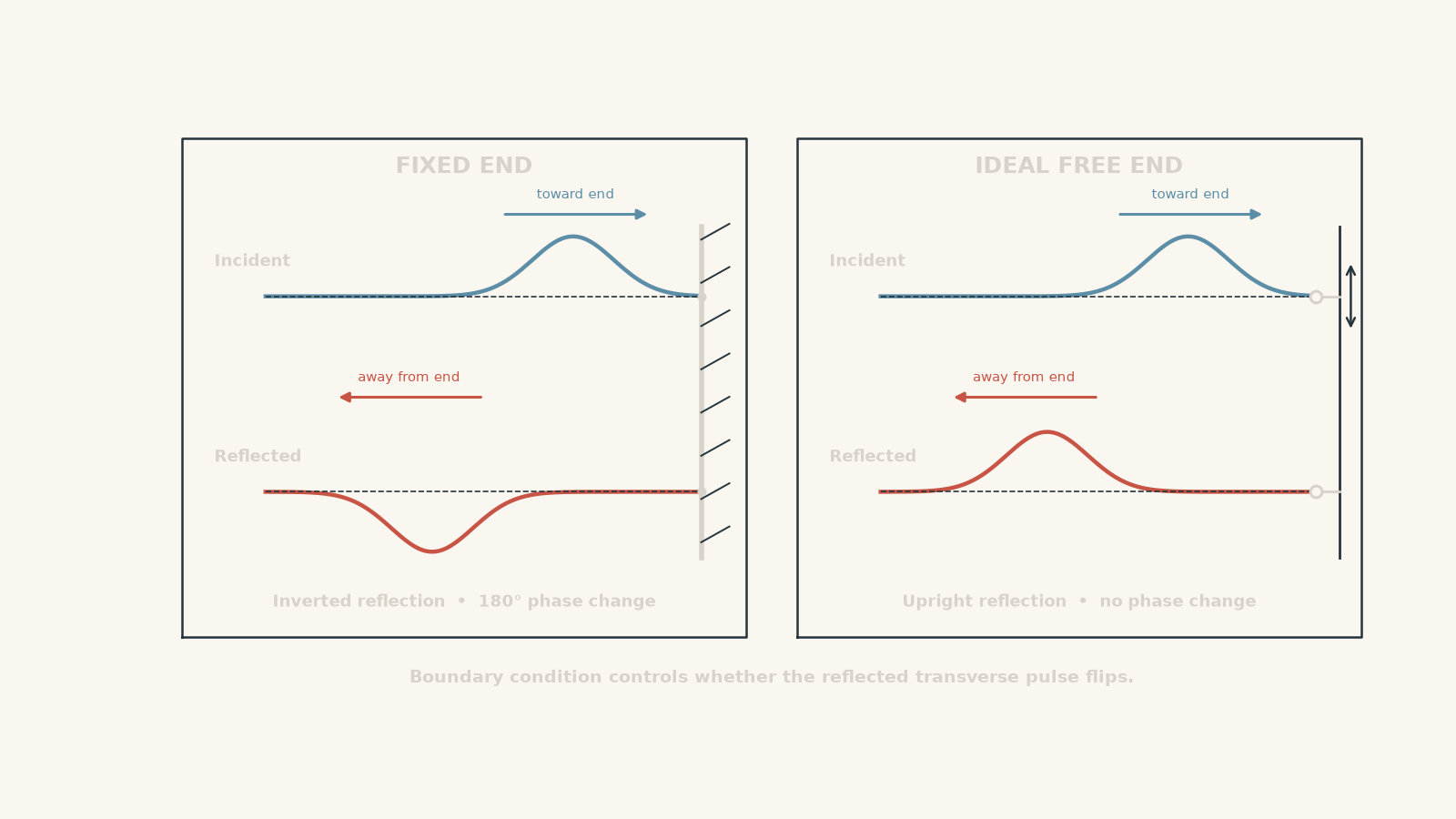
This cancellation at the endpoint is an application of superposition. The incident and reflected waves overlap, and their displacements add.
03A free end behaves differently
Now replace the fixed attachment with a very light ring that can slide vertically along a smooth pole.
The string is still under tension, but its endpoint is free to move up and down. An upward pulse reaches the end.
What should happen now?
The reflected pulse returns upward. It is not inverted.
The simple mental model is:
- fixed end: the endpoint is forbidden from moving, so the reflected displacement must invert
- free end: the endpoint can move, so the pulse does not need to invert
There is a more precise condition underneath this. At an ideal free end, the transverse force on the endpoint must be zero. For a string, that means the string has zero slope right at the end. The non-inverted reflected wave satisfies that condition.
So “fixed” and “free” are not just labels to memorise. Each boundary imposes a different physical rule.
Worked example: When does the reflected pulse return?
An upward pulse passes point \(P\), which is \(0.72\ \text{m}\) from a fixed end of a string. The pulse travels at \(3.6\ \text{m s}^{-1}\). Determine when the reflected pulse next reaches \(P\), and state whether it is upward or downward.
Step 1
The pulse must travel from \(P\) to the boundary and then back to \(P\).
\[
d=2(0.72\ \text{m})=1.44\ \text{m}
\]
Step 2
\[
t=\frac{d}{v}
\]
Substituting,
\[
t=\frac{1.44\ \text{m}}{3.6\ \text{m s}^{-1}}
=0.40\ \text{s}
\]
Step 3
The original pulse was upward. Reflection from a fixed end inverts the pulse, so it returns downward.
The reflected pulse reaches \(P\) after \(0.40\ \text{s}\) as a downward pulse.
Notice that two different ideas were needed. The travel time came from the wave speed. The orientation came from the boundary condition.
04Phase change: what does \(180^\circ\) actually mean?
For a repeating sinusoidal wave, phase tells you where a point is within its oscillation cycle.
A crest and the next trough are half a cycle apart. Half a full \(360^\circ\) cycle is
\[
180^\circ=\pi\ \text{rad}
\]
So an inverted reflected sinusoidal wave has undergone a phase change of
\[
\Delta\phi=180^\circ=\pi\ \text{rad}
\]
at the boundary.
For transverse displacement on an ideal string:
| Boundary | Reflected displacement | Phase change caused by reflection |
|---|---|---|
| Fixed end | Inverted | \(180^\circ\) or \(\pi\ \text{rad}\) |
| Free end | Not inverted | \(0^\circ\) |
For a single isolated pulse, “inverted” is the clearest description because a single pulse does not have a repeating cycle. Calling it a \(180^\circ\) phase reversal is useful shorthand for connecting the pulse behaviour to sinusoidal waves.
05Changing direction does not automatically mean changing phase
This is probably the most tempting misconception.
A student sees a wave turn around and thinks, “It reversed direction, so it must also have reversed phase.”
Those are different changes.
A reflected wave always changes its direction of propagation. A wave travelling towards a wall comes back away from the wall.
But that tells you nothing by itself about whether a crest returns as a crest or as a trough.
At a free end, for example, the wave reverses its direction of travel without a \(180^\circ\) phase reversal.
Keep these ideas separate:
- direction of travel tells you where the wave is going
- phase tells you the state of the oscillation
A person can walk back towards you without suddenly turning upside down. Waves get the same privilege.
06What stays the same when a wave reflects?
Suppose a sinusoidal wave reflects from a stationary wall and remains in the same medium.
Its frequency does not change. The boundary is being driven by the incoming oscillation at the same frequency, so the reflected wave has that frequency too.
Its wave speed also remains the same because it is travelling back through the same medium.
Using
\[
v=f\lambda
\]
where \(v\) is wave speed in metres per second, \(f\) is frequency in hertz, and \(\lambda\) is wavelength in metres, the reflected wavelength must therefore also be unchanged.
So for reflection back into the same medium:
- \(f\) stays the same
- \(v\) stays the same
- \(\lambda\) stays the same
- direction changes
- phase may or may not reverse, depending on the boundary
Amplitude needs more care. At an ideal perfectly reflecting boundary, the reflected amplitude can equal the incident amplitude. Real boundaries usually transfer or absorb some energy, so the reflected amplitude may be smaller.
An inverted wave does not have “negative energy”. The minus sign describes displacement or phase, not the amount of energy carried.
07Real boundaries can reflect and transmit at the same time
A fixed end and a free end are useful ideal cases. Many real boundaries sit between those extremes.
Imagine joining a light string to a much heavier string. When a pulse reaches the join, it usually does two things:
- part of the disturbance reflects back along the first string
- part continues into the second string as a transmitted wave
The boundary therefore does not have to choose between “reflection” and “transmission”. Both can happen.
For two strings under the same tension, a heavier string has a greater wave impedance, meaning it resists the wave motion more strongly.
A pulse travelling from the lighter string towards the heavier string sees a more fixed-like boundary. The reflected displacement is inverted.
A pulse travelling from the heavier string towards the lighter string sees a more free-like boundary. The reflected displacement is not inverted.
This gives a useful pattern:
| Incident wave meets… | Reflected displacement on the original string |
|---|---|
| Ideal fixed end | Inverted |
| Higher-impedance string | Inverted |
| Ideal free end | Not inverted |
| Lower-impedance string | Not inverted |
Be careful with the common phrase “reflection from a denser medium causes inversion”. It can work as a shortcut for two strings under comparable conditions, but density alone is not the general rule. The deeper idea is how the boundary responds to the wave.
If the two joined media happen to have matching wave properties, there may be essentially no reflected wave at all. In that case, asking for the phase of the reflected wave is meaningless because there is no reflected wave to track.
08Reflection phase and total phase difference are not the same thing
Suppose a sinusoidal wave reflects from a fixed end. The reflection itself contributes a \(180^\circ\) phase reversal.
Does that mean the incident and reflected waves are \(180^\circ\) out of phase everywhere along the string?
No.
The reflected wave has also travelled to the boundary and back. That extra distance produces an additional phase difference.
This becomes important when incident and reflected waves overlap to make a standing wave.
At the fixed endpoint, the two displacement waves must cancel, producing a node.
Move one quarter of a wavelength away from the fixed end. The reflected wave’s extra round-trip distance is
\[
2\left(\frac{\lambda}{4}\right)=\frac{\lambda}{2}
\]
Half a wavelength corresponds to another \(180^\circ\) of phase.
The total difference there is therefore
\[
180^\circ+180^\circ=360^\circ
\]
which is equivalent to \(0^\circ\).
So one quarter wavelength from a fixed end, the incident and reflected displacement waves are in phase and reinforce each other.
This is why memorising only “fixed end means \(180^\circ\)” isn’t enough. That \(180^\circ\) is the phase change at the reflection itself, not necessarily the phase difference between the two waves at every position.
09One final precision: phase depends on what is oscillating
The fixed-end rule above describes transverse displacement on a string.
For sound waves, you can describe the oscillation using either the displacement of air particles or the variation in air pressure. Those quantities do not behave identically at a boundary.
At a rigid closed wall, air particles cannot oscillate backwards and forwards through the wall. Their motion is fixed-like, so the reflected particle displacement reverses phase.
But the reflected pressure variation does not reverse phase there. Incident and reflected pressure variations reinforce at the rigid wall, producing a pressure antinode.
So the sentence “reflection from a rigid wall always gives a \(180^\circ\) phase change” is too vague.
Always ask: phase change of which physical quantity?
That small question becomes very useful when you study standing sound waves in pipes.
10A reliable way to handle reflection questions
When a reflection problem appears, work through it in this order:
- Identify what is being represented. Is it a ray, a wavefront, a pulse, displacement, or pressure?
- For direction, draw the normal. Measure incidence and reflection angles from it.
- For phase, identify the boundary condition. Is the displacement fixed, free, or meeting another medium?
- Keep direction reversal separate from phase reversal.
- If two waves are being compared away from the boundary, include the phase caused by their different travel distances as well as any phase shift at reflection.
That sequence prevents several different ideas from being compressed into one unreliable rule.
11Questions and solutions
Question 1
A water-wave ray approaches a straight barrier at \(18^\circ\) to the barrier. Determine its angle of incidence and the angle of reflection.
Solution 1
The angle of incidence is \(72^\circ\), and the angle of reflection is also \(72^\circ\).
Angles of incidence and reflection are measured from the normal, not from the barrier.
The normal is at \(90^\circ\) to the barrier, so
\[
i=90^\circ-18^\circ=72^\circ
\]
The law of reflection gives
\[
r=i=72^\circ
\]
Therefore,
\[
\boxed{i=r=72^\circ}
\]
The trap is using the given \(18^\circ\) directly as the angle of incidence.
Question 2
An upward pulse travels along a string towards an ideal free end. Describe the reflected pulse’s direction of travel, orientation, and phase change due to reflection.
How would each answer change if the end were fixed instead?
Solution 2
At a free end, the pulse travels back along the string without inversion, so the reflection adds no phase reversal. At a fixed end, it travels back inverted, corresponding to a \(180^\circ\) phase reversal.
For the free end:
- the direction of propagation reverses
- the upward pulse remains upward
- the phase change due to reflection is \(0^\circ\)
For the fixed end:
- the direction of propagation also reverses
- the upward pulse becomes downward
- the phase change due to reflection is \(180^\circ\), or \(\pi\ \text{rad}\)
The key misconception is assuming that reversal of direction automatically means reversal of phase. Both boundaries reverse the direction, but only the fixed boundary inverts the string displacement.
Question 3
A periodic water wave has frequency \(5.0\ \text{Hz}\) and wavelength \(0.24\ \text{m}\). It strikes a stationary straight barrier at \(38^\circ\) to the normal and reflects back through the same water.
Determine:
- the wave speed before reflection
- the frequency of the reflected wave
- the wavelength of the reflected wave
- the reflected angle measured from the normal
Solution 3
The wave speed is \(1.2\ \text{m s}^{-1}\), the reflected frequency is \(5.0\ \text{Hz}\), the reflected wavelength is \(0.24\ \text{m}\), and the reflected angle is \(38^\circ\).
The wave speed is
\[
v=f\lambda
\]
Substituting,
\[
v=(5.0\ \text{Hz})(0.24\ \text{m})
=1.2\ \text{m s}^{-1}
\]
The reflected wave remains in the same water, so its speed does not change. Reflection from a stationary boundary also does not change its frequency:
\[
f_{\text{reflected}}=5.0\ \text{Hz}
\]
Using \(v=f\lambda\),
\[
\lambda_{\text{reflected}}
=\frac{v}{f}
=\frac{1.2\ \text{m s}^{-1}}{5.0\ \text{s}^{-1}}
=0.24\ \text{m}
\]
Finally, the law of reflection gives
\[
r=i=38^\circ
\]
So the wave’s direction changes, while its frequency, speed, and wavelength remain unchanged because it returns through the same medium.
Question 4
A pulse travelling along a light string reaches a join with a much heavier string under the same tension. Part of the pulse is transmitted into the heavier string and part is reflected.
A student argues that because the reflected pulse is inverted, all of the incident energy must have been reflected.
Explain whether the student is correct.
Solution 4
The student is incorrect. Inversion tells us the phase or sign of the reflected displacement, not what fraction of the energy was reflected.
The heavier string presents a more fixed-like boundary to the incident pulse, so the reflected displacement is inverted.
However, the join is not an ideal fixed wall. The second string can move, so some of the wave energy can continue into it as a transmitted wave.
Therefore the incident energy is divided between reflected and transmitted waves, apart from any small losses in a real system.
The misconception is treating “inverted” as if it meant “completely reflected”. Phase behaviour and energy transfer are separate properties.
Question 5
A continuous sinusoidal wave reflects from an ideal fixed end of a string. Point \(P\) is located \(\lambda/4\) from the fixed end.
A student says, “The incident and reflected waves must be \(180^\circ\) out of phase at \(P\), because reflection from a fixed end causes a \(180^\circ\) phase shift.”
Is the student correct? Explain.
Solution 5
No. At point \(P\), the incident and reflected displacement waves are in phase in the ideal case.
The fixed-end reflection itself contributes a phase change of
\[
180^\circ
\]
But the reflected wave also travels from \(P\) to the boundary and back. The extra distance is
\[
2\left(\frac{\lambda}{4}\right)=\frac{\lambda}{2}
\]
A path difference of half a wavelength contributes another
\[
180^\circ
\]
Therefore the total phase difference at \(P\) is
\[
180^\circ+180^\circ=360^\circ
\]
Since \(360^\circ\) is equivalent to \(0^\circ\), the two waves are in phase at \(P\).
With equal incident and reflected amplitudes, they reinforce there, producing a displacement antinode.
The trap is treating the phase change at the boundary as though it were the complete phase difference at every point on the string.
Question 6
A steady sound wave reflects from a rigid wall. A student writes:
The wall is fixed, so the reflected sound wave must be \(180^\circ\) out of phase with the incident sound wave.
A microphone beside the wall is being used to measure the wave. Explain why the student’s statement is incomplete, and predict the pressure behaviour at the wall.
Solution 6
The statement is incomplete and is incorrect for the pressure variation measured by the microphone. At an ideal rigid wall, the wall is a pressure antinode.
A sound wave can be described using different oscillating quantities.
At a rigid wall, the air cannot oscillate through the wall. The particle displacement or velocity therefore behaves like the displacement of a string at a fixed end. Its reflected component reverses phase so that the air’s normal motion is zero at the wall.
Pressure behaves differently. The incident and reflected pressure variations reinforce at the rigid boundary rather than cancelling.
The result is a pressure antinode: the pressure variation has maximum amplitude at the wall.
So it is not enough to say that “the sound” has a particular phase reversal. You must identify whether you mean particle displacement, particle velocity, or pressure.
12What reflection explains next
Once reflected phase is clear, standing waves become much less like a collection of diagrams to memorise.
A fixed string end must have zero displacement, so incident and reflected waves cancel there and form a node. An ideal free string end allows maximum displacement and forms an antinode.
For sound, a rigid closed end is a particle-displacement node but a pressure antinode.
Those boundary conditions determine where nodes and antinodes can exist, which in turn determines the wavelengths and resonant frequencies allowed on strings and in pipes. Reflection is the mechanism underneath the standing-wave patterns.