
Wave Diffraction: How Wavelength and Gap Size Control Spreading
Learn why waves spread after passing through a gap, and how the ratio of wavelength to gap width controls the amount of diffraction.
Imagine straight water waves approaching a gap in a barrier. On the far side, will the waves keep travelling almost straight ahead, or will they fan out in many directions?
Before reading on, make a prediction for these two changes:
- Keep the gap the same, but make the wavelength longer.
- Keep the wavelength the same, but make the gap narrower.
In both cases, the waves spread out more. That spreading is diffraction.
The important idea is not simply “waves diffract at gaps”. The amount of diffraction depends on a comparison:
\[
\text{diffraction depends on the ratio } \frac{\lambda}{a}
\]
where \(\lambda\) is the wavelength, measured in metres (m), and \(a\) is the width of the gap, also measured in metres.
A large value of \(\lambda/a\) means strong spreading. A small value means weak spreading.
01Why does a wave spread after passing through a gap?
Picture a set of straight water-wave crests moving towards a barrier.
If the opening is very wide compared with the wavelength, most of the wave continues almost straight ahead. There is some spreading near the edges, but the centre of the wave barely changes direction.
Now make the opening narrower. The wave emerging from the gap becomes increasingly curved.
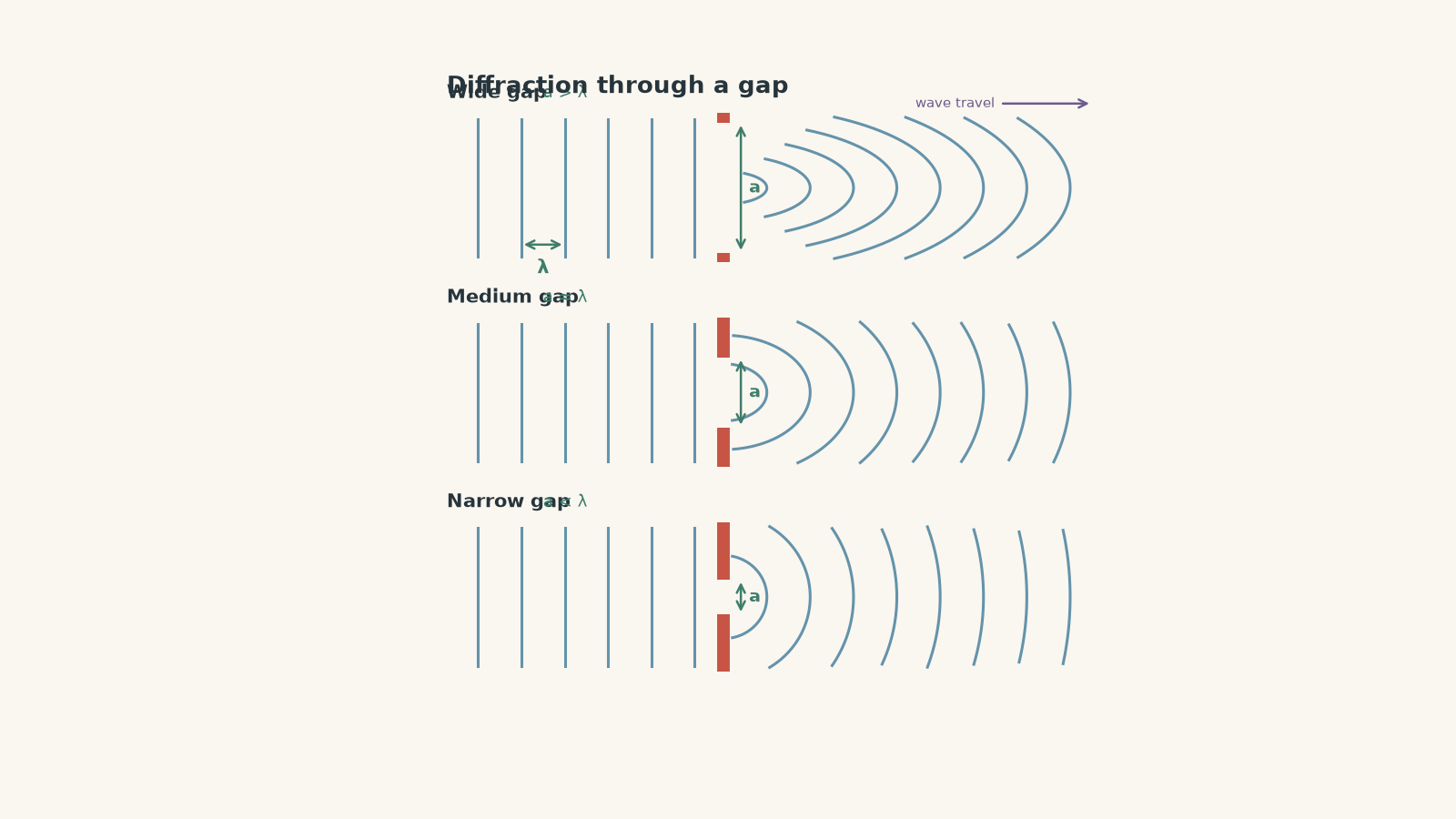
A useful first model is to imagine that every point across the opening becomes a source of small secondary waves. These secondary waves overlap to form the outgoing wave.
When the gap is wide, there are many contributing points spread across a large distance. Their waves reinforce strongly in the forward direction and tend to cancel at larger angles.
When the gap is narrow, the sources are packed into a smaller region. The outgoing wave can remain reinforced across a much wider range of directions.
That is why narrowing the gap increases diffraction.
This explanation is based on the Huygens-Fresnel principle. The simple picture of each point producing little circular waves is useful, but it isn’t the whole mathematical description. The final diffraction pattern comes from interference between all those secondary waves.
02The comparison that matters: wavelength versus gap size
Students often try to remember diffraction with separate rules such as “small gaps cause diffraction” and “long wavelengths cause diffraction”.
A better rule is:
Compare the wavelength with the gap width.
Suppose a gap is 1 metre wide.
A wavelength of \(1\ \text{mm}\) is tiny compared with that gap. There will be very little spreading.
A wavelength of \(0.5\ \text{m}\) is comparable with the gap. There will be substantial spreading.
A wavelength of \(1\ \text{m}\) is the same size as the gap. The spreading is very strong.
So there is no absolute gap size that counts as “small”. A 1 cm gap is enormous to visible light, but tiny compared with some radio wavelengths.
This is one of the most useful habits in wave physics: compare lengths instead of judging one length by itself.
What happens when the gap is much larger than the wavelength?
If
\[
a \gg \lambda
\]
the gap width \(a\) is much greater than the wavelength \(\lambda\).
The outgoing wave mostly continues forwards. Diffraction is weak.
For example, visible light has wavelengths of roughly \(4 \times 10^{-7}\ \text{m}\) to \(7 \times 10^{-7}\ \text{m}\). A doorway about \(1\ \text{m}\) wide is therefore millions of wavelengths across.
That is why light does not visibly fan around an ordinary doorway enough to illuminate everything behind the wall.
What happens when the gap is comparable with the wavelength?
If
\[
a \approx \lambda
\]
the gap and wavelength are similar in size.
The wave spreads strongly after passing through the opening.
This is the regime where diffraction becomes especially obvious.
What happens when the gap is smaller than the wavelength?
If
\[
a < \lambda
\]
the simple idea that the wave should somehow “not fit” is misleading. Waves are not solid objects trying to squeeze through a doorway.
A wave can still pass through an opening smaller than its wavelength, although transmission may become more complicated depending on the physical system. What matters for our diffraction model is that the transmitted wave is extremely spread out.
The “does it fit?” picture is therefore a poor model. A wavelength is a distance between repeating points of a wave, not the physical width of an object.
03Changing wavelength while keeping the gap fixed
Now keep the same gap and compare two waves.
Wave A has wavelength \(2\ \text{cm}\).
Wave B has wavelength \(8\ \text{cm}\).
Which one spreads more?
Wave B does. Its wavelength is larger relative to the gap.
Suppose the gap width is \(20\ \text{cm}\). Then
\[
\frac{\lambda_A}{a}=\frac{2}{20}=0.10
\]
while
\[
\frac{\lambda_B}{a}=\frac{8}{20}=0.40
\]
Wave B has the larger ratio, so it produces greater diffraction.
This is why lower-frequency waves often diffract more strongly than higher-frequency waves travelling at the same speed. From
\[
v=f\lambda
\]
where \(v\) is wave speed in metres per second, \(f\) is frequency in hertz (Hz), and \(\lambda\) is wavelength in metres, we have
\[
\lambda=\frac{v}{f}
\]
If the wave speed stays constant, decreasing frequency increases wavelength. A longer wavelength then gives stronger diffraction through the same opening.
04Putting an angle on the spreading
For a single narrow slit, the outgoing wave does not spread with equal intensity in every direction. It forms a central bright region with weaker regions on either side.
For light, the pattern can be observed on a screen.
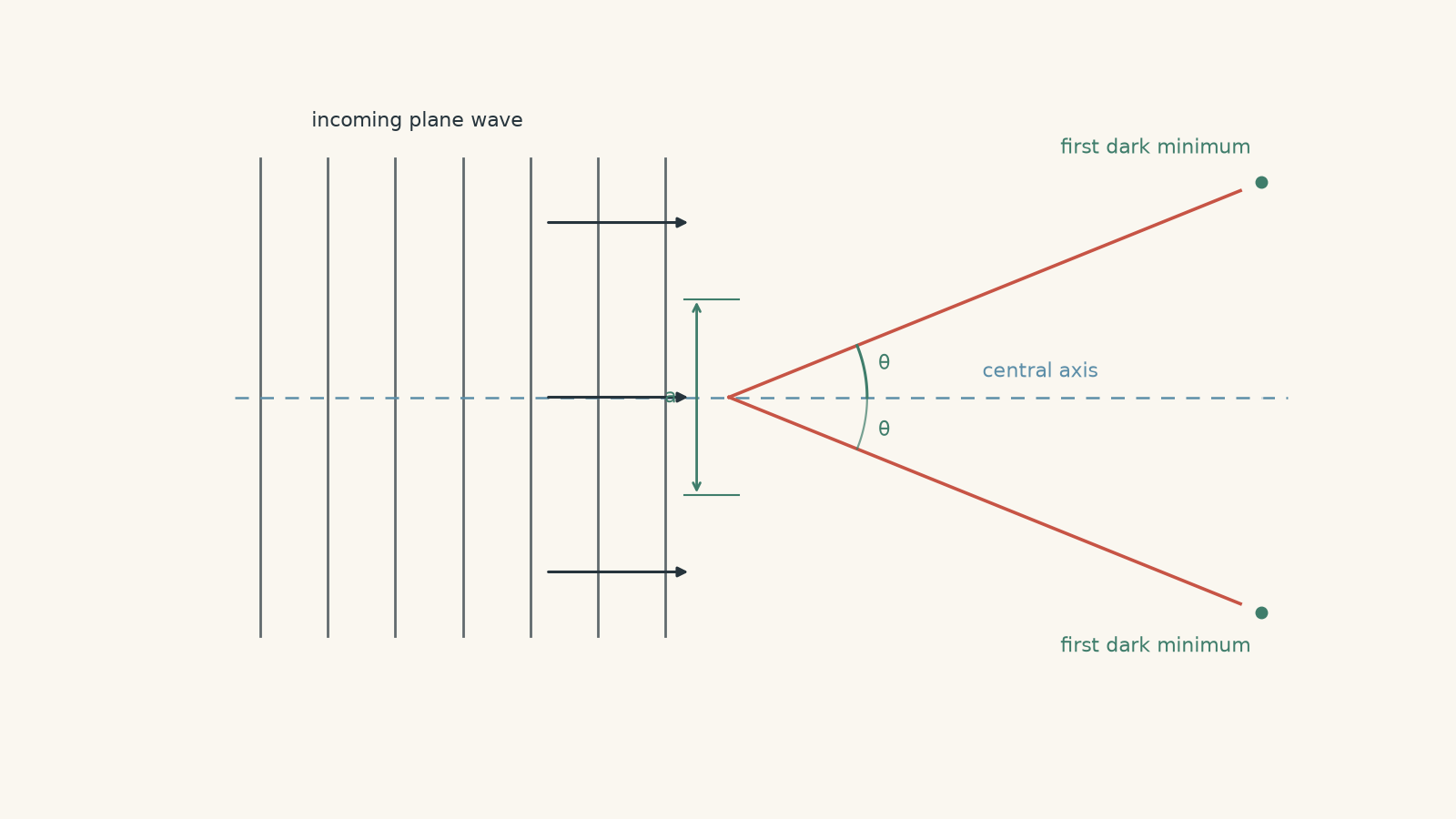
The first dark minimum occurs when
\[
a\sin\theta=\lambda
\]
for the first minimum, where:
- \(a\) is the slit width in metres,
- \(\lambda\) is the wavelength in metres,
- \(\theta\) is the angle from the central axis to the first dark minimum.
Rearranging,
\[
\sin\theta=\frac{\lambda}{a}
\]
Now the qualitative rule becomes mathematical.
If \(\lambda\) increases while \(a\) stays constant, \(\sin\theta\) increases, so \(\theta\) increases. The diffraction pattern spreads out.
If \(a\) decreases while \(\lambda\) stays constant, \(\lambda/a\) increases, so \(\theta\) increases again.
The equation is telling us exactly what our physical model predicted.
Worked example: Find the diffraction angle
Light of wavelength \(600\ \text{nm}\) passes through a slit of width \(3.0\ \mu\text{m}\). Calculate the angle from the centre of the pattern to the first minimum.
Step 1
A nanometre is \(10^{-9}\ \text{m}\), so
\[
\lambda=600\times10^{-9}\ \text{m}
\]
A micrometre is \(10^{-6}\ \text{m}\), so
\[
a=3.0\times10^{-6}\ \text{m}
\]
Step 2
\[
\sin\theta=\frac{\lambda}{a}
\]
Substitute the values:
\[
\sin\theta
=
\frac{600\times10^{-9}}{3.0\times10^{-6}}
=
0.200
\]
Step 3
\[
\theta=\sin^{-1}(0.200)=11.5^\circ
\]
The first minimum is about \(11.5^\circ\) from the central axis.
That means the central bright region extends from approximately \(-11.5^\circ\) to \(+11.5^\circ\), so its angular width is roughly \(23.0^\circ\).
Notice what created this fairly large spread: the wavelength is a significant fraction of the slit width.
05Changing the gap while keeping wavelength fixed
Now suppose the wavelength stays fixed but the slit becomes narrower.
Imagine going on a group date where ten people are trying to leave through a huge restaurant doorway. Everyone can mostly continue in the direction they were already walking.
Now imagine the same crowd leaving through one tiny doorway. Once everyone emerges, their possible directions fan out from almost the same starting location.
That is roughly the geometric intuition behind stronger spreading from a smaller aperture. The people represent different parts of the wavefront, and their outgoing directions represent the range of directions in the diffraction pattern.
The analogy breaks because people do not interfere with one another like waves. The actual diffraction pattern depends on constructive and destructive interference, not on pedestrians choosing directions.
Worked example: How much does narrowing the slit matter?
Monochromatic light has wavelength \(500\ \text{nm}\). It first passes through a slit of width \(10.0\ \mu\text{m}\), then through a second slit of width \(2.00\ \mu\text{m}\). Find the first-minimum angle for each slit and compare the spreading.
Step 1
\[
\lambda=500\times10^{-9}\ \text{m}=5.00\times10^{-7}\ \text{m}
\]
For the wider slit,
\[
a_1=10.0\times10^{-6}\ \text{m}=1.00\times10^{-5}\ \text{m}
\]
For the narrower slit,
\[
a_2=2.00\times10^{-6}\ \text{m}
\]
Step 2
\[
\sin\theta_1
=
\frac{\lambda}{a_1}
=
\frac{5.00\times10^{-7}}{1.00\times10^{-5}}
=
0.0500
\]
Therefore,
\[
\theta_1=\sin^{-1}(0.0500)=2.87^\circ
\]
Step 3
\[
\sin\theta_2
=
\frac{\lambda}{a_2}
=
\frac{5.00\times10^{-7}}{2.00\times10^{-6}}
=
0.250
\]
Therefore,
\[
\theta_2=\sin^{-1}(0.250)=14.5^\circ
\]
Step 4
Reducing the slit width from \(10.0\ \mu\text{m}\) to \(2.00\ \mu\text{m}\) makes the first minimum move from \(2.87^\circ\) to \(14.5^\circ\).
The narrower slit therefore produces a much broader central diffraction maximum.
This is the opposite of what you might expect from ordinary objects. A smaller opening does not produce a narrower beam of waves. Once diffraction becomes significant, a smaller aperture produces more angular spreading.
06The most tempting misconception: a narrow gap makes a narrow beam
Suppose you want light to emerge from a tiny opening. It feels reasonable to predict that the opening will “trim” the light into a very narrow beam.
That prediction works reasonably well when the opening is enormous compared with the wavelength. In that situation, ray diagrams are useful and diffraction is tiny.
But keep shrinking the opening towards the wavelength of the light and the prediction fails.
A narrower slit means a larger value of
\[
\frac{\lambda}{a}
\]
and therefore a larger diffraction angle.
So:
| Change | Effect on \(\lambda/a\) | Diffraction |
|---|---|---|
| Increase wavelength | Increases | More spreading |
| Decrease wavelength | Decreases | Less spreading |
| Increase gap width | Decreases | Less spreading |
| Decrease gap width | Increases | More spreading |
Do not memorise those four rows separately if you can avoid it. Remember the ratio.
07Similar ratios give similar diffraction
There is another useful consequence.
Consider these two situations:
- wavelength \(1.0\ \text{mm}\), gap width \(5.0\ \text{mm}\)
- wavelength \(2.0\ \text{m}\), gap width \(10.0\ \text{m}\)
The physical sizes are completely different, but both have
\[
\frac{\lambda}{a}=0.20
\]
For the first minimum,
\[
\sin\theta=0.20
\]
so both produce the same diffraction angle:
\[
\theta=11.5^\circ
\]
This is why diffraction is best understood through relative size.
The wave does not care whether the apparatus is microscopic or several metres wide. The important question is how large the aperture is compared with the wavelength.
08A limit of the simple first-minimum equation
There is a useful trap hidden inside
\[
\sin\theta=\frac{\lambda}{a}
\]
Suppose \(\lambda=2.0\ \text{cm}\) and \(a=1.0\ \text{cm}\).
Substitution gives
\[
\sin\theta=2
\]
But the sine of a real angle cannot be greater than 1.
So you must not type \(\sin^{-1}(2)\) into a calculator and assume the physics has failed.
Instead, the result tells you that there is no first diffraction minimum satisfying this equation. The wavelength is too large relative to the slit for that minimum to occur at any physical angle between \(0^\circ\) and \(90^\circ\).
This is a good example of why an equation should be interpreted, not just calculated.
09Questions and solutions
Question 1
Water waves of wavelength \(0.40\ \text{m}\) pass through a gap \(2.0\ \text{m}\) wide. The wavelength is then increased to \(0.80\ \text{m}\), while the gap remains unchanged.
Which set of waves diffracts more strongly? Explain using the relevant ratio.
Solution 1
The \(0.80\ \text{m}\) waves diffract more strongly because their wavelength is larger relative to the gap width.
Initially,
\[
\frac{\lambda}{a}
=
\frac{0.40}{2.0}
=
0.20
\]
After the wavelength increases,
\[
\frac{\lambda}{a}
=
\frac{0.80}{2.0}
=
0.40
\]
The ratio has doubled from \(0.20\) to \(0.40\). A larger \(\lambda/a\) ratio means greater angular spreading.
The important point is not simply that the wavelength became “large”. It became larger relative to the unchanged gap.
Question 2
Light of wavelength \(450\ \text{nm}\) passes through a slit of width \(3.00\ \mu\text{m}\).
Calculate the angle from the central axis to the first minimum.
Solution 2
The first minimum occurs at approximately \(8.63^\circ\) from the central axis.
Convert both values to metres:
\[
\lambda=450\times10^{-9}\ \text{m}
\]
and
\[
a=3.00\times10^{-6}\ \text{m}
\]
For the first minimum,
\[
a\sin\theta=\lambda
\]
so
\[
\sin\theta=\frac{\lambda}{a}
\]
Substitute:
\[
\sin\theta
=
\frac{450\times10^{-9}}{3.00\times10^{-6}}
=
0.150
\]
Therefore,
\[
\theta
=
\sin^{-1}(0.150)
=
8.63^\circ
\]
The diffraction pattern therefore has its first dark region \(8.63^\circ\) to either side of the centre.
Question 3
Two single-slit experiments produce exactly the same angle to the first diffraction minimum.
Experiment A uses wavelength \(600\ \text{nm}\) and slit width \(4.0\ \mu\text{m}\).
Experiment B uses wavelength \(450\ \text{nm}\).
Determine the slit width required in Experiment B and explain why changing both quantities can leave the diffraction unchanged.
Solution 3
Experiment B requires a slit width of \(3.0\ \mu\text{m}\), because the ratio \(\lambda/a\) must remain the same.
For the first minimum,
\[
\sin\theta=\frac{\lambda}{a}
\]
The two experiments have the same \(\theta\), so they must have the same value of \(\lambda/a\):
\[
\frac{\lambda_A}{a_A}
=
\frac{\lambda_B}{a_B}
\]
Substitute the known values:
\[
\frac{600\times10^{-9}}{4.0\times10^{-6}}
=
\frac{450\times10^{-9}}{a_B}
\]
The ratio on the left is
\[
\frac{600\times10^{-9}}{4.0\times10^{-6}}
=
0.150
\]
Therefore,
\[
a_B
=
\frac{450\times10^{-9}}{0.150}
=
3.0\times10^{-6}\ \text{m}
=
3.0\ \mu\text{m}
\]
Both the wavelength and slit width became smaller, but by the same factor. Their ratio did not change, so the diffraction angle did not change.
This is why saying “a smaller slit always means more diffraction” is incomplete. It is only true when the wavelength is held constant.
Question 4
A student investigates diffraction using light of wavelength \(700\ \text{nm}\). They reduce the slit width until it reaches \(500\ \text{nm}\).
They substitute the values into
\[
\sin\theta=\frac{\lambda}{a}
\]
and obtain
\[
\sin\theta=1.4
\]
The student concludes that the first minimum must occur at an angle greater than \(90^\circ\).
Explain what is wrong with this conclusion and what the calculation actually tells us.
Solution 4
The conclusion is incorrect because no real angle has a sine of \(1.4\); the calculation shows that a first minimum described by \(a\sin\theta=\lambda\) does not exist for these values.
Using
\[
\sin\theta=\frac{\lambda}{a}
\]
gives
\[
\sin\theta
=
\frac{700\times10^{-9}}{500\times10^{-9}}
=
1.4
\]
For any physical angle,
\[
-1\leq\sin\theta\leq1
\]
so \(\sin\theta=1.4\) has no real solution.
The trap is to treat every substituted number as though a calculator must be able to return an angle. Physics equations also contain conditions about what solutions are physically possible.
Here, the wavelength is larger than the slit width. The wave is in a regime of extremely strong spreading, but there is no first dark minimum satisfying the usual first-minimum condition.
Question 5
A radio wave of wavelength \(3.0\ \text{m}\) passes through an opening \(12\ \text{m}\) wide. A second wave passes through an opening only \(2.0\ \text{m}\) wide.
A student claims that the second wave must diffract more because its opening is narrower.
Give one possible wavelength for the second wave that would make the student’s claim false, and justify your choice quantitatively.
Solution 5
One valid choice is a wavelength smaller than \(0.50\ \text{m}\), such as \(0.20\ \text{m}\). With that wavelength, the second wave diffracts less despite travelling through the narrower opening.
For the first wave,
\[
\frac{\lambda_1}{a_1}
=
\frac{3.0}{12}
=
0.25
\]
For the second wave to diffract less, it needs
\[
\frac{\lambda_2}{a_2}<0.25
\]
Since
\[
a_2=2.0\ \text{m}
\]
we require
\[
\frac{\lambda_2}{2.0}<0.25
\]
which gives
\[
\lambda_2<0.50\ \text{m}
\]
Choosing \(\lambda_2=0.20\ \text{m}\),
\[
\frac{\lambda_2}{a_2}
=
\frac{0.20}{2.0}
=
0.10
\]
This is smaller than \(0.25\), so the second wave spreads less.
The student’s mistake is comparing gap widths alone. Diffraction depends on the gap width relative to the wavelength, not on gap width by itself.
10What diffraction lets you understand next
The key quantity is now clear:
\[
\frac{\lambda}{a}
\]
Increase the wavelength or decrease the gap width, and diffraction becomes stronger. Decrease the wavelength or increase the gap width, and it becomes weaker.
That relationship leads directly into a deeper idea: a single-slit diffraction pattern is created by interference between different parts of the same wavefront. Understanding how those parts cancel to produce dark minima is the next step towards analysing interference patterns, diffraction gratings, and the limits of optical instruments.