
Wave Refraction: Speed, Wavelength and Direction Changes
Learn how changes in wave speed affect wavelength and direction during refraction, with clear explanations, worked examples, and HSC-style practice.
A set of straight water-wave crests reaches a shallow patch at an angle. One end of each crest enters the shallow water first. That end slows down while the other end is still moving faster in deep water.
Predict what happens. Does the wave keep travelling in the same direction, turn towards the boundary, or turn towards the line perpendicular to the boundary?
It turns towards the perpendicular line, called the normal. At the same time, the crests become closer together.
Those two changes, direction and wavelength, come from the same cause: the wave speed has changed.
01Start with the speed change
Suppose a wave travels from medium 1 into medium 2.
Three quantities matter immediately:
- \(v\), the wave speed, measured in metres per second (\(\text{m s}^{-1}\))
- \(f\), the frequency, measured in hertz (\(\text{Hz}\))
- \(\lambda\), the wavelength, measured in metres (\(\text{m}\))
They are related by
\[
v = f\lambda
\]
Frequency tells you how many complete wave cycles pass a point each second. Wavelength tells you the distance between matching points on consecutive waves, such as crest to crest.
Now imagine the wave reaches a fixed boundary and slows down. What can change in \(v=f\lambda\)?
The frequency does not suddenly change. The incoming wave is driving the boundary at a certain rate, so the transmitted wave is produced at that same rate. For the stationary boundaries considered in HSC Physics,
\[
f_1 = f_2
\]
If \(f\) stays constant and \(v\) decreases, then \(\lambda\) must decrease as well.
So:
| Speed change | Frequency | Wavelength |
|---|---|---|
| Wave slows down | unchanged | decreases |
| Wave speeds up | unchanged | increases |
This is the first rule to have firmly in your head:
At a stationary boundary, a change in wave speed produces the same proportional change in wavelength, while frequency remains constant.
Mathematically,
\[
v_1=f\lambda_1
\]
and
\[
v_2=f\lambda_2
\]
so
\[
\frac{\lambda_2}{\lambda_1}=\frac{v_2}{v_1}
\]
If the new speed is 70% of the old speed, the new wavelength is also 70% of the old wavelength.
Worked example: What happens to the wavelength in shallow water?
A water wave has a frequency of \(5.0\ \text{Hz}\). It travels at \(0.72\ \text{m s}^{-1}\) in deep water and \(0.45\ \text{m s}^{-1}\) after entering a shallower region. Calculate the wavelength in each region.
Step 1
\[
\lambda_1=\frac{v_1}{f}
=\frac{0.72}{5.0}
=0.144\ \text{m}
\]
Step 2
\[
\lambda_2=\frac{v_2}{f}
=\frac{0.45}{5.0}
=0.090\ \text{m}
\]
Step 3
The wave slows from \(0.72\ \text{m s}^{-1}\) to \(0.45\ \text{m s}^{-1}\), so its wavelength decreases from \(0.144\ \text{m}\) to \(0.090\ \text{m}\). The crests are closer together in the shallow water.
The frequency remains \(5.0\ \text{Hz}\).
02Why does the direction change?
A speed change explains the wavelength change quite easily. The bending takes one more step.
Picture two people carrying a long pool noodle between them while jogging diagonally from concrete onto thick grass. One person reaches the grass first and slows down. The other person is still moving faster on the concrete.
For a moment, one end moves farther than the other. The pool noodle pivots.
A wavefront behaves in a similar way. If one part of a wavefront enters the new medium before the rest, that part changes speed first. The unequal motion makes the wavefront rotate.
The analogy is useful, but don’t take it literally. A wavefront is not a rigid pool noodle. It is a line joining points of the wave that are at the same stage of oscillation.
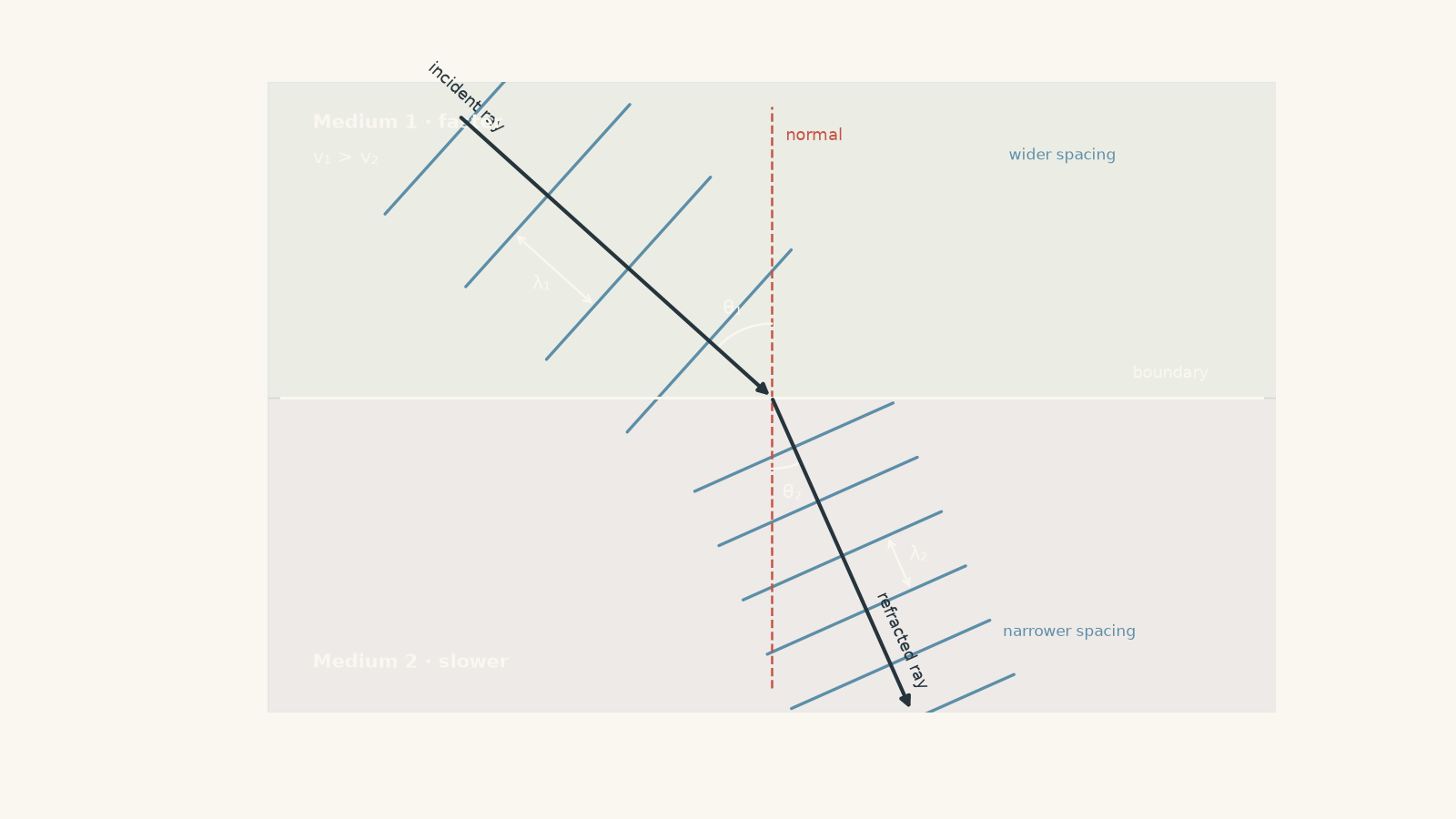
The direction of wave travel is perpendicular to the wavefronts. We often draw this direction using a ray.
Now the bending rule becomes:
- if the wave slows down, the ray bends towards the normal
- if the wave speeds up, the ray bends away from the normal
The normal is an imaginary line drawn at \(90^\circ\) to the boundary.
This matters because refraction angles are measured from the normal, not from the surface.
The important exception: normal incidence
Suppose the wave approaches the boundary directly along the normal.
Every part of the wavefront reaches the boundary at the same time. No side gets a head start, so there is no rotation of the wavefront.
The speed can still change. The wavelength can still change. But the direction does not.
So the shortcut “a speed change makes a wave bend” is incomplete.
A better statement is:
A wave changes direction when it crosses a boundary obliquely and its speed changes.
03Turning the picture into Snell’s law
Let:
- \(\theta_1\) be the angle of incidence, measured from the normal
- \(\theta_2\) be the angle of refraction, measured from the normal
- \(v_1\) and \(v_2\) be the wave speeds in the two media
For refraction,
\[
\frac{\sin\theta_1}{\sin\theta_2}
=
\frac{v_1}{v_2}
\]
Because frequency stays constant and \(v=f\lambda\),
\[
\frac{v_1}{v_2}
=
\frac{\lambda_1}{\lambda_2}
\]
so we can also write
\[
\frac{\sin\theta_1}{\sin\theta_2}
=
\frac{v_1}{v_2}
=
\frac{\lambda_1}{\lambda_2}
\]
This equation links all three parts of the same physical process.
If \(v_2\theta_1\).
Step 2: Apply Snell’s law.
\[
n_1\sin\theta_1=n_2\sin\theta_2
\]
Therefore,
\[
\sin\theta_2
=
\frac{n_1}{n_2}\sin\theta_1
=
\frac{1.49}{1.33}\sin50.0^\circ
\]
\[
\sin\theta_2\approx0.858
\]
so
\[
\theta_2\approx59.1^\circ
\]
The angle has increased, so the ray bends away from the normal.
Step 3: Relate wavelength to speed.
Since
\[
v=\frac{c}{n}
\]
the speed ratio is
\[
\frac{v_2}{v_1}
=
\frac{n_1}{n_2}
=
\frac{1.49}{1.33}
\]
Frequency is unchanged, so the wavelength changes by the same ratio:
\[
\frac{\lambda_2}{\lambda_1}
=
\frac{1.49}{1.33}
\]
Therefore,
\[
\lambda_2
=
410\ \text{nm}\times\frac{1.49}{1.33}
\approx459\ \text{nm}
\]
The light has a wavelength of about \(459\ \text{nm}\) in the water.
Notice what did not happen: the source suddenly began oscillating at a different frequency. The frequency stayed constant. The wavelength changed because the wave speed changed.
04The misconceptions that cause most refraction mistakes
“The wave slows down, so its frequency decreases”
This sounds reasonable because speed and frequency appear together in \(v=f\lambda\).
The problem is that two quantities could change. At a stationary boundary, the frequency is fixed by the incoming oscillation. It is the wavelength that adjusts.
So if speed halves,
\[
v_2=\frac{1}{2}v_1
\]
then
\[
\lambda_2=\frac{1}{2}\lambda_1
\]
while
\[
f_2=f_1
\]
“Towards the normal means towards the surface”
It means the opposite geometrically.
The normal sticks out at \(90^\circ\) to the surface. A ray bending towards the normal gets a smaller angle from the normal.
If an angle falls from \(50^\circ\) to \(30^\circ\), the ray has bent towards the normal.
“A slower wave bends because it loses energy”
Refraction is fundamentally about a change in wave speed across the boundary, not simply about energy being lost.
Some real materials may absorb some wave energy, but absorption is not what Snell’s law is describing. A wave can refract even when energy losses are negligible.
“If the speed changes, the direction must change”
Not at normal incidence.
If the wave arrives perpendicular to the boundary, the entire wavefront changes speed together. Its wavelength changes, but its ray continues straight ahead.
“A light wave’s colour must change because its wavelength changes”
The wavelength does change inside a material, but the frequency remains fixed.
For ordinary visible light, frequency is the more useful quantity for identifying where the light sits in the electromagnetic spectrum. If the light later returns to its original medium, its speed and wavelength return to their corresponding values there.
05A compact decision method
When a refraction question gives you a boundary between two media, work in this order:
- Compare the speeds. Is the wave speeding up or slowing down?
- Predict the bending. Slower means towards the normal. Faster means away from the normal.
- Keep frequency constant. For the stationary boundaries used here, \(f_1=f_2\).
- Change wavelength with speed. Use \(v=f\lambda\) or \(\lambda_2/\lambda_1=v_2/v_1\).
- Calculate the angle if needed. Use Snell’s law.
- Check the result against your prediction. A calculation that says a slower wave bends away from the normal should immediately make you suspicious.
That final check catches a lot of calculator and rearrangement errors.
06Questions and solutions
Question 1
A continuous water wave of frequency \(12\ \text{Hz}\) travels at \(0.48\ \text{m s}^{-1}\) before crossing normally into a region where its speed is \(0.30\ \text{m s}^{-1}\).
Calculate its wavelength in each region, state its frequency after crossing, and describe any change in direction.
Solution 1
The wavelength decreases from \(0.040\ \text{m}\) to \(0.025\ \text{m}\), the frequency remains \(12\ \text{Hz}\), and the wave does not change direction.
Before the boundary,
\[
\lambda_1=\frac{v_1}{f}
=\frac{0.48}{12}
=0.040\ \text{m}
\]
After the boundary,
\[
\lambda_2=\frac{v_2}{f}
=\frac{0.30}{12}
=0.025\ \text{m}
\]
The boundary is stationary, so the frequency remains \(12\ \text{Hz}\).
Although the wave speed changes, the wave arrives at normal incidence. The whole wavefront reaches the boundary together, so there is no rotation of the wavefront and therefore no change in direction.
The tempting mistake is to assume that any speed change must produce visible bending.
Question 2
A wave travels at \(3.2\ \text{m s}^{-1}\) in medium A and \(2.4\ \text{m s}^{-1}\) in medium B. Its frequency is \(8.0\ \text{Hz}\), and it strikes the boundary at an angle of \(45^\circ\) to the normal.
Calculate the wavelength in both media and the angle of refraction.
Solution 2
The wavelength decreases from \(0.40\ \text{m}\) to \(0.30\ \text{m}\), and the wave refracts at approximately \(32^\circ\) to the normal.
The wavelengths are
\[
\lambda_A=\frac{v_A}{f}
=\frac{3.2}{8.0}
=0.40\ \text{m}
\]
and
\[
\lambda_B=\frac{v_B}{f}
=\frac{2.4}{8.0}
=0.30\ \text{m}
\]
For the angle,
\[
\frac{\sin\theta_A}{\sin\theta_B}
=
\frac{v_A}{v_B}
\]
so
\[
\sin\theta_B
=
\frac{2.4}{3.2}\sin45^\circ
\approx0.530
\]
Therefore,
\[
\theta_B
=
\sin^{-1}(0.530)
\approx32.0^\circ
\]
The speed decreases, and the angle decreases from \(45^\circ\) to \(32^\circ\). The wave has therefore bent towards the normal, which agrees with the physical prediction.
Question 3
A student observes a wave entering a second medium. The wavelength in the second medium is \(75\%\) of its original value. The angle of incidence is \(50^\circ\).
The student says, “The shorter wavelength means the frequency must have increased.”
Evaluate this statement and calculate the angle of refraction.
Solution 3
The student’s statement is incorrect. The frequency remains constant, the wave speed falls to \(75\%\) of its original value, and the angle of refraction is approximately \(35^\circ\).
At a stationary boundary,
\[
f_2=f_1
\]
and
\[
\frac{v_2}{v_1}
=
\frac{\lambda_2}{\lambda_1}
=0.75
\]
So the shorter wavelength is caused by the lower speed, not by a higher frequency.
Using the speed form of Snell’s law,
\[
\sin\theta_2
=
\frac{v_2}{v_1}\sin\theta_1
\]
gives
\[
\sin\theta_2
=
0.75\sin50^\circ
\approx0.575
\]
Therefore,
\[
\theta_2
\approx35.1^\circ
\]
The ray bends towards the normal because it enters the slower medium.
The misconception comes from treating \(v=f\lambda\) as though a change in one quantity tells you automatically which of the other two changed. You need the boundary condition, \(f_1=f_2\), before making that decision.
Question 4
During an experiment, a group measures a wave crossing a stationary boundary.
They obtain:
- angle of incidence \(=40^\circ\)
- angle of refraction \(=25^\circ\)
- incident wavelength \(=12\ \text{cm}\)
- refracted wavelength \(=8.0\ \text{cm}\)
Determine whether the angle measurements and wavelength measurements are approximately consistent with the same refraction model.
Solution 4
Yes. The two sets of measurements give speed ratios of about \(1.52\) and \(1.50\), so they are approximately consistent.
From Snell’s law,
\[
\frac{v_1}{v_2}
=
\frac{\sin40^\circ}{\sin25^\circ}
\]
\[
\frac{v_1}{v_2}
\approx
\frac{0.643}{0.423}
\approx1.52
\]
From the wavelengths, frequency is unchanged, so
\[
\frac{v_1}{v_2}
=
\frac{\lambda_1}{\lambda_2}
=
\frac{12}{8.0}
=1.50
\]
The values differ slightly, which is reasonable for experimental measurements rounded to the stated precision.
Both measurements also tell the same physical story. Medium 2 has the lower wave speed, its wavelength is shorter, and the ray bends towards the normal.
A stronger analysis checks whether separate pieces of evidence agree with one another rather than applying one equation and stopping.
Question 5
A wave passes through three regions. Regions A and C contain the same medium and have wave speed \(6.0\ \text{m s}^{-1}\). Between them is a parallel-sided slab of medium B, where the wave speed is \(4.0\ \text{m s}^{-1}\).
The wave has frequency \(10\ \text{Hz}\) and enters medium B from A at \(50^\circ\) to the normal.
Calculate:
- the angle of the wave inside B
- the angle after it enters C
- the wavelength in each region
A student claims, “Because the second boundary reverses the first refraction, the wave leaves exactly as though the slab had never been there.” Evaluate the claim.
Solution 5
The angle in B is approximately \(30.7^\circ\), the wave leaves into C at \(50^\circ\), and its wavelengths are \(0.60\ \text{m}\), \(0.40\ \text{m}\), and \(0.60\ \text{m}\) in A, B, and C respectively. The student’s claim is only partly correct because the outgoing ray is parallel to the incoming ray but can be laterally displaced.
At the first boundary,
\[
\sin\theta_B
=
\frac{v_B}{v_A}\sin\theta_A
\]
so
\[
\sin\theta_B
=
\frac{4.0}{6.0}\sin50^\circ
\]
\[
\theta_B\approx30.7^\circ
\]
The wave slows down, so it bends towards the normal.
At the second boundary, the wave returns to a medium with the original speed. Applying Snell’s law again,
\[
\frac{\sin30.7^\circ}{\sin\theta_C}
=
\frac{4.0}{6.0}
\]
which gives
\[
\theta_C\approx50^\circ
\]
The outgoing ray is therefore parallel to the incoming ray.
The wavelengths are
\[
\lambda_A=\frac{6.0}{10}=0.60\ \text{m}
\]
\[
\lambda_B=\frac{4.0}{10}=0.40\ \text{m}
\]
and
\[
\lambda_C=\frac{6.0}{10}=0.60\ \text{m}
\]
The frequency remains \(10\ \text{Hz}\) throughout.
The student is right that the original angle and wavelength are restored once the wave returns to the original type of medium. However, a parallel-sided slab generally shifts the ray sideways because it travelled at a different angle while inside B. The slab changes the path even though the final direction is restored.
Question 6
Light travels from glass with refractive index \(1.50\) into air with refractive index \(1.00\). Its angle of incidence inside the glass is \(50^\circ\).
A student substitutes the values into Snell’s law and obtains
\[
\sin\theta_2=1.15
\]
They conclude that their calculator or Snell’s law must be wrong.
Explain what the result actually means.
Solution 6
The calculation is signalling that no ordinary refracted ray can emerge into the air at this angle. The light undergoes total internal reflection rather than Snell’s law producing a real refracted angle.
Starting with
\[
n_1\sin\theta_1=n_2\sin\theta_2
\]
gives
\[
\sin\theta_2
=
\frac{1.50}{1.00}\sin50^\circ
\approx1.15
\]
But the sine of a real angle cannot be greater than 1.
That is not a calculator failure. As light travels from the higher-index glass into lower-index air, it bends away from the normal. As the incident angle increases, the refracted angle approaches \(90^\circ\). Beyond a particular incident angle, called the critical angle, there is no propagating refracted ray into the second medium.
The useful lesson is that equations have physical limits. An impossible mathematical result can be evidence that the situation has crossed into a different physical regime.
07What refraction lets you understand next
Refraction is easier to organise if you treat direction and wavelength as two consequences of one cause.
A wave reaches a boundary. Its speed changes. The frequency remains fixed by the incoming wave. The wavelength therefore changes. If the boundary is crossed obliquely, different parts of the wavefront change speed at different times, rotating the wavefront and changing the direction of travel.
From that one chain,
\[
\text{speed change}
\rightarrow
\text{wavelength change}
\rightarrow
\text{wavefront rotation at oblique incidence}
\]
you can build Snell’s law rather than memorising it as an isolated formula.
The next useful step is to push the “bends away from the normal” case to its limit. When light travels from a slower optical medium into a faster one, the refracted angle can eventually reach \(90^\circ\). That leads directly to the critical angle and total internal reflection, which is the same refraction model taken to its edge case.