
Wave Superposition and Interference for HSC Physics
Learn how to add wave displacements, distinguish constructive and destructive interference, and use phase and path difference correctly. Includes worked examples and HSC-style practice questions with solutions.
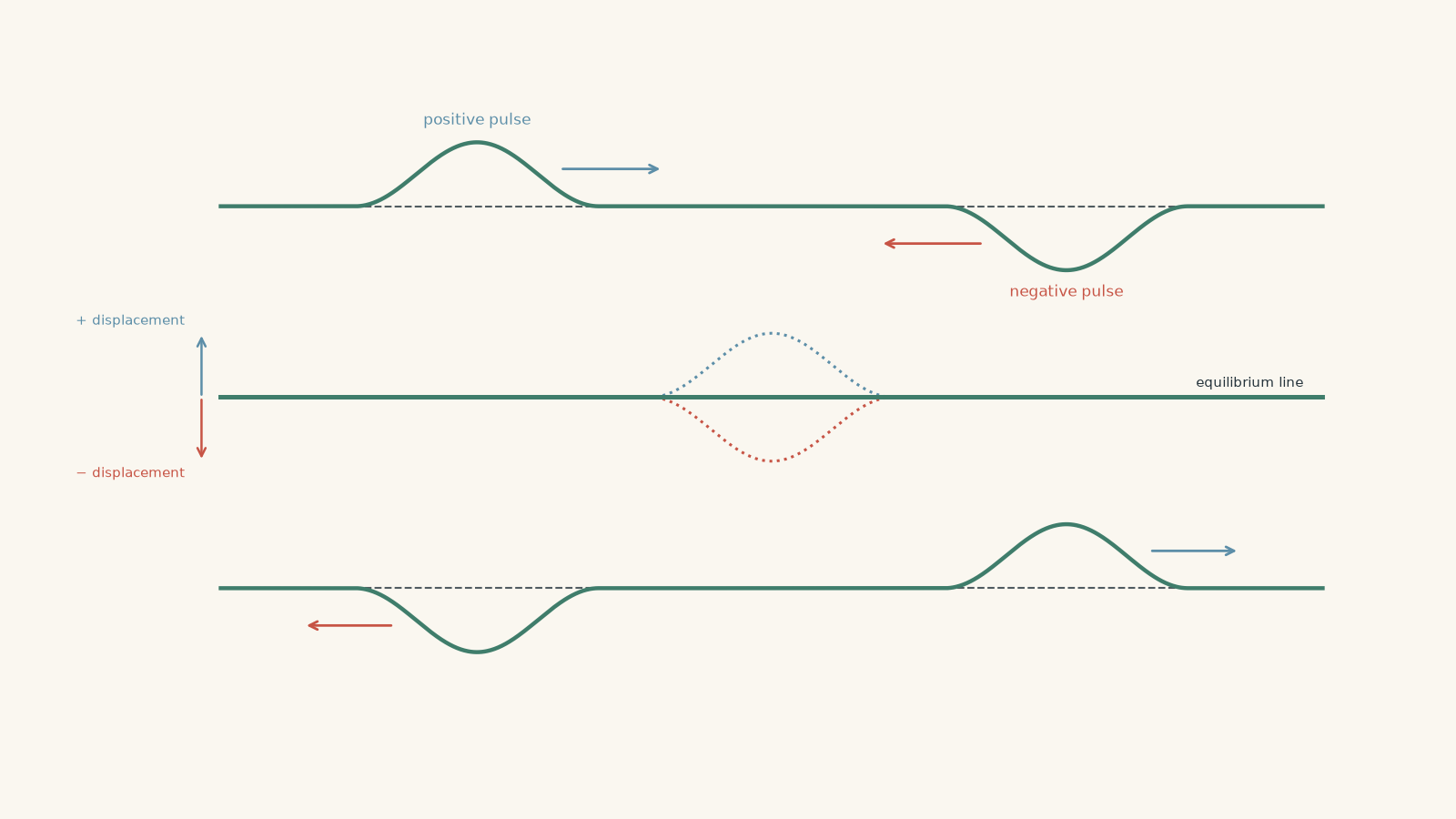
Two pulses travel towards each other along a string. One pushes the string 4 mm above its equilibrium position. The other pushes it 3 mm below. When they meet, where is the string?
A tempting picture is that the pulses collide, bounce off, or somehow compete to see which one wins. None of those pictures is quite right. At the instant they overlap, the string is simply \(1\text{ mm}\) above equilibrium because the two displacements add:
\[
+4\text{ mm}+(-3\text{ mm})=+1\text{ mm}
\]
That simple addition rule is wave superposition. It explains constructive interference, destructive interference, and, with one extra step, why standing waves have nodes and antinodes.
01Start by adding displacements
Picture a single point on a stretched string. We will call its equilibrium position \(y=0\).
A pulse passes and moves that point \(5\text{ mm}\) upward. Its displacement is \(+5\text{ mm}\).
Now imagine a second pulse reaching the same point at the same time and, by itself, moving it \(2\text{ mm}\) upward.
Predict the actual displacement while they overlap.
The point does not choose one pulse. It also does not move \(5\text{ mm}\), then another \(2\text{ mm}\) as two separate motions. The effects exist at the same time, so we add them:
\[
y_{\text{resultant}}=+5\text{ mm}+3\text{ mm}=+8\text{ mm}
\]
More generally, the principle of superposition states that when waves overlap, the resultant displacement at a point is the algebraic sum of the displacements that each wave would produce separately:
\[
y_{\text{resultant}}=y_1+y_2+y_3+\cdots
\]
Here:
- \(y_{\text{resultant}}\) is the actual displacement of the medium from equilibrium
- \(y_1,y_2,y_3,\ldots\) are the individual wave displacements at that same position and time
The word algebraic matters. Direction is represented by sign.
If upward is positive:
\[
+4\text{ mm}+(+3\text{ mm})=+7\text{ mm}
\]
but
\[
+4\text{ mm}+(-3\text{ mm})=+1\text{ mm}
\]
The second wave has not somehow become a “negative wave”. Its displacement is simply in the opposite direction at that point.
A useful mental model is two people giving simultaneous movement instructions: “4 mm up” and “3 mm down”. The final position comes from adding the signed instructions.
The analogy breaks because waves do not permanently merge into one instruction. In an ideal linear medium, each wave continues travelling after the overlap.
02Constructive interference means the displacements reinforce
Suppose two overlapping pulses both displace a point upwards:
\[
y_1=+4\text{ mm},\qquad y_2=+3\text{ mm}
\]
Then:
\[
y_{\text{resultant}}=+7\text{ mm}
\]
Their effects reinforce each other. This is constructive interference.
The same thing happens if both displacements are downward:
\[
y_1=-4\text{ mm},\qquad y_2=-3\text{ mm}
\]
so
\[
y_{\text{resultant}}=-7\text{ mm}
\]
The negative sign only tells us the direction. The magnitude of the displacement has increased from what either wave produced alone.
For pulses, a useful first rule is:
If the overlapping displacements point in the same direction, they interfere constructively at that position and time.
Worked example: Two upward pulses overlap
Two pulses overlap at a point on a string. Pulse A would produce a displacement of \(+2.8\text{ cm}\), while pulse B would produce a displacement of \(+1.6\text{ cm}\). Find the resultant displacement and identify the type of interference.
Step 1
\[
y_{\text{resultant}}=y_A+y_B
\]
Step 2
\[
y_{\text{resultant}}
=+2.8\text{ cm}+(+1.6\text{ cm})
=+4.4\text{ cm}
\]
Step 3
The resultant displacement is \(4.4\text{ cm}\) above equilibrium. Both individual displacements were upward, so they reinforce each other.
This is constructive interference.
03Destructive interference means the displacements oppose
Now suppose one pulse pushes upwards and another pushes downwards:
\[
y_1=+5\text{ mm},\qquad y_2=-3\text{ mm}
\]
Superposition still gives:
\[
y_{\text{resultant}}
=+5\text{ mm}+(-3\text{ mm})
=+2\text{ mm}
\]
This is destructive interference because the displacements oppose each other.
Notice something important: destructive interference does not automatically mean zero displacement.
Complete cancellation only occurs when the two displacements have equal magnitudes and opposite directions:
\[
+5\text{ mm}+(-5\text{ mm})=0
\]
If the magnitudes are different, the cancellation is only partial.
This gives a better rule:
| Displacements during overlap | Result | Interference |
|---|---|---|
| Same direction | Reinforced displacement | Constructive |
| Opposite directions, unequal magnitudes | Partial cancellation | Destructive |
| Opposite directions, equal magnitudes | Zero resultant displacement | Complete destructive |
Worked example: Opposing pulses with unequal size
At one instant, two pulses overlap at a point on a string. Pulse A produces a displacement of \(+7.0\text{ mm}\), while pulse B produces \(-4.5\text{ mm}\). Find the resultant displacement.
Step 1
\[
y_{\text{resultant}}=y_A+y_B
\]
Step 2
\[
y_{\text{resultant}}
=+7.0\text{ mm}+(-4.5\text{ mm})
=+2.5\text{ mm}
\]
Step 3
The point is \(2.5\text{ mm}\) above equilibrium.
The displacements oppose each other, so the waves are interfering destructively at that position and time. However, they do not cancel completely because their displacement magnitudes are unequal.
04The waves do not destroy each other
Imagine two identical pulses approaching each other. One is upward and one is downward.
At the instant of perfect overlap:
\[
y_1=+A,\qquad y_2=-A
\]
so
\[
y_{\text{resultant}}=0
\]
The string can momentarily look flat.
What do you predict happens next? Do both pulses disappear?
They do not. After the overlap, the pulses continue travelling.
That result can seem strange because we often treat the visible shape of the string as if it were the wave itself. The shape is only the resultant displacement at that instant.
During overlap, each individual wave is still part of the superposition. Once their positions separate, their individual displacements no longer cancel at the same points, so the pulses become visible again.
For the ideal waves used in HSC problems, superposition does not permanently alter the waves.
05Destructive interference does not mean energy has vanished
Another tempting conclusion is:
“If the resultant displacement is zero, the wave energy must be zero.”
That does not follow.
Zero displacement at one instant is not the same thing as zero energy. A point on a string can pass through equilibrium while moving quickly. It then has kinetic energy even though its displacement is zero.
More generally, interference changes how wave energy is distributed. Constructive interference produces regions of larger oscillation, while destructive interference can produce regions of smaller oscillation or, in special cases, zero displacement.
This becomes especially important when you study standing waves. At a node, the displacement is always zero, but that does not mean the two travelling waves responsible for the standing-wave pattern have ceased to exist.
06For continuous waves, phase tells you how they interfere
With isolated pulses, looking at the direction of each displacement is often enough.
Continuous sinusoidal waves need a more precise idea because their displacements keep changing.
Consider two waves of the same frequency.
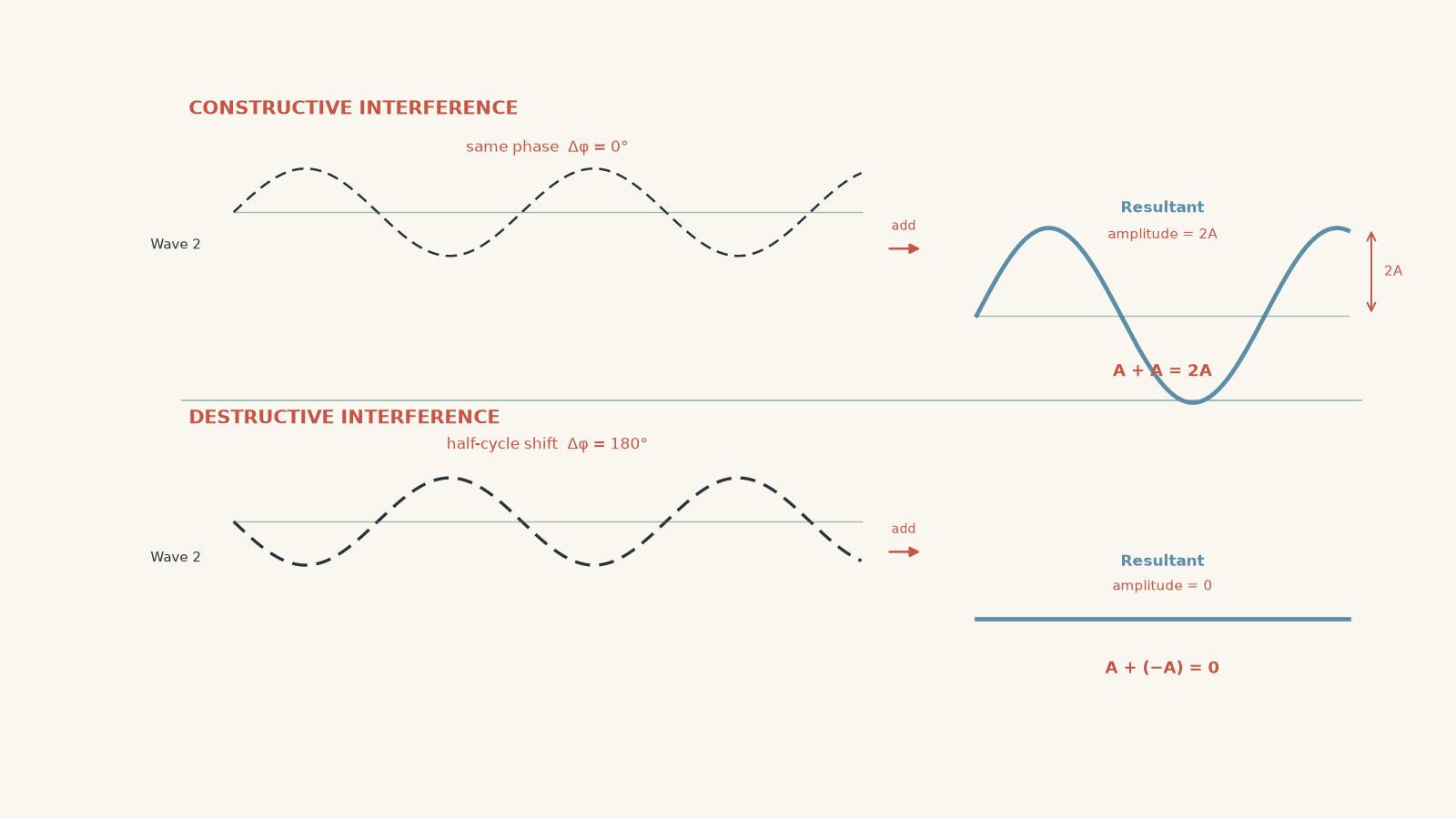
If their crests arrive together, their troughs also arrive together. They are in phase.
For two equal-amplitude waves:
\[
+A+(+A)=+2A
\]
at a crest, while
\[
-A+(-A)=-2A
\]
at a trough.
The resultant wave therefore has amplitude \(2A\). This is complete constructive interference.
Now shift one wave by half a cycle. Whenever one has displacement \(+A\), the other has displacement \(-A\). They are \(180^\circ\), or \(\pi\) radians, out of phase.
For equal amplitudes:
\[
+A+(-A)=0
\]
This gives complete destructive interference.
The cases between these two extremes give partial interference. The displacements still add, but the waves are neither perfectly in phase nor perfectly out of phase.
07Path difference can create a phase difference
Suppose two coherent waves leave sources in phase but travel different distances before reaching a point.
If one travels exactly one extra wavelength, it arrives one whole cycle behind. A whole cycle puts it back in phase with the other wave.
If the path difference is \(\Delta L\), the corresponding phase difference is
\[
\Delta\phi=\frac{2\pi\Delta L}{\lambda}
\]
where:
- \(\Delta\phi\) is the phase difference in radians
- \(\Delta L\) is the path difference in metres
- \(\lambda\) is the wavelength in metres
For sources that begin in phase, constructive interference occurs when the path difference is a whole number of wavelengths:
\[
\Delta L=m\lambda
\]
where \(m=0,1,2,3,\ldots\)
Destructive interference occurs when the path difference is an odd number of half-wavelengths:
\[
\Delta L=\left(m+\frac12\right)\lambda
\]
These rules come directly from superposition. A whole-wavelength path difference makes corresponding crests and troughs arrive together. A half-wavelength offset makes a crest from one wave arrive with a trough from the other.
There is an important hidden assumption here: the sources must begin in phase. If the sources already have a phase difference when the waves are produced, path difference alone does not tell you the final phase relationship.
Worked example: Path difference with incomplete cancellation
Two coherent sources emit waves in phase with wavelength \(0.80\text{ m}\). At point P, one wave travels \(3.40\text{ m}\), while the other travels \(4.60\text{ m}\). Their amplitudes at P are \(5.0\text{ mm}\) and \(3.0\text{ mm}\), respectively.
Determine the type of interference and the amplitude of the resultant wave.
Step 1
\[
\Delta L
=4.60\text{ m}-3.40\text{ m}
=1.20\text{ m}
\]
Step 2
\[
\frac{\Delta L}{\lambda}
=\frac{1.20\text{ m}}{0.80\text{ m}}
=1.5
\]
So:
\[
\Delta L=\frac32\lambda
\]
This is an odd number of half-wavelengths. Because the sources began in phase, the waves arrive \(180^\circ\) out of phase.
Step 3
Choose the displacement of the first wave as positive at some instant. The second has the opposite displacement because it is half a cycle out of phase:
\[
A_{\text{resultant}}
=\left|5.0\text{ mm}-3.0\text{ mm}\right|
=2.0\text{ mm}
\]
Step 4
The waves interfere destructively, but the cancellation is incomplete. Their amplitudes are unequal, so the resultant amplitude is \(2.0\text{ mm}\), not zero.
This is a common HSC trap. Being \(180^\circ\) out of phase guarantees that the waves oppose each other. It does not guarantee complete cancellation unless their amplitudes are also equal.
08A reliable way to solve superposition questions
When a superposition problem gets messy, use this order:
- Choose a positive direction. For example, upward might be positive.
- Find each individual displacement at the same position and time.
- Give each displacement the correct sign.
- Add the displacements algebraically.
- Interpret the result. A positive or negative sign gives direction, not a different kind of wave.
- Classify the interference. Same-direction displacements reinforce. Opposite-direction displacements cancel partially or completely.
- For continuous waves, check phase. If a path difference is involved, convert it into a fraction of a wavelength or a phase difference.
- Check the assumptions. In particular, the usual path-difference rules assume sources that begin in phase.
One thing you should not do is automatically add amplitudes.
For example, waves with amplitudes \(5\text{ mm}\) and \(3\text{ mm}\) do not always produce an \(8\text{ mm}\) wave. That only happens when they are in phase. If they are \(180^\circ\) out of phase, the resultant amplitude is \(2\text{ mm}\).
Superposition is fundamentally about adding instantaneous displacements.
09Questions and solutions
Question 1
At a particular instant, two pulses overlap at a point on a string. Their individual displacements are \(+3.2\text{ cm}\) and \(+1.5\text{ cm}\).
Find the resultant displacement and identify the type of interference.
Solution 1
The resultant displacement is \(+4.7\text{ cm}\), and the interference is constructive.
Superposition requires the individual displacements to be added:
\[
y_{\text{resultant}}
=+3.2\text{ cm}+(+1.5\text{ cm})
=+4.7\text{ cm}
\]
Both displacements are in the same direction, so they reinforce each other. The point on the string is therefore \(4.7\text{ cm}\) above equilibrium.
Question 2
Two pulses overlap at a point. Pulse A produces a displacement of \(+6.0\text{ mm}\), while pulse B produces a displacement of \(-8.5\text{ mm}\).
Calculate the resultant displacement and explain why calling the interference “destructive” does not mean the displacement must be zero.
Solution 2
The resultant displacement is \(-2.5\text{ mm}\), and the interference is destructive but not completely destructive.
Using superposition:
\[
y_{\text{resultant}}
=+6.0\text{ mm}+(-8.5\text{ mm})
=-2.5\text{ mm}
\]
The negative sign means the point is \(2.5\text{ mm}\) below equilibrium.
The two displacements oppose each other, which makes the interference destructive. Complete cancellation would require equal magnitudes and opposite signs. Here, \(6.0\text{ mm}\neq8.5\text{ mm}\), so a non-zero displacement remains.
The trap is treating “destructive” as another way of saying “zero”. Destructive interference means opposition, not necessarily complete cancellation.
Question 3
Two identical pulses approach each other on a string. One pulse has a maximum displacement of \(+4.0\text{ cm}\), while the other has the same shape inverted, with maximum displacement \(-4.0\text{ cm}\).
At one instant they overlap perfectly and the string is flat. A student says, “The waves have cancelled, so no waves exist anymore.”
Explain what is wrong with this statement and describe what happens next.
Solution 3
The resultant displacement is temporarily zero, but both pulses still exist and continue travelling after the overlap.
At perfect overlap, corresponding displacements add to zero:
\[
y_{\text{resultant}}
=+y+(-y)
=0
\]
at every overlapping point.
This is complete destructive interference. It tells us the resultant displacement during the overlap, not that the individual waves have been destroyed.
For ideal waves in a linear medium, the pulses pass through one another. After they separate, each pulse reappears with its original shape and continues in its original direction.
The student’s mistake is confusing the resultant wave shape with the individual waves that produce it.
Question 4
Two coherent sources emit equal-amplitude waves in phase. The wavelength is \(0.60\text{ m}\).
At point Q, the two path lengths are \(5.10\text{ m}\) and \(6.00\text{ m}\).
Determine whether the interference at Q is constructive or destructive. State whether complete cancellation is possible.
Solution 4
The waves interfere destructively at Q, and complete cancellation is possible because their amplitudes are equal.
First find the path difference:
\[
\Delta L
=6.00\text{ m}-5.10\text{ m}
=0.90\text{ m}
\]
Compare this with the wavelength:
\[
\frac{\Delta L}{\lambda}
=\frac{0.90}{0.60}
=1.5
\]
Therefore:
\[
\Delta L=\frac32\lambda
\]
A path difference of \(1.5\lambda\) is an odd number of half-wavelengths. For sources that begin in phase, the waves therefore arrive \(180^\circ\) out of phase.
Their displacements oppose each other. Because their amplitudes are also equal, one displacement is the exact negative of the other:
\[
y_1+y_2=0
\]
so complete destructive interference can occur.
The important distinction is that the path difference gives the phase relationship, while the equal amplitudes make complete cancellation possible.
Question 5
Two in-phase coherent sources produce waves of frequency \(50\text{ Hz}\). At a particular point, the path difference is \(0.40\text{ m}\). The wave speed is initially \(40\text{ m s}^{-1}\).
The waves initially interfere destructively.
The wave speed is then increased to \(48\text{ m s}^{-1}\), while the source frequency and the two path lengths remain unchanged.
Will the interference still be completely destructive? Calculate the new phase difference.
Solution 5
No. The interference will no longer be completely destructive. The new phase difference is \(\frac{5\pi}{6}\text{ rad}\), or \(150^\circ\).
Initially, the wavelength is
\[
\lambda=\frac{v}{f}
=\frac{40\text{ m s}^{-1}}{50\text{ Hz}}
=0.80\text{ m}
\]
The path difference is therefore
\[
\Delta L
=0.40\text{ m}
=\frac12\lambda
\]
which explains the initial destructive interference.
When the speed increases, the frequency stays at \(50\text{ Hz}\) because it is controlled by the sources. The new wavelength is
\[
\lambda’
=\frac{v’}{f}
=\frac{48\text{ m s}^{-1}}{50\text{ Hz}}
=0.96\text{ m}
\]
The physical path difference has not changed, so it is now
\[
\frac{\Delta L}{\lambda’}
=\frac{0.40}{0.96}
=\frac{5}{12}
\]
of a wavelength.
The new phase difference is
\[
\Delta\phi
=\frac{2\pi\Delta L}{\lambda’}
=2\pi\left(\frac{5}{12}\right)
=\frac{5\pi}{6}\text{ rad}
\]
which is \(150^\circ\), not \(180^\circ\).
Therefore the waves are no longer exactly out of phase, so complete destructive interference does not occur.
The tempting mistake is to remember that the path difference was \(0.40\text{ m}\) and assume the interference condition must stay the same. Interference depends on path difference relative to the wavelength. Changing the wave speed changes the wavelength when frequency remains fixed.
10From superposition to standing waves
The key idea is smaller than it first appears: whenever waves overlap, add their displacements at the same place and time.
Constructive and destructive interference are consequences of that rule, not separate rules to memorise. Phase and path difference simply tell you whether those displacements tend to reinforce or oppose each other.
The next useful step is standing waves. When two waves of the same frequency and amplitude travel in opposite directions, repeated superposition creates fixed nodes, where destructive interference occurs, and antinodes, where the oscillation reaches its largest amplitude. Understanding those patterns is much easier once you can look at overlapping waves and ask the right first question: what are the signed displacements here, right now?