
Pitch, Loudness and Sound Waves: HSC Physics Guide
Learn how frequency relates to pitch, and how amplitude and intensity affect loudness. Includes worked examples, common misconceptions, and HSC-style practice.
Imagine a speaker playing a steady note. You turn the volume knob up. The sound gets much louder, but the note does not suddenly become higher.
Now imagine leaving the volume alone and changing the note from a low hum to a high whistle. The pitch changes, but it does not have to become louder.
So what is the wave actually doing differently in each case?
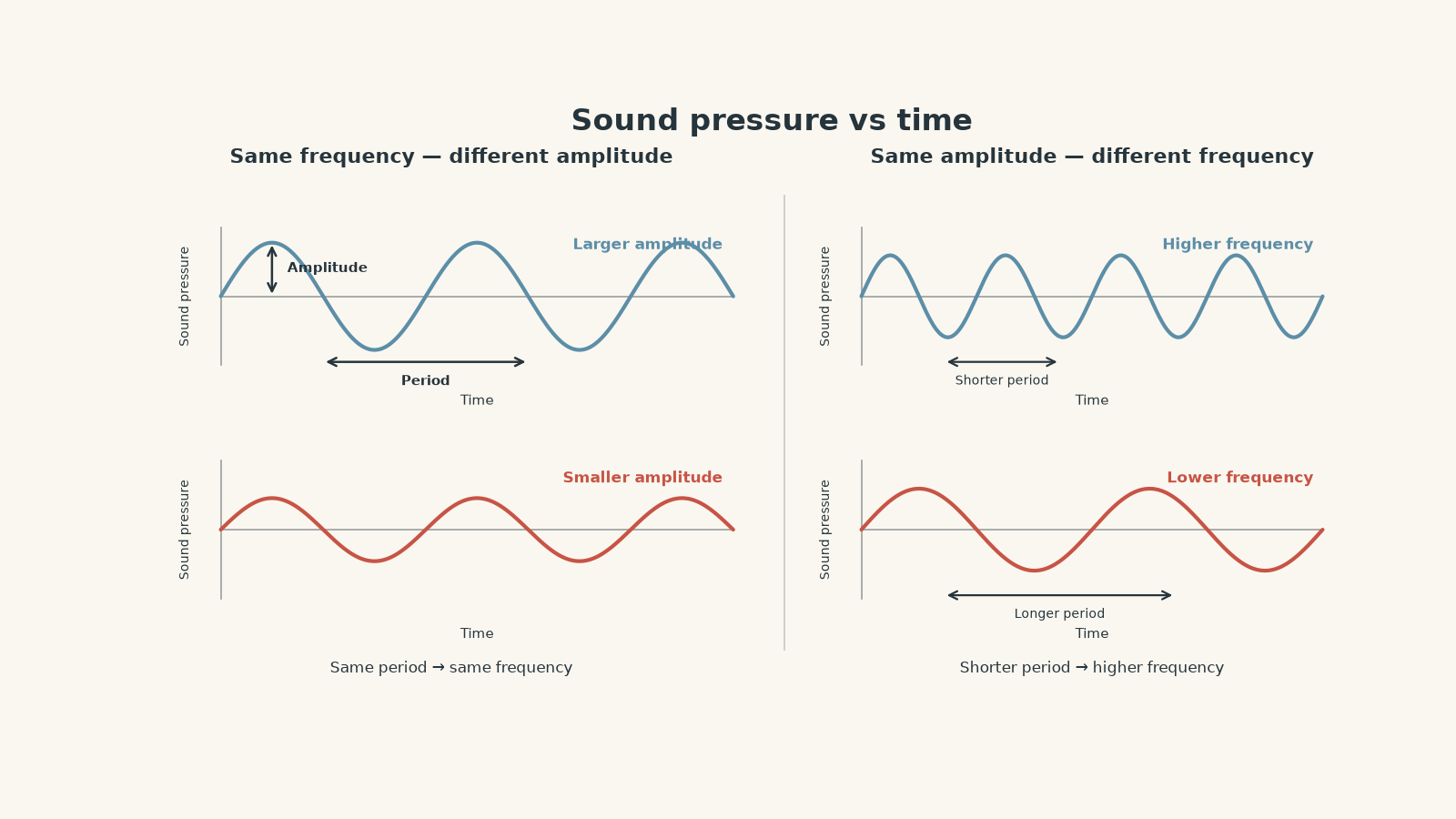
Picture a graph of air pressure at one point in front of the speaker. If the wave becomes taller but keeps the same spacing between cycles, what would you predict: higher pitch, greater loudness, both, or neither?
The best first prediction is greater loudness, but the same pitch. The height of the wave is connected to its amplitude and intensity. The spacing of the cycles is connected to frequency.
That simple model is extremely useful. It just needs a few careful qualifications before it becomes accurate physics.
01Start with what the sound wave is doing
Sound in air is a longitudinal mechanical wave. As it passes, air particles oscillate backwards and forwards around their equilibrium positions. The disturbance creates alternating regions of slightly higher and lower pressure.
The air does not travel from the speaker all the way to your ear. Individual air particles mostly jiggle around their usual positions while energy is transferred through the medium.
Suppose we measure the pressure at one fixed point as the sound passes. We might get a graph like a sine wave.
Two features immediately matter:
- the horizontal spacing between repeated parts of the wave tells us about its timing
- the vertical size of the pressure variation tells us about the strength of the disturbance
Those two features lead us towards pitch and loudness, but they are not themselves pitch and loudness.
02Frequency is the main physical quantity behind pitch
Imagine counting how many pressure cycles pass your ear each second.
If 200 complete cycles arrive each second, the frequency is \(200\ \text{Hz}\). If 800 cycles arrive each second, the frequency is \(800\ \text{Hz}\).
One hertz, written Hz, means one cycle per second.
Frequency is therefore
\[
f = \frac{1}{T}
\]
where:
- \(f\) is frequency in hertz, Hz
- \(T\) is the period in seconds, s
The period is the time for one complete cycle.
For a simple pure tone, increasing the frequency normally gives a higher perceived pitch. Decreasing the frequency gives a lower pitch.
So a \(900\ \text{Hz}\) pure tone has a higher pitch than a \(300\ \text{Hz}\) pure tone.
Pitch is a perception, not another name for frequency
This distinction is worth keeping.
Frequency is a measurable property of the wave. Pitch is what your auditory system perceives.
For simple tones, the connection is strong enough that HSC questions often let you reason directly from frequency to pitch. Higher frequency means higher pitch.
Real sounds can be more complicated. A musical instrument usually produces many frequencies at once. The perceived pitch is generally associated with the fundamental frequency or repetition pattern, while the mixture of harmonics helps determine the sound’s timbre.
So this statement is useful:
Higher frequency generally produces higher pitch.
This statement is too crude:
Pitch is frequency.
They are closely related, but one is physical and one is perceptual.
03Frequency also affects wavelength
Frequency is connected to wavelength through the wave equation:
\[
v = f\lambda
\]
where:
- \(v\) is wave speed in metres per second, \(\text{m s}^{-1}\)
- \(f\) is frequency in hertz, Hz
- \(\lambda\) is wavelength in metres, m
Here is a common trap. A student increases the frequency of a speaker and predicts that the sound must travel faster.
In the same air under the same conditions, that is not what happens.
The speed is mainly determined by the properties of the medium. If \(v\) stays approximately constant and \(f\) increases, then \(\lambda\) must decrease.
Higher pitch therefore does not mean the sound is racing through the room faster. It means the pressure oscillations are happening more frequently and, in the same medium, the wavelength is shorter.
Worked example: What changes when the frequency increases?
A speaker produces a \(425\ \text{Hz}\) tone in air where the speed of sound is \(340\ \text{m s}^{-1}\). The speaker is adjusted to produce an \(850\ \text{Hz}\) tone instead. Find the wavelength of each sound and describe the change in pitch.
Step 1
\[
v=f\lambda
\]
so
\[
\lambda=\frac{v}{f}
\]
Step 2
\[
\lambda_1
=\frac{340}{425}
=0.800\ \text{m}
\]
Step 3
\[
\lambda_2
=\frac{340}{850}
=0.400\ \text{m}
\]
Step 4
The frequency has doubled, so the wavelength has halved from \(0.800\ \text{m}\) to \(0.400\ \text{m}\).
The second sound has the higher pitch because its frequency is higher. Its speed has not doubled. Both sounds travel through the same air at \(340\ \text{m s}^{-1}\) in this model.
04Amplitude tells us how large the disturbance is
Now keep the frequency fixed and make the pressure variations larger.
The amplitude is the maximum size of the oscillation away from equilibrium.
For a sound wave, you have to be careful about what is being measured. Amplitude could refer to quantities such as:
- pressure variation
- particle displacement
- particle velocity
On a typical sound pressure graph, a taller wave means a greater pressure amplitude.
You can picture the difference as air particles having a rather awkward dance. Frequency tells you how quickly they repeat the movement. Amplitude tells you how large the movement or pressure variation is.
A dancer can repeat the same step twice per second using tiny movements or huge movements. The repetition rate has not changed just because the movement became bigger.
The analogy breaks because air particles are coupled by forces and the quantitative relationship between different types of amplitude is governed by wave physics. Still, it is useful for keeping “how fast it repeats” separate from “how large the disturbance is”.
05Loudness is related to amplitude, but amplitude is not loudness
A larger-amplitude sound wave usually transfers energy at a greater rate.
That leads us to intensity.
Sound intensity is the power transferred by the wave per unit area:
\[
I=\frac{P}{A}
\]
where:
- \(I\) is intensity in watts per square metre, \(\text{W m}^{-2}\)
- \(P\) is power in watts, W
- \(A\) is area in square metres, \(\text{m}^2\)
For waves of the same type travelling through the same medium, the intensity is proportional to the square of the amplitude.
For pressure amplitude \(p\),
\[
I\propto p^2
\]
This square relationship matters.
If the pressure amplitude doubles, the intensity does not merely double.
It becomes
\[
2^2=4
\]
times as great.
If the pressure amplitude triples, the intensity becomes
\[
3^2=9
\]
times as great.
The important qualification
Students often write:
Bigger amplitude means louder sound.
That is a useful first model, but it is not an exact definition.
A larger sound intensity generally produces a greater perceived loudness, but loudness is a human perception. It also depends on factors including frequency and the listener’s hearing.
Your ears are not equally sensitive to every frequency. Two sounds with the same measured intensity but very different frequencies therefore need not sound equally loud.
The safe distinction is:
| Quantity | What it describes | Typical unit | Main connection |
|---|---|---|---|
| Frequency | Rate of oscillation | Hz | Main physical cue for pitch |
| Amplitude | Size of the wave disturbance | Depends on quantity measured | Affects intensity |
| Intensity | Power transferred per unit area | \(\text{W m}^{-2}\) | Important physical factor affecting loudness |
| Pitch | Perception of how high or low a sound seems | No ordinary SI unit | Strongly related to frequency |
| Loudness | Perceived strength of a sound | Perceptual quantity | Influenced by intensity, frequency, and hearing |
06Sound intensity level uses a logarithmic scale
The range of sound intensities humans can encounter is enormous. Writing every intensity directly in \(\text{W m}^{-2}\) quickly becomes inconvenient.
Sound intensity level is therefore commonly expressed in decibels.
\[
L=10\log_{10}\left(\frac{I}{I_0}\right)
\]
where:
- \(L\) is sound intensity level in decibels, dB
- \(I\) is the sound intensity in \(\text{W m}^{-2}\)
- \(I_0\) is a reference intensity, commonly \(1.0\times10^{-12}\ \text{W m}^{-2}\)
The scale is logarithmic.
That means a change of \(10\ \text{dB}\) corresponds to multiplying the intensity by 10, not adding some fixed number of \(\text{W m}^{-2}\).
A \(20\ \text{dB}\) increase corresponds to
\[
10^{20/10}=100
\]
times the intensity.
A \(30\ \text{dB}\) increase corresponds to
\[
10^{30/10}=1000
\]
times the intensity.
Do not turn that into “1000 times as loud”. Intensity and loudness are not the same quantity.
Worked example: Same pitch, very different intensity
Two pure tones have the same frequency. Tone A has a sound intensity level of \(62\ \text{dB}\), while Tone B has a sound intensity level of \(74\ \text{dB}\).
Find the ratio of their intensities. Then, assuming both waves travel through the same medium, find the ratio of their pressure amplitudes.
Step 1
\[
\Delta L=74-62=12\ \text{dB}
\]
Step 2
For two intensities,
\[
\Delta L
=10\log_{10}\left(\frac{I_B}{I_A}\right)
\]
Substitute \(\Delta L=12\ \text{dB}\):
\[
12
=10\log_{10}\left(\frac{I_B}{I_A}\right)
\]
Divide by 10:
\[
1.2
=\log_{10}\left(\frac{I_B}{I_A}\right)
\]
Therefore,
\[
\frac{I_B}{I_A}
=10^{1.2}
\approx15.8
\]
Tone B has about \(15.8\) times the intensity of Tone A.
Step 3
Since
\[
I\propto p^2
\]
then
\[
\frac{I_B}{I_A}
=
\left(\frac{p_B}{p_A}\right)^2
\]
so
\[
\frac{p_B}{p_A}
=\sqrt{15.8}
\approx3.98
\]
Tone B therefore has about \(4.0\) times the pressure amplitude.
Step 4
Tone B would generally be perceived as louder, but it is not correct to say it is \(15.8\) times as loud.
The two tones still have the same pitch because their frequencies are the same. Changing intensity or amplitude does not, by itself, require a change in frequency.
07The graph-reading rule that prevents most mistakes
When you are given two wave graphs against time, separate the horizontal and vertical information.
For pitch:
- Compare the periods.
- A shorter period means a higher frequency because \(f=1/T\).
- Higher frequency means higher pitch for simple tones.
For intensity:
- Compare the amplitudes, making sure the graphs show the same physical quantity and use the same scale.
- Greater pressure amplitude means greater intensity in the same medium.
- Remember the square relationship, \(I\propto p^2\).
For loudness:
- Greater intensity usually suggests greater loudness.
- Do not claim loudness is identical to intensity.
- If the frequencies differ greatly, remember that human hearing sensitivity also matters.
There is one more graph trap. A wave drawn with a taller line is not automatically greater amplitude unless both graphs use the same vertical scale. Always read the axes.
08Four statements that sound similar but mean different things
“The frequency doubled.”
There are twice as many oscillations each second. For a simple tone, the pitch becomes higher. In the same medium, the wavelength halves.
“The pressure amplitude doubled.”
The maximum pressure variation doubled. In the same medium, the intensity becomes four times as large.
“The intensity doubled.”
Twice as much sound power is passing through each square metre. The pressure amplitude increases by a factor of \(\sqrt{2}\), not by a factor of 2.
“The sound intensity level increased by \(10\ \text{dB}\).”
The physical intensity increased by a factor of 10. This does not mean the number representing loudness has increased tenfold.
Keeping those sentences separate saves a lot of trouble.
09Questions and solutions
Question 1
A pure tone has a period of \(2.5\times10^{-3}\ \text{s}\). Calculate its frequency. A second pure tone has a period of \(1.25\times10^{-3}\ \text{s}\). Which has the higher pitch?
Solution 1
The frequencies are \(400\ \text{Hz}\) and \(800\ \text{Hz}\), and the second tone has the higher pitch.
Frequency and period are related by
\[
f=\frac{1}{T}
\]
For the first tone,
\[
f_1
=\frac{1}{2.5\times10^{-3}}
=400\ \text{Hz}
\]
For the second tone,
\[
f_2
=\frac{1}{1.25\times10^{-3}}
=800\ \text{Hz}
\]
The second frequency is twice as large, so a simple pure tone at \(800\ \text{Hz}\) has the higher pitch.
The important idea is that pitch is being inferred from the frequency, not from the height of the wave.
Question 2
A sound wave travelling through air has a pressure amplitude of \(0.020\ \text{Pa}\). The source is adjusted so that the pressure amplitude becomes \(0.060\ \text{Pa}\), while the frequency remains unchanged.
By what factor does the intensity change, and what happens to the pitch?
Solution 2
The intensity increases by a factor of 9, while the pitch remains unchanged.
The pressure amplitude changes by the factor
\[
\frac{0.060}{0.020}=3
\]
For sound travelling through the same medium,
\[
I\propto p^2
\]
so
\[
\frac{I_2}{I_1}
=
\left(\frac{p_2}{p_1}\right)^2
=3^2
=9
\]
The intensity is therefore nine times as great.
The frequency did not change, so the pitch does not change. The sound would generally be perceived as louder because its intensity has increased.
The tempting mistake is to say the intensity tripled because the amplitude tripled. Intensity depends on the square of pressure amplitude.
Question 3
Two sounds have intensity levels of \(40\ \text{dB}\) and \(80\ \text{dB}\).
A student says, “The second sound has twice the intensity because \(80\) is twice \(40\).”
Calculate the actual intensity ratio and explain the mistake.
Solution 3
The \(80\ \text{dB}\) sound has \(10\,000\) times the intensity of the \(40\ \text{dB}\) sound, not twice the intensity.
The difference in level is
\[
\Delta L=80-40=40\ \text{dB}
\]
Use
\[
\Delta L
=10\log_{10}\left(\frac{I_2}{I_1}\right)
\]
Substituting,
\[
40
=10\log_{10}\left(\frac{I_2}{I_1}\right)
\]
so
\[
4
=\log_{10}\left(\frac{I_2}{I_1}\right)
\]
and therefore
\[
\frac{I_2}{I_1}
=10^4
=10\,000
\]
The student’s mistake is treating the decibel scale as linear. It is logarithmic.
It would also be incorrect to conclude that the second sound is \(10\,000\) times as loud. The calculation gives an intensity ratio, while loudness is a perception.
Question 4
Two pure tones travel through the same air.
- Tone A has frequency \(300\ \text{Hz}\) and intensity \(2.0\times10^{-6}\ \text{W m}^{-2}\).
- Tone B has frequency \(900\ \text{Hz}\) and intensity \(2.0\times10^{-6}\ \text{W m}^{-2}\).
A student concludes, “Tone B has three times the pitch and exactly the same loudness as Tone A.”
Assess both parts of the student’s conclusion.
Solution 4
Tone B certainly has the higher pitch, but the information given is not enough to conclude that the two tones are perceived as exactly equally loud.
Tone B has a frequency of \(900\ \text{Hz}\), compared with \(300\ \text{Hz}\) for Tone A. The frequency is three times as large.
For simple tones, the higher frequency corresponds to the higher pitch. Saying it has “three times the pitch”, however, is not a good physical description because pitch is a perception rather than a simple linear quantity measured in hertz. The precise statement is that Tone B has three times the frequency and a higher perceived pitch.
The intensities are equal:
\[
I_A=I_B=2.0\times10^{-6}\ \text{W m}^{-2}
\]
but equal physical intensity does not guarantee equal perceived loudness. Human hearing sensitivity depends on frequency, among other factors.
The trap is treating both pitch and loudness as though they are simply alternative units for frequency and intensity. They are perceptual responses related to those physical quantities, not identical to them.
Question 5
A sound engineer records two pure tones in the same medium.
Tone X has a pressure amplitude twice that of Tone Y. Tone Y has a sound intensity level of \(55\ \text{dB}\).
The engineer claims that Tone X must have a sound intensity level of \(110\ \text{dB}\) because its amplitude is twice as large.
Determine the actual sound intensity level of Tone X.
Solution 5
Tone X has a sound intensity level of about \(61\ \text{dB}\), not \(110\ \text{dB}\).
Because the pressure amplitude doubles,
\[
\frac{p_X}{p_Y}=2
\]
and because
\[
I\propto p^2
\]
the intensity ratio is
\[
\frac{I_X}{I_Y}
=2^2
=4
\]
Now calculate the change in intensity level:
\[
\Delta L
=10\log_{10}\left(\frac{I_X}{I_Y}\right)
=10\log_{10}(4)
\]
\[
\Delta L
\approx10(0.602)
\approx6.02\ \text{dB}
\]
Therefore,
\[
L_X
=55+6.02
\approx61\ \text{dB}
\]
The engineer’s mistake is doubling a decibel value when the amplitude doubles. There are two non-linear relationships involved: intensity depends on amplitude squared, and decibels depend logarithmically on intensity.
Question 6
A microphone records two sounds from the same source at different settings.
At the first setting, the sound has frequency \(500\ \text{Hz}\) and pressure amplitude \(p\).
At the second setting, the frequency is \(1000\ \text{Hz}\) and the pressure amplitude is \(2p\).
Both sounds travel through the same air.
A student says, “The second setting has twice the pitch and twice the intensity.”
Identify what can be concluded reliably and correct the student’s reasoning.
Solution 6
The second setting has the higher pitch and four times the intensity. It has twice the frequency, but describing its pitch as exactly twice as large is not the careful conclusion.
First compare the frequencies:
\[
\frac{f_2}{f_1}
=
\frac{1000}{500}
=2
\]
The frequency has doubled. For pure tones, the second setting therefore has a higher perceived pitch.
Pitch itself is perceptual, so the precise quantitative statement is that the frequency doubled, rather than that the pitch doubled.
Now compare the pressure amplitudes:
\[
\frac{p_2}{p_1}=2
\]
Since both waves travel through the same medium,
\[
I\propto p^2
\]
so
\[
\frac{I_2}{I_1}
=
\left(\frac{p_2}{p_1}\right)^2
=2^2
=4
\]
The second setting therefore has four times the intensity, not twice the intensity.
The two changes are independent pieces of information. The frequency change determines the main change in pitch, while the pressure-amplitude change determines the intensity change.
10Where this leads next
The useful habit is to keep three layers separate.
First, describe the wave itself using quantities such as frequency, wavelength, amplitude, and intensity.
Second, use the physics linking those quantities:
\[
v=f\lambda
\]
and, under the same relevant conditions,
\[
I\propto p^2
\]
Third, connect the physical wave to perception. Frequency is the main cue for pitch. Intensity is an important factor affecting loudness, but neither perception is simply another name for the corresponding wave quantity.
Once that separation is clear, ideas such as harmonics, resonance, standing waves, and musical timbre become much easier. You can ask two different questions without mixing them up: which frequencies are present, and how much energy is carried by each part of the sound?