
Reflection of Sound: Echoes and Acoustics for HSC Physics
Learn how sound reflects from surfaces, how echoes and reverberation form, and how to solve reflection problems using travel time and path length.
Clap your hands in a bedroom and you usually hear one short clap. Do the same near a distant concrete wall and you might hear clap… clap. The second sound isn’t produced by a second source. It is your original sound returning after travelling to the wall and back.
Before going further, predict this: if you move twice as far from the wall, does the echo take twice as long, four times as long, or the same time to return?
It takes twice as long. That result comes directly from the distance travelled by the sound, and it gives us a useful way to understand echoes, room acoustics, and sound reflection.
01What actually reflects when sound hits a surface?
Sound in air is a travelling pressure disturbance. Air particles oscillate back and forth, creating moving regions of higher and lower pressure.
When that disturbance reaches a wall, the air cannot simply keep oscillating through the wall in exactly the same way. The boundary forces the wave to respond. Some of the wave’s energy may be:
- reflected back into the air
- absorbed by the material
- transmitted into or through the material
The reflected part is what matters for an echo.
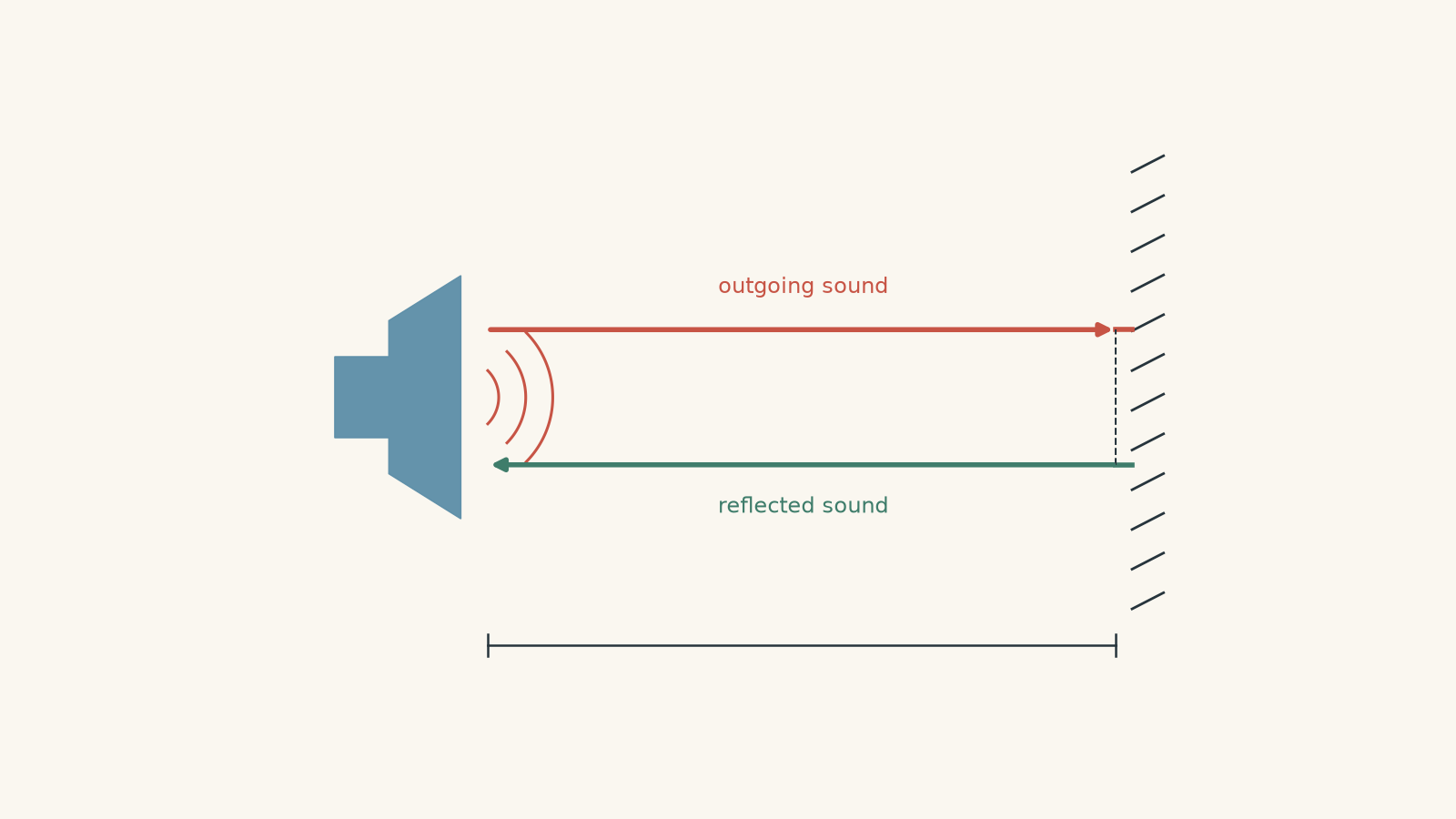
A bouncing ball is a useful first picture. Throw a ball at a wall and it comes back. A sound wave can also return from a boundary.
But don’t push that analogy too far. Sound isn’t a stream of tiny balls. A wave can split its energy between reflection, absorption, and transmission, and reflected sound waves can overlap and interfere with other waves.
02Why an echo has a delay
Suppose you stand a distance \(d\) from a large wall and clap.
The sound must travel:
- from you to the wall, a distance \(d\)
- from the wall back to you, another distance \(d\)
So its total distance is \(2d\).
We already know the wave relationship
\[
v = \frac{s}{t}
\]
where:
- \(v\) is wave speed in metres per second (\(\text{m s}^{-1}\))
- \(s\) is distance travelled in metres (\(\text{m}\))
- \(t\) is travel time in seconds (\(\text{s}\))
For an echo returning to the same location, \(s = 2d\). Therefore,
\[
v = \frac{2d}{t}
\]
and so
\[
d = \frac{vt}{2}
\]
That factor of 2 is one of the easiest things to miss in an echo calculation.
Worked example: How far away is the wall?
A student claps and hears an echo \(0.240\text{ s}\) later. Take the speed of sound in air to be \(343\text{ m s}^{-1}\). Calculate the distance from the student to the reflecting wall.
Step 1
The wall distance is therefore half the total distance travelled by the sound.
Step 2
\[
d = \frac{vt}{2}
\]
Step 3
\[
d = \frac{(343)(0.240)}{2}
= \frac{82.32}{2}
= 41.16\text{ m}
\]
Step 4
The wall is approximately
\[
\boxed{41.2\text{ m}}
\]
away.
The sound actually travelled about \(82.3\text{ m}\), because it crossed the \(41.2\text{ m}\) gap twice.
03An echo and a reflection are not the same thing
This distinction is important.
A reflection occurs whenever some sound energy returns from a boundary. An echo is a reflected sound that reaches the listener late enough, and strongly enough, to be perceived as a separate sound.
That means a room can contain lots of reflected sound without producing an obvious hello… hello… hello effect.
For a short sound, a delay of roughly \(0.1\text{ s}\) is often used as a rule of thumb for when a reflection may become distinguishable as a separate echo. It isn’t a sharp biological switch. The result also depends on the original sound, the strength of the reflection, other sounds in the room, and the listener.
Using \(v = 343\text{ m s}^{-1}\), a \(0.1\text{ s}\) round trip corresponds to
\[
d = \frac{(343)(0.1)}{2} \approx 17.2\text{ m}
\]
So a large, hard surface roughly \(17\text{ m}\) or more away can potentially produce a noticeable echo from a short sound.
Closer surfaces still reflect sound. The reflected sound simply tends to arrive too quickly to be heard as a separate event.
Worked example: Echo or blended reflection?
A student stands \(12.0\text{ m}\) from the rear wall of a hall. Estimate the delay between a clap and the sound reflected directly from that wall. Take the speed of sound to be \(343\text{ m s}^{-1}\).
Step 1
The sound travels to the wall and back:
\[
s = 2d = 2(12.0) = 24.0\text{ m}
\]
Step 2
\[
t = \frac{24.0}{343}
= 0.06997\text{ s}
\]
So
\[
\boxed{t \approx 0.0700\text{ s}}
\]
Step 3
The reflection returns about \(70\text{ ms}\) after the original clap.
That is shorter than the rough \(0.1\text{ s}\) separation commonly associated with a clearly distinct echo. The student would therefore be more likely to hear the reflection blending with the original sound rather than appearing as a clean second clap.
Notice what we haven’t concluded: the wall doesn’t reflect sound. It does. The issue is whether our hearing separates the reflection from the original.
04From echoes to reverberation
Now imagine a hall rather than one isolated wall.
A clap can reflect from the side walls, ceiling, floor, back wall, stage, seats, and other large surfaces. These reflected waves travel different distances, so they arrive at slightly different times.
The result is reverberation: reflected sound persists for a short time after the source produces it.
A useful mental picture is a group chat where everyone repeats the same message, but each reply arrives with a slightly different delay. One late reply is easy to identify. Fifty nearly overlapping replies blur together.
The analogy breaks because reflected sound waves aren’t messages arriving independently. They are physical pressure waves that can overlap and interfere.
A small amount of reverberation can make music sound fuller. Too much can make speech difficult to understand because one syllable is still bouncing around while the next one arrives.
This is why controlling reflection matters in classrooms, theatres, recording spaces, and large halls.
05Why some surfaces reflect more sound than others
You might predict that a concrete wall and a thick curtain produce identical reflections because both block you from walking through them.
They don’t.
When sound reaches a boundary, the amount reflected depends on how the materials respond to the pressure disturbance. One useful quantity is acoustic impedance, which describes how strongly a medium resists the particle motion associated with a sound wave.
A large change in acoustic impedance across a boundary tends to produce stronger reflection.
For ordinary room acoustics, surface structure also matters. A useful practical comparison is:
| Surface or structure | Typical acoustic behaviour |
|---|---|
| Large concrete or brick wall | Strong reflection of much of the incident sound |
| Glass | Often strongly reflective |
| Thick carpet | Absorbs more sound, particularly at higher frequencies, than a hard floor |
| Thick curtains or acoustic material | Can reduce reflections by absorbing sound energy |
| Irregular surface | Can scatter reflected sound in many directions |
When sound is absorbed, its energy does not vanish. Some of the organised mechanical energy of the sound ultimately becomes internal energy in the material and surrounding air.
This is why adding absorptive materials can reduce reverberation without somehow “stopping sound from existing”.
06The direction of reflection
So far, we’ve treated sound as travelling straight to a wall and straight back. Sound can also strike a surface at an angle.
For a flat surface that is large and smooth compared with the wavelength, we can use a ray model similar to the one used for light reflection.
The law of reflection is
\[
\theta_i = \theta_r
\]
where:
- \(\theta_i\) is the angle of incidence
- \(\theta_r\) is the angle of reflection
Both angles are measured from the normal, an imaginary line perpendicular to the surface.
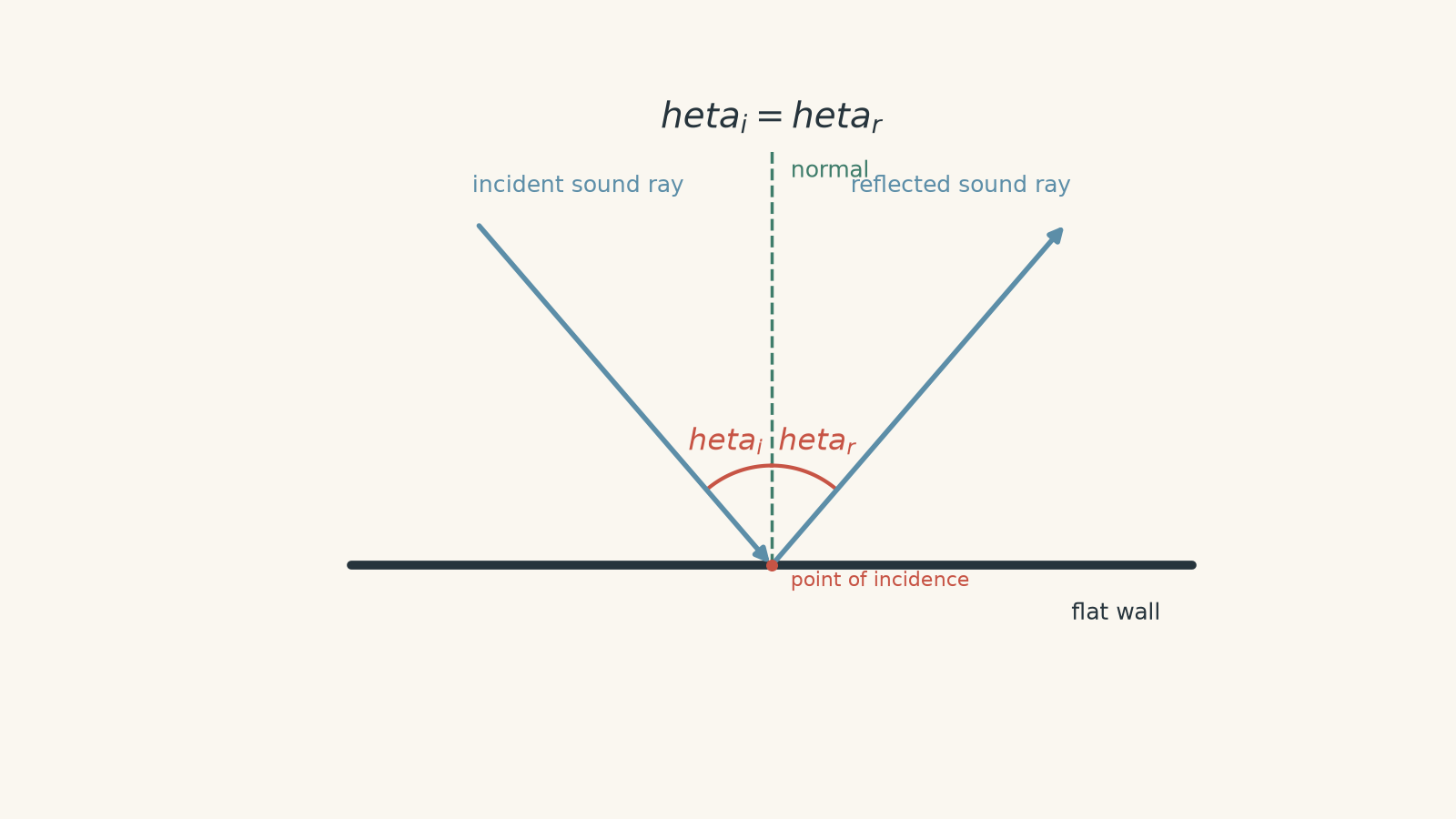
Here’s the common trap. Suppose a sound ray makes an angle of \(30^\circ\) with the wall itself. Is its angle of incidence \(30^\circ\)?
No. The normal is \(90^\circ\) to the wall, so
\[
\theta_i = 90^\circ – 30^\circ = 60^\circ
\]
The reflected ray is also \(60^\circ\) from the normal.
07Smooth reflection versus scattered reflection
The word “smooth” needs some care in wave physics.
A surface that looks rough to your eye can still behave as a relatively smooth reflector for a sound wave if its bumps are small compared with the wavelength.
The wavelength is
\[
\lambda = \frac{v}{f}
\]
where:
- \(\lambda\) is wavelength in metres
- \(v\) is wave speed in \(\text{m s}^{-1}\)
- \(f\) is frequency in hertz (\(\text{Hz}\))
For sound travelling at \(343\text{ m s}^{-1}\):
- a \(200\text{ Hz}\) sound has wavelength \(1.72\text{ m}\)
- a \(4000\text{ Hz}\) sound has wavelength \(0.0858\text{ m}\), or about \(8.6\text{ cm}\)
A surface with irregularities several centimetres across is tiny compared with the wavelength of the \(200\text{ Hz}\) sound but much more significant compared with the wavelength of the \(4000\text{ Hz}\) sound.
So the higher-frequency sound may be scattered much more strongly.
This helps explain why the acoustic behaviour of a room can depend on frequency. “The wall reflects sound” is useful as a starting statement, but it isn’t the complete story.
08The factor-of-two rule has a hidden assumption
You’ve now seen
\[
d = \frac{vt}{2}
\]
several times. It is useful, but it is not a universal “reflection formula”.
The division by 2 works when the sound travels from the measuring location to a reflector and then returns across the same distance.
Suppose instead that a loudspeaker sends a pulse to a microphone across a room. The microphone receives:
- one wave travelling directly from speaker to microphone
- another wave that takes a longer path by reflecting from the ceiling
If the reflected path is \(4\text{ m}\) longer than the direct path, the extra delay is
\[
\Delta t = \frac{\Delta s}{v}
\]
There is no automatic division by 2. You use the actual difference in path lengths.
This is a useful HSC habit: before using an equation, identify what physical journey the distance represents.
09The most tempting misconception
A student hears no obvious echo in a classroom and concludes:
The classroom walls must not reflect sound.
The observation is reasonable. The conclusion isn’t.
Several reflected waves can return within only a few milliseconds of the direct sound. Your ears may combine them rather than identify each reflection separately. Furniture, people, curtains, carpet, ceiling materials, and irregular surfaces can also absorb or scatter some of the energy.
So:
No distinct echo does not mean no reflection.
A better question is: how much energy is reflected, in what directions, and how long after the direct sound does it arrive?
That shift from “does reflection happen?” to “what does the reflection do?” is what makes the idea useful for acoustics.
10Questions and solutions
Question 1
A student stands in front of a large flat wall and produces a short sound. The echo returns \(0.150\text{ s}\) later.
Taking the speed of sound to be \(343\text{ m s}^{-1}\), calculate the student’s distance from the wall.
Solution 1
The student is approximately \(\boxed{25.7\text{ m}}\) from the wall.
The measured \(0.150\text{ s}\) is the time for the sound to travel to the wall and back, so the total distance is \(2d\).
Using
\[
d = \frac{vt}{2}
\]
gives
\[
d = \frac{(343)(0.150)}{2}
= \frac{51.45}{2}
= 25.725\text{ m}
\]
Therefore,
\[
\boxed{d \approx 25.7\text{ m}}
\]
The common mistake is to calculate \(343(0.150)=51.45\text{ m}\) and call that the wall distance. That value is the total round-trip distance travelled by the sound.
Question 2
Two identical short sound pulses are directed towards separate walls at the same distance.
Wall A is bare concrete. Wall B is covered with thick sound-absorbing material.
Predict which returned pulse is likely to have the greater amplitude, and explain what happens to the sound energy at each wall.
Solution 2
The pulse reflected from Wall A is likely to have the greater amplitude.
Concrete generally reflects a larger fraction of incident sound energy than a deliberately absorptive surface. More reflected energy means a larger-amplitude returning wave, provided the geometry is otherwise the same.
At each wall, the incident sound energy can be divided between reflection, absorption, and transmission. Wall B absorbs a larger fraction of the sound energy, with that energy ultimately becoming internal energy in the material and its surroundings.
The trap is to say that Wall B “destroys” the sound energy. Energy is transferred or transformed. It is not simply lost from the energy accounting.
Question 3
A sound ray strikes a flat reflecting panel at an angle of \(35^\circ\) to the surface of the panel.
Determine:
- the angle of incidence
- the angle of reflection
- the angle made by the reflected ray with the surface
Solution 3
The angle of incidence is \(55^\circ\), the angle of reflection is \(55^\circ\), and the reflected ray is \(35^\circ\) to the surface.
Angles of incidence and reflection are measured from the normal, not from the reflecting surface.
Because the normal is perpendicular to the panel,
\[
\theta_i = 90^\circ – 35^\circ = 55^\circ
\]
The law of reflection gives
\[
\theta_r = \theta_i = 55^\circ
\]
Therefore, the reflected ray makes
\[
90^\circ – 55^\circ = 35^\circ
\]
with the panel.
The tempting mistake is to call \(35^\circ\) the angle of incidence simply because it is the angle supplied in the question. Always check what line the angle is measured from.
Question 4
A speaker sends a very short pulse towards a microphone. The direct path from the speaker to the microphone is \(8.0\text{ m}\). A second copy of the pulse reaches the microphone after reflecting from the ceiling and travels a total distance of \(11.4\text{ m}\).
Take the speed of sound as \(343\text{ m s}^{-1}\).
Calculate the delay between the direct and reflected pulses. Explain why dividing by 2 would be incorrect.
Solution 4
The reflected pulse arrives approximately \(\boxed{9.91\text{ ms}}\) after the direct pulse, and there is no factor of 2 because we are comparing two different complete paths.
The difference between the path lengths is
\[
\Delta s = 11.4 – 8.0 = 3.4\text{ m}
\]
The corresponding time difference is
\[
\Delta t = \frac{\Delta s}{v}
= \frac{3.4}{343}
= 0.00991\text{ s}
\]
Converting to milliseconds,
\[
\Delta t = 9.91\text{ ms}
\]
Therefore,
\[
\boxed{\Delta t \approx 9.91\text{ ms}}
\]
The familiar echo formula \(d = vt/2\) applies when a measured round trip consists of travelling to a reflector and returning over the same distance. Here, both \(8.0\text{ m}\) and \(11.4\text{ m}\) are already complete speaker-to-microphone paths. We only need their difference.
This is why memorising “reflection means divide by 2” is dangerous. The geometry decides the equation.
Question 5
A student stands \(18.0\text{ m}\) from a large wall in an indoor hall. Using \(343\text{ m s}^{-1}\), the expected round-trip delay from that wall is slightly more than \(0.1\text{ s}\).
The student produces a short sound but does not hear an obvious separate echo. Another student concludes, “That proves the wall did not reflect the sound.”
Assess this conclusion. Give at least two physically reasonable explanations for the observation that are consistent with sound reflection occurring.
Solution 5
The conclusion is not justified. Failing to hear a distinct echo does not prove that reflection did not occur.
First, the predicted delay is
\[
t = \frac{2d}{v}
= \frac{2(18.0)}{343}
= 0.105\text{ s}
\]
So a reflected wave travelling directly to the wall and back would arrive about
\[
\boxed{0.105\text{ s}}
\]
after the original sound.
That delay is around the commonly used \(0.1\text{ s}\) rule of thumb, but this rule does not guarantee that a listener will perceive two separate sounds.
One possible explanation is that the reflected wave is too weak. Some sound may be absorbed, transmitted, or scattered, leaving a returning wave that is difficult to distinguish from the original sound and background noise.
A second explanation is that many other reflections are present. Reflections from the ceiling, floor, side walls, seats, and other surfaces can overlap to produce reverberation, masking the particular reflection from the wall.
The duration of the original sound also matters. If it lasts long enough, the reflected sound can overlap with it even when the travel-time difference is around \(0.1\text{ s}\).
The important reasoning is that an echo is a perception of a sufficiently separated reflection, not the definition of reflection itself. The absence of a clearly heard echo is therefore not evidence that the reflected wave has zero amplitude.
11Where reflection leads next
Once you can track a sound wave out to a boundary and back, several later wave ideas become easier.
Two or more reflected waves can overlap, so the next question is no longer just where does the sound go? It becomes what happens when the returning wave meets another wave?
That leads directly to superposition, interference, and standing waves. In rooms, pipes, and musical instruments, reflection doesn’t merely send sound back towards its source. Under the right conditions, repeated reflections create stable patterns of large and small amplitude.
So the echo equation is only the first use of reflection. The bigger idea is that boundaries change the paths of waves, and once those paths overlap, the behaviour of the whole system changes.