
Resonance in Sound Systems: Natural Frequencies Explained
Learn how resonance occurs when strings and air columns are driven at their natural frequencies, and how boundary conditions determine the modes that form.
A speaker sends a steady tone into a tube. At most frequencies, not much happens. Then the frequency changes slightly and the tube suddenly sounds much louder, even though the speaker has not become more powerful.
Why?
Before reading on, make a prediction. Suppose the tube has a natural frequency of 400 Hz. Which driving tone should produce the largest response: 350 Hz, 400 Hz, or 450 Hz?
The 400 Hz tone. The driving frequency matches one of the tube’s natural frequencies, so energy is transferred into the oscillation particularly effectively. That large response is resonance.
01Start with the timing
Think about pushing someone on a swing.
If you push at roughly the right point in every cycle, each push adds energy to the motion. The swing’s amplitude grows. If you push with awkward timing, some pushes help, some do very little, and some can work against the motion.
A driven string or air column behaves similarly. An external source supplies repeated oscillations. When the source drives the system at one of its natural frequencies, successive cycles reinforce the oscillation.
That swing analogy is useful for understanding the timing, but it is incomplete. A string or air column is not one object moving back and forth as a single lump. Waves travel through it, reflect from boundaries, and interfere to form standing waves. Its natural frequencies come from the standing-wave patterns that fit the boundaries.
That is the extra layer we need.
02What is a natural frequency?
Every vibrating system has frequencies at which it can sustain particular patterns of motion.
For a string fixed at both ends, only standing waves with a node at each end can persist.
For an air column, the allowed patterns depend on whether each end is open or closed.
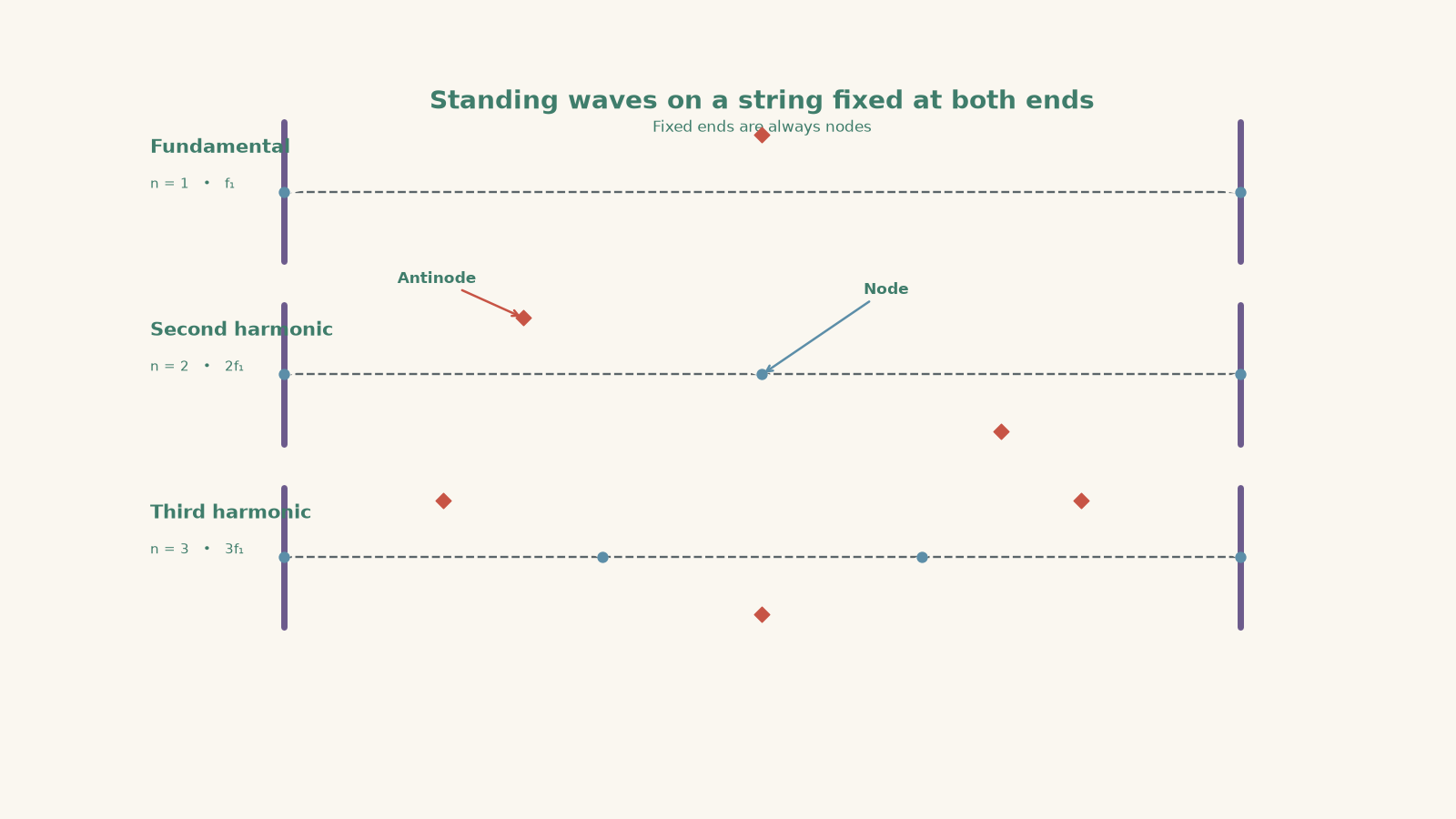
Before we write equations, recall three wave ideas:
- frequency, \(f\), is the number of oscillations each second, measured in hertz (Hz)
- wavelength, \(\lambda\), is the length of one complete wave cycle, measured in metres (m)
- wave speed, \(v\), is related to them by \(v = f\lambda\)
A standing wave forms when waves travelling in opposite directions interfere.
A node is a point where the oscillation has zero amplitude.
An antinode is a point where the amplitude is largest.
The boundary conditions decide where nodes and antinodes must occur. That restriction decides which wavelengths, and therefore which frequencies, are possible.
03Natural frequencies of a string fixed at both ends
A fixed end cannot move, so both ends of the string must be nodes.
The simplest possible standing wave fits half a wavelength along the string:
\[
L = \frac{\lambda_1}{2}
\]
where \(L\) is the string length and \(\lambda_1\) is the wavelength of the fundamental mode.
Therefore,
\[
\lambda_1 = 2L
\]
Using \(v = f\lambda\),
\[
f_1 = \frac{v}{2L}
\]
where:
- \(f_1\) is the fundamental frequency in Hz
- \(v\) is the wave speed on the string in m s\(^{-1}\)
- \(L\) is the string length in m
Higher standing-wave patterns can fit two, three, four, or more half-wavelengths along the string.
So the allowed frequencies are
\[
f_n = \frac{nv}{2L}
\]
where \(n = 1, 2, 3, \ldots\)
These are the string’s natural frequencies.
The fundamental has \(n=1\). The second harmonic has \(n=2\). The third harmonic has \(n=3\), and so on.
Worked example: Which driving frequency resonates with the string?
A string is fixed at both ends. It is \(0.80\text{ m}\) long, and waves travel along it at \(240\text{ m s}^{-1}\). A driver can oscillate at 130 Hz, 150 Hz, or 175 Hz. Which frequency produces resonance in the fundamental mode?
Step 1
\[
f_1 = \frac{v}{2L}
\]
Step 2
\[
f_1 = \frac{240}{2(0.80)}
= \frac{240}{1.60}
= 150\text{ Hz}
\]
Step 3
The matching driving frequency is
\[
\boxed{150\text{ Hz}}
\]
At 150 Hz, the driver supplies energy at the same frequency as the string’s fundamental natural oscillation. The string therefore develops a much larger steady-state amplitude than it does at 130 Hz or 175 Hz, assuming similar driving force and damping.
04What resonance actually means
A common shortcut is:
Resonance happens when the driving frequency equals the natural frequency.
That is useful, but it can be misunderstood.
Resonance does not mean the driving force suddenly becomes larger. The external force may have exactly the same amplitude across the whole frequency sweep.
What changes is how effectively the repeated driving transfers energy to the system.
Near a natural frequency, the timing between the driver and the oscillation allows energy to build up over many cycles. Away from the natural frequency, the forcing does not reinforce the motion as effectively.
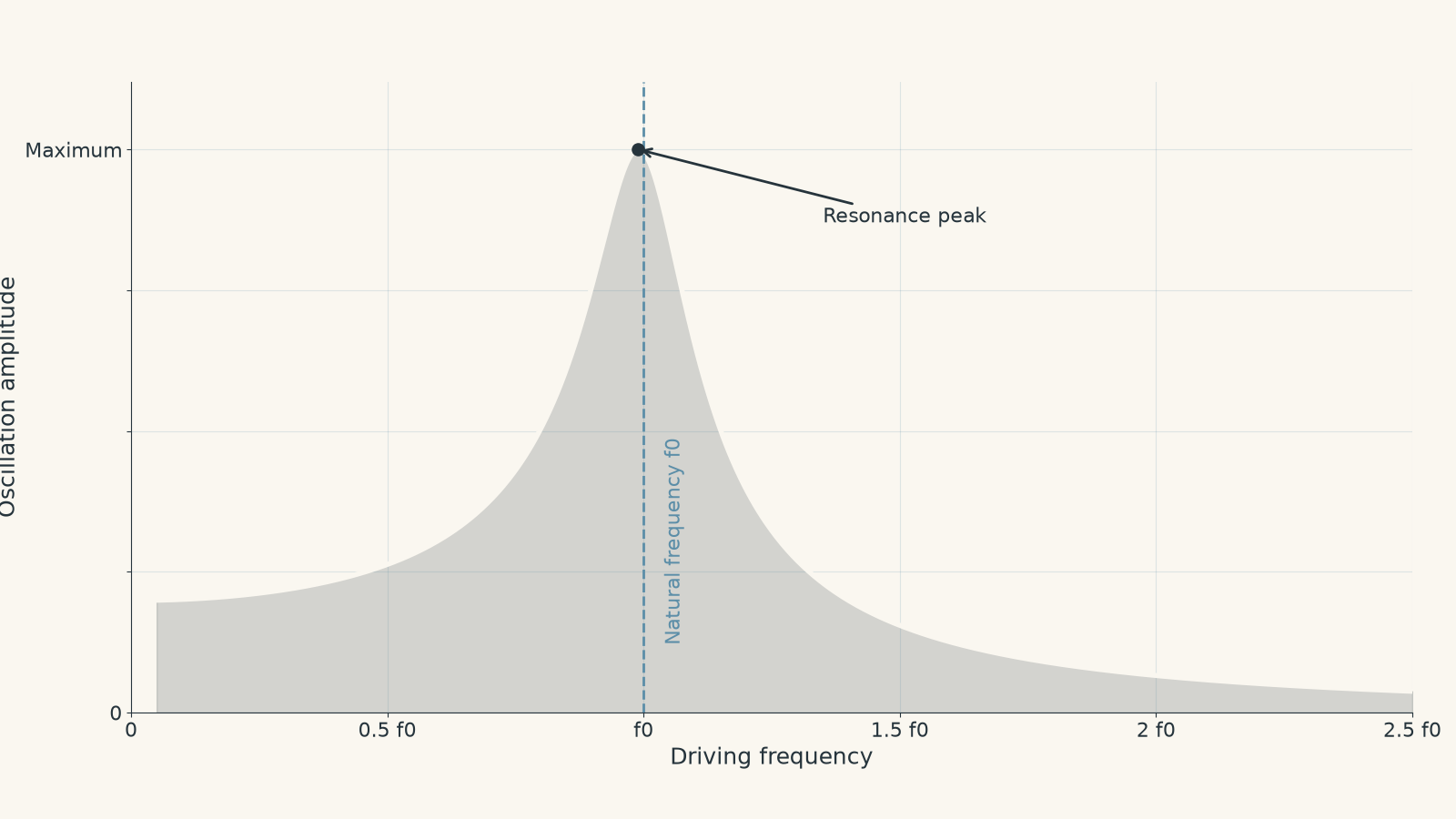
The graph also fixes another misconception. Resonance is not an all-or-nothing event where the system is motionless at every other frequency. A driven system generally responds across a range of frequencies. The amplitude simply becomes especially large near resonance.
05Resonance in an open air column
Now imagine a tube that is open at both ends.
At an open end, the air is free to move, so an open end corresponds approximately to a displacement antinode.
That word “approximately” matters. Real tubes have end effects, meaning the effective acoustic length is slightly different from the measured physical length. In standard HSC calculations, unless told otherwise, we usually use the ideal boundary model.
With displacement antinodes at both ends, an open tube has the same allowed wavelength pattern as a string fixed at both ends, even though the node and antinode locations are different.
Its natural frequencies are therefore
\[
f_n = \frac{nv}{2L}
\]
where \(v\) is now the speed of sound in air.
So an open tube supports the fundamental and all integer harmonics:
\[
f_1,\ 2f_1,\ 3f_1,\ 4f_1,\ldots
\]
Be careful with the analogy to a string. The frequency pattern is the same, but the physical boundary conditions are not. A fixed string end is a displacement node, while an open air-column end is approximately an air-displacement antinode.
06A tube closed at one end behaves differently
Now close one end of the tube.
Air cannot move back and forth through the closed end, so the closed end is a displacement node. The open end remains a displacement antinode.
Can half a wavelength fit between those two boundaries?
No. Half a wavelength takes you from one node to the next node, or from one antinode to the next antinode. We need to go from a node to an antinode.
The shortest pattern is one quarter of a wavelength:
\[
L = \frac{\lambda_1}{4}
\]
so
\[
\lambda_1 = 4L
\]
and therefore
\[
f_1 = \frac{v}{4L}
\]
The next allowed mode must still have a node at the closed end and an antinode at the open end. This gives three quarters of a wavelength, then five quarters, and so on.
The natural frequencies are
\[
f_n = \frac{(2n-1)v}{4L}
\]
where \(n = 1, 2, 3, \ldots\)
This produces
\[
f_1,\ 3f_1,\ 5f_1,\ 7f_1,\ldots
\]
Only the odd harmonics occur in the ideal closed-open tube.
| System | Boundary pattern | Fundamental frequency | Ideal natural frequencies |
|---|---|---|---|
| String fixed at both ends | node to node | \(f_1=\frac{v}{2L}\) | \(f_n=nf_1\) |
| Tube open at both ends | antinode to antinode | \(f_1=\frac{v}{2L}\) | \(f_n=nf_1\) |
| Tube closed at one end | node to antinode | \(f_1=\frac{v}{4L}\) | \(f_n=(2n-1)f_1\) |
Worked example: Which resonance occurs in a closed tube?
A tube is closed at one end and has length \(0.50\text{ m}\). Take the speed of sound as \(340\text{ m s}^{-1}\). A speaker drives the air column at 510 Hz. Determine whether this is a natural frequency and, if so, identify the mode.
Step 1
\[
f_1 = \frac{v}{4L}
= \frac{340}{4(0.50)}
= \frac{340}{2.00}
= 170\text{ Hz}
\]
Step 2
A closed-open tube supports odd multiples of the fundamental:
\[
170\text{ Hz},\ 510\text{ Hz},\ 850\text{ Hz},\ldots
\]
Step 3
\[
510 = 3(170)
\]
So 510 Hz is the third harmonic.
Using the mode-number form,
\[
f_n=\frac{(2n-1)v}{4L}
\]
the third harmonic corresponds to \(2n-1=3\), so \(n=2\). This is the second allowed mode, but the third harmonic.
The speaker therefore drives the air column at one of its natural frequencies, so resonance occurs.
This naming is worth noticing. In a closed-open tube, “second allowed mode” does not mean “second harmonic”. The second harmonic is absent.
07Why the amplitude does not grow forever
Our simple swing picture might suggest that every correctly timed push keeps making the amplitude larger without limit.
Real systems do not behave that way.
Energy is continually lost through processes such as:
- air resistance
- friction at supports
- internal deformation of materials
- sound radiation into the surroundings
These effects are grouped under damping.
At resonance, the system initially gains energy and its amplitude grows. Eventually, the average energy supplied by the driver each cycle equals the average energy lost through damping.
The system then reaches a steady oscillation with a finite amplitude.
Greater damping generally produces a lower and broader resonance peak. Lower damping produces a sharper, larger peak.
So “resonance gives infinite amplitude” is only a feature of an unrealistic ideal model with no energy losses.
08Matching the frequency is necessary, but there is another detail
Suppose a string’s second harmonic is 300 Hz. You attach a small driver and run it at exactly 300 Hz.
Must the second harmonic become strongly excited?
Not necessarily.
The driver’s position matters as well as its frequency.
For the second harmonic of a string fixed at both ends, there is a node at the centre. That point does not move in the ideal standing-wave pattern.
If a driver tries to move the string exactly at that node, it couples very poorly to the second-harmonic mode. Moving the driver away from the node can excite that mode much more effectively.
This adds an important refinement:
A driving frequency matching a natural frequency creates the conditions for resonance, but the driver must also couple effectively to that mode.
At HSC level, most numerical problems focus on the frequency condition. In experiments and real instruments, the spatial coupling can matter too.
09The most tempting misconception
A student sees a large resonance peak and says:
“The wave travels faster at resonance, which is why the amplitude increases.”
That prediction feels reasonable because something dramatic clearly changes.
But the wave speed is not what causes the resonance peak.
For a particular medium under fixed conditions, wave speed is determined by the properties of that medium. On a string, it depends on quantities such as tension and linear mass density. In air, the speed of sound depends mainly on the properties and temperature of the air.
At resonance, the important change is the efficiency of energy transfer, not a sudden increase in wave speed.
The equation
\[
v=f\lambda
\]
still holds. If a different natural mode has a higher frequency while the wave speed remains approximately constant, its wavelength must be shorter.
For example, doubling the frequency on an ideal string with unchanged wave speed halves the wavelength.
10Questions and solutions
Question 1
A string \(0.60\text{ m}\) long is fixed at both ends. Waves travel along the string at \(180\text{ m s}^{-1}\).
Calculate its fundamental frequency. Would a driver operating at 150 Hz produce fundamental resonance?
Solution 1
The fundamental frequency is \(150\text{ Hz}\), so a 150 Hz driver produces fundamental resonance.
For a string fixed at both ends,
\[
f_1=\frac{v}{2L}
\]
where \(v=180\text{ m s}^{-1}\) and \(L=0.60\text{ m}\).
Substituting,
\[
f_1
=\frac{180}{2(0.60)}
=\frac{180}{1.20}
=150\text{ Hz}
\]
The driving frequency is therefore equal to the string’s fundamental natural frequency:
\[
f_{\text{drive}}=f_1=150\text{ Hz}
\]
Successive driving cycles can transfer energy efficiently into the fundamental standing-wave mode, so a large resonant response is expected.
Question 2
An ideal tube has length \(0.40\text{ m}\). Take the speed of sound as \(344\text{ m s}^{-1}\).
Calculate the fundamental frequency when:
a. both ends are open
b. one end is closed
Explain why simply closing one end changes the resonant frequency even though neither the tube length nor the speed of sound has changed.
Solution 2
The open-open tube has a fundamental frequency of \(430\text{ Hz}\), while the closed-open tube has a fundamental frequency of \(215\text{ Hz}\). Closing one end changes the boundary conditions, so a different standing-wave pattern must fit inside the same length.
For the open-open tube,
\[
f_1=\frac{v}{2L}
\]
Substituting,
\[
f_1
=\frac{344}{2(0.40)}
=\frac{344}{0.80}
=430\text{ Hz}
\]
For the closed-open tube,
\[
f_1=\frac{v}{4L}
\]
so
\[
f_1
=\frac{344}{4(0.40)}
=\frac{344}{1.60}
=215\text{ Hz}
\]
The change is not caused by a different wave speed. The air is still the same medium.
Instead, the standing wave must satisfy different boundary conditions. The open-open fundamental fits half a wavelength into the tube:
\[
L=\frac{\lambda}{2}
\]
The closed-open fundamental fits only one quarter of a wavelength:
\[
L=\frac{\lambda}{4}
\]
For the same \(L\), the closed-open fundamental therefore has twice the wavelength. Because \(v=f\lambda\) and \(v\) is unchanged, twice the wavelength means half the frequency.
Question 3
A speaker is connected to a signal generator and placed near an air column. As the driving frequency increases, a strong resonance is observed at 240 Hz and another at 720 Hz.
A student concludes:
“The tube must be closed at one end because 720 Hz is three times 240 Hz.”
Is that conclusion justified from these observations alone? Explain.
Solution 3
No. The observations are consistent with a closed-open tube, but they do not prove that the tube is closed at one end.
For an ideal closed-open tube, the allowed harmonics are odd multiples of the fundamental:
\[
f_1,\ 3f_1,\ 5f_1,\ldots
\]
If \(f_1=240\text{ Hz}\), then
\[
3f_1=720\text{ Hz}
\]
so the two observed peaks certainly fit that pattern.
However, an open-open tube has natural frequencies
\[
f_1,\ 2f_1,\ 3f_1,\ldots
\]
It could therefore also have natural frequencies at
\[
240\text{ Hz},\ 480\text{ Hz},\ 720\text{ Hz},\ldots
\]
If the 480 Hz mode was not detected, that does not automatically mean it does not exist. The source position, detector position, damping, or coupling to that particular mode could make its observed response weak.
The trap is treating “we did not observe a peak” as identical to “that natural frequency cannot exist”. More evidence about the boundary conditions or a careful search for the 480 Hz resonance would be needed.
Question 4
Two strings have the same length, tension, and linear mass density, so they have the same natural frequencies. String A is strongly damped, while string B is weakly damped.
Both are driven by forces of equal amplitude while the driving frequency is swept through the fundamental resonance.
Compare their resonance frequencies and their maximum amplitudes.
Solution 4
The strings have approximately the same fundamental resonance frequency, but the weakly damped string B reaches the larger maximum amplitude.
Their natural frequencies are set mainly by the wave speed and string length. Since those relevant physical properties are the same, their fundamental natural frequencies are the same in the simple HSC model:
\[
f_1=\frac{v}{2L}
\]
Damping affects how rapidly mechanical energy is removed from the oscillation.
String A loses energy more rapidly, so its steady resonant amplitude remains smaller.
String B loses less energy per cycle. Near resonance, energy supplied by the driver can build up to a larger stored oscillation before the input and loss rates balance.
The misconception to avoid is that a taller resonance peak means the system has a different natural frequency. Damping mainly changes the size and sharpness of the resonance response, rather than creating a completely different set of standing-wave frequencies.
Question 5
A string fixed at both ends has a second-harmonic natural frequency of 400 Hz. A small mechanical driver is attached exactly at the midpoint of the string and oscillates at 400 Hz.
A student predicts a very large second-harmonic resonance because the driving frequency exactly matches the natural frequency.
Explain why that prediction can fail, even in an idealised string.
Solution 5
The second harmonic may be excited only very weakly because the midpoint is a node of that mode, so frequency matching alone does not guarantee strong coupling.
For the second harmonic of a string fixed at both ends, the standing-wave pattern contains nodes at both ends and another node at the midpoint.
The midpoint therefore has zero displacement in the ideal second-harmonic mode.
Although the driver has the correct frequency,
\[
f_{\text{drive}}=f_2=400\text{ Hz},
\]
it is attempting to force the string precisely where that particular mode requires essentially no motion.
As a result, the driver couples poorly to the second harmonic. Moving the driver away from the midpoint, towards a position where the mode has substantial displacement, would allow much more effective energy transfer.
The hidden assumption in the student’s argument is that matching the frequency is the only requirement. It identifies a natural mode that can resonate, but strong resonance also depends on how the driving force interacts spatially with that mode.
11What resonance lets you work out next
Once you can connect resonance to standing-wave boundary conditions, several later ideas become much easier to reason about.
You can predict which harmonics an instrument can support, explain why changing the effective length changes pitch, and use measured resonance frequencies to infer properties such as an unknown wavelength, wave speed, or effective air-column length.
The next useful step is to connect these resonant modes to harmonics, overtones, and sound quality. The fundamental frequency largely sets the perceived pitch, while the mixture of higher resonant modes helps distinguish two sound sources even when they play the same note.