
Standing Waves on Strings: Harmonics and Wave Speed
Learn how string length, tension, linear mass density, and wave speed determine the allowed harmonics of a standing wave. Includes worked examples and HSC-style practice.
Pluck a stretched string and you hear one main note, even though the string could, in principle, move in countless different ways. Shorten the string and the note rises. Tighten it and the note rises again. Make the string heavier and the note falls.
But here is the more interesting problem: why are only certain frequencies allowed? Why can’t a string fixed at both ends form a stable standing wave at any frequency you choose?
The answer comes from fitting waves between two boundaries. Once we understand that geometry, the effects of string length, tension, mass density, and wave speed all fall into place.
01Why only certain standing waves fit
Imagine sending a pulse along a string fixed at both ends. The pulse travels to an end, reflects, and comes back. If waves keep travelling in both directions, they overlap.
At some frequencies, this interference produces a stable pattern called a standing wave. Certain points remain still. These are nodes. Between neighbouring nodes are points that oscillate with maximum amplitude, called antinodes.
The fixed ends create an important restriction:
Both ends must be nodes.
Now make a prediction. Suppose the string has length \(L\). Could a standing wave fit if the distance from one end to the other were \(0.73\lambda\), where \(\lambda\) is the wavelength?
No. A fixed end must land exactly on a node, and neighbouring nodes are separated by half a wavelength. The string therefore has to contain a whole number of half-wavelengths.
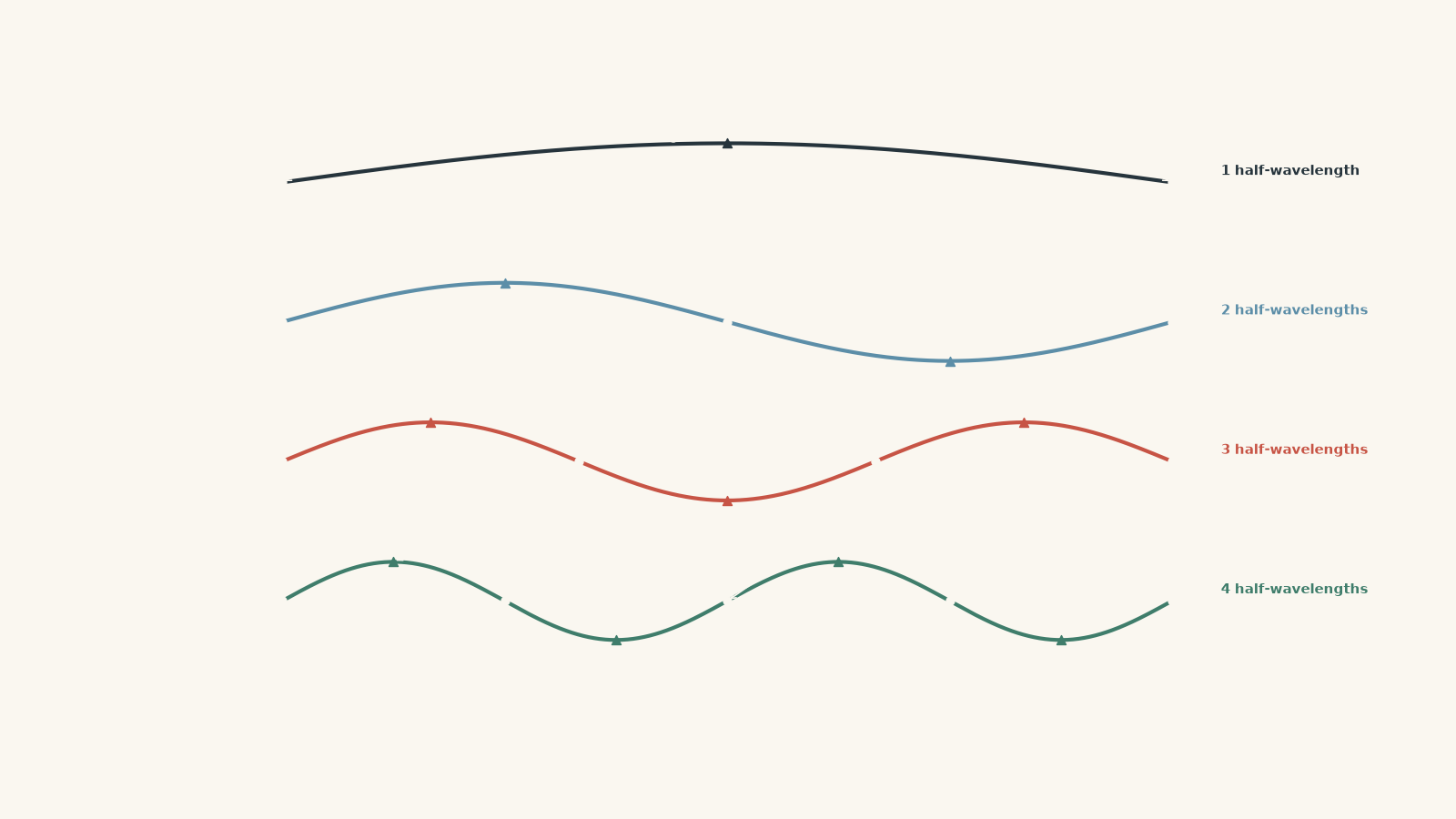
For the simplest pattern, one half-wavelength fits:
\[
L=\frac{\lambda_1}{2}
\]
so
\[
\lambda_1=2L
\]
For the next pattern, two half-wavelengths fit:
\[
L=2\left(\frac{\lambda_2}{2}\right)=\lambda_2
\]
For the third pattern, three half-wavelengths fit:
\[
L=3\left(\frac{\lambda_3}{2}\right)
\]
so
\[
\lambda_3=\frac{2L}{3}
\]
The general rule is
\[
\lambda_n=\frac{2L}{n}
\]
where:
- \(\lambda_n\) is the wavelength of the \(n\)th allowed mode, in metres
- \(L\) is the vibrating length of the string, in metres
- \(n\) is a positive integer: \(1,2,3,\ldots\)
That integer matters. Values such as \(n=2.4\) don’t describe an allowed standing-wave mode for a string fixed at both ends.
02Fundamental frequency and harmonics
The mode with \(n=1\) is the fundamental frequency, also called the first harmonic.
Higher values of \(n\) give the higher harmonics.
| Harmonic | Half-wavelengths along string | Wavelength | Frequency |
|---|---|---|---|
| \(n=1\) | 1 | \(2L\) | \(f_1\) |
| \(n=2\) | 2 | \(L\) | \(2f_1\) |
| \(n=3\) | 3 | \(\frac{2L}{3}\) | \(3f_1\) |
| \(n=4\) | 4 | \(\frac{L}{2}\) | \(4f_1\) |
A useful way to picture this is to imagine trying to fit identical half-wave “loops” into the string. The ends are like two extremely strict bouncers: a node must be standing at each door. You can fit one loop, two loops, three loops, and so on, but not two and a bit.
That picture is useful for the geometry. It breaks down if you imagine the loops as separate objects. The string is one continuous object, and the standing wave comes from interference between travelling waves.
03Turning wavelength into frequency
You already know the wave equation:
\[
v=f\lambda
\]
where \(v\) is wave speed in metres per second, \(f\) is frequency in hertz, and \(\lambda\) is wavelength in metres.
For the \(n\)th harmonic,
\[
f_n=\frac{v}{\lambda_n}
\]
and we just found that
\[
\lambda_n=\frac{2L}{n}
\]
Therefore,
\[
f_n=\frac{nv}{2L}
\]
This is the first major standing-wave equation for a string fixed at both ends.
It tells us immediately that, if the wave speed and length stay constant,
\[
f_n=nf_1
\]
where
\[
f_1=\frac{v}{2L}
\]
So the second harmonic has twice the fundamental frequency, the third has three times the fundamental frequency, and so on.
A tempting misconception: higher harmonic means higher wave speed
The third harmonic has three times the frequency of the fundamental. Does that mean waves are travelling three times faster?
No.
On the same string, with the same tension and linear mass density, the wave speed is the same for every harmonic. The third harmonic has three times the frequency because its wavelength is one-third as large:
\[
v=f\lambda
\]
Frequency rises while wavelength falls by the matching factor, so \(v\) stays unchanged.
04What determines the wave speed?
We now need to know where \(v\) comes from.
For an ideal stretched string,
\[
v=\sqrt{\frac{T}{\mu}}
\]
where:
- \(v\) is the transverse wave speed in \(\text{m s}^{-1}\)
- \(T\) is the tension in the string, in newtons
- \(\mu\) is the linear mass density, in \(\text{kg m}^{-1}\)
Linear mass density means mass per unit length:
\[
\mu=\frac{m}{L}
\]
for a uniform piece of string of mass \(m\) and length \(L\).
Be careful with the word “density” here. \(\mu\) is not ordinary volumetric density in \(\text{kg m}^{-3}\). It tells us how much mass is packed into each metre of string.
The physics of the wave-speed equation makes sense before you calculate anything.
A larger tension gives a stronger restoring force when the string is displaced, so disturbances travel faster.
A larger linear mass density means more mass has to be accelerated, so disturbances travel more slowly.
Combining
\[
f_n=\frac{nv}{2L}
\]
with
\[
v=\sqrt{\frac{T}{\mu}}
\]
gives the key result:
\[
f_n=\frac{n}{2L}\sqrt{\frac{T}{\mu}}
\]
This one equation connects the allowed harmonics to harmonic number, string length, tension, linear mass density, and wave speed.
05Reading the equation without calculating
Before reaching for a calculator, you should be able to predict how the frequency changes.
From
\[
f_n=\frac{n}{2L}\sqrt{\frac{T}{\mu}}
\]
we get:
| Change | Effect on \(f_n\), if everything else stays constant |
|---|---|
| Increase harmonic number \(n\) | \(f_n\) increases directly with \(n\) |
| Increase length \(L\) | \(f_n\) decreases as \(1/L\) |
| Increase tension \(T\) | \(f_n\) increases as \(\sqrt{T}\) |
| Increase linear mass density \(\mu\) | \(f_n\) decreases as \(1/\sqrt{\mu}\) |
Here is an important prediction.
If you double the tension, does the frequency double?
It feels plausible. More tension means faster waves, so perhaps twice the tension means twice the frequency.
But tension sits inside a square root:
\[
f\propto\sqrt{T}
\]
Doubling the tension multiplies the frequency by
\[
\sqrt{2}\approx1.41
\]
not by \(2\).
To double the frequency using tension alone, you would need four times the tension.
06Worked example: Find the fundamental and third harmonic
A string of length \(0.80\text{ m}\) is held under a tension of \(72\text{ N}\). Its linear mass density is \(2.0\times10^{-3}\text{ kg m}^{-1}\). Find the fundamental frequency and the frequency of the third harmonic.
Step 1
\[
v=\sqrt{\frac{T}{\mu}}
=\sqrt{\frac{72}{2.0\times10^{-3}}}
=\sqrt{36000}
=189.7\text{ m s}^{-1}
\]
The disturbance travels along the string at about \(190\text{ m s}^{-1}\).
Step 2
\[
f_1=\frac{v}{2L}
=\frac{189.7}{2(0.80)}
=118.6\text{ Hz}
\]
Step 3
\[
f_3=3f_1
=3(118.6)
=355.8\text{ Hz}
\]
So the frequencies are approximately
\[
\boxed{f_1=119\text{ Hz}}
\]
and
\[
\boxed{f_3=356\text{ Hz}}
\]
The third harmonic has three times the frequency of the fundamental, but the waves still travel along the string at the same speed, \(189.7\text{ m s}^{-1}\).
07Worked example: Find the required tension
A \(0.75\text{ m}\) string has a linear mass density of \(1.6\times10^{-3}\text{ kg m}^{-1}\). What tension is needed for its third harmonic to have a frequency of \(300\text{ Hz}\)?
Step 1
For the third harmonic, \(n=3\):
\[
f_n=\frac{nv}{2L}
\]
Rearranging,
\[
v=\frac{2Lf_n}{n}
\]
Substitute the values:
\[
v=\frac{2(0.75)(300)}{3}
=150\text{ m s}^{-1}
\]
So the string needs a wave speed of \(150\text{ m s}^{-1}\).
Step 2
\[
v=\sqrt{\frac{T}{\mu}}
\]
Square both sides:
\[
v^2=\frac{T}{\mu}
\]
Therefore,
\[
T=\mu v^2
\]
Step 3
\[
T=(1.6\times10^{-3})(150)^2
=36\text{ N}
\]
Therefore,
\[
\boxed{T=36\text{ N}}
\]
A tension of \(36\text{ N}\) makes the wave speed large enough for exactly three half-wavelengths to fit while the string oscillates at \(300\text{ Hz}\).
08Changing the string length
From
\[
f_n=\frac{n}{2L}\sqrt{\frac{T}{\mu}}
\]
frequency is inversely proportional to length when \(n\), \(T\), and \(\mu\) remain constant:
\[
f_n\propto\frac{1}{L}
\]
So halving the vibrating length doubles every allowed frequency.
This is why shortening a vibrating string produces a higher note.
There is a small trap here. If you shorten the vibrating section of the same uniform string, its linear mass density does not change. Each metre still contains the same amount of mass.
The mass of the vibrating section becomes smaller, but
\[
\mu=\frac{\text{mass of section}}{\text{length of section}}
\]
remains constant.
Don’t accidentally keep the section’s mass fixed while changing its length unless the question actually describes a different string with that fixed mass.
09Changing the mass density
Suppose two strings have the same length and tension, but one has four times the linear mass density.
Predict the frequency before calculating.
Because
\[
f\propto\frac{1}{\sqrt{\mu}}
\]
multiplying \(\mu\) by \(4\) divides the frequency by
\[
\sqrt{4}=2
\]
So the heavier string has half the frequency for the same harmonic.
This is another place where a direct proportionality guess fails. Four times the mass per metre does not make the frequency one-quarter as large. The square root matters.
10The discrete-frequency trap
The equation
\[
f_n=\frac{n}{2L}\sqrt{\frac{T}{\mu}}
\]
does more than calculate a frequency. It tells us that the allowed frequencies are discrete.
Suppose your calculation gives
\[
n=4.6
\]
You cannot conclude that the string is vibrating in the “4.6th harmonic”.
For an ideal string fixed at both ends,
\[
n=1,2,3,\ldots
\]
If a driver forces the string at a frequency between its allowed resonant frequencies, you generally do not get the large, stable standing-wave pattern associated with resonance.
The driver can still make the string move. The point is that the motion will not match one of the ideal normal modes with nodes at both ends and the corresponding stable standing-wave pattern.
11Real strings are slightly less perfect
The HSC model treats the string as flexible and uniform, with constant tension and small-amplitude transverse motion. Under those assumptions,
\[
f_n=nf_1
\]
exactly.
Real strings can have stiffness, non-uniformity, and imperfect boundary conditions. Their higher-frequency modes may therefore differ slightly from exact integer multiples of the fundamental.
That does not make the HSC model wrong. It tells you what the model assumes and when those assumptions are useful.
12Questions and solutions
Question 1
A string fixed at both ends has length \(1.00\text{ m}\), tension \(64\text{ N}\), and linear mass density \(4.0\times10^{-3}\text{ kg m}^{-1}\). Calculate the frequency of its second harmonic.
Solution 1
The second harmonic has a frequency of approximately \(\boxed{126\text{ Hz}}\).
First find the wave speed:
\[
v=\sqrt{\frac{T}{\mu}}
=\sqrt{\frac{64}{4.0\times10^{-3}}}
=\sqrt{16000}
=126.5\text{ m s}^{-1}
\]
For \(n=2\),
\[
f_2=\frac{2v}{2L}
=\frac{2(126.5)}{2(1.00)}
=126.5\text{ Hz}
\]
Therefore,
\[
\boxed{f_2\approx126\text{ Hz}}
\]
The second harmonic contains two half-wavelengths along the string. In this particular case, its numerical frequency happens to equal the numerical wave speed, but their units and physical meanings are completely different.
Question 2
A string is vibrating in one particular harmonic at \(180\text{ Hz}\) while under a tension of \(45\text{ N}\). The length, linear mass density, and harmonic number remain unchanged while the tension is increased to \(80\text{ N}\). Find the new frequency.
Solution 2
The new frequency is \(\boxed{240\text{ Hz}}\).
Because only tension changes,
\[
f\propto\sqrt{T}
\]
so
\[
\frac{f_2}{f_1}
=
\sqrt{\frac{T_2}{T_1}}
\]
Substituting,
\[
\frac{f_2}{180}
=
\sqrt{\frac{80}{45}}
=
\sqrt{\frac{16}{9}}
=
\frac{4}{3}
\]
Therefore,
\[
f_2=180\left(\frac{4}{3}\right)
=240\text{ Hz}
\]
The frequency rises by one-third even though the tension rises by more than one-third. The trap is treating frequency as directly proportional to tension instead of proportional to its square root.
Question 3
A uniform string has a vibrating length of \(0.90\text{ m}\) and a mass of \(5.4\text{ g}\) over that vibrating section. Its tension is \(48.6\text{ N}\). It is driven at \(150\text{ Hz}\).
Determine whether \(150\text{ Hz}\) is an allowed harmonic frequency and, if it is, identify the harmonic.
Solution 3
Yes. \(150\text{ Hz}\) is the \(\boxed{\text{third harmonic}}\).
First convert the mass to kilograms:
\[
5.4\text{ g}=5.4\times10^{-3}\text{ kg}
\]
The linear mass density is
\[
\mu=\frac{m}{L}
=\frac{5.4\times10^{-3}}{0.90}
=6.0\times10^{-3}\text{ kg m}^{-1}
\]
Now find the wave speed:
\[
v=\sqrt{\frac{T}{\mu}}
=\sqrt{\frac{48.6}{6.0\times10^{-3}}}
=\sqrt{8100}
=90\text{ m s}^{-1}
\]
The fundamental frequency is
\[
f_1=\frac{v}{2L}
=\frac{90}{2(0.90)}
=50\text{ Hz}
\]
Therefore,
\[
n=\frac{f_n}{f_1}
=\frac{150}{50}
=3
\]
Since \(n=3\) is an integer,
\[
\boxed{150\text{ Hz is the third harmonic}}
\]
If the calculation had produced a non-integer value of \(n\), such as \(3.4\), that frequency would not be one of the ideal allowed standing-wave frequencies.
Question 4
A uniform string fixed at both ends is initially vibrating in its fourth harmonic. Its vibrating length is then reduced to three-quarters of its original value by moving one fixed boundary. The same string is used, and its tension remains unchanged.
The driving frequency is also kept unchanged.
Which harmonic, if any, can now resonate at the original driving frequency?
Solution 4
The original driving frequency now corresponds to the \(\boxed{\text{third harmonic}}\).
Because the same uniform string is used and its tension is unchanged, \(\mu\) and \(v\) remain unchanged.
Originally,
\[
f=\frac{4v}{2L}
\]
The new length is
\[
L’=\frac{3L}{4}
\]
For a harmonic \(n’\) on the shortened string,
\[
f=\frac{n’v}{2L’}
\]
Because the driving frequency has not changed,
\[
\frac{4v}{2L}
=
\frac{n’v}{2(3L/4)}
\]
Cancel \(v\) and simplify:
\[
\frac{2}{L}
=
\frac{2n’}{3L}
\]
so
\[
n’=3
\]
Therefore,
\[
\boxed{n’=3}
\]
The subtle point is that shortening the string normally raises the frequency of a particular harmonic. But the question does not require the harmonic number to stay the same. By moving from the fourth harmonic to the third, the shortened string can resonate at the original frequency.
Question 5
A string fixed at both ends forms a five-loop standing-wave pattern when driven at \(250\text{ Hz}\). Its tension is then increased by \(44\%\), while its length, linear mass density, and driving frequency remain unchanged.
A student argues:
“The wave speed increases by \(20\%\), so the wavelength increases by \(20\%\). That should just produce another standing-wave pattern.”
Determine whether an exact standing wave is possible at \(250\text{ Hz}\) after the tension change. Then find the frequency required to produce the fourth harmonic at the new tension.
Solution 5
An exact harmonic standing wave is not possible at \(250\text{ Hz}\) after the tension change. The fourth harmonic at the new tension occurs at \(\boxed{240\text{ Hz}}\).
A five-loop pattern corresponds to the fifth harmonic, so initially
\[
f_5=250\text{ Hz}
\]
and therefore
\[
f_1=\frac{250}{5}=50\text{ Hz}
\]
The tension rises by a factor of
\[
1.44
\]
Since
\[
v\propto\sqrt{T}
\]
the new wave speed is multiplied by
\[
\sqrt{1.44}=1.20
\]
With the length unchanged, all allowed frequencies also increase by a factor of \(1.20\). The new fundamental frequency is therefore
\[
f_1’=1.20(50)=60\text{ Hz}
\]
At a driving frequency of \(250\text{ Hz}\), the required harmonic number would be
\[
n=\frac{250}{60}=4.17
\]
But a fixed-fixed string requires
\[
n=1,2,3,\ldots
\]
Therefore \(250\text{ Hz}\) is not an exact allowed harmonic frequency after the tension change.
For the fourth harmonic,
\[
f_4’=4f_1′
=4(60)
=240\text{ Hz}
\]
so
\[
\boxed{f_4’=240\text{ Hz}}
\]
The student’s wave-speed reasoning was partly correct: the speed does increase by \(20\%\). The mistake was assuming that any resulting wavelength can form a standing wave. The boundary conditions still require an integer number of half-wavelengths to fit into the string.
13What this lets you understand next
Standing waves on strings bring two ideas together: the medium determines the wave speed, while the boundaries determine which wavelengths are allowed.
For a fixed-fixed string,
\[
\boxed{\lambda_n=\frac{2L}{n}}
\]
and
\[
\boxed{f_n=\frac{n}{2L}\sqrt{\frac{T}{\mu}}}
\]
That same way of thinking becomes useful when you study resonance more broadly. Instead of asking only, “How fast does the wave travel?”, you can ask a second question: which patterns are actually allowed by the boundaries?
That is the step from ordinary travelling waves to normal modes, resonance, and the standing-wave patterns that appear in strings, air columns, and many other oscillating systems.