
Standing Waves in Closed Pipes: Nodes and Odd Harmonics
Learn why closed pipes form a node at the closed end, an antinode at the open end, and only support odd harmonics.
Blow across the top of a bottle and you can get a clear note. Make the air column shorter, and the pitch rises. But here is the strange part: a pipe closed at one end cannot support just any standing-wave pattern that fits inside it.
Suppose a closed pipe has a fundamental frequency of 200 Hz. What frequency would you expect next: 400 Hz or 600 Hz?
For an ideal pipe that is closed at one end and open at the other, it is 600 Hz. The 400 Hz pattern cannot satisfy the conditions at both ends of the pipe.
That missing second harmonic is the key to understanding closed pipes.
01What has to happen at each end?
Sound in air is a longitudinal wave. Air particles oscillate backwards and forwards parallel to the direction in which the sound travels.
Inside a pipe, sound waves reflect from the ends. An incoming wave and its reflection can interfere to produce a standing wave, with fixed positions where the air moves very little and other positions where it moves strongly.
Before worrying about equations, picture the two ends of a pipe.
At a closed end, the air is pressed against a solid wall. The air particles there cannot oscillate backwards and forwards through the wall. Their displacement must therefore be zero.
So a closed end is a displacement node.
At an open end, the air is free to move in and out. Its displacement can be large.
So an open end is approximately a displacement antinode.
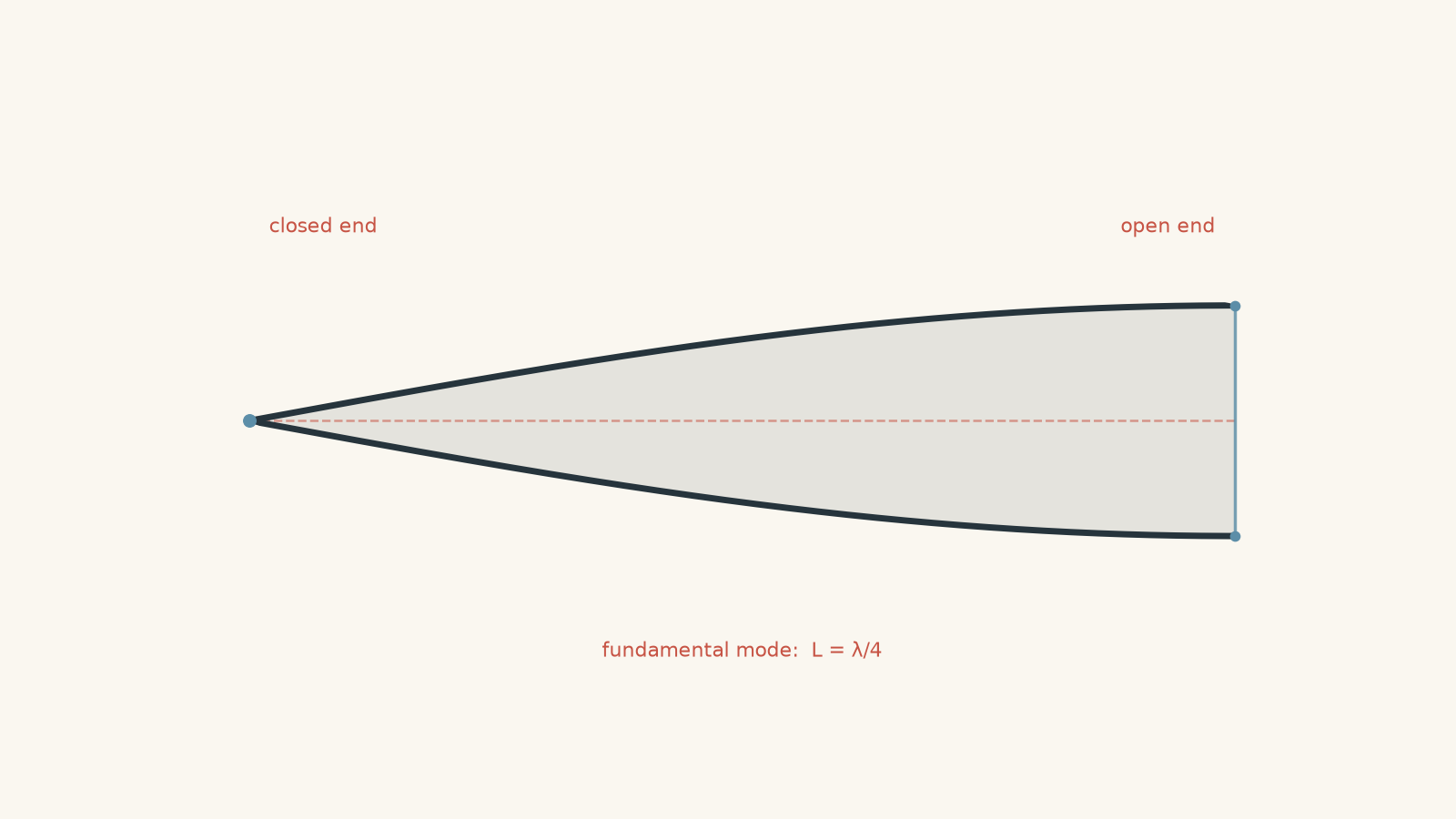
For an ideal closed pipe:
| Position | Air-particle displacement |
|---|---|
| Closed end | Node |
| Open end | Antinode |
That one boundary condition controls every allowed standing-wave pattern.
02The shortest pattern that can fit
A standing wave has alternating nodes and antinodes.
In a sinusoidal standing wave:
- node to nearest antinode = \(\frac{\lambda}{4}\)
- node to nearest node = \(\frac{\lambda}{2}\)
- antinode to nearest antinode = \(\frac{\lambda}{2}\)
Here, \(\lambda\) is the wavelength in metres.
A closed pipe needs a node at one end and an antinode at the other. What is the shortest piece of a wave that goes from a node to an antinode?
One quarter of a wavelength.
So for the simplest possible standing wave,
\[
L = \frac{\lambda}{4}
\]
where \(L\) is the pipe length.
Rearranging gives
\[
\lambda = 4L
\]
This is the fundamental mode of a closed pipe.
It is worth picturing this before memorising it. The pipe isn’t somehow “one quarter of a sound wave” in the sense that only one quarter of a travelling wave exists. Rather, the standing-wave pattern between the two boundaries has the spatial shape of one quarter of a sinusoidal cycle.
03From wavelength to fundamental frequency
For any wave,
\[
v = f\lambda
\]
where:
- \(v\) is wave speed in metres per second, \(\text{m s}^{-1}\)
- \(f\) is frequency in hertz, Hz
- \(\lambda\) is wavelength in metres, m
For the fundamental of a closed pipe, \(\lambda = 4L\). Therefore,
\[
f_1 = \frac{v}{4L}
\]
The subscript 1 means the first harmonic, or fundamental frequency.
Worked example: Find the fundamental frequency
A pipe is 0.85 m long and closed at one end. The speed of sound is \(340\text{ m s}^{-1}\). Find its fundamental frequency.
Step 1
\[
\lambda = 4L
\]
Step 2
\[
\lambda = 4(0.85\text{ m}) = 3.40\text{ m}
\]
Step 3
\[
f = \frac{v}{\lambda}
= \frac{340\text{ m s}^{-1}}{3.40\text{ m}}
= 100\text{ Hz}
\]
The fundamental frequency is therefore 100 Hz.
This means the lowest-frequency standing wave satisfying a displacement node at the closed end and an antinode at the open end has a frequency of 100 Hz.
04Why the second harmonic does not fit
Now try to increase the frequency.
A student might reason that the next mode should have twice the fundamental frequency. That is exactly what happens for a string fixed at both ends, so the prediction is sensible.
But a closed pipe has different boundary conditions at its two ends.
To double the fundamental frequency while keeping the wave speed constant, we would halve the wavelength. Starting from
\[
L=\frac{\lambda_1}{4},
\]
the proposed second harmonic would have wavelength
\[
\lambda_2=\frac{\lambda_1}{2}.
\]
That would make the pipe length equal to
\[
L=\frac{\lambda_2}{2}.
\]
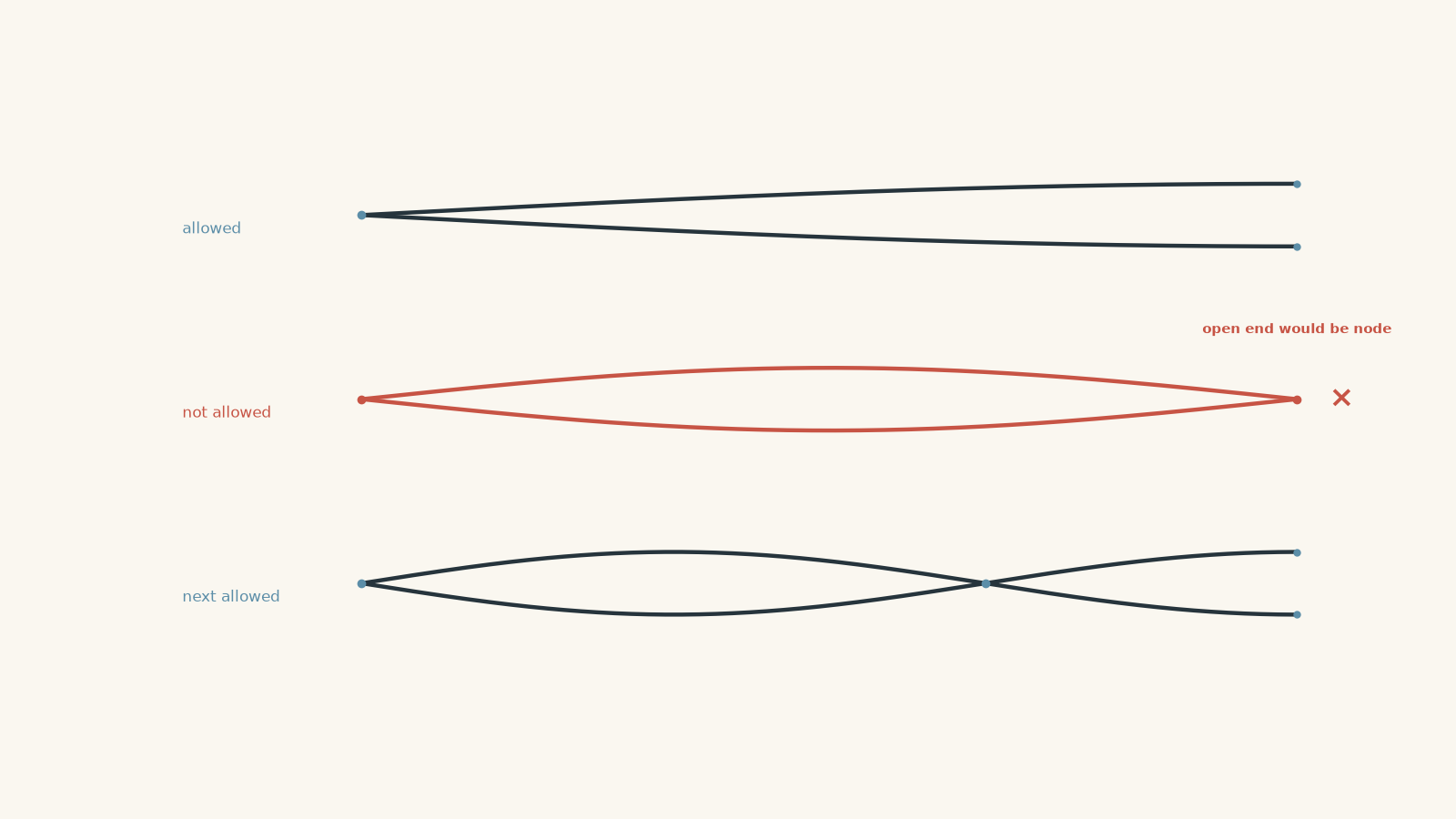
A half-wavelength takes you from a node back to another node.
But the open end requires an antinode.
So the second-harmonic pattern doesn’t fit.
This is not a rule invented to make closed-pipe questions annoying. The pattern is rejected because it violates the physical condition at the open end.
05Why only odd harmonics appear
The next allowed pattern must still begin at a node and end at an antinode.
Starting from the closed end, we can fit:
\[
\frac{\lambda}{4},\quad
\frac{3\lambda}{4},\quad
\frac{5\lambda}{4},\quad
\frac{7\lambda}{4},\ldots
\]
So the allowed pipe lengths are
\[
L=\frac{(2n-1)\lambda_n}{4},
\]
where \(n=1,2,3,\ldots\) counts the allowed modes.
Rearranging,
\[
\lambda_n=\frac{4L}{2n-1}.
\]
Using \(v=f\lambda\),
\[
f_n=\frac{(2n-1)v}{4L}.
\]
This notation needs care. When \(n=1,2,3,\ldots\), the corresponding physical harmonics are:
| Allowed mode number \(n\) | Pipe length pattern | Frequency | Harmonic name |
|---|---|---|---|
| 1 | \(L=\frac{\lambda}{4}\) | \(f_1\) | 1st harmonic |
| 2 | \(L=\frac{3\lambda}{4}\) | \(3f_1\) | 3rd harmonic |
| 3 | \(L=\frac{5\lambda}{4}\) | \(5f_1\) | 5th harmonic |
| 4 | \(L=\frac{7\lambda}{4}\) | \(7f_1\) | 7th harmonic |
So an ideal closed pipe supports frequencies in the ratio
\[
1:3:5:7:\ldots
\]
It supports the odd harmonics of its fundamental frequency.
Calling the second allowed mode the “second harmonic” is a common mistake. It is the second mode, but it has three times the fundamental frequency, so it is the third harmonic.
06A useful way to picture the pattern
Imagine a very strict first date where one person has to stay completely still at one end of the table, while the other has to be as free to move as possible at the other end.
The still person represents the displacement node at the closed end. The free-moving person represents the displacement antinode at the open end.
You can add more oscillating sections between them, but the two end conditions cannot change. Every acceptable pattern still has to begin with zero displacement and finish with maximum displacement.
The analogy stops being useful once we care about what the air actually does. Air particles oscillate locally around equilibrium positions. They do not travel from the node to the antinode like people moving along a table.
07Worked example: Identify an allowed resonance
A 0.50 m pipe is closed at one end. The speed of sound is \(340\text{ m s}^{-1}\). Determine the first three resonant frequencies.
Step 1
\[
f_1=\frac{v}{4L}
=\frac{340\text{ m s}^{-1}}{4(0.50\text{ m})}
=170\text{ Hz}
\]
Step 2
The first three allowed harmonics are the 1st, 3rd, and 5th:
\[
f_1=170\text{ Hz}
\]
\[
f_3=3(170\text{ Hz})=510\text{ Hz}
\]
\[
f_5=5(170\text{ Hz})=850\text{ Hz}
\]
The first three resonant frequencies are therefore 170 Hz, 510 Hz, and 850 Hz.
Notice what is missing. Frequencies such as 340 Hz and 680 Hz are integer multiples of 170 Hz, but they are even harmonics and do not satisfy the node-antinode boundary conditions.
08Displacement and pressure are not the same pattern
There is one extra layer of precision that causes plenty of confusion.
So far, we have described air-particle displacement. But sound waves also involve pressure variations.
At the closed end, the air cannot move much, but it can be compressed strongly against the wall. Therefore:
- a displacement node is a pressure antinode
- a displacement antinode is a pressure node
For a closed pipe:
| Position | Displacement | Pressure variation |
|---|---|---|
| Closed end | Node | Antinode |
| Open end | Antinode | Node |
This can seem backwards at first. Think about the closed end. The wall stops the air particles from moving, so displacement is small. But neighbouring particles can bunch up against that boundary, producing large pressure changes.
At the open end, air can move freely, while its pressure remains close to the atmospheric pressure outside. So displacement variation is large, while pressure variation is small.
If a diagram does not tell you whether it represents displacement or pressure, do not casually label its nodes and antinodes. The two patterns are reversed.
09The ideal model has a limitation
Saying that the displacement antinode occurs exactly at the open end is an idealisation.
In a real pipe, the oscillating air extends slightly beyond the physical opening. The pipe therefore behaves as if its resonating air column were a little longer than its measured length. This is called end correction.
For most introductory HSC calculations, if no end correction is supplied or requested, use the ideal model:
\[
f_1=\frac{v}{4L}.
\]
But remember what the equation assumes. The effective resonating length and the measured length have been treated as equal.
Worked example: Work backwards from a resonance
A closed pipe resonates at 735 Hz in its third harmonic. The speed of sound is \(343\text{ m s}^{-1}\). Find the ideal length of the pipe.
Step 1
The third harmonic is an allowed resonance, with
\[
f_3=\frac{3v}{4L}.
\]
Step 2
\[
L=\frac{3v}{4f_3}
\]
Step 3
\[
L
=\frac{3(343\text{ m s}^{-1})}{4(735\text{ Hz})}
=\frac{1029}{2940}\text{ m}
=0.350\text{ m}
\]
The ideal pipe length is 0.350 m.
The important move was not the arithmetic. It was recognising that 735 Hz was the third harmonic, so the fundamental would be one third of that frequency.
10The quickest decision rule
When you see a pipe standing-wave question, first identify the ends.
For a pipe closed at one end and open at the other:
- Use a displacement node at the closed end.
- Use a displacement antinode at the open end.
- Fit an odd number of quarter-wavelengths into the pipe.
- Use
\[
L=\frac{(2n-1)\lambda_n}{4}.
\]
- Therefore the allowed frequencies are
\[
f_n=\frac{(2n-1)v}{4L}.
\]
- Expect only the 1st, 3rd, 5th, 7th, and higher odd harmonics.
If the question instead shows a pressure standing wave, reverse the node and antinode labels.
11Questions and solutions
Question 1
A pipe 0.75 m long is closed at one end. Take the speed of sound to be \(345\text{ m s}^{-1}\).
Calculate the fundamental frequency.
Solution 1
The fundamental frequency is 115 Hz.
For the fundamental mode of a closed pipe,
\[
L=\frac{\lambda}{4},
\]
so
\[
\lambda=4L=4(0.75\text{ m})=3.00\text{ m}.
\]
Using
\[
v=f\lambda,
\]
we obtain
\[
f=\frac{v}{\lambda}
=\frac{345\text{ m s}^{-1}}{3.00\text{ m}}
=115\text{ Hz}.
\]
The 0.75 m air column therefore supports a lowest resonant frequency of 115 Hz in the ideal closed-pipe model.
Question 2
A closed pipe has a fundamental frequency of 140 Hz. State the next two allowed resonant frequencies and identify their harmonic numbers.
Solution 2
The next two allowed frequencies are 420 Hz, the third harmonic, and 700 Hz, the fifth harmonic.
A pipe closed at one end supports only odd harmonics:
\[
f_1,\quad 3f_1,\quad 5f_1,\ldots
\]
Therefore,
\[
f_3=3(140\text{ Hz})=420\text{ Hz},
\]
and
\[
f_5=5(140\text{ Hz})=700\text{ Hz}.
\]
A tempting mistake is to call 420 Hz the “second harmonic” because it is the second allowed resonance. It is the second allowed mode, but its frequency is three times the fundamental, so it is the third harmonic.
Question 3
A student draws a standing-wave displacement pattern in a pipe closed at the left end and open at the right end. Their drawing shows an antinode at both ends.
Explain why the drawing cannot represent an allowed resonance of the pipe.
Solution 3
The drawing is not an allowed displacement standing wave because the closed end must be a displacement node, not an antinode.
At a closed end, the solid wall prevents the air particles at the boundary from oscillating backwards and forwards. Their displacement is therefore zero, which makes the closed end a displacement node.
The open end is approximately a displacement antinode because the air there can move freely.
An antinode at the closed end would require maximum air-particle displacement at a position where the wall prevents that motion. The drawing therefore violates the physical boundary condition, regardless of how neatly the rest of the wave appears to fit.
Question 4
A 0.60 m pipe is closed at one end. The speed of sound is \(336\text{ m s}^{-1}\).
A sound source can produce frequencies of 140 Hz, 280 Hz, 420 Hz, 560 Hz, and 700 Hz.
Which of these frequencies can produce ideal resonances in the pipe? Explain your reasoning rather than testing each frequency separately.
Solution 4
The resonant frequencies from the list are 140 Hz, 420 Hz, and 700 Hz.
First find the fundamental frequency:
\[
f_1=\frac{v}{4L}
=\frac{336\text{ m s}^{-1}}{4(0.60\text{ m})}
=\frac{336}{2.40}\text{ Hz}
=140\text{ Hz}.
\]
A closed pipe supports only odd multiples of its fundamental:
\[
f=(1,3,5,7,\ldots)f_1.
\]
Therefore,
\[
f_1=140\text{ Hz},
\]
\[
f_3=3(140\text{ Hz})=420\text{ Hz},
\]
and
\[
f_5=5(140\text{ Hz})=700\text{ Hz}.
\]
The frequencies 280 Hz and 560 Hz are the second and fourth harmonics of 140 Hz. They would require standing-wave patterns that do not have a displacement node at one end and an antinode at the other.
The useful shortcut is therefore to identify the fundamental first, then apply the odd-harmonic rule.
Question 5
Two ideal air columns have the same length. Pipe A is open at both ends. Pipe B is closed at one end and open at the other.
A student claims: “Because the pipes have the same length and contain the same air, they must have the same fundamental frequency.”
Evaluate the claim using standing-wave boundary conditions.
Solution 5
The claim is incorrect: Pipe B has half the fundamental frequency of Pipe A under the ideal model.
For an open pipe, each open end is a displacement antinode. The shortest standing-wave pattern connecting one antinode to another contains half a wavelength:
\[
L=\frac{\lambda_A}{2}.
\]
Therefore,
\[
\lambda_A=2L
\]
and
\[
f_A=\frac{v}{2L}.
\]
For Pipe B, the closed end is a displacement node and the open end is a displacement antinode. The shortest allowed pattern contains one quarter of a wavelength:
\[
L=\frac{\lambda_B}{4}.
\]
Therefore,
\[
\lambda_B=4L
\]
and
\[
f_B=\frac{v}{4L}.
\]
Comparing the two,
\[
f_B=\frac{1}{2}f_A.
\]
The student’s hidden assumption is that pipe length alone determines the resonant wavelength. It does not. The boundary conditions determine what fraction of a wavelength can fit into that length.
Question 6
An experimenter measures strong resonances from a pipe at approximately 255 Hz, 425 Hz, and 595 Hz. They claim the pipe is closed at one end and that these are consecutive allowed modes.
Without knowing the pipe length or speed of sound, determine whether the measurements are consistent with that claim. If they are, estimate the fundamental frequency.
Solution 6
The measurements are consistent with consecutive allowed modes of a closed pipe, with an estimated fundamental frequency of 85 Hz.
For an ideal closed pipe, allowed frequencies have the form
\[
f=(1,3,5,7,\ldots)f_1.
\]
The measured frequencies differ by
\[
425-255=170\text{ Hz}
\]
and
\[
595-425=170\text{ Hz}.
\]
Consecutive odd harmonics differ by \(2f_1\), because
\[
(5f_1-3f_1)=2f_1
\]
and similarly for later neighbouring modes.
Therefore,
\[
2f_1=170\text{ Hz},
\]
so
\[
f_1=85\text{ Hz}.
\]
Now test the measured values:
\[
3f_1=3(85\text{ Hz})=255\text{ Hz},
\]
\[
5f_1=5(85\text{ Hz})=425\text{ Hz},
\]
\[
7f_1=7(85\text{ Hz})=595\text{ Hz}.
\]
So the observed peaks match the third, fifth, and seventh harmonics.
The subtle point is that the lowest observed resonance does not have to be the fundamental. Here, treating 255 Hz as the fundamental would predict the next allowed resonance at \(3(255)=765\text{ Hz}\), which contradicts the measurements.
12What this lets you understand next
The odd-harmonic pattern is really a boundary-condition problem. Once you can look at the ends of a system and decide where nodes and antinodes must occur, the frequency equations stop being isolated formulas.
That same idea is the useful next step when comparing closed pipes, open pipes, and standing waves on strings. Their harmonic patterns differ because their boundaries impose different conditions on the wave.