
Beat Frequency in HSC Physics: How Beats Work
Learn why nearby sound frequencies produce beats, how to calculate beat frequency and beat period, and how beats can be used to identify unknown frequencies.
Two instruments are trying to play exactly the same note. At first they sound almost right, but instead of one steady sound you hear the volume swell, fade, swell, fade. Nothing is turning the volume knob. So where is that pulsing coming from?
Before reading on, make a prediction. If one instrument produces \(440\text{ Hz}\) and the other produces \(443\text{ Hz}\), how many loud pulses would you expect to hear each second?
The answer is 3 beats per second. Those beats come from interference between two waves whose frequencies are close, but not quite equal.
01Why two steady sounds can produce a changing loudness
Start with something easier to picture than sound waves. Imagine two people clapping at almost the same rate.
For a moment, their claps line up. A little later, one person has drifted ahead, so the claps are badly out of sync. Keep listening and they eventually line up again.
Neither person changed their clapping rate. The changing pattern appeared because their rates were slightly different.
Two sound waves with nearby frequencies behave in a similar way.
When their compressions and rarefactions line up, they reinforce one another. The resultant sound has a larger amplitude. When a compression from one wave lines up with a rarefaction from the other, they partly cancel, producing a smaller amplitude.
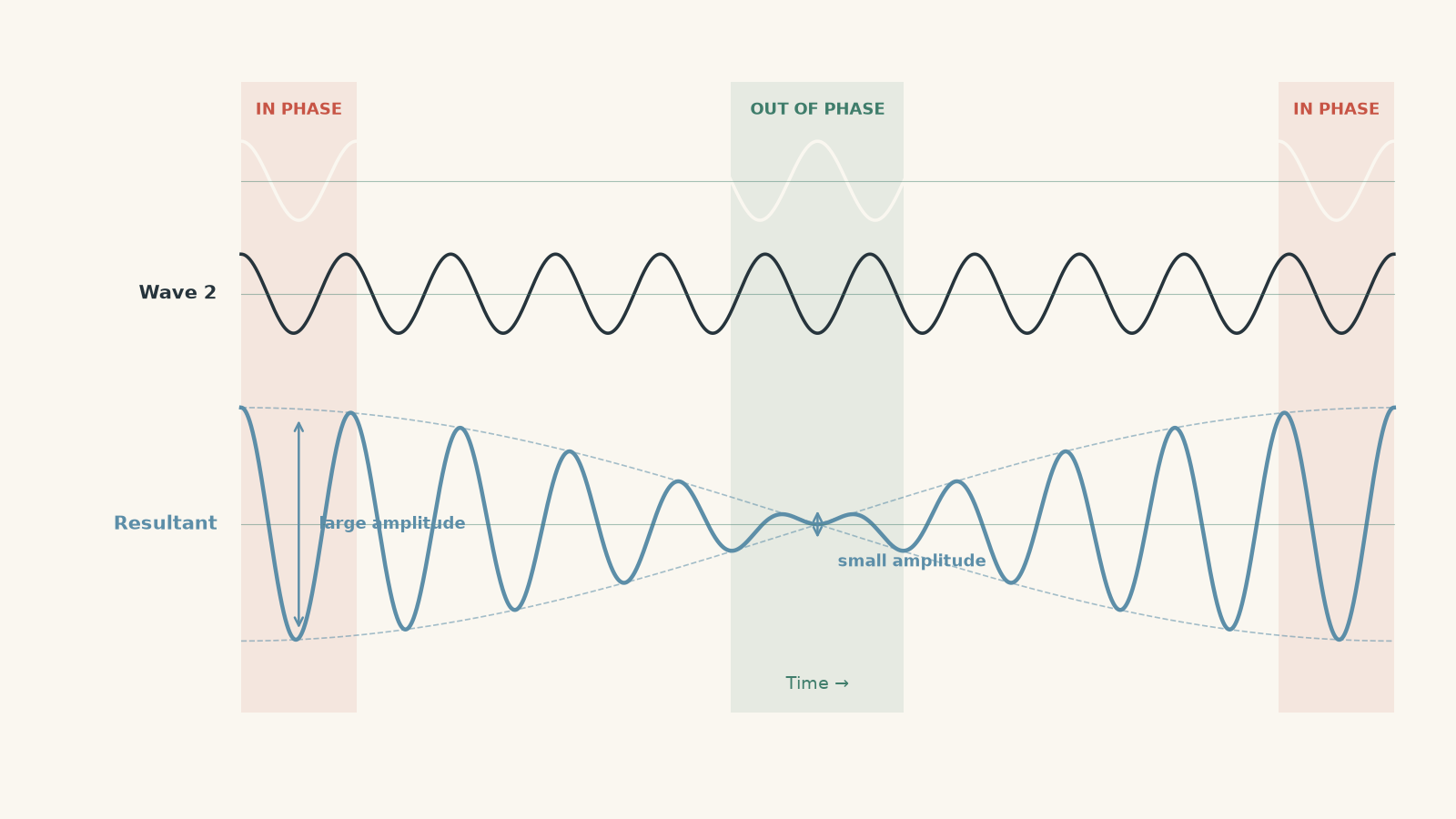
This is just superposition: when waves overlap, their displacements add.
The important twist is that waves with slightly different frequencies don’t stay in the same phase relationship. They repeatedly drift into and out of alignment.
That creates the repeating change in amplitude that we call beats.
02Beat frequency
Suppose two sounds have frequencies \(f_1\) and \(f_2\), measured in hertz.
Their beat frequency is
\[
f_b = |f_1-f_2|
\]
where:
- \(f_b\) is the beat frequency in hertz,
- \(f_1\) is the frequency of the first wave in hertz,
- \(f_2\) is the frequency of the second wave in hertz.
The absolute value signs matter because a frequency can’t be negative. We only care about the size of the difference.
So if the two frequencies are \(440\text{ Hz}\) and \(443\text{ Hz}\),
\[
f_b=|440-443|=3\text{ Hz}
\]
You hear three cycles of rising and falling loudness each second.
A useful way to remember this is:
Nearby frequencies control the pitch of the sound. Their difference controls how quickly the beats occur.
Worked example: Find the beat frequency
Two tuning forks produce frequencies of \(256\text{ Hz}\) and \(260\text{ Hz}\). What beat frequency is heard when they are sounded together?
Step 1
\[
f_b=|f_1-f_2|
\]
Step 2
\[
f_b=|256-260|=4\text{ Hz}
\]
Step 3
The beat frequency is
\[
\boxed{4\text{ Hz}}
\]
so the loudness rises and falls four times each second.
03What is actually changing?
A common mistake is to imagine that each source is getting louder and quieter.
It isn’t.
Each source can be producing a wave with a constant amplitude. The changing amplitude belongs to the resultant wave formed when the two waves overlap.
Think about two students walking around a circular running track at almost the same speed. Sometimes they’re next to each other. Later they’re on opposite sides of the track. Eventually the faster student catches up and they’re together again.
For sound waves, being “together” corresponds roughly to being in phase. Being on opposite sides corresponds to being out of phase.
The analogy has a limit. Sound waves aren’t little objects travelling around a loop. Their phase relationship changes continuously because the waves oscillate at different frequencies.
04Why the difference in frequency gives the beat frequency
Take two waves with frequencies of \(100\text{ Hz}\) and \(103\text{ Hz}\).
In one second:
- the first wave completes 100 cycles,
- the second wave completes 103 cycles.
The second wave gains three complete cycles on the first during that second.
Each time it gains one full cycle, the waves return to the same phase relationship. That means the pattern of strong reinforcement repeats three times per second.
So the beat frequency is
\[
f_b=|103-100|=3\text{ Hz}
\]
This gives a more useful picture than simply memorising the formula. The beat frequency tells you how quickly one wave gains cycles on the other.
05A more precise wave description
The previous picture is enough for most beat-frequency problems, but we can make it more precise.
For two waves with equal amplitudes \(A\),
\[
y_1=A\cos(2\pi f_1t)
\]
and
\[
y_2=A\cos(2\pi f_2t)
\]
where \(t\) is time in seconds.
Superposition gives
\[
y=y_1+y_2
\]
Using a trigonometric identity,
\[
y=2A\cos\left(\pi(f_1-f_2)t\right)
\cos\left(\pi(f_1+f_2)t\right)
\]
Don’t let the equation hide the physics.
The second cosine term oscillates rapidly. It describes the sound vibration itself, with a frequency centred around the average of the two original frequencies.
The first cosine term changes much more slowly. It controls the size of the resultant amplitude.
That slow variation produces the beats.
There is one subtle point here. The amplitude factor contains \((f_1-f_2)/2\) if you interpret the cosine’s ordinary oscillation frequency directly. So why isn’t the beat frequency half the frequency difference?
Because we hear a loud beat whenever the magnitude of the amplitude becomes large. Both positive and negative peaks of the envelope correspond to large oscillation amplitudes. Those loudness maxima occur at the full difference frequency:
\[
\boxed{f_b=|f_1-f_2|}
\]
That distinction is worth understanding because it prevents a surprisingly common factor-of-two error.
06Beat period
You can also describe beats using the time between successive loudness maxima.
This is the beat period, \(T_b\).
As with any periodic motion,
\[
T_b=\frac{1}{f_b}
\]
where \(T_b\) is measured in seconds.
So a beat frequency of \(4\text{ Hz}\) gives
\[
T_b=\frac{1}{4}=0.25\text{ s}
\]
There is a loudness maximum every \(0.25\text{ s}\).
Worked example: Use beats to determine an unknown frequency
A student compares a string with a \(440\text{ Hz}\) reference tone. They hear \(5\) beats per second. The student then tightens the string slightly, which increases its frequency, and the beat frequency falls to \(2\text{ Hz}\). What was the string’s original frequency?
Step 1
The string differs from \(440\text{ Hz}\) by \(5\text{ Hz}\):
\[
|f-440|=5
\]
So there are initially two possible frequencies:
\[
f=435\text{ Hz}
\]
or
\[
f=445\text{ Hz}
\]
The beat frequency alone does not tell us whether the unknown frequency is above or below the reference frequency.
Step 2
Tightening the string increases its frequency.
The beat frequency becomes smaller, so the string’s frequency must be moving towards \(440\text{ Hz}\).
If the string had started at \(445\text{ Hz}\), increasing its frequency would move it further away from \(440\text{ Hz}\), making the beat frequency larger.
Therefore, the original frequency must have been below \(440\text{ Hz}\).
Step 3
\[
\boxed{f=435\text{ Hz}}
\]
The later observation resolves an ambiguity that the beat-frequency equation alone cannot resolve.
This is an important HSC habit: don’t stop once you’ve substituted into a formula. Check what the physical change tells you.
07Using beats for tuning
Beats are useful because a slow beat is much easier to detect than a tiny difference between two high frequencies.
Suppose a reference source produces exactly \(500\text{ Hz}\).
If another source produces \(506\text{ Hz}\), you hear
\[
f_b=|506-500|=6\text{ Hz}
\]
As you adjust the unknown source towards \(500\text{ Hz}\), the beats slow down:
\[
6\text{ Hz}\rightarrow4\text{ Hz}\rightarrow2\text{ Hz}\rightarrow1\text{ Hz}
\]
When the frequencies become equal,
\[
f_b=|500-500|=0
\]
and the beats disappear.
So the practical tuning rule is simple:
| What happens to the beats? | What it means |
|---|---|
| Beats get slower | The frequencies are getting closer |
| Beats get faster | The frequencies are getting further apart |
| Beats disappear | The frequencies are equal, within the accuracy of the measurement |
Be careful with the last row. Hearing no beats doesn’t prove two real sources have mathematically perfect identical frequencies. It means any remaining difference is too small to produce a detectable beat during the observation.
08The most tempting misconception: add or average the frequencies
Suppose two sources produce \(700\text{ Hz}\) and \(704\text{ Hz}\).
A student might average them:
\[
\frac{700+704}{2}=702\text{ Hz}
\]
That number isn’t useless. It is close to the frequency associated with the rapidly oscillating resultant sound.
But it is not the beat frequency.
The beat frequency describes the slow change in amplitude:
\[
f_b=|704-700|=4\text{ Hz}
\]
So there are two different ideas here:
- the individual waves oscillate hundreds of times per second,
- the resultant loudness changes only four times per second.
Don’t confuse the rate of vibration with the rate at which the amplitude pattern repeats.
09Beats need nearby frequencies
Mathematically, waves with different frequencies can still interfere.
But the familiar slow “wah-wah-wah” beat effect is clearest when the frequencies are close together. If the frequency separation becomes large, the ear may begin to distinguish the two frequencies separately rather than hearing a single pitch whose loudness rises and falls slowly.
For HSC calculations involving beats, the intended model is usually two nearby frequencies, with
\[
f_b=|f_1-f_2|
\]
The word “nearby” is therefore doing some real work. It tells you what physical situation the equation is being used to describe.
10Do the waves need equal amplitudes?
No.
Two waves can have different amplitudes and still produce beats if their frequencies are close.
Equal amplitudes make the effect especially clear because destructive interference can make the resultant amplitude very small. If one wave is much stronger than the other, the loudness still changes periodically, but the minima are not as deep.
The frequency of the beats is still determined by
\[
f_b=|f_1-f_2|
\]
Changing amplitude changes how noticeable the beats are, not how frequently they occur.
11Questions and solutions
Question 1
Two sound sources have frequencies of \(315\text{ Hz}\) and \(321\text{ Hz}\). Determine the beat frequency and the time between successive beats.
Solution 1
The beat frequency is \(\boxed{6\text{ Hz}}\), and successive beats are separated by approximately \(\boxed{0.167\text{ s}}\).
The beat frequency is the difference between the two source frequencies:
\[
f_b=|f_1-f_2|
\]
Substituting,
\[
f_b=|321-315|=6\text{ Hz}
\]
The beat period is
\[
T_b=\frac{1}{f_b}
=\frac{1}{6}
=0.167\text{ s}
\]
So the resultant sound reaches a loudness maximum about every \(0.167\text{ s}\).
Question 2
A \(500\text{ Hz}\) reference tone is played with an unknown tone. Successive loudness maxima are \(0.20\text{ s}\) apart.
Determine the possible frequencies of the unknown tone.
Solution 2
The unknown frequency could be \(\boxed{495\text{ Hz}}\) or \(\boxed{505\text{ Hz}}\).
First find the beat frequency from the beat period:
\[
f_b=\frac{1}{T_b}
=\frac{1}{0.20}
=5.0\text{ Hz}
\]
The unknown frequency must therefore differ from \(500\text{ Hz}\) by \(5\text{ Hz}\):
\[
|f-500|=5
\]
Hence,
\[
f=500-5=495\text{ Hz}
\]
or
\[
f=500+5=505\text{ Hz}
\]
The important trap is assuming that beat frequency tells you which source has the higher frequency. It doesn’t. A second observation is needed to resolve that ambiguity.
Question 3
A string produces \(4\) beats per second when sounded with a \(600\text{ Hz}\) reference oscillator. The tension in the string is then increased slightly. Its frequency increases, and the beat frequency initially becomes \(6\text{ Hz}\).
Was the string’s original frequency \(596\text{ Hz}\) or \(604\text{ Hz}\)? Explain.
Solution 3
The string’s original frequency was \(\boxed{604\text{ Hz}}\).
A beat frequency of \(4\text{ Hz}\) initially gives two possibilities:
\[
|f-600|=4
\]
so
\[
f=596\text{ Hz}
\]
or
\[
f=604\text{ Hz}
\]
Increasing the tension increases the string’s frequency.
If the string started at \(596\text{ Hz}\), raising its frequency would initially move it towards \(600\text{ Hz}\). The frequency difference, and therefore the beat frequency, would decrease.
Instead, the beat frequency increases from \(4\text{ Hz}\) to \(6\text{ Hz}\). The string must therefore have already been above the reference frequency and moved even further away from it.
So its initial frequency was
\[
\boxed{604\text{ Hz}}
\]
The key is not the arithmetic. It is connecting the direction of the frequency change to the observed change in beat frequency.
Question 4
Two speakers produce frequencies of \(800\text{ Hz}\) and \(803\text{ Hz}\). Speaker A has a much larger amplitude than speaker B.
A student claims, “Because the amplitudes are unequal, the beat frequency will be less than \(3\text{ Hz}\).”
Evaluate the claim.
Solution 4
The claim is incorrect. The beat frequency remains \(\boxed{3\text{ Hz}}\).
Beat frequency depends on the difference between the frequencies:
\[
f_b=|f_1-f_2|
\]
Substituting,
\[
f_b=|803-800|=3\text{ Hz}
\]
Unequal amplitudes affect the depth of the beats. Because the stronger wave cannot be completely cancelled by the weaker one, the minimum resultant amplitude will not fall as low as it could for two equal-amplitude waves.
However, the relative phase still repeats at the same rate. The beat frequency therefore remains \(3\text{ Hz}\).
The misconception comes from mixing up two separate properties: amplitude controls how strong the variation is, while frequency difference controls how quickly that variation repeats.
Question 5
A \(450\text{ Hz}\) reference tone and an unknown tone produce \(2\) beats per second. The unknown source is adjusted continuously so that its frequency increases. The beat frequency falls to zero, then begins increasing again.
Explain what happened to the unknown frequency. Also determine its initial frequency.
Solution 5
The unknown source began at \(\boxed{448\text{ Hz}}\), increased to \(450\text{ Hz}\), and then continued above \(450\text{ Hz}\).
Initially,
\[
|f-450|=2
\]
so the possible frequencies are
\[
f=448\text{ Hz}
\]
or
\[
f=452\text{ Hz}
\]
We are told that the unknown frequency is increasing.
The beat frequency first decreases. Therefore the unknown frequency must initially be moving towards \(450\text{ Hz}\). That is only possible if it starts below the reference frequency, at
\[
\boxed{448\text{ Hz}}
\]
As the unknown frequency reaches \(450\text{ Hz}\),
\[
f_b=|450-450|=0
\]
so the beats disappear.
The adjustment continues, so the unknown frequency rises above \(450\text{ Hz}\). The difference between the frequencies then starts increasing again, which makes the beat frequency increase.
The tempting mistake is to assume that zero beat frequency means the adjustment must have stopped. It doesn’t. Zero beats identify the instant when the two frequencies are equal. If the unknown frequency keeps changing, the beats return.
12Where beats lead next
Beats are one specific consequence of a much broader idea: superposition.
Once you can picture two nearby frequencies repeatedly moving into and out of phase, interference becomes much less mysterious. The same principle helps explain constructive and destructive interference, standing waves, resonance measurements, and why experimentalists can detect tiny frequency differences without measuring each high frequency directly.
The equation
\[
f_b=|f_1-f_2|
\]
is short. The useful physics is knowing what that difference means: it measures how quickly two nearly matching waves lose, then regain, the same phase relationship.