
Snell’s Law for HSC Physics: Refraction Angles Explained
Learn how to use Snell's law to calculate refraction angles and predict whether light bends toward or away from the normal.
A laser beam enters a glass block at an angle. If you draw the beam continuing straight, your diagram is usually wrong. But simply remembering “light bends in glass” isn’t enough either. You need to predict which way it bends, then calculate the new angle.
Before doing any maths, make a prediction. A ray travels from air into glass at an angle to the surface. Will it bend toward the normal or away from the normal?
It bends toward the normal. The useful question is why.
01Why changing speed changes direction
Light travels at different speeds in different materials. We describe this using refractive index, \(n\):
\[
n = \frac{c}{v}
\]
where:
- \(n\) is the refractive index, with no unit
- \(c\) is the speed of light in a vacuum, approximately \(3.00 \times 10^8\ \text{m s}^{-1}\)
- \(v\) is the speed of light in the material, in \(\text{m s}^{-1}\)
A larger refractive index means a lower speed of light in that medium.
Air has a refractive index close to \(1.00\). Water is about \(1.33\), while many types of glass are around \(1.5\). The exact value depends on the material and the wavelength of the light.
So when light travels from air into glass, its speed decreases.
Picture a shopping trolley rolling diagonally from smooth concrete into thick grass. One front wheel reaches the grass first and slows before the other wheel does. The trolley turns.
A wavefront behaves in a related way. One side of the wavefront enters the slower medium first, so that side advances less distance. The wavefront rotates, which changes the direction in which the light travels.
For light entering a slower medium, this rotation makes the ray bend toward the normal.
The trolley analogy has limits. Light isn’t a rigid object with wheels, and refraction isn’t caused by mechanical drag. More precisely, the speed and wavelength of the electromagnetic wave change at the boundary, while its frequency remains the same.
Since
\[
v = f\lambda
\]
a decrease in wave speed \(v\), while frequency \(f\) stays constant, means the wavelength \(\lambda\) decreases.
02Measure every angle from the normal
This is the detail that causes a surprising number of wrong answers.
The normal is an imaginary line drawn perpendicular to the boundary between the two media.
Angles in Snell’s law are measured between the ray and the normal, not between the ray and the surface.
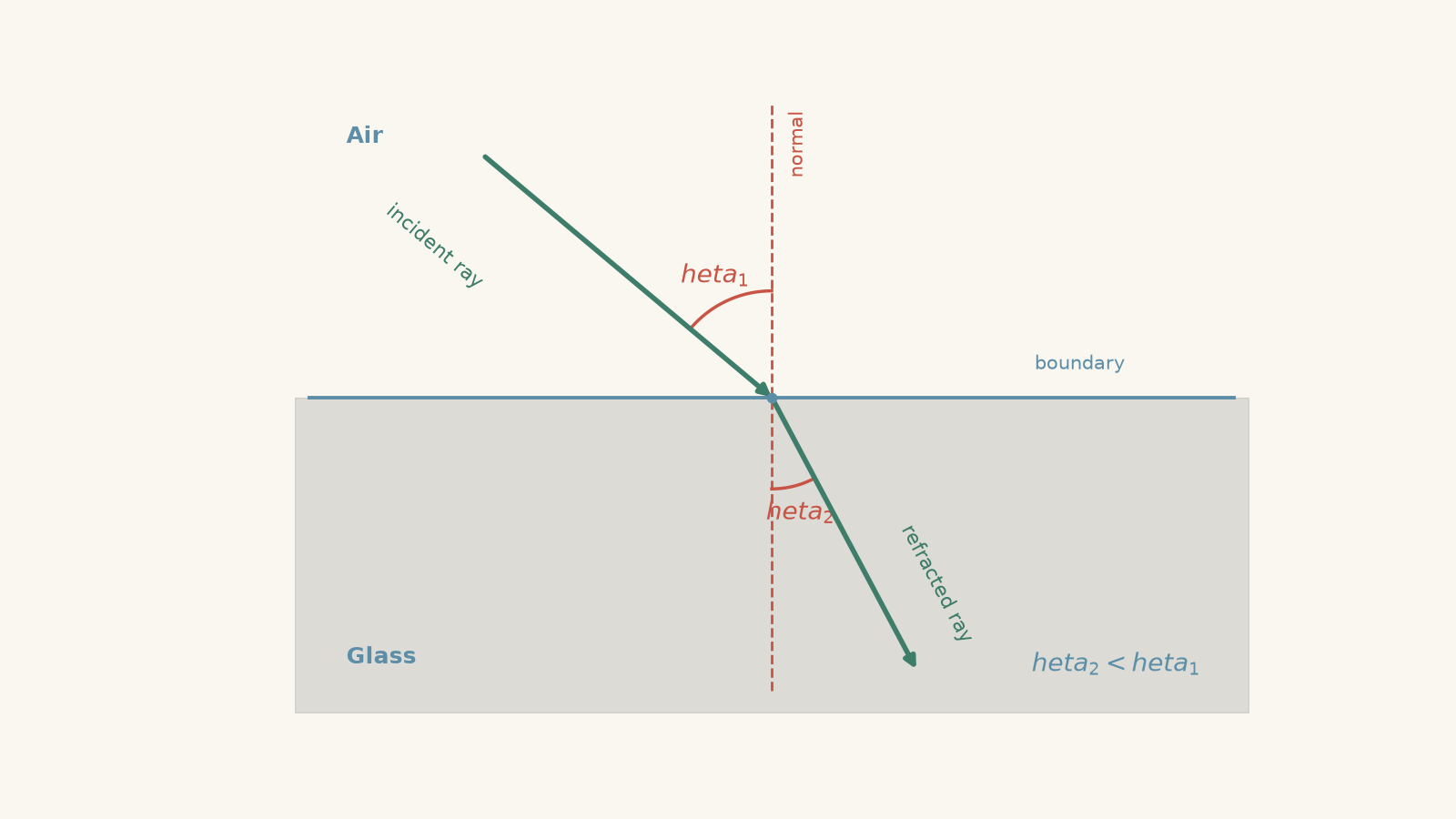
The incoming angle is called the angle of incidence, \(\theta_1\). The outgoing angle in the second medium is the angle of refraction, \(\theta_2\).
If a question tells you that a ray is \(25^\circ\) to the surface, then its angle to the normal is not \(25^\circ\). It is
\[
90^\circ – 25^\circ = 65^\circ
\]
That conversion should happen before you use Snell’s law.
03Snell’s law
Once the geometry is clear, the calculation is compact:
\[
n_1\sin\theta_1 = n_2\sin\theta_2
\]
where:
- \(n_1\) is the refractive index of the medium containing the incident ray
- \(n_2\) is the refractive index of the medium containing the refracted ray
- \(\theta_1\) is the angle of incidence, measured from the normal
- \(\theta_2\) is the angle of refraction, measured from the normal
If you are finding the refracted angle, rearrange:
\[
\theta_2 = \sin^{-1}\left(\frac{n_1}{n_2}\sin\theta_1\right)
\]
For HSC calculations involving angles in degrees, make sure your calculator is in degree mode.
Before pressing any buttons, predict the answer. If the light enters a medium with a larger refractive index, should \(\theta_2\) be larger or smaller than \(\theta_1\)?
Smaller. The ray bends toward the normal.
That prediction is useful because it gives you an immediate error check.
Worked example: Air into glass
A ray of light travels from air, with \(n_1 = 1.00\), into glass with \(n_2 = 1.50\). The angle of incidence is \(35.0^\circ\). Calculate the angle of refraction.
Step 1
The refractive index increases from \(1.00\) to \(1.50\). Light slows down, so the ray should bend toward the normal. We therefore expect \(\theta_2 < 35.0^\circ\).
Step 2
\[
n_1\sin\theta_1 = n_2\sin\theta_2
\]
Step 3
\[
1.00\sin 35.0^\circ = 1.50\sin\theta_2
\]
Rearranging,
\[
\sin\theta_2
= \frac{1.00\sin35.0^\circ}{1.50}
= 0.382
\]
Step 4
\[
\theta_2 = \sin^{-1}(0.382) = 22.5^\circ
\]
The refracted angle is therefore
\[
\boxed{\theta_2 = 22.5^\circ}
\]
The result matches our prediction. The angle decreased from \(35.0^\circ\) to \(22.5^\circ\), so the ray bent toward the normal.
04A fast direction rule
You can usually decide the direction before calculating anything.
| Change at the boundary | What happens to the angle? | Direction |
|---|---|---|
| \(n_2 > n_1\) | \(\theta_2 < \theta_1\) | Toward the normal |
| \(n_2 < n_1\) | \(\theta_2 > \theta_1\), if refraction is possible | Away from the normal |
| \(n_2 = n_1\) | \(\theta_2 = \theta_1\) | No change in direction |
| \(\theta_1 = 0^\circ\) | \(\theta_2 = 0^\circ\) | No change in direction |
The first two rows come directly from Snell’s law.
Suppose \(n_2 > n_1\). Rearranging gives
\[
\sin\theta_2 = \frac{n_1}{n_2}\sin\theta_1
\]
Since \(n_1/n_2 < 1\), the value of \(\sin\theta_2\) is smaller than \(\sin\theta_1\). For angles between \(0^\circ\) and \(90^\circ\), that means
\[
\theta_2 < \theta_1
\]
So “toward the normal” isn’t a separate rule you need to memorise. It follows from Snell’s law.
Worked example: The angle is given from the surface
A ray travels through acrylic with refractive index \(1.49\) and enters water with refractive index \(1.33\). The ray makes an angle of \(50.0^\circ\) with the boundary surface. Calculate the angle of refraction.
Step 1
Snell’s law uses the angle to the normal. The normal is \(90^\circ\) to the surface, so
\[
\theta_1 = 90.0^\circ – 50.0^\circ = 40.0^\circ
\]
Step 2
The refractive index decreases from \(1.49\) to \(1.33\). The light speeds up, so it should bend away from the normal.
We expect \(\theta_2 > 40.0^\circ\).
Step 3
\[
1.49\sin40.0^\circ = 1.33\sin\theta_2
\]
Therefore,
\[
\sin\theta_2
= \frac{1.49\sin40.0^\circ}{1.33}
= 0.720
\]
Step 4
\[
\theta_2 = \sin^{-1}(0.720) = 46.1^\circ
\]
So
\[
\boxed{\theta_2 = 46.1^\circ}
\]
The refracted angle is larger than the incident angle, exactly as expected for a ray moving into the lower-index medium.
Notice the trap. Using the given \(50.0^\circ\) directly in Snell’s law would produce the wrong answer because that angle was measured from the surface.
05What “toward the normal” actually means
Students sometimes picture the normal as if it were pulling the ray sideways. It isn’t.
“Toward the normal” simply means the refracted ray has a smaller angle to the normal than the incident ray:
\[
\theta_2 < \theta_1
\]
Similarly, “away from the normal” means
\[
\theta_2 > \theta_1
\]
This language only makes sense if both angles are being measured from the normal.
There is also an important special case. Suppose light hits the boundary exactly along the normal:
\[
\theta_1 = 0^\circ
\]
Snell’s law gives
\[
n_1\sin0^\circ = n_2\sin\theta_2
\]
Since \(\sin0^\circ = 0\),
\[
\sin\theta_2 = 0
\]
and therefore
\[
\theta_2 = 0^\circ
\]
The speed can still change. The wavelength can still change. But the ray does not change direction because there is no sideways component to redirect.
So observing “no bending” does not automatically prove that the two media have the same refractive index.
06The most common Snell’s law mistakes
Using the angle to the surface
This is the big one. Snell’s law always uses angles to the normal.
If a ray is \(70^\circ\) to the surface, then it is only \(20^\circ\) to the normal.
Swapping the refractive indices
The subscripts must follow the ray.
Medium 1 contains the incident ray. Medium 2 contains the refracted ray.
A useful habit is to write
\[
\text{medium 1} \rightarrow \text{medium 2}
\]
before substituting.
Predicting the bend using the wrong rule
A larger refractive index means a lower light speed.
So:
- lower \(n\) to higher \(n\): toward the normal
- higher \(n\) to lower \(n\): away from the normal
Don’t base the direction on vague ideas such as one material being “thicker” or “denser”. Refractive index is the quantity that matters here.
Forgetting to use inverse sine
After finding \(\sin\theta_2\), you still need the angle.
If
\[
\sin\theta_2 = 0.60
\]
then
\[
\theta_2 = \sin^{-1}(0.60)
\]
not \(0.60^\circ\).
Trusting a calculator result without checking the physics
Suppose light travels from air into glass. If your calculated refracted angle is larger than the incident angle, something has probably gone wrong.
Your qualitative prediction is part of the solution, not decoration.
07When Snell’s law gives an impossible sine
Consider light travelling from glass into air. Because it is moving from a higher refractive index to a lower one, the ray bends away from the normal.
As the incident angle increases, the refracted angle gets closer and closer to \(90^\circ\).
Eventually, a Snell’s law calculation can produce something like
\[
\sin\theta_2 = 1.08
\]
There is no real angle whose sine is \(1.08\). Sine values for real angles cannot exceed \(1\).
That does not mean Snell’s law has failed. It means there is no propagating refracted ray in the second medium. The light undergoes total internal reflection.
The boundary case occurs when the refracted ray would travel at \(90^\circ\) to the normal, along the boundary. The corresponding incident angle is called the critical angle.
For light travelling from \(n_1\) into a lower-index medium \(n_2\),
\[
n_1\sin\theta_c = n_2\sin90^\circ
\]
so
\[
\sin\theta_c = \frac{n_2}{n_1}
\]
You don’t need to force an inverse-sine calculation when Snell’s law gives a value greater than \(1\). Recognising the impossible value is the physics.
08Questions and solutions
Question 1
A light ray travels from air, \(n_1 = 1.00\), into water, \(n_2 = 1.33\), at an angle of incidence of \(48.0^\circ\).
Calculate the angle of refraction and state whether the ray bends toward or away from the normal.
Solution 1
The angle of refraction is \(34.0^\circ\), and the ray bends toward the normal.
The ray enters a medium with a higher refractive index, so we should expect its angle to the normal to decrease.
Using Snell’s law,
\[
n_1\sin\theta_1 = n_2\sin\theta_2
\]
gives
\[
1.00\sin48.0^\circ = 1.33\sin\theta_2
\]
Therefore,
\[
\sin\theta_2
= \frac{1.00\sin48.0^\circ}{1.33}
= 0.559
\]
and
\[
\theta_2 = \sin^{-1}(0.559) = 34.0^\circ
\]
So
\[
\boxed{\theta_2 = 34.0^\circ}
\]
Since \(34.0^\circ < 48.0^\circ\), the ray has bent toward the normal. This also provides a useful check that the calculation is physically sensible.
Question 2
A ray travels from glass with refractive index \(1.52\) into a liquid with refractive index \(1.36\). Before reaching the boundary, the ray makes an angle of \(52.0^\circ\) with the boundary surface.
Calculate the angle of refraction, measured from the normal.
Solution 2
The angle of refraction is \(43.5^\circ\) from the normal.
The important trap is that the given \(52.0^\circ\) is measured from the surface, not from the normal.
The incident angle is therefore
\[
\theta_1 = 90.0^\circ – 52.0^\circ = 38.0^\circ
\]
Now apply Snell’s law:
\[
1.52\sin38.0^\circ = 1.36\sin\theta_2
\]
Rearranging,
\[
\sin\theta_2
= \frac{1.52\sin38.0^\circ}{1.36}
= 0.688
\]
Therefore,
\[
\theta_2 = \sin^{-1}(0.688) = 43.5^\circ
\]
Hence,
\[
\boxed{\theta_2 = 43.5^\circ}
\]
The refractive index decreases from \(1.52\) to \(1.36\), so the ray should bend away from the normal. The angle increasing from \(38.0^\circ\) to \(43.5^\circ\) agrees with that prediction.
Question 3
A ray travels from air, \(n = 1.00\), into a glass sheet, \(n = 1.50\), at an angle of incidence of \(60.0^\circ\). It then passes from the glass into water, \(n = 1.33\).
The two glass surfaces are parallel.
Calculate:
- the angle of the ray inside the glass
- the angle of the ray after it enters the water
A student claims that changing the refractive index of the glass must change the final angle in the water. Assess this claim, assuming the two boundaries remain parallel.
Solution 3
The ray travels through the glass at \(35.3^\circ\) to the normal and enters the water at \(40.6^\circ\). For parallel boundaries, changing the glass refractive index changes the path inside the glass, but not the final angle in the water.
At the air-glass boundary,
\[
1.00\sin60.0^\circ = 1.50\sin\theta_g
\]
where \(\theta_g\) is the angle inside the glass.
Therefore,
\[
\sin\theta_g
= \frac{1.00\sin60.0^\circ}{1.50}
= 0.577
\]
so
\[
\theta_g = \sin^{-1}(0.577) = 35.3^\circ
\]
Thus,
\[
\boxed{\theta_g = 35.3^\circ}
\]
At the glass-water boundary,
\[
1.50\sin35.3^\circ = 1.33\sin\theta_w
\]
where \(\theta_w\) is the angle in the water.
This gives
\[
\sin\theta_w
= \frac{1.50\sin35.3^\circ}{1.33}
= 0.651
\]
so
\[
\theta_w = \sin^{-1}(0.651) = 40.6^\circ
\]
Therefore,
\[
\boxed{\theta_w = 40.6^\circ}
\]
There is a more revealing way to see the result. Because the two glass surfaces are parallel, their normals are parallel. The two Snell’s law equations are
\[
1.00\sin60.0^\circ = 1.50\sin\theta_g
\]
and
\[
1.50\sin\theta_g = 1.33\sin\theta_w
\]
Combining them gives
\[
1.00\sin60.0^\circ = 1.33\sin\theta_w
\]
The glass refractive index has cancelled.
So the student’s claim is not correct for the final direction when the boundaries are parallel. Changing the glass refractive index changes the angle and path length inside the glass, but the final angle in the water is determined by the initial medium, final medium, and initial angle.
Question 4
A ray crosses from one transparent material into another without changing direction.
A student concludes that the two materials must have equal refractive indices.
Is that conclusion justified? Explain how you could distinguish between the possible explanations by changing the experiment.
Solution 4
No. A ray crossing without changing direction does not, by itself, prove that the refractive indices are equal.
One possibility is that
\[
n_1 = n_2
\]
In that case, Snell’s law gives
\[
\sin\theta_1 = \sin\theta_2
\]
so the ray continues in the same direction.
But there is another possibility: the ray may have entered along the normal, with
\[
\theta_1 = 0^\circ
\]
Then Snell’s law gives
\[
n_1\sin0^\circ = n_2\sin\theta_2
\]
so
\[
\theta_2 = 0^\circ
\]
regardless of whether the two refractive indices are equal.
To distinguish the explanations, send the ray toward the boundary at a non-zero angle.
If it still passes through without changing direction, equal refractive indices would be consistent with the observation. If it bends, the original straight path occurred because the first ray arrived along the normal.
The trap is assuming that “no bending” means “no change in optical properties”. At normal incidence, speed and wavelength may change even though direction does not.
Question 5
Light travels inside a transparent polymer with refractive index \(1.40\) and reaches a polymer-air boundary at an incident angle of \(55.0^\circ\).
A student applies Snell’s law and obtains
\[
\sin\theta_2 = 1.15
\]
They decide the calculator must be malfunctioning.
Explain what actually happens to the light. Then calculate the largest incident angle for which a propagating refracted ray can still enter the air.
Solution 5
The light undergoes total internal reflection at \(55.0^\circ\). The limiting incident angle is the critical angle, approximately \(45.6^\circ\).
Apply Snell’s law using \(n_1 = 1.40\) for the polymer and \(n_2 = 1.00\) for air:
\[
1.40\sin55.0^\circ = 1.00\sin\theta_2
\]
so
\[
\sin\theta_2
= 1.40\sin55.0^\circ
= 1.15
\]
The student’s numerical result is not evidence of a calculator problem. It is the important clue.
For any real angle,
\[
-1 \leq \sin\theta \leq 1
\]
so no real refracted angle can satisfy \(\sin\theta_2 = 1.15\). There is therefore no propagating refracted ray in the air. The light is totally internally reflected.
To find the largest incident angle that still permits refraction, set the refracted angle to its limiting value:
\[
\theta_2 = 90^\circ
\]
Then
\[
1.40\sin\theta_c = 1.00\sin90^\circ
\]
Since \(\sin90^\circ = 1\),
\[
\sin\theta_c = \frac{1.00}{1.40} = 0.714
\]
Therefore,
\[
\theta_c = \sin^{-1}(0.714) = 45.6^\circ
\]
so
\[
\boxed{\theta_c = 45.6^\circ}
\]
At exactly \(45.6^\circ\), the refracted ray travels along the boundary at \(90^\circ\) to the normal. For incident angles greater than \(45.6^\circ\), including \(55.0^\circ\), total internal reflection occurs.
The key reasoning step is noticing that an “impossible” sine value is a physical result, not something to repair by changing calculator settings or forcing an angle.
09What Snell’s law lets you do next
Snell’s law gives you more than a way to calculate one missing angle. It links the geometry of a ray to the change in wave speed at a boundary.
Once you can reliably identify the normal, predict the direction of bending, and apply
\[
n_1\sin\theta_1 = n_2\sin\theta_2
\]
you can handle several closely connected ideas: refraction through multiple boundaries, apparent depth, critical angle, and total internal reflection.
The habit worth carrying into those topics is simple. Predict the physics first, then calculate. If the number disagrees with the prediction, investigate why rather than automatically trusting the calculator.