
Critical Angle and Total Internal Reflection for HSC Physics
Learn how to calculate the critical angle, decide when total internal reflection occurs, and avoid common angle and refractive index mistakes.
A ray of light travelling inside glass hits a glass-air boundary. At an incident angle of \(40^\circ\), some light escapes into the air. Increase the angle to \(45^\circ\), and suddenly none of it escapes. The light reflects back into the glass.
So somewhere between those angles, the behaviour changes. What sets that threshold?
That threshold is the critical angle. It tells you when refraction reaches its limit and total internal reflection begins.
01Start with what happens during refraction
Suppose light travels from glass into air. Glass has a higher refractive index than air, so the light speeds up as it crosses the boundary.
What should happen to the ray?
It bends away from the normal.
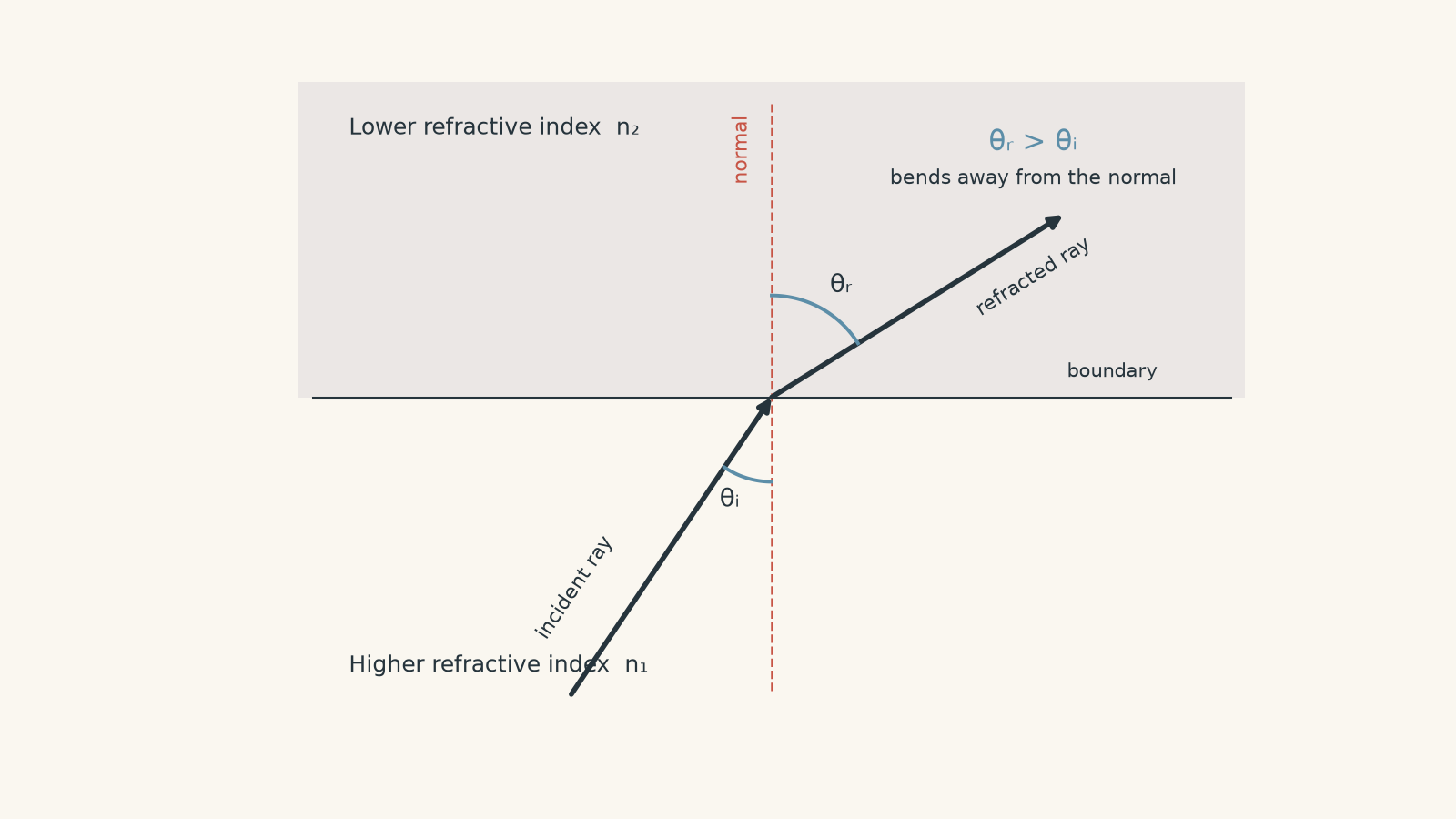
The normal is an imaginary line drawn at \(90^\circ\) to the surface. In optics, angles are measured from this normal, not from the surface itself.
This matters because Snell’s law uses those angles:
\[
n_1\sin\theta_1=n_2\sin\theta_2
\]
where:
- \(n_1\) is the refractive index of the medium the light starts in
- \(n_2\) is the refractive index of the second medium
- \(\theta_1\) is the angle of incidence
- \(\theta_2\) is the angle of refraction
Now imagine gradually increasing \(\theta_1\) while the two materials stay the same.
Because the light is moving from higher \(n\) to lower \(n\), the refracted ray bends further and further away from the normal. That means \(\theta_2\) keeps getting larger.
But there is a problem. How large can \(\theta_2\) become?
The largest possible angle from the normal is \(90^\circ\). At that point, the refracted ray travels along the boundary itself.
That is where the critical angle appears.
02What the critical angle actually means
The critical angle, \(\theta_c\), is the angle of incidence in the higher refractive index medium for which the refracted ray has an angle of \(90^\circ\).
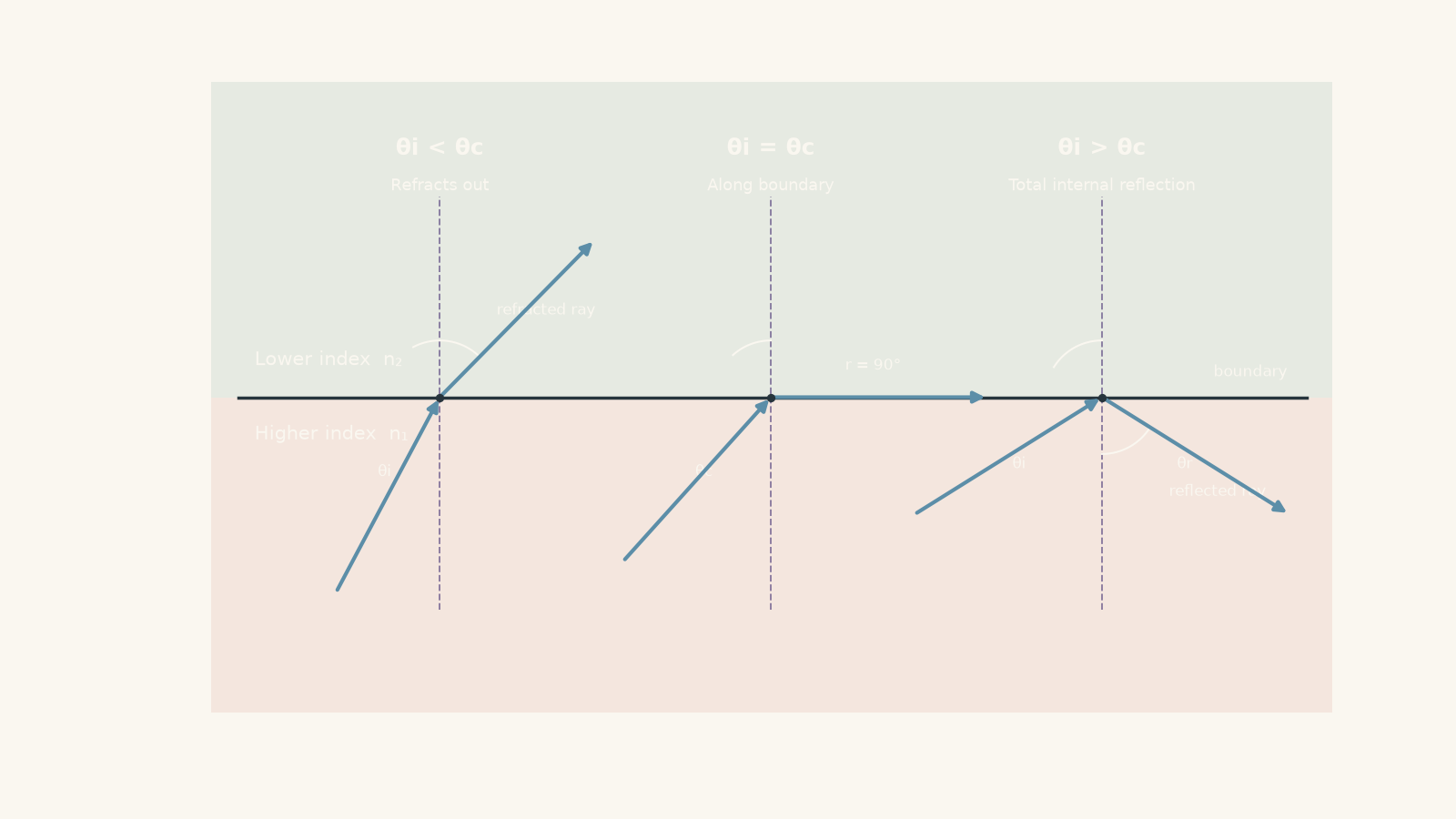
At the critical angle:
\[
\theta_1=\theta_c
\]
and
\[
\theta_2=90^\circ
\]
Put that into Snell’s law:
\[
n_1\sin\theta_c=n_2\sin90^\circ
\]
Since \(\sin90^\circ=1\),
\[
n_1\sin\theta_c=n_2
\]
so:
\[
\boxed{\sin\theta_c=\frac{n_2}{n_1}}
\]
Therefore:
\[
\boxed{\theta_c=\sin^{-1}\left(\frac{n_2}{n_1}\right)}
\]
There is an important condition hidden inside this equation:
\[
n_1>n_2
\]
A critical angle only exists when light travels from a higher refractive index to a lower refractive index.
Light travelling from air into glass cannot undergo total internal reflection at that boundary. It is going the wrong way.
03What happens below, at, and above the critical angle?
The critical angle is a threshold, not an angle at which total internal reflection has already started.
| Incident angle | What happens? |
|---|---|
| \(\theta_1<\theta_c\) | Light can refract into the second medium. Some reflection also usually occurs. |
| \(\theta_1=\theta_c\) | The refracted ray travels along the boundary at \(90^\circ\) to the normal. |
| \(\theta_1>\theta_c\) | Total internal reflection occurs. |
That middle row is a common trap.
At exactly the critical angle, the refracted ray is still part of the model. Total internal reflection requires the angle of incidence to be greater than the critical angle.
Worked example: Find the critical angle for glass
A ray of light travels from glass with refractive index \(1.50\) into air with refractive index \(1.00\). Calculate the critical angle.
Step 1
The light travels from \(n_1=1.50\) to \(n_2=1.00\).
Since \(1.50>1.00\), the light is travelling from higher refractive index to lower refractive index, so total internal reflection is possible.
Step 2
\[
\sin\theta_c=\frac{n_2}{n_1}
=\frac{1.00}{1.50}
=0.6667
\]
Step 3
\[
\theta_c=\sin^{-1}(0.6667)=41.8^\circ
\]
So:
\[
\boxed{\theta_c=41.8^\circ}
\]
The result means that a ray striking the glass-air boundary at more than \(41.8^\circ\) to the normal undergoes total internal reflection.
A ray at \(40^\circ\) can still escape. A ray at \(45^\circ\) cannot, according to the ideal ray model.
04Why total internal reflection happens
There is a useful mathematical way to see why the refraction suddenly stops.
Rearrange Snell’s law:
\[
\sin\theta_2=\frac{n_1}{n_2}\sin\theta_1
\]
If \(n_1>n_2\), then the factor \(n_1/n_2\) is greater than 1.
As \(\theta_1\) increases, the calculated value of \(\sin\theta_2\) eventually reaches 1. That occurs at the critical angle.
Try increasing \(\theta_1\) further. The equation would require:
\[
\sin\theta_2>1
\]
But no real angle has a sine greater than 1.
That doesn’t mean Snell’s law has mysteriously failed. It means there is no ordinary transmitted ray that can satisfy the boundary conditions. In the HSC ray model, the light is totally internally reflected.
A more complete wave description includes a very small electromagnetic field extending into the second medium, called an evanescent field. You do not need that detail to calculate the HSC critical angle, but it is worth knowing that “total internal reflection” is a model with more wave physics underneath it.
05The two conditions for total internal reflection
Students often remember the critical angle formula but forget that total internal reflection needs two conditions.
Both must be true:
- Light must travel from a medium with higher refractive index to one with lower refractive index.
- The angle of incidence must be greater than the critical angle.
A large incident angle by itself is not enough.
For example, light travelling from air into glass at \(80^\circ\) does not undergo total internal reflection. Air has the lower refractive index, so the first condition fails.
You can picture it like trying to leave a party through a doorway with a strangely strict exit policy. Being dramatic and approaching the door at a ridiculous angle doesn’t help if you’re actually entering the party rather than leaving it. The direction between the two media matters first.
The analogy breaks down because light isn’t choosing whether to leave, of course. The real behaviour comes from electromagnetic waves at a boundary.
06Be careful about which angle you are given
Suppose a diagram says a ray strikes a surface at \(12^\circ\).
That statement is incomplete. Is the \(12^\circ\) measured from the normal or from the surface?
Snell’s law and the critical angle always use the angle to the normal.
Since the surface and normal are perpendicular:
\[
\theta_{\text{normal}}=90^\circ-\theta_{\text{surface}}
\]
So a ray making \(12^\circ\) with the surface makes:
\[
90^\circ-12^\circ=78^\circ
\]
with the normal.
That difference can completely change whether total internal reflection occurs.
Worked example: A ray inside an optical fibre
An optical fibre has a core with refractive index \(1.48\) surrounded by cladding with refractive index \(1.44\). A ray inside the core reaches the core-cladding boundary at an angle of \(12^\circ\) to the boundary surface. Determine whether total internal reflection occurs.
Step 1
The ray is \(12^\circ\) from the surface, so its angle of incidence is:
\[
\theta_1=90^\circ-12^\circ=78^\circ
\]
Step 2
The ray travels from the core, where \(n_1=1.48\), into the cladding, where \(n_2=1.44\).
Since:
\[
1.48>1.44
\]
a critical angle exists.
Step 3
\[
\sin\theta_c=\frac{n_2}{n_1}
=\frac{1.44}{1.48}
=0.9730
\]
Therefore:
\[
\theta_c=\sin^{-1}(0.9730)=76.7^\circ
\]
Step 4
\[
78^\circ>76.7^\circ
\]
Therefore:
\[
\boxed{\text{total internal reflection occurs}}
\]
The ray only exceeds the critical angle by about \(1.3^\circ\). If you had incorrectly treated the given \(12^\circ\) as the angle of incidence, you would have predicted the opposite result.
07How changing the materials changes the critical angle
Look again at:
\[
\sin\theta_c=\frac{n_2}{n_1}
\]
Suppose \(n_1\) stays fixed while \(n_2\) increases.
Predict what happens to \(\theta_c\).
The fraction \(n_2/n_1\) becomes larger, so \(\sin\theta_c\) becomes larger. Therefore, the critical angle also becomes larger.
That means total internal reflection becomes possible over a smaller range of incident angles.
For example, if the critical angle rises from \(40^\circ\) to \(70^\circ\), an incident ray at \(60^\circ\) changes from undergoing total internal reflection to being able to refract out.
There is a useful limiting case here. Imagine \(n_2\) getting closer and closer to \(n_1\):
\[
\frac{n_2}{n_1}\rightarrow1
\]
so:
\[
\theta_c\rightarrow90^\circ
\]
The range of angles greater than the critical angle shrinks away.
If the refractive indices become equal, there is no meaningful refracting boundary between the materials and no total internal reflection caused by that boundary.
08The most tempting misconception
A student might say:
“If light reaches the critical angle, it reflects completely.”
It sounds reasonable because the phrase “critical angle” feels like the point where total internal reflection switches on.
But the exact threshold matters:
- below \(\theta_c\): refraction is possible
- at \(\theta_c\): the refracted ray is at \(90^\circ\)
- above \(\theta_c\): total internal reflection occurs
Another tempting mistake is to compare the incident angle with the critical angle before checking which medium the ray starts in. Always check the refractive indices first.
A reliable decision process is:
- Identify \(n_1\), the medium the light is travelling in.
- Identify \(n_2\), the medium it is approaching.
- Check whether \(n_1>n_2\).
- If so, calculate \(\theta_c=\sin^{-1}(n_2/n_1)\).
- Make sure the incident angle is measured from the normal.
- Compare \(\theta_1\) with \(\theta_c\).
09Questions and solutions
Question 1
Light travels through water with refractive index \(1.33\) towards an air boundary with refractive index \(1.00\).
Calculate the critical angle. Would a ray incident at \(50.0^\circ\) undergo total internal reflection?
Solution 1
The critical angle is \(48.8^\circ\), so a ray incident at \(50.0^\circ\) undergoes total internal reflection.
The light travels from higher refractive index to lower refractive index because:
\[
1.33>1.00
\]
so a critical angle exists.
Using:
\[
\sin\theta_c=\frac{n_2}{n_1}
\]
gives:
\[
\sin\theta_c=\frac{1.00}{1.33}=0.7519
\]
Therefore:
\[
\theta_c=\sin^{-1}(0.7519)=48.8^\circ
\]
The actual angle is:
\[
50.0^\circ>48.8^\circ
\]
so the ray is above the threshold:
\[
\boxed{\text{total internal reflection occurs}}
\]
The important comparison is with the angle measured from the normal.
Question 2
A light ray travels from glass with refractive index \(1.52\) into water with refractive index \(1.33\). The angle of incidence is \(58.0^\circ\).
Determine whether total internal reflection occurs. If it does not, calculate the angle of refraction.
Solution 2
Total internal reflection does not occur. The ray refracts into the water at approximately \(75.6^\circ\) to the normal.
First calculate the critical angle:
\[
\sin\theta_c=\frac{1.33}{1.52}=0.8750
\]
so:
\[
\theta_c=\sin^{-1}(0.8750)=61.0^\circ
\]
The incident angle is only \(58.0^\circ\):
\[
58.0^\circ<61.0^\circ
\]
Therefore, the ray has not reached the critical angle.
Use Snell’s law to find the refracted angle:
\[
n_1\sin\theta_1=n_2\sin\theta_2
\]
Substituting:
\[
1.52\sin58.0^\circ=1.33\sin\theta_2
\]
so:
\[
\sin\theta_2
=\frac{1.52\sin58.0^\circ}{1.33}
\approx0.969
\]
and therefore:
\[
\theta_2\approx75.6^\circ
\]
Thus:
\[
\boxed{\theta_2\approx75.6^\circ}
\]
The large refracted angle makes sense. The light is travelling from higher refractive index to lower refractive index, so it bends away from the normal and is already quite close to the \(90^\circ\) condition that defines the critical angle.
Question 3
A transparent solid has refractive index \(1.62\). When it is placed against an unknown liquid, the critical angle at the solid-liquid boundary is measured as \(57.0^\circ\).
Calculate the refractive index of the liquid. State what happens to a ray incident at exactly \(57.0^\circ\).
Solution 3
The liquid has refractive index approximately \(1.36\). At exactly \(57.0^\circ\), the refracted ray travels along the boundary, so total internal reflection has not yet occurred.
Start with:
\[
\sin\theta_c=\frac{n_2}{n_1}
\]
Rearrange for \(n_2\):
\[
n_2=n_1\sin\theta_c
\]
Substitute:
\[
n_2=1.62\sin57.0^\circ
\]
\[
n_2\approx1.36
\]
Therefore:
\[
\boxed{n_2\approx1.36}
\]
At the critical angle:
\[
\theta_2=90^\circ
\]
so the transmitted ray runs along the boundary.
The trap is treating the critical angle itself as an angle of total internal reflection. The incident angle must be greater than \(57.0^\circ\) for total internal reflection to occur.
Question 4
A student claims:
“If the refractive index of the second medium increases while the first medium stays unchanged, total internal reflection becomes easier because the second medium bends the light more strongly.”
Is the student’s conclusion correct? Explain using the critical angle equation and describe what happens as \(n_2\) approaches \(n_1\).
Solution 4
The conclusion is incorrect. Increasing \(n_2\) makes the critical angle larger, so total internal reflection occurs over a smaller range of incident angles.
For light travelling from \(n_1\) to a lower refractive index \(n_2\):
\[
\sin\theta_c=\frac{n_2}{n_1}
\]
If \(n_1\) stays constant while \(n_2\) increases, then \(n_2/n_1\) increases.
Therefore:
\[
\sin\theta_c\text{ increases}
\]
and hence:
\[
\theta_c\text{ increases}
\]
Total internal reflection requires:
\[
\theta_1>\theta_c
\]
so increasing the critical angle makes that condition harder to satisfy.
As \(n_2\) approaches \(n_1\):
\[
\frac{n_2}{n_1}\rightarrow1
\]
which gives:
\[
\theta_c\rightarrow90^\circ
\]
The available range of incident angles above the critical angle therefore approaches zero.
The student’s phrase “bends the light more strongly” hides the important point. What matters is the ratio of the two refractive indices and how that ratio sets the maximum possible refracted angle.
Question 5
A ray travels inside a transparent slab with refractive index \(1.60\). It reaches the upper surface at \(25.0^\circ\) to the surface itself.
Initially, the material above the slab is air with refractive index \(1.00\).
- Determine whether total internal reflection occurs.
- The air is replaced by a liquid with refractive index \(1.40\). Determine whether total internal reflection still occurs.
- Calculate the minimum refractive index of the liquid that would prevent total internal reflection for this same ray.
Solution 5
The ray undergoes total internal reflection with both air and the \(n=1.40\) liquid. A liquid needs a refractive index of at least approximately \(1.45\) to prevent total internal reflection for this ray.
First notice the hidden angle issue. The given \(25.0^\circ\) is measured from the surface, not the normal.
Therefore, the angle of incidence is:
\[
\theta_1=90.0^\circ-25.0^\circ=65.0^\circ
\]
For part 1, with air:
\[
\sin\theta_c=\frac{1.00}{1.60}=0.625
\]
so:
\[
\theta_c=\sin^{-1}(0.625)=38.7^\circ
\]
Since:
\[
65.0^\circ>38.7^\circ
\]
the ray undergoes total internal reflection.
For part 2, replace the air with a liquid of refractive index \(1.40\):
\[
\sin\theta_c=\frac{1.40}{1.60}=0.875
\]
so:
\[
\theta_c=\sin^{-1}(0.875)=61.0^\circ
\]
The ray still has an incident angle of \(65.0^\circ\), so:
\[
65.0^\circ>61.0^\circ
\]
and total internal reflection still occurs.
For part 3, the threshold for preventing total internal reflection occurs when this ray is exactly at the critical angle:
\[
\theta_c=65.0^\circ
\]
Using:
\[
\sin\theta_c=\frac{n_2}{n_1}
\]
gives:
\[
n_2=n_1\sin\theta_c
\]
Substitute:
\[
n_2=1.60\sin65.0^\circ
\]
\[
n_2\approx1.45
\]
Therefore:
\[
\boxed{n_2\approx1.45}
\]
A second medium with \(n_2\geq1.45\) makes the critical angle at least \(65.0^\circ\), so this particular ray is no longer above the critical angle.
This question exposes two easy mistakes: using the angle to the surface without converting it, and assuming that replacing air with any lower-index material will preserve total internal reflection.
10What this lets you understand next
The critical angle gives you the boundary between refraction and total internal reflection. That is the key idea behind guiding light through optical fibres and other transparent structures.
The next step is to connect the direction of a ray inside a fibre to its angle of incidence at the core-cladding boundary. Once you can do that, you can predict which rays stay trapped, which escape, and why choosing the refractive indices of the core and cladding matters.