
Light Intensity and the Inverse-Square Law for HSC Physics
Learn why light intensity decreases with distance from a point-like source, how the inverse-square law works, and how to apply it to energy transfer calculations.
A torch looks bright when it is close to a wall and much dimmer when you step backwards. Nothing inside the torch has changed. It is still transferring energy at roughly the same rate. So where did the brightness go?
Before reading on, make a prediction. If you move twice as far from a small light source, will the intensity become half as large, one quarter as large, or something else?
For an ideal point-like source spreading energy equally in all directions, the intensity becomes one quarter as large. The reason is not that the light “runs out” as it travels. The same energy is being spread over a larger area.
That geometric idea is the inverse-square law.
01Start with the energy, not the formula
Imagine a tiny lamp floating in empty space. It emits light equally in every direction.
After a short time, some of that light has travelled 1 m from the lamp. Picture all those light rays passing through the surface of an invisible sphere with radius 1 m.
A little later, the light reaches an invisible sphere with radius 2 m.
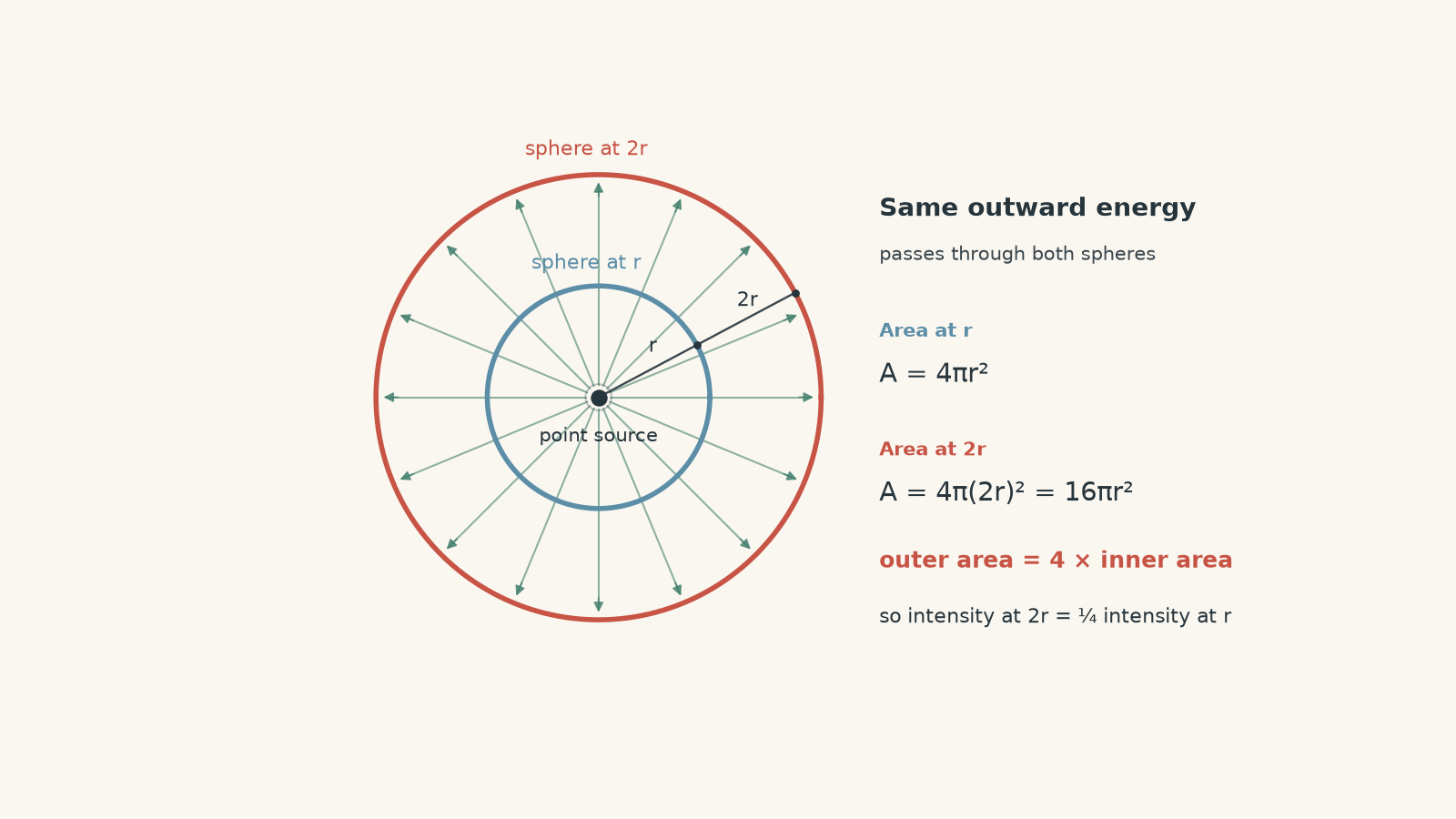
Here is the important part: the second sphere does not receive less total energy just because it is farther away. If there is no absorption, the light crossing the first sphere also goes on to cross the second sphere.
What changes is the area over which that energy is distributed.
The surface area of a sphere is
\[
A = 4\pi r^2
\]
where:
- \(A\) is the surface area in square metres (\(\mathrm{m^2}\))
- \(r\) is the distance from the source in metres (\(\mathrm{m}\))
If the distance doubles from \(r\) to \(2r\), the new area is
\[
A = 4\pi(2r)^2 = 16\pi r^2
\]
The original area was \(4\pi r^2\), so the new area is four times as large.
The same energy is now spread across four times the area. Each square metre therefore receives only one quarter as much energy per second.
That is where the inverse square comes from.
02What intensity actually measures
Light intensity tells us the rate at which energy is transferred through each unit of area.
If a source has power \(P\), then it transfers energy at a rate of \(P\) joules per second.
For an ideal point-like source radiating equally in all directions, that power is spread over the surface area \(4\pi r^2\). Therefore,
\[
I = \frac{P}{4\pi r^2}
\]
where:
- \(I\) is intensity in watts per square metre (\(\mathrm{W\,m^{-2}}\))
- \(P\) is the source power in watts (\(\mathrm{W}\))
- \(r\) is the distance from the source in metres (\(\mathrm{m}\))
The equation says something physically simple:
Intensity is power divided by the area over which that power has spread.
A useful way to picture this is a group pizza being shared. If four people suddenly turn into sixteen people, the pizza has not mysteriously shrunk. Each person just gets a smaller share.
For light, the “pizza” is the emitted power and the “people” are patches of area on an expanding sphere. The analogy breaks because light is not divided into fixed slices for separate patches, but it captures the geometric reason intensity falls.
03Why it is called an inverse-square law
Suppose the power stays constant.
Then
\[
I = \frac{P}{4\pi r^2}
\]
contains several quantities that do not change. We can write the relationship more compactly as
\[
I \propto \frac{1}{r^2}
\]
The symbol \(\propto\) means “is proportional to”.
So if distance increases, intensity decreases according to the square of that distance.
| Change in distance | Change in intensity |
|---|---|
| \(r \to 2r\) | \(I \to \frac{I}{4}\) |
| \(r \to 3r\) | \(I \to \frac{I}{9}\) |
| \(r \to 4r\) | \(I \to \frac{I}{16}\) |
| \(r \to \frac{r}{2}\) | \(I \to 4I\) |
| \(r \to \frac{r}{3}\) | \(I \to 9I\) |
Notice that distance and intensity are not inversely proportional in the simple \(1/r\) sense.
Doubling the distance does not halve the intensity. It quarters it.
That is one of the most common mistakes with this topic.
04A faster way to compare two distances
You will not always know the power of the source.
Fortunately, if the same source is being compared at two distances, the power and \(4\pi\) cancel.
Start with
\[
I_1 = \frac{P}{4\pi r_1^2}
\]
and
\[
I_2 = \frac{P}{4\pi r_2^2}
\]
Dividing the second equation by the first gives
\[
\frac{I_2}{I_1}
=
\frac{r_1^2}{r_2^2}
\]
or
\[
\frac{I_2}{I_1}
=
\left(\frac{r_1}{r_2}\right)^2
\]
This ratio form is often the quickest method when a question asks how intensity changes with distance.
Worked example: Intensity from a small lamp
A small lamp emits 36 W of light approximately equally in all directions. Calculate the intensity 3.0 m from the lamp.
Step 1
The lamp is being treated as a point-like source radiating equally in all directions, so
\[
I = \frac{P}{4\pi r^2}
\]
Step 2
\[
I
=
\frac{36}{4\pi(3.0)^2}
=
\frac{36}{36\pi}
\]
Step 3
\[
I \approx 0.318\ \mathrm{W\,m^{-2}}
\]
So,
\[
\boxed{I \approx 0.32\ \mathrm{W\,m^{-2}}}
\]
At a distance of 3.0 m, each square metre of a spherical surface centred on the lamp receives about 0.32 J of light energy each second.
05Intensity and energy transfer are connected, but they are not the same thing
Intensity is a rate of energy transfer per unit area.
Suppose a detector with area \(A_d\) is facing the incoming light directly. If the intensity across the detector is approximately uniform, the power received is
\[
P_{\text{received}} = IA_d
\]
where \(A_d\) is the detector area in \(\mathrm{m^2}\).
If that light is received for a time \(t\), then
\[
E = P_{\text{received}}t
\]
so
\[
E = IA_dt
\]
where \(E\) is energy in joules (\(\mathrm{J}\)) and \(t\) is time in seconds (\(\mathrm{s}\)).
This gives us a useful chain of ideas:
\[
\text{source power}
\rightarrow
\text{spreading over area}
\rightarrow
\text{intensity}
\rightarrow
\text{energy received by a detector}
\]
A lower intensity means the same detector receives energy more slowly.
Worked example: Moving a detector farther away
A sensor with an area of \(2.0\times10^{-3}\ \mathrm{m^2}\) is placed 2.0 m from a point-like source. The source emits 50 W equally in all directions.
The sensor is then moved to 5.0 m from the source. Calculate the intensity at 5.0 m and the energy incident on the sensor during 30 s.
Assume the sensor faces the incoming light directly and all of its area is illuminated.
Step 1
\[
I = \frac{P}{4\pi r^2}
\]
Substituting \(P = 50\ \mathrm{W}\) and \(r = 5.0\ \mathrm{m}\),
\[
I
=
\frac{50}{4\pi(5.0)^2}
=
\frac{50}{100\pi}
\approx 0.159\ \mathrm{W\,m^{-2}}
\]
Step 2
\[
P_{\text{received}} = IA_d
\]
\[
P_{\text{received}}
=
(0.159)(2.0\times10^{-3})
=
3.18\times10^{-4}\ \mathrm{W}
\]
Step 3
\[
E = P_{\text{received}}t
\]
\[
E
=
(3.18\times10^{-4})(30)
=
9.55\times10^{-3}\ \mathrm{J}
\]
Therefore,
\[
\boxed{I \approx 0.159\ \mathrm{W\,m^{-2}}}
\]
and
\[
\boxed{E \approx 9.5\times10^{-3}\ \mathrm{J}}
\]
The sensor receives only about \(9.5\ \mathrm{mJ}\) during the 30 s interval. Most of the source’s 50 W misses the tiny sensor because the energy is spreading across an enormous spherical area.
06The tempting misconception: light gets weaker because it uses up energy
A student might say, “The light has travelled farther, so it must have lost energy.”
That sounds reasonable. Many moving things slow down or lose energy because of friction or resistance.
But geometric spreading is different.
In an ideal vacuum, a photon does not gradually surrender energy simply because it has travelled farther. The drop in intensity occurs because the emitted energy is spread over a larger spherical area.
Imagine two complete spheres surrounding the same source. If no light is absorbed between them, the same total power crosses both spheres.
What changes is the power per square metre.
This distinction matters because real situations can contain both effects:
- geometric spreading, which gives the inverse-square dependence
- absorption or scattering, which can reduce the total transmitted power as the radiation travels through matter
The inverse-square law itself describes the first effect.
07Why the source must be point-like
The equation
\[
I = \frac{P}{4\pi r^2}
\]
does not magically apply to every lamp, laser, screen, or glowing object.
It relies on a particular model.
The source should be approximately point-like, meaning its physical size is small compared with the distance from which you observe it.
Suppose you are 100 m from a tiny light bulb. Treating the bulb as one point is probably a reasonable approximation.
Now suppose your eye is 2 cm from a large glowing screen. Different parts of the screen are at noticeably different distances and directions from you. Treating the whole screen as one point would be a poor model.
“Point source” therefore does not mean the object must literally have zero size. It means its dimensions are small enough compared with the distances involved that treating it as a point gives a useful approximation.
08Why the source must spread energy in the right way
The \(4\pi r^2\) in the formula comes from the surface area of a sphere.
That assumes the source radiates equally in all directions. The technical term is isotropic.
Many real sources are not perfectly isotropic.
A torch deliberately directs much of its light forwards. A laser is even more directional. For those sources, putting the total power into
\[
I = \frac{P}{4\pi r^2}
\]
would incorrectly pretend that the power had been distributed over an entire sphere.
You may still find an inverse-square relationship in some situations, but you cannot assume the spherical formula without checking the geometry and the source model.
09A useful test: does the area grow as \(r^2\)?
When deciding whether an inverse-square model makes sense, ask what surface the energy is spreading across.
For a point source in three-dimensional space, the spreading surface is spherical:
\[
A = 4\pi r^2
\]
Since area grows as \(r^2\), intensity falls as \(1/r^2\).
This is the deeper reason for the law. It is a geometric result, not a special rule that light happens to obey.
The same reasoning appears in other physical situations involving point-like sources and three-dimensional spreading.
10Don’t confuse intensity with total power
Suppose two students stand at different distances from the same source.
The farther student measures a lower intensity. Has the source power changed?
No.
For an ideal source, the emitted power is still \(P\). The difference is how thinly that power has been spread by the time it reaches each distance.
Think about these two statements:
- “The source emits 60 J every second.”
- “At my location, each square metre receives 0.20 J every second.”
The first describes power.
The second describes intensity.
Keeping those ideas separate prevents a lot of mistakes.
11Using ratios without getting the fraction backwards
Suppose intensity is \(I_1\) at distance \(r_1\). You move farther away to \(r_2\).
We have
\[
\frac{I_2}{I_1}
=
\left(\frac{r_1}{r_2}\right)^2
\]
If \(r_2 > r_1\), then \(r_1/r_2 < 1\), so \(I_2/I_1 < 1\).
That makes physical sense: moving farther away should reduce the intensity.
This gives you a quick error check. If your calculation says the intensity increased after moving farther from the same isotropic source, you have probably inverted the ratio.
Worked example: Finding an unknown distance
At 4.0 m from a small isotropic light source, the intensity is \(2.5\ \mathrm{W\,m^{-2}}\). At another location, the intensity is \(0.40\ \mathrm{W\,m^{-2}}\).
Calculate the second distance.
Step 1
\[
\frac{I_2}{I_1}
=
\left(\frac{r_1}{r_2}\right)^2
\]
Step 2
\[
\frac{0.40}{2.5}
=
\left(\frac{4.0}{r_2}\right)^2
\]
\[
0.16
=
\left(\frac{4.0}{r_2}\right)^2
\]
Step 3
\[
0.40 = \frac{4.0}{r_2}
\]
Step 4
\[
r_2 = \frac{4.0}{0.40} = 10\ \mathrm{m}
\]
Therefore,
\[
\boxed{r_2 = 10\ \mathrm{m}}
\]
The weaker intensity occurs farther from the source, as expected.
Notice why taking the square root matters. An intensity reduction by a factor of \(6.25\) does not require the distance to increase by a factor of \(6.25\). The distance increases by \(\sqrt{6.25} = 2.5\).
12Where the simple model stops being enough
For HSC problems, you will often be given conditions that make the inverse-square model appropriate. In real measurements, several complications can appear.
The simple relation
\[
I = \frac{P}{4\pi r^2}
\]
works best when:
- the source can be treated as point-like
- the source emits approximately equally in all directions
- there is negligible absorption or scattering between source and observer
- the distance \(r\) is measured from the effective position of the source
- the detector is small enough that the intensity does not vary significantly across it
If one of these assumptions fails, do not automatically throw away the physics. Instead, identify which part of the model needs changing.
For example, air containing smoke may scatter some light. The geometric spreading still happens, but less power may reach a distant sphere than a nearer one.
13Questions and solutions
Question 1
A small isotropic source produces an intensity of \(12\ \mathrm{W\,m^{-2}}\) at a distance of 2.0 m. What intensity would be measured at 4.0 m?
Solution 1
The intensity is \(\boxed{3.0\ \mathrm{W\,m^{-2}}}\).
For the same source,
\[
\frac{I_2}{I_1}
=
\left(\frac{r_1}{r_2}\right)^2
\]
Substituting the values,
\[
\frac{I_2}{12}
=
\left(\frac{2.0}{4.0}\right)^2
=
\frac{1}{4}
\]
so
\[
I_2 = 12\times\frac{1}{4}
=3.0\ \mathrm{W\,m^{-2}}
\]
Doubling the distance spreads the same power across four times the spherical area, so the intensity becomes one quarter as large. The tempting mistake is to halve the intensity because the distance doubled, but the dependence is on \(r^2\), not \(r\).
Question 2
A point-like source emits 80 W isotropically. Calculate the intensity 2.5 m from the source.
Solution 2
The intensity is approximately \(\boxed{1.0\ \mathrm{W\,m^{-2}}}\).
For an isotropic point source,
\[
I = \frac{P}{4\pi r^2}
\]
Substituting \(P = 80\ \mathrm{W}\) and \(r = 2.5\ \mathrm{m}\),
\[
I
=
\frac{80}{4\pi(2.5)^2}
=
\frac{80}{25\pi}
\approx 1.02\ \mathrm{W\,m^{-2}}
\]
Therefore,
\[
\boxed{I \approx 1.0\ \mathrm{W\,m^{-2}}}
\]
This means each square metre of an imaginary sphere 2.5 m from the source has about 1.0 J of energy crossing it each second.
Question 3
A detector of area \(4.0\times10^{-3}\ \mathrm{m^2}\) is placed 6.0 m from an isotropic source that emits 120 W. Assume the detector faces the incoming radiation directly.
Calculate:
a. the intensity at the detector
b. the power incident on the detector
c. the energy incident on the detector in 2.0 minutes
Solution 3
The intensity is \(\boxed{0.265\ \mathrm{W\,m^{-2}}}\), the incident power is \(\boxed{1.06\times10^{-3}\ \mathrm{W}}\), and the energy received in 2.0 minutes is \(\boxed{0.127\ \mathrm{J}}\).
First, calculate the intensity:
\[
I
=
\frac{P}{4\pi r^2}
=
\frac{120}{4\pi(6.0)^2}
=
\frac{120}{144\pi}
\approx 0.265\ \mathrm{W\,m^{-2}}
\]
For part b, the detector intercepts only a small part of the spreading radiation:
\[
P_{\text{received}} = IA_d
\]
\[
P_{\text{received}}
=
(0.265)(4.0\times10^{-3})
=
1.06\times10^{-3}\ \mathrm{W}
\]
For part c, first convert 2.0 minutes to seconds:
\[
t = 120\ \mathrm{s}
\]
Then
\[
E
=
P_{\text{received}}t
=
(1.06\times10^{-3})(120)
=
0.127\ \mathrm{J}
\]
The source emits 120 J every second, but the small detector intercepts only a tiny fraction of that power.
Question 4
Two identical detectors are placed at distances \(r\) and \(3r\) from the same isotropic point source.
Detector A, at distance \(r\), receives 0.72 J of energy during a certain time interval. Both detectors have the same area and face the source in the same way.
How much energy does detector B receive during the same time interval?
Solution 4
Detector B receives \(\boxed{0.080\ \mathrm{J}}\).
At \(3r\), the intensity is
\[
\frac{I_B}{I_A}
=
\left(\frac{r}{3r}\right)^2
=
\frac{1}{9}
\]
Because the detectors have the same area and collect light for the same length of time,
\[
E = IAt
\]
shows that the energy received is directly proportional to intensity.
Therefore,
\[
E_B
=
\frac{0.72}{9}
=
0.080\ \mathrm{J}
\]
A tempting approach is to divide by 3 because detector B is three times farther away. That ignores the fact that the spherical area has increased by \(3^2 = 9\).
Question 5
A student measures the intensity of light from a lamp at several distances and obtains these results.
| Distance from lamp (\(\mathrm{m}\)) | Intensity (\(\mathrm{W\,m^{-2}}\)) |
|---|---|
| 1.0 | 20 |
| 2.0 | 5.0 |
| 3.0 | 2.2 |
The student says, “The lamp must be losing energy as the light travels because the measured intensity gets smaller.”
Evaluate this claim using the data.
Solution 5
The claim is not supported by these measurements. The data are approximately consistent with inverse-square spreading, which can reduce intensity even if the total power crossing each spherical surface remains constant.
If the intensity at 1.0 m is \(20\ \mathrm{W\,m^{-2}}\), the inverse-square law predicts at 2.0 m:
\[
I_2
=
20\left(\frac{1.0}{2.0}\right)^2
=
5.0\ \mathrm{W\,m^{-2}}
\]
At 3.0 m it predicts:
\[
I_3
=
20\left(\frac{1.0}{3.0}\right)^2
=
2.22\ \mathrm{W\,m^{-2}}
\]
The measured values of \(5.0\ \mathrm{W\,m^{-2}}\) and \(2.2\ \mathrm{W\,m^{-2}}\) closely match these predictions.
The decreasing intensity can therefore be explained by geometric spreading alone. The experiment does not show that the radiation itself is progressively losing energy in transit.
To establish significant absorption, the student would need evidence that the measured intensity falls more quickly than expected from geometric spreading, together with appropriate control of other effects.
Question 6
A source is described as emitting 40 W of light. A student uses
\[
I = \frac{P}{4\pi r^2}
\]
to calculate the intensity 5.0 m directly in front of the source.
Later, the student learns that the source is a tightly focused lamp that sends almost all of its light into a narrow forward beam.
Explain why the student’s calculation may be incorrect, even though the source is small compared with 5.0 m.
Solution 6
The calculation may be incorrect because being point-like is not enough. The equation \(\boxed{I=P/(4\pi r^2)}\) also assumes that the source distributes its power isotropically over a complete sphere.
The student’s calculation would give
\[
I
=
\frac{40}{4\pi(5.0)^2}
=
\frac{40}{100\pi}
\approx 0.127\ \mathrm{W\,m^{-2}}
\]
but this treats the 40 W as though it were spread uniformly over all directions.
A tightly focused lamp sends much more power into some directions than others. Directly in front of it, the actual intensity could therefore be much greater than the spherical model predicts.
The hidden assumption is the important part of the question. A source can be small enough to approximate as a point while still being highly directional. The inverse-square formula with \(4\pi r^2\) requires both an appropriate point-source approximation and approximately isotropic emission.
14What this idea lets you do next
The inverse-square law gives you more than a formula for brightness. It gives you a general method for reasoning about energy that spreads through three-dimensional space.
Once you can separate total power from power per unit area, you can analyse detectors, radiation measurements, and other situations where a source distributes energy across an expanding surface.
The next useful question is what happens when the medium itself removes energy through absorption or scattering. Then geometric spreading is still present, but it is no longer the whole story.