
Temperature and Average Kinetic Energy in HSC Physics
Understand why temperature measures average particle kinetic energy, not total thermal energy. Includes worked examples, misconceptions, and HSC-style practice.
A mug of water at \(80^\circ\text{C}\) feels much hotter than a swimming pool at \(25^\circ\text{C}\). But which one contains more thermal energy?
Your first instinct might be the mug because its temperature is higher. That prediction mixes up two different ideas. Temperature tells us about the average energy of particles. Total thermal energy depends on how much energy all the particles have together. A huge number of moderately energetic particles can therefore contain more energy than a small number of highly energetic ones.
That distinction is the key to using the particle model properly.
01Start with the particles
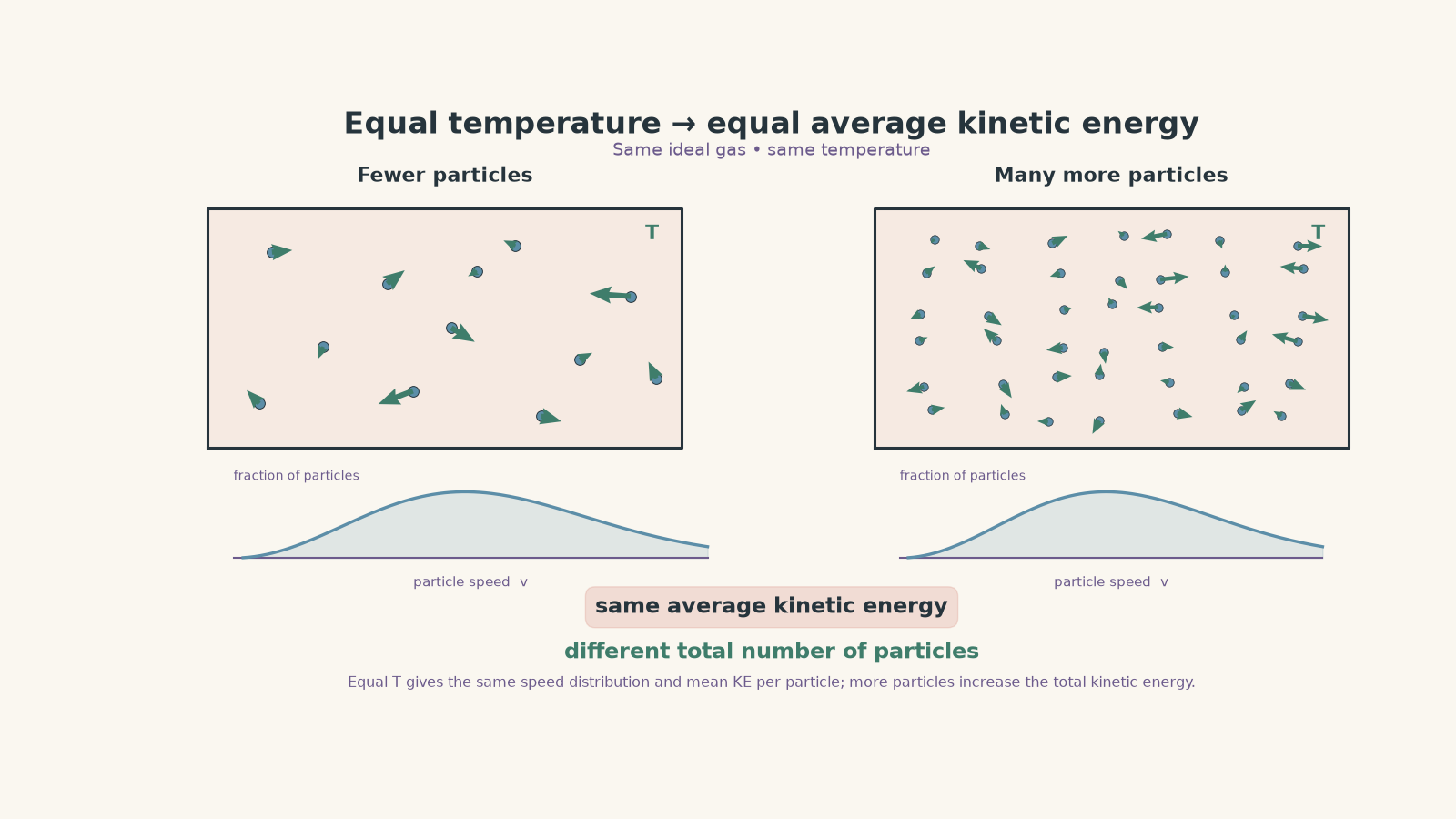
Picture two sealed boxes containing the same gas.
Box A contains 100 particles. Box B contains 1,000 particles. Suppose the particles in both boxes have the same average kinetic energy.
Which box has the higher temperature?
Neither. Their temperatures are the same because their particles have the same average kinetic energy.
Which box has more energy associated with the motion of all its particles?
Box B. It has ten times as many particles contributing energy.
This gives us our first useful mental model:
- temperature is connected to the average kinetic energy per particle
- total energy depends on both the energy per particle and the number of particles
Think of a group receiving exam marks. Temperature is a bit like the average mark. Total energy is more like the sum of everyone’s marks. A class of 100 students averaging 70 has a much larger total than a class of 10 students averaging 90, even though the smaller class has the higher average.
The analogy breaks because energy is a physical quantity that can move between systems, while exam marks obviously aren’t. The useful part is just the distinction between an average and a total.
02What temperature actually measures
Particles in matter are always moving in some way.
In a gas, particles move through space in constantly changing directions. In a solid, atoms vibrate about approximately fixed positions. Liquids sit somewhere between these pictures, with particles moving and rearranging while remaining close together.
The kinetic energy of one particle is
\[
E_k = \frac{1}{2}mv^2
\]
where:
- \(E_k\) is kinetic energy in joules (J)
- \(m\) is the particle’s mass in kilograms (kg)
- \(v\) is the particle’s speed in metres per second (m s\(^{-1}\))
Not every particle in a substance moves at the same speed. At any instant, some are moving faster and some more slowly.
Temperature therefore doesn’t tell us the kinetic energy of one particular particle. It is linked to the average kinetic energy of the particles.
For an ideal monatomic gas, this relationship can be written precisely as
\[
\langle E_k \rangle = \frac{3}{2}k_B T
\]
where:
- \(\langle E_k \rangle\) is the average translational kinetic energy per particle in joules
- \(k_B\) is the Boltzmann constant, \(1.38 \times 10^{-23}\text{ J K}^{-1}\)
- \(T\) is absolute temperature in kelvin (K)
Notice something important: the number of particles doesn’t appear in this equation.
That means doubling the amount of gas, while keeping its temperature unchanged, does not increase the average kinetic energy per particle. You simply have twice as many particles with the same average kinetic energy.
03Why temperature must be in kelvin
Suppose a gas warms from \(20^\circ\text{C}\) to \(40^\circ\text{C}\).
Has its average kinetic energy doubled?
It is tempting to say yes because 40 is twice 20. But Celsius does not start at zero kinetic energy.
Convert to kelvin:
\[
20^\circ\text{C} = 293\text{ K}
\]
\[
40^\circ\text{C} = 313\text{ K}
\]
For an ideal gas, average translational kinetic energy is proportional to absolute temperature, so the ratio is
\[
\frac{313}{293} \approx 1.068
\]
The average kinetic energy has increased by about \(6.8\%\), not \(100\%\).
This is why equations involving particle kinetic energy require temperature in kelvin.
Worked example: Average kinetic energy of a gas particle
An ideal monatomic gas is at \(300\text{ K}\). Calculate the average translational kinetic energy of one gas particle.
Step 1
\[
\langle E_k \rangle = \frac{3}{2}k_B T
\]
Step 2
\[
\begin{aligned}
\langle E_k \rangle
&= \frac{3}{2}(1.38 \times 10^{-23})(300) \\
&= 6.21 \times 10^{-21}\text{ J}
\end{aligned}
\]
Step 3
The gas particles do not each have exactly \(6.21 \times 10^{-21}\text{ J}\) of kinetic energy. Some have more and some have less. This value is the average translational kinetic energy per particle.
04Temperature is not total thermal energy
Now imagine keeping that gas at \(300\text{ K}\) but doubling the number of particles.
The average kinetic energy per particle stays
\[
6.21 \times 10^{-21}\text{ J}
\]
so the temperature stays the same.
But there are now twice as many particles carrying kinetic energy. The total translational kinetic energy doubles.
For \(N\) particles of an ideal monatomic gas,
\[
E_{k,\text{total}} = N\langle E_k\rangle
\]
so
\[
E_{k,\text{total}} = \frac{3}{2}Nk_BT
\]
Using \(N = nN_A\), where \(n\) is the amount of gas in moles and \(N_A\) is Avogadro’s constant, we can also write
\[
E_{k,\text{total}} = \frac{3}{2}nRT
\]
where:
- \(n\) is the amount of gas in moles (mol)
- \(R\) is the universal gas constant, \(8.31\text{ J mol}^{-1}\text{ K}^{-1}\)
- \(T\) is absolute temperature in kelvin
This equation exposes the distinction clearly.
Average energy per particle depends on \(T\).
Total translational kinetic energy depends on both \(n\) and \(T\).
Worked example: Hotter gas versus more gas
Sample A contains \(0.20\text{ mol}\) of an ideal monatomic gas at \(600\text{ K}\). Sample B contains \(0.50\text{ mol}\) of the same gas at \(300\text{ K}\).
Which sample has the greater temperature, and which has the greater total translational kinetic energy?
Step 1
Sample A is at \(600\text{ K}\), while sample B is at \(300\text{ K}\).
Therefore, particles in A have the greater average kinetic energy.
In fact,
\[
\frac{\langle E_k\rangle_A}{\langle E_k\rangle_B}
=
\frac{600}{300}
=
2
\]
The average translational kinetic energy per particle in A is twice that in B.
Step 2
\[
\begin{aligned}
E_{k,A}
&= \frac{3}{2}nRT \\
&= \frac{3}{2}(0.20)(8.31)(600) \\
&= 1.50 \times 10^3\text{ J}
\end{aligned}
\]
Step 3
\[
\begin{aligned}
E_{k,B}
&= \frac{3}{2}(0.50)(8.31)(300) \\
&= 1.87 \times 10^3\text{ J}
\end{aligned}
\]
Step 4
Sample A is hotter, so each particle has more kinetic energy on average.
However, sample B contains more particles. That larger number more than compensates for its lower average kinetic energy, so B has the greater total translational kinetic energy.
This is exactly why “hotter” does not automatically mean “contains more energy”.
05A precision upgrade: internal energy is more than particle motion
So far, we have deliberately used an ideal monatomic gas because it gives us a very clean model. Its internal energy can be treated as the translational kinetic energy of its particles.
Real substances can be more complicated.
Particles can store energy through:
- translational motion
- rotational motion
- vibrations
- interactions between particles
The more precise quantity is internal energy, which is the microscopic energy stored within a system due to particle motion and particle interactions.
For example, particles in a liquid attract nearby particles. Changing their separation can change potential energy as well as kinetic energy.
This becomes especially important during a change of state.
Consider ice melting at constant temperature. Energy enters the ice-water system, but the temperature can remain unchanged while melting occurs.
Does that mean the transferred energy disappeared?
No. The energy changes the microscopic arrangement and interactions of the particles rather than increasing their average kinetic energy.
That is why the statement “adding energy always raises temperature” is false.
06The misconception to avoid
A student sees these two objects:
- a spark at \(1200^\circ\text{C}\)
- a large bathtub of water at \(40^\circ\text{C}\)
They conclude that the spark must contain more thermal energy because \(1200^\circ\text{C}\) is much hotter.
The reasoning feels sensible because temperature tells us something real about particle energy. The mistake is treating an average as though it were a total.
The spark contains very little matter. The bath contains an enormous number of particles.
Temperature alone is therefore not enough information to compare the total internal energies of two different systems.
There is another complication too. If the substances differ, their microscopic structures and energy-storage mechanisms can differ. So you generally cannot determine total internal energy from temperature and mass alone without knowing something about the substance and its state.
A useful decision rule is:
| Question | Quantity to think about |
|---|---|
| How energetic is a typical particle’s random motion? | Temperature |
| Which ideal gas has the greater average translational kinetic energy? | Compare absolute temperatures |
| How much microscopic energy is stored by the whole system? | Internal energy |
| Does adding more particles at the same temperature increase average kinetic energy? | No |
| Does adding more particles at the same temperature usually increase total internal energy? | Yes, if the added material is in the same state under comparable conditions |
| Does transferring energy always increase temperature? | No, especially during changes of state |
07Questions and solutions
Question 1
Two samples of the same ideal monatomic gas are both at \(350\text{ K}\). Sample X contains \(0.10\text{ mol}\), while sample Y contains \(0.30\text{ mol}\).
Compare their average translational kinetic energies per particle and their total translational kinetic energies.
Solution 1
The particles have the same average translational kinetic energy, but sample Y has three times the total translational kinetic energy.
Average kinetic energy depends only on absolute temperature:
\[
\langle E_k\rangle = \frac{3}{2}k_BT
\]
Both samples are at \(350\text{ K}\), so their average particle kinetic energies are equal.
For total kinetic energy,
\[
E_{k,\text{total}} = \frac{3}{2}nRT
\]
Both samples have the same \(T\), so total energy is proportional to the amount \(n\):
\[
\frac{E_Y}{E_X}
=
\frac{0.30}{0.10}
=
3
\]
Therefore, sample Y contains three times the total translational kinetic energy.
The common trap is to think that having more energetic particles means having a higher temperature. Here the particles are not more energetic on average. There are simply more of them.
Question 2
An ideal monatomic gas is heated from \(27^\circ\text{C}\) to \(127^\circ\text{C}\) without changing the number of particles.
Calculate the factor by which its average translational kinetic energy changes.
Solution 2
The average translational kinetic energy increases by a factor of approximately \(1.33\), not by \(127/27\).
The kinetic energy relationship requires absolute temperature.
Convert the temperatures to kelvin:
\[
\begin{aligned}
T_1 &= 27 + 273 = 300\text{ K} \\
T_2 &= 127 + 273 = 400\text{ K}
\end{aligned}
\]
Because
\[
\langle E_k\rangle \propto T
\]
the ratio is
\[
\frac{\langle E_k\rangle_2}{\langle E_k\rangle_1}
=
\frac{400}{300}
=
1.33
\]
So the average translational kinetic energy becomes about \(1.33\) times its original value, which is an increase of about \(33\%\).
The tempting mistake is to use Celsius values in the ratio. Celsius does not have its zero at zero particle kinetic energy, so it cannot be used directly in this proportional relationship.
Question 3
Container P holds \(0.40\text{ mol}\) of an ideal monatomic gas at \(250\text{ K}\). Container Q holds \(0.15\text{ mol}\) of the same gas at \(500\text{ K}\).
Determine:
- which gas has the greater average translational kinetic energy per particle
- which gas has the greater total translational kinetic energy
Solution 3
Gas Q has the greater average kinetic energy per particle, but gas P has the greater total translational kinetic energy.
For part 1, average kinetic energy is proportional to absolute temperature:
\[
\frac{\langle E_k\rangle_Q}{\langle E_k\rangle_P}
=
\frac{500}{250}
=
2
\]
So particles in Q have twice the average translational kinetic energy.
For part 2, use
\[
E_{k,\text{total}} = \frac{3}{2}nRT
\]
For P:
\[
\begin{aligned}
E_P
&= \frac{3}{2}(0.40)(8.31)(250) \\
&= 1.25 \times 10^3\text{ J}
\end{aligned}
\]
For Q:
\[
\begin{aligned}
E_Q
&= \frac{3}{2}(0.15)(8.31)(500) \\
&= 9.35 \times 10^2\text{ J}
\end{aligned}
\]
Therefore,
\[
E_P > E_Q
\]
Even though Q is twice as hot on an absolute temperature scale, P contains enough extra particles to give it the greater total kinetic energy.
The trap is comparing temperature first and stopping there. Temperature determines the average, while the total also depends on the amount of gas.
Question 4
A student makes this argument:
“Object A and object B are made from the same material. A is at a higher temperature, so A must have greater internal energy.”
Give one condition under which this conclusion would be reasonable, then explain why the statement is not generally valid.
Solution 4
The conclusion would be reasonable if the two objects contained the same amount of the same material in the same physical state under comparable conditions, but temperature alone does not determine total internal energy.
If two samples have the same mass, composition, and state, a higher temperature will generally correspond to greater internal energy because the microscopic particles have greater average energy.
But the original statement does not say the objects contain the same amount of material.
A small hot sample can have less total internal energy than a much larger cooler sample. Internal energy is an extensive quantity, meaning it depends on the amount of matter present.
Temperature is an intensive quantity. It does not increase merely because more of the same material is added.
The student’s argument therefore confuses a property describing the average microscopic state with a quantity describing the energy of the entire system.
Question 5
Two sealed containers hold ideal monatomic gases.
Container A contains \(N\) particles at temperature \(T\).
Container B contains \(2N\) particles at temperature \(T/2\).
A student claims, “Container A has more total translational kinetic energy because its particles have greater average kinetic energy.”
Assess the claim without substituting numerical values.
Solution 5
The claim is incorrect. The containers have equal total translational kinetic energy, even though particles in A have twice the average kinetic energy.
For one particle,
\[
\langle E_k\rangle = \frac{3}{2}k_BT
\]
So for A,
\[
\langle E_k\rangle_A = \frac{3}{2}k_BT
\]
For B,
\[
\begin{aligned}
\langle E_k\rangle_B
&= \frac{3}{2}k_B\left(\frac{T}{2}\right) \\
&= \frac{1}{2}\langle E_k\rangle_A
\end{aligned}
\]
A therefore has the greater average kinetic energy per particle.
However, total translational kinetic energy is
\[
E_{k,\text{total}} = \frac{3}{2}Nk_BT
\]
For A:
\[
E_A = \frac{3}{2}Nk_BT
\]
For B:
\[
\begin{aligned}
E_B
&= \frac{3}{2}(2N)k_B\left(\frac{T}{2}\right) \\
&= \frac{3}{2}Nk_BT
\end{aligned}
\]
Therefore,
\[
E_A = E_B
\]
Container B has twice as many particles, but each has half the average kinetic energy. Those effects cancel exactly.
This is the deeper reason temperature cannot be used by itself to compare the total energy of systems.
08What this distinction lets you understand next
Once you separate average particle energy from total internal energy, several later thermal physics ideas become much easier to organise.
Heating a substance can increase average particle kinetic energy and therefore temperature. But energy can also change particle arrangements and potential energies, particularly during changes of state. The amount of energy required also depends on how much material is present and on the material itself.
That sets up the next useful distinction: temperature change is an observable result, while heat is energy transferred because of a temperature difference. Keeping those ideas separate prevents many of the same mistakes that come from treating temperature as though it were simply “how much thermal energy something has”.