
Force on a Charge in an Electric Field: HSC Physics Guide
Learn how to apply F = qE, calculate electric force, and determine its direction for positive and negative charges in HSC Physics.
Two particles sit in the same uniform electric field. One has charge \(+q\), and the other has charge \(-q\). The field points to the right.
Which way does each particle feel a force?
It is tempting to think the field itself points in the direction that all charges move. It doesn’t. The electric field direction tells you the force direction for a positive charge. A negative charge feels a force in the opposite direction.
That single idea is what makes
\[
\vec F = q\vec E
\]
much easier to use correctly.
01Start with what an electric field tells you
Imagine placing a tiny positive charge at some point near other charges. It experiences an electric force.
The electric field at that point tells you two things:
- the direction a positive charge would be pushed
- the force per coulomb of positive charge placed there
So if the electric field points right, a positive charge is pushed right.
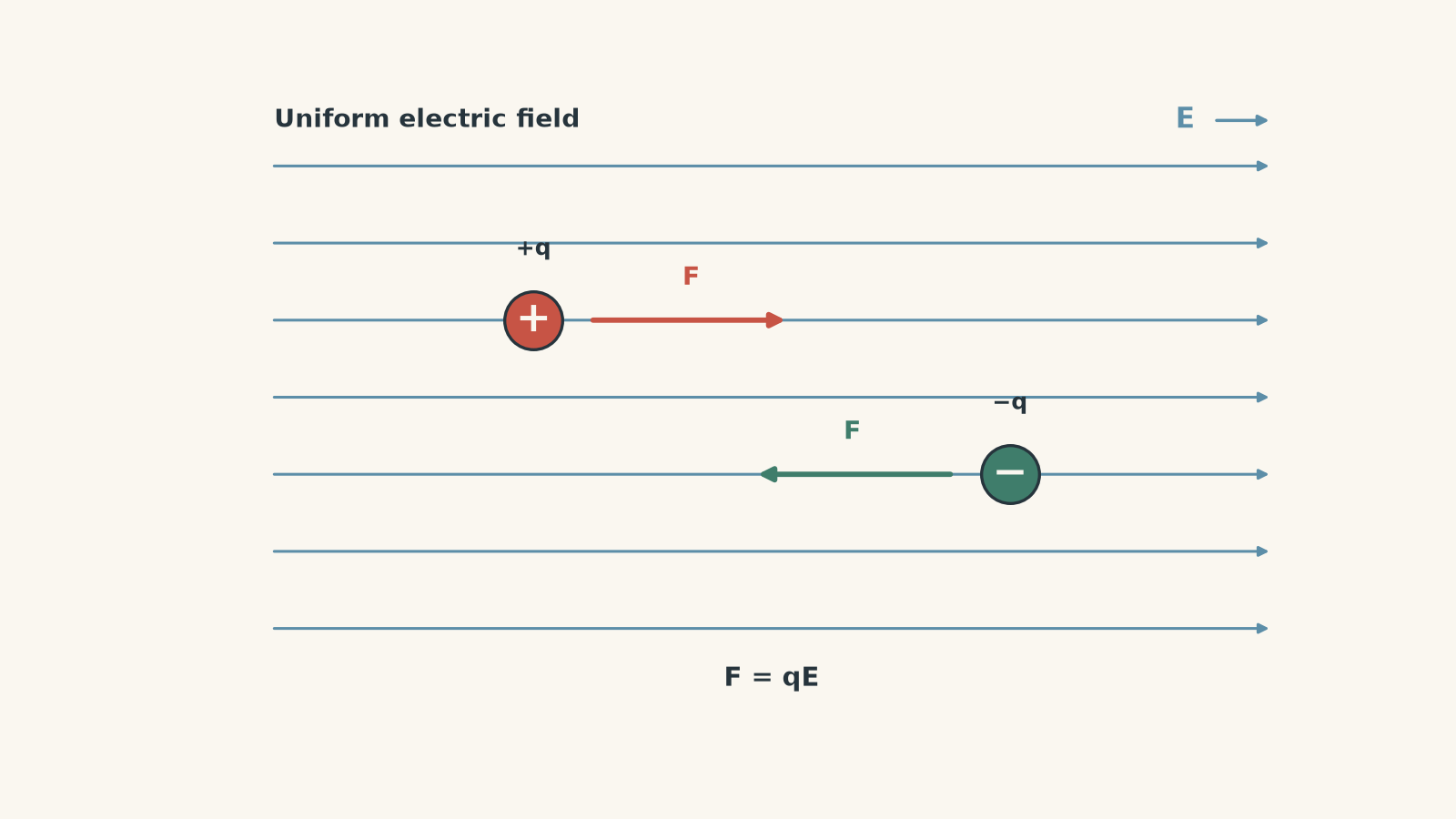
Now replace that positive charge with a negative one. The electrical interaction reverses, so the force points left.
This is built directly into the equation because a negative value of \(q\) reverses the direction of the force vector.
02The equation \(F = qE\)
The vector relationship is
\[
\vec F = q\vec E
\]
where:
- \(\vec F\) is the electric force on the charge, measured in newtons (N)
- \(q\) is the charge, measured in coulombs (C)
- \(\vec E\) is the electric field strength, measured in newtons per coulomb (N/C)
The arrows above \(F\) and \(E\) remind us that force and electric field have direction.
For the magnitude of the force, use
\[
F = |q|E
\]
because a magnitude cannot be negative.
The sign of the charge is then used to determine direction.
| Charge | Force direction |
|---|---|
| \(q>0\) | Same direction as \(\vec E\) |
| \(q<0\) | Opposite direction to \(\vec E\) |
| \(q=0\) | No electric force |
There is a useful way to remember this without memorising another rule. The direction of \(\vec E\) was defined using a positive test charge. Positive charges therefore follow the field direction. Negative charges do the opposite.
03Why multiplying by a negative charge reverses the force
Suppose we choose right as the positive \(x\)-direction.
An electric field pointing right might be written as
\[
E_x = +400\text{ N/C}
\]
For a charge of \(+2.0\times10^{-6}\text{ C}\),
\[
F_x=qE_x=(+2.0\times10^{-6})(+400)
=+8.0\times10^{-4}\text{ N}
\]
The positive result means the force points in the positive direction, which is right.
Now use a charge of \(-2.0\times10^{-6}\text{ C}\):
\[
F_x=qE_x=(-2.0\times10^{-6})(+400)
=-8.0\times10^{-4}\text{ N}
\]
The magnitude is still \(8.0\times10^{-4}\text{ N}\), but the negative sign tells us the force points left.
The force did not somehow become a “negative force”. The minus sign records direction relative to our chosen coordinate system.
Worked example: force on a positive charge
A charge of \(+3.0\,\mu\text{C}\) is placed in a uniform electric field of \(2.5\times10^4\text{ N/C}\) directed east. Find the electric force on the charge.
Step 1
The prefix \(\mu\) means \(10^{-6}\), so
\[
q=+3.0\times10^{-6}\text{ C}
\]
Step 2
\[
\begin{aligned}
F&=|q|E\\
&=(3.0\times10^{-6})(2.5\times10^4)\\
&=7.5\times10^{-2}\text{ N}
\end{aligned}
\]
Step 3
The charge is positive, so the force is in the same direction as the electric field.
Therefore,
\[
\boxed{F=7.5\times10^{-2}\text{ N east}}
\]
The field is pushing this positive charge east with a force of \(0.075\text{ N}\).
04The most common mistake: following the field arrow for every charge
Suppose an electron is placed in an electric field pointing upwards.
Where is the electric force?
A student might choose upwards because that is where the field arrow points. That feels reasonable if you think of field lines like wind arrows. A leaf in wind generally gets pushed in the direction the wind moves.
An electric field is different. Its direction is defined by what would happen to a positive charge.
An electron has negative charge, so its force is downwards.
The wind analogy therefore breaks at exactly this point. Wind pushes ordinary objects in its flow direction. An electric field can exert forces in opposite directions depending on the sign of the charge.
For an electron,
\[
q=-1.602\times10^{-19}\text{ C}
\]
so \(\vec F=q\vec E\) automatically reverses the field direction.
05Charge affects magnitude as well as direction
Now compare two positive charges in the same electric field:
- charge A is \(+1.0\,\mu\text{C}\)
- charge B is \(+4.0\,\mu\text{C}\)
Before calculating, predict the force on B compared with A.
Because
\[
F=|q|E
\]
the force is directly proportional to the magnitude of the charge. Four times the charge gives four times the force, provided the electric field is unchanged.
The same rule applies to negative charges. A charge of \(-4.0\,\mu\text{C}\) feels the same force magnitude as \(+4.0\,\mu\text{C}\) in the same field, but in the opposite direction.
This distinction between magnitude and direction is worth keeping sharp:
- \(|q|\) controls how large the force is
- the sign of \(q\) determines whether the force follows or opposes \(\vec E\)
Worked example: a charged particle held against gravity
A tiny particle has a mass of \(4.0\times10^{-7}\text{ kg}\). It is stationary in a vertical electric field of strength \(2.0\times10^5\text{ N/C}\) directed downwards. Ignore air resistance. Find the charge on the particle.
Step 1
The particle is stationary, so its acceleration is zero. The resultant force must therefore be zero.
Gravity acts downwards, so the electric force must act upwards with the same magnitude.
The electric field points downwards, but the electric force points upwards. Therefore, the particle must have a negative charge.
Step 2
Using \(F_g=mg\), where \(g=9.8\text{ m/s}^2\),
\[
\begin{aligned}
F_g&=mg\\
&=(4.0\times10^{-7})(9.8)\\
&=3.92\times10^{-6}\text{ N}
\end{aligned}
\]
For equilibrium,
\[
F_E=F_g=3.92\times10^{-6}\text{ N}
\]
Step 3
\[
\begin{aligned}
|q|&=\frac{F_E}{E}\\
&=\frac{3.92\times10^{-6}}{2.0\times10^5}\\
&=1.96\times10^{-11}\text{ C}
\end{aligned}
\]
Step 4
We already established that the charge must be negative.
\[
\boxed{q=-2.0\times10^{-11}\text{ C}}
\]
The negative sign is not an extra decoration added at the end. It is necessary to explain why the electric force points upwards when the electric field points downwards.
06A reliable method for direction questions
When a question gives you an electric field and a charge, use this order.
- Identify the electric field direction.
- Find the force magnitude using \(F=|q|E\).
- Check the sign of the charge.
- If \(q>0\), the force follows the field.
- If \(q<0\), the force points opposite the field.
This order is usually safer than putting a negative charge straight into a calculator and trying to interpret a negative numerical answer afterwards.
If the problem uses a coordinate axis, however, signed components can be very useful. For example,
\[
F_x=qE_x
\]
gives both the magnitude and the direction along the \(x\)-axis.
07Electric field direction is not necessarily motion direction
There is one more trap.
If a positive charge feels a force to the right, does that mean it must be moving to the right?
No.
Force determines acceleration, not necessarily velocity.
A positive charge could initially be travelling left while the electric force acts right. It would slow down, perhaps stop, and then begin moving right.
Similarly, a negative charge in a rightward electric field accelerates left, but it could temporarily still be moving right.
This is the same idea you already use in mechanics. A ball thrown upwards has an upward velocity while gravity gives it a downward acceleration.
For a charged particle,
\[
\vec F=q\vec E
\]
and Newton’s second law gives
\[
\vec F=m\vec a
\]
so
\[
\vec a=\frac{q\vec E}{m}
\]
The direction of acceleration follows the electric force, not necessarily the current velocity.
08Questions and solutions
Question 1
A charge of \(-6.0\times10^{-6}\text{ C}\) is placed in a uniform electric field of \(3.0\times10^3\text{ N/C}\) directed north.
Calculate the electric force on the charge, including its direction.
Solution 1
The electric force is \(\boxed{1.8\times10^{-2}\text{ N south}}\).
Use
\[
F=|q|E
\]
Substituting,
\[
\begin{aligned}
F&=(6.0\times10^{-6})(3.0\times10^3)\\
&=1.8\times10^{-2}\text{ N}
\end{aligned}
\]
The charge is negative, so its force is opposite to the electric field. The field points north, so the force points south.
A common mistake is to report north because that is the field direction. That would be correct for a positive charge, not a negative one.
Question 2
Two particles are placed at the same point in a uniform electric field.
Particle A has charge \(+2.0\,\mu\text{C}\). Particle B has charge \(-5.0\,\mu\text{C}\).
Compare the electric forces on the two particles in terms of magnitude and direction.
Solution 2
Particle B experiences a force with \(\boxed{2.5}\) times the magnitude of the force on particle A, and the two forces point in opposite directions.
For particle A,
\[
F_A=|q_A|E=(2.0\times10^{-6})E
\]
For particle B,
\[
F_B=|q_B|E=(5.0\times10^{-6})E
\]
Therefore,
\[
\frac{F_B}{F_A}
=
\frac{5.0\times10^{-6}}{2.0\times10^{-6}}
=2.5
\]
Both particles are in the same field, so the larger charge magnitude produces the larger force magnitude.
Particle A is positive, so its force follows the field. Particle B is negative, so its force opposes the field. Their force directions are therefore opposite.
The tempting misconception is that the negative charge should experience a “smaller” force because its charge value is numerically below zero. Force magnitude depends on \(|q|\), not on whether the charge is positive or negative.
Question 3
A positively charged particle is moving east when it enters a region containing a uniform electric field directed west.
A student says, “Because the electric field points west, the particle immediately starts moving west.”
Explain what actually happens. Assume the electric field is the only force acting.
Solution 3
The particle initially continues moving east, but it accelerates west and therefore slows down.
Because the charge is positive, the electric force is in the same direction as the electric field:
\[
\vec F=q\vec E
\]
so the force points west.
Newton’s second law gives
\[
\vec a=\frac{\vec F}{m}
\]
so the acceleration also points west.
However, acceleration and velocity are different quantities. At the instant the particle enters the field, its velocity is still eastward. The westward acceleration reduces that eastward velocity.
If the field continues to act for long enough, the particle may reach zero velocity and then begin moving west.
The student’s mistake is assuming that force determines the direction of motion. Force determines the direction of acceleration.
Question 4
A charged particle is suspended motionless between two horizontal plates. The electric field between the plates points vertically upwards.
The particle’s mass is \(7.5\times10^{-8}\text{ kg}\), and the electric field strength is \(4.0\times10^4\text{ N/C}\).
Determine the sign and magnitude of the particle’s charge. Use \(g=9.8\text{ m/s}^2\).
Solution 4
The particle has a \(\boxed{\text{positive charge of }1.8\times10^{-11}\text{ C}}\).
Because the particle is motionless, its resultant force is zero.
Gravity acts downwards:
\[
\begin{aligned}
F_g&=mg\\
&=(7.5\times10^{-8})(9.8)\\
&=7.35\times10^{-7}\text{ N}
\end{aligned}
\]
The electric force must therefore act upwards with the same magnitude:
\[
F_E=7.35\times10^{-7}\text{ N}
\]
The electric field also points upwards. Since the electric force is in the same direction as the field, the charge must be positive.
Now use
\[
F_E=|q|E
\]
so
\[
\begin{aligned}
|q|
&=\frac{F_E}{E}\\
&=\frac{7.35\times10^{-7}}{4.0\times10^4}\\
&=1.84\times10^{-11}\text{ C}
\end{aligned}
\]
To two significant figures,
\[
\boxed{q=+1.8\times10^{-11}\text{ C}}
\]
The important reasoning happens before the arithmetic. If the field points upwards and the electric force must also point upwards, the charge cannot be negative.
Question 5
A particle of unknown charge is moving to the right through a uniform electric field that also points to the right. Measurements show that the particle is slowing down.
A student concludes that the measurements must be wrong because “the electric field should make the particle speed up”.
Assuming the electric field is the only force acting, determine what can be concluded about the sign of the particle’s charge and explain why.
Solution 5
The particle must have a \(\boxed{\text{negative charge}}\).
The particle is moving right but slowing down. Its acceleration must therefore point left.
Since the electric field is the only source of force, the electric force also points left because
\[
\vec F=m\vec a
\]
Yet the electric field points right.
From
\[
\vec F=q\vec E
\]
a force opposite to the field requires \(q<0\).
So there is no conflict in the measurements. A negative particle in a rightward electric field feels a leftward force. If it is initially travelling right, that force slows it down.
The hidden assumption in the student’s reasoning is that the direction of the electric field must match the direction of motion. It only matches the force direction for a positive charge. Even then, force controls acceleration rather than directly setting velocity.
Once you can move confidently between \(\vec E\), the sign of \(q\), and \(\vec F\), the next step is to combine electric forces with Newton’s laws. That lets you predict how charged particles accelerate, curve, stop, or remain in equilibrium inside electric fields.